


 Скачать презентацию Financial Institutions and Markets Dr Andrew L H
aa01bee6a00a4729a72b23df0606a648.ppt
- Количество слайдов: 33
 Financial Institutions and Markets Dr. Andrew L. H. Parkes Day 9 “How do financial markets work? ” Sept. 29, 2012 Fin Institutions & Markets, Day 9 Sup 卜安吉
 Chapter 10: Stocks Remember the Dividend Growth Model (Gordon Growth Model)? Ø Ø Ø Present Value of a Stock How to calculate these What’s the value of stock if the company goes Bankrupt? Ø Sept. 29, 2012 WALL STREET - USA ZERO!!! Fin Institutions & Markets, Day 9 Sup 2
 Approaches for Valuing Common Stock n Dividend n Using n Free 102) Sept. 29, 2012 growth model the multiples of comparable firms cash flow method (covered in Fin Institutions & Markets, Day 9 Sup 3
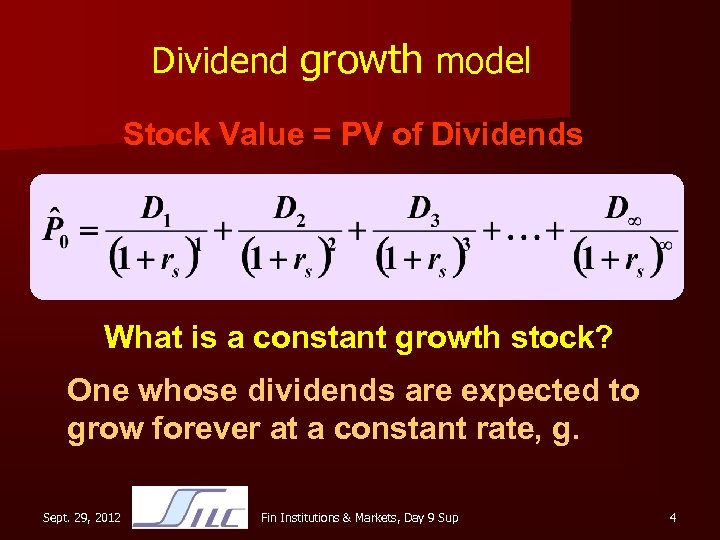 Dividend growth model Stock Value = PV of Dividends What is a constant growth stock? One whose dividends are expected to grow forever at a constant rate, g. Sept. 29, 2012 Fin Institutions & Markets, Day 9 Sup 4
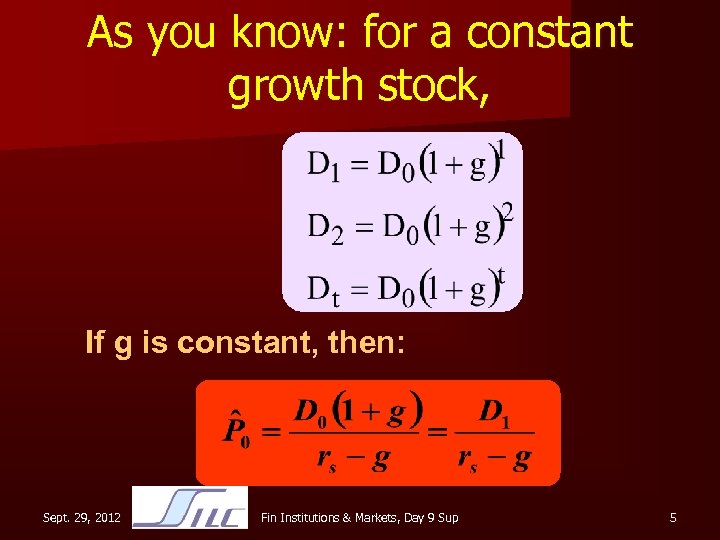 As you know: for a constant growth stock, If g is constant, then: Sept. 29, 2012 Fin Institutions & Markets, Day 9 Sup 5
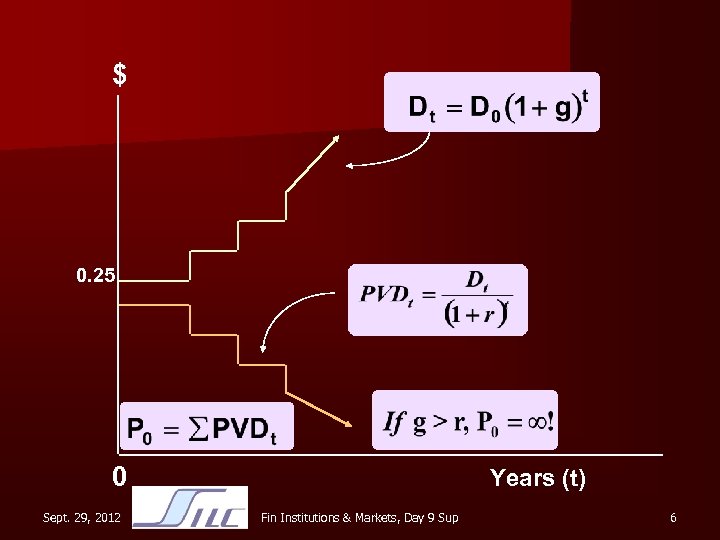 $ 0. 25 0 Sept. 29, 2012 Years (t) Fin Institutions & Markets, Day 9 Sup 6
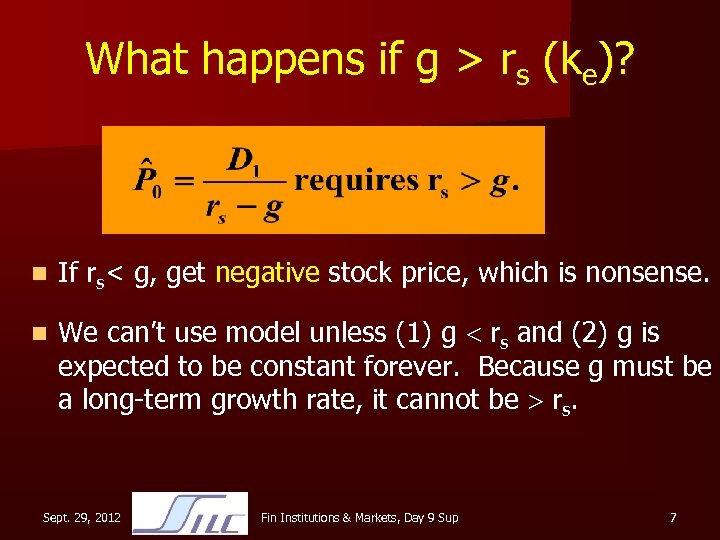 What happens if g > rs (ke)? n If rs< g, get negative stock price, which is nonsense. n We can’t use model unless (1) g rs and (2) g is expected to be constant forever. Because g must be a long-term growth rate, it cannot be rs. Sept. 29, 2012 Fin Institutions & Markets, Day 9 Sup 7
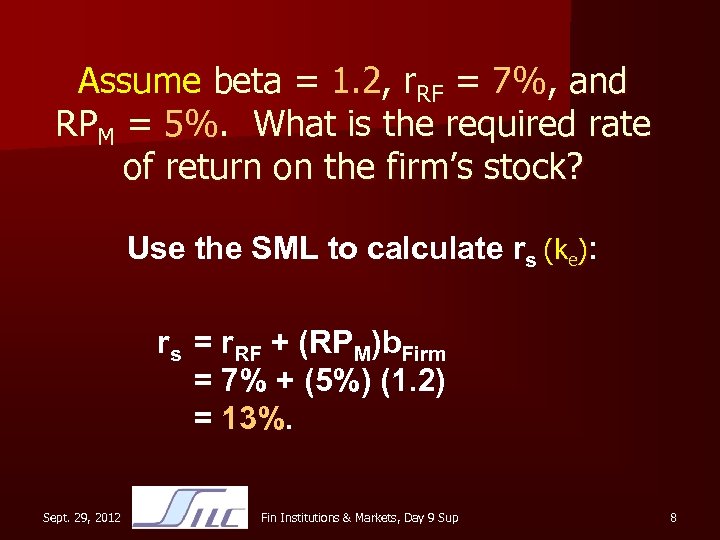 Assume beta = 1. 2, r. RF = 7%, and RPM = 5%. What is the required rate of return on the firm’s stock? Use the SML to calculate rs (ke): rs = r. RF + (RPM)b. Firm = 7% + (5%) (1. 2) = 13%. Sept. 29, 2012 Fin Institutions & Markets, Day 9 Sup 8
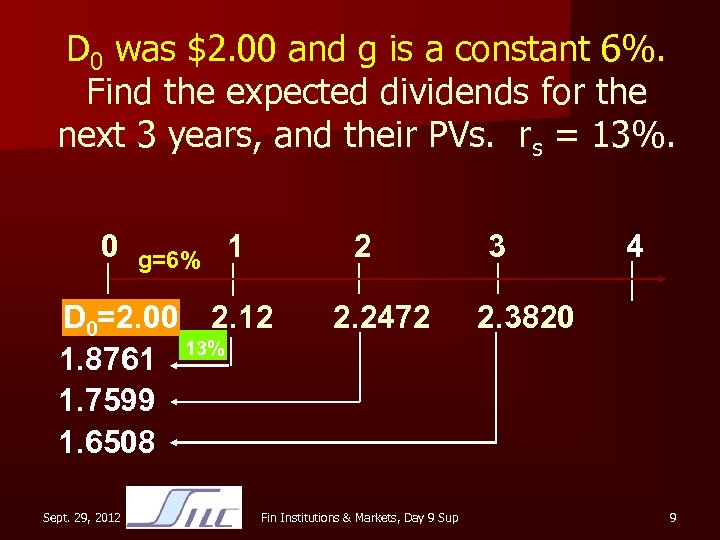 D 0 was $2. 00 and g is a constant 6%. Find the expected dividends for the next 3 years, and their PVs. rs = 13%. 0 g=6% 1 2 D 0=2. 00 2. 12 13% 1. 8761 1. 7599 1. 6508 Sept. 29, 2012 2. 2472 Fin Institutions & Markets, Day 9 Sup 3 4 2. 3820 9
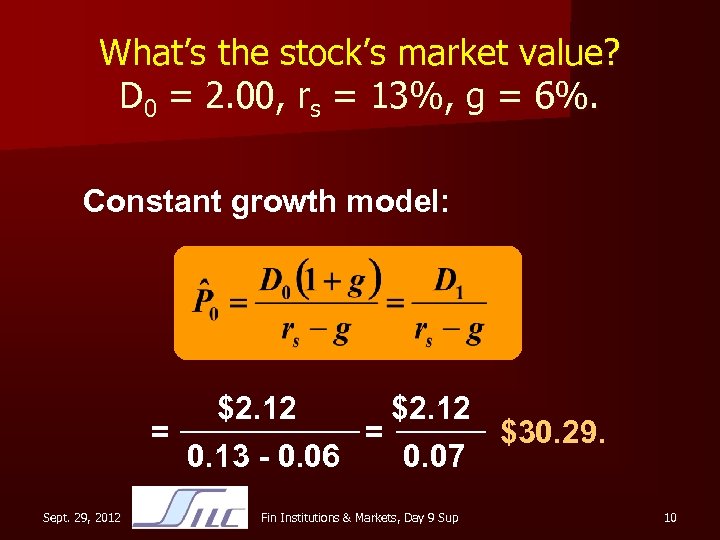 What’s the stock’s market value? D 0 = 2. 00, rs = 13%, g = 6%. Constant growth model: $2. 12 = = $30. 29. 0. 13 - 0. 06 0. 07 Sept. 29, 2012 Fin Institutions & Markets, Day 9 Sup 10
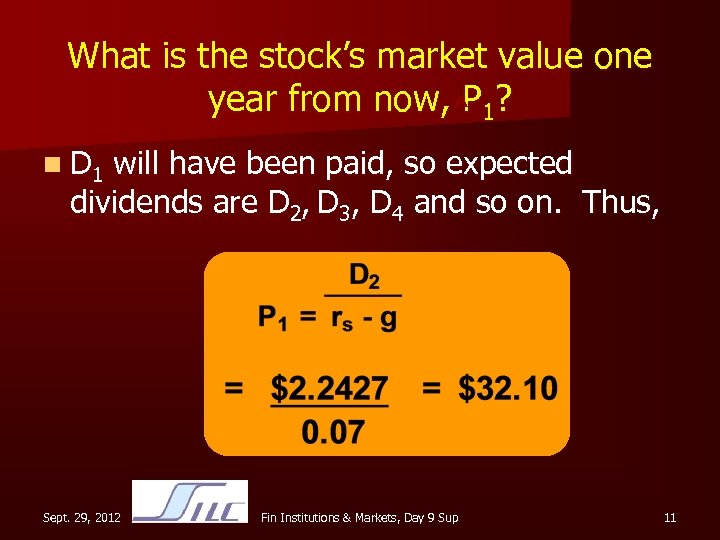 What is the stock’s market value one year from now, ^P 1? n D 1 will have been paid, so expected dividends are D 2, D 3, D 4 and so on. Thus, Sept. 29, 2012 Fin Institutions & Markets, Day 9 Sup 11
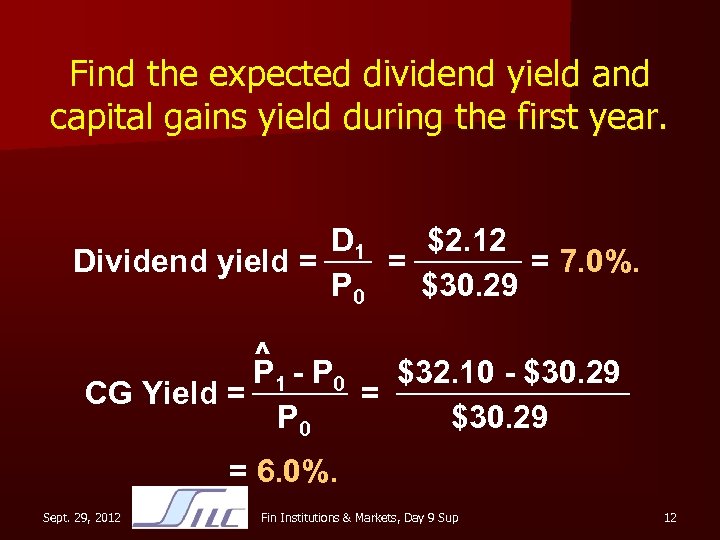 Find the expected dividend yield and capital gains yield during the first year. D 1 $2. 12 Dividend yield = = = 7. 0%. P 0 $30. 29 ^ P 1 - P 0 $32. 10 - $30. 29 CG Yield = = P 0 $30. 29 = 6. 0%. Sept. 29, 2012 Fin Institutions & Markets, Day 9 Sup 12
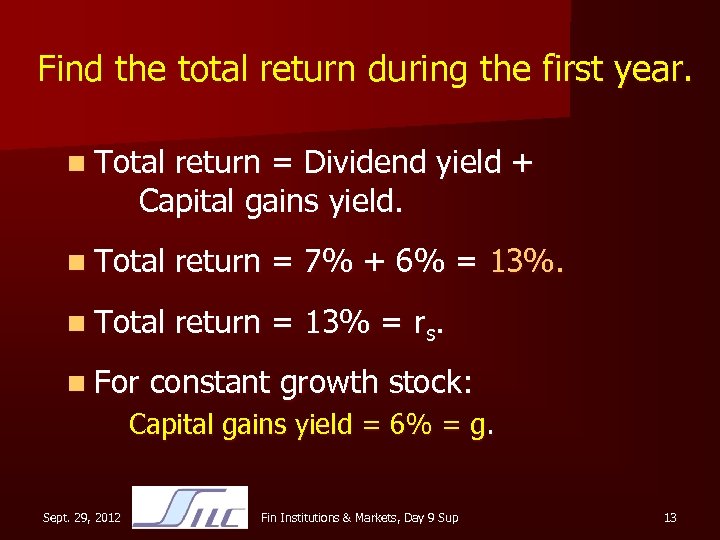 Find the total return during the first year. n Total return = Dividend yield + Capital gains yield. n Total return = 7% + 6% = 13%. n Total return = 13% = rs. n For constant growth stock: Capital gains yield = 6% = g. Sept. 29, 2012 Fin Institutions & Markets, Day 9 Sup 13
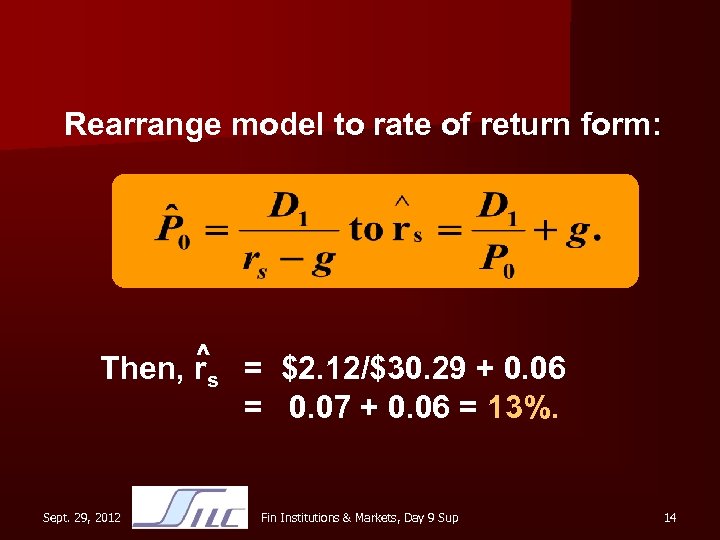 Rearrange model to rate of return form: ^ Then, rs = $2. 12/$30. 29 + 0. 06 = 0. 07 + 0. 06 = 13%. Sept. 29, 2012 Fin Institutions & Markets, Day 9 Sup 14
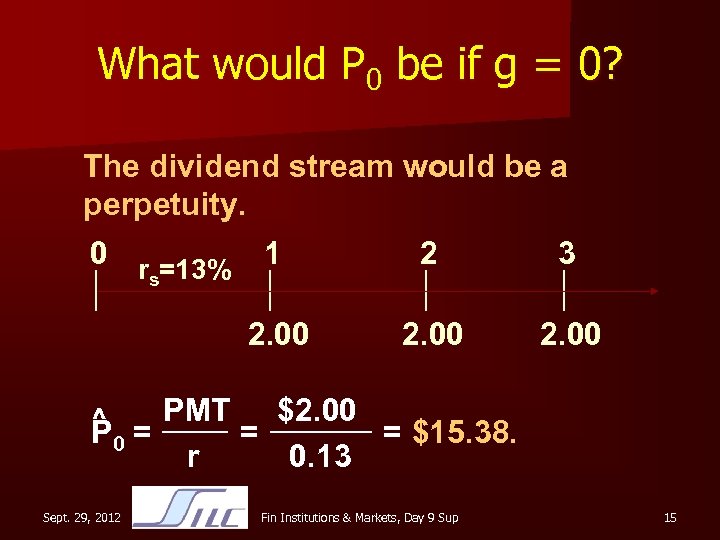 What would P 0 be if g = 0? The dividend stream would be a perpetuity. 0 r =13% s 1 2 3 2. 00 PMT $2. 00 P 0 = = = $15. 38. r 0. 13 ^ Sept. 29, 2012 Fin Institutions & Markets, Day 9 Sup 15
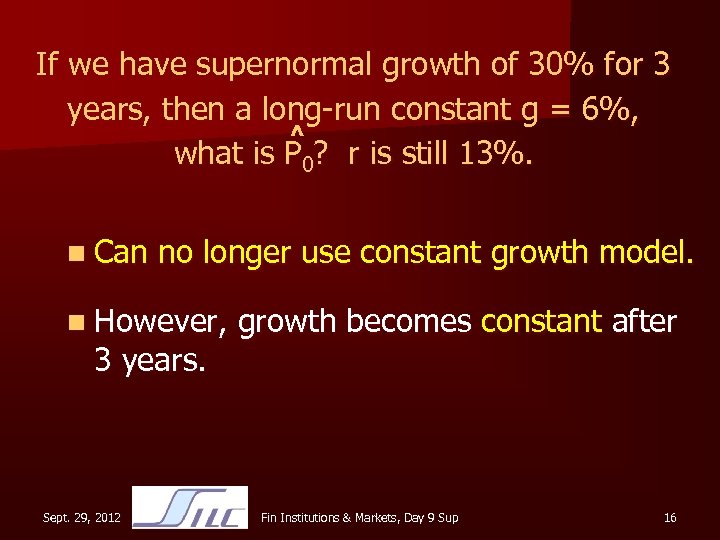 If we have supernormal growth of 30% for 3 years, then a long-run constant g = 6%, ^ what is P 0? r is still 13%. n Can no longer use constant growth model. n However, 3 years. Sept. 29, 2012 growth becomes constant after Fin Institutions & Markets, Day 9 Sup 16
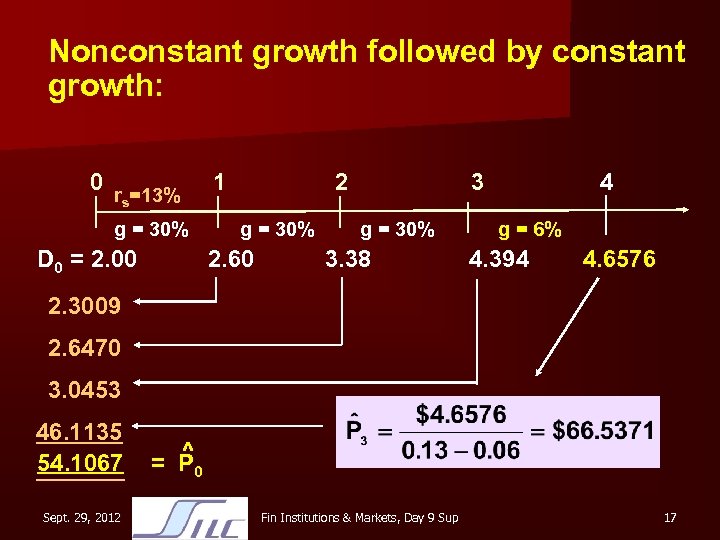 Nonconstant growth followed by constant growth: 0 r =13% s g = 30% D 0 = 2. 00 1 2 g = 30% 2. 60 3 g = 30% 3. 38 4 g = 6% 4. 394 4. 6576 2. 3009 2. 6470 3. 0453 46. 1135 54. 1067 Sept. 29, 2012 ^ = P 0 Fin Institutions & Markets, Day 9 Sup 17
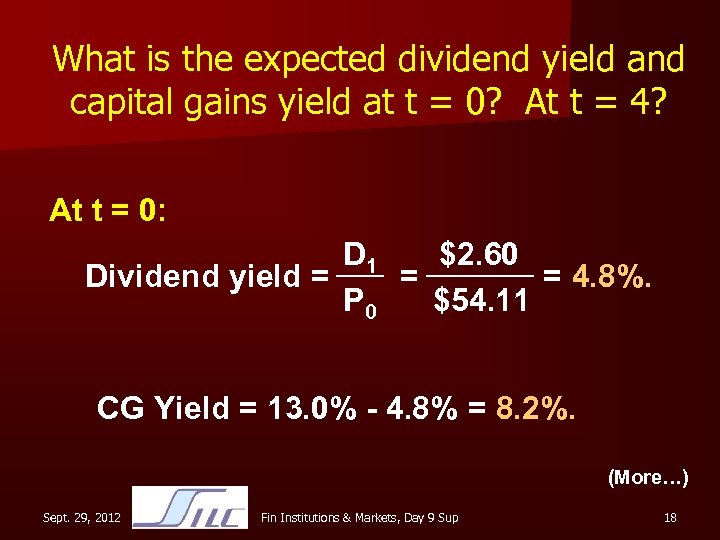 What is the expected dividend yield and capital gains yield at t = 0? At t = 4? At t = 0: D 1 $2. 60 Dividend yield = = = 4. 8%. P 0 $54. 11 CG Yield = 13. 0% - 4. 8% = 8. 2%. (More…) Sept. 29, 2012 Fin Institutions & Markets, Day 9 Sup 18
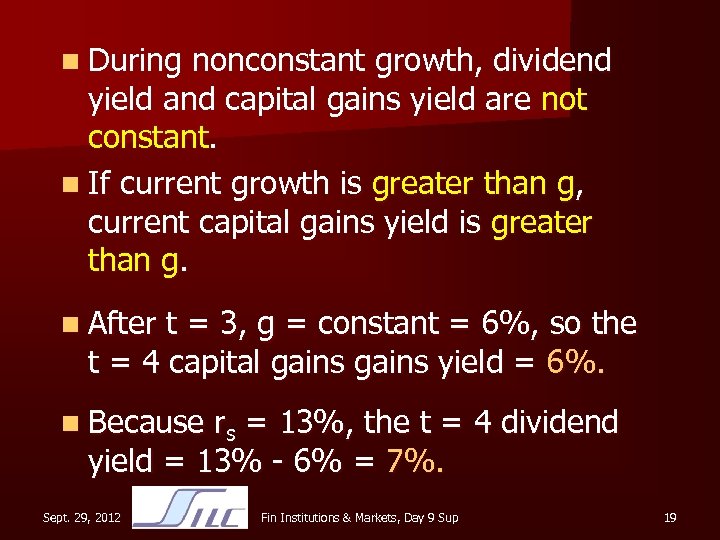 n During nonconstant growth, dividend yield and capital gains yield are not constant. n If current growth is greater than g, current capital gains yield is greater than g. n After t = 3, g = constant = 6%, so the t = 4 capital gains yield = 6%. n Because rs = 13%, the t = 4 dividend yield = 13% - 6% = 7%. Sept. 29, 2012 Fin Institutions & Markets, Day 9 Sup 19
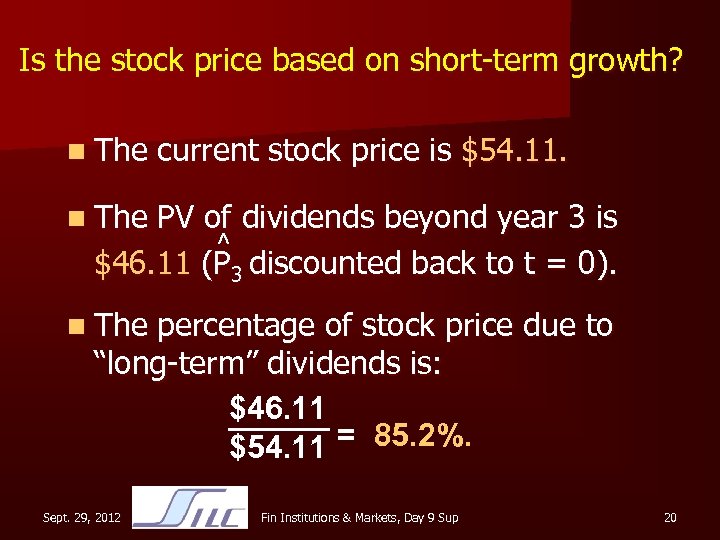 Is the stock price based on short-term growth? n The current stock price is $54. 11. n The PV of dividends beyond year 3 is ^ $46. 11 (P 3 discounted back to t = 0). n The percentage of stock price due to “long-term” dividends is: $46. 11 $54. 11 = 85. 2%. Sept. 29, 2012 Fin Institutions & Markets, Day 9 Sup 20
 If most of a stock’s value is due to longterm cash flows, why do so many managers focus on quarterly earnings? n Sometimes changes in quarterly earnings are a signal of future changes in cash flows. This would affect the current stock price. n Sometimes managers have bonuses tied to quarterly earnings. Sept. 29, 2012 Fin Institutions & Markets, Day 9 Sup 21
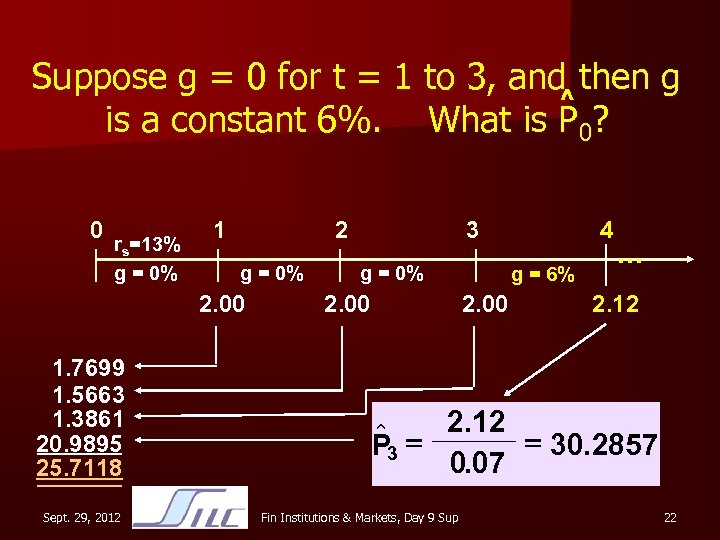 Suppose g = 0 for t = 1 to 3, and then g ^ is a constant 6%. What is P 0? 0 rs=13% g = 0% 1 2 g = 0% 2. 00 1. 7699 1. 5663 1. 3861 20. 9895 25. 7118 Sept. 29, 2012 3 g = 0% 2. 00 4 g = 6% 2. 00 . . . 2. 12 30. 2857 P 3 0. 07 Fin Institutions & Markets, Day 9 Sup 22
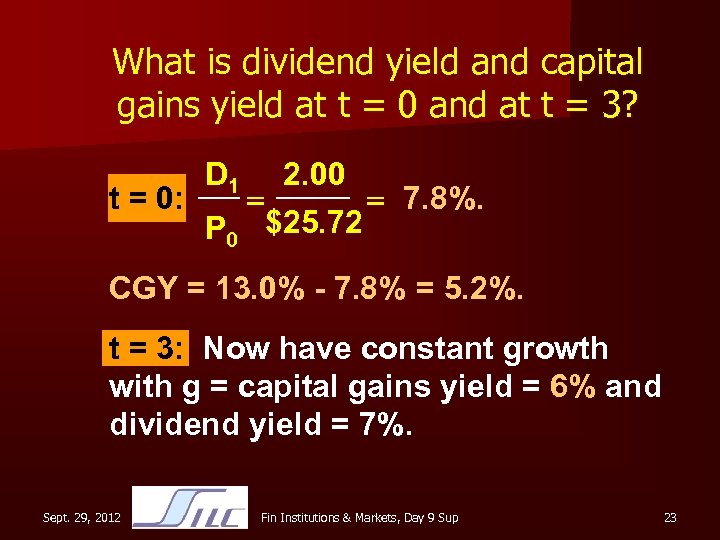 What is dividend yield and capital gains yield at t = 0 and at t = 3? D 1 2. 00 t = 0: 7. 8%. P 0 $25. 72 CGY = 13. 0% - 7. 8% = 5. 2%. t = 3: Now have constant growth with g = capital gains yield = 6% and dividend yield = 7%. Sept. 29, 2012 Fin Institutions & Markets, Day 9 Sup 23
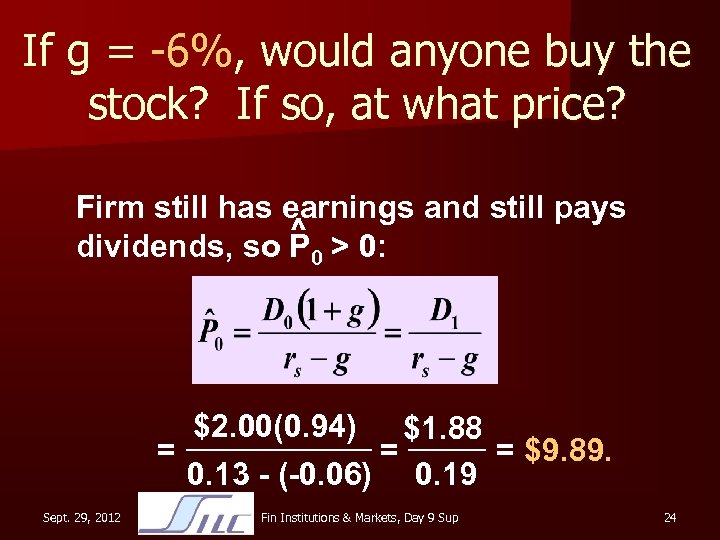 If g = -6%, would anyone buy the stock? If so, at what price? Firm still has earnings and still pays ^ > 0: dividends, so P 0 $2. 00(0. 94) $1. 88 = = = $9. 89. 0. 13 - (-0. 06) 0. 19 Sept. 29, 2012 Fin Institutions & Markets, Day 9 Sup 24
 What are the annual dividend and capital gains yield? Capital gains yield = g = -6. 0%. Dividend yield = 13. 0% - (-6. 0%) = 19. 0%. Both yields are constant over time, with the high dividend yield (19%) offsetting the negative capital gains yield. Sept. 29, 2012 Fin Institutions & Markets, Day 9 Sup 25
 Using the Stock Price Multiples to Estimate Stock Price n Analysts often use the P/E multiple (the price per share divided by the earnings per share) or the P/CF multiple (price per share divided by cash flow per share, which is the earnings per share plus the dividends per share) to value stocks. n Example: – Estimate the average P/E ratio of comparable firms. This is the P/E multiple. – Multiply this average P/E ratio by the expected earnings of the company to estimate its stock price. Sept. 29, 2012 Fin Institutions & Markets, Day 9 Sup 26
 Using Entity Multiples n The entity value (V) is: – the market value of equity (# shares of stock multiplied by the price per share) – plus the value of debt. Pick a measure, such as EBITDA, Sales, Customers, Eyeballs, etc. n Calculate the average entity ratio for a sample of comparable firms. For example, n – V/EBITDA – V/Customers Sept. 29, 2012 Fin Institutions & Markets, Day 9 Sup 27
 Using Entity Multiples (Continued) n Find the entity value of the firm in question. For example, – Multiply the firm’s sales by the V/Sales multiple. – Multiply the firm’s # of customers by the V/Customers ratio The result is the total value of the firm. n Subtract the firm’s debt to get the total value of equity. n Divide by the number of shares to get the price per share. n Sept. 29, 2012 Fin Institutions & Markets, Day 9 Sup 28
 Problems with Market Multiple Methods n It is often hard to find comparable firms. n The average ratio for the sample of comparable firms often has a wide range. – For example, the average P/E ratio might be 20, but the range could be from 10 to 50. How do you know whether your firm should be compared to the low, average, or high performers? Sept. 29, 2012 Fin Institutions & Markets, Day 9 Sup 29
 Why are stock prices volatile? ^ n rs = r. RF + (RPM)bi could change. l Inflation expectations l Risk aversion l Company risk n g could change. Sept. 29, 2012 Fin Institutions & Markets, Day 9 Sup 30
 What is market equilibrium? In equilibrium, stock prices are stable. There is no general tendency for people to buy versus to sell. ^ The expected price, P, must equal the actual price, P. In other words, the fundamental value must be the same as the price. (More…) Sept. 29, 2012 Fin Institutions & Markets, Day 9 Sup 31
 In equilibrium, expected returns must equal required returns: ^ rs = D 1/P 0 + g = rs = r. RF + (r. M - r. RF)b. Sept. 29, 2012 Fin Institutions & Markets, Day 9 Sup 32
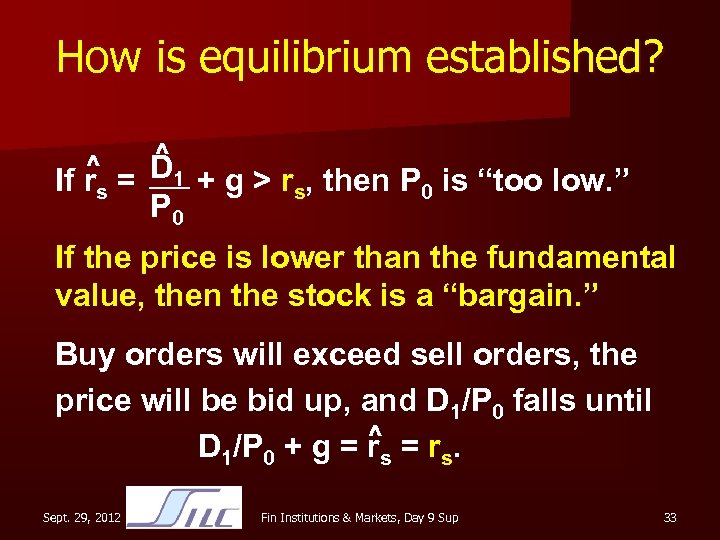 How is equilibrium established? ^ If rs = D 1 + g > rs, then P 0 is “too low. ” P 0 ^ If the price is lower than the fundamental value, then the stock is a “bargain. ” Buy orders will exceed sell orders, the price will be bid up, and D 1/P 0 falls until D 1/P 0 + g = ^s = rs. r Sept. 29, 2012 Fin Institutions & Markets, Day 9 Sup 33