


 Скачать презентацию Financial Incentives to Encourage Wind Power System Production
6aa378fdc95a7208379711241f196d84.ppt
- Количество слайдов: 17
 Financial Incentives to Encourage Wind Power System Production Sasha Kemmet Iowa State University
 Presentation Overview • • Issue Definition Background Information Current Federal Financial Incentives State and Local Financial Incentives Recommendations Summary Questions Acknowledgements
 Issue Definition • U. S. recognizes need for clean and sustainable power • Traditional generation methods receive substantial government support • President George W. Bush recognizes the potential of wind power to provide up to 20% of the nation’s energy needs • Wind power provides zero-emission energy at an economically competitive price
 Background Feasibility • Broad public support: 88% of Americans support expanding wind farms • Advancements in turbine technology • Public Utility Regulatory Policies Act (PURPA): Requires utility buy back • Wind intermittency poses challenges • Transmission costs add a significant cost
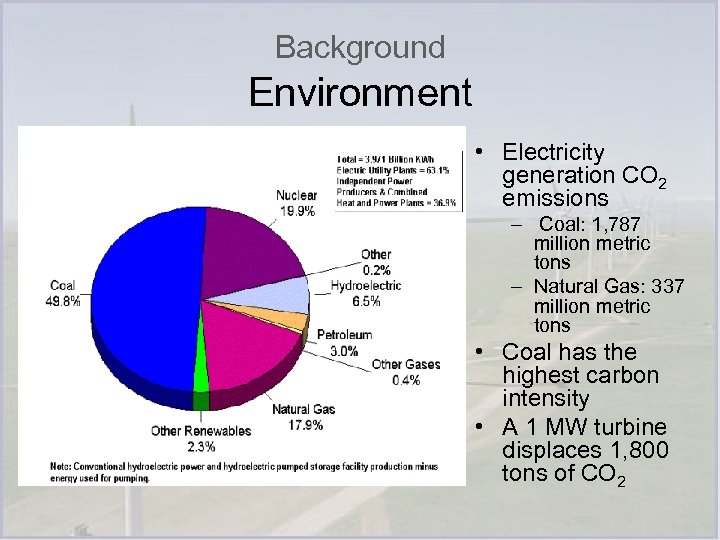 Background Environment • Electricity generation CO 2 emissions – Coal: 1, 787 million metric tons – Natural Gas: 337 million metric tons • Coal has the highest carbon intensity • A 1 MW turbine displaces 1, 800 tons of CO 2
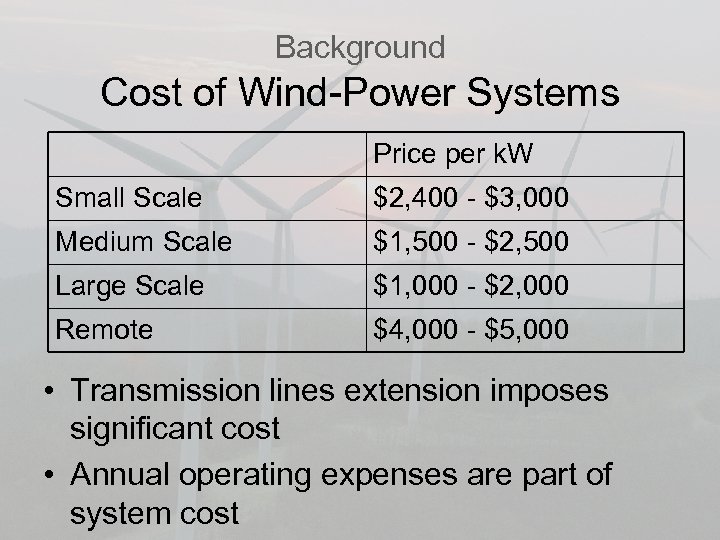 Background Cost of Wind-Power Systems Price per k. W Small Scale $2, 400 - $3, 000 Medium Scale $1, 500 - $2, 500 Large Scale $1, 000 - $2, 000 Remote $4, 000 - $5, 000 • Transmission lines extension imposes significant cost • Annual operating expenses are part of system cost
 Federal Financial Incentives Production Tax Credit (PTC) Explanation and Benefits • The Energy Policy Act of 1992: established PTC • Provide a proportional annual tax credit • Currently set at 1. 9 cents/k. Wh • Available for the first 10 years of a generator’s operation Concerns • Reduced by grants, tax-exempt bonds, and subsidized financing • Cannot absorb total benefit • Do not help projects sustain debt • Delayed renewal causes significant problems
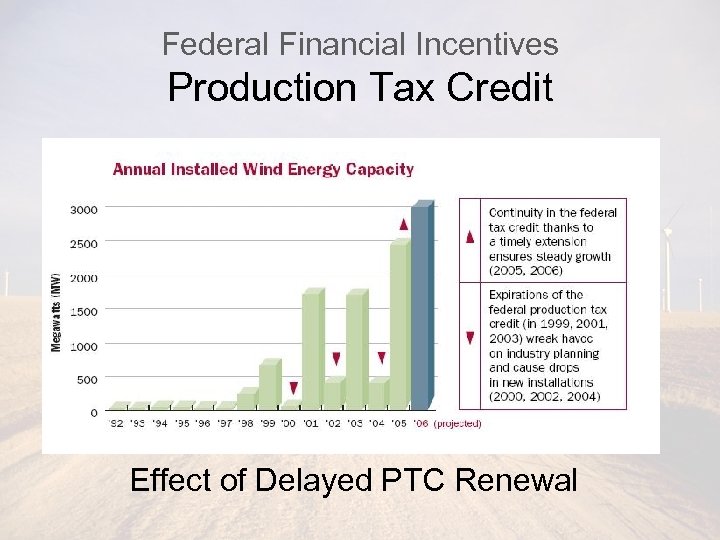 Federal Financial Incentives Production Tax Credit Effect of Delayed PTC Renewal
 Federal Financial Incentives Project Loan Guarantee Explanation and Benefits • Ensures loan repayment • Reduces transaction cost and institutional barriers Concerns • May reduce PTCs • High administrative costs • Often do not help investor obtain a private loan
 State and Local Financial Incentives Net Metering Explanation and Benefits • Producer is paid for the difference between electricity generated and consumed • Simplifies metering and interconnection requirements • Provides more stable revenue Concerns • Less incentive for larger projects • Does not directly reduce financing costs • Group net metering
 State and Local Financial Incentives Direct Production Incentives Explanation and Benefits • Similar to PTC without tax basis • Allow investors to absorb total benefits of the incentive • Allow projects to sustain debt by directly increasing revenue Concerns • Require administrative distribution of funds • Subject to yearly budget appropriations • Do not benefit off-grid projects • Require a cash fund to be created
 State and Local Financial Incentives Government Subsidized Loan Explanation and Benefits • Lower transaction cost • Lower debt costs • Can require a technical loan application Concerns • Reduce PTC • Loan defaults • Benefit private project owners more • Require the creation of a cash fund
 Recommendations Clear and Consistent Energy Policy • Determine available incentives • Long-term PTC renewal • Eliminate the “boom-and-bust” environment Federal Government Subsidized Loan • Reduce capital costs • Model off existing programs • Require technical application
 Recommendations Alternate Energy Revolving Loan Program • Iowa: AERLP can serve as a model • Funded 25 wind projects since 1996: 41, 537 MWh annually • Finances half of a project’s cost up to $250, 000 at 0% interest for 20 years • Available to all groups except for non rateregulated utilities • Not available to refinance existing loan • Requires technical application
 Summary • Diversified energy portfolio to include sustainable energy • Wind energy is a zero-emission power source, economically feasible, and has broad public support • Clear and consistent energy policy with long term PTC renewal • Federal government subsidized loan • Smart investment in securing inexpensive and clean energy for the future
 Questions?
 Acknowledgements • • • IEEE USA Dr. Wolf Yeigh Erica Wissolik Pender Mc. Carter and Chris Mc. Manes Chelsey Mac. Neill, Tony Azevedo, and WISE Interns • Dr. Mani Mina, Iowa State University • Family