


 Скачать презентацию Financial Engineering The Valuation of Derivative Securities Zvi
2dff312e211a5bef30c29ba83d64748f.ppt
- Количество слайдов: 43
 Financial Engineering The Valuation of Derivative Securities Zvi Wiener mswiener@mscc. huji. ac. il tel: 02 -588 -3049 Zvi Wiener Cont. Time. Fin - 4 1
 Derivative Security A derivative security is one whose value depends exclusively on a fixed set of asset values and time. Derivatives on traded securities can be priced in an arbitrage setting. Derivatives on non traded securities can be priced in an equilibrium setting. Zvi Wiener Cont. Time. Fin - 4 2
 Derivative Security Black-Scholes, Merton 1973 Options, Forwards, Futures, Swaps Real Options Zvi Wiener Cont. Time. Fin - 4 3
 Derivative Security - the proportion of the value paid in cash. Pure options: = 1. Pure Forwards: = 0. No arbitrage assumption. Free tradability of the underling asset. Otherwise one have to find the equilibrium. Zvi Wiener Cont. Time. Fin - 4 4
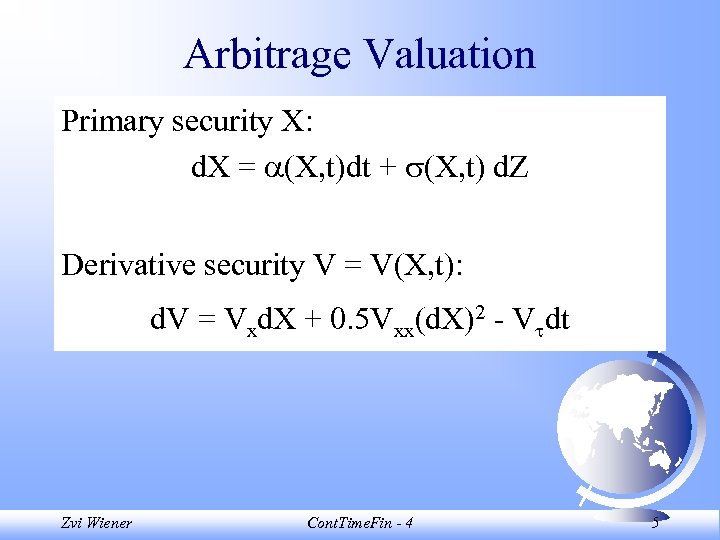 Arbitrage Valuation Primary security X: d. X = (X, t)dt + (X, t) d. Z Derivative security V = V(X, t): d. V = Vxd. X + 0. 5 Vxx(d. X)2 - V dt Zvi Wiener Cont. Time. Fin - 4 5
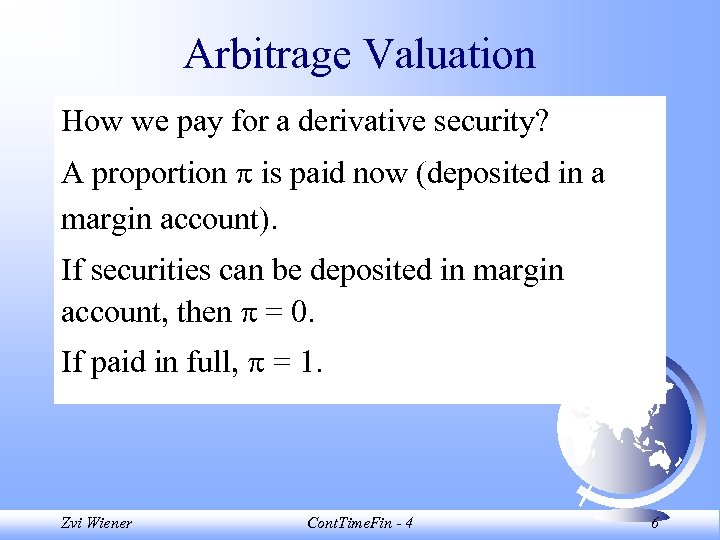 Arbitrage Valuation How we pay for a derivative security? A proportion is paid now (deposited in a margin account). If securities can be deposited in margin account, then = 0. If paid in full, = 1. Zvi Wiener Cont. Time. Fin - 4 6
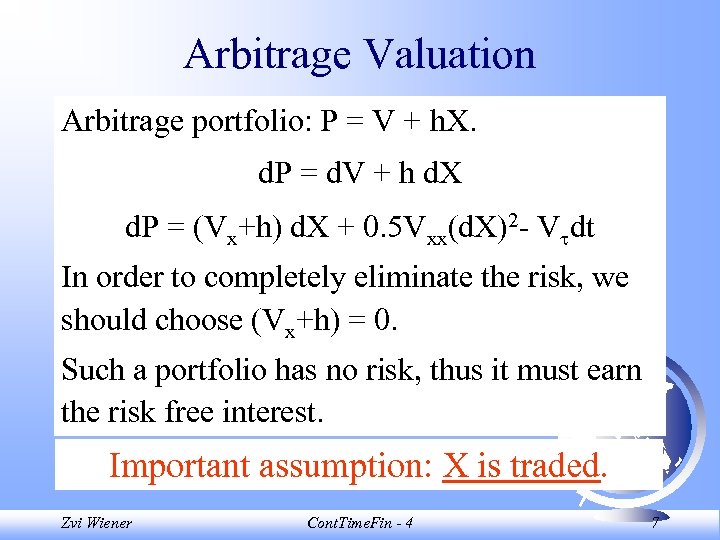 Arbitrage Valuation Arbitrage portfolio: P = V + h. X. d. P = d. V + h d. X d. P = (Vx+h) d. X + 0. 5 Vxx(d. X)2 - V dt In order to completely eliminate the risk, we should choose (Vx+h) = 0. Such a portfolio has no risk, thus it must earn the risk free interest. Important assumption: X is traded. Zvi Wiener Cont. Time. Fin - 4 7
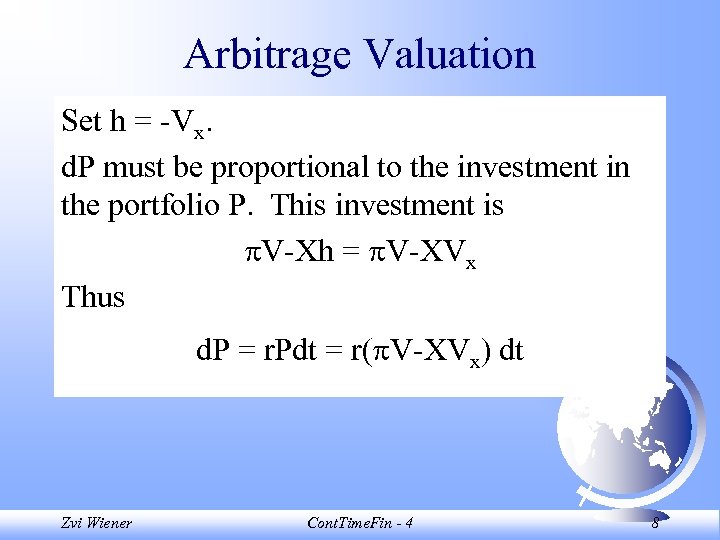 Arbitrage Valuation Set h = -Vx. d. P must be proportional to the investment in the portfolio P. This investment is V-Xh = V-XVx Thus d. P = r. Pdt = r( V-XVx) dt Zvi Wiener Cont. Time. Fin - 4 8
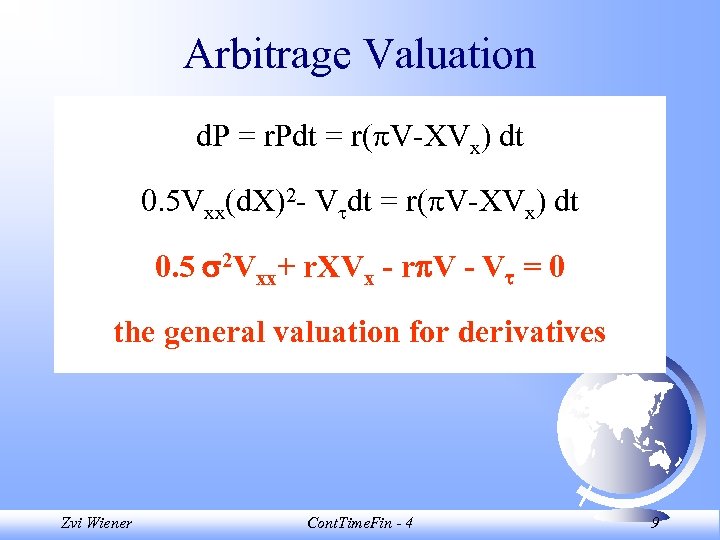 Arbitrage Valuation d. P = r. Pdt = r( V-XVx) dt 0. 5 Vxx(d. X)2 - V dt = r( V-XVx) dt 0. 5 2 Vxx+ r. XVx - r V - V = 0 the general valuation for derivatives Zvi Wiener Cont. Time. Fin - 4 9
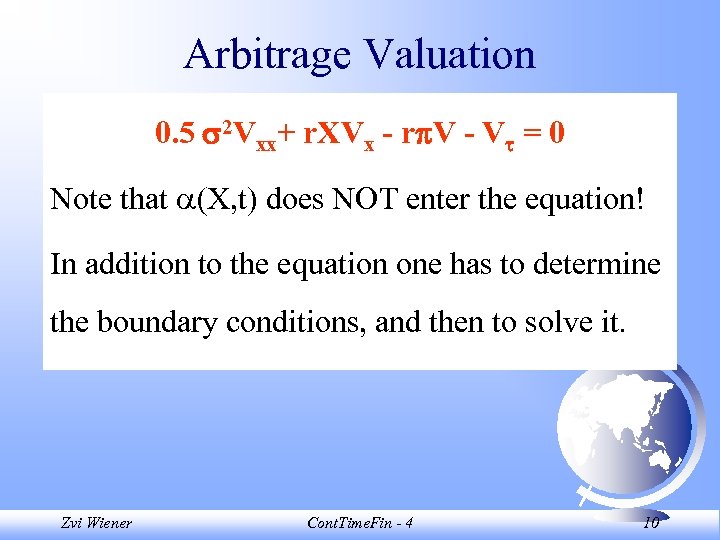 Arbitrage Valuation 0. 5 2 Vxx+ r. XVx - r V - V = 0 Note that (X, t) does NOT enter the equation! In addition to the equation one has to determine the boundary conditions, and then to solve it. Zvi Wiener Cont. Time. Fin - 4 10
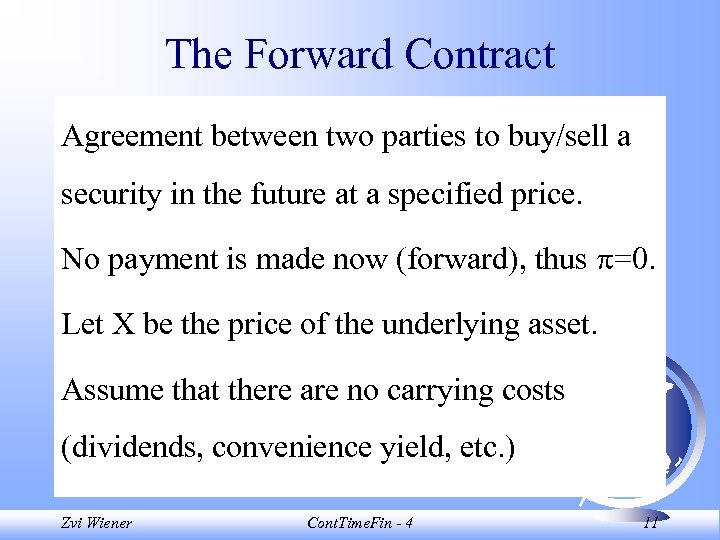 The Forward Contract Agreement between two parties to buy/sell a security in the future at a specified price. No payment is made now (forward), thus =0. Let X be the price of the underlying asset. Assume that there are no carrying costs (dividends, convenience yield, etc. ) Zvi Wiener Cont. Time. Fin - 4 11
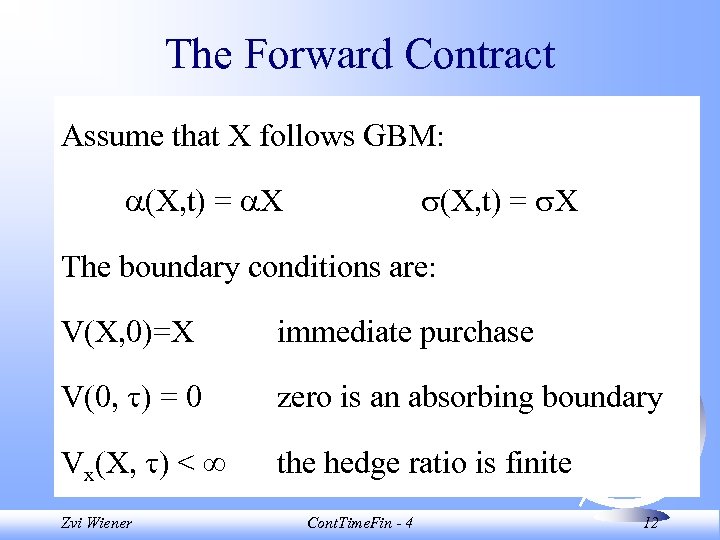 The Forward Contract Assume that X follows GBM: (X, t) = X The boundary conditions are: V(X, 0)=X immediate purchase V(0, ) = 0 zero is an absorbing boundary Vx(X, ) < the hedge ratio is finite Zvi Wiener Cont. Time. Fin - 4 12
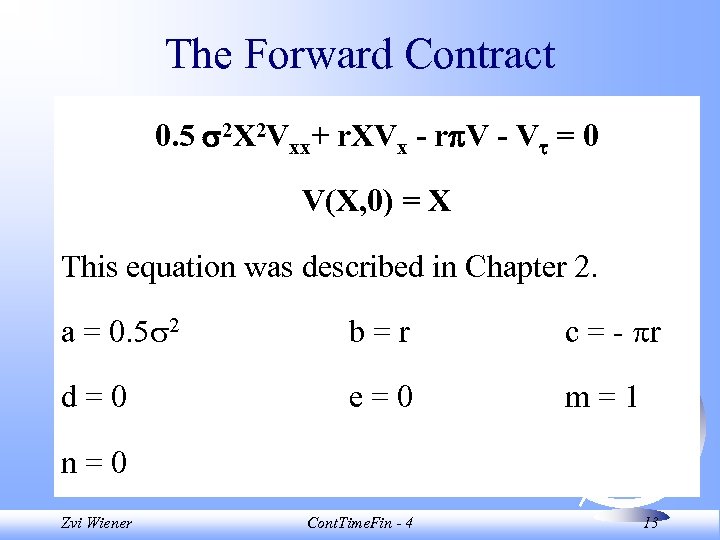 The Forward Contract 0. 5 2 X 2 Vxx+ r. XVx - r V - V = 0 V(X, 0) = X This equation was described in Chapter 2. a = 0. 5 2 b=r c = - r d=0 e=0 m=1 n=0 Zvi Wiener Cont. Time. Fin - 4 13
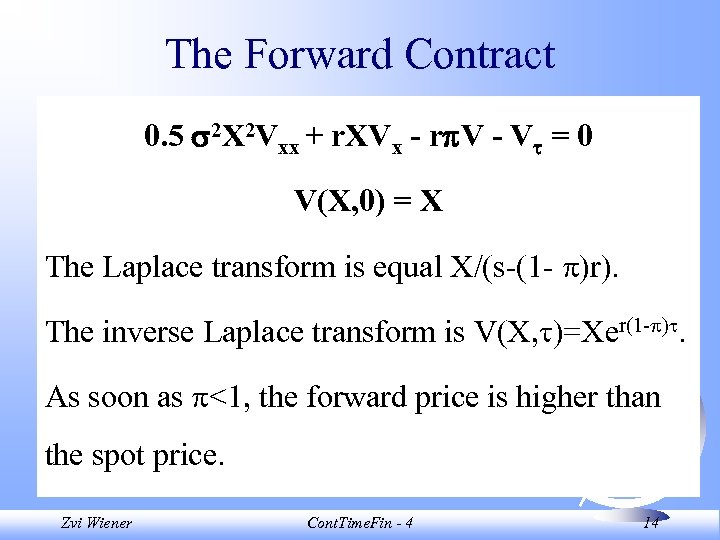 The Forward Contract 0. 5 2 X 2 Vxx + r. XVx - r V - V = 0 V(X, 0) = X The Laplace transform is equal X/(s-(1 - )r). The inverse Laplace transform is V(X, )=Xer(1 - ). As soon as <1, the forward price is higher than the spot price. Zvi Wiener Cont. Time. Fin - 4 14
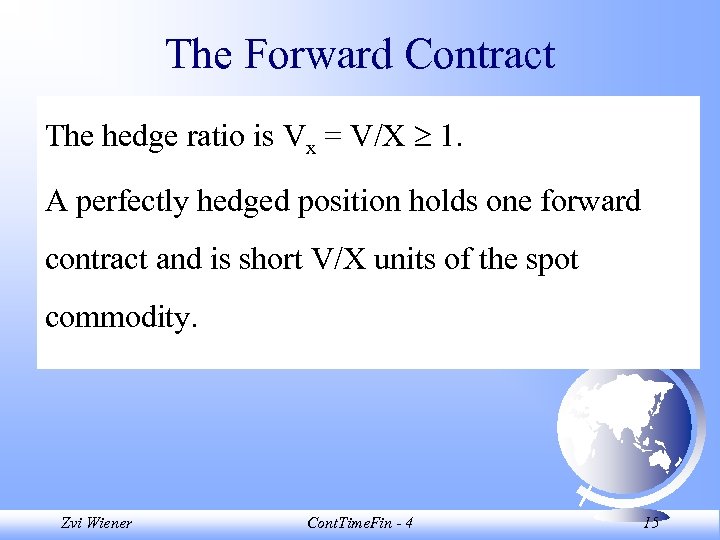 The Forward Contract The hedge ratio is Vx = V/X 1. A perfectly hedged position holds one forward contract and is short V/X units of the spot commodity. Zvi Wiener Cont. Time. Fin - 4 15
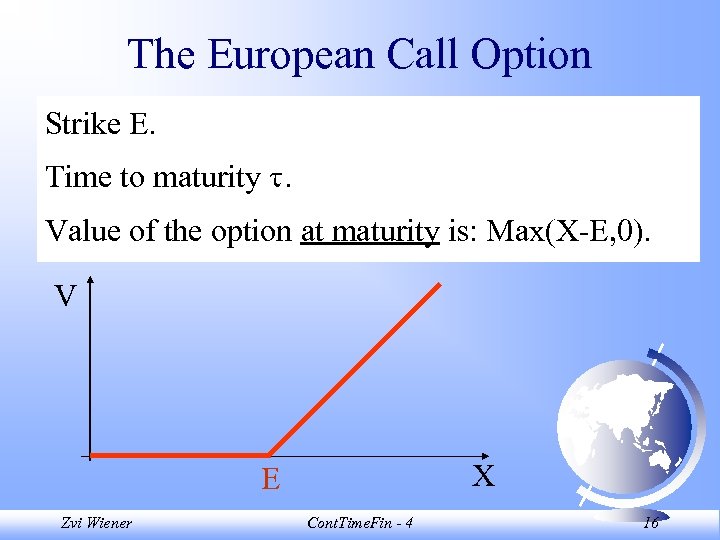 The European Call Option Strike E. Time to maturity . Value of the option at maturity is: Max(X-E, 0). V X E Zvi Wiener Cont. Time. Fin - 4 16
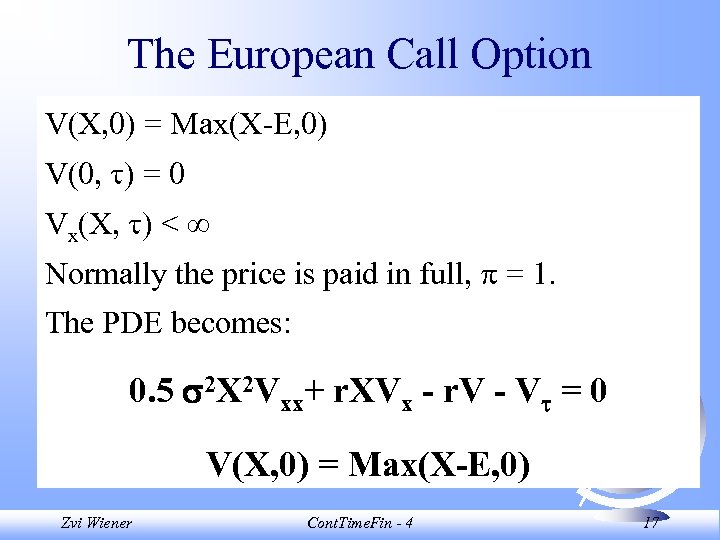 The European Call Option V(X, 0) = Max(X-E, 0) V(0, ) = 0 Vx(X, ) < Normally the price is paid in full, = 1. The PDE becomes: 0. 5 2 X 2 Vxx+ r. XVx - r. V - V = 0 V(X, 0) = Max(X-E, 0) Zvi Wiener Cont. Time. Fin - 4 17
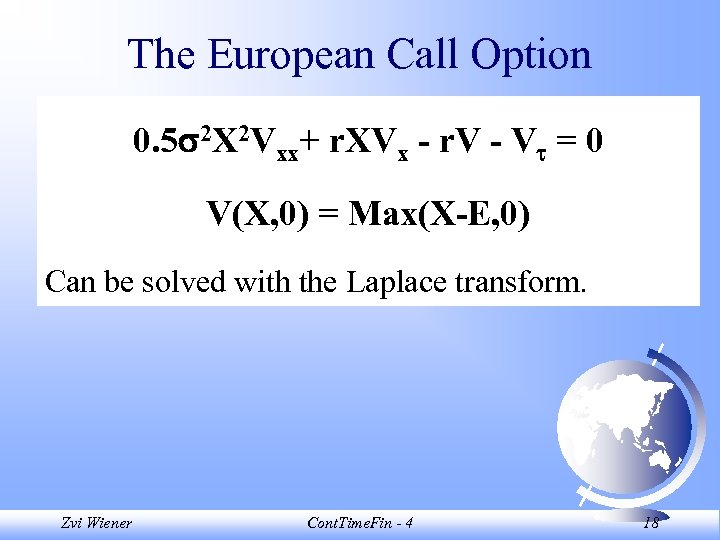 The European Call Option 0. 5 2 X 2 Vxx+ r. XVx - r. V - V = 0 V(X, 0) = Max(X-E, 0) Can be solved with the Laplace transform. Zvi Wiener Cont. Time. Fin - 4 18
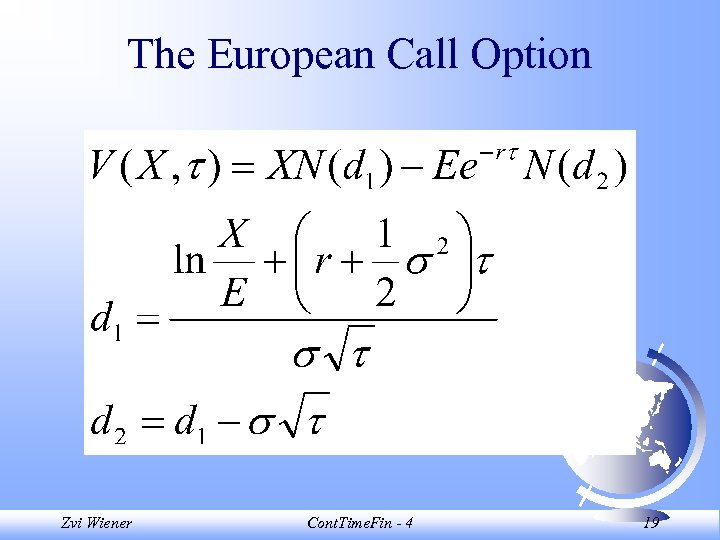 The European Call Option Zvi Wiener Cont. Time. Fin - 4 19
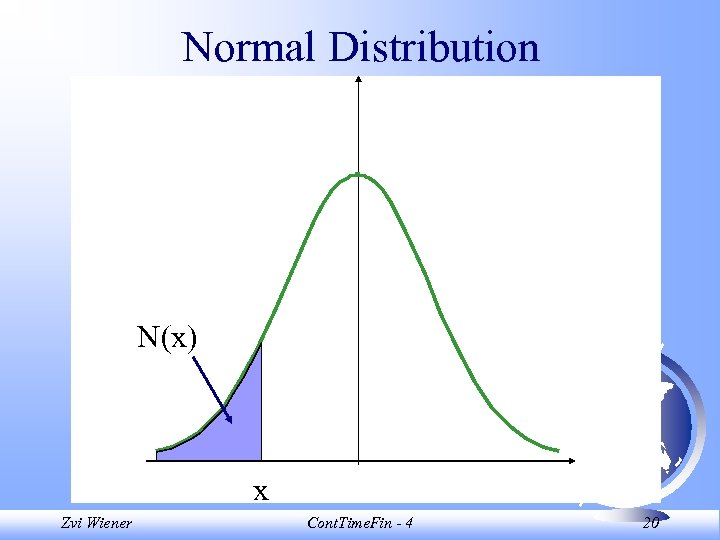 Normal Distribution N(x) x Zvi Wiener Cont. Time. Fin - 4 20
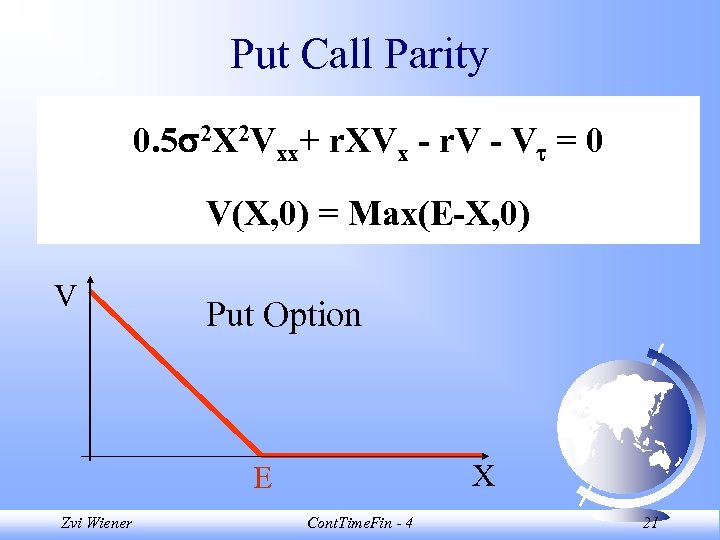 Put Call Parity 0. 5 2 X 2 Vxx+ r. XVx - r. V - V = 0 V(X, 0) = Max(E-X, 0) V Put Option X E Zvi Wiener Cont. Time. Fin - 4 21
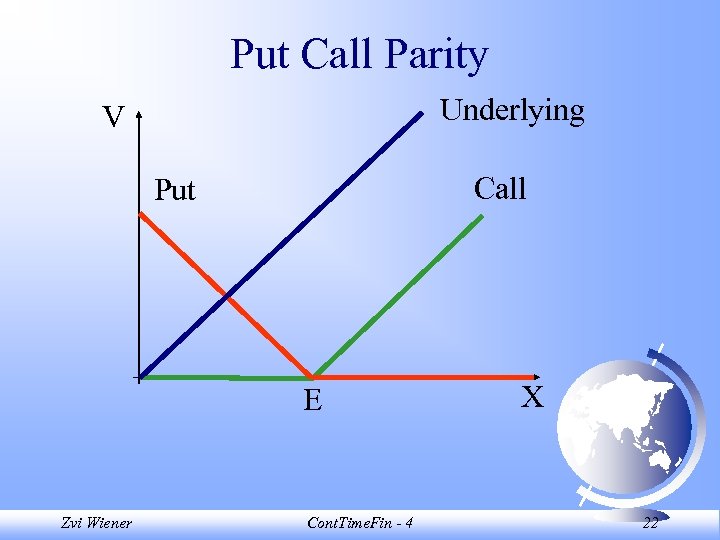 Put Call Parity Underlying V Call Put E Zvi Wiener Cont. Time. Fin - 4 X 22
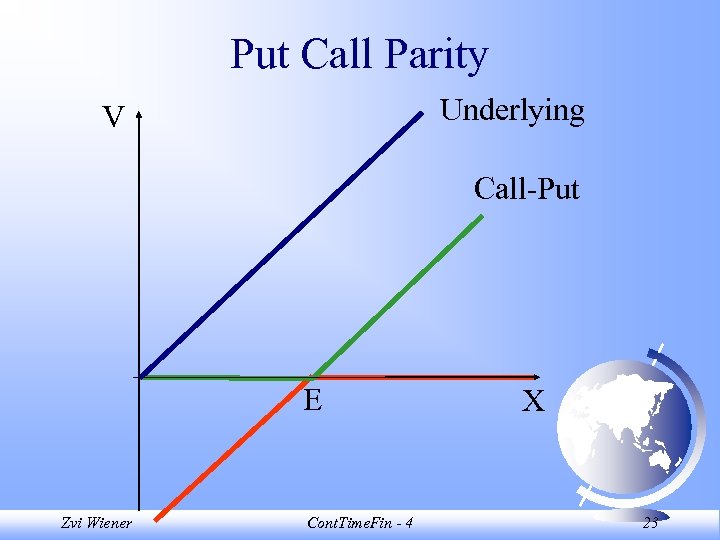 Put Call Parity Underlying V Call-Put E Zvi Wiener Cont. Time. Fin - 4 X 23
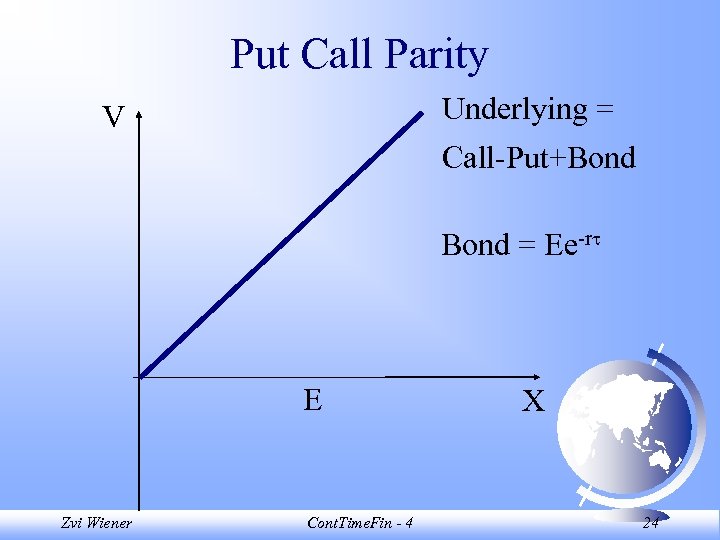 Put Call Parity Underlying = V Call-Put+Bond = Ee-r E Zvi Wiener Cont. Time. Fin - 4 X 24
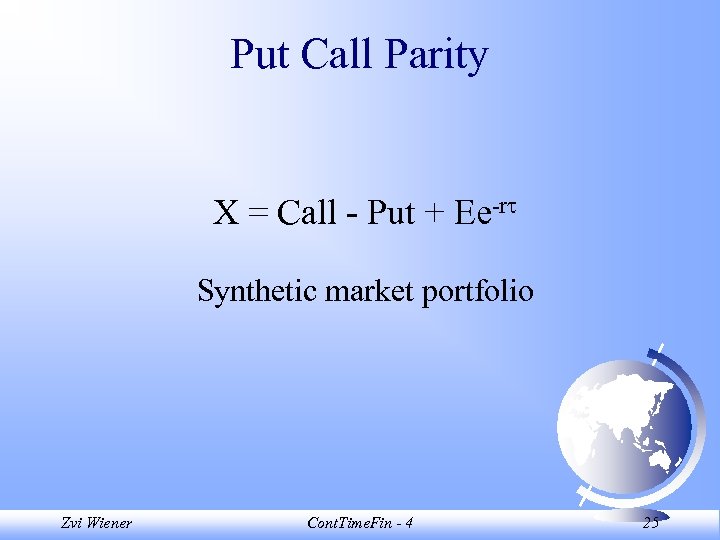 Put Call Parity X = Call - Put + Ee-r Synthetic market portfolio Zvi Wiener Cont. Time. Fin - 4 25
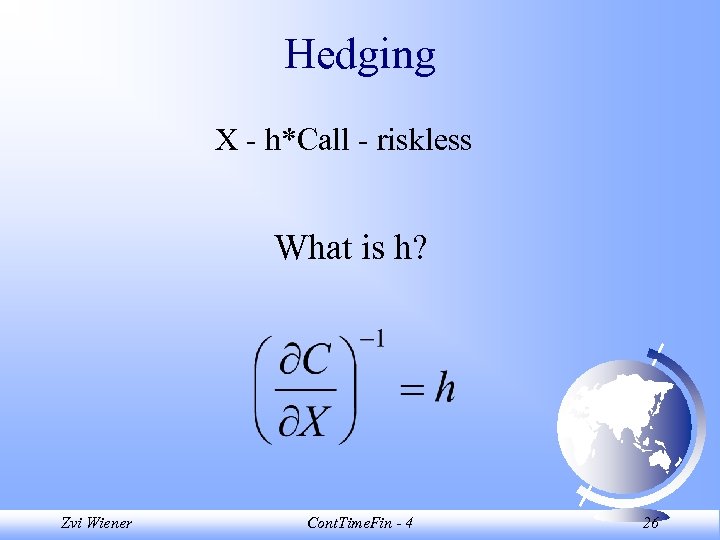 Hedging X - h*Call - riskless What is h? Zvi Wiener Cont. Time. Fin - 4 26
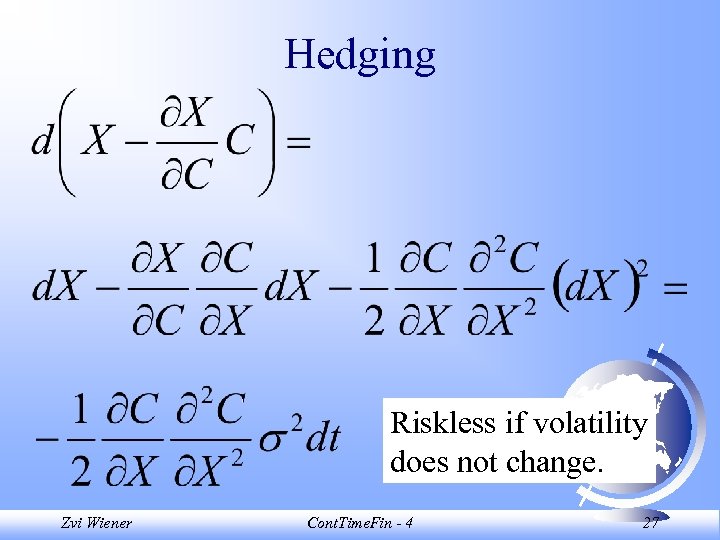 Hedging Riskless if volatility does not change. Zvi Wiener Cont. Time. Fin - 4 27
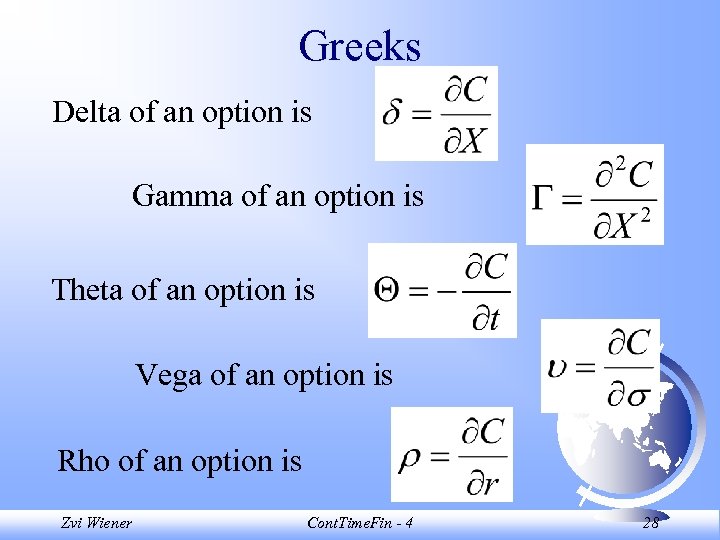 Greeks Delta of an option is Gamma of an option is Theta of an option is Vega of an option is Rho of an option is Zvi Wiener Cont. Time. Fin - 4 28
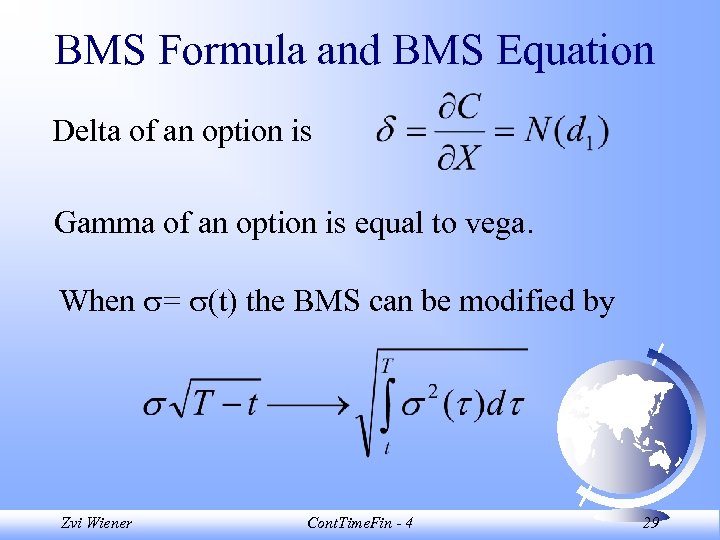 BMS Formula and BMS Equation Delta of an option is Gamma of an option is equal to vega. When = (t) the BMS can be modified by Zvi Wiener Cont. Time. Fin - 4 29
 Implied Volatility The value of volatility that makes the BMS formula to be equal to the observed price. Volatility smile. Confirms that the BMS formula is more general than the BMS formula. Zvi Wiener Cont. Time. Fin - 4 30
 Equilibrium Valuation This corresponds to the case when the underlying security does not earn the risk-free rate r. Example: dividends are paid (continuously or discrete) it is not traded cost-of-carry (storage, maintenance, spoilage costs) convenience yield from liquid assets Zvi Wiener Cont. Time. Fin - 4 31
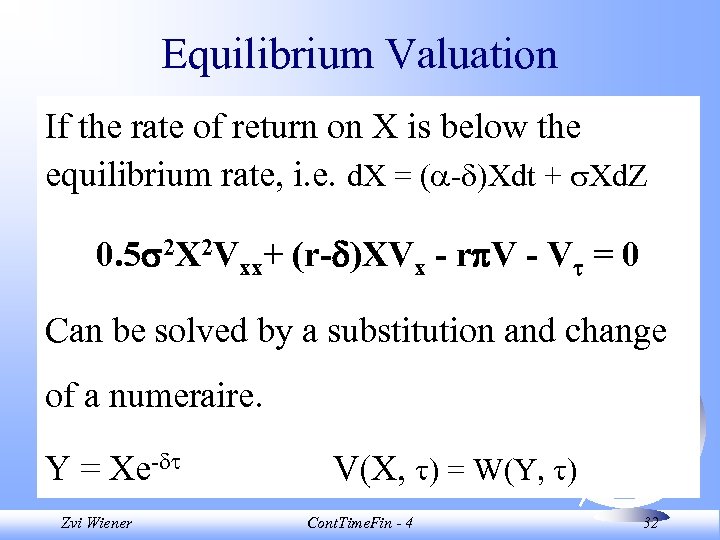 Equilibrium Valuation If the rate of return on X is below the equilibrium rate, i. e. d. X = ( - )Xdt + Xd. Z 0. 5 2 X 2 Vxx+ (r- )XVx - r V - V = 0 Can be solved by a substitution and change of a numeraire. Y = Xe- Zvi Wiener V(X, ) = W(Y, ) Cont. Time. Fin - 4 32
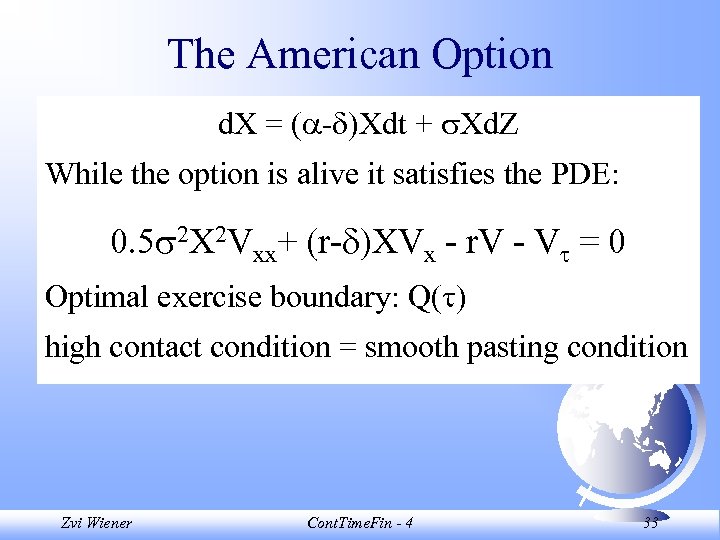 The American Option d. X = ( - )Xdt + Xd. Z While the option is alive it satisfies the PDE: 0. 5 2 X 2 Vxx+ (r- )XVx - r. V - V = 0 Optimal exercise boundary: Q( ) high contact condition = smooth pasting condition Zvi Wiener Cont. Time. Fin - 4 33
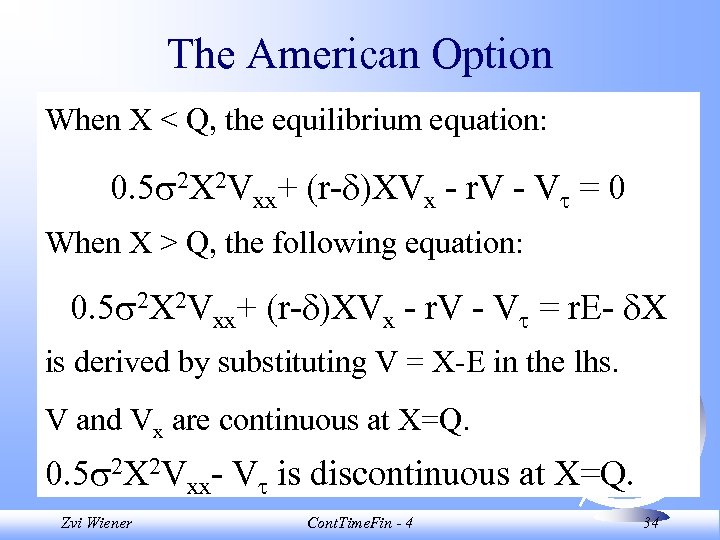 The American Option When X < Q, the equilibrium equation: 0. 5 2 X 2 Vxx+ (r- )XVx - r. V - V = 0 When X > Q, the following equation: 0. 5 2 X 2 Vxx+ (r- )XVx - r. V - V = r. E- X is derived by substituting V = X-E in the lhs. V and Vx are continuous at X=Q. 0. 5 2 X 2 Vxx- V is discontinuous at X=Q. Zvi Wiener Cont. Time. Fin - 4 34
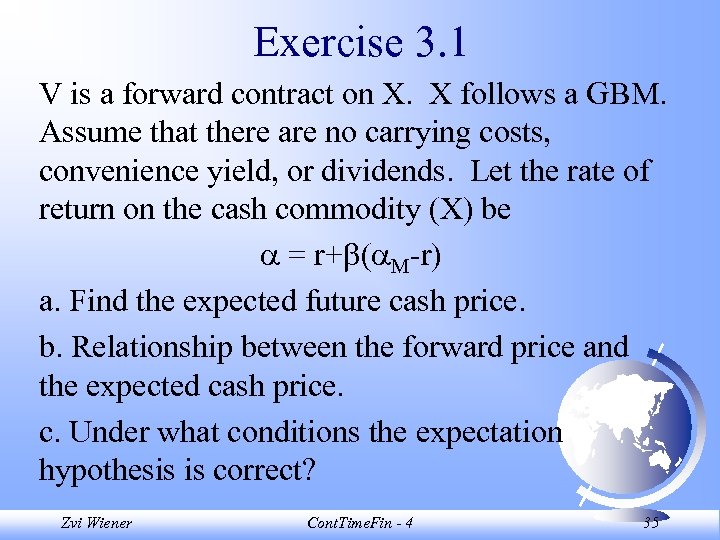 Exercise 3. 1 V is a forward contract on X. X follows a GBM. Assume that there are no carrying costs, convenience yield, or dividends. Let the rate of return on the cash commodity (X) be = r+ ( M-r) a. Find the expected future cash price. b. Relationship between the forward price and the expected cash price. c. Under what conditions the expectation hypothesis is correct? Zvi Wiener Cont. Time. Fin - 4 35
 Solution 3. 1 Zvi Wiener Cont. Time. Fin - 4 36
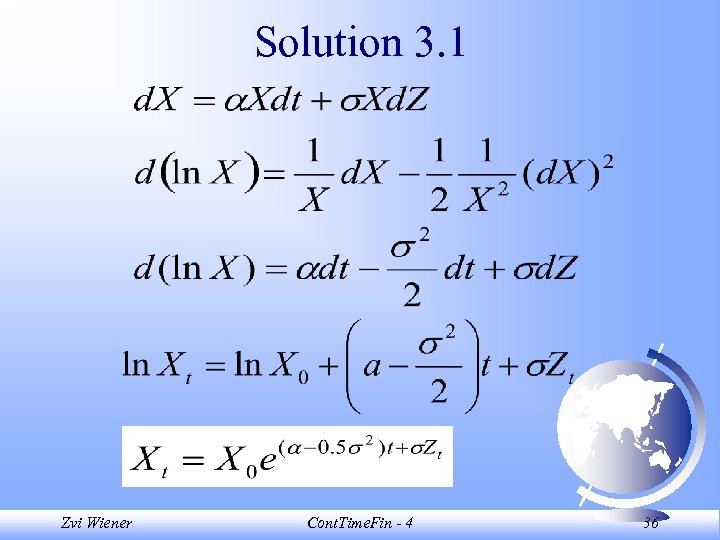
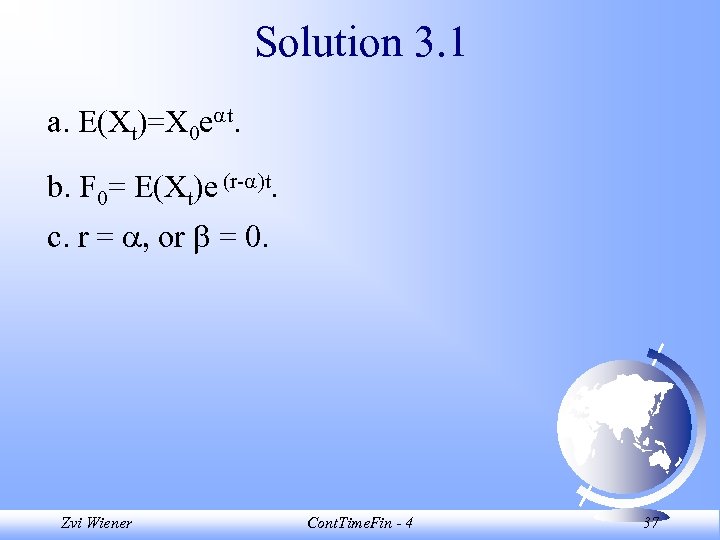 Solution 3. 1 a. E(Xt)=X 0 e t. b. F 0= E(Xt)e (r- )t. c. r = , or = 0. Zvi Wiener Cont. Time. Fin - 4 37
 Exercise 3. 2 What are the effects of carrying costs, convenience yields, and dividends? Zvi Wiener Cont. Time. Fin - 4 38
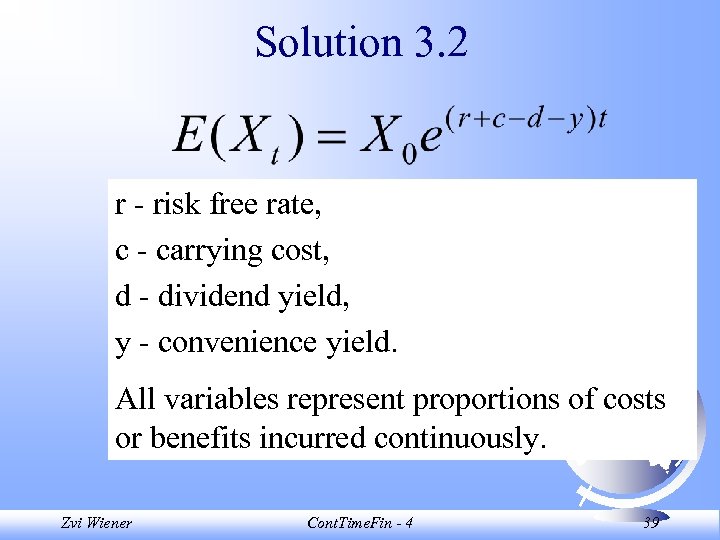 Solution 3. 2 r - risk free rate, c - carrying cost, d - dividend yield, y - convenience yield. All variables represent proportions of costs or benefits incurred continuously. Zvi Wiener Cont. Time. Fin - 4 39
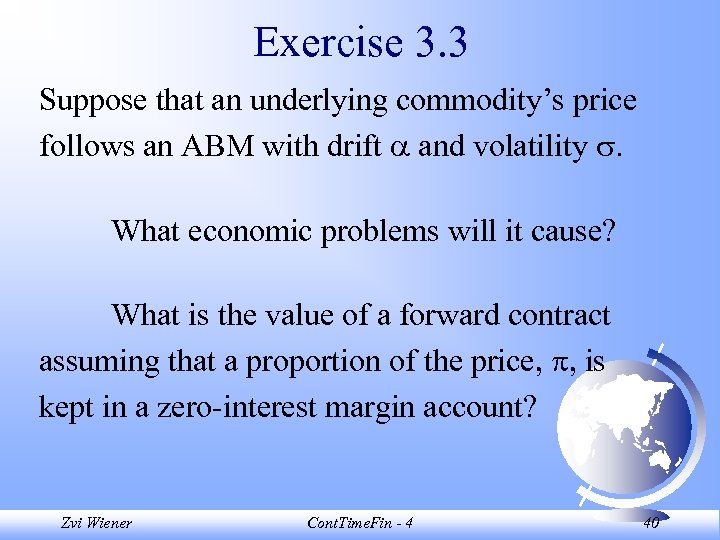 Exercise 3. 3 Suppose that an underlying commodity’s price follows an ABM with drift and volatility . What economic problems will it cause? What is the value of a forward contract assuming that a proportion of the price, , is kept in a zero-interest margin account? Zvi Wiener Cont. Time. Fin - 4 40
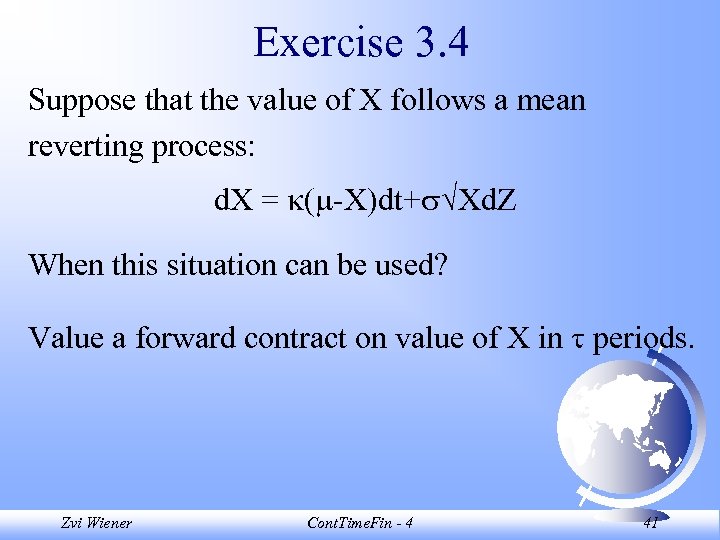 Exercise 3. 4 Suppose that the value of X follows a mean reverting process: d. X = ( -X)dt+ Xd. Z When this situation can be used? Value a forward contract on value of X in periods. Zvi Wiener Cont. Time. Fin - 4 41
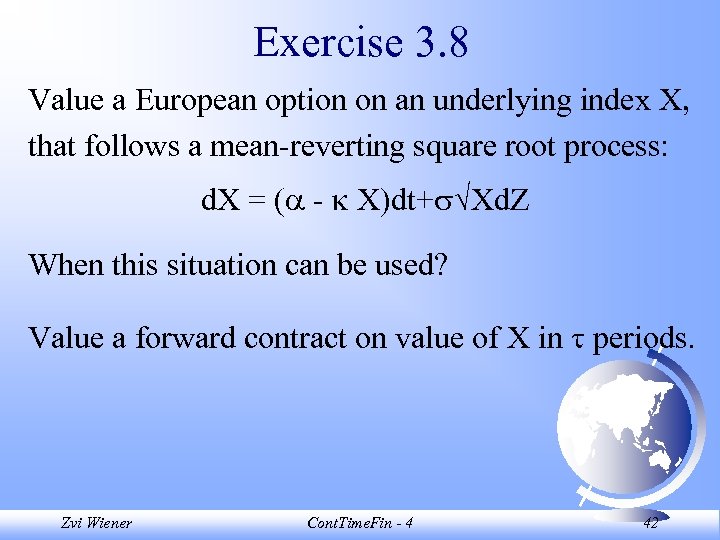 Exercise 3. 8 Value a European option on an underlying index X, that follows a mean-reverting square root process: d. X = ( - X)dt+ Xd. Z When this situation can be used? Value a forward contract on value of X in periods. Zvi Wiener Cont. Time. Fin - 4 42
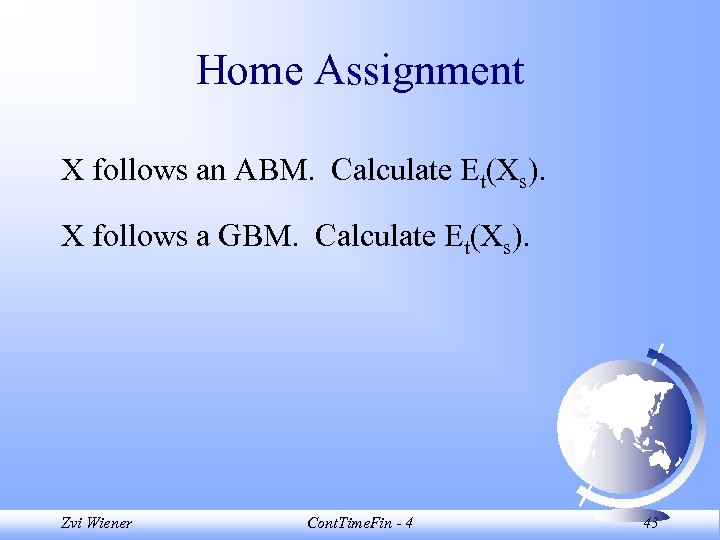 Home Assignment X follows an ABM. Calculate Et(Xs). X follows a GBM. Calculate Et(Xs). Zvi Wiener Cont. Time. Fin - 4 43