


 Скачать презентацию Financial Engineering Continuous Time Finance Zvi Wiener mswiener mscc
0b90fe9f5fcdd723f7eed8acff191d82.ppt
- Количество слайдов: 62
 Financial Engineering Continuous Time Finance Zvi Wiener mswiener@mscc. huji. ac. il tel: 02 -588 -3049 Zvi Wiener Cont. Time. Fin - 5 1
 Futures Contracts F Mark to market F Convergence property F Spot-futures parity F Cost-of-carry F Martingale F Risk-neutral Measure F Forwards and Futures F Girsanov’s Theorem and its counterpart F Feynman-Kac Formula F Stochastic optimization F The Maximum Principle F Zvi Wiener Cont. Time. Fin - 5 2
 Futures Markets Futures and forward contracts are similar to options in that they specify purchase or sale of some underlying security at some future date. However a future contract means an obligation of both sides. It is a commitment rather than an investment. Zvi Wiener Cont. Time. Fin - 5 3
 Basics of Futures Contracts Delivery of a commodity at a specified place, price, quantity and quality. Example: no. 2 hard winter wheat or no. 1 soft red wheat delivered at an approved warehouse by December 31, 1997. Zvi Wiener Cont. Time. Fin - 5 4
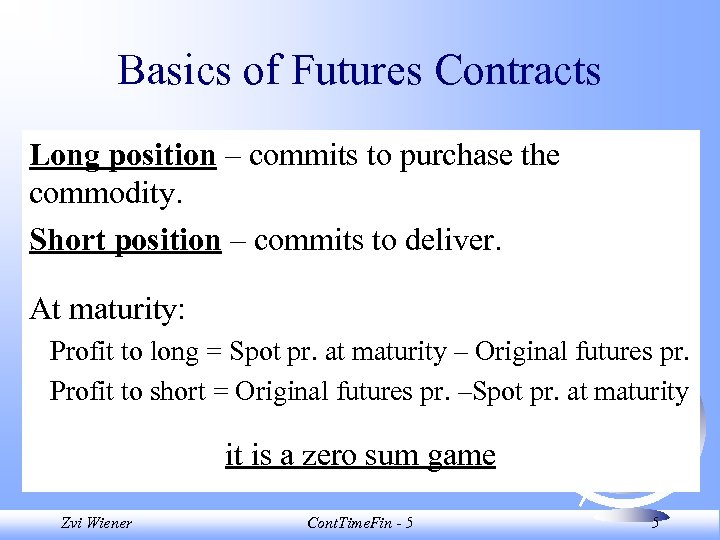 Basics of Futures Contracts Long position – commits to purchase the commodity. Short position – commits to deliver. At maturity: Profit to long = Spot pr. at maturity – Original futures pr. Profit to short = Original futures pr. –Spot pr. at maturity it is a zero sum game Zvi Wiener Cont. Time. Fin - 5 5
 Futures Markets The initial investment is zero however some margin is required. The later cash flow is mark-to-market for a future contract and is concentrated in one point for the forward contract. Futures are standardized and not specify the counterside. Zvi Wiener Cont. Time. Fin - 5 6
 Futures Markets F Currencies – all major currencies, including cross rate F Agricultural – corn, wheat, meat, coffee, sugar, lumber, rice F Metals and Energy – copper, gold, silver, oil, gas, aluminum F Interest Rates Futures – eurodollars, T-bonds, LIBOR, Municipal, Fed funds F Equity Futures – S&P 500, NYSE index, OTC, FT-SE, Toronto Zvi Wiener Cont. Time. Fin - 5 7
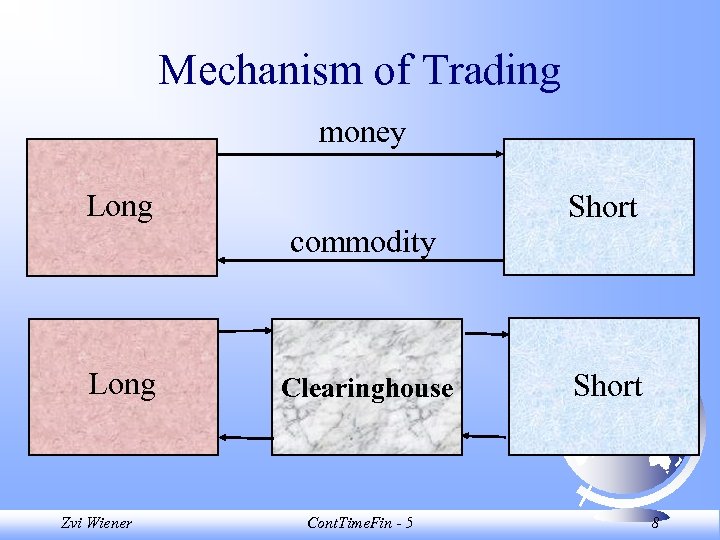 Mechanism of Trading money Long Short commodity Long Zvi Wiener Clearinghouse Cont. Time. Fin - 5 Short 8
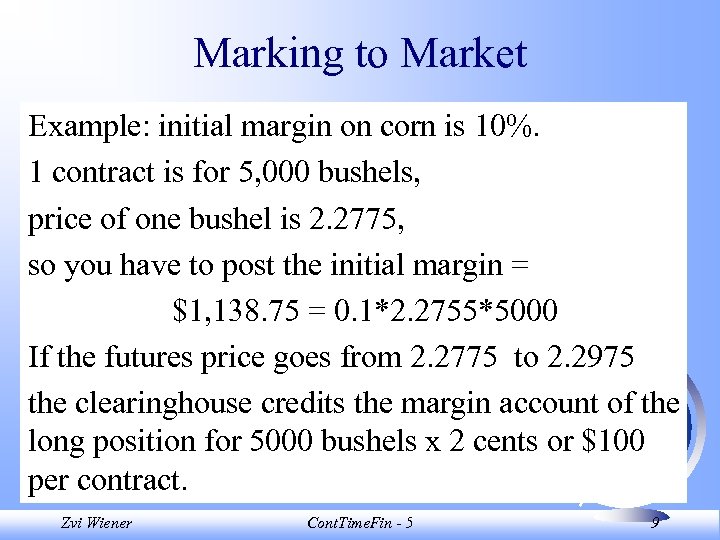 Marking to Market Example: initial margin on corn is 10%. 1 contract is for 5, 000 bushels, price of one bushel is 2. 2775, so you have to post the initial margin = $1, 138. 75 = 0. 1*2. 2755*5000 If the futures price goes from 2. 2775 to 2. 2975 the clearinghouse credits the margin account of the long position for 5000 bushels x 2 cents or $100 per contract. Zvi Wiener Cont. Time. Fin - 5 9
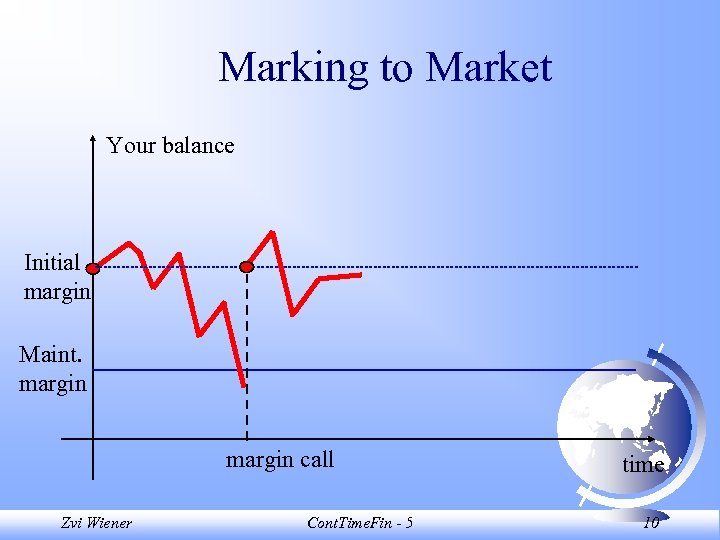 Marking to Market Your balance Initial margin Maint. margin call Zvi Wiener Cont. Time. Fin - 5 time 10
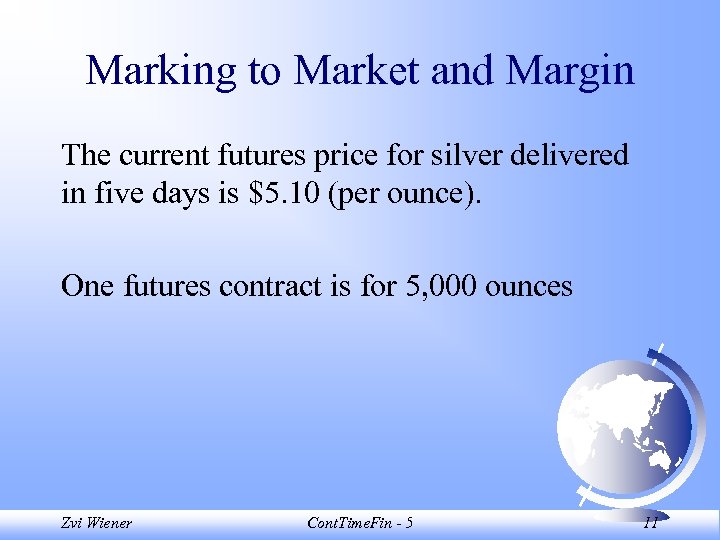 Marking to Market and Margin The current futures price for silver delivered in five days is $5. 10 (per ounce). One futures contract is for 5, 000 ounces Zvi Wiener Cont. Time. Fin - 5 11
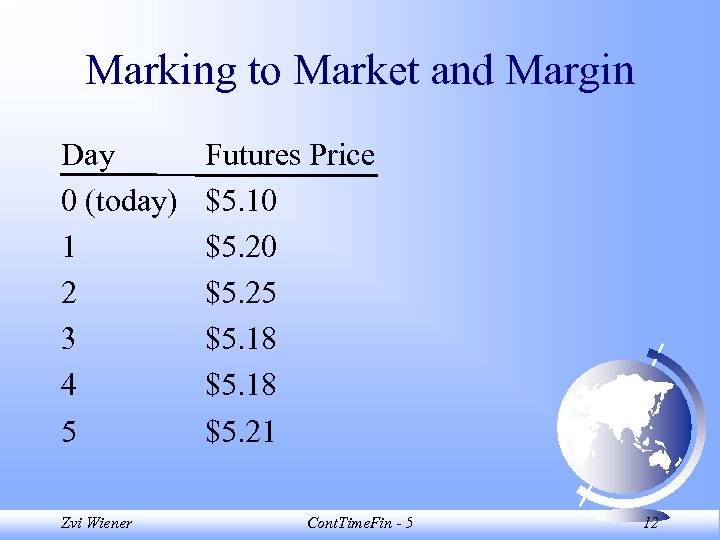 Marking to Market and Margin Day 0 (today) 1 2 3 4 5 Zvi Wiener Futures Price $5. 10 $5. 25 $5. 18 $5. 21 Cont. Time. Fin - 5 12
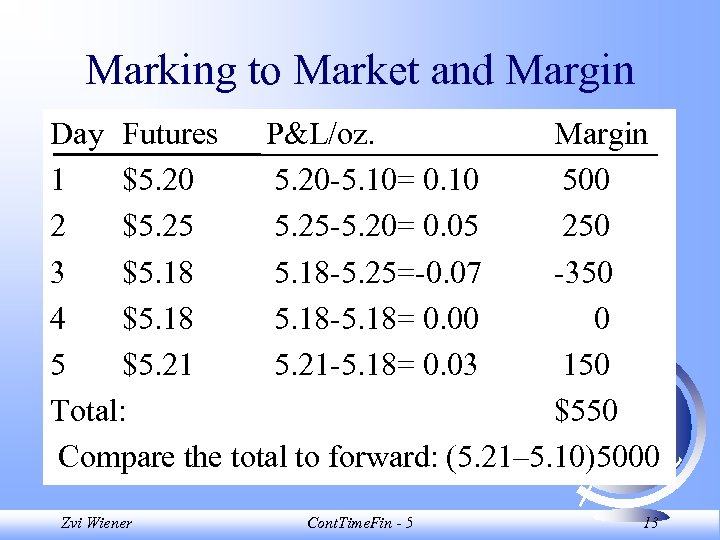 Marking to Market and Margin Day Futures P&L/oz. Margin 1 $5. 20 -5. 10= 0. 10 500 2 $5. 25 -5. 20= 0. 05 250 3 $5. 18 -5. 25=-0. 07 -350 4 $5. 18 -5. 18= 0. 00 0 5 $5. 21 -5. 18= 0. 03 150 Total: $550 Compare the total to forward: (5. 21– 5. 10)5000 Zvi Wiener Cont. Time. Fin - 5 13
 Convergence Property The futures price and the spot price must converge at maturity. Otherwise there will be an arbitrage based on actual delivery. Sometimes delivery is costly! Zvi Wiener Cont. Time. Fin - 5 14
 Futures Markets Cash delivery: sometimes is allowed, sometimes is the only way to deliver. The question of quality is resolved with a conversion factor. The cheapest to deliver option. Zvi Wiener Cont. Time. Fin - 5 15
 Futures Markets The S&P 500 futures calls for delivery of $500 times the value of the index. If at maturity the index is at 475, then $500 x 475=$237, 500 cash is the delivery value. If the contract was written on the futures price 470 (some time ago), who will pay money? Short side will pay to the long side. Zvi Wiener Cont. Time. Fin - 5 16
 Futures Markets Strategies Hedging and Speculation – efficient tool for hedging and speculation. A significant leverage effect. Zvi Wiener Cont. Time. Fin - 5 17
 Basis Risk and Hedging The basis is the difference between the futures price and the spot price. (At maturity it approaches zero). This risk is important if the futures position is not held till maturity and is liquidated in advance. Spread position is when an investor is long a futures with one ttm and short with another. Zvi Wiener Cont. Time. Fin - 5 18
 Spot-Futures Parity Theorem Create a riskless position involving a futures contract and the spot position. Buy one stock for S and take a short futures position in it. The only difference is from dividends. Thus F + D – S is riskless. The amount of money invested is S. Zvi Wiener Cont. Time. Fin - 5 19
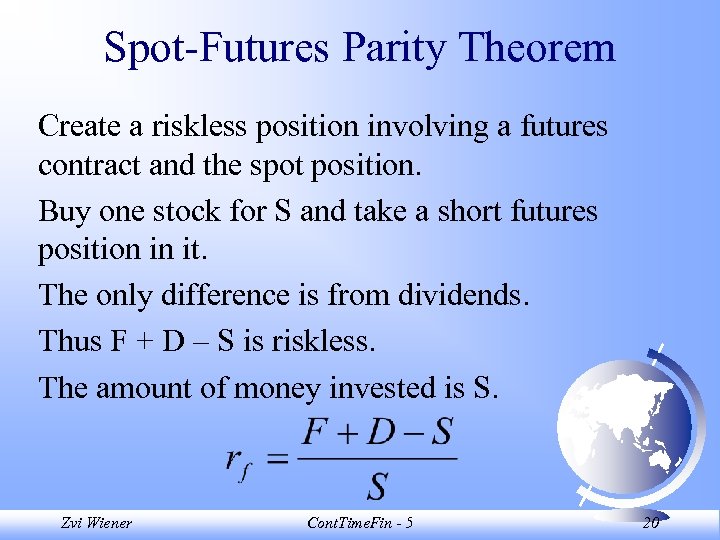 Spot-Futures Parity Theorem Create a riskless position involving a futures contract and the spot position. Buy one stock for S and take a short futures position in it. The only difference is from dividends. Thus F + D – S is riskless. The amount of money invested is S. Zvi Wiener Cont. Time. Fin - 5 20
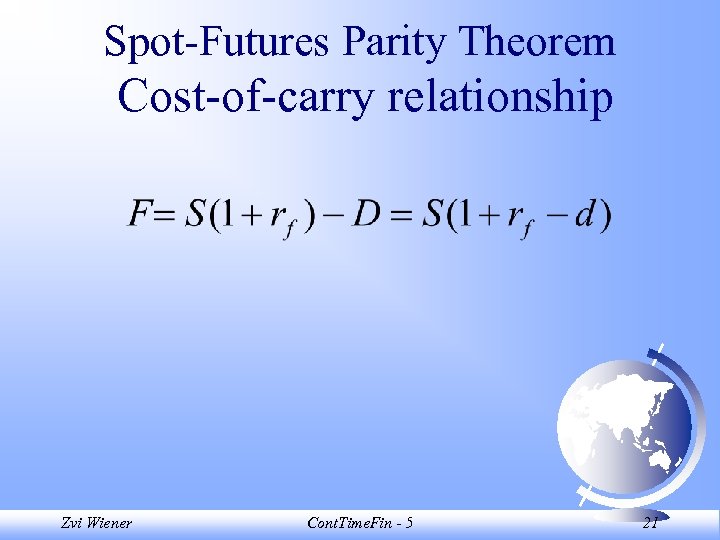 Spot-Futures Parity Theorem Cost-of-carry relationship Zvi Wiener Cont. Time. Fin - 5 21
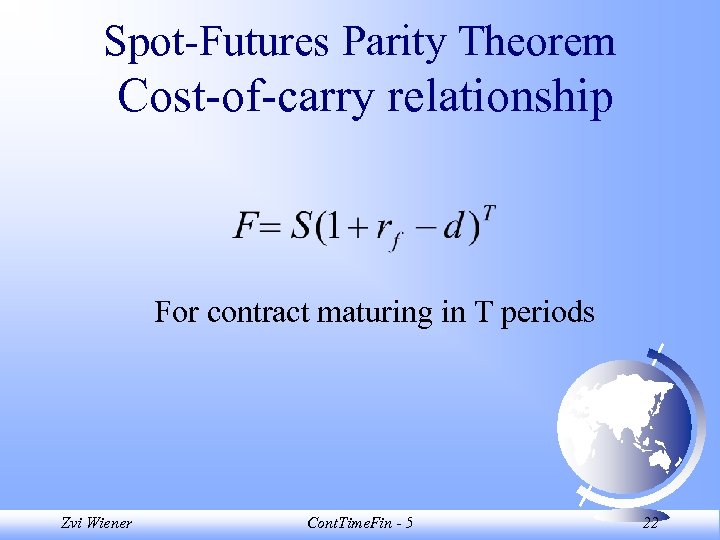 Spot-Futures Parity Theorem Cost-of-carry relationship For contract maturing in T periods Zvi Wiener Cont. Time. Fin - 5 22
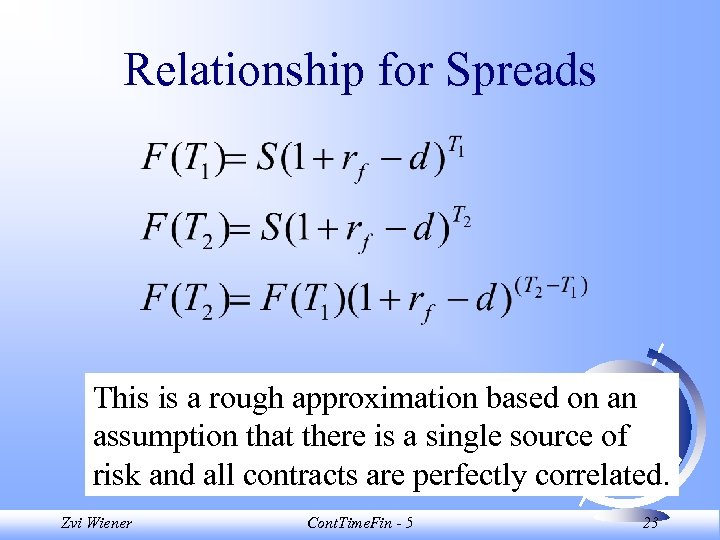 Relationship for Spreads This is a rough approximation based on an assumption that there is a single source of risk and all contracts are perfectly correlated. Zvi Wiener Cont. Time. Fin - 5 23
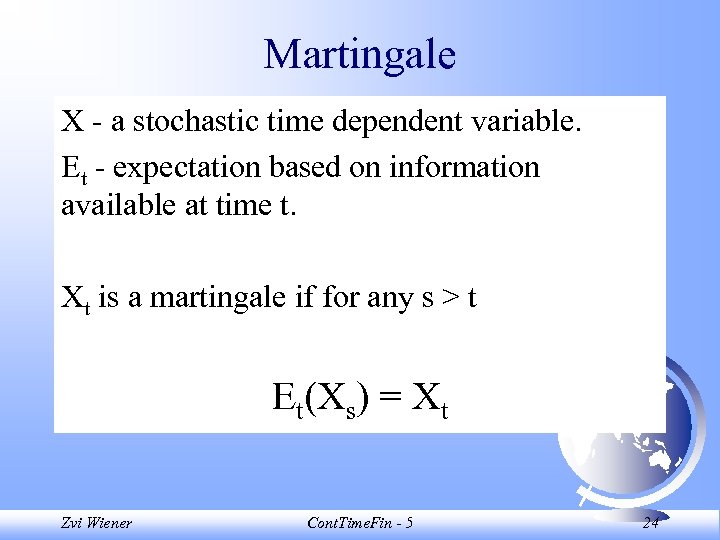 Martingale X - a stochastic time dependent variable. Et - expectation based on information available at time t. Xt is a martingale if for any s > t Et(Xs) = Xt Zvi Wiener Cont. Time. Fin - 5 24
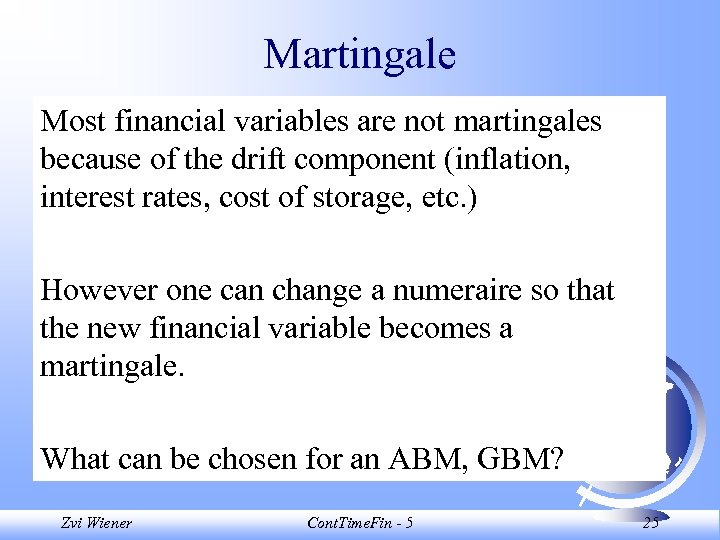 Martingale Most financial variables are not martingales because of the drift component (inflation, interest rates, cost of storage, etc. ) However one can change a numeraire so that the new financial variable becomes a martingale. What can be chosen for an ABM, GBM? Zvi Wiener Cont. Time. Fin - 5 25
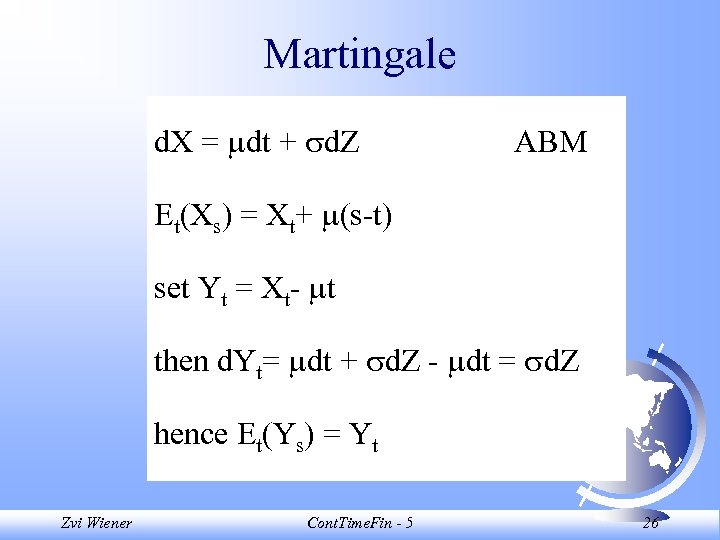 Martingale d. X = dt + d. Z ABM Et(Xs) = Xt+ (s-t) set Yt = Xt- t then d. Yt= dt + d. Z - dt = d. Z hence Et(Ys) = Yt Zvi Wiener Cont. Time. Fin - 5 26
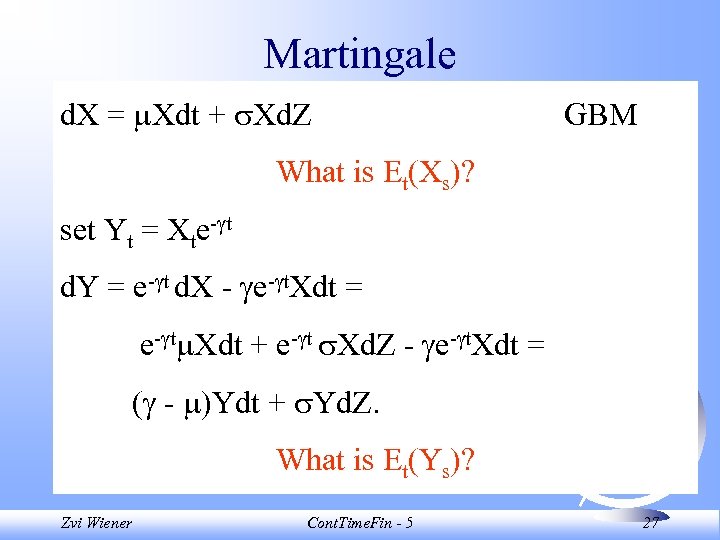 Martingale d. X = Xdt + Xd. Z GBM What is Et(Xs)? set Yt = Xte- t d. Y = e- t d. X - e- t. Xdt = e- t Xdt + e- t Xd. Z - e- t. Xdt = ( - )Ydt + Yd. Z. What is Et(Ys)? Zvi Wiener Cont. Time. Fin - 5 27
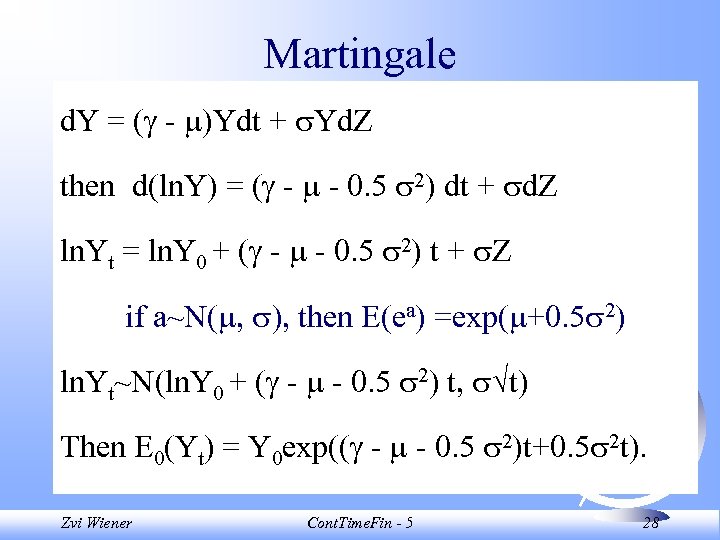 Martingale d. Y = ( - )Ydt + Yd. Z then d(ln. Y) = ( - - 0. 5 2) dt + d. Z ln. Yt = ln. Y 0 + ( - - 0. 5 2) t + Z if a~N( , ), then E(ea) =exp( +0. 5 2) ln. Yt~N(ln. Y 0 + ( - - 0. 5 2) t, t) Then E 0(Yt) = Y 0 exp(( - - 0. 5 2)t+0. 5 2 t). Zvi Wiener Cont. Time. Fin - 5 28
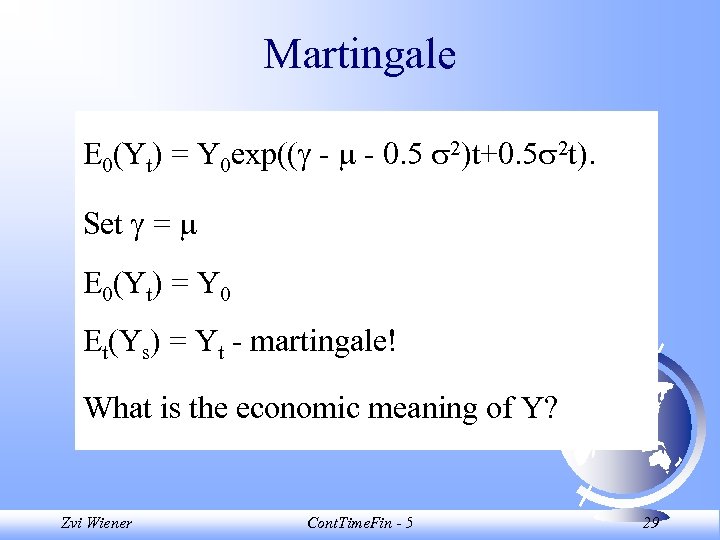 Martingale E 0(Yt) = Y 0 exp(( - - 0. 5 2)t+0. 5 2 t). Set = E 0(Yt) = Y 0 Et(Ys) = Yt - martingale! What is the economic meaning of Y? Zvi Wiener Cont. Time. Fin - 5 29
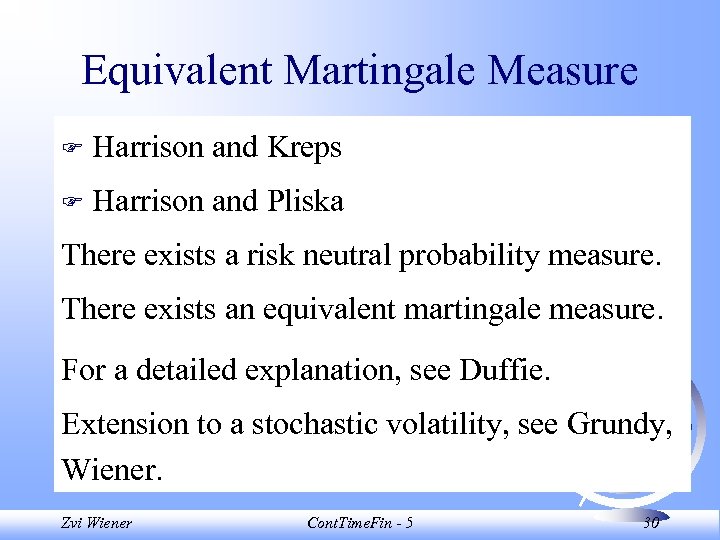 Equivalent Martingale Measure F Harrison and Kreps F Harrison and Pliska There exists a risk neutral probability measure. There exists an equivalent martingale measure. For a detailed explanation, see Duffie. Extension to a stochastic volatility, see Grundy, Wiener. Zvi Wiener Cont. Time. Fin - 5 30
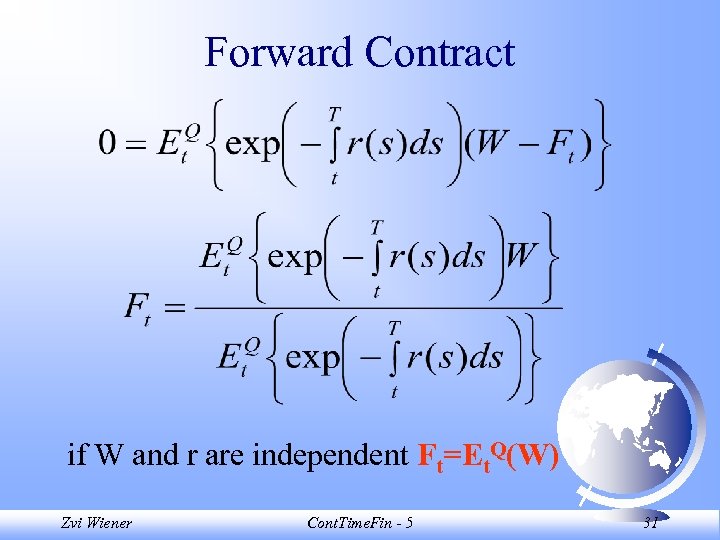 Forward Contract if W and r are independent Ft=Et. Q(W) Zvi Wiener Cont. Time. Fin - 5 31
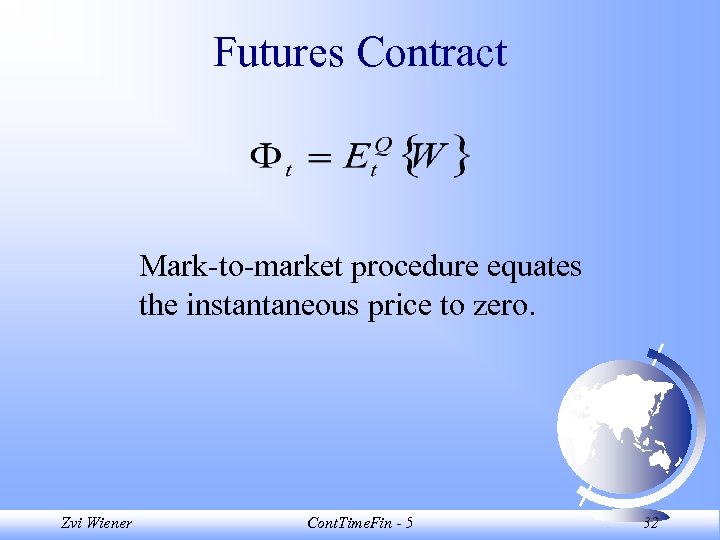 Futures Contract Mark-to-market procedure equates the instantaneous price to zero. Zvi Wiener Cont. Time. Fin - 5 32
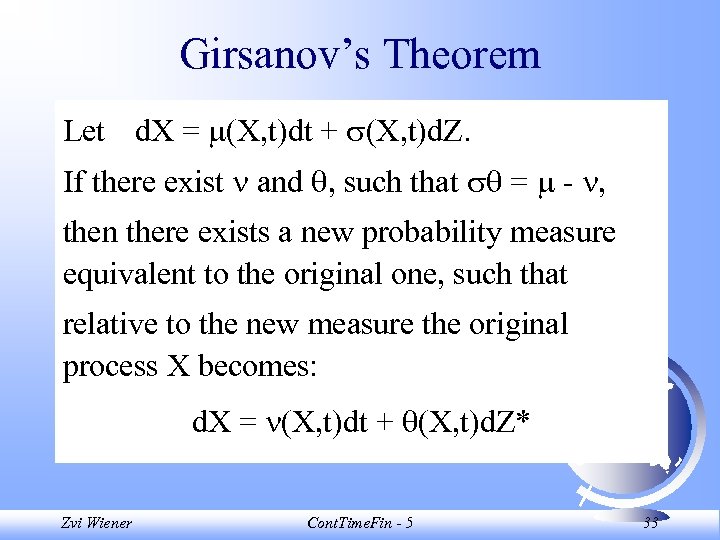 Girsanov’s Theorem Let d. X = (X, t)dt + (X, t)d. Z. If there exist and , such that = - , then there exists a new probability measure equivalent to the original one, such that relative to the new measure the original process X becomes: d. X = (X, t)dt + (X, t)d. Z* Zvi Wiener Cont. Time. Fin - 5 33
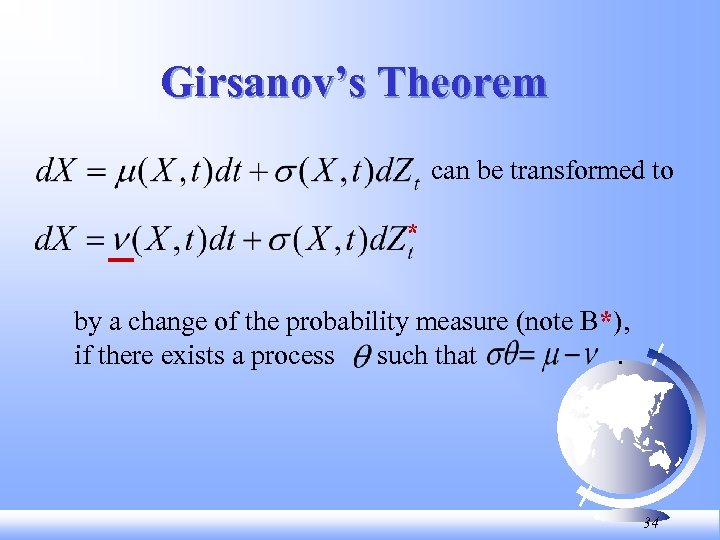 Girsanov’s Theorem can be transformed to * by a change of the probability measure (note B*), if there exists a process such that. 34
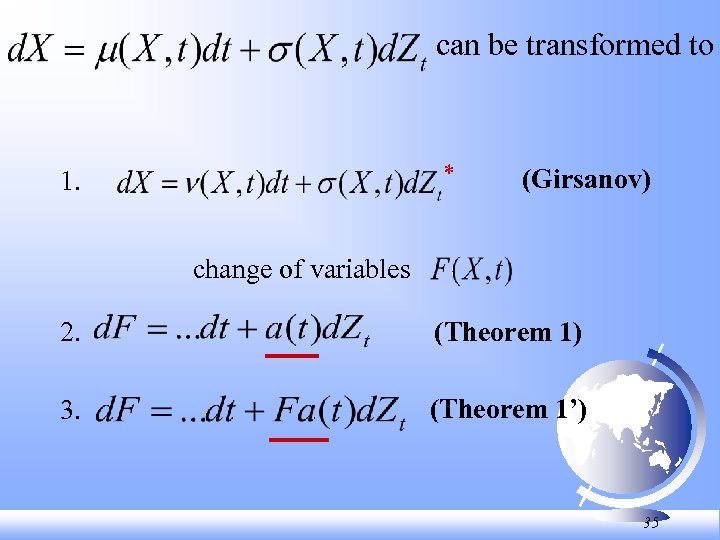 can be transformed to * 1. (Girsanov) change of variables 2. (Theorem 1) 3. (Theorem 1’) 35
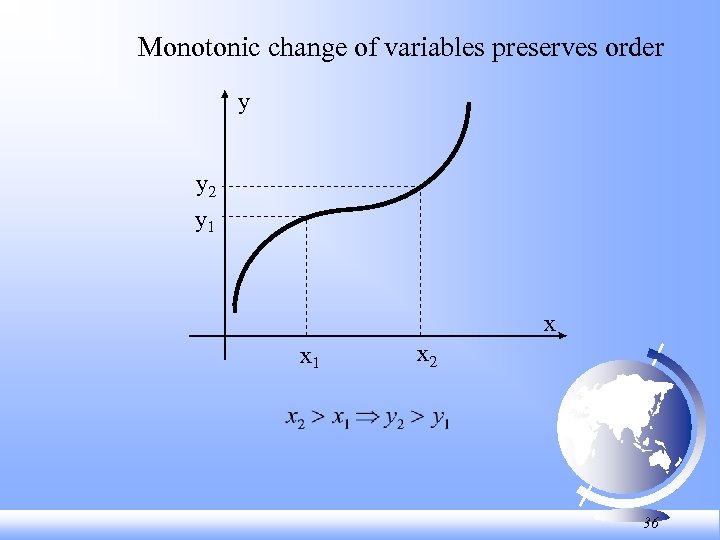 Monotonic change of variables preserves order y y 2 y 1 x x 1 x 2 36
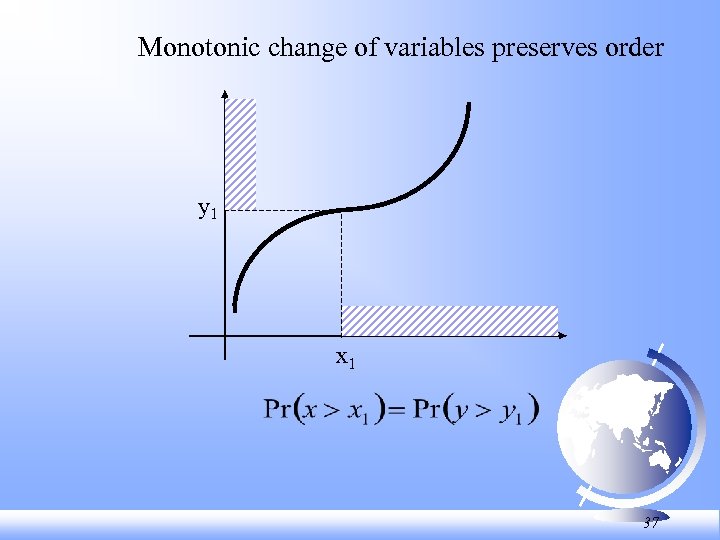 Monotonic change of variables preserves order y 1 x x 1 37
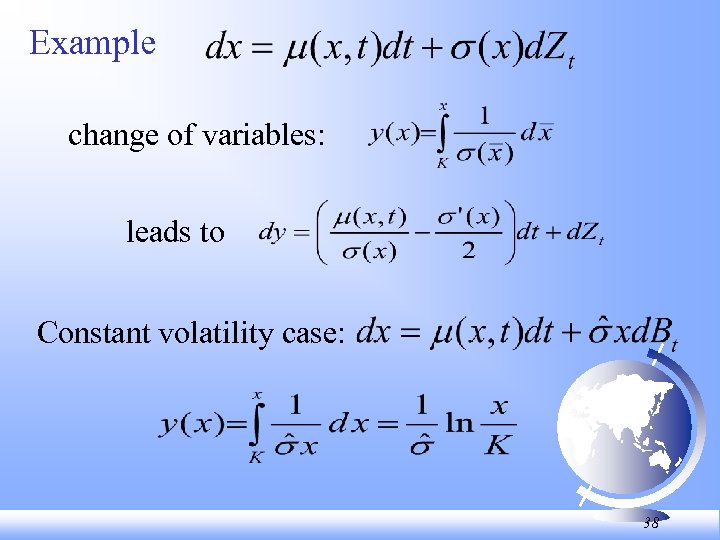 Example change of variables: leads to Constant volatility case: 38
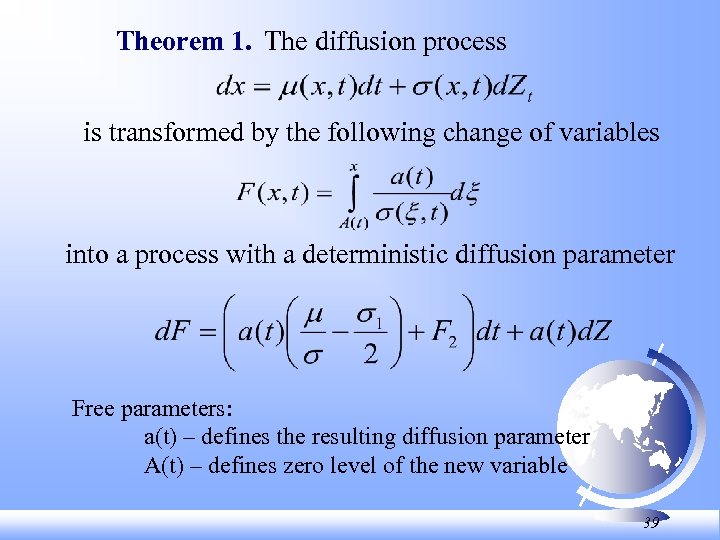 Theorem 1. The diffusion process is transformed by the following change of variables into a process with a deterministic diffusion parameter Free parameters: a(t) – defines the resulting diffusion parameter A(t) – defines zero level of the new variable 39
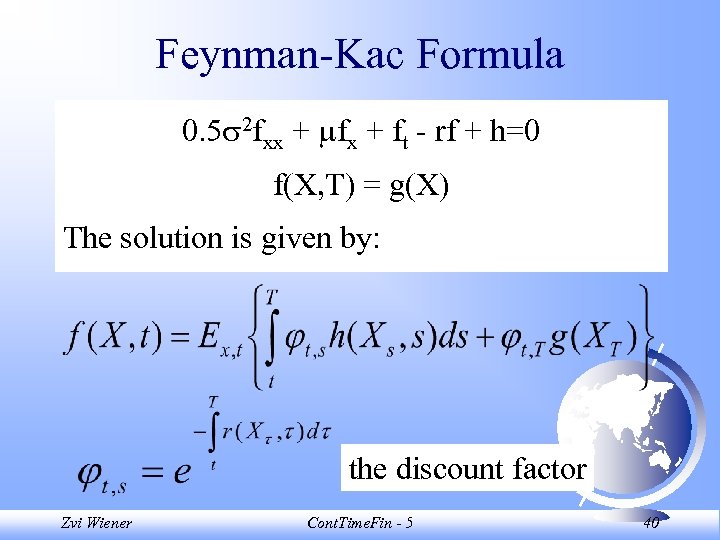 Feynman-Kac Formula 0. 5 2 fxx + ft - rf + h=0 f(X, T) = g(X) The solution is given by: the discount factor Zvi Wiener Cont. Time. Fin - 5 40
 Stochastic Optimization In many cases financial assets involve decisions. In some cases we should assume that decision makers are rational and try to use an optimal decision, in some cases we assume not rational behavior. Zvi Wiener Cont. Time. Fin - 5 41
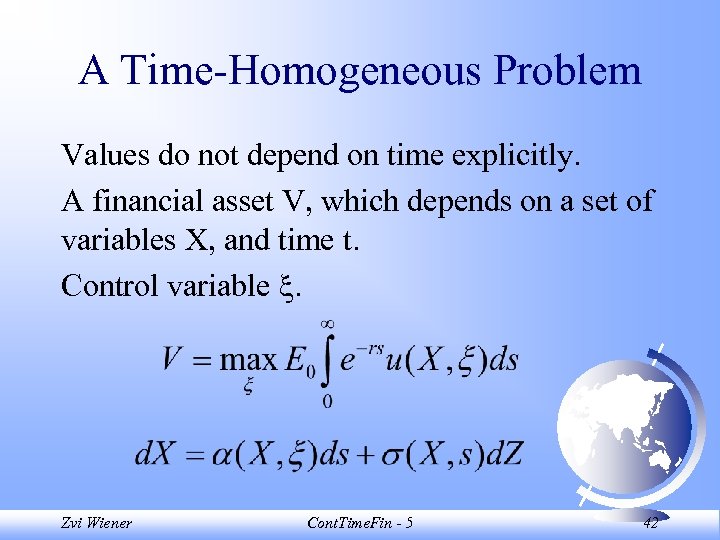 A Time-Homogeneous Problem Values do not depend on time explicitly. A financial asset V, which depends on a set of variables X, and time t. Control variable . Zvi Wiener Cont. Time. Fin - 5 42
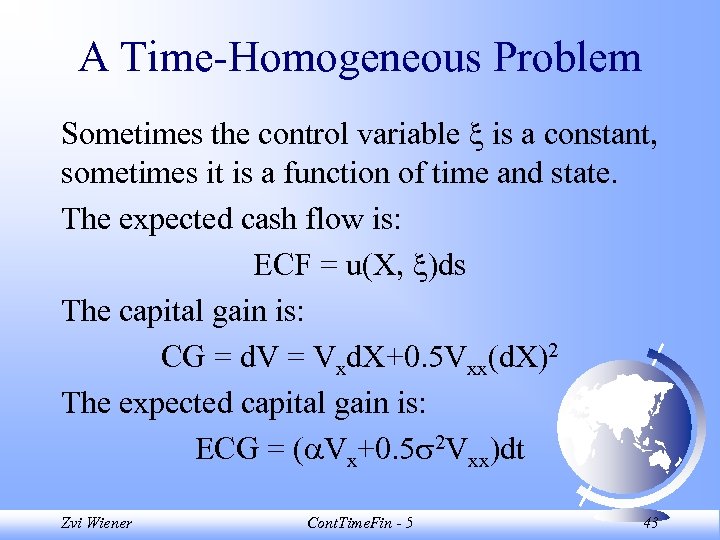 A Time-Homogeneous Problem Sometimes the control variable is a constant, sometimes it is a function of time and state. The expected cash flow is: ECF = u(X, )ds The capital gain is: CG = d. V = Vxd. X+0. 5 Vxx(d. X)2 The expected capital gain is: ECG = ( Vx+0. 5 2 Vxx)dt Zvi Wiener Cont. Time. Fin - 5 43
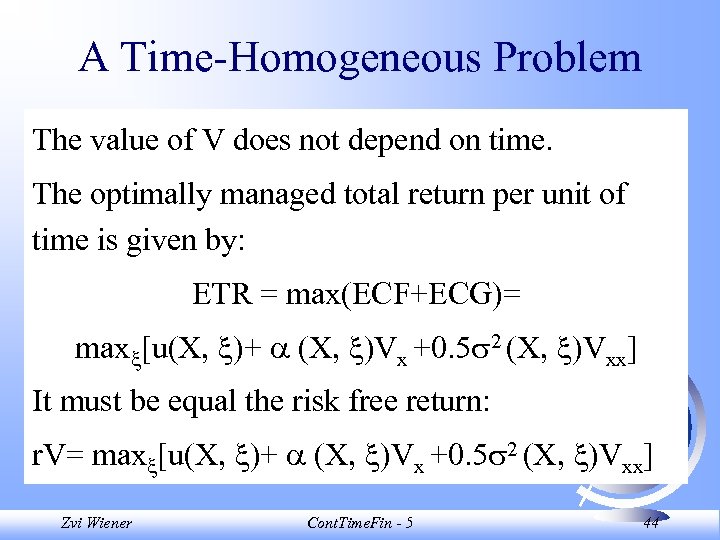 A Time-Homogeneous Problem The value of V does not depend on time. The optimally managed total return per unit of time is given by: ETR = max(ECF+ECG)= max [u(X, )+ (X, )Vx +0. 5 2 (X, )Vxx] It must be equal the risk free return: r. V= max [u(X, )+ (X, )Vx +0. 5 2 (X, )Vxx] Zvi Wiener Cont. Time. Fin - 5 44
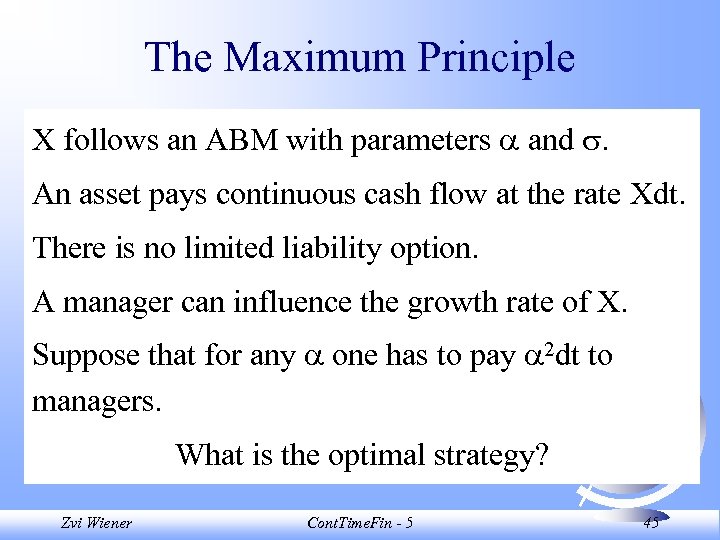 The Maximum Principle X follows an ABM with parameters and . An asset pays continuous cash flow at the rate Xdt. There is no limited liability option. A manager can influence the growth rate of X. Suppose that for any one has to pay 2 dt to managers. What is the optimal strategy? Zvi Wiener Cont. Time. Fin - 5 45
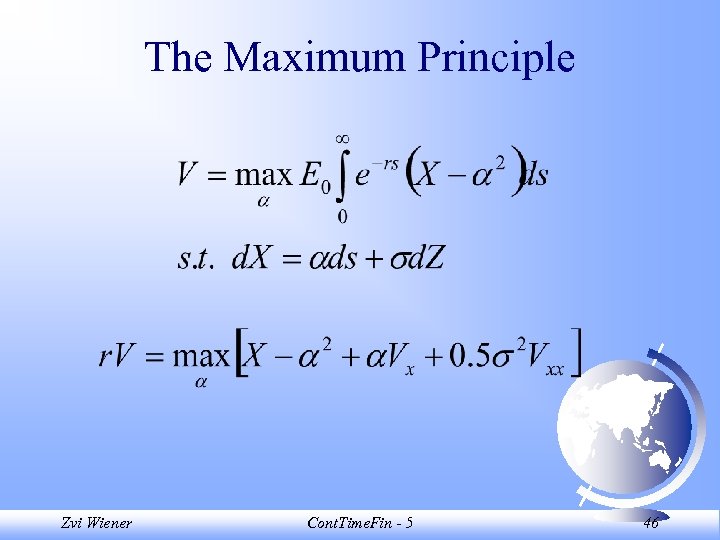 The Maximum Principle Zvi Wiener Cont. Time. Fin - 5 46
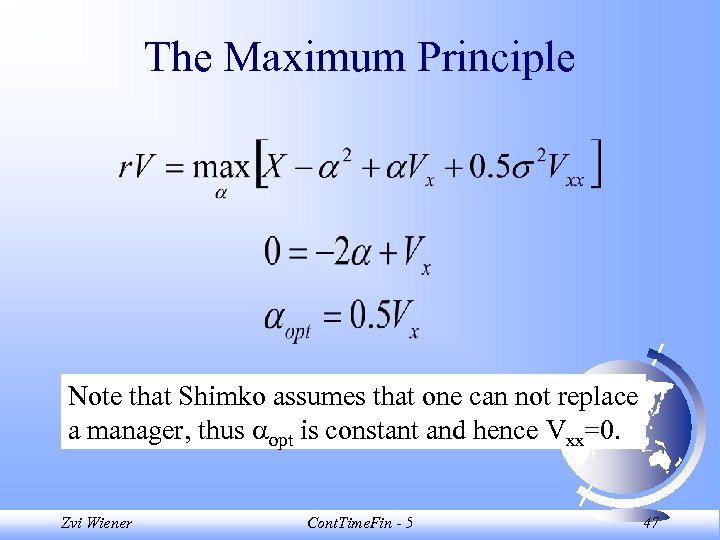 The Maximum Principle Note that Shimko assumes that one can not replace a manager, thus opt is constant and hence Vxx=0. Zvi Wiener Cont. Time. Fin - 5 47
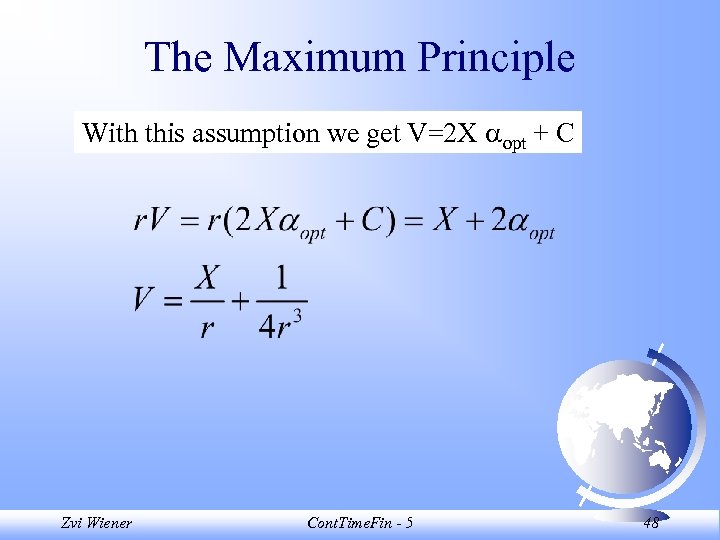 The Maximum Principle With this assumption we get V=2 X opt + C Zvi Wiener Cont. Time. Fin - 5 48
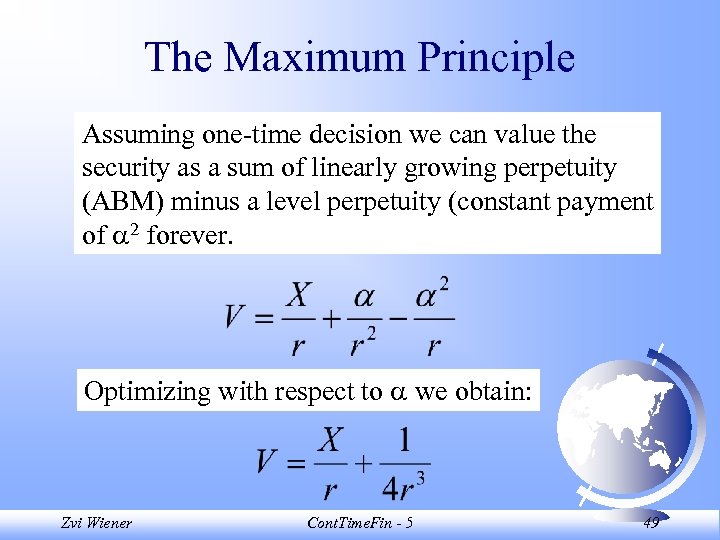 The Maximum Principle Assuming one-time decision we can value the security as a sum of linearly growing perpetuity (ABM) minus a level perpetuity (constant payment of 2 forever. Optimizing with respect to we obtain: Zvi Wiener Cont. Time. Fin - 5 49
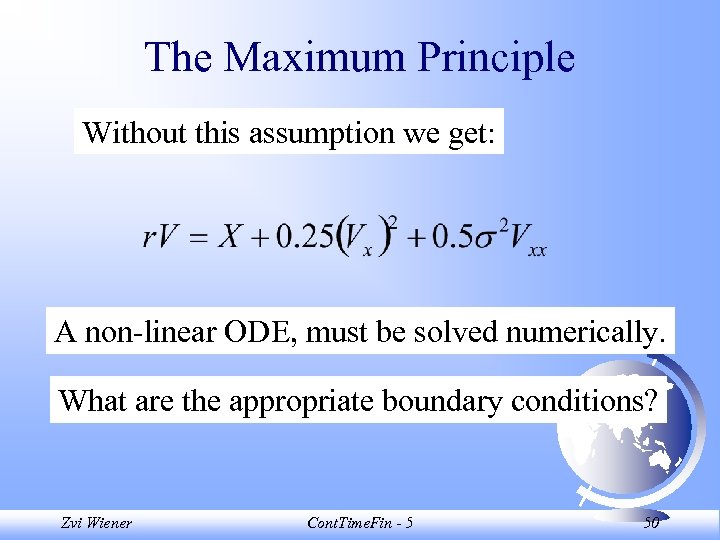 The Maximum Principle Without this assumption we get: A non-linear ODE, must be solved numerically. What are the appropriate boundary conditions? Zvi Wiener Cont. Time. Fin - 5 50
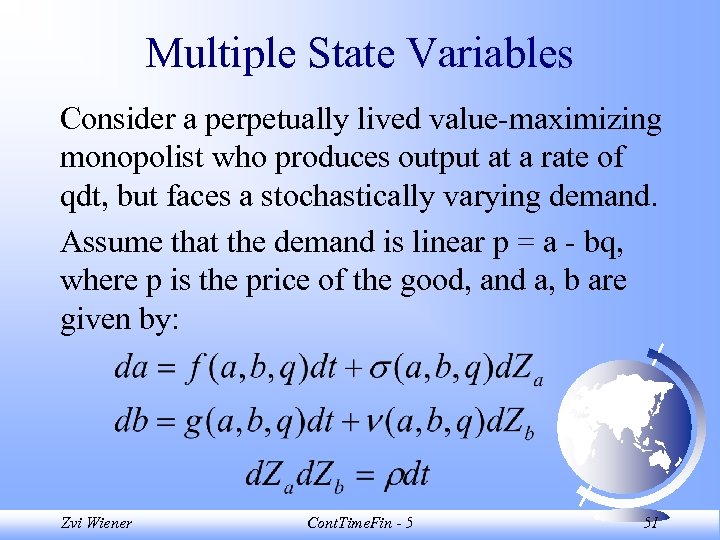 Multiple State Variables Consider a perpetually lived value-maximizing monopolist who produces output at a rate of qdt, but faces a stochastically varying demand. Assume that the demand is linear p = a - bq, where p is the price of the good, and a, b are given by: Zvi Wiener Cont. Time. Fin - 5 51
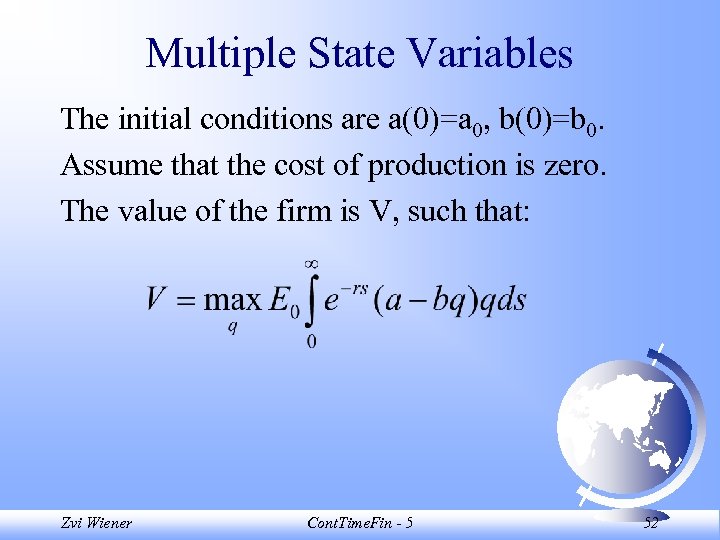 Multiple State Variables The initial conditions are a(0)=a 0, b(0)=b 0. Assume that the cost of production is zero. The value of the firm is V, such that: Zvi Wiener Cont. Time. Fin - 5 52
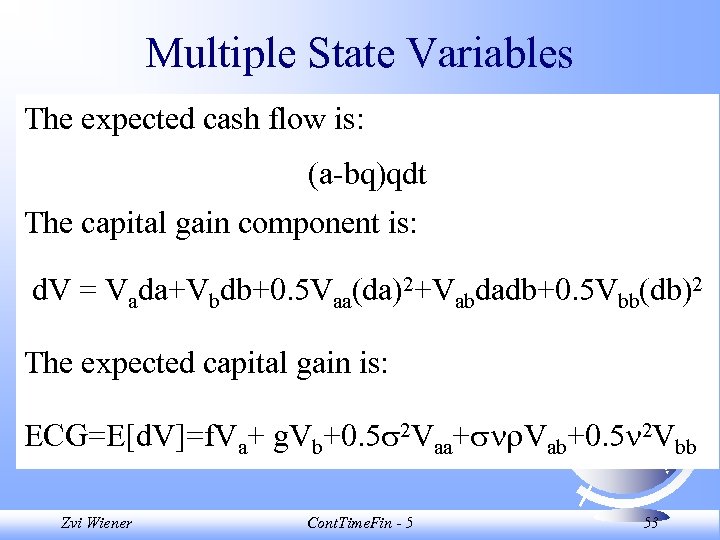 Multiple State Variables The expected cash flow is: (a-bq)qdt The capital gain component is: d. V = Vada+Vbdb+0. 5 Vaa(da)2+Vabdadb+0. 5 Vbb(db)2 The expected capital gain is: ECG=E[d. V]=f. Va+ g. Vb+0. 5 2 Vaa+ Vab+0. 5 2 Vbb Zvi Wiener Cont. Time. Fin - 5 53
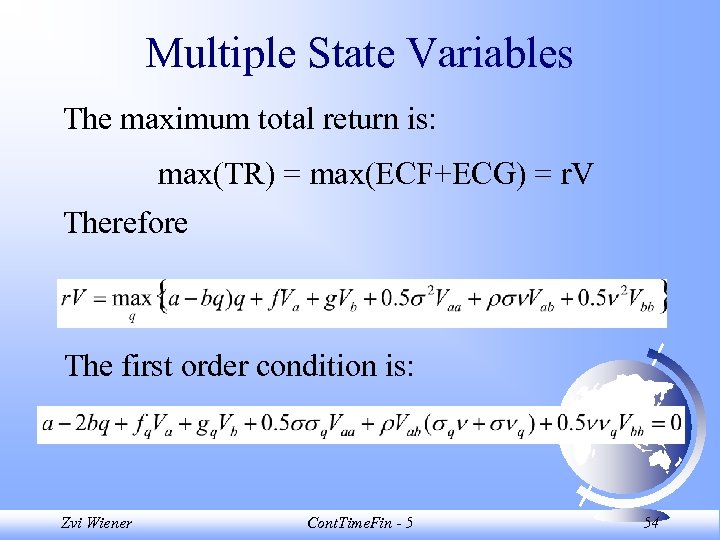 Multiple State Variables The maximum total return is: max(TR) = max(ECF+ECG) = r. V Therefore The first order condition is: Zvi Wiener Cont. Time. Fin - 5 54
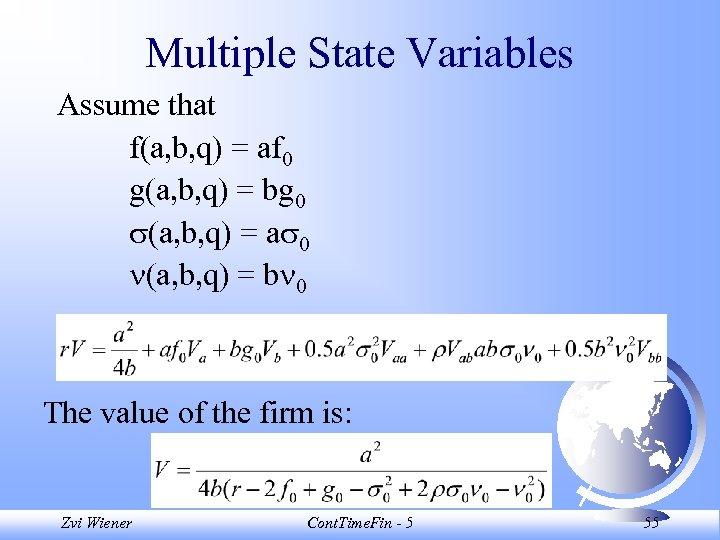 Multiple State Variables Assume that f(a, b, q) = af 0 g(a, b, q) = bg 0 (a, b, q) = a 0 (a, b, q) = b 0 The value of the firm is: Zvi Wiener Cont. Time. Fin - 5 55
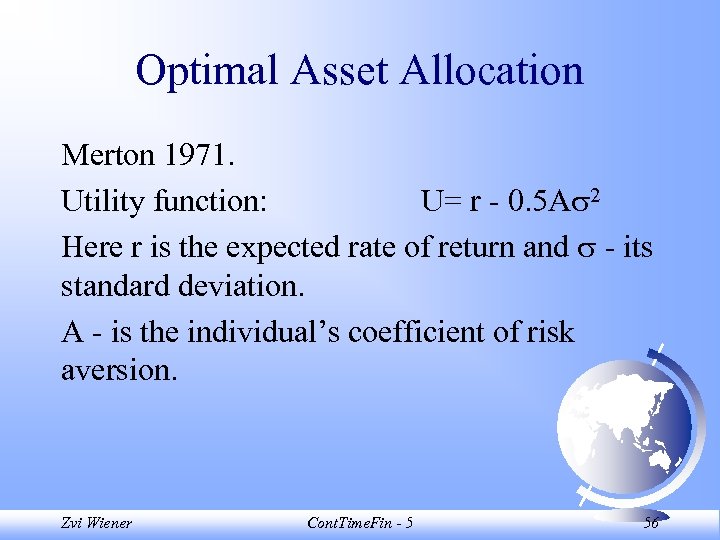 Optimal Asset Allocation Merton 1971. Utility function: U= r - 0. 5 A 2 Here r is the expected rate of return and - its standard deviation. A - is the individual’s coefficient of risk aversion. Zvi Wiener Cont. Time. Fin - 5 56
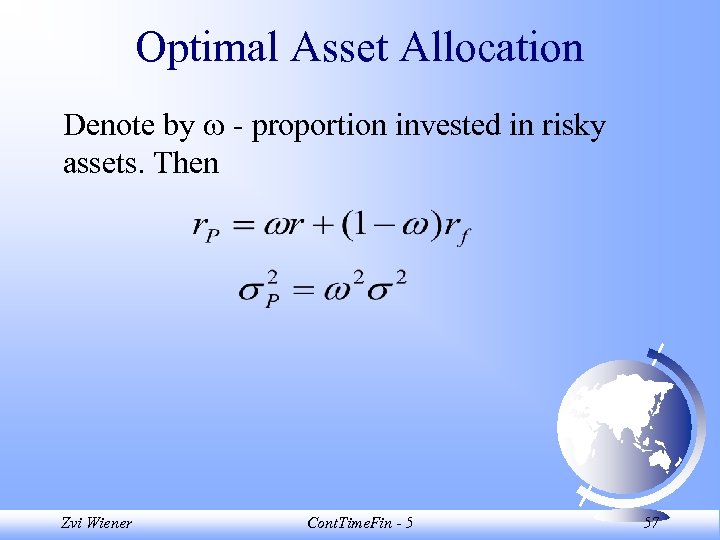 Optimal Asset Allocation Denote by - proportion invested in risky assets. Then Zvi Wiener Cont. Time. Fin - 5 57
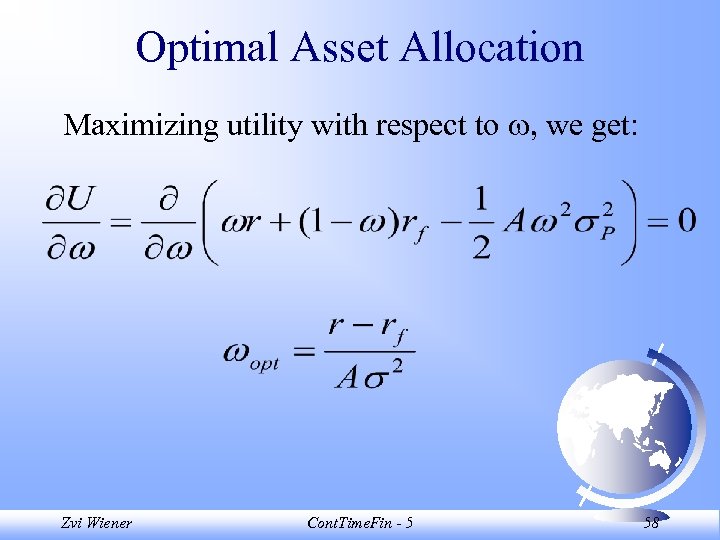 Optimal Asset Allocation Maximizing utility with respect to , we get: Zvi Wiener Cont. Time. Fin - 5 58
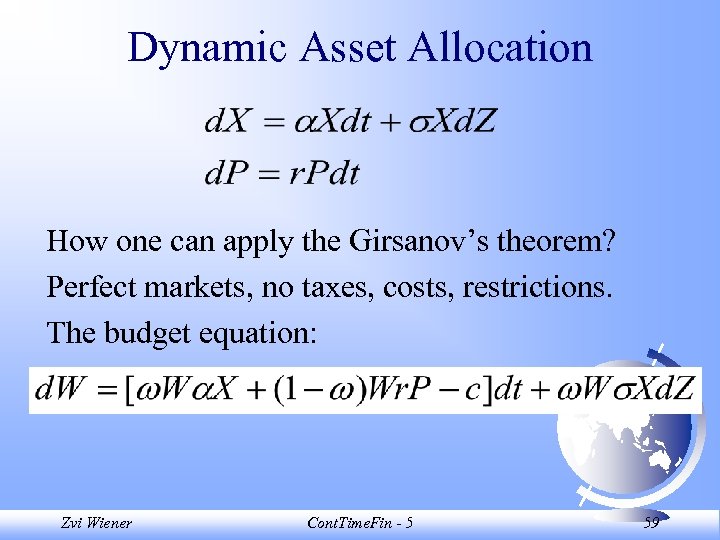 Dynamic Asset Allocation How one can apply the Girsanov’s theorem? Perfect markets, no taxes, costs, restrictions. The budget equation: Zvi Wiener Cont. Time. Fin - 5 59
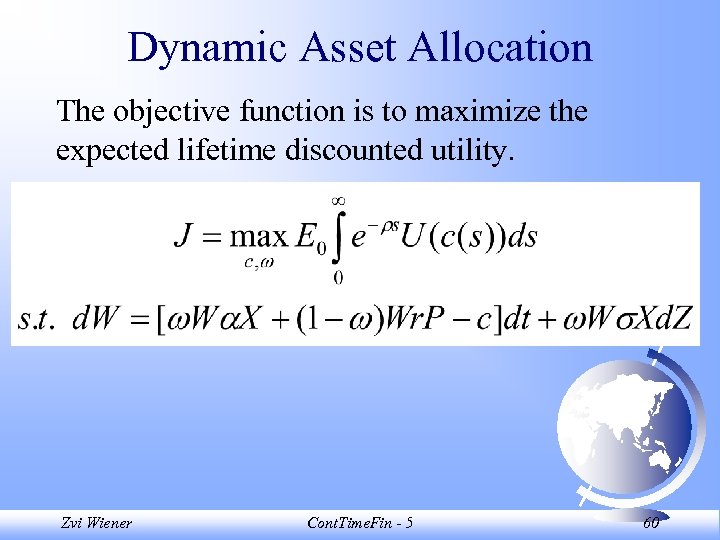 Dynamic Asset Allocation The objective function is to maximize the expected lifetime discounted utility. Zvi Wiener Cont. Time. Fin - 5 60
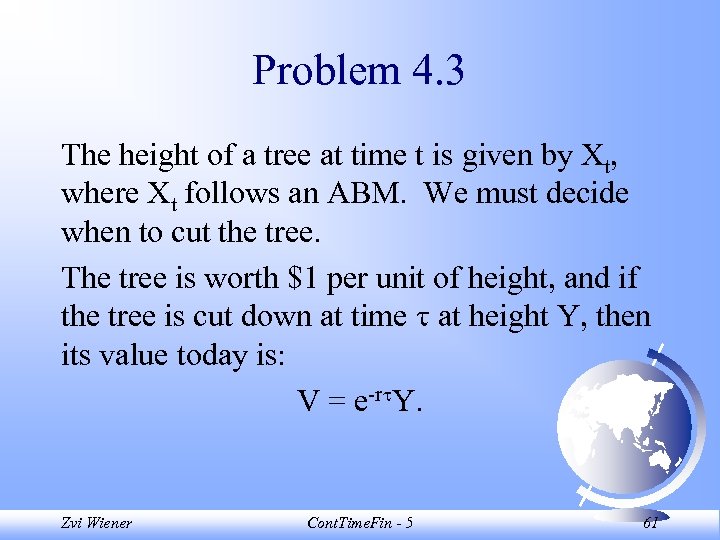 Problem 4. 3 The height of a tree at time t is given by Xt, where Xt follows an ABM. We must decide when to cut the tree. The tree is worth $1 per unit of height, and if the tree is cut down at time at height Y, then its value today is: V = e-r Y. Zvi Wiener Cont. Time. Fin - 5 61
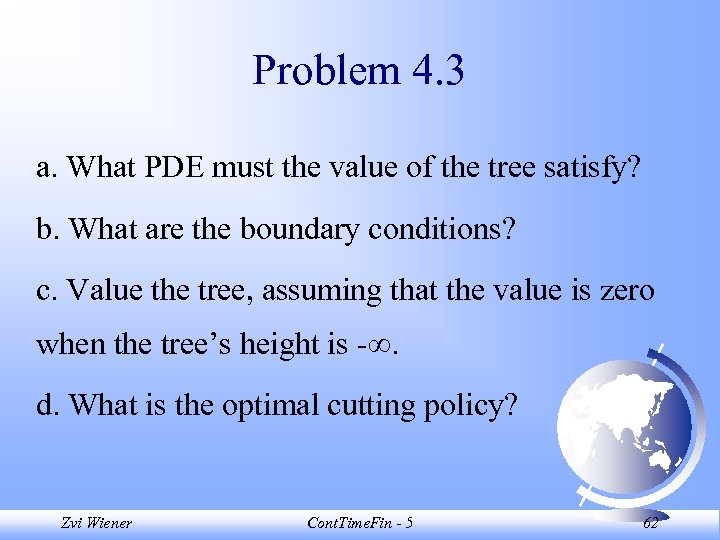 Problem 4. 3 a. What PDE must the value of the tree satisfy? b. What are the boundary conditions? c. Value the tree, assuming that the value is zero when the tree’s height is -. d. What is the optimal cutting policy? Zvi Wiener Cont. Time. Fin - 5 62