


 Скачать презентацию Financial Crisis Your Asset Allocation Strategy Developed
50bf20947ba3217611acce20b50267fd.ppt
- Количество слайдов: 57
 Financial Crisis & Your Asset Allocation Strategy Developed by Barbara O’Neill, Ph. D. , CFP, Rutgers Cooperative Extension Adapted by Jean Lown, Ph. D. Family, Consumer & Human Development, USU November 12, 2008
 Overview Financial Crisis l Asset Allocation Principles l Risk-Return Relationship l Application to TIAA-CREF Retirement Investment Options » 9 new investment choices (as of 2003) l TIAA-CREF vs. Fidelity l Taking Action l 2
 Worldwide Market Meltdown l l l Worst $ crisis since Depression Nowhere to hide » Stocks & Bonds » Domestic & foreign » Real estate, too Should you sell? » Buy low & sell high » Market timing doesn’t work 3
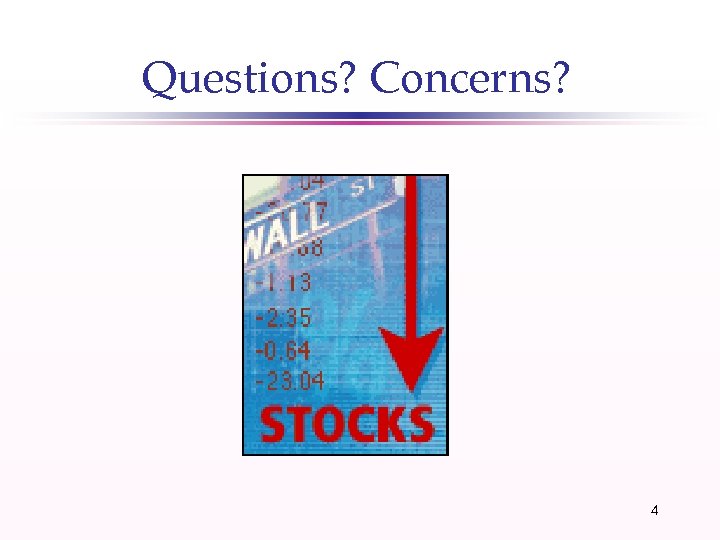 Questions? Concerns? 4
 Basic Investment Principles Diversification l Asset Allocation l Market volatility l Time horizon » Retirement v. life span l 5
 Investment Goals? 6
 Asset Allocation l Diversifying portfolio multiple investment categories to reduce investment risk l Ex: 50% stock, 30% bonds, 20% cash assets (e. g. , Treasury bills) l Lower risk by reducing volatility l Loss in one investment offset by gains in another 7
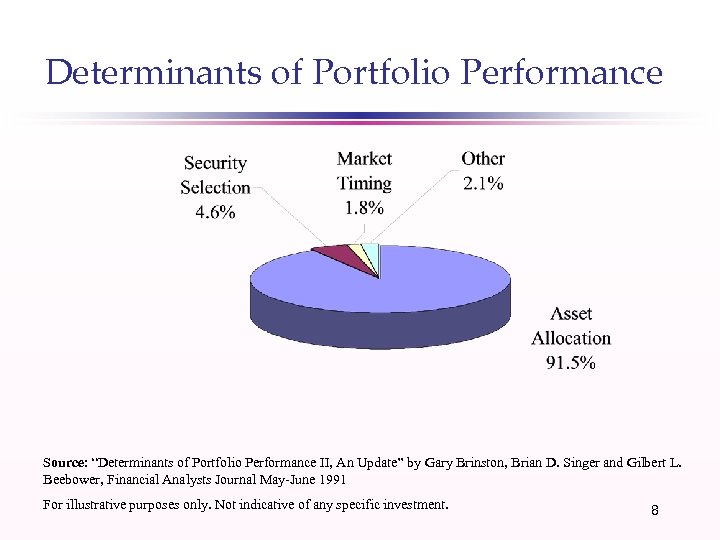 Determinants of Portfolio Performance Source: “Determinants of Portfolio Performance II, An Update” by Gary Brinston, Brian D. Singer and Gilbert L. Beebower, Financial Analysts Journal May-June 1991 For illustrative purposes only. Not indicative of any specific investment. 8
 Callan Periodic Table of Investment Returns l http: //www. callan. com/research/institute/ periodic/ l Benefits of asset allocation l 20 years asset class performance l Best performing asset class changes l This year’s “winner” = next year’s “loser” l Invest in them all 9
 Market Timing is Futile l $100 invested in large company stocks (S&P 500 index): June 1980 - June 2000 » » l $2, 456 IF invested entire time $613 if you missed the best 15 months Biggest market gains concentrated in short periods 10
 More Market Timing Futility l S&P 500 stock market index 1998 -2000 l If investor stayed fully invested: 41. 4% return l If investor missed top 10 trading days of 1998, 1999, & 2000: - 41. 7% return l Stay invested in both bull & bear markets 11
 Importance of Asset Allocation Asset allocation is the MOST important decision an investor makes (i. e. , buying some stock, NOT Coke versus Pepsi) l Asset allocation determines about 90% of the return variation between portfolios l Study repeated numerous times by different researchers with similar results l 12
 Why Use Asset Allocation? To Increase Long Term Investment Results l Scenario #1: $100, 000 invested at 8% over 25 years grows to $684, 848 l Scenario #2: $100, 000 divided equally among 5 investments: » One loses principal; other 4 earn 0%, 5%, 10%, and 15% average annual returns » Diversified portfolio = $962, 800 over 25 years 13
 Factors to Consider l Investment objective (e. g. , retirement) l Time horizon (e. g. , life expectancy for retirement) l Amount of money you have to invest l Your risk tolerance and experience » Caution about risk tests! 14
 Downside of Asset Allocation l In short run… diversified portfolio MAY generate lower return compared to a “hot” asset class (e. g. , growth stocks from 1995 -99) BUT l No one knows the next “hot” asset class (i. e. , Callan table) l Asset allocation reduces volatility to provide a competitive rate of return 15
 Major Asset Classes l l Stocks » Large company growth & value » Mid cap growth & value » Small growth & value » International Real estate (e. g. , REITs) l Bonds » Domestic » International » Corporate » Municipal l Cash (CDs, I-bonds, MMMFs, Treasury bills) 16
 Stock Capitalization l Large Cap companies: valued at >$5 billion » l Mid-Cap: $1 -5 billion » l Exxon. Mobil, General Electric, Microsoft Bath & Beyond, Monsanto, Hilton Hotels Small-Cap: <$1 billion » Earthlink, First. Fed Financial, Vintage Petroleum 17
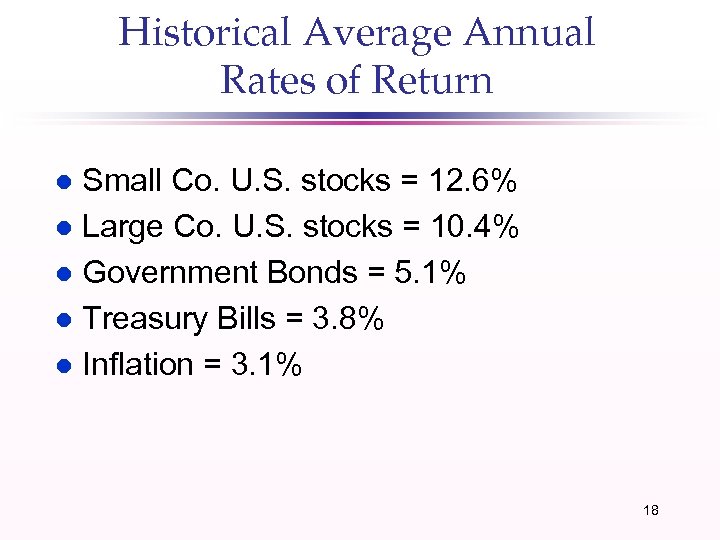 Historical Average Annual Rates of Return Small Co. U. S. stocks = 12. 6% l Large Co. U. S. stocks = 10. 4% l Government Bonds = 5. 1% l Treasury Bills = 3. 8% l Inflation = 3. 1% l 18
 Why Invest Internationally? l l l Low correlation among world markets » (e. g. , U. S. & foreign stocks) World markets (especially small companies) are driven by local dynamics Investing in U. S. multinationals does not deliver the same level of diversification Benefits of diversification outweigh currency, market, & political risks U. S. : <1/3 of the world’s stock markets » Big 4: BRIC 19
 Asset Allocation Process l Define goals and time horizon l Assess your risk tolerance l Identify asset mix of current portfolio l Create target portfolio (asset model) l Select specific investments l Review and rebalance portfolio yearly 20
 Other Things to Know About Asset Allocation l Portfolio risk decreases as the # of asset classes increases Best results are achieved over time l Diversify holdings within each asset category » Stock: different industry sectors l » Bonds: different types and maturities 21
 More Asset Allocation Tips l Stick to your asset allocation model unless personal circumstances change l Rebalance when asset percentages change by a certain amount (e. g. , 2%) or yearly (automatic rebalancing) l No one sector > 10%- 30% 22
 Risk-Return Relationship Low risk = low return l High risk = possibility of high return l Risk: chance of loss of principal in the short run » 2000 -2003 U. S. stocks lost 49% (after incredible run-up in prices in 1990 s) » October 2007 to Oct 2008 lost 40%+ l 23
 Stocks are Risky in Short Run Very volatile in sort run (1 -5 years) » annual returns -50% to +50%!! » 2003 was a great year to buy stocks when all news was gloom & doom » Today is buying opportunity l Large Co. U. S. stocks = 10. 7% (avg. returns since 1926) l 24
 “Safe” Investments are Risky in the Long Run Inflation = 3. 1% l Government Bonds = 5. 1% -3. 1% = 2% l Treasury Bills = 3. 8% - 3. 1% = 0. 7% l Subtract the impact of taxes » ‘safe’ investments = negative returns l You will not reach long term goals l 25
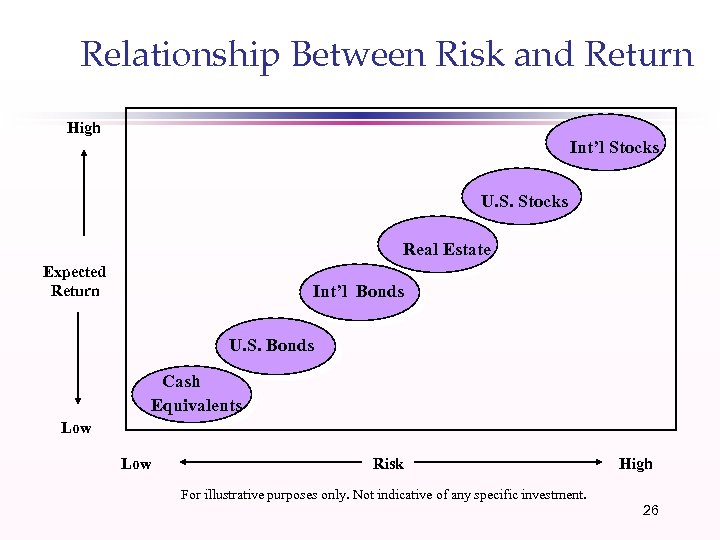 Relationship Between Risk and Return High Int’l Stocks U. S. Stocks Real Estate Expected Return Int’l Bonds U. S. Bonds Cash Equivalents Low Risk High For illustrative purposes only. Not indicative of any specific investment. 26
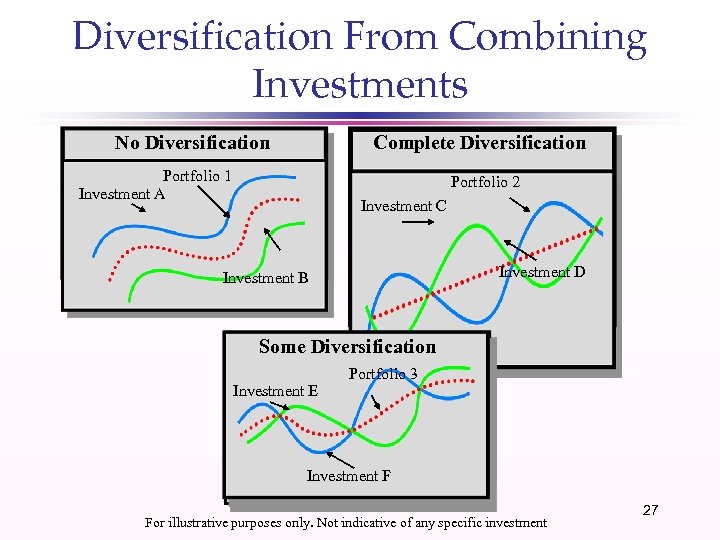 Diversification From Combining Investments No Diversification Complete Diversification Portfolio 1 Investment A Portfolio 2 Investment C Investment D Investment B Some Diversification Investment E Portfolio 3 Investment F For illustrative purposes only. Not indicative of any specific investment 27
 2000 -2003 was a gut check Thank goodness some of my portfolio was in bonds & real estate! » Stocks tanked » Bonds held steady » Real estate saved the day l Here we go again! l 28
 Invest for Growth There is no such thing as a risk-free investment! l Retirement $ must grow faster than inflation to provide financial security l Risk is relative » Short term volatility=long term growth » Diversified portfolio needs stocks for growth l 29
 Understand Risk Tolerance Beware of taking risk tests and settling for a conservative portfolio l Conservative investors risk outliving their assets l Life expectancy calculators » http: //www. ces. purdue. edu/retirement/ Module 1/module 1 b. html l 30
 Time Horizon for Retirement? Until the day you retire? l Until the day you die? l 31
 Envision your dream 32
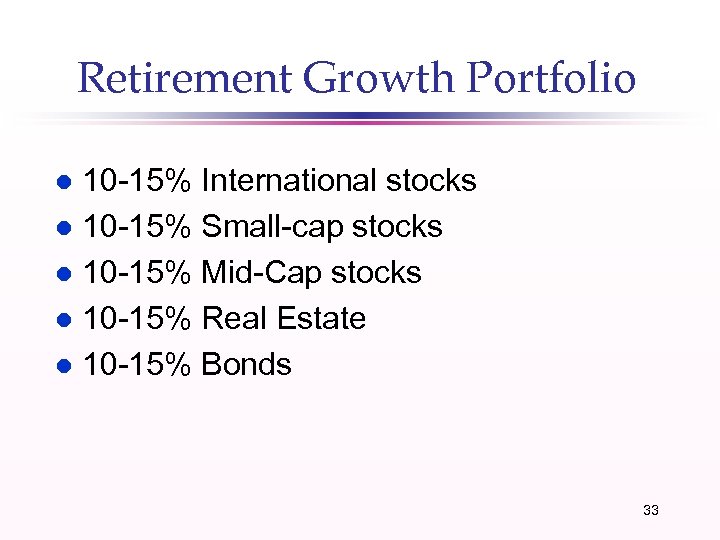 Retirement Growth Portfolio 10 -15% International stocks l 10 -15% Small-cap stocks l 10 -15% Mid-Cap stocks l 10 -15% Real Estate l 10 -15% Bonds l 33
 Tips For Funding a Tax. Deferred Employer Plan l Diversify across asset classes l Avoid market timing l Choose investments with solid historical performance » Past returns are NO guarantee for the future!! » <10 year track record is too short! Choose funds with low fees l 34
 Your “Action” List Review your current asset allocation l Consider your other retirement accounts l Use the TIAA-CREF web site » Risk tolerance quiz » Asset allocation calculators l Talk with a representative l Reallocate, Rebalance, Re-visit l 35
 Before You Decide Read the website l Understand the risks l Make careful choices l Don’t be afraid to change asset allocation » You can always change your mind l 36
 37
37
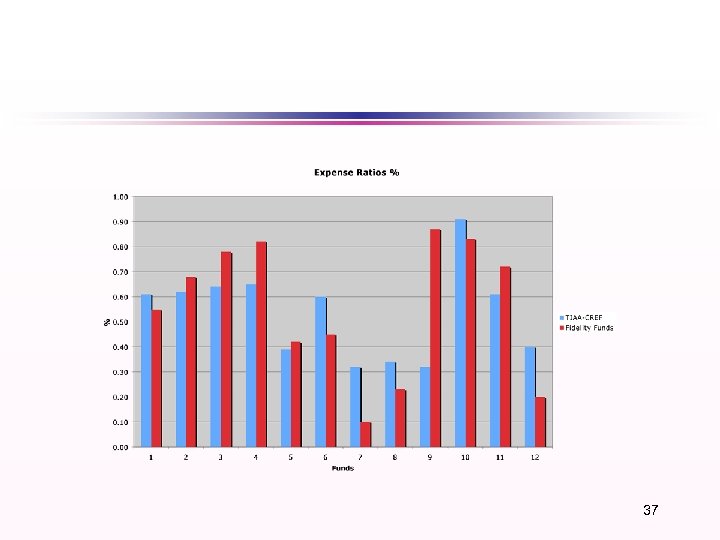
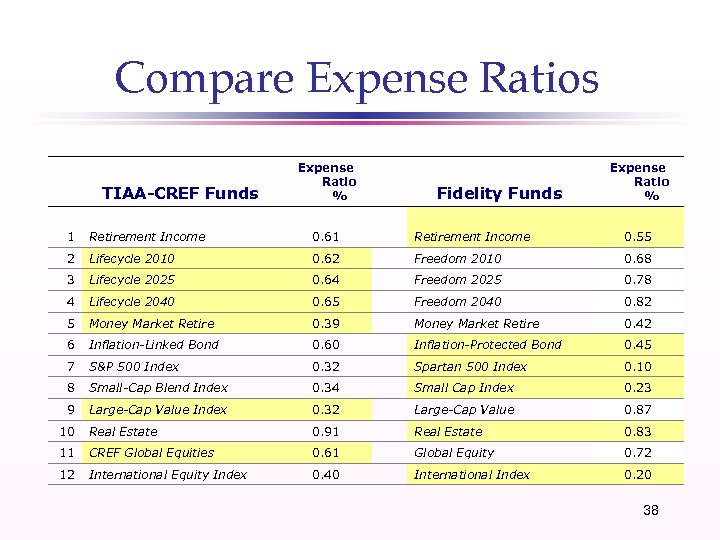 Compare Expense Ratios TIAA-CREF Funds Expense Ratio % 1 Retirement Income 0. 61 2 Lifecycle 2010 0. 62 3 Lifecycle 2025 4 Fidelity Funds Expense Ratio % Retirement Income 0. 55 Freedom 2010 0. 68 0. 64 Freedom 2025 0. 78 Lifecycle 2040 0. 65 Freedom 2040 0. 82 5 Money Market Retire 0. 39 Money Market Retire 0. 42 6 Inflation-Linked Bond 0. 60 Inflation-Protected Bond 0. 45 7 S&P 500 Index 0. 32 Spartan 500 Index 0. 10 8 Small-Cap Blend Index 0. 34 Small Cap Index 0. 23 9 Large-Cap Value Index 0. 32 Large-Cap Value 0. 87 10 Real Estate 0. 91 Real Estate 0. 83 11 CREF Global Equities 0. 61 Global Equity 0. 72 12 International Equity Index 0. 40 International Index 0. 20 38
 The Big Picture l Same principles can be applied to » 401(k) plans » Individual retirement accounts (IRAs) » Other retirement plans 39
 Key Considerations For Successful Investing l Establish policies and objectives l Stick to your plan and stay focused l Educate yourself to make informed decisions l Monitor investment performance l If you need help, seek a professional advisor 40
 Before You Decide Read the TIAA-CREF website l Understand risk l Make choices based on solid investment principles l Don’t be afraid of making mistakes; you can always change your asset allocation l 41
 Questions? Comments? Experiences? 42
 43
43
 5 TIAA-CREF Asset Classes Guaranteed (low risk; low return) l Fixed-Income (bonds) l Equities (stocks) » High return; volatile in the short run l Real Estate » Inflation protection; reduce volatility l Money Market (safe; low return) l 44
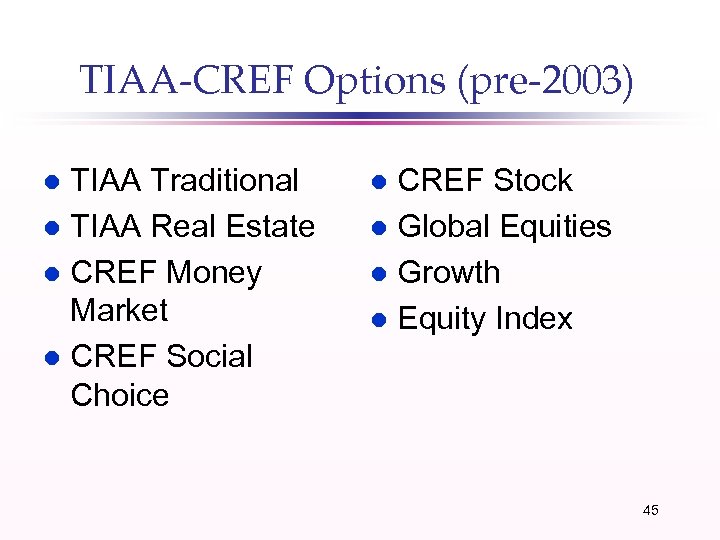 TIAA-CREF Options (pre-2003) TIAA Traditional l TIAA Real Estate l CREF Money Market l CREF Social Choice l CREF Stock l Global Equities l Growth l Equity Index l 45
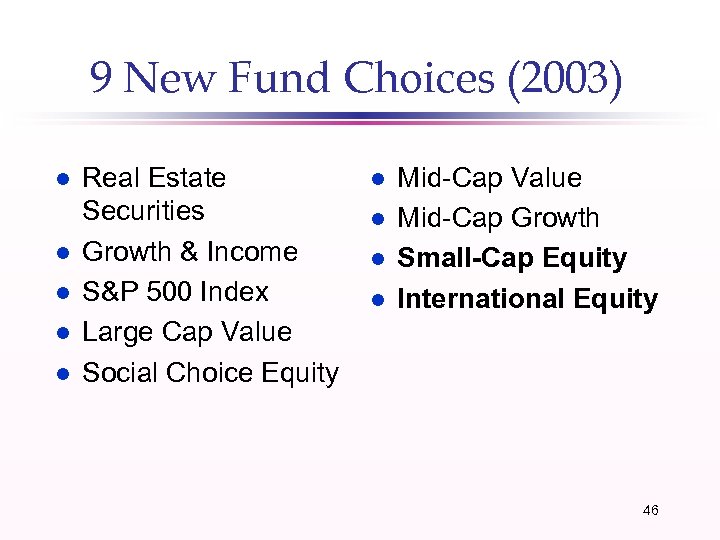 9 New Fund Choices (2003) l l l Real Estate Securities Growth & Income S&P 500 Index Large Cap Value Social Choice Equity l l Mid-Cap Value Mid-Cap Growth Small-Cap Equity International Equity 46
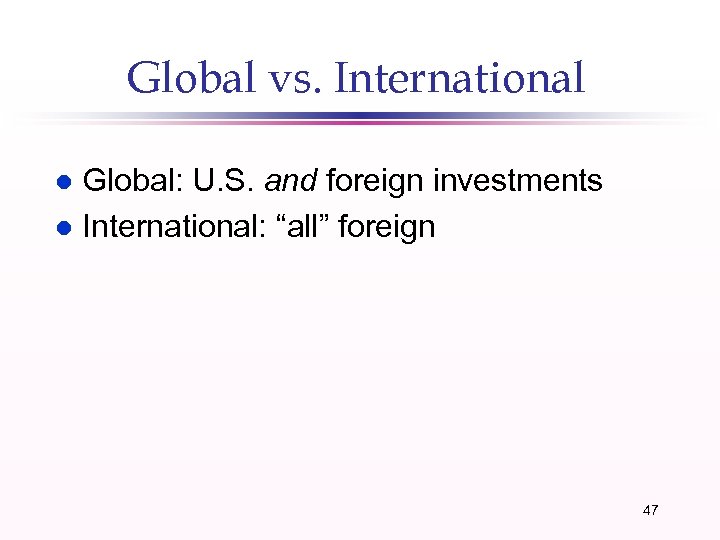 Global vs. International Global: U. S. and foreign investments l International: “all” foreign l 47
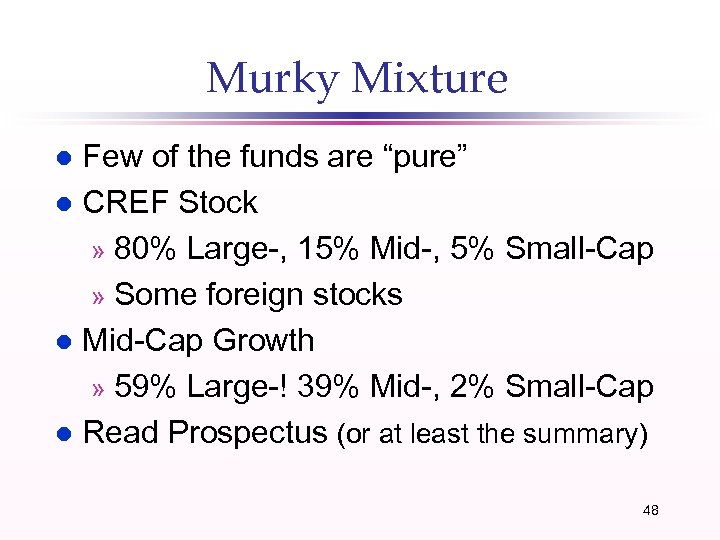 Murky Mixture Few of the funds are “pure” l CREF Stock » 80% Large-, 15% Mid-, 5% Small-Cap » Some foreign stocks l Mid-Cap Growth » 59% Large-! 39% Mid-, 2% Small-Cap l Read Prospectus (or at least the summary) l 48
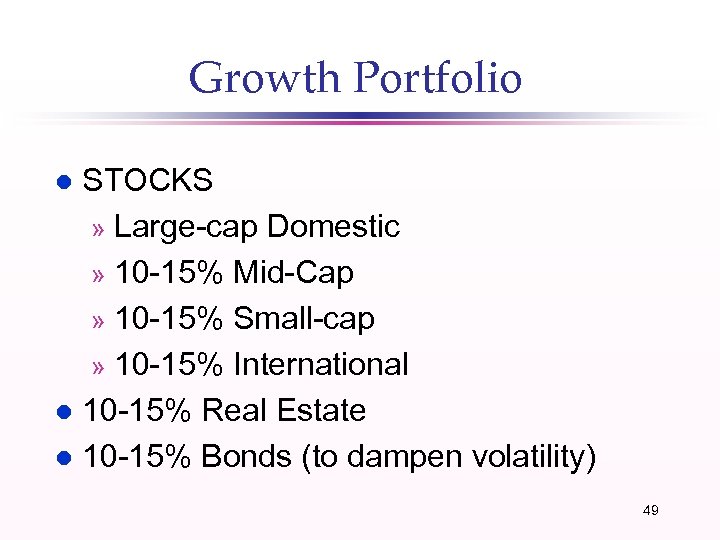 Growth Portfolio STOCKS » Large-cap Domestic » 10 -15% Mid-Cap » 10 -15% Small-cap » 10 -15% International l 10 -15% Real Estate l 10 -15% Bonds (to dampen volatility) l 49
 Adjusting Your Allocation You can change future allocations l You can transfer current balances among funds l Use TIAA-CREF. org web site l Sign up for automatic rebalancing l 50
 Tips for Allocating Your Retirement Contributions l Diversify across asset classes » Stocks, bonds, real estate l Avoid market timing l Choose investments with strong historical performance (stocks) » >10 year track record 51
 The Big Picture Same principles can be applied to » 401(k) plans » Individual retirement accounts (IRAs) » Other retirement plans l Past returns are NO guarantee for the future!! l 5 -10 year track record for a specific investment is too short. l 52
 Key Considerations For Successful Investing l Establish policies and objectives l Stick to your plan and stay focused l Educate yourself to make informed decisions l Monitor investment performance l If you need help, seek a professional advisor 53
 Your “Action” List Review your current asset allocation l Consider your other retirement accounts l Use the TIAA-CREF web site » Risk tolerance quiz » Asset allocation calculators l Talk with a representative l Reallocate, Rebalance, Re-visit l 54
 Before You Decide Read the website l Understand the risks l Make careful choices l You can always change your mind so don’t be afraid to change your asset allocation. l 55
 Financial Planning for Women No December meeting l Topics for 2009? l send email to Jean. Lown@usu. edu l 56
 Questions? Comments? Experiences? 57