 Скачать презентацию Financial Attitudes Beliefs Behaviors Of College Students
f1e076f716db5d1160fa04e5e1c67fa0.ppt
- Количество слайдов: 42



Financial Attitudes, Beliefs & Behaviors Of College Students Copyright. 1997, Dr. T. K. Hira, Professor ISU 1
Our personal financial situations u Are often better reflections of who we are internally than of who we seem to be on the outside u Our money behavior reflects our self-worth which was shaped by our childhood Copyright. 1997, Dr. T. K. Hira, Professor ISU 2
What causes excessive behaviors? u No single factor is sufficiently powerful enough to explain excessive behaviors u Multidimensional factors influence excessive behavior: – psychological, – social, – cultural, – environmental: » economic, market, credit. Copyright. 1997, Dr. T. K. Hira, Professor ISU 3
Credit Environment: past & present u Debt vs. credit u Credit Use – Purpose: production/consumption – attitudes: decades of instant gratification u Credit Industry – numerous products - credit cards – technology – high risk lending Copyright. 1997, Dr. T. K. Hira, Professor ISU 4
Need for research u there has been little research on when and how one acquires knowledge of money and the economic system in general or the degree to which family influence carries over into consumption activities as adults (Abramovitch, et al. , 1991). Copyright. 1997, Dr. T. K. Hira, Professor ISU 5
Previous studies u Credit use and payment practices u Trends and amounts of student loans u Financial socialization in the family u Personal finance knowledge Copyright. 1997, Dr. T. K. Hira, Professor ISU 6
Objectives. . to understand. . u Childhood experiences with money u Sources of influence on their financial behavior u Current spending patterns, u Use of credit: credit cards, student loans and other consumer debt, u Ability to handle debt repayment responsibility in the future u Feelings about current debt u Need for more information Copyright. 1997, Dr. T. K. Hira, Professor ISU 7
Samples and Data collection u Random sample - in Spring ‘ 97 – 2000 selected – 665 completed the questionnaire – a response rate of 34 percent u Convenient sample -Fall ‘ 96) – 442 seniors – During student loan exit interview Copyright. 1997, Dr. T. K. Hira, Professor ISU 8
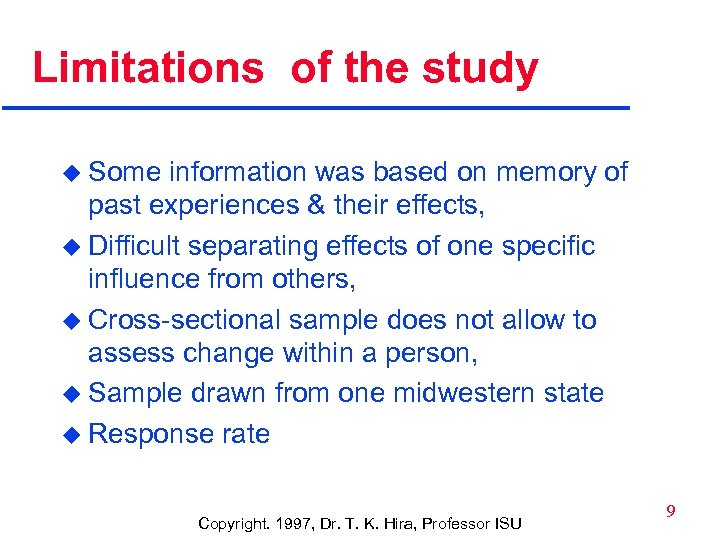
Limitations of the study u Some information was based on memory of past experiences & their effects, u Difficult separating effects of one specific influence from others, u Cross-sectional sample does not allow to assess change within a person, u Sample drawn from one midwestern state u Response rate Copyright. 1997, Dr. T. K. Hira, Professor ISU 9
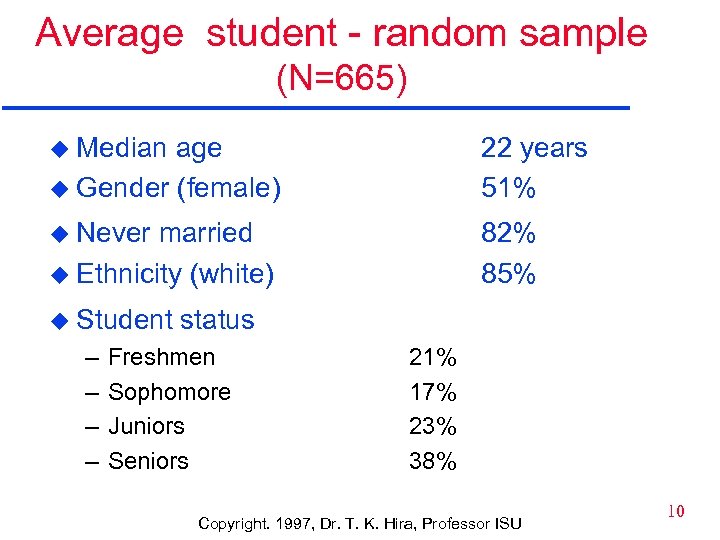
Average student - random sample (N=665) u Median age u Gender (female) 22 years 51% u Never 82% 85% married u Ethnicity (white) u Student – – status Freshmen Sophomore Juniors Seniors 21% 17% 23% 38% Copyright. 1997, Dr. T. K. Hira, Professor ISU 10
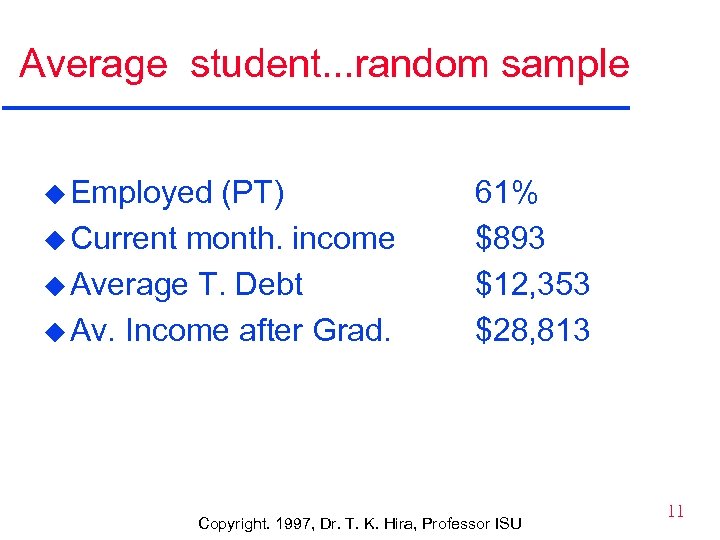
Average student. . . random sample u Employed (PT) u Current month. income u Average T. Debt u Av. Income after Grad. 61% $893 $12, 353 $28, 813 Copyright. 1997, Dr. T. K. Hira, Professor ISU 11
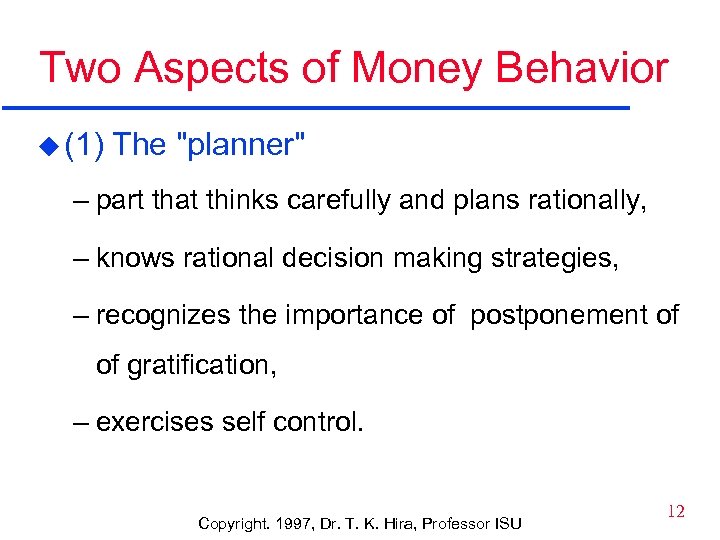
Two Aspects of Money Behavior u (1) The "planner" – part that thinks carefully and plans rationally, – knows rational decision making strategies, – recognizes the importance of postponement of of gratification, – exercises self control. Copyright. 1997, Dr. T. K. Hira, Professor ISU 12
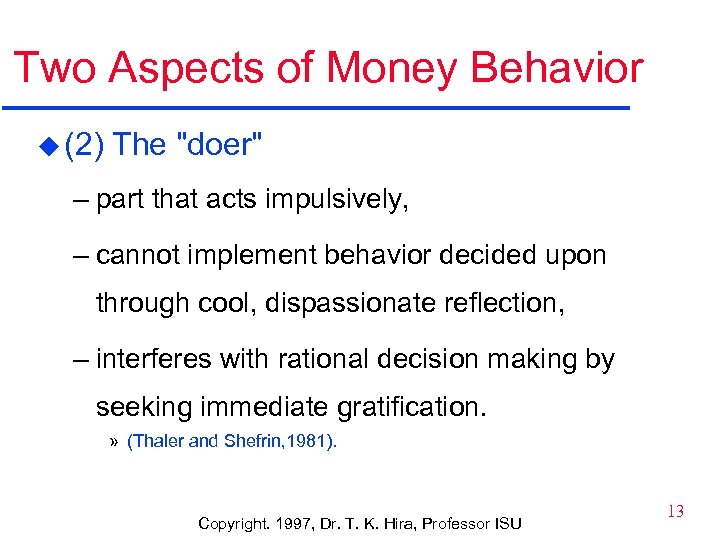
Two Aspects of Money Behavior u (2) The "doer" – part that acts impulsively, – cannot implement behavior decided upon through cool, dispassionate reflection, – interferes with rational decision making by seeking immediate gratification. » (Thaler and Shefrin, 1981). Copyright. 1997, Dr. T. K. Hira, Professor ISU 13
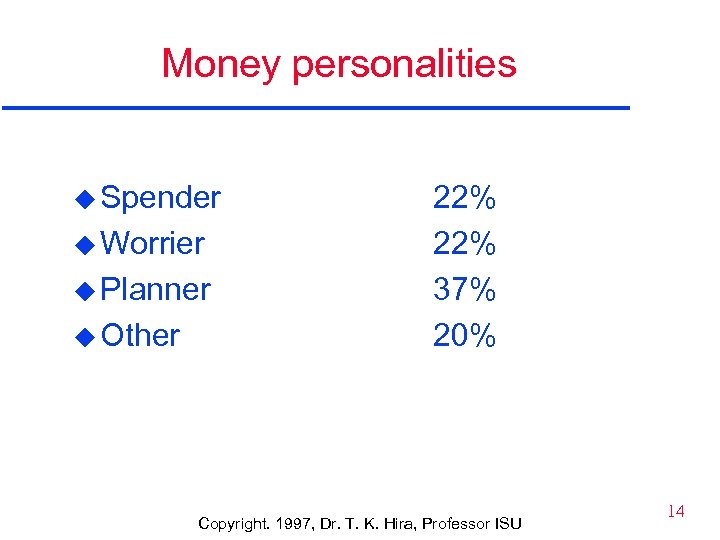
Money personalities u Spender u Worrier u Planner u Other 22% 37% 20% Copyright. 1997, Dr. T. K. Hira, Professor ISU 14
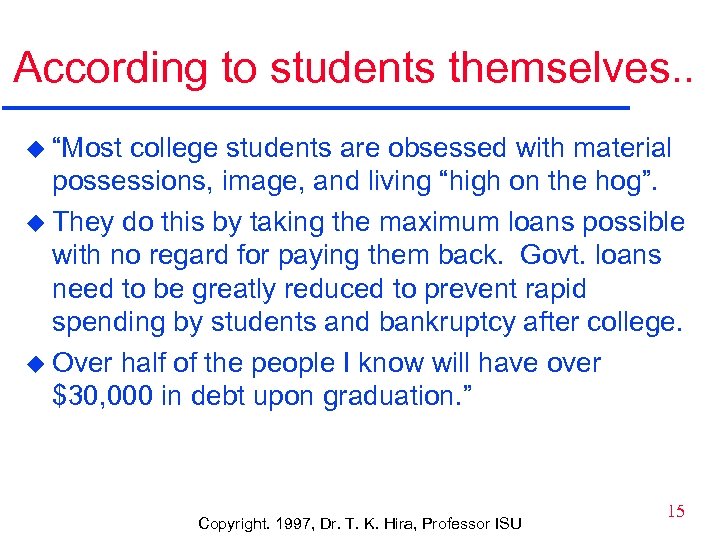
According to students themselves. . u “Most college students are obsessed with material possessions, image, and living “high on the hog”. u They do this by taking the maximum loans possible with no regard for paying them back. Govt. loans need to be greatly reduced to prevent rapid spending by students and bankruptcy after college. u Over half of the people I know will have over $30, 000 in debt upon graduation. ” Copyright. 1997, Dr. T. K. Hira, Professor ISU 15
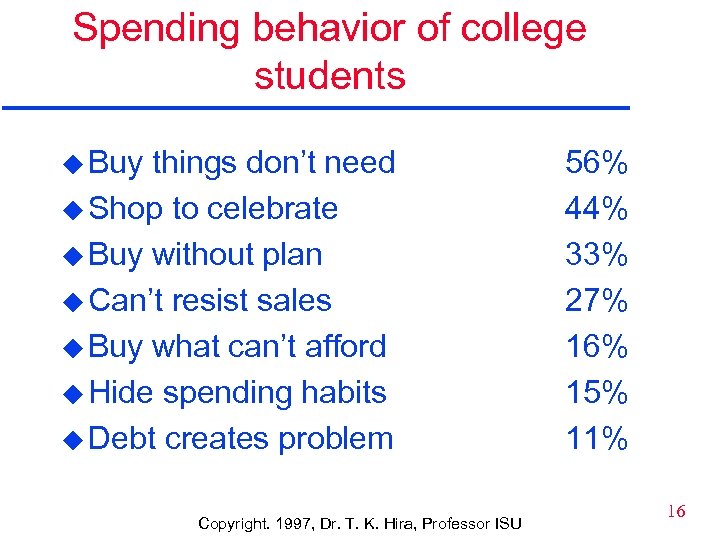
Spending behavior of college students u Buy things don’t need u Shop to celebrate u Buy without plan u Can’t resist sales u Buy what can’t afford u Hide spending habits u Debt creates problem Copyright. 1997, Dr. T. K. Hira, Professor ISU 56% 44% 33% 27% 16% 15% 11% 16
Compulsive buying behavior Lisa says. . . “Shopping fills an emptiness in my soul” Copyright. 1997, Dr. T. K. Hira, Professor ISU 17
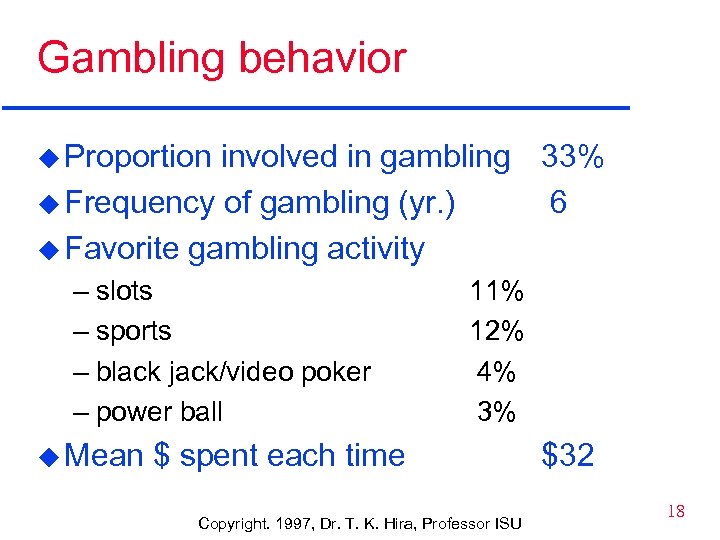
Gambling behavior u Proportion involved in gambling 33% u Frequency of gambling (yr. ) 6 u Favorite gambling activity – slots – sports – black jack/video poker – power ball u Mean 11% 12% 4% 3% $ spent each time Copyright. 1997, Dr. T. K. Hira, Professor ISU $32 18
Sources of influence on consumer behavior u Socialization agents have been classified into four categories on the basis of formality of the agent and learner type: – formal agents: family or school – informal agents: mass media or peers (Ward, 1973; Ward, 1974; Talmon, 1963). Copyright. 1997, Dr. T. K. Hira, Professor ISU 19
Your financial behavior u u Do you know your money personality? Who had the most influence on your money habits – Mom? u u u Dad? What are your strong and weak points when it comes to handling money? What steps have you taken to assure your financial security? What role does money play in your relationships to others? – friends --parents u u Others? --siblings --spouse How easy is it for you to talk to others about your money concerns? What is your most important money concern for the: – present and – the future? Copyright. 1997, Dr. T. K. Hira, Professor ISU 20
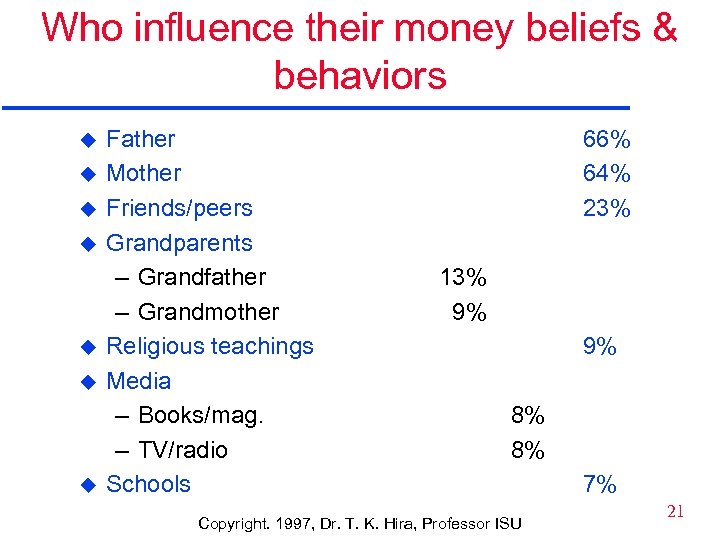
Who influence their money beliefs & behaviors u u u u Father Mother Friends/peers Grandparents – Grandfather – Grandmother Religious teachings Media – Books/mag. – TV/radio Schools 66% 64% 23% 13% 9% 9% 8% 8% Copyright. 1997, Dr. T. K. Hira, Professor ISU 7% 21
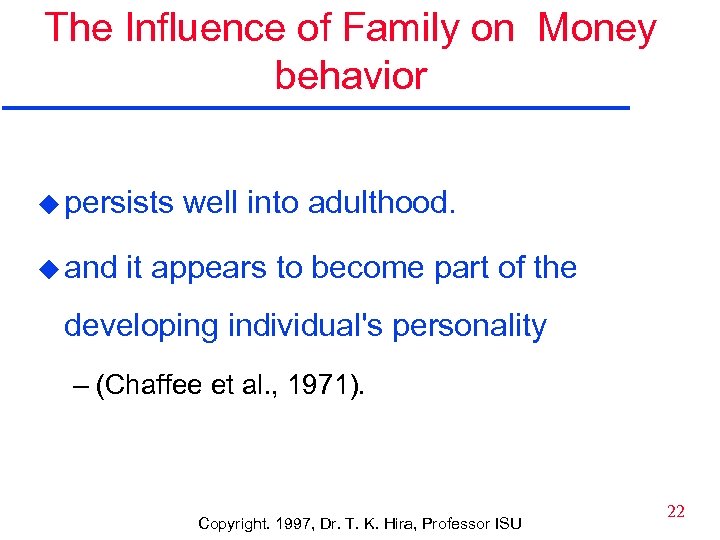
The Influence of Family on Money behavior u persists u and well into adulthood. it appears to become part of the developing individual's personality – (Chaffee et al. , 1971). Copyright. 1997, Dr. T. K. Hira, Professor ISU 22
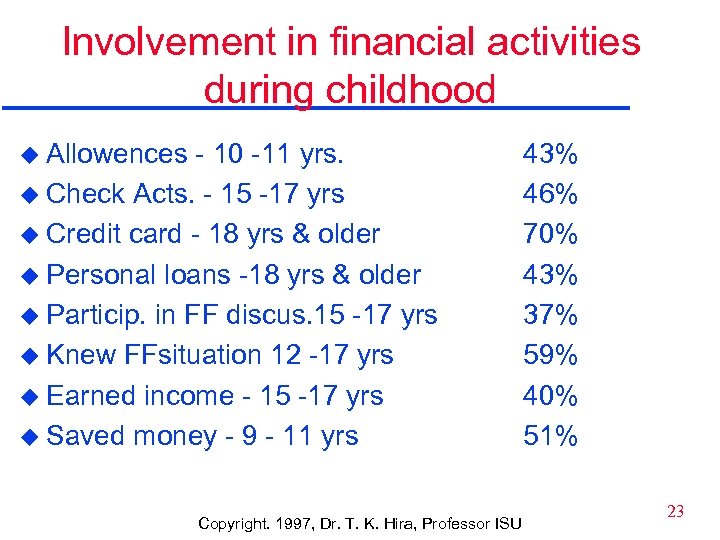
Involvement in financial activities during childhood u Allowences - 10 -11 yrs. u Check Acts. - 15 -17 yrs u Credit card - 18 yrs & older u Personal loans -18 yrs & older u Particip. in FF discus. 15 -17 yrs u Knew FFsituation 12 -17 yrs u Earned income - 15 -17 yrs u Saved money - 9 - 11 yrs Copyright. 1997, Dr. T. K. Hira, Professor ISU 43% 46% 70% 43% 37% 59% 40% 51% 23
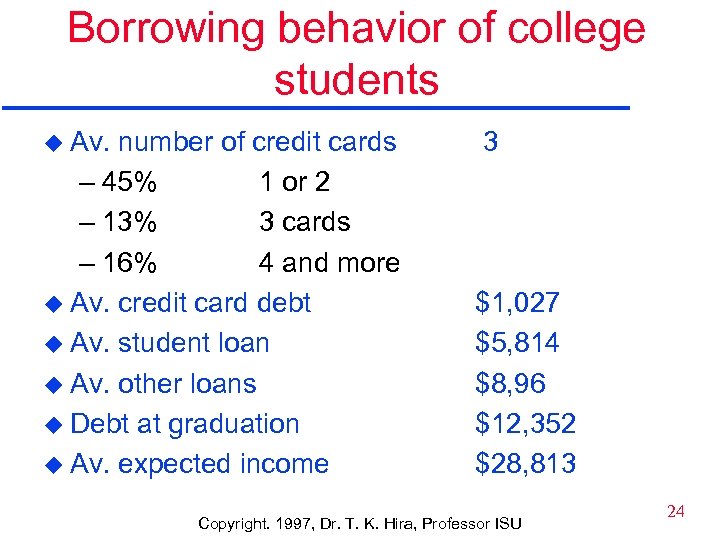
Borrowing behavior of college students u Av. number of credit cards – 45% 1 or 2 – 13% 3 cards – 16% 4 and more u Av. credit card debt u Av. student loan u Av. other loans u Debt at graduation u Av. expected income 3 $1, 027 $5, 814 $8, 96 $12, 352 $28, 813 Copyright. 1997, Dr. T. K. Hira, Professor ISU 24
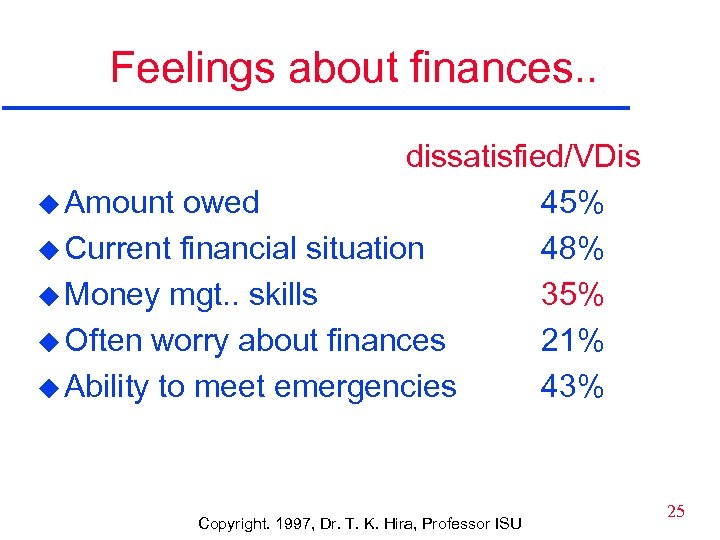
Feelings about finances. . dissatisfied/VDis u Amount owed 45% u Current financial situation 48% u Money mgt. . skills 35% u Often worry about finances 21% u Ability to meet emergencies 43% Copyright. 1997, Dr. T. K. Hira, Professor ISU 25
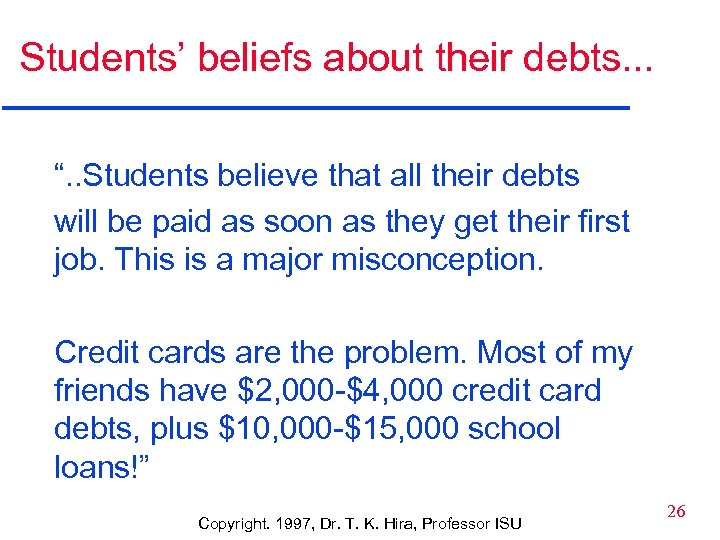
Students’ beliefs about their debts. . . “. . Students believe that all their debts will be paid as soon as they get their first job. This is a major misconception. Credit cards are the problem. Most of my friends have $2, 000 -$4, 000 credit card debts, plus $10, 000 -$15, 000 school loans!” Copyright. 1997, Dr. T. K. Hira, Professor ISU 26
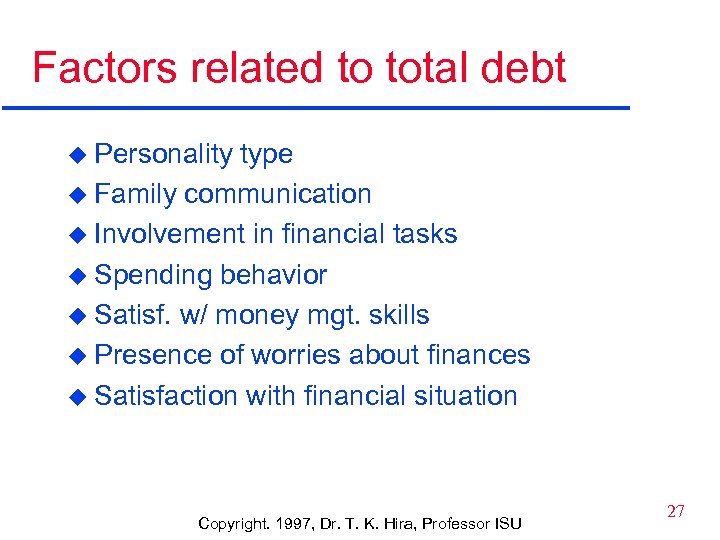
Factors related to total debt u Personality type u Family communication u Involvement in financial tasks u Spending behavior u Satisf. w/ money mgt. skills u Presence of worries about finances u Satisfaction with financial situation Copyright. 1997, Dr. T. K. Hira, Professor ISU 27
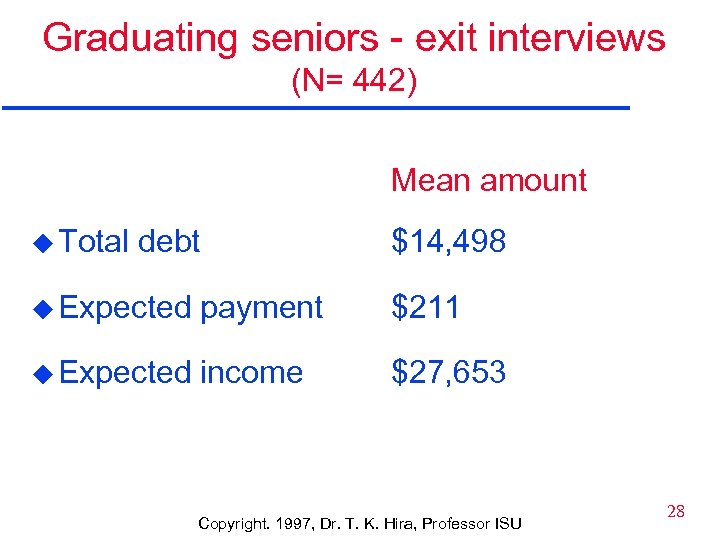
Graduating seniors - exit interviews (N= 442) Mean amount u Total debt $14, 498 u Expected payment $211 u Expected income $27, 653 Copyright. 1997, Dr. T. K. Hira, Professor ISU 28
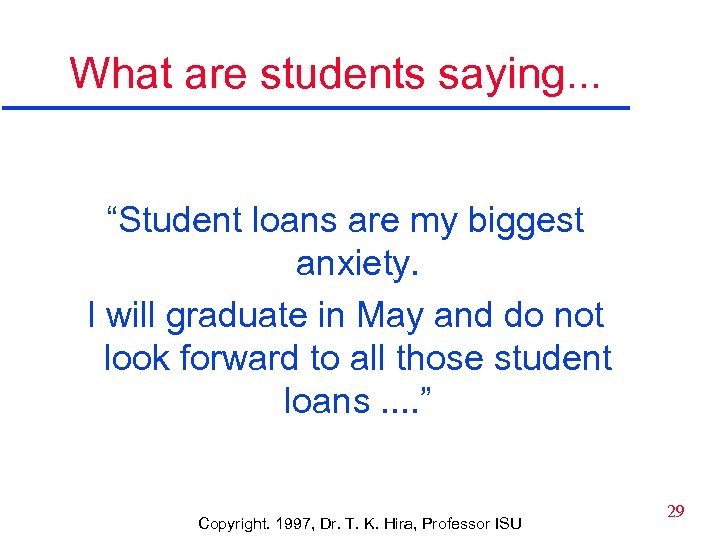
What are students saying. . . “Student loans are my biggest anxiety. I will graduate in May and do not look forward to all those student loans. . ” Copyright. 1997, Dr. T. K. Hira, Professor ISU 29
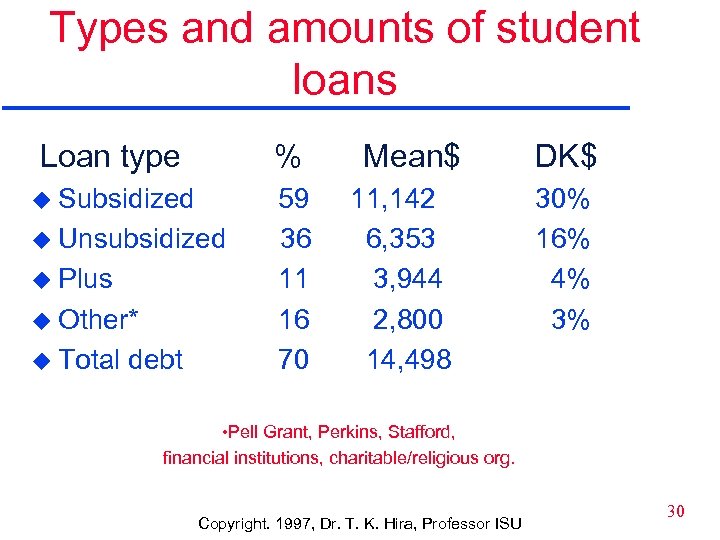
Types and amounts of student loans Loan type % u Subsidized u Unsubsidized u Plus u Other* u Total debt 59 36 11 16 70 Mean$ 11, 142 6, 353 3, 944 2, 800 14, 498 DK$ 30% 16% 4% 3% • Pell Grant, Perkins, Stafford, financial institutions, charitable/religious org. Copyright. 1997, Dr. T. K. Hira, Professor ISU 30
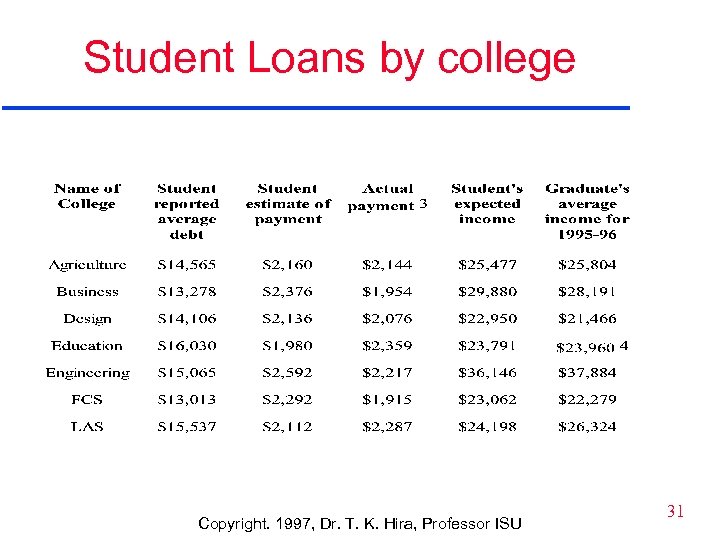
Student Loans by college Copyright. 1997, Dr. T. K. Hira, Professor ISU 31
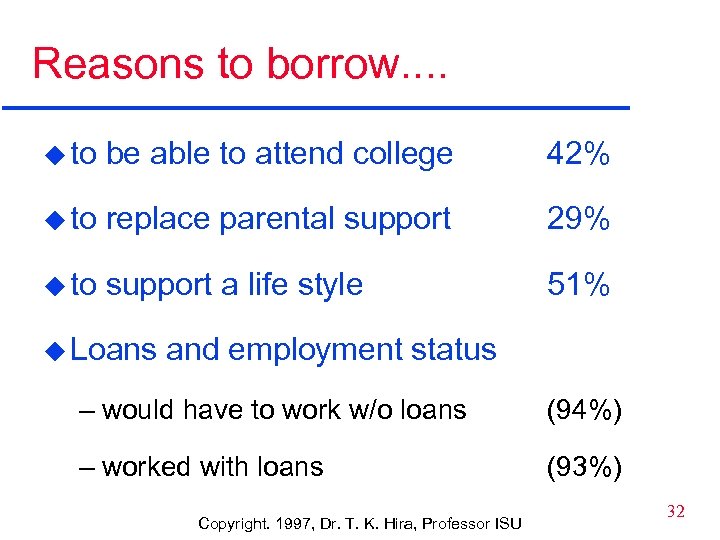
Reasons to borrow. . u to be able to attend college 42% u to replace parental support 29% u to support a life style 51% u Loans and employment status – would have to work w/o loans (94%) – worked with loans (93%) Copyright. 1997, Dr. T. K. Hira, Professor ISU 32
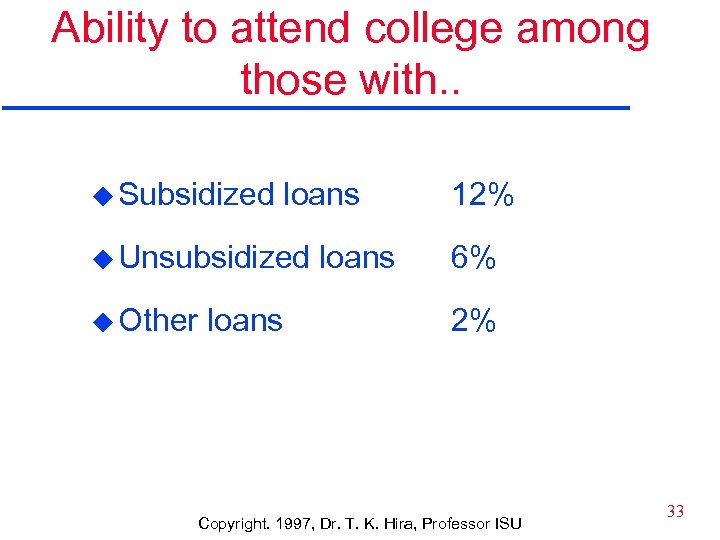
Ability to attend college among those with. . u Subsidized loans u Unsubsidized u Other loans 12% 6% 2% Copyright. 1997, Dr. T. K. Hira, Professor ISU 33
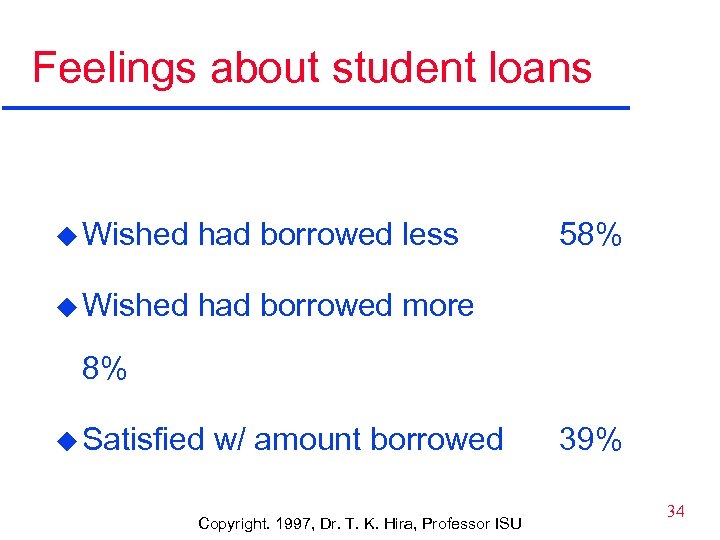
Feelings about student loans u Wished had borrowed less u Wished 58% had borrowed more 8% u Satisfied w/ amount borrowed Copyright. 1997, Dr. T. K. Hira, Professor ISU 39% 34
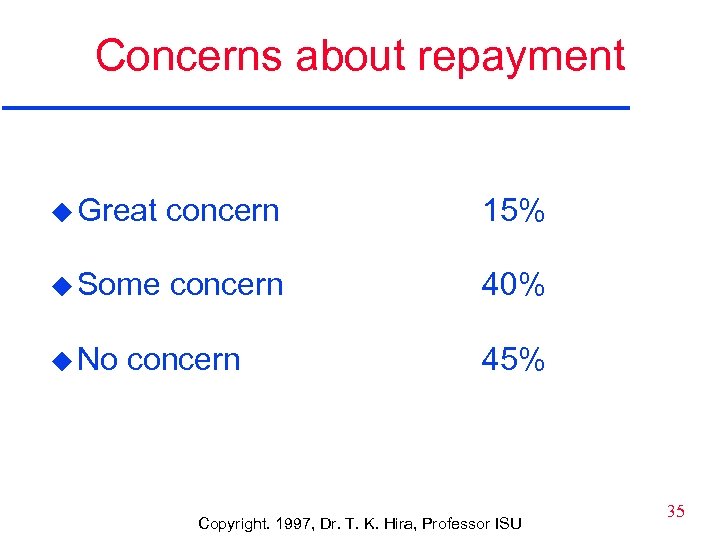
Concerns about repayment u Great concern 15% u Some concern 40% u No concern 45% Copyright. 1997, Dr. T. K. Hira, Professor ISU 35
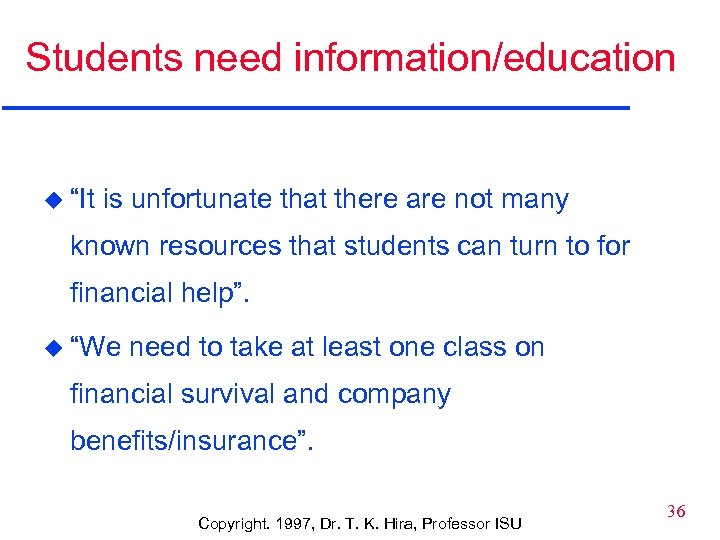
Students need information/education u “It is unfortunate that there are not many known resources that students can turn to for financial help”. u “We need to take at least one class on financial survival and company benefits/insurance”. Copyright. 1997, Dr. T. K. Hira, Professor ISU 36
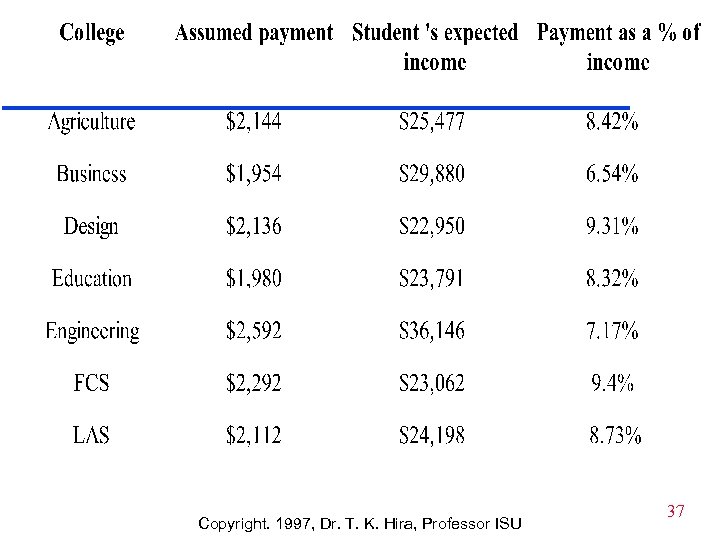
Copyright. 1997, Dr. T. K. Hira, Professor ISU 37
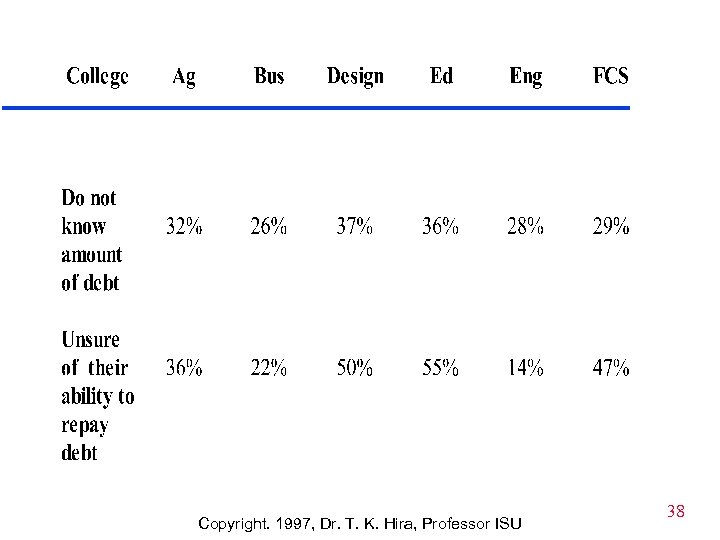
Copyright. 1997, Dr. T. K. Hira, Professor ISU 38
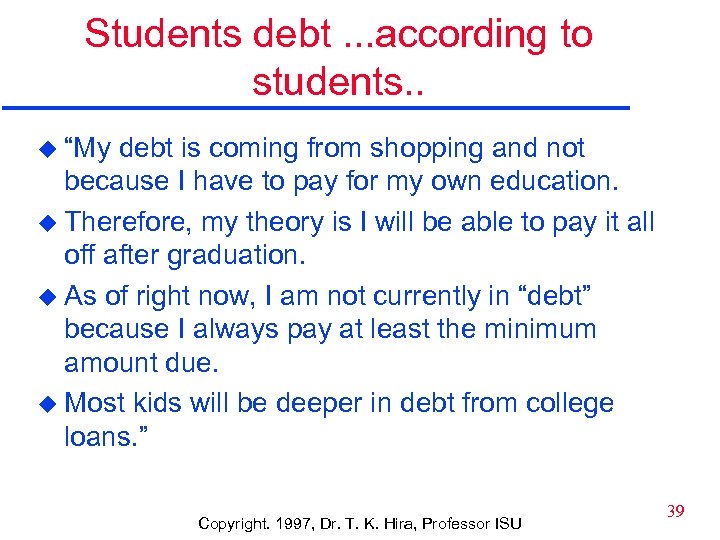
Students debt. . . according to students. . u “My debt is coming from shopping and not because I have to pay for my own education. u Therefore, my theory is I will be able to pay it all off after graduation. u As of right now, I am not currently in “debt” because I always pay at least the minimum amount due. u Most kids will be deeper in debt from college loans. ” Copyright. 1997, Dr. T. K. Hira, Professor ISU 39
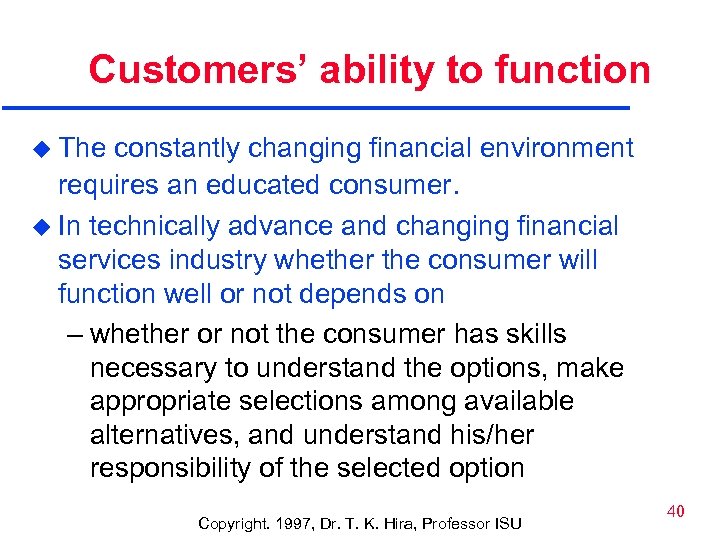
Customers’ ability to function u The constantly changing financial environment requires an educated consumer. u In technically advance and changing financial services industry whether the consumer will function well or not depends on – whether or not the consumer has skills necessary to understand the options, make appropriate selections among available alternatives, and understand his/her responsibility of the selected option Copyright. 1997, Dr. T. K. Hira, Professor ISU 40
Who is responsible to educate consumers. . young and adult u Financial institutions – all lenders: educational and non educational u Commercial institutions u Employers u Borrowers – themselves and their children u Educators – schools and colleges – adult and continuing education Copyright. 1997, Dr. T. K. Hira, Professor ISU 41
THANKS for giving me the opportunity to be with you Copyright. 1997, Dr. T. K. Hira, Professor ISU 42
Скачать презентацию Financial Attitudes Beliefs Behaviors Of College Students
f1e076f716db5d1160fa04e5e1c67fa0.ppt