


 Скачать презентацию Financial Assets Chapter 7 Power Point Authors Susan
8054accc738f5cc3cd1b53cef4d3d9b2.ppt
- Количество слайдов: 40
 Financial Assets Chapter 7 Power. Point Authors: Susan Coomer Galbreath, Ph. D. , CPA Charles W. Caldwell, D. B. A. , CMA Jon A. Booker, Ph. D. , CPA, CIA Cynthia J. Rooney, Ph. D. , CPA Mc. Graw-Hill/Irwin Copyright © 2012 The Mc. Graw-Hill Companies, Inc. 7 -1
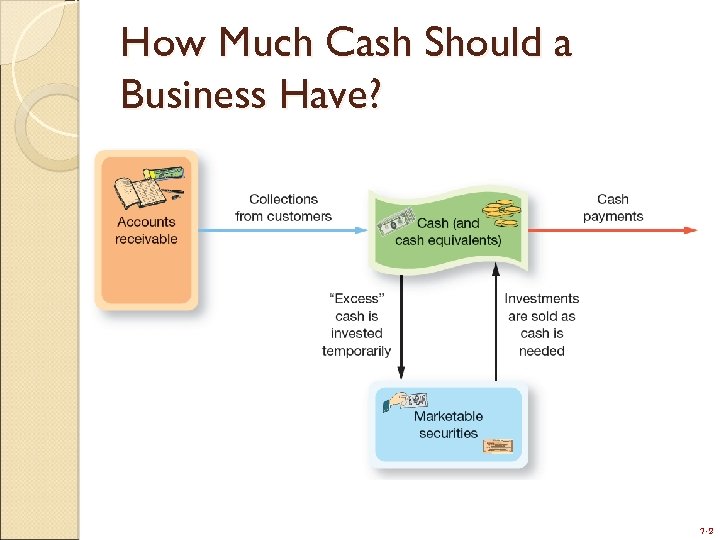 How Much Cash Should a Business Have? 7 -2
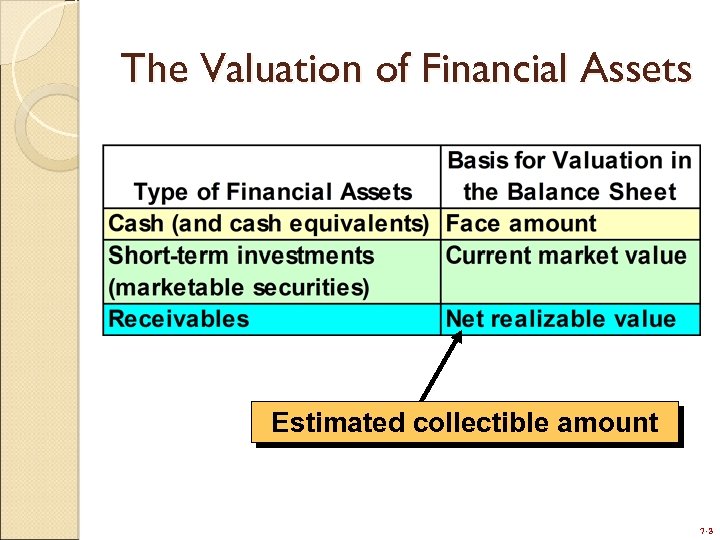 The Valuation of Financial Assets Estimated collectible amount 7 -3
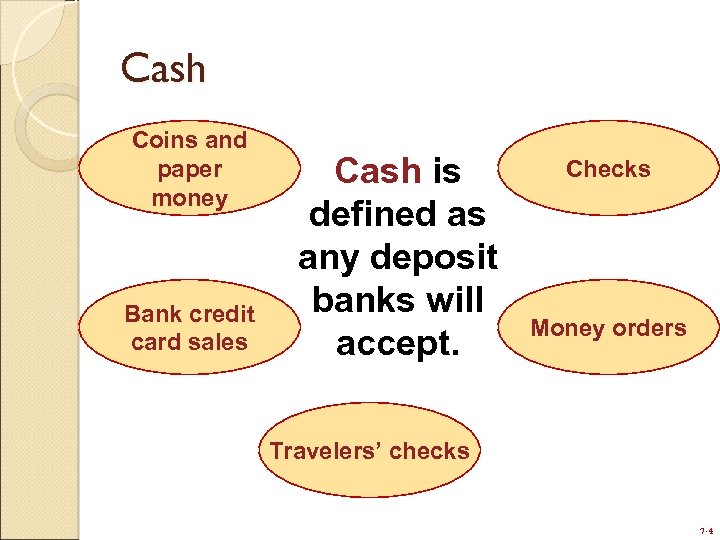 Cash Coins and paper money Bank credit card sales Cash is defined as any deposit banks will accept. Checks Money orders Travelers’ checks 7 -4
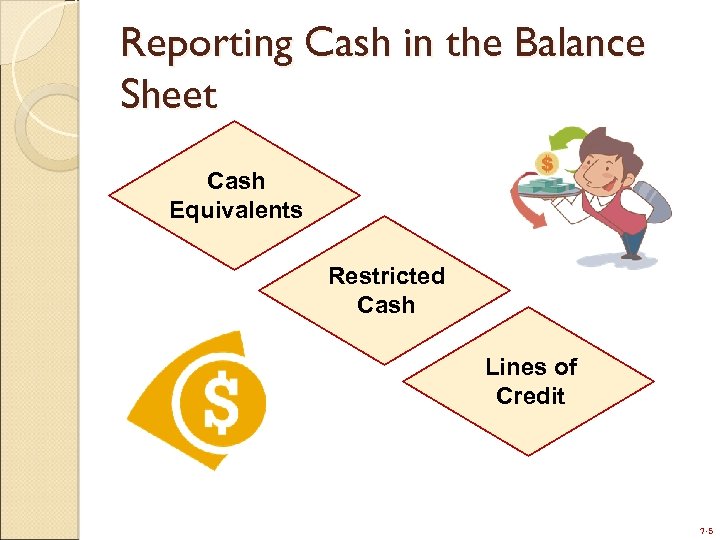 Reporting Cash in the Balance Sheet Cash Equivalents Restricted Cash Lines of Credit 7 -5
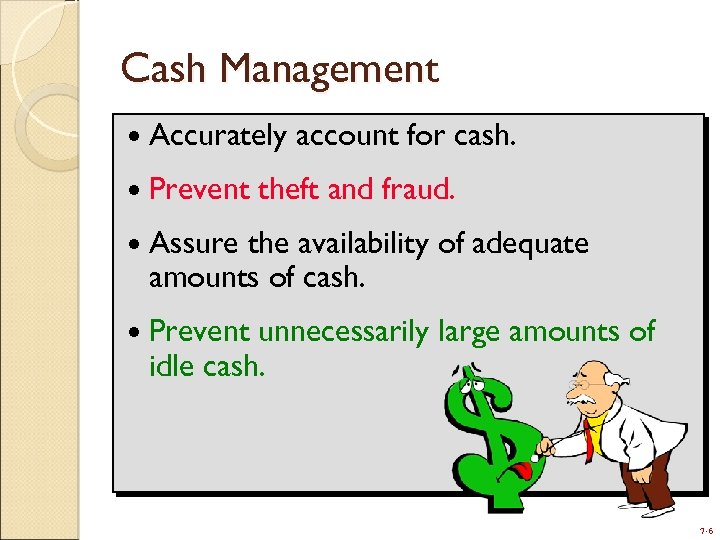 Cash Management Accurately Prevent account for cash. theft and fraud. Assure the availability of adequate amounts of cash. Prevent unnecessarily large amounts of idle cash. 7 -6
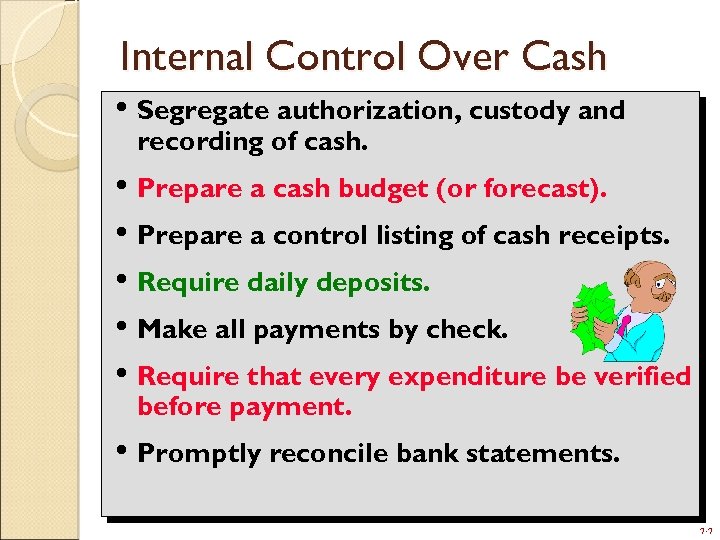 Internal Control Over Cash • Segregate authorization, custody and recording of cash. • Prepare a cash budget (or forecast). • Prepare a control listing of cash receipts. • Require daily deposits. • Make all payments by check. • Require that every expenditure be verified before payment. • Promptly reconcile bank statements. 7 -7
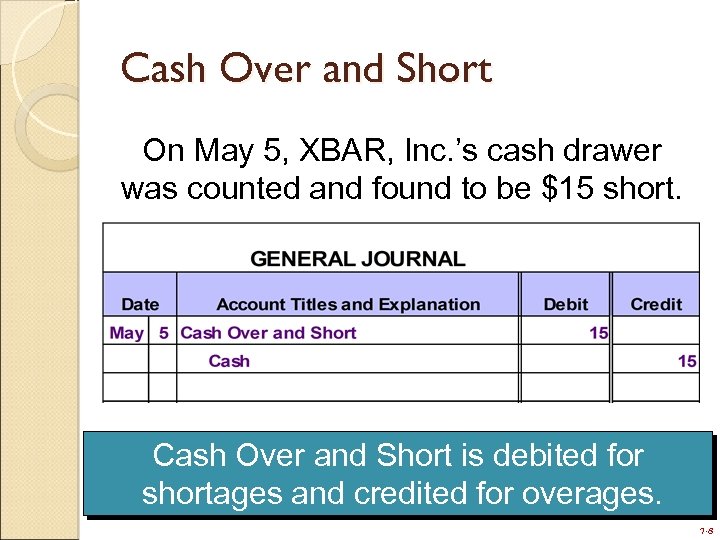 Cash Over and Short On May 5, XBAR, Inc. ’s cash drawer was counted and found to be $15 short. Cash Over and Short is debited for shortages and credited for overages. 7 -8
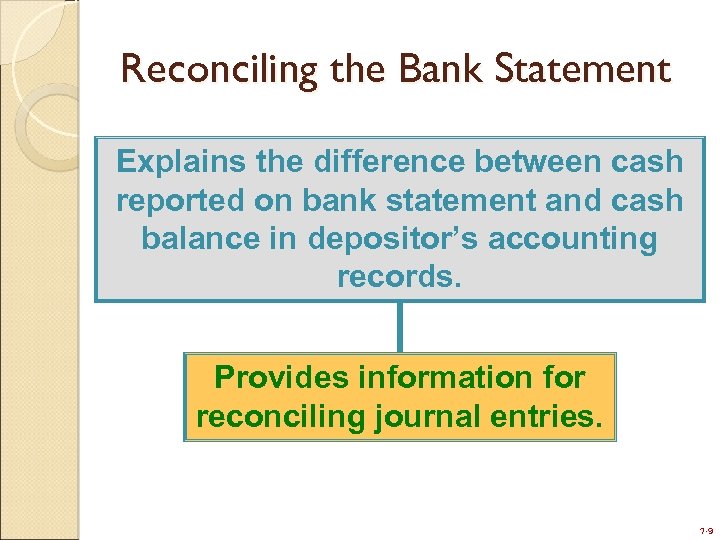 Reconciling the Bank Statement Explains the difference between cash reported on bank statement and cash balance in depositor’s accounting records. Provides information for reconciling journal entries. 7 -9
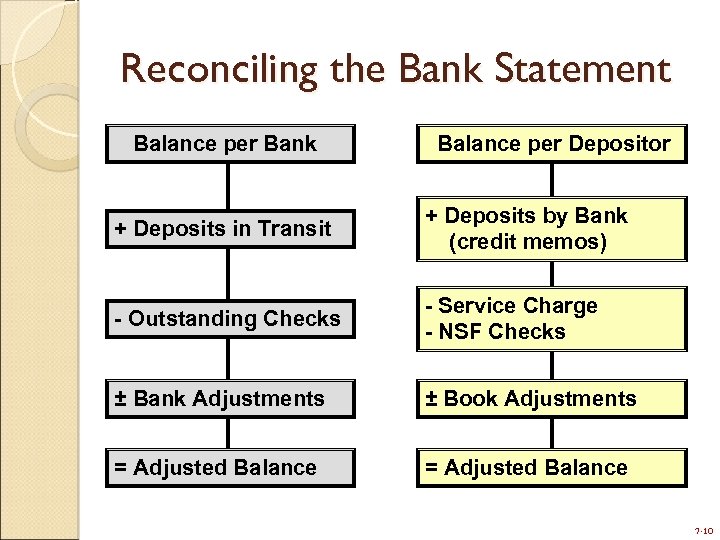 Reconciling the Bank Statement Balance per Bank Balance per Depositor + Deposits in Transit + Deposits by Bank (credit memos) - Outstanding Checks - Service Charge - NSF Checks ± Bank Adjustments ± Book Adjustments = Adjusted Balance 7 -10
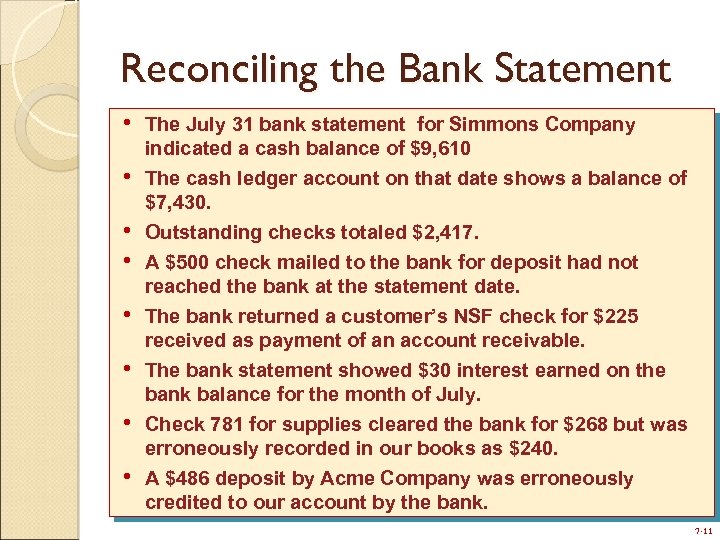 Reconciling the Bank Statement • The July 31 bank statement for Simmons Company indicated a cash balance of $9, 610 • The cash ledger account on that date shows a balance of • • • $7, 430. Outstanding checks totaled $2, 417. A $500 check mailed to the bank for deposit had not reached the bank at the statement date. The bank returned a customer’s NSF check for $225 received as payment of an account receivable. The bank statement showed $30 interest earned on the bank balance for the month of July. Check 781 for supplies cleared the bank for $268 but was erroneously recorded in our books as $240. A $486 deposit by Acme Company was erroneously credited to our account by the bank. 7 -11
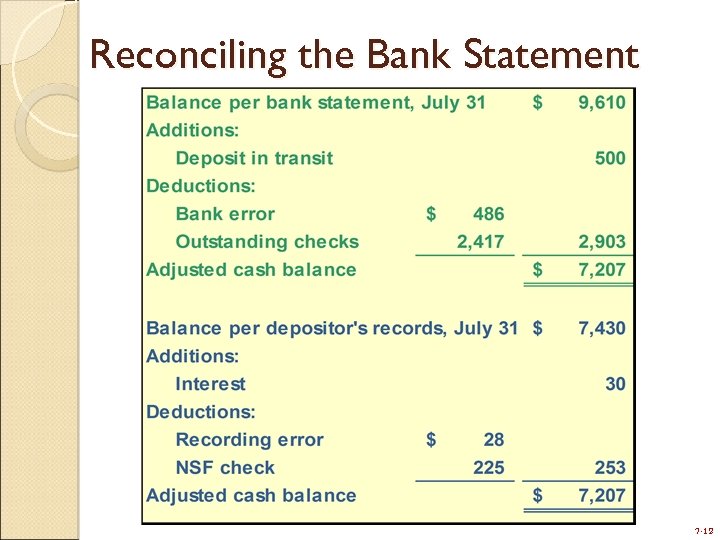 Reconciling the Bank Statement 7 -12
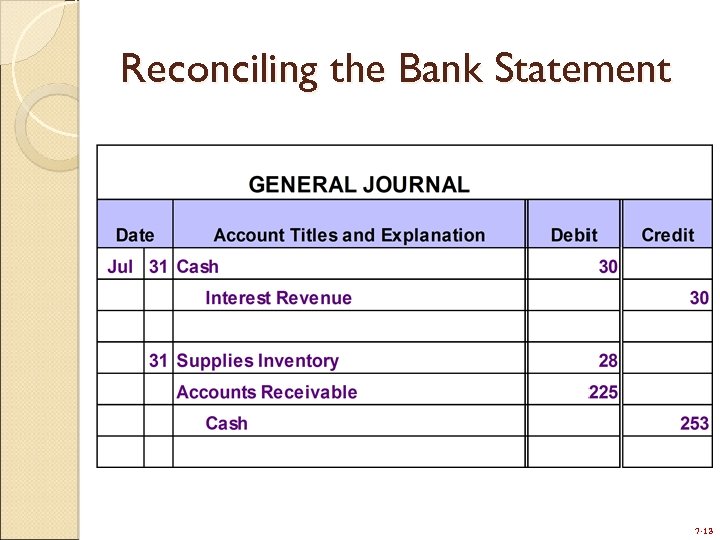 Reconciling the Bank Statement 7 -13
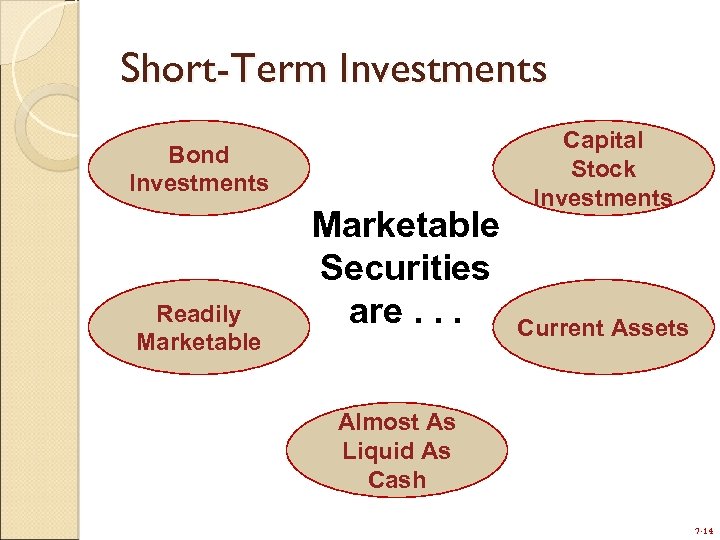 Short-Term Investments Bond Investments Readily Marketable Securities are. . . Capital Stock Investments Current Assets Almost As Liquid As Cash 7 -14
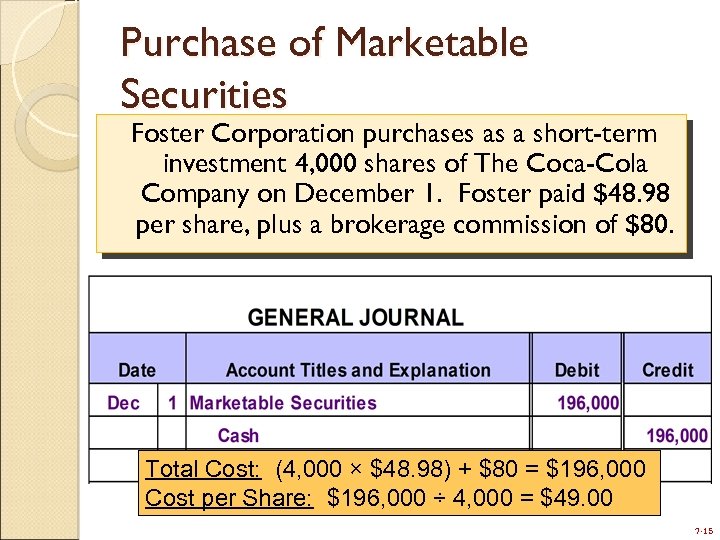 Purchase of Marketable Securities Foster Corporation purchases as a short-term investment 4, 000 shares of The Coca-Cola Company on December 1. Foster paid $48. 98 per share, plus a brokerage commission of $80. Total Cost: (4, 000 × $48. 98) + $80 = $196, 000 Cost per Share: $196, 000 ÷ 4, 000 = $49. 00 7 -15
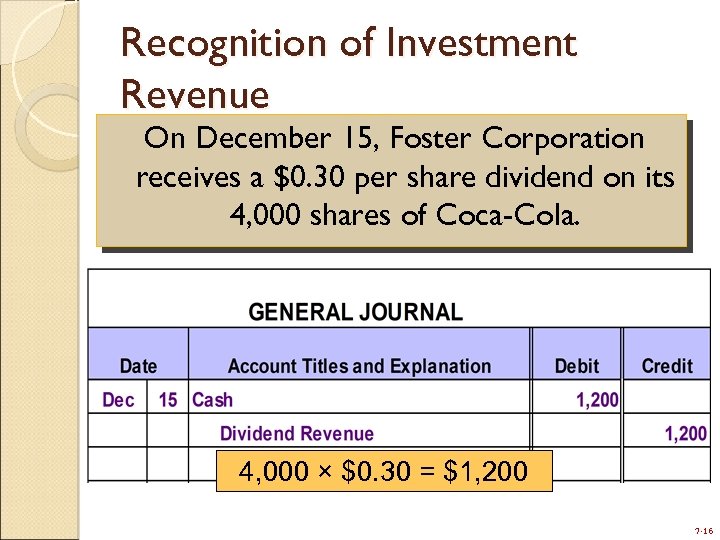 Recognition of Investment Revenue On December 15, Foster Corporation receives a $0. 30 per share dividend on its 4, 000 shares of Coca-Cola. 4, 000 × $0. 30 = $1, 200 7 -16
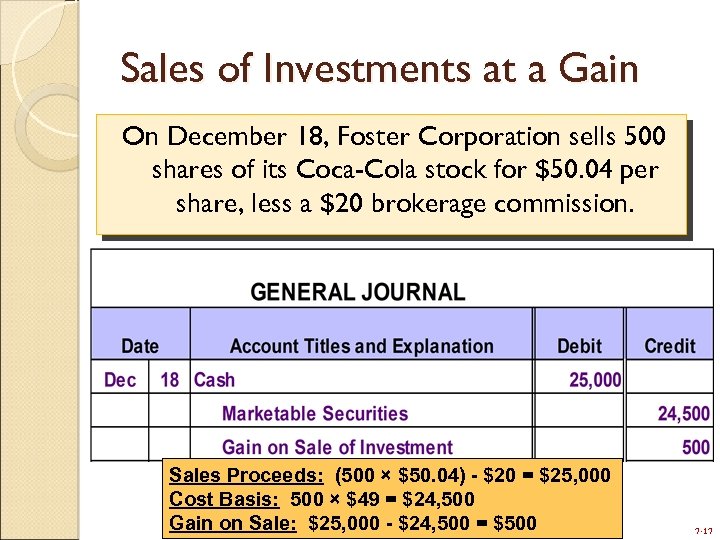 Sales of Investments at a Gain On December 18, Foster Corporation sells 500 shares of its Coca-Cola stock for $50. 04 per share, less a $20 brokerage commission. Sales Proceeds: (500 × $50. 04) - $20 = $25, 000 Cost Basis: 500 × $49 = $24, 500 Gain on Sale: $25, 000 - $24, 500 = $500 7 -17
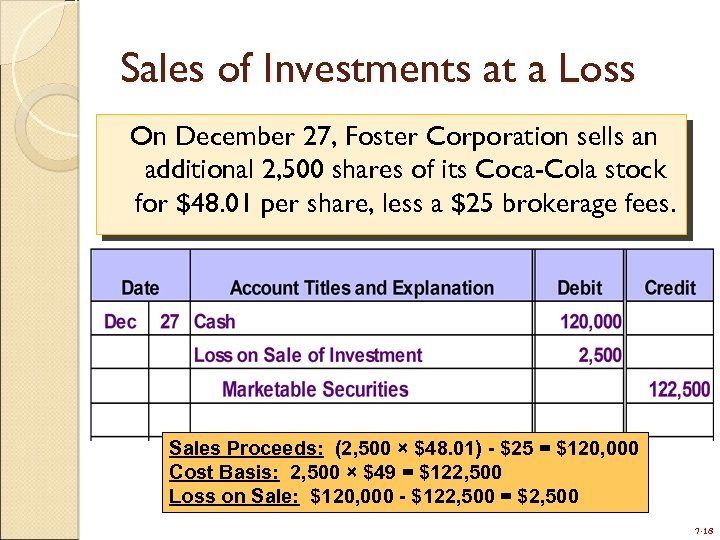 Sales of Investments at a Loss On December 27, Foster Corporation sells an additional 2, 500 shares of its Coca-Cola stock for $48. 01 per share, less a $25 brokerage fees. Sales Proceeds: (2, 500 × $48. 01) - $25 = $120, 000 Cost Basis: 2, 500 × $49 = $122, 500 Loss on Sale: $120, 000 - $122, 500 = $2, 500 7 -18
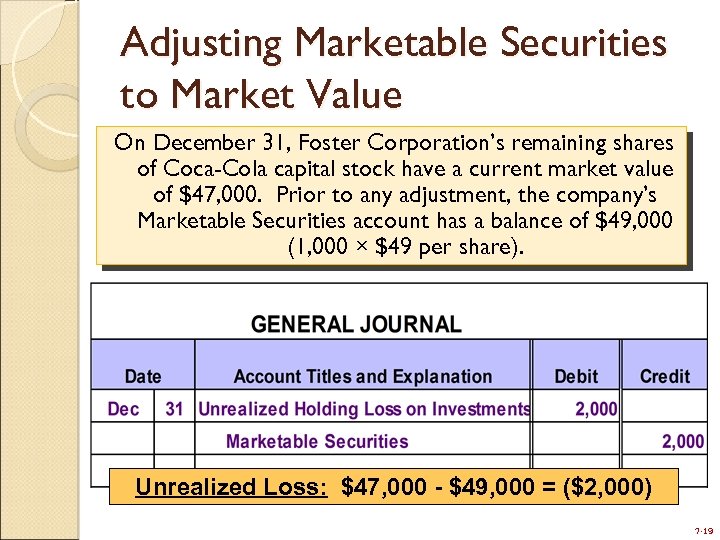 Adjusting Marketable Securities to Market Value On December 31, Foster Corporation’s remaining shares of Coca-Cola capital stock have a current market value of $47, 000. Prior to any adjustment, the company’s Marketable Securities account has a balance of $49, 000 (1, 000 × $49 per share). Unrealized Loss: $47, 000 - $49, 000 = ($2, 000) 7 -19
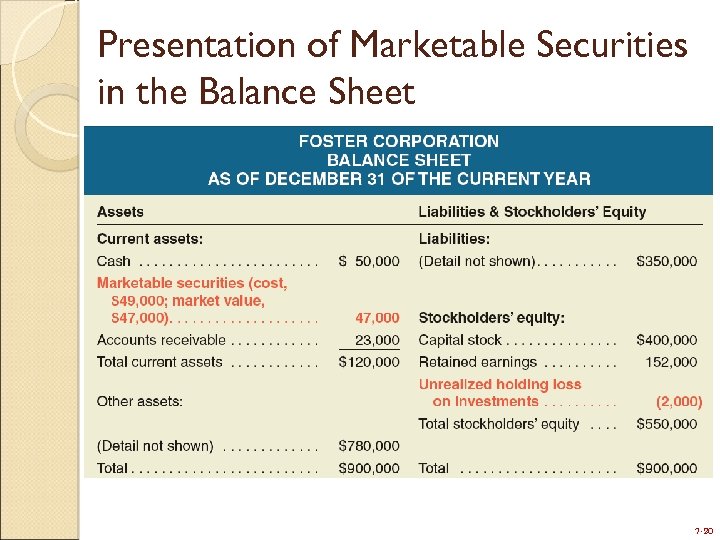 Presentation of Marketable Securities in the Balance Sheet 7 -20
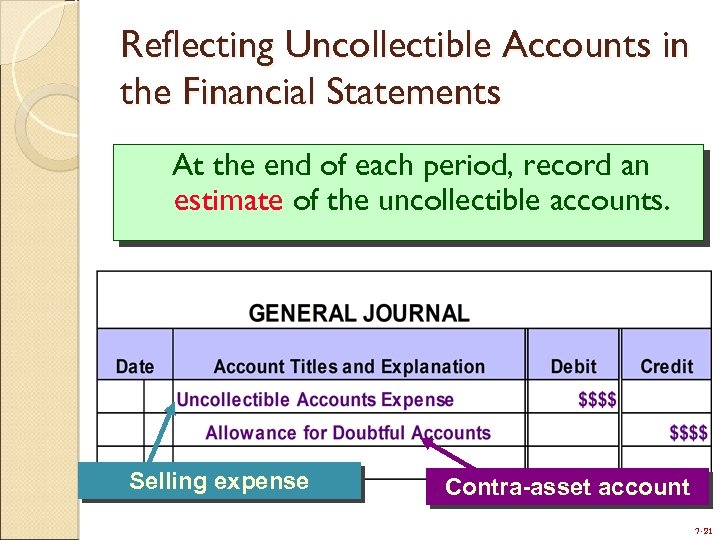 Reflecting Uncollectible Accounts in the Financial Statements At the end of each period, record an estimate of the uncollectible accounts. Selling expense Contra-asset account 7 -21
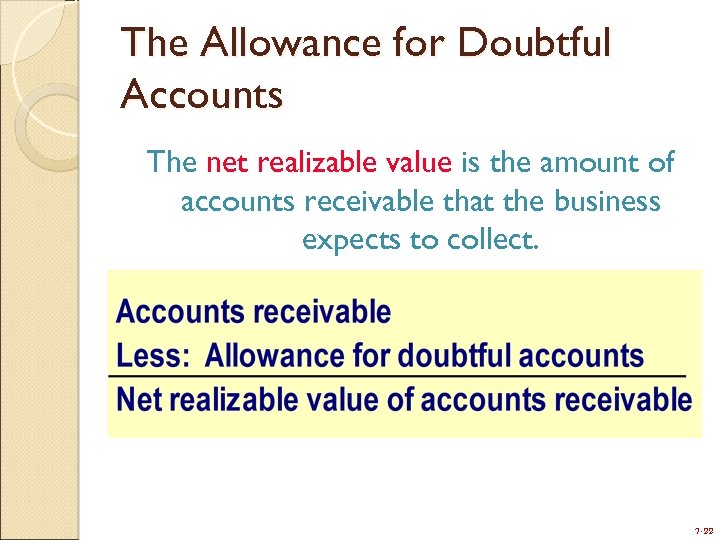 The Allowance for Doubtful Accounts The net realizable value is the amount of accounts receivable that the business expects to collect. 7 -22
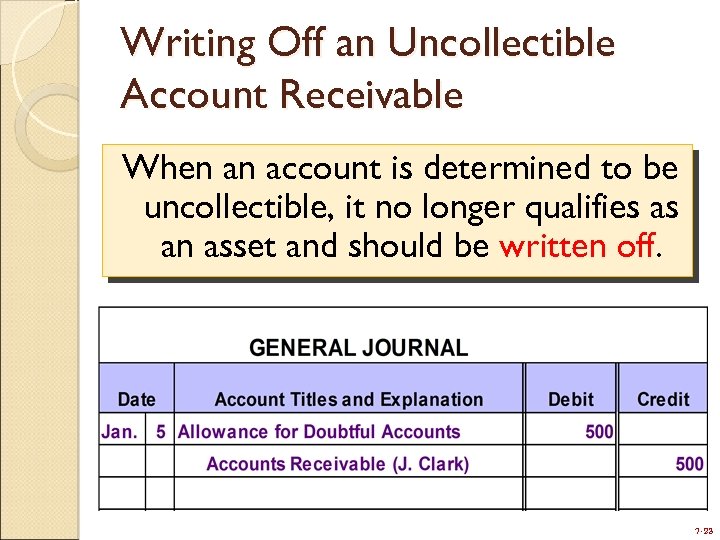 Writing Off an Uncollectible Account Receivable When an account is determined to be uncollectible, it no longer qualifies as an asset and should be written off. 7 -23
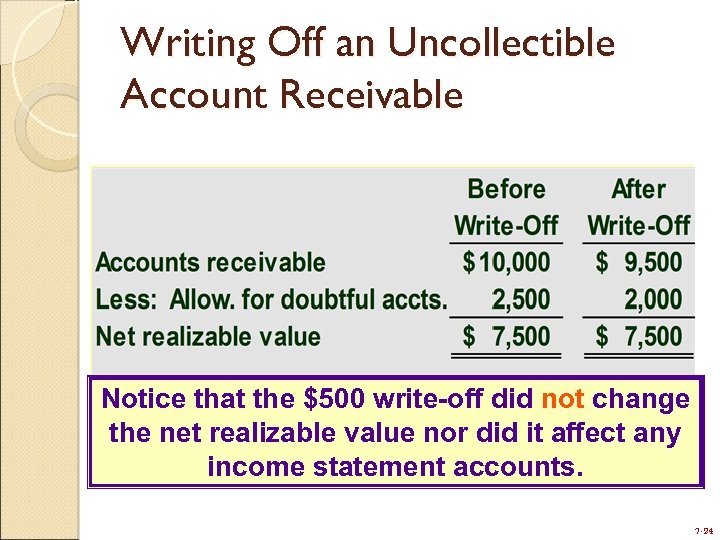 Writing Off an Uncollectible Account Receivable Notice that the $500 write-off did not change the net realizable value nor did it affect any income statement accounts. 7 -24
 Monthly Estimates of Credit Losses At the end of each month, management should estimate the probable amount of uncollectible accounts and adjust the Allowance for Doubtful Accounts to this new estimate. Two Approaches to Estimating Credit Losses 1. Balance Sheet Approach 2. Income Statement Approach 7 -25
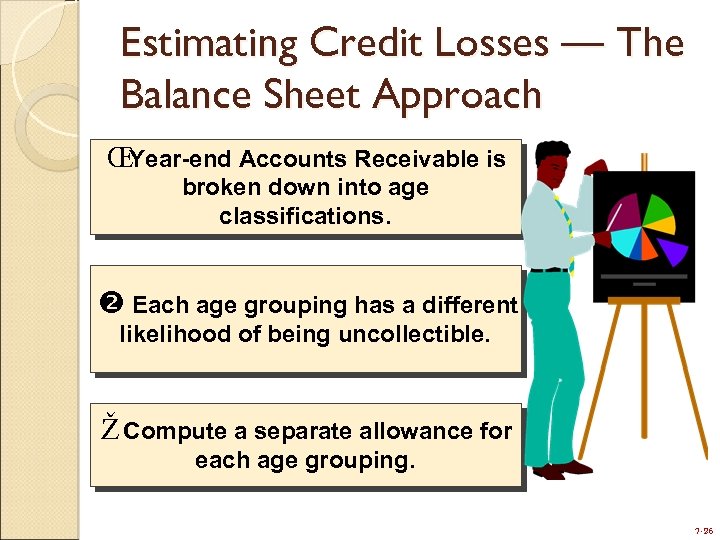 Estimating Credit Losses — The Balance Sheet Approach ŒYear-end Accounts Receivable is broken down into age classifications. Each age grouping has a different likelihood of being uncollectible. Ž Compute a separate allowance for each age grouping. 7 -26
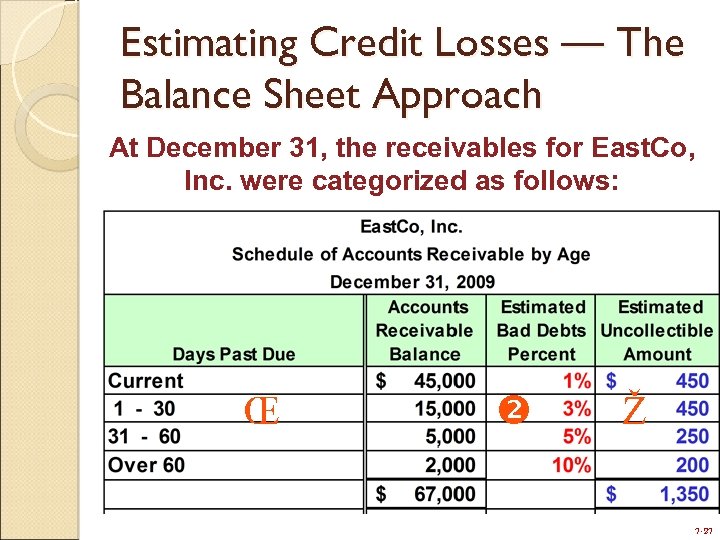 Estimating Credit Losses — The Balance Sheet Approach At December 31, the receivables for East. Co, Inc. were categorized as follows: Œ Ž 7 -27
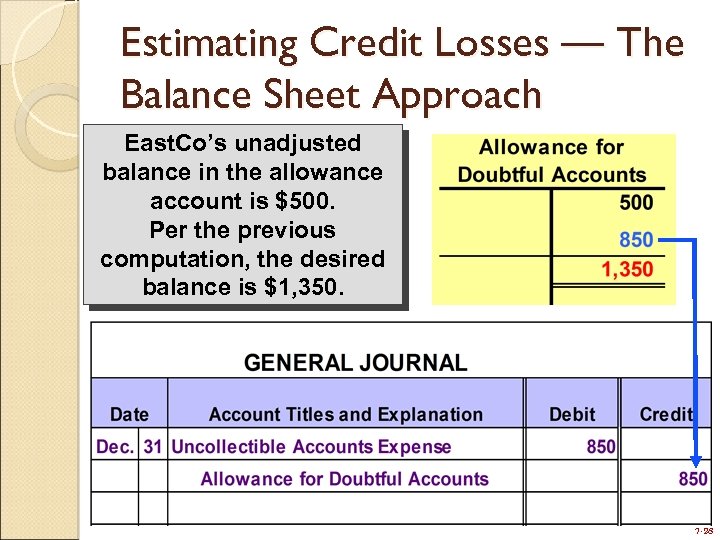 Estimating Credit Losses — The Balance Sheet Approach East. Co’s unadjusted balance in the allowance account is $500. Per the previous computation, the desired balance is $1, 350. 7 -28
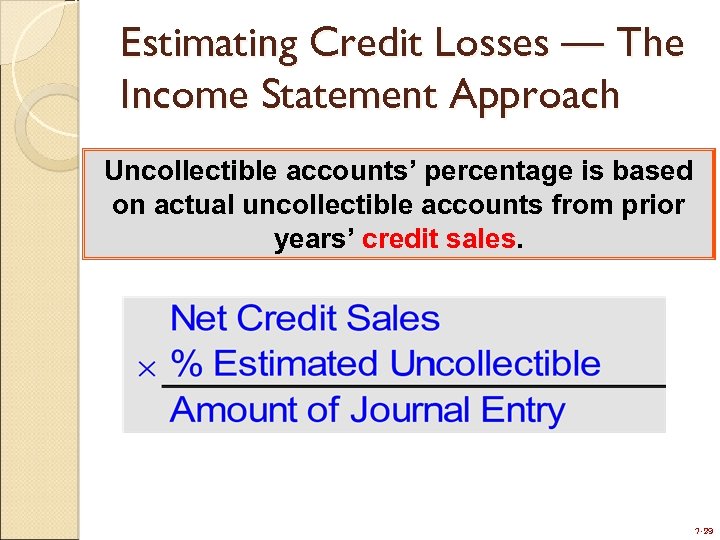 Estimating Credit Losses — The Income Statement Approach Uncollectible accounts’ percentage is based on actual uncollectible accounts from prior years’ credit sales. 7 -29
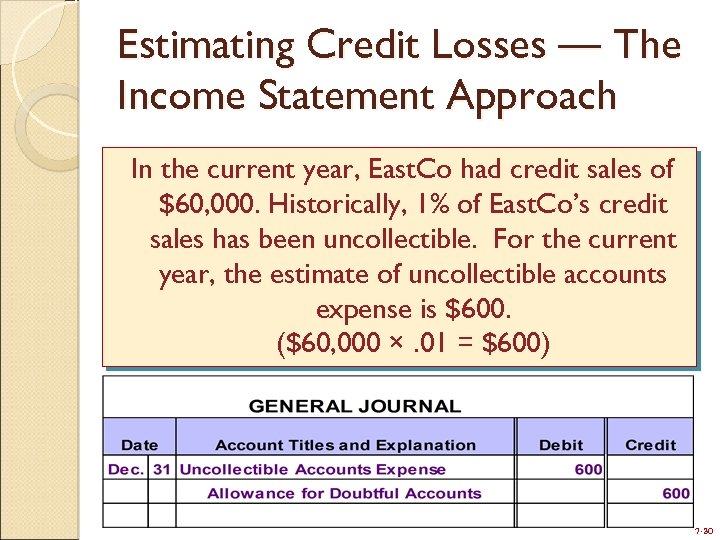 Estimating Credit Losses — The Income Statement Approach In the current year, East. Co had credit sales of $60, 000. Historically, 1% of East. Co’s credit sales has been uncollectible. For the current year, the estimate of uncollectible accounts expense is $600. ($60, 000 ×. 01 = $600) 7 -30
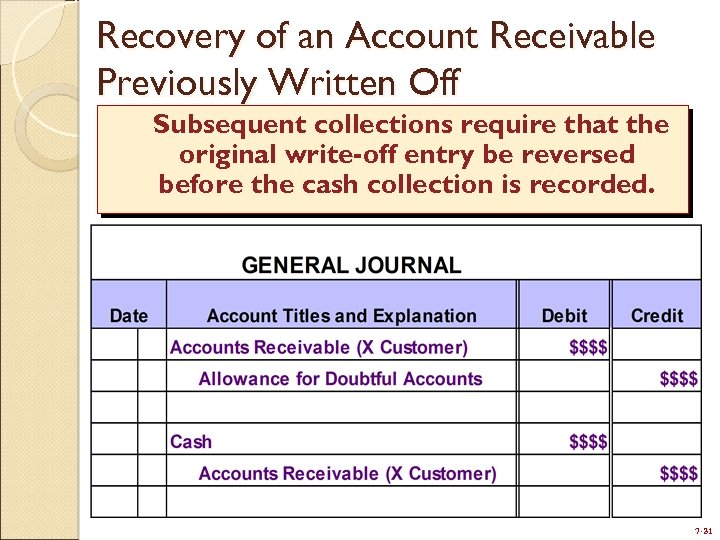 Recovery of an Account Receivable Previously Written Off Subsequent collections require that the original write-off entry be reversed before the cash collection is recorded. 7 -31
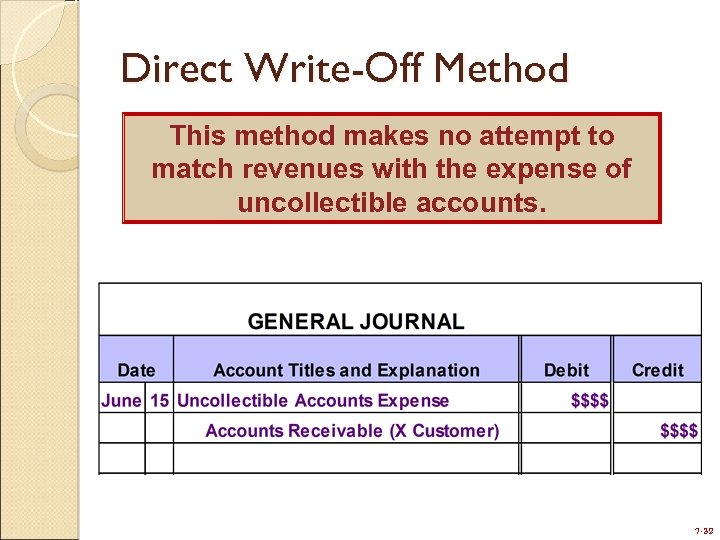 Direct Write-Off Method This method makes no attempt to match revenues with the expense of uncollectible accounts. 7 -32
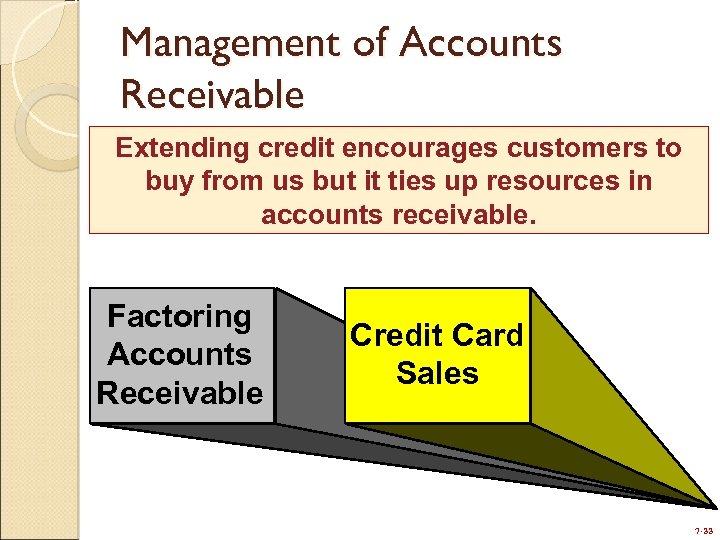 Management of Accounts Receivable Extending credit encourages customers to buy from us but it ties up resources in accounts receivable. Factoring Accounts Receivable Credit Card Sales 7 -33
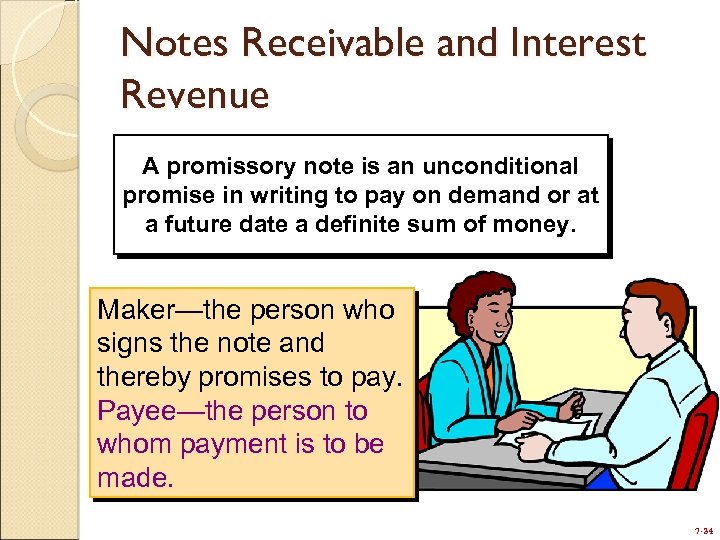 Notes Receivable and Interest Revenue A promissory note is an unconditional promise in writing to pay on demand or at a future date a definite sum of money. Maker—the person who signs the note and thereby promises to pay. Payee—the person to whom payment is to be made. 7 -34
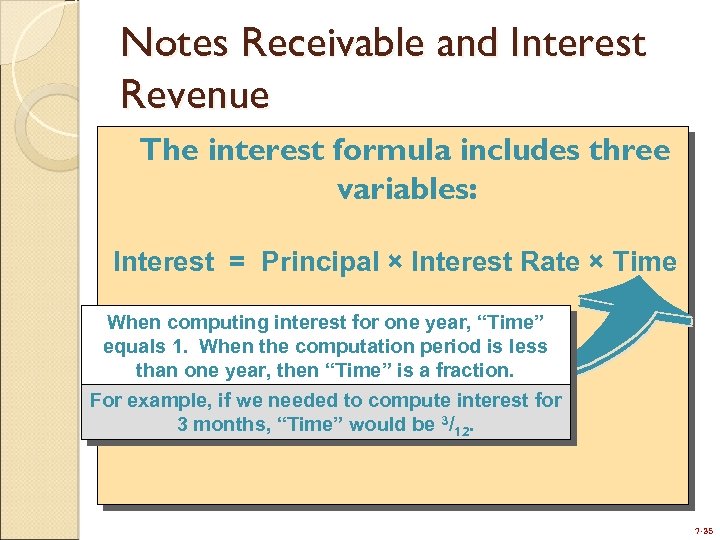 Notes Receivable and Interest Revenue The interest formula includes three variables: Interest = Principal × Interest Rate × Time When computing interest for one year, “Time” equals 1. When the computation period is less than one year, then “Time” is a fraction. For example, if we needed to compute interest for 3 months, “Time” would be 3/12. 7 -35
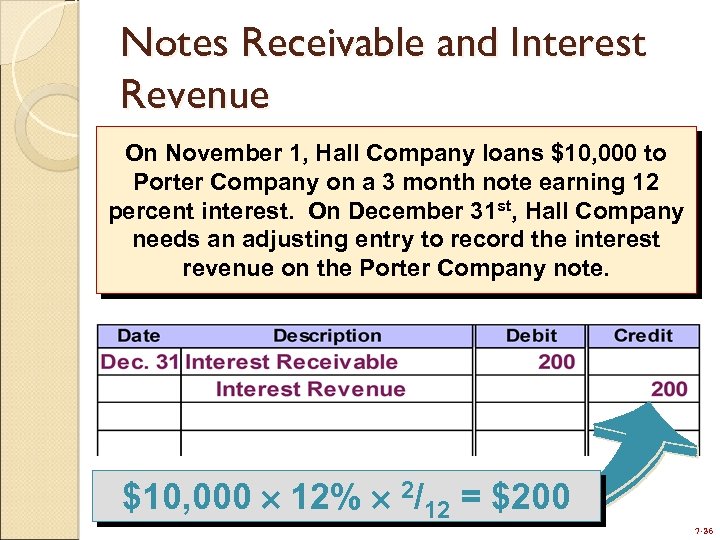 Notes Receivable and Interest Revenue On November 1, Hall Company loans $10, 000 to Porter Company on a 3 month note earning 12 percent interest. On December 31 st, Hall Company needs an adjusting entry to record the interest revenue on the Porter Company note. $10, 000 12% 2/12 = $200 7 -36
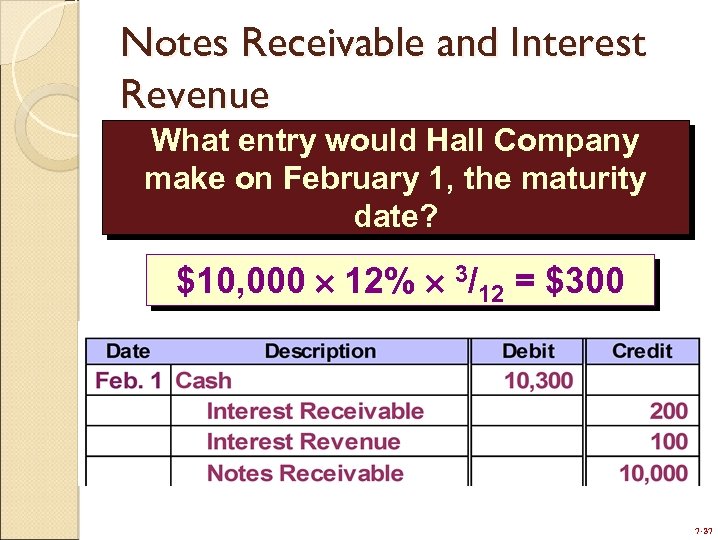 Notes Receivable and Interest Revenue What entry would Hall Company make on February 1, the maturity date? $10, 000 12% 3/12 = $300 7 -37
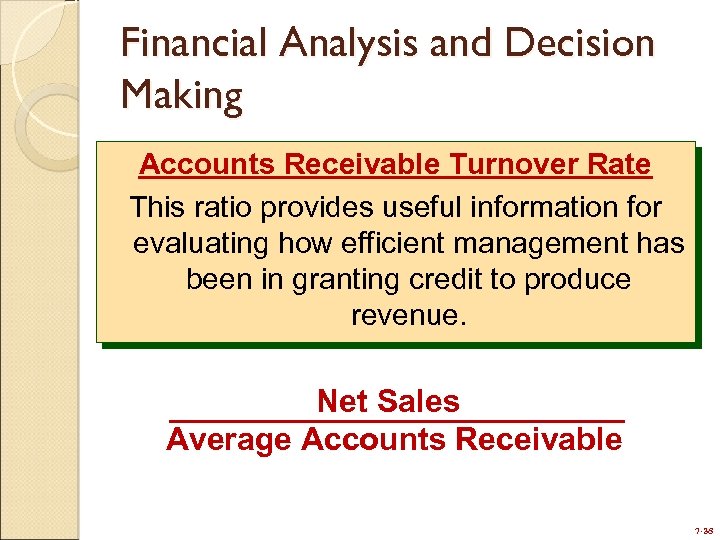 Financial Analysis and Decision Making Accounts Receivable Turnover Rate This ratio provides useful information for evaluating how efficient management has been in granting credit to produce revenue. Net Sales Average Accounts Receivable 7 -38
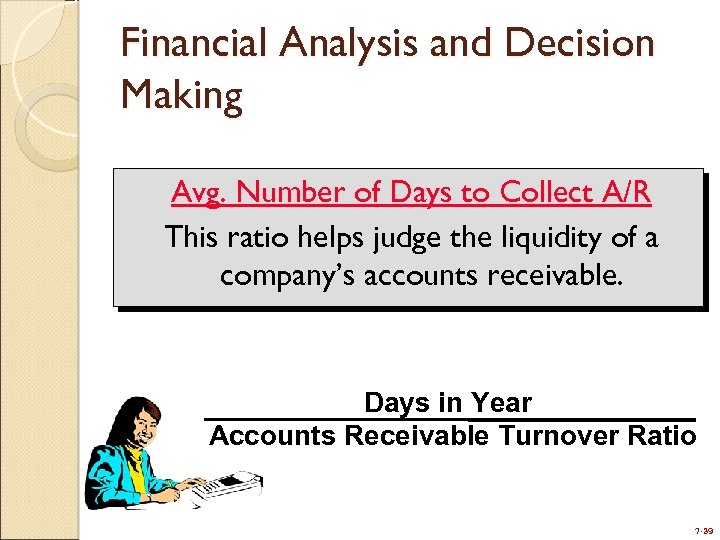 Financial Analysis and Decision Making Avg. Number of Days to Collect A/R This ratio helps judge the liquidity of a company’s accounts receivable. Days in Year Accounts Receivable Turnover Ratio 7 -39
 End of Chapter 7 7 -40