


 Скачать презентацию Financial and Managerial Accounting Wild Shaw and Chiappetta
3aaab1a8a47aaf6fdff15710619d4512.ppt
- Количество слайдов: 43
 Financial and Managerial Accounting Wild, Shaw, and Chiappetta Fourth Edition Mc. Graw-Hill/Irwin Copyright © 2011 by The Mc. Graw-Hill Companies, Inc. All rights reserved.
 Chapter 23 Relevant Costing for Managerial Decisions
 Conceptual Learning Objectives C 1: Describe the importance of relevant costs for short-term decisions. 23 -3
 Analytical Learning Objectives A 1: Evaluate short-term managerial decisions using relevant costs. A 2: Determine product selling price based on total costs. 23 -4
 Procedural Learning Objectives P 1: Identify relevant costs and apply them to managerial decisions 23 -5
 C 1 Decision Making Decision making involves five steps: Define the task and the goal. Identify alternative actions. Collect relevant information on alternatives. Select the course of action. Analyze and assess decision. 23 -6
 C 1 Relevant Costs l l l 1 l Costs that are applicable to a particular decision. Costs that should have a bearing on which alternative a manager selects. Costs that are avoidable. Future costs that differ between alternatives. 2 23 -7
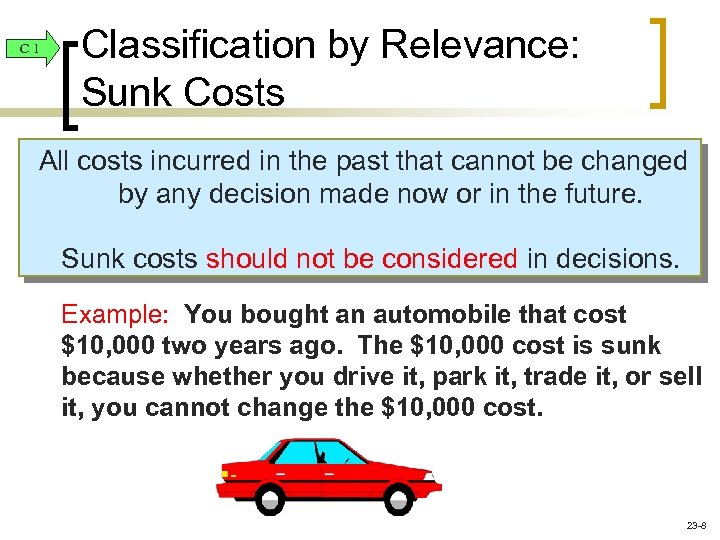 C 1 Classification by Relevance: Sunk Costs All costs incurred in the past that cannot be changed by any decision made now or in the future. Sunk costs should not be considered in decisions. Example: You bought an automobile that cost $10, 000 two years ago. The $10, 000 cost is sunk because whether you drive it, park it, trade it, or sell it, you cannot change the $10, 000 cost. 23 -8
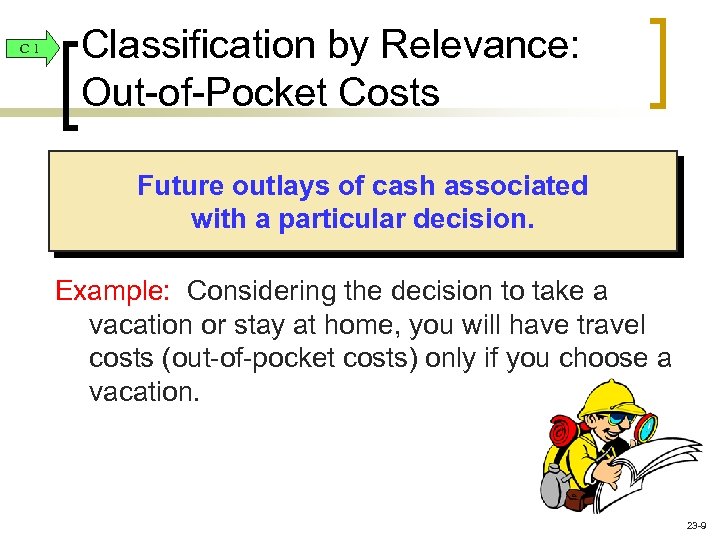 C 1 Classification by Relevance: Out-of-Pocket Costs Future outlays of cash associated with a particular decision. Example: Considering the decision to take a vacation or stay at home, you will have travel costs (out-of-pocket costs) only if you choose a vacation. 23 -9
 C 1 Classification by Relevance: Opportunity Costs The potential benefit that is given up when one alternative is selected over another. Example: If you were not attending college, you could be earning $20, 000 per year. Your opportunity cost of attending college for one year is $20, 000. 23 -10
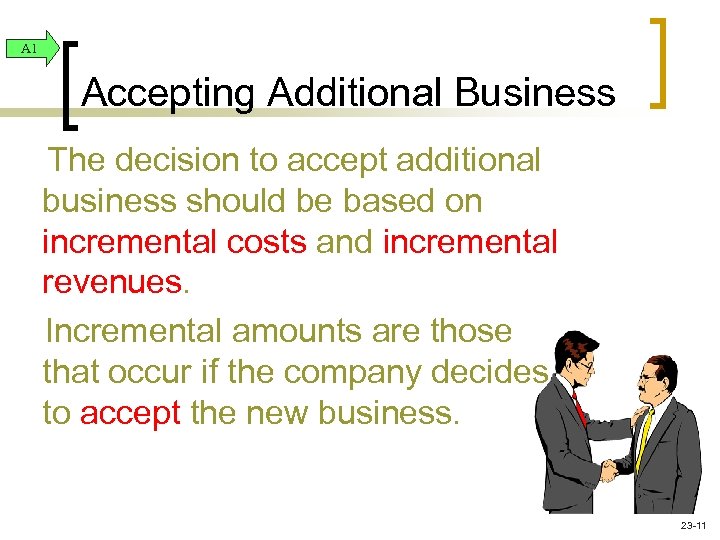 A 1 Accepting Additional Business The decision to accept additional business should be based on incremental costs and incremental revenues. Incremental amounts are those that occur if the company decides to accept the new business. 23 -11
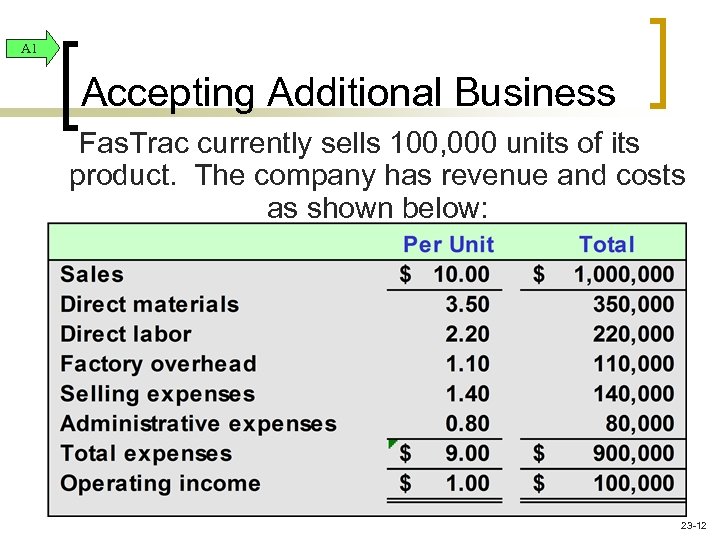 A 1 Accepting Additional Business Fas. Trac currently sells 100, 000 units of its product. The company has revenue and costs as shown below: 23 -12
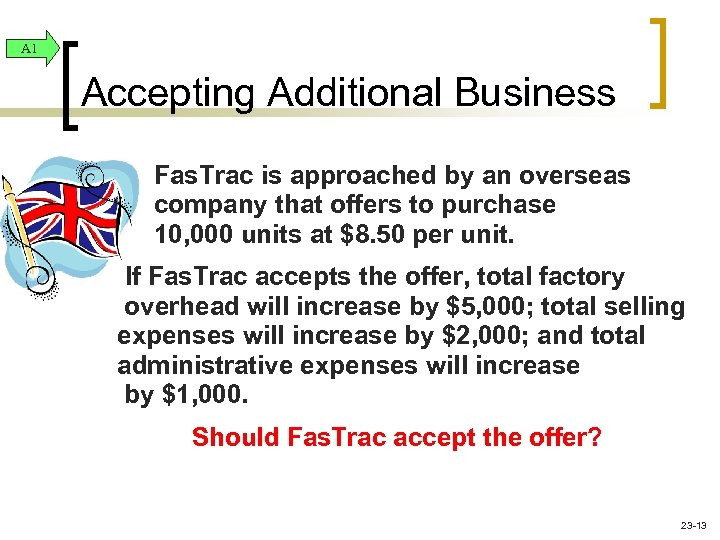 A 1 Accepting Additional Business Fas. Trac is approached by an overseas company that offers to purchase 10, 000 units at $8. 50 per unit. If Fas. Trac accepts the offer, total factory overhead will increase by $5, 000; total selling expenses will increase by $2, 000; and total administrative expenses will increase by $1, 000. Should Fas. Trac accept the offer? 23 -13
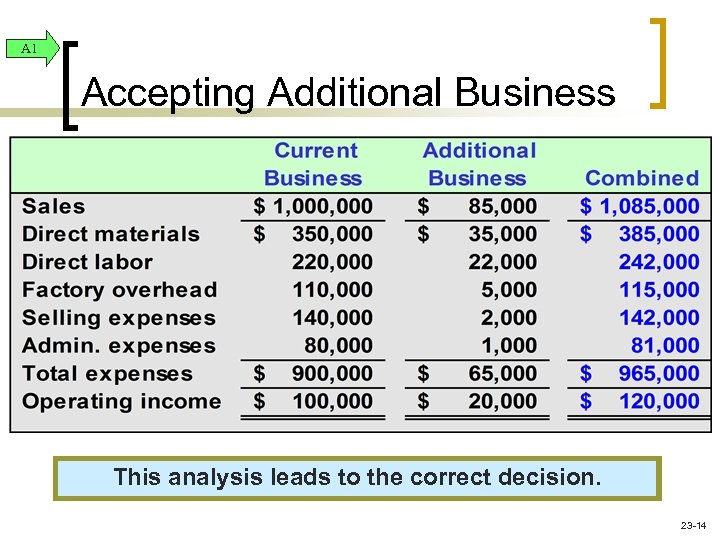 A 1 Accepting Additional Business This analysis leads to the correct decision. 23 -14
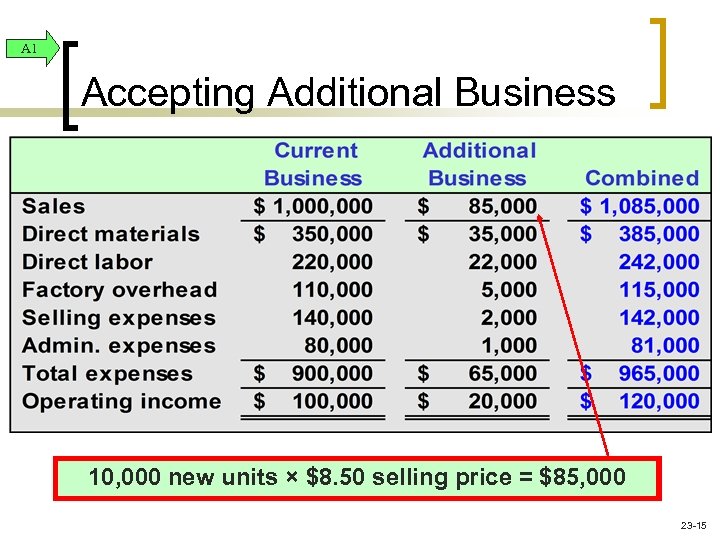 A 1 Accepting Additional Business 10, 000 new units × $8. 50 selling price = $85, 000 23 -15
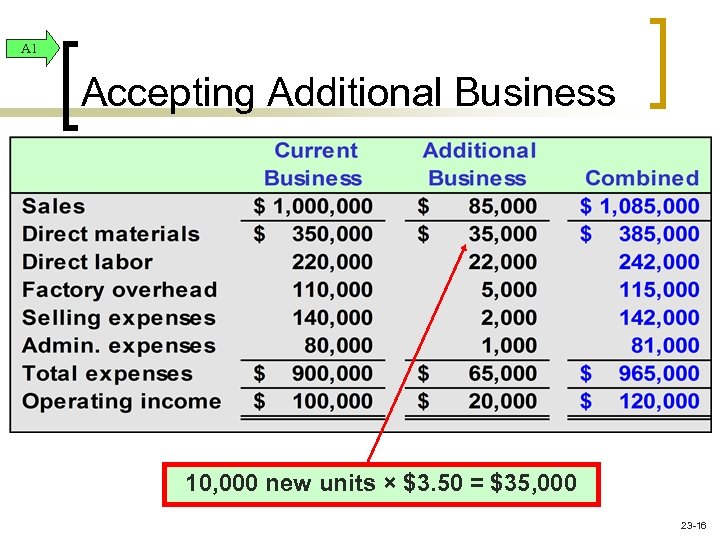 A 1 Accepting Additional Business 10, 000 new units × $3. 50 = $35, 000 23 -16
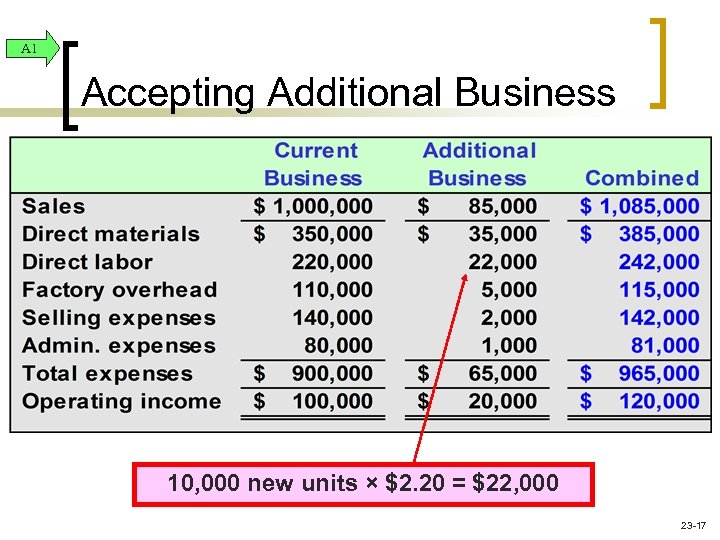 A 1 Accepting Additional Business 10, 000 new units × $2. 20 = $22, 000 23 -17
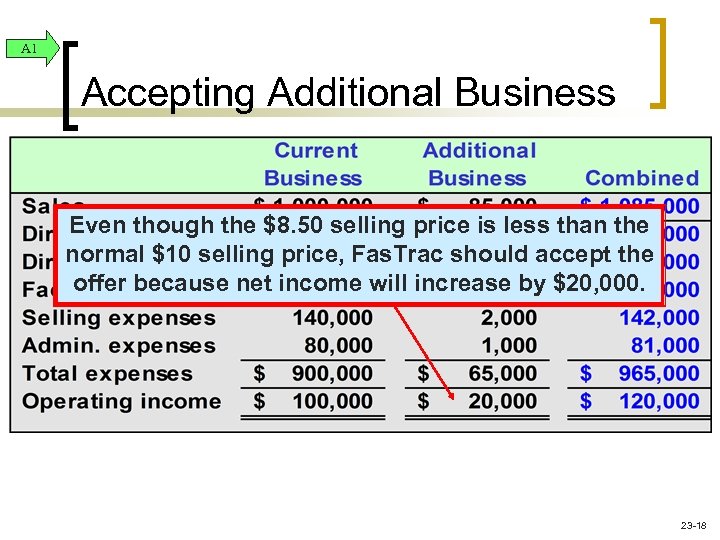 A 1 Accepting Additional Business Even though the $8. 50 selling price is less than the normal $10 selling price, Fas. Trac should accept the offer because net income will increase by $20, 000. 23 -18
 A 1 Make or Buy Decisions l l l Incremental costs also are important in the decision to make a product or purchase it from a supplier. The cost to produce an item must include (1) direct materials, (2) direct labor and (3) incremental overhead. We should not use the predetermined overhead rate to determine product cost. 23 -19
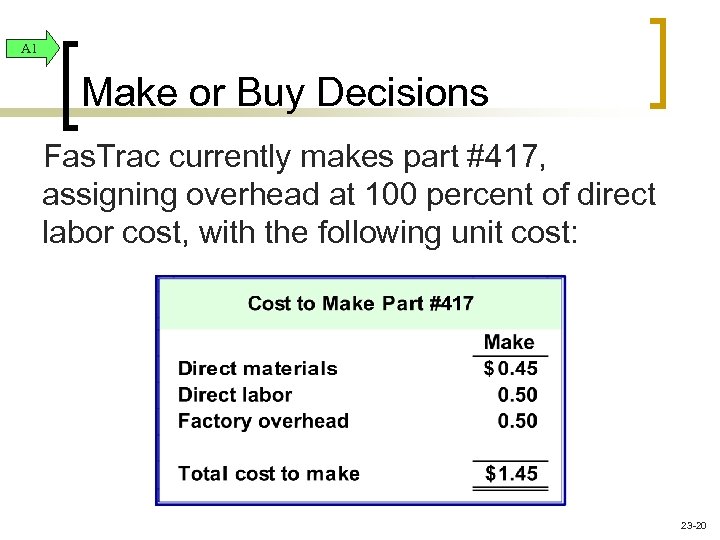 A 1 Make or Buy Decisions Fas. Trac currently makes part #417, assigning overhead at 100 percent of direct labor cost, with the following unit cost: 23 -20
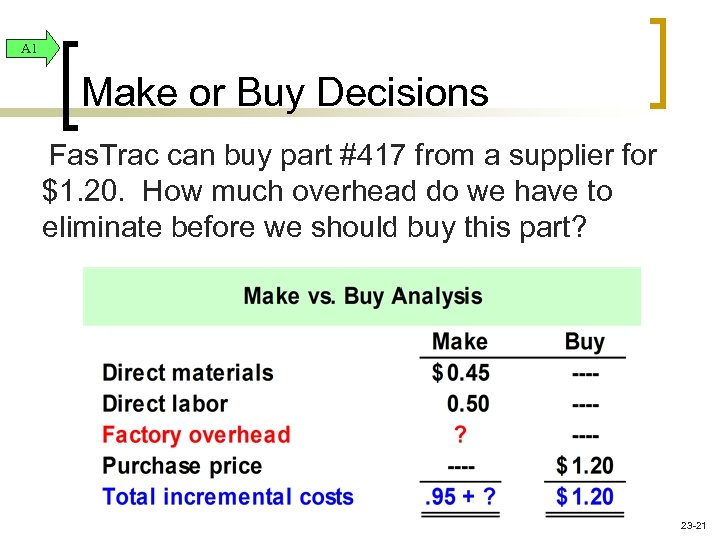 A 1 Make or Buy Decisions Fas. Trac can buy part #417 from a supplier for $1. 20. How much overhead do we have to eliminate before we should buy this part? 23 -21
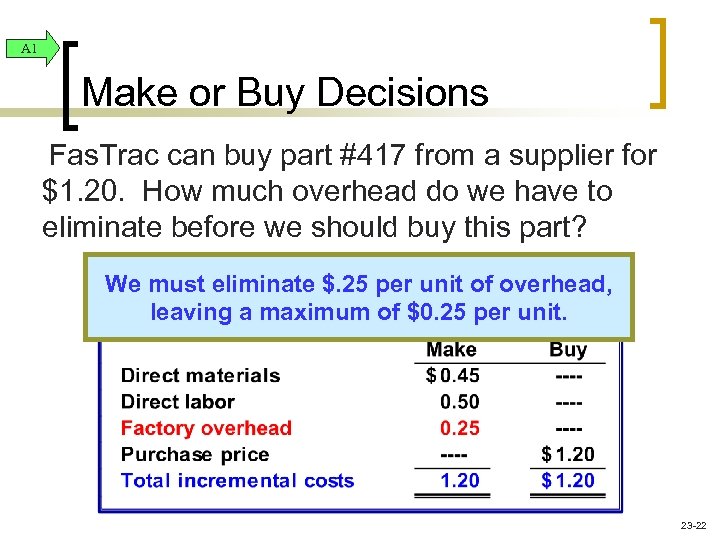 A 1 Make or Buy Decisions Fas. Trac can buy part #417 from a supplier for $1. 20. How much overhead do we have to eliminate before we should buy this part? We must eliminate $. 25 per unit of overhead, leaving a maximum of $0. 25 per unit. 23 -22
 A 1 Scrap or Rework Costs incurred in manufacturing units of product that do not meet quality standards are sunk costs and cannot be recovered. As long as rework costs are recovered through sale of the product, and rework does not interfere with normal production, we should rework rather than scrap. 23 -23
 A 1 Scrap or Rework Fas. Trac has 10, 000 defective units that cost $1. 00 each to make. The units can be scrapped now for $. 40 each or reworked at an additional cost of $. 80 per unit. If reworked, the units can be sold for the normal selling price of $1. 50 each. Reworking the defective units will prevent the production of 10, 000 new units that would also sell for $1. 50. Should Fas. Trac scrap or rework? 23 -24
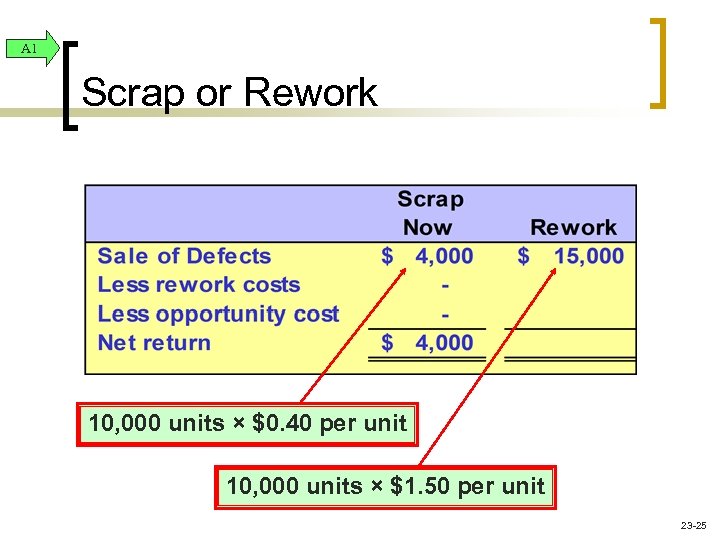 A 1 Scrap or Rework 10, 000 units × $0. 40 per unit 10, 000 units × $1. 50 per unit 23 -25
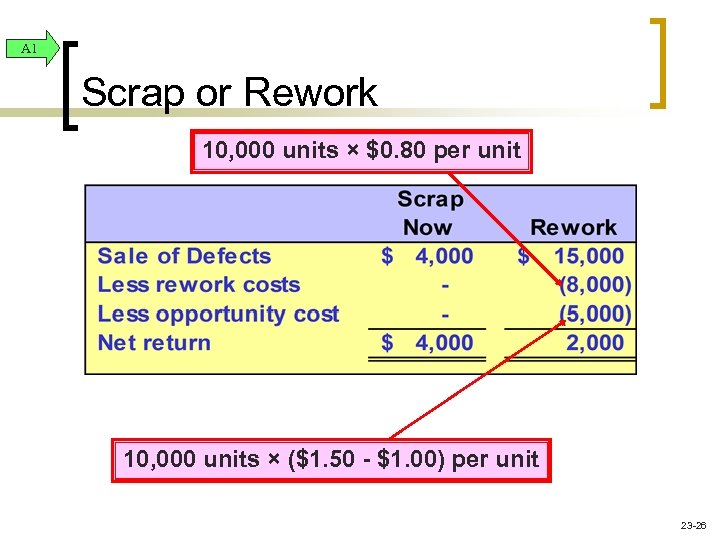 A 1 Scrap or Rework 10, 000 units × $0. 80 per unit 10, 000 units × ($1. 50 - $1. 00) per unit 23 -26
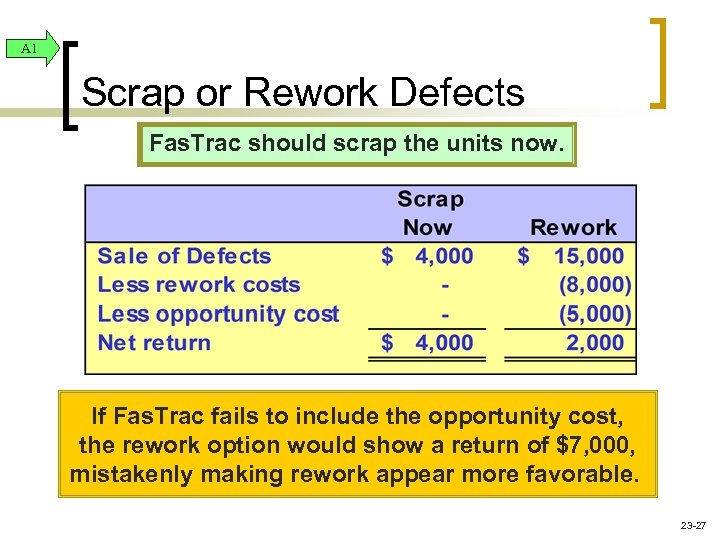 A 1 Scrap or Rework Defects Fas. Trac should scrap the units now. If Fas. Trac fails to include the opportunity cost, the rework option would show a return of $7, 000, mistakenly making rework appear more favorable. 23 -27
 A 1 Sell or Process l l Businesses are often faced with the decision to sell partially completed products or to process them to completion. As a general rule, we process further only if incremental revenues exceed incremental costs. 23 -28
 A 1 Sell or Process Fas. Trac has 40, 000 units of partially finished product Q. Processing costs to date are $30, 000. The 40, 000 unfinished units can be sold as is for $50, 000 or they can be processed further to produce finished products X, Y, and Z. The additional processing will cost $80, 000 and result in the following revenues: Continue 23 -29
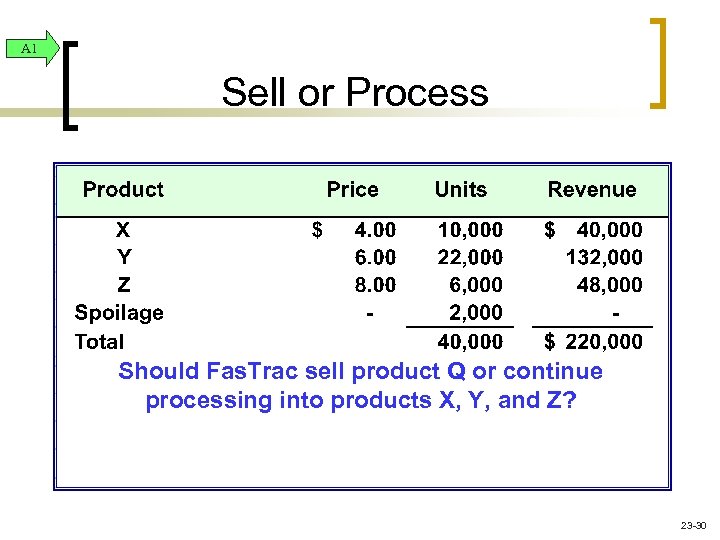 A 1 Sell or Process Should Fas. Trac sell product Q or continue processing into products X, Y, and Z? 23 -30
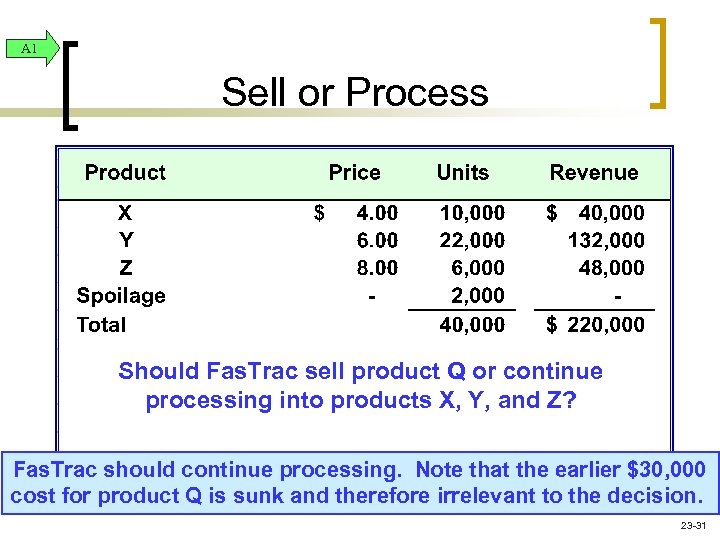 A 1 Sell or Process Should Fas. Trac sell product Q or continue processing into products X, Y, and Z? Fas. Trac should continue processing. Note that the earlier $30, 000 cost for product Q is sunk and therefore irrelevant to the decision. 23 -31
 A 1 Sales Mix Selection l When a company sells a variety of products, some are likely to be more profitable than others. l To make an informed decision, management must consider. . . l The contribution margin of each product, l The facilities required to produce each product and any constraints on the facilities, and l The demand for each product. 23 -32
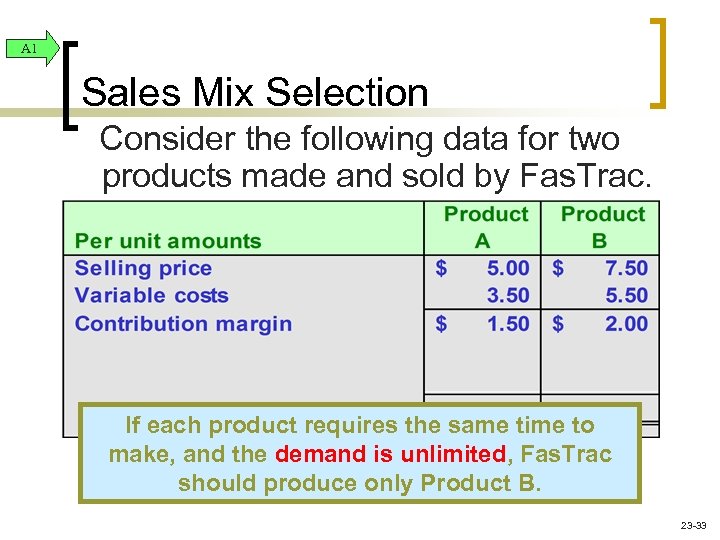 A 1 Sales Mix Selection Consider the following data for two products made and sold by Fas. Trac. If each product requires the same time to make, and the demand is unlimited, Fas. Trac should produce only Product B. 23 -33
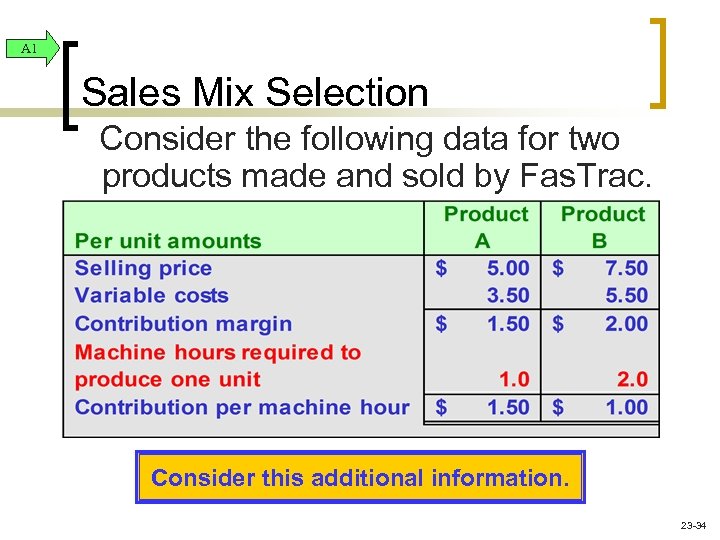 A 1 Sales Mix Selection Consider the following data for two products made and sold by Fas. Trac. Consider this additional information. 23 -34
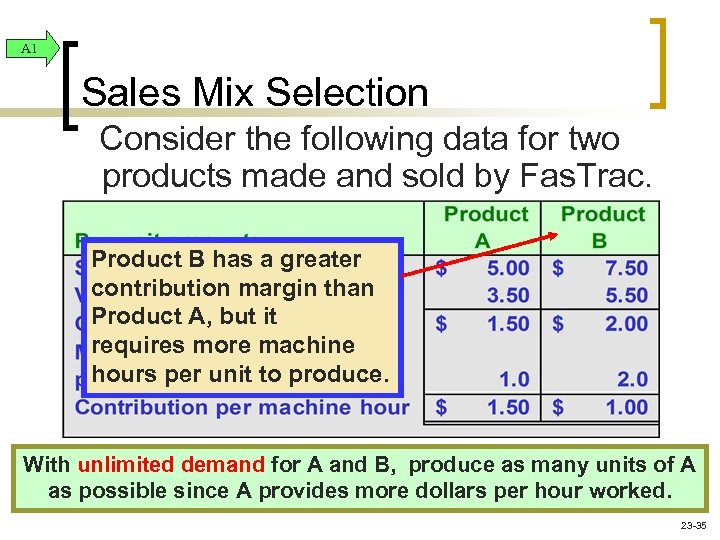 A 1 Sales Mix Selection Consider the following data for two products made and sold by Fas. Trac. Product B has a greater contribution margin than Product A, but it requires more machine hours per unit to produce. With unlimited demand for A and B, produce as many units of A as possible since A provides more dollars per hour worked. 23 -35
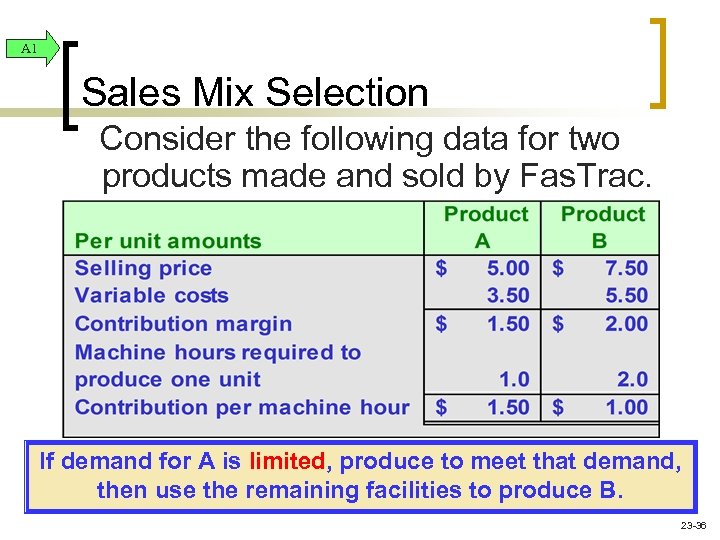 A 1 Sales Mix Selection Consider the following data for two products made and sold by Fas. Trac. If demand for A is limited, produce to meet that demand, then use the remaining facilities to produce B. 23 -36
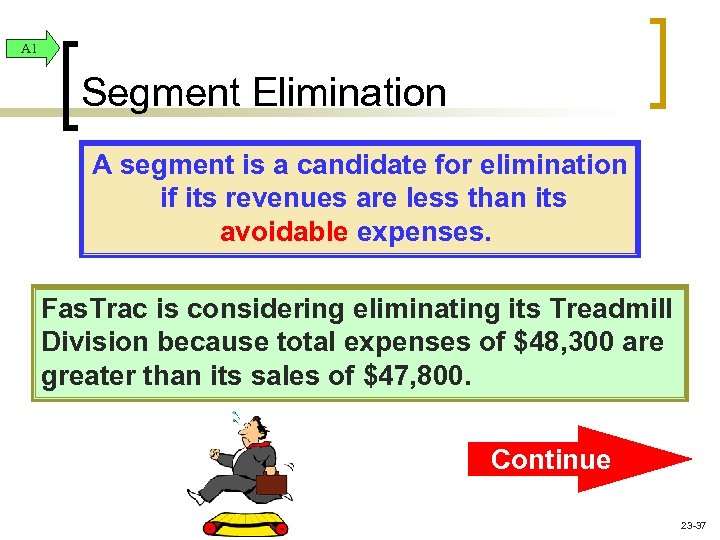 A 1 Segment Elimination A segment is a candidate for elimination if its revenues are less than its avoidable expenses. Fas. Trac is considering eliminating its Treadmill Division because total expenses of $48, 300 are greater than its sales of $47, 800. Continue 23 -37
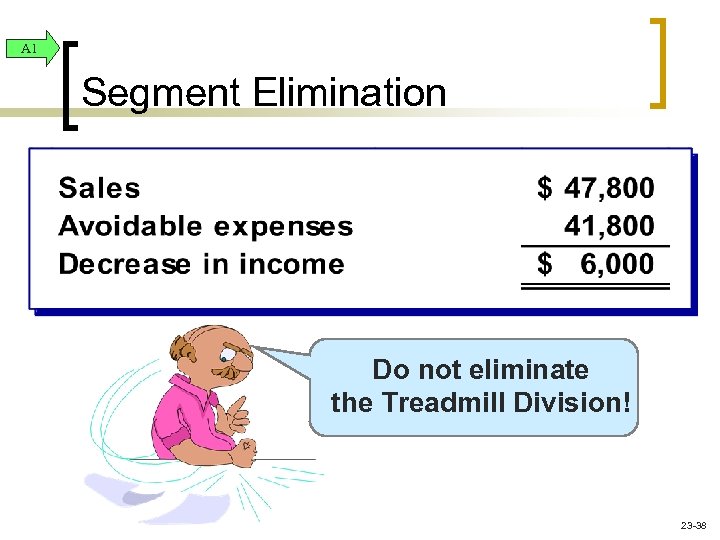 A 1 Segment Elimination Do not eliminate the Treadmill Division! 23 -38
 A 1 Qualitative Factors in Decisions Qualitative factors are involved in most all managerial decisions. For example: l Quality. l Delivery schedule. l Supplier reputation. l Employee morale. l Customer opinions. 23 -39
 A 2 Setting Product Prices Relevant costs are useful to management to assist in determining prices for special shortterm decisions. However, long run pricing decisions also need to cover both variable and fixed costs. The “cost plus” method, where management adds a markup to the costs to reach a target price is most common 23 -40
 A 2 Four Steps Using Total Cost Method: 1. Determine the total costs (production and non-production) 2. Determine the total cost per unit. 3. Determine the markup per unit. 4. Determine the selling price per unit. 23 -41
 P 1 Identify relevant costs and apply them to managerial decisions. n Historical costs are generally not relevant to decisions. Instead the relevant costs are the additional costs, called incremental costs. They can also be called differential costs. These are costs incurred if a company decides on a specific course of action. 23 -42
 End of Chapter 23 23 -43