


 Скачать презентацию FINANCIAL AND ECONOMIC ASPECTS OF ENERGY SAVING WITHIN
828cb5174faede45425b387ee55d7c0a.ppt
- Количество слайдов: 35
 "FINANCIAL AND ECONOMIC ASPECTS OF ENERGY SAVING WITHIN THE FRAMEWORK OF THE CSRC APPROACH" Workshop: "TRANSNATIONAL ENERGY SAVING NETWORKS" 13 - 14 December 2005 Vilnius-Kaunas, Lithuania Seppo Silvonen, Motiva Oy Finland The key international organisations in energy saving and the role of the EU in the regulation of energy saving
 1 THE KEY INTERNATIONAL ORGANISATIONS IN ENERGY SAVING
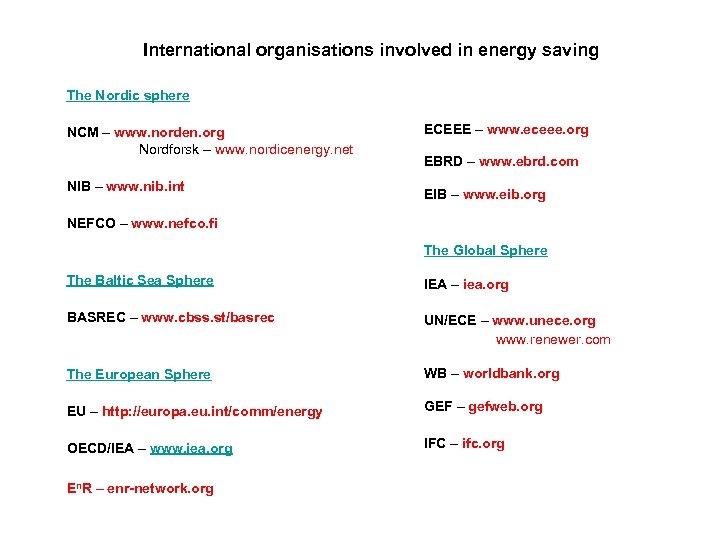 International organisations involved in energy saving The Nordic sphere NCM – www. norden. org Nordforsk – www. nordicenergy. net NIB – www. nib. int ECEEE – www. eceee. org EBRD – www. ebrd. com EIB – www. eib. org NEFCO – www. nefco. fi The Global Sphere The Baltic Sea Sphere IEA – iea. org BASREC – www. cbss. st/basrec UN/ECE – www. unece. org www. renewer. com WB – worldbank. org The European Sphere EU – http: //europa. eu. int/comm/energy OECD/IEA – www. iea. org En. R – enr-network. org GEF – gefweb. org IFC – ifc. org
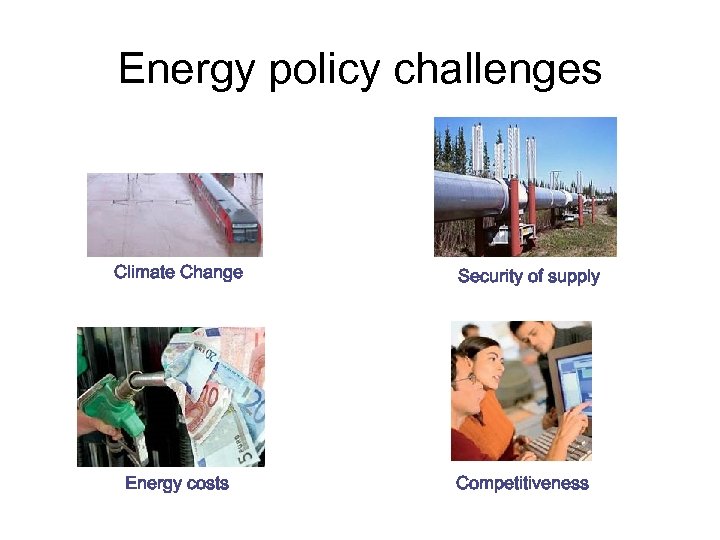 Energy policy challenges Climate Change Energy costs Security of supply Competitiveness
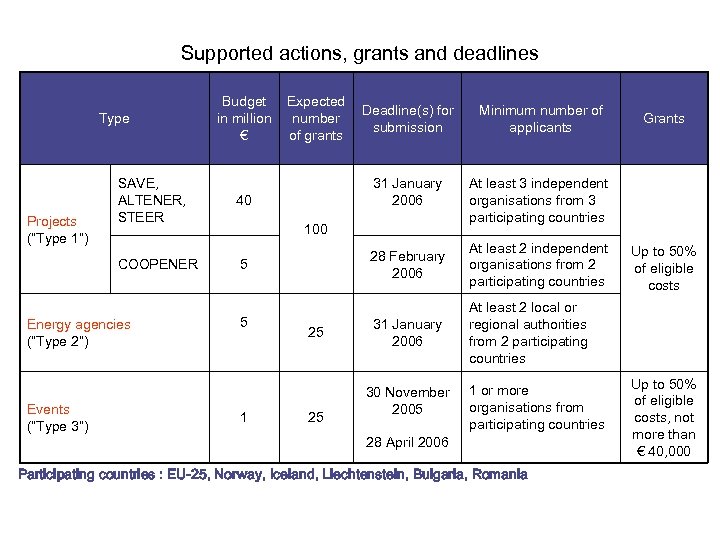 Supported actions, grants and deadlines Type Projects (“Type 1”) SAVE, ALTENER, STEER COOPENER Energy agencies (“Type 2”) Events (“Type 3”) Budget in million € Expected number of grants Minimum number of applicants 31 January 2006 40 Deadline(s) for submission At least 3 independent organisations from 3 participating countries 100 28 February 2006 5 5 1 25 25 At least 2 independent organisations from 2 participating countries 31 January 2006 Grants At least 2 local or regional authorities from 2 participating countries 30 November 2005 1 or more organisations from participating countries 28 April 2006 Participating countries : EU-25, Norway, Iceland, Liechtenstein, Bulgaria, Romania Up to 50% of eligible costs, not more than € 40, 000
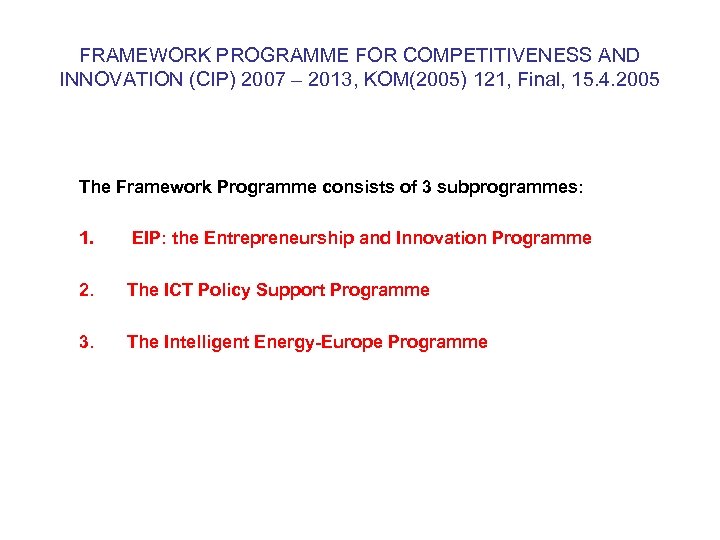 FRAMEWORK PROGRAMME FOR COMPETITIVENESS AND INNOVATION (CIP) 2007 – 2013, KOM(2005) 121, Final, 15. 4. 2005 The Framework Programme consists of 3 subprogrammes: 1. 2. EIP: the Entrepreneurship and Innovation Programme 3. The Intelligent Energy-Europe Programme The ICT Policy Support Programme
 The Intelligent Energy-Europe Programme components • SAVE • ALTENER • STEER • Initiatives covering several areas • Initiatives concerning market introduction – Launching of new, piloted technologies to the market
 PROPOSAL OF THE COMISSION FOR THE FUNDING FRAME (2007 -2013) • Programme total € 4212, 60 million • Share of IEE € 780 million
 European Energy Network
 2 THE ROLE OF THE EU IN THE REGULATION OF ENERGY SAVING
 Energiatehokkuusdirektiivin tavoitteena on… • edistää rakennusten energiatehokkuuden parantamista yhteisössä – ottaen huomioon ulkoiset ilmasto-olosuhteet, paikalliset olosuhteet sekä sisäilmastolle asetetut vaatimukset ja kustannustehokkuus.
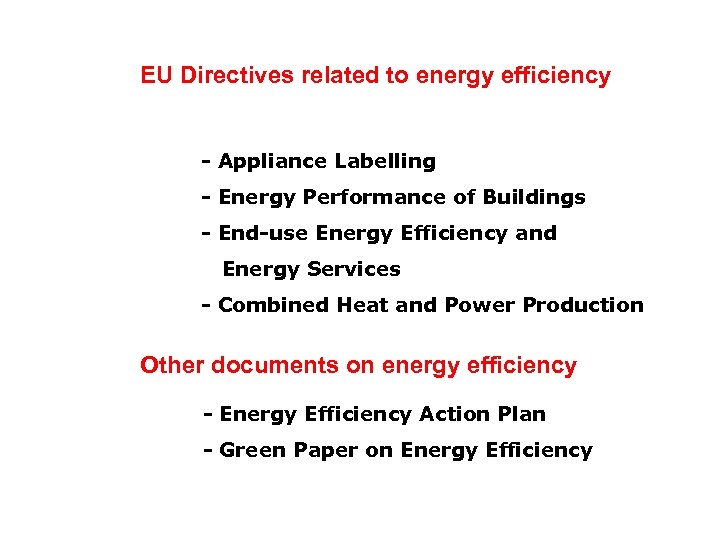 EU Directives related to energy efficiency - Appliance Labelling - Energy Performance of Buildings - End-use Energy Efficiency and Energy Services - Combined Heat and Power Production Other documents on energy efficiency - Energy Efficiency Action Plan - Green Paper on Energy Efficiency
 DIRECTIVE ON THE ENERGY PERFORMANCE OF BUILDINGS
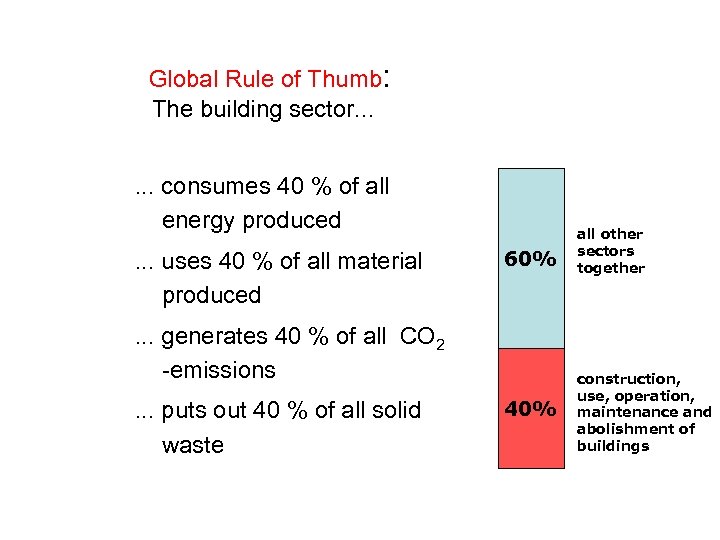 Global Rule of Thumb: The building sector. . . consumes 40 % of all energy produced. . . uses 40 % of all material produced 60% . . . generates 40 % of all CO 2 -emissions. . . puts out 40 % of all solid waste 40% all other sectors together construction, use, operation, maintenance and abolishment of buildings
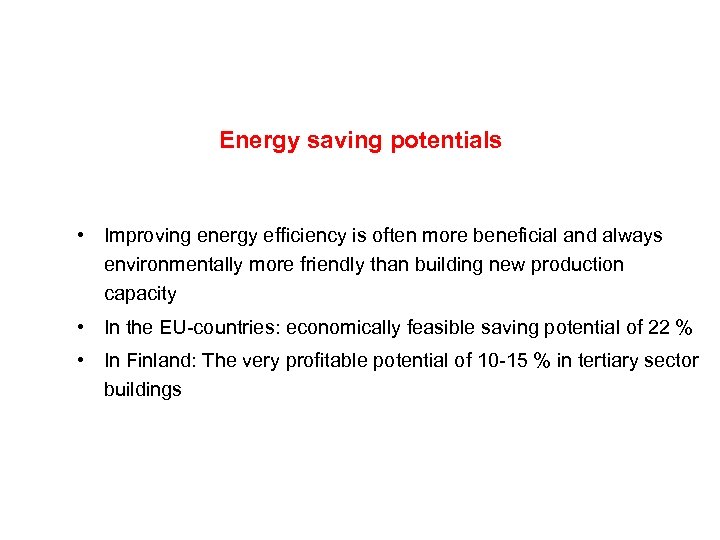 Energy saving potentials • Improving energy efficiency is often more beneficial and always environmentally more friendly than building new production capacity • In the EU-countries: economically feasible saving potential of 22 % • In Finland: The very profitable potential of 10 -15 % in tertiary sector buildings
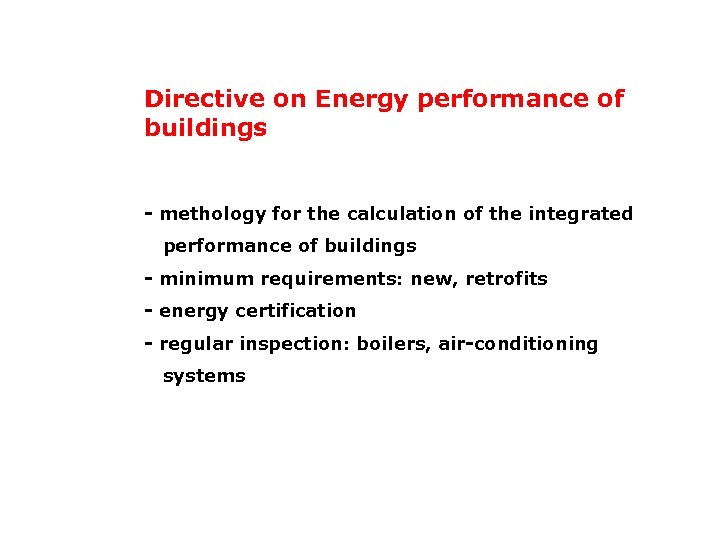 Directive on Energy performance of buildings - methology for the calculation of the integrated performance of buildings - minimum requirements: new, retrofits - energy certification - regular inspection: boilers, air-conditioning systems
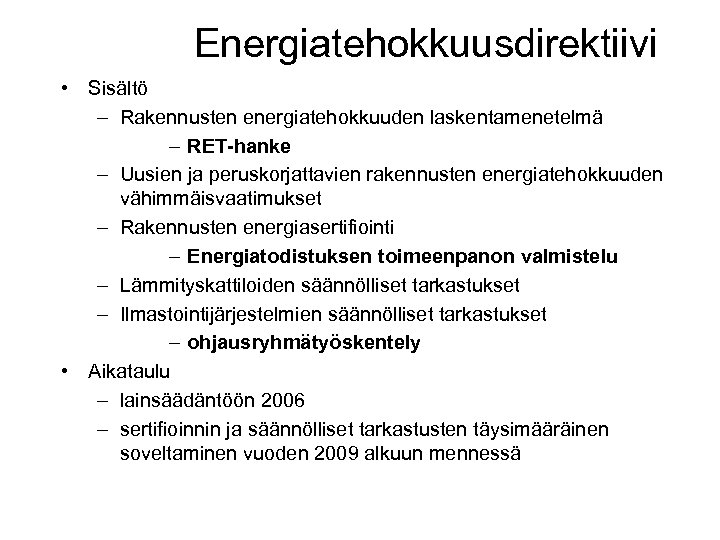 Energiatehokkuusdirektiivi • Sisältö – Rakennusten energiatehokkuuden laskentamenetelmä – RET-hanke – Uusien ja peruskorjattavien rakennusten energiatehokkuuden vähimmäisvaatimukset – Rakennusten energiasertifiointi – Energiatodistuksen toimeenpanon valmistelu – Lämmityskattiloiden säännölliset tarkastukset – Ilmastointijärjestelmien säännölliset tarkastukset – ohjausryhmätyöskentely • Aikataulu – lainsäädäntöön 2006 – sertifioinnin ja säännölliset tarkastusten täysimääräinen soveltaminen vuoden 2009 alkuun mennessä
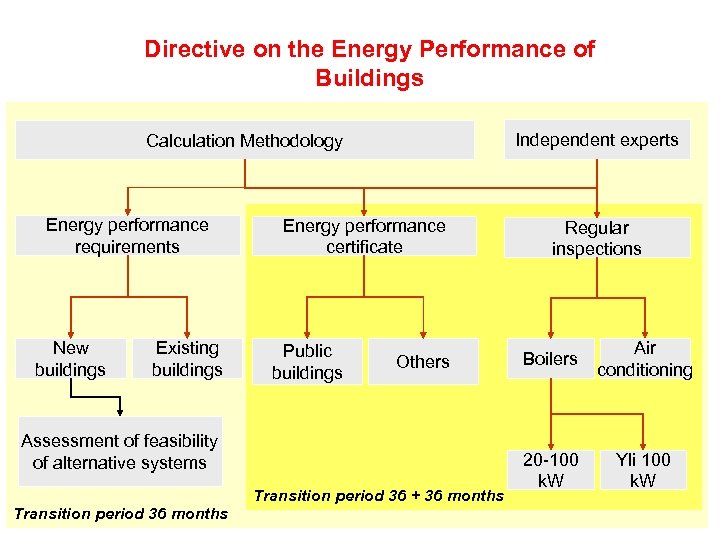 Directive on the Energy Performance of Buildings Independent experts Calculation Methodology Energy performance requirements New buildings Existing buildings Energy performance certificate Public buildings Others Assessment of feasibility of alternative systems Transition period 36 + 36 months Transition period 36 months Regular inspections Boilers Air conditioning 20 -100 k. W Yli 100 k. W
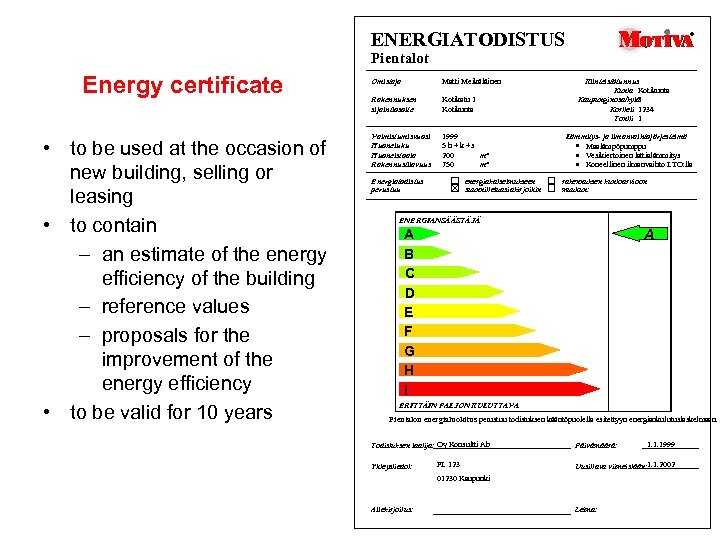 ENERGIATODISTUS Pientalot Energy certificate • to be used at the occasion of new building, selling or leasing • to contain – an estimate of the energy efficiency of the building – reference values – proposals for the improvement of the energy efficiency • to be valid for 10 years Omistaja Matti Meikäläinen Rakennuksen sijaintiosoite Kotikatu 1 Kotikunta Valmistumisvuosi Huoneluku Huoneistoala Rakennustilavuus 1999 5 h + k +s 200 m² 750 m³ Energiatodistus perustuu energiakatselmukseen suunnitteluasiakirjoihin Kiinteistötunnus Kunta Kotikunta Kaupunginosa/kylä 1 Kortteli 1234 Tontti 1 Lämmitys- ja ilmanvaihtojärjestelmä · Maalämpöpumppu · Vesikiertoinen lattialämmitys · Koneellinen ilmanvaihto LTO: lla rakennuksen kuntoarvioon muuhun: ENERGIANSÄÄSTÄJÄ A B C D E F G H I A ERITTÄIN PALJON KULUTTAVA Pientalon energialuokitus perustuu todistuksen kääntöpuolella esitettyyn energiankulutuslaskelmaan. Todistuksen laatija: Oy Konsultti Ab Yhteystiedot: PL 123 Päivämäärä: Uusittava viimeistään: 1. 1. 2002 01230 Kaupunki Allekirjoitus: 1. 1. 1999 Leima:
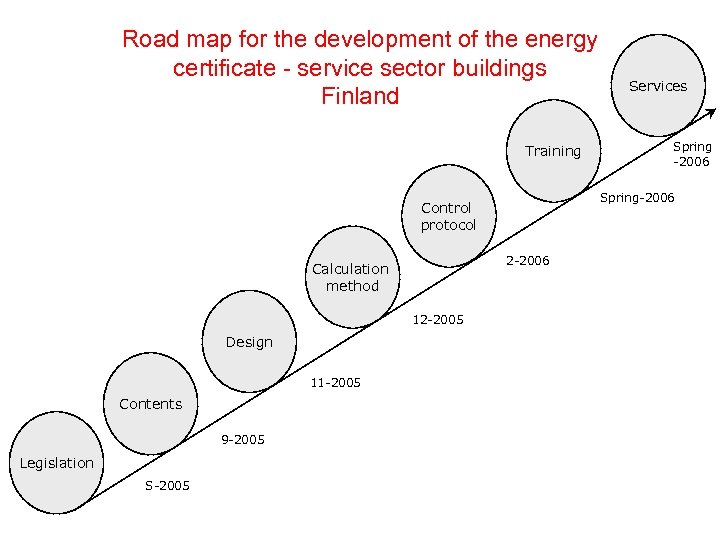 Road map for the development of the energy certificate - service sector buildings Finland Training 2 -2006 12 -2005 Design 11 -2005 Contents 9 -2005 Legislation S-2005 Spring -2006 Spring-2006 Control protocol Calculation method Services
 DIRECTIVE ON END-USE EFFICIENCY AND ENERGY SERVICES
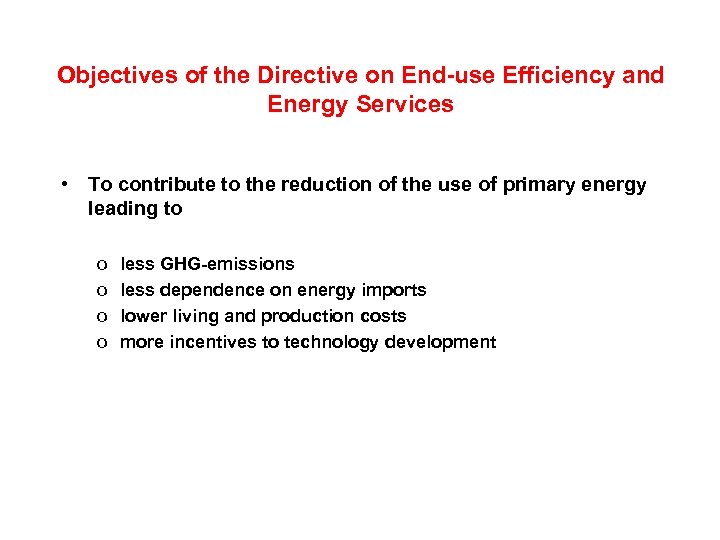 Objectives of the Directive on End-use Efficiency and Energy Services • To contribute to the reduction of the use of primary energy leading to o o less GHG-emissions less dependence on energy imports lower living and production costs more incentives to technology development
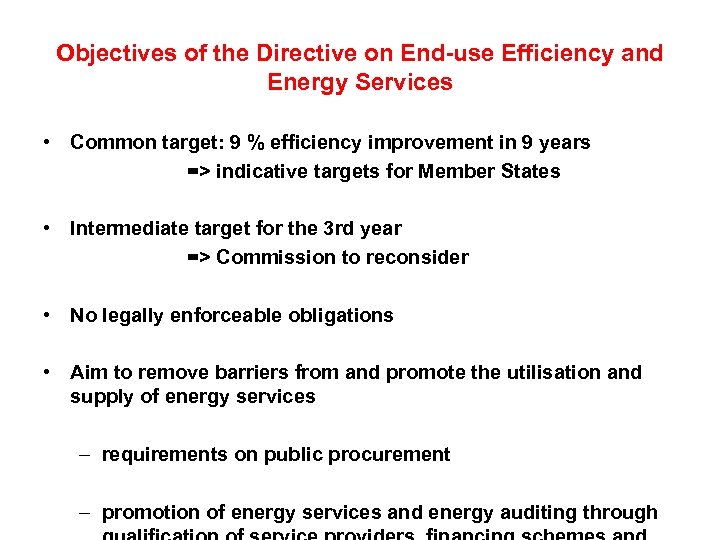 Objectives of the Directive on End-use Efficiency and Energy Services • Common target: 9 % efficiency improvement in 9 years => indicative targets for Member States • Intermediate target for the 3 rd year => Commission to reconsider • No legally enforceable obligations • Aim to remove barriers from and promote the utilisation and supply of energy services – requirements on public procurement – promotion of energy services and energy auditing through
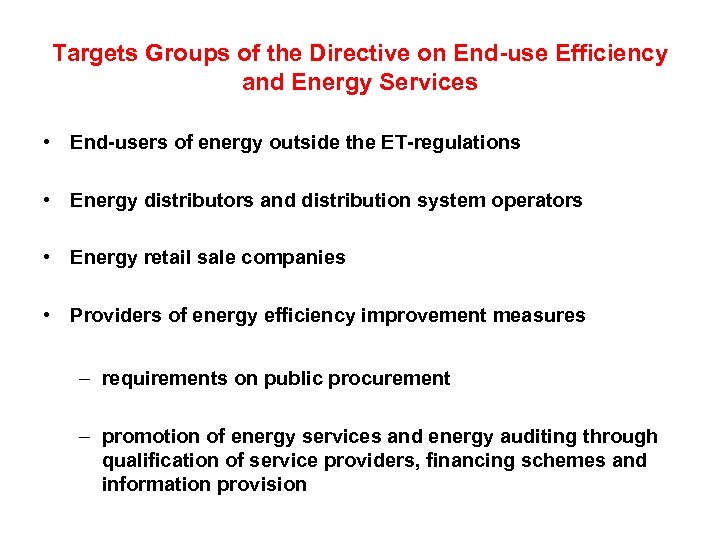 Targets Groups of the Directive on End-use Efficiency and Energy Services • End-users of energy outside the ET-regulations • Energy distributors and distribution system operators • Energy retail sale companies • Providers of energy efficiency improvement measures – requirements on public procurement – promotion of energy services and energy auditing through qualification of service providers, financing schemes and information provision
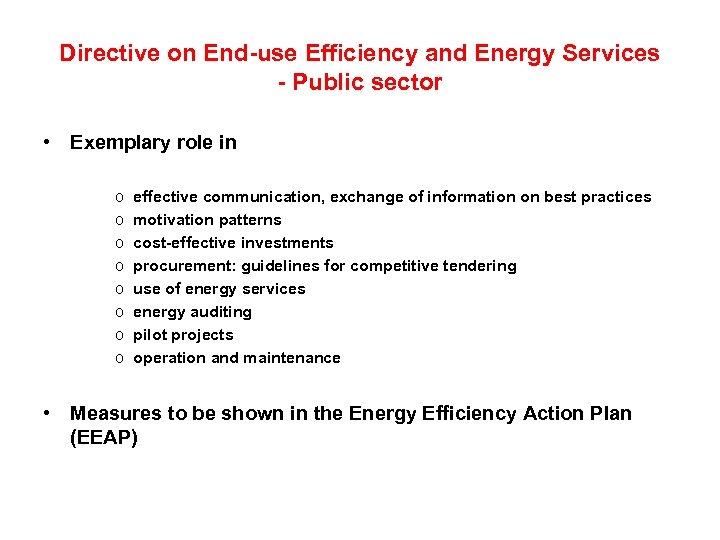 Directive on End-use Efficiency and Energy Services - Public sector • Exemplary role in o o o o effective communication, exchange of information on best practices motivation patterns cost-effective investments procurement: guidelines for competitive tendering use of energy services energy auditing pilot projects operation and maintenance • Measures to be shown in the Energy Efficiency Action Plan (EEAP)
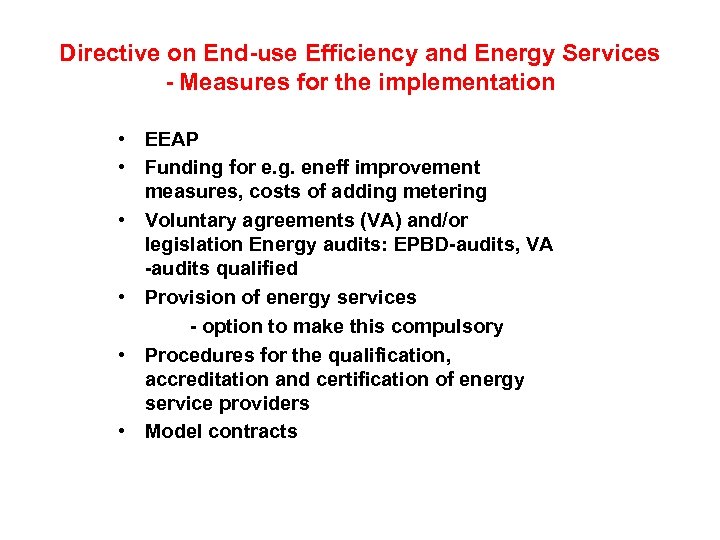 Directive on End-use Efficiency and Energy Services - Measures for the implementation • EEAP • Funding for e. g. eneff improvement measures, costs of adding metering • Voluntary agreements (VA) and/or legislation Energy audits: EPBD-audits, VA -audits qualified • Provision of energy services - option to make this compulsory • Procedures for the qualification, accreditation and certification of energy service providers • Model contracts
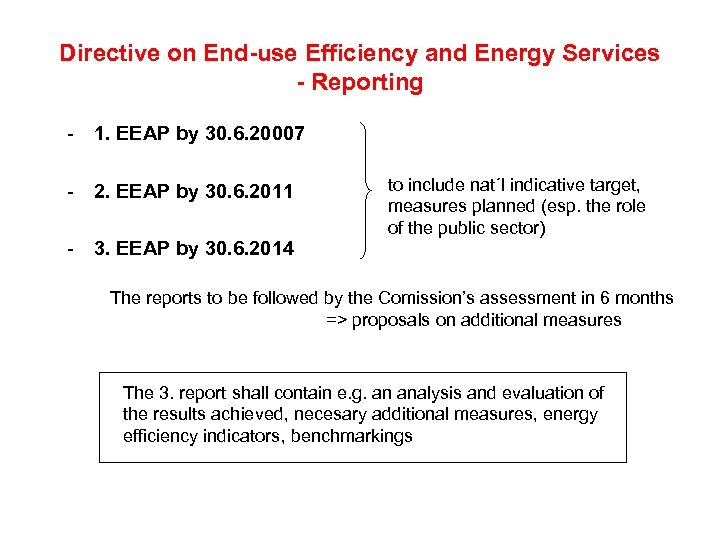 Directive on End-use Efficiency and Energy Services - Reporting - 1. EEAP by 30. 6. 20007 - 2. EEAP by 30. 6. 2011 - 3. EEAP by 30. 6. 2014 to include nat´l indicative target, measures planned (esp. the role of the public sector) The reports to be followed by the Comission’s assessment in 6 months => proposals on additional measures The 3. report shall contain e. g. an analysis and evaluation of the results achieved, necesary additional measures, energy efficiency indicators, benchmarkings
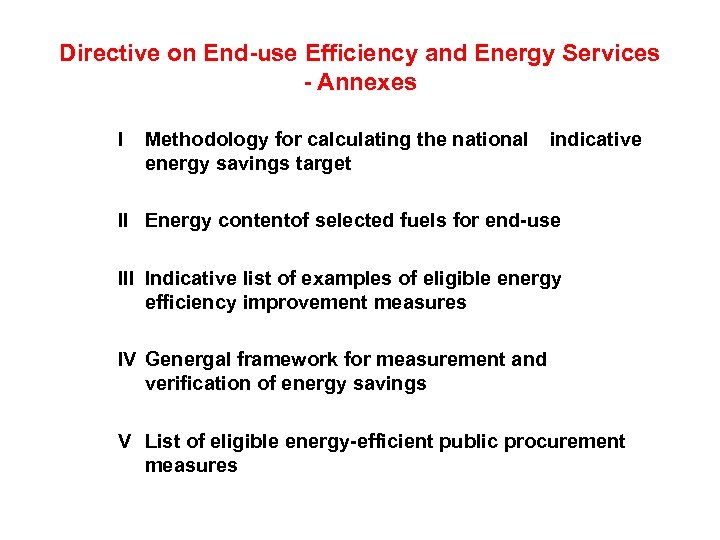 Directive on End-use Efficiency and Energy Services - Annexes I Methodology for calculating the national indicative energy savings target II Energy contentof selected fuels for end-use III Indicative list of examples of eligible energy efficiency improvement measures IV Genergal framework for measurement and verification of energy savings V List of eligible energy-efficient public procurement measures
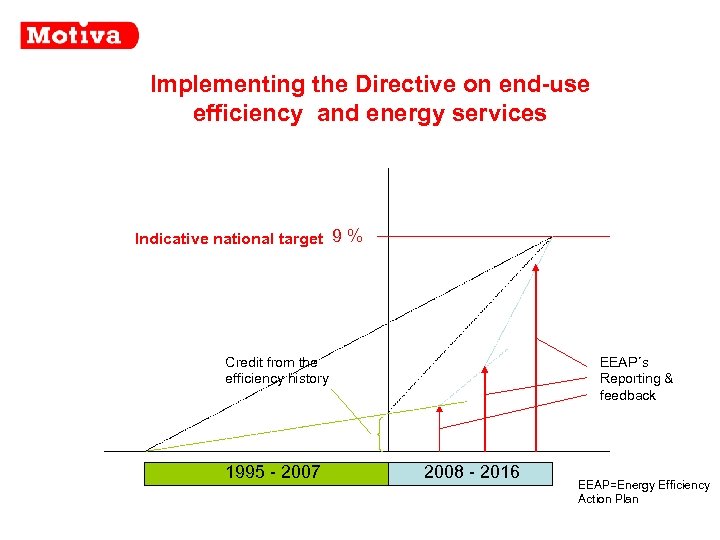 Implementing the Directive on end-use efficiency and energy services Indicative national target 9 % Credit from the efficiency history 1995 - 2007 EEAP´s Reporting & feedback 2008 - 2016 EEAP=Energy Efficiency Action Plan
 Other EU-documents on energy efficiency
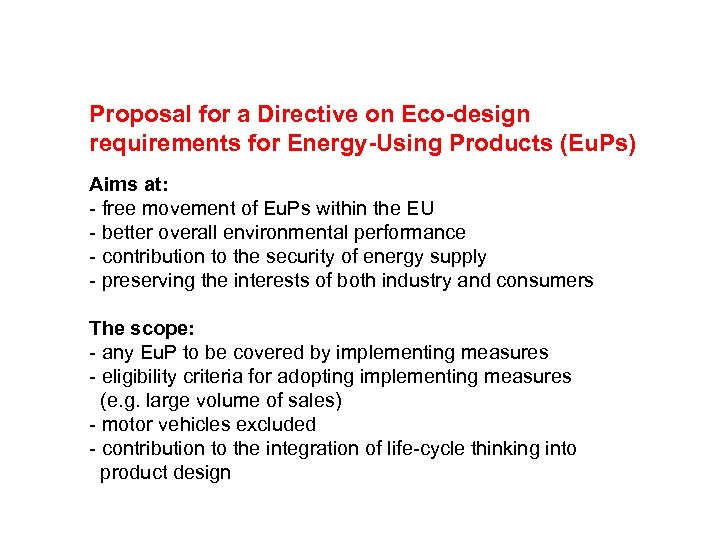 Proposal for a Directive on Eco-design requirements for Energy-Using Products (Eu. Ps) Aims at: - free movement of Eu. Ps within the EU - better overall environmental performance - contribution to the security of energy supply - preserving the interests of both industry and consumers The scope: - any Eu. P to be covered by implementing measures - eligibility criteria for adopting implementing measures (e. g. large volume of sales) - motor vehicles excluded - contribution to the integration of life-cycle thinking into product design
 Green Paper on energy efficiency Contents A – Identifying the obstacles o o specific measures: financial obstacles, need for energy services need for action by public authorities the external costs information and education B – A European intiative o Action at Community level o National level o Industry o Transport o Regional and local level o A strategy open to the world
 More information on new direction of energy use: www. motiva. fi