


 Скачать презентацию Financial Advice Roman Inderst University of Frankfurt IMFS
ae4004688bb184766ccff9db4af8b0fe.ppt
- Количество слайдов: 22
 Financial Advice Roman Inderst University of Frankfurt (IMFS) & Imperial College London Based on: „Consumer Protection in Markets with Advice“ (with M. Ottaviani, forthcoming in „Competition Policy International“) Roman Inderst – Financial Advice 1
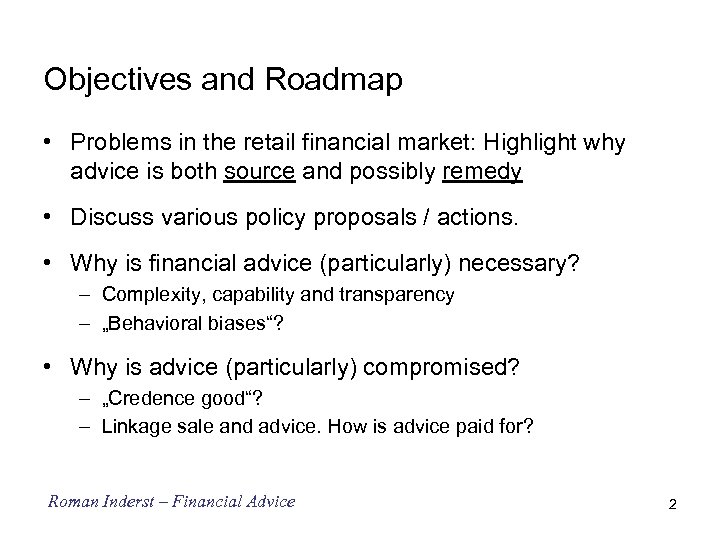 Objectives and Roadmap • Problems in the retail financial market: Highlight why advice is both source and possibly remedy • Discuss various policy proposals / actions. • Why is financial advice (particularly) necessary? – Complexity, capability and transparency – „Behavioral biases“? • Why is advice (particularly) compromised? – „Credence good“? – Linkage sale and advice. How is advice paid for? Roman Inderst – Financial Advice 2
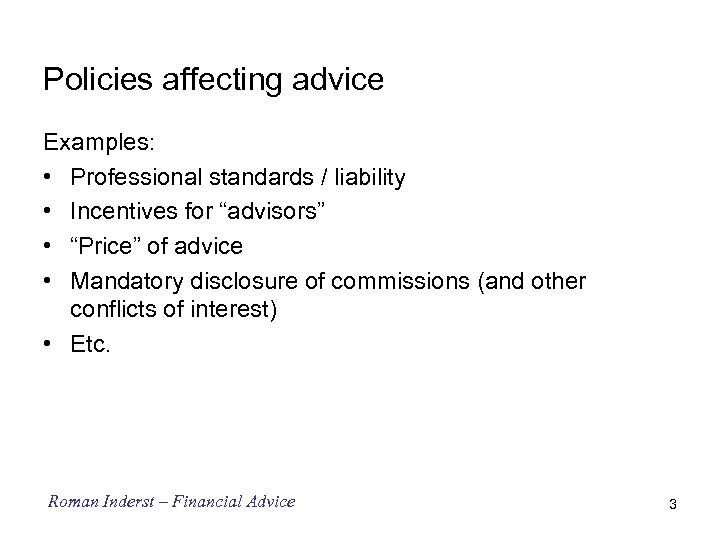 Policies affecting advice Examples: • Professional standards / liability • Incentives for “advisors” • “Price” of advice • Mandatory disclosure of commissions (and other conflicts of interest) • Etc. Roman Inderst – Financial Advice 3
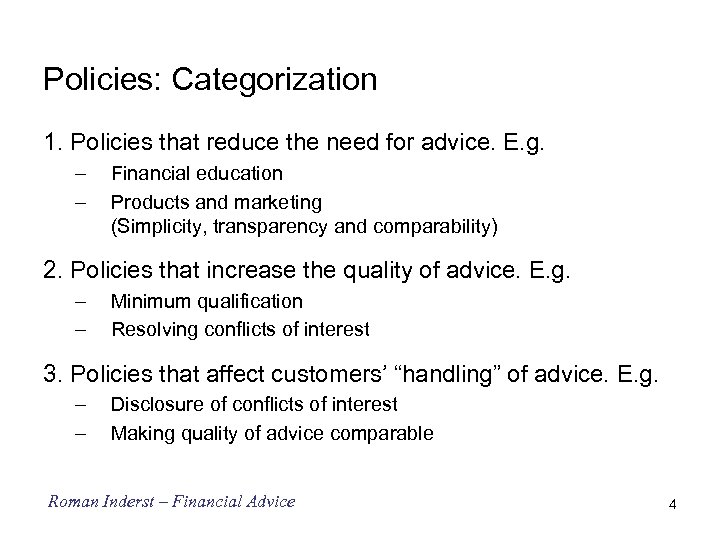 Policies: Categorization 1. Policies that reduce the need for advice. E. g. – – Financial education Products and marketing (Simplicity, transparency and comparability) 2. Policies that increase the quality of advice. E. g. – – Minimum qualification Resolving conflicts of interest 3. Policies that affect customers’ “handling” of advice. E. g. – – Disclosure of conflicts of interest Making quality of advice comparable Roman Inderst – Financial Advice 4
 Financial Advice: Background Caveat: Focus is on general insights, not on specificities of particular products and markets! 1. Pervasiveness of advice 2. Financial capability and „biases“ 3. Paying for advice 4. Customer „naivité“ Roman Inderst – Financial Advice 5
 Pervasiveness of Advice • Increasing evidence that advice plays a key role for financial products. E. g. , investment: – US survey: 80% „obtain financial advice“. – Eurobarometer 2003: (Vast) majority in most countries expects financial institutions to provide advice. • But do people rely on financial advice? – E. g. , micro-level portfolio/trading and survey data for large German bank shows that customers who report to rely always on advice generate 20% higher revenenues for bank through more trading („churning“ ? ) and more „incentivized“ products. – Who relies on advice? Less infomred. No perception of conflict of interest. Older. Roman Inderst – Financial Advice 6
 Financial Capability and “Biases” • Capability and sophistication: – Role of specific knowledge vs. general education; and of experience vs. cognitive skills? – “Necessary” level (endogenous!)? Existing level? – Are policies targeted at “education” effective? Roman Inderst – Financial Advice 7
 Financial Capability and “Biases” • “Biases” (Behavioral economics) – General perspective: Decision-making deviates from “standard model” as people “process information differently” (e. g. , overconfidence, “salience”/inattention) and have “different preferences” (e. g. , procrastination, reference points, mental accounting) – Relevance of some “biases” is product specific (investment/saving, consumer credit, etc. ). • Enhanced need for (unbiased) advice? But: Does face-to-face advice create new problems? – Undue “influence” on customer’s decision? – Use of “sales techniques”, “perceived expertise” etc. Roman Inderst – Financial Advice 8
 Paying for Advice • Though differs between products and markets, advice is commonly paid for „indirectly“: Higher product prices and commissions! • Key conceptual difference: How does advice “work”? – “Pure credence good”: Unsophisticated customer. E. g. advice on affordability! – “Pure provision of hard information”: Sophisticated customer. Roman Inderst – Financial Advice 9
 Paying for Advice • If advice is “credence good”, then “commissions” are bound to lead to biased advice: – Immediate when decision is between purchasing or not. – Possible when choice is between different products. • Evidence? From investment products – Underperformance of mutual founds sold through broker/agent networks. – Higher fees (“loads”) Induce higher distribution. – Rely more on advice More trading, higher bank revenues. Roman Inderst – Financial Advice 10
 Customer naivité / credulity ? • Frequent claims that customers (wrongly) view brokers as “trusted” advisors. • Evidence that this is “too naïve” ? – Evidence on investors’ reaction to analyst recommendations – “Trusting” customers rely more on advice and generate higher revenues – Experimental evidence of “blind trust” and “unsufficient discounting” of clearly biased advice • But: Asking people directly about prevalence of commissions is possibly misleading! “Salience” when they buy? Size? Roman Inderst – Financial Advice 11
 Making Advice Work in Financial Markets How to pay for advice? Commission puzzle? • The “not so benign” view: – Starting point: Customer naivité! Underestimate true probability with which they will end up purchasing (particular) product! – Shifting payment from fixed fee for advice into higher product prices (and commissions!) reduces “perceived payment”. – Absence of fixed fee = Exploitative device. – When customers remain naïve, competition is no remedy! Roman Inderst – Financial Advice 12
 Paying for Advice • But: Interference can backfire when customers are wary! – Key: Quality of advisor’s information is endogenous! – Remuneration must ensure both information acquisition and unbiased advice. Trade-off, in particular, when advisor has no “intrinsic interest” • Ilustration: “Sophisticated” customer’s view of advice – Ex-ante customer is uncertain whether / which product(s) provide “best fit”. More information is valuable and can increase the probability of a purchase. – Advisor’s “margin” can incentivize information acquisition. Roman Inderst – Financial Advice 13
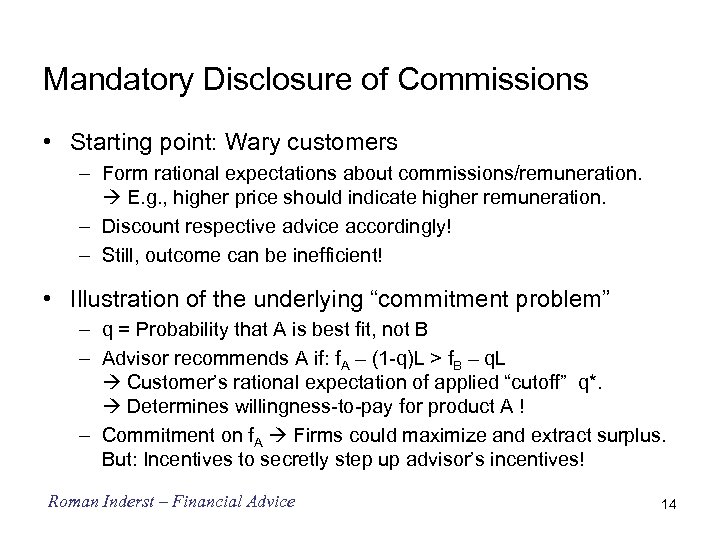 Mandatory Disclosure of Commissions • Starting point: Wary customers – Form rational expectations about commissions/remuneration. E. g. , higher price should indicate higher remuneration. – Discount respective advice accordingly! – Still, outcome can be inefficient! • Illustration of the underlying “commitment problem” – q = Probability that A is best fit, not B – Advisor recommends A if: f. A – (1 -q)L > f. B – q. L Customer’s rational expectation of applied “cutoff” q*. Determines willingness-to-pay for product A ! – Commitment on f. A Firms could maximize and extract surplus. But: Incentives to secretly step up advisor’s incentives! Roman Inderst – Financial Advice 14
 Disclosure (cont. ) • Are firms’ incentives to disclose commissions aligned with social efficiency? Not so when customers are “naïve”! Disclosure could make them “wary”! • However, drawbacks of mandatory disclosure: – Information overload? “Wrong” information salient? – “Moral licence” for advisors? – Dampening of commissions also dampens their beneficial effects! E. g. commissions reward customer acquisition. Underprovision of such incentives, e. g. , as “common agency” problem, as no internalization of customer surplus etc. Roman Inderst – Financial Advice 15
 Other forms of regulating remuneration • E. g. structure: Upfront vs. trail – Most obvious for insurance products Cancellation. – Credit products? Link to default? – Connected to contract regulation, e. g. , termination/cancellation clauses. Roman Inderst – Financial Advice 16
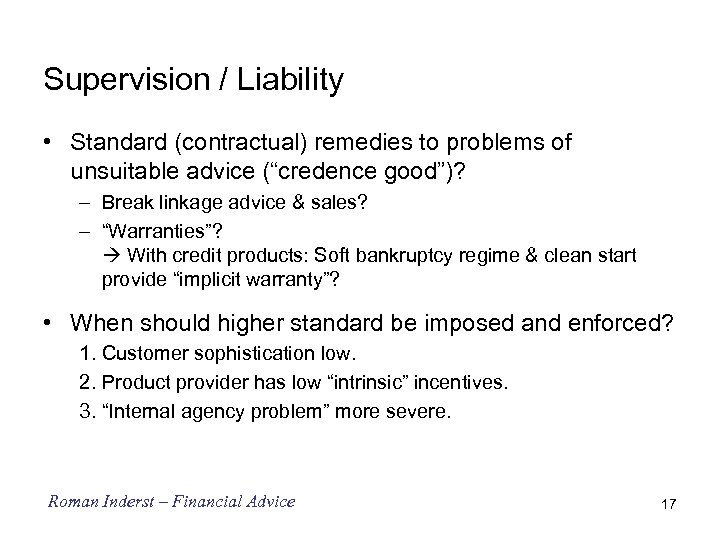 Supervision / Liability • Standard (contractual) remedies to problems of unsuitable advice (“credence good”)? – Break linkage advice & sales? – “Warranties”? With credit products: Soft bankruptcy regime & clean start provide “implicit warranty”? • When should higher standard be imposed and enforced? 1. Customer sophistication low. 2. Product provider has low “intrinsic” incentives. 3. “Internal agency problem” more severe. Roman Inderst – Financial Advice 17
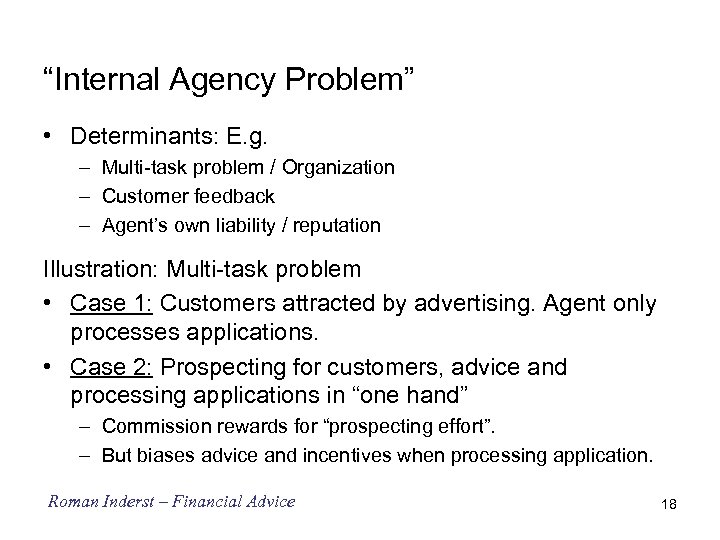 “Internal Agency Problem” • Determinants: E. g. – Multi-task problem / Organization – Customer feedback – Agent’s own liability / reputation Illustration: Multi-task problem • Case 1: Customers attracted by advertising. Agent only processes applications. • Case 2: Prospecting for customers, advice and processing applications in “one hand” – Commission rewards for “prospecting effort”. – But biases advice and incentives when processing application. Roman Inderst – Financial Advice 18
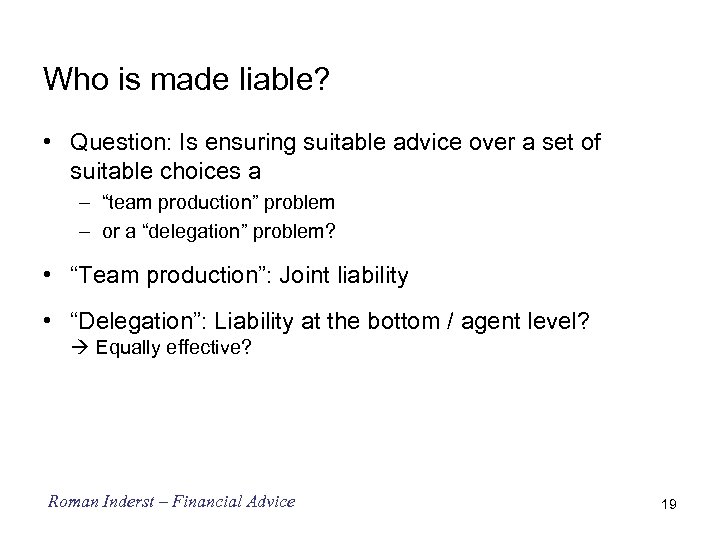 Who is made liable? • Question: Is ensuring suitable advice over a set of suitable choices a – “team production” problem – or a “delegation” problem? • “Team production”: Joint liability • “Delegation”: Liability at the bottom / agent level? Equally effective? Roman Inderst – Financial Advice 19
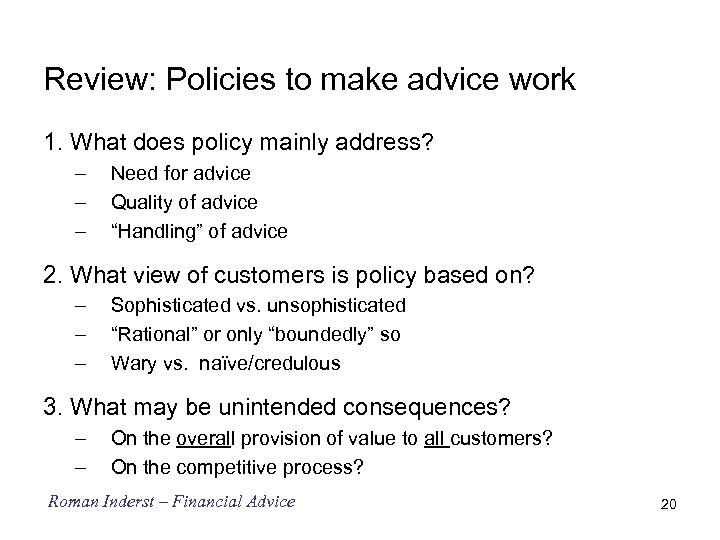 Review: Policies to make advice work 1. What does policy mainly address? – – – Need for advice Quality of advice “Handling” of advice 2. What view of customers is policy based on? – – – Sophisticated vs. unsophisticated “Rational” or only “boundedly” so Wary vs. naïve/credulous 3. What may be unintended consequences? – – On the overall provision of value to all customers? On the competitive process? Roman Inderst – Financial Advice 20
 Concluding Remarks • For many financial products functioning advice may be crucial to provide real customer value. • But advice “works” differently for different customer groups and products. Also different likelihood of persistently compromised value. Different policies relevant (with different intended and unintended consequences). • “Segmentation” approach? Roman Inderst – Financial Advice 21
 Financial Advice Roman Inderst University of Frankfurt (IMFS) & Imperial College London Based on: „Consumer Protection in Markets with Advice“ (with M. Ottaviani, forthcoming in „Competition Policy International“) Roman Inderst – Financial Advice 22