


 Скачать презентацию FINANCE IN A CANADIAN SETTING Sixth Canadian Edition
a091b28167dba38ae770bb639503e1e9.ppt
- Количество слайдов: 30
 FINANCE IN A CANADIAN SETTING Sixth Canadian Edition Lusztig, Cleary, Schwab
 CHAPTER SIX Bond and Common Share Valuation
 Learning Objectives 1. 2. Name the five variables of a debt contract. Describe how to estimate bond prices and bond yields. 3. Discuss the three leading theories on the term structure of interest rates, and explain how they differ. 4. Explain the dividend discount model (DDM) and how financial officers use it to value shares.
 Introduction n • • Topics explored and discussed include: valuation of bonds and common share Rates at which debt instruments are discounted and determined through the financial markets valuation of bonds and common share without explicit consideration of risk Risk premiums associated with interest rates
 Valuation of Bonds n n n Bond – a debt instrument that entitles the owner to specified periodic interest payments and eventually to the repayment of principle at the stated date of maturity Coupon rate – the rate specified on the original contract in relation to the face value of the debt Effective yield or yield to maturity – the yield investors realize by holding to maturity a debt contract that they bought at a particular market price
 Valuation of Bonds n Debt contracts are characterized by • The face value • Stated interest rate • Time pattern of repayment under the debt contract • Current market price of the debt contract • Effective yield of the debt contract, based on its current price
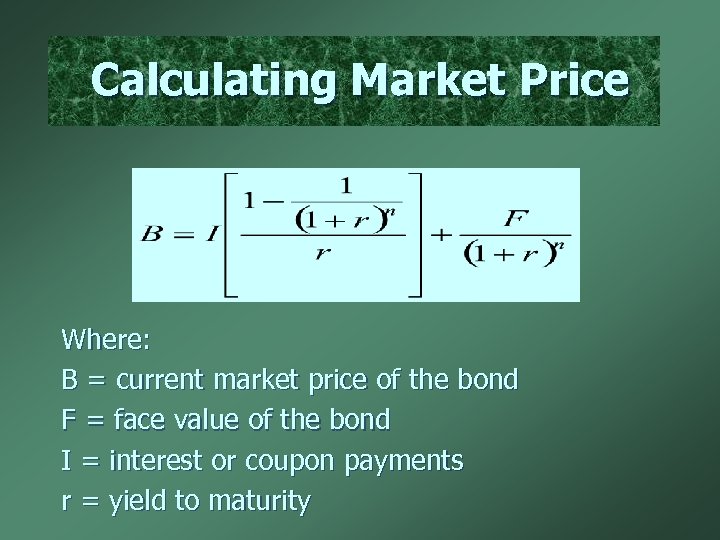 Calculating Market Price Where: B = current market price of the bond F = face value of the bond I = interest or coupon payments r = yield to maturity
 Semi-annual coupons n • • • In calculating the bond price for semi-annual coupons the following changes must be recognized: Divide the annual coupon by two to determine the amount of semi-annual coupon Divide the market yield by two to obtain the six-month market yield Multiply the number of years to maturity by two to obtain the number of semi-annual periods to maturity
 Perpetual Bonds n n n Zero-coupon bond (or strip bond) do not pay any interest during its life Zeros are created when financial intermediaries buy traditional bonds and strip the cash flow from them and sell the coupon and cash flow separately Purchaser pays less for zeros and receives face value at maturity
 Bond Yields n Yield to Maturity - the yield investors realize by holding to maturity a debt contract that they bought at a particular market price. The yield captures both the coupon income and the capital gain or loss realized by purchasing the bond at a price different from its face value n Two methods in calculating YTM include: 1. 2. Linear interpolation Approximation formula
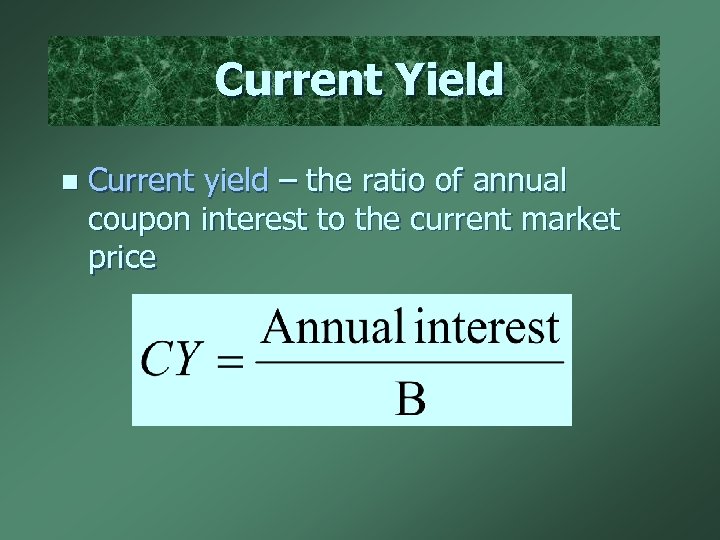 Current Yield n Current yield – the ratio of annual coupon interest to the current market price
 Determinants of Interest Rates n The effective yield of a debt contract is established by the general economic factors that effect the overall level of interest rates and by such features of the debt contract as its maturity, currency denomination, and risk of default.
 Determinants of Interest Rates n Interest - the price paid for borrowing money • Changes in interest is measured in basis points. • One basis point = 1/100 th of one percent
 Determinants of Interest Rates n Loanable fund theory –the relationship between the supply and demand for funds where the supply of capital with interest rates and the demand for funds as the costs . At equilibrium interest rates are such that demand equals supply.
 Determinants of Interest Rates Real risk-free rate interest – the basic interest rate that must be offered to individuals to persuade them to save rather than consume and is not affected by price changes or risk factors n Nominal interest rates – represent the real rate (RR) plus the expected inflation n
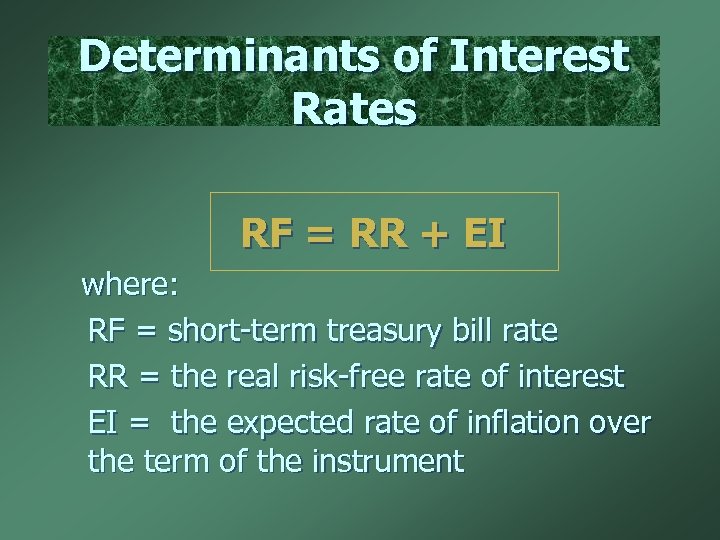 Determinants of Interest Rates RF = RR + EI where: RF = short-term treasury bill rate RR = the real risk-free rate of interest EI = the expected rate of inflation over the term of the instrument
 Term Structure of Interest Rates – the relationship between time to maturity and yields for a particular category of bonds at a particular time n Yield curve – the graphical depiction of the relationship between yields and time to maturity n
 Term Structure of Interest Rates n The three most common term structure of interest rate theories include: 1. Expectations theory 2. Liquidity preference theory 3. Market segmentation theory
 Common Share Valuation n Two basic approaches are used in fundamental security analysis: 1. Present Value using the DDM 2. Relative valuation methods which values shares relative to some company characteristics based on a multiple that is deemed appropriate
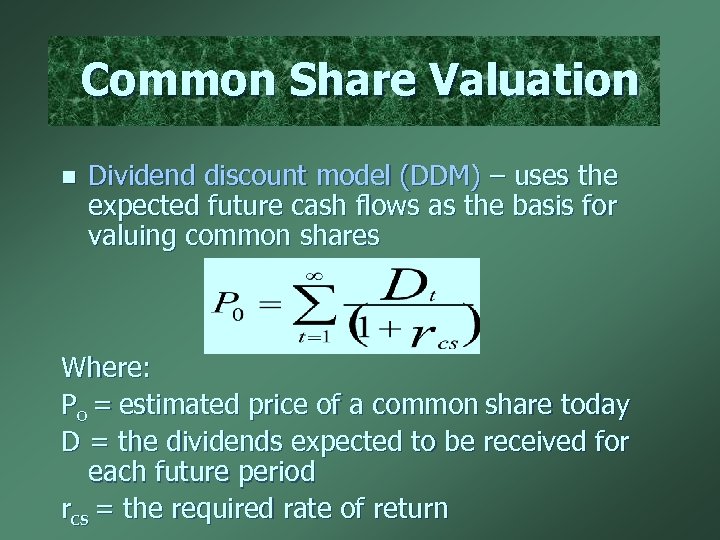 Common Share Valuation n Dividend discount model (DDM) – uses the expected future cash flows as the basis for valuing common shares Where: Po = estimated price of a common share today D = the dividends expected to be received for each future period rcs = the required rate of return
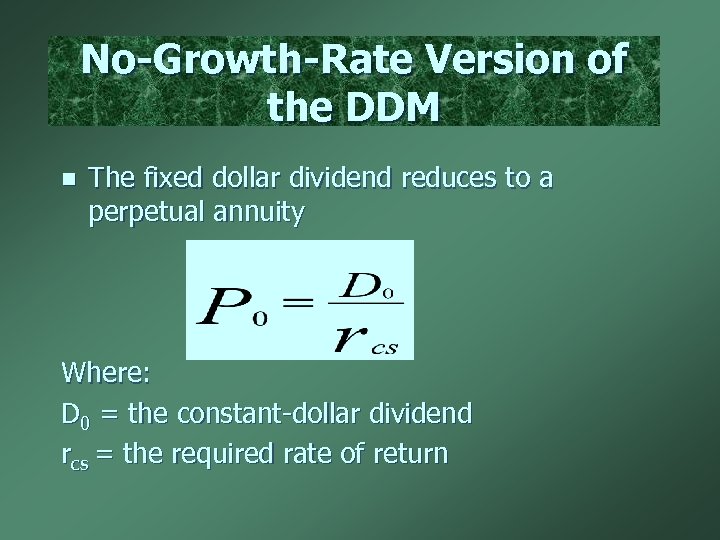 No-Growth-Rate Version of the DDM n The fixed dollar dividend reduces to a perpetual annuity Where: D 0 = the constant-dollar dividend rcs = the required rate of return
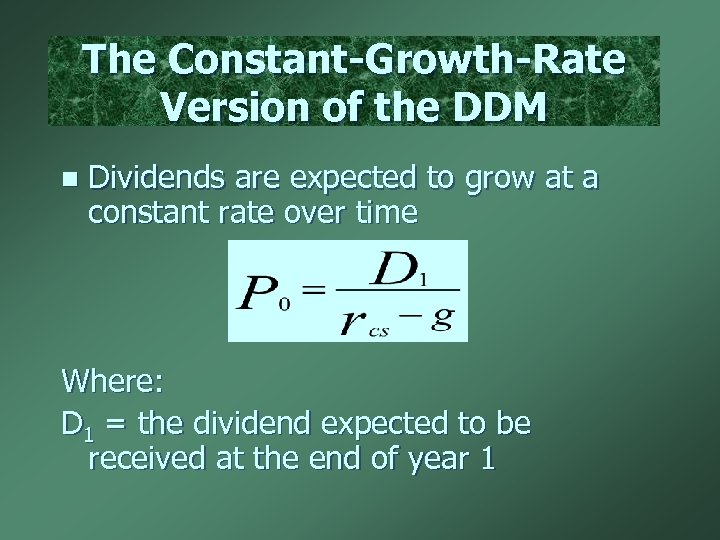 The Constant-Growth-Rate Version of the DDM n Dividends are expected to grow at a constant rate over time Where: D 1 = the dividend expected to be received at the end of year 1
 Estimating the Growth Rate in Future Dividends n Three estimates are required in order to implement the constant-growth-rate of the DDM: 1. The expected dividend at the end of the year 2. The required rate of return by shareholders 3. The expected growth rate in dividends
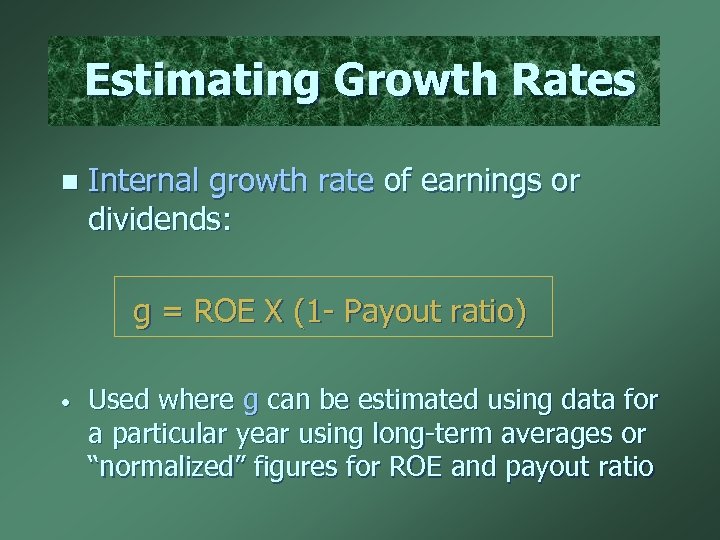 Estimating Growth Rates n Internal growth rate of earnings or dividends: g = ROE X (1 - Payout ratio) • Used where g can be estimated using data for a particular year using long-term averages or “normalized” figures for ROE and payout ratio
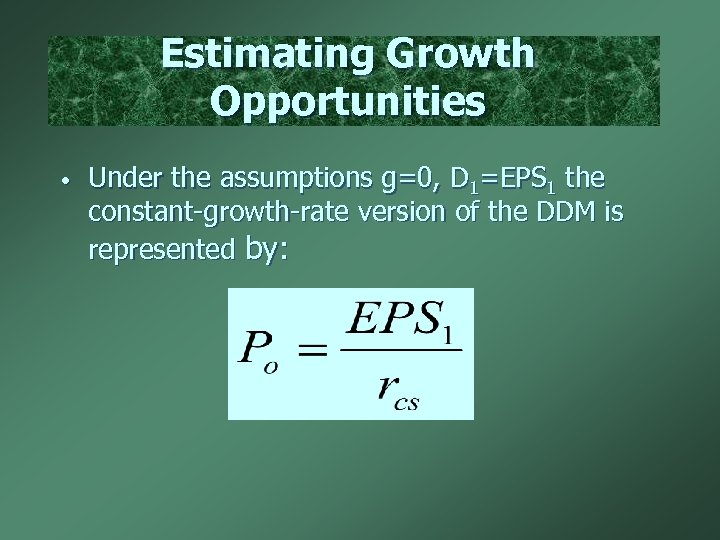 Estimating Growth Opportunities • Under the assumptions g=0, D 1=EPS 1 the constant-growth-rate version of the DDM is represented by:
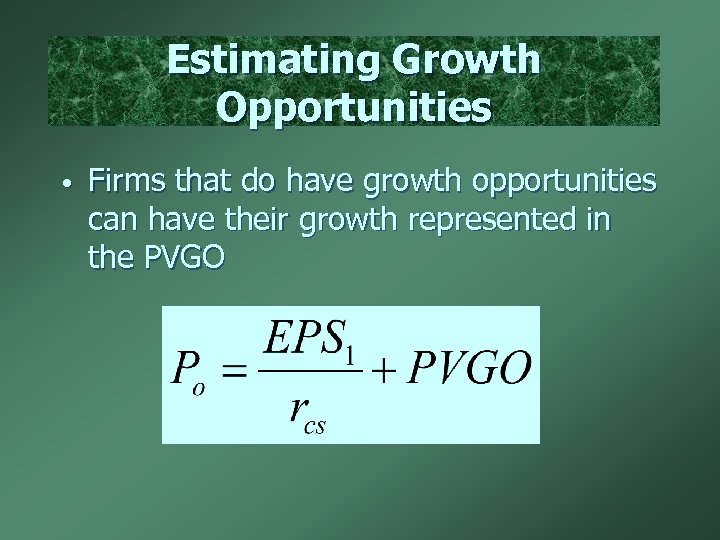 Estimating Growth Opportunities • Firms that do have growth opportunities can have their growth represented in the PVGO
 Other Versions of The DDM n Multiple-growth-rate version n Two-stage-growth-rate version
 Summary 1. Market prices of debt such as bonds are calculated by discounting future cash flows specified under the loan contract (periodic interest payments and eventual repayment of principle) at the prevailing interest rate. 2. Interest is the price paid for borrowed money, and in free financial markets, it is determined by the laws of supply and demand. Interest rates tend to parallel inflation, and in an environment of general price-level changes, we have to distinguish between nominal and real interest rates.
 Summary 3. The liquidity preference theory postulates that investors prefer short maturities, and borrowers desire long maturities. Therefore, the term structure should be upward sloping and exhibit a built-in liquidity premium. According to the expectations hypothesis, the yield curve reflects expectations about the future levels of interest rates. When investors expect short-term rates to fall, we must observe an inverted or downward-sloping yield curve.
 Summary 4. According to the dividend discount model (DDM), the value of a stock today is the discounted value of all future dividends. To account for an infinite stream of dividends, stocks to be valued are classified by their expected growth rate in dividends.