


 Скачать презентацию FINANCE IN A CANADIAN SETTING Sixth Canadian Edition
e90eb72ef90a3da596f65cc44909f1e8.ppt
- Количество слайдов: 21
 FINANCE IN A CANADIAN SETTING Sixth Canadian Edition Lusztig, Cleary, Schwab
 CHAPTER NINETEEN Options and Long-Term Financing
 Learning Objectives 1. Describe how rights work for existing shareholders. 2. Explain the gains and losses involved in the exercise of rights. 3. Identify what warrants are, and how they differ from options and rights. 4. Discuss convertible securities, conversion price, and conversion ratio. 5. Explain why a company issues convertible securities over common stock.
 Introduction n n Review l rights l warrants l convertible securities Consider different situations where long-term financing instruments can be thought of as options
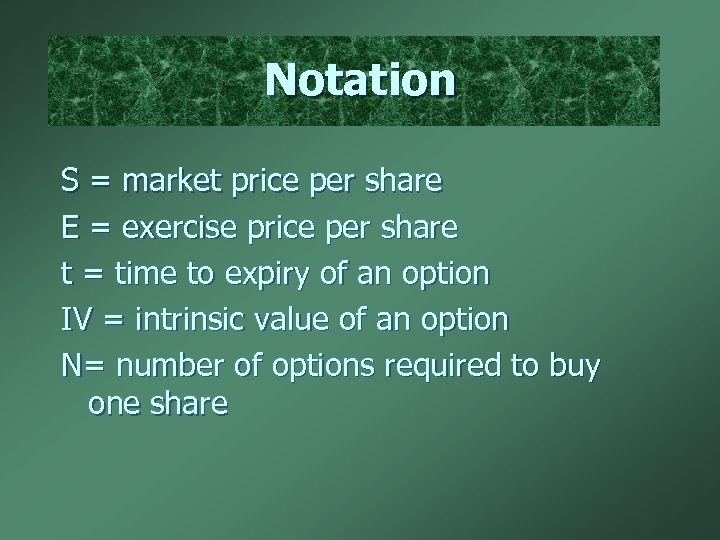 Notation S = market price per share E = exercise price per share t = time to expiry of an option IV = intrinsic value of an option N= number of options required to buy one share
 Rights – privileges granted to shareholders to acquire additional shares at a predetermined price, usually below the current market price n Rights may be offered because: n l l l current market conditions are not conducive to traditional share issues management wants to give existing shareholders the opportunity to acquire shares to give existing shareholders the opportunity to maintain their proportion of ownership in the company
 Rights n n n Rights holders can take four courses of action: l Exercise the rights l Sell the rights l Buy additional rights l Let the rights expire No commissions are levied on exercising rights A secondary market can develop for rights
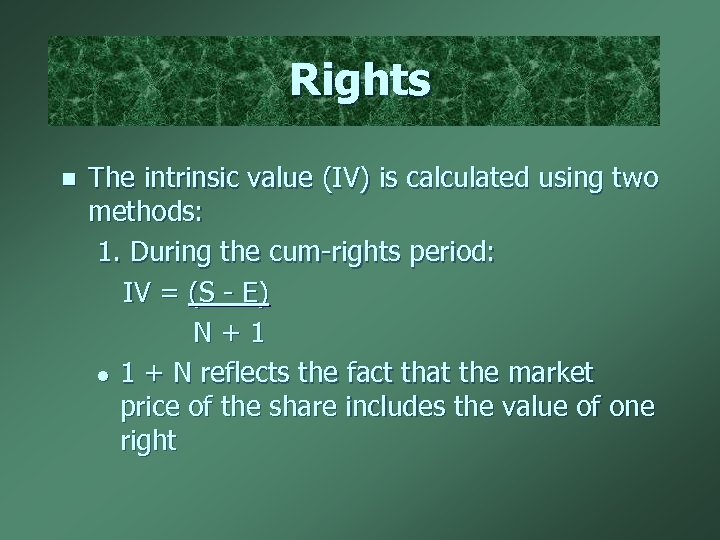 Rights n The intrinsic value (IV) is calculated using two methods: 1. During the cum-rights period: IV = (S - E) N+1 l 1 + N reflects the fact that the market price of the share includes the value of one right
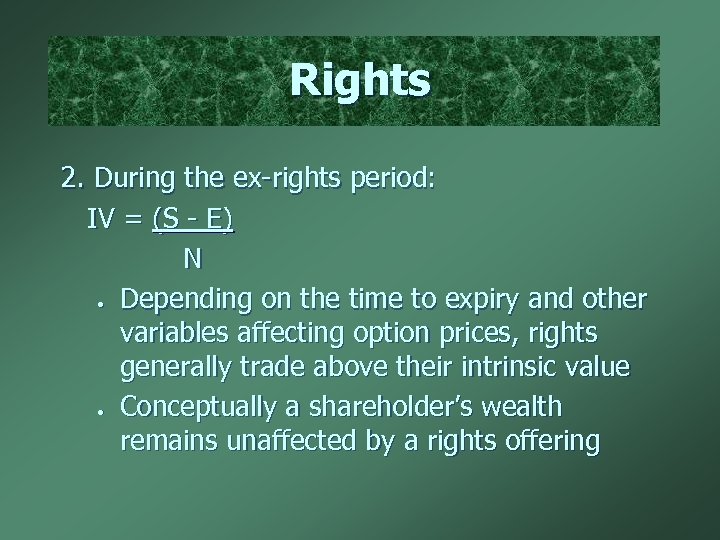 Rights 2. During the ex-rights period: IV = (S - E) N Depending on the time to expiry and other variables affecting option prices, rights generally trade above their intrinsic value Conceptually a shareholder’s wealth remains unaffected by a rights offering l l
 Warrants n n n Warrants – long-term options that firms make available on their own shares Generally issued in conjunction with issues of senior securities Known as “sweeteners” to make the issue more marketable Usually can be detached from senior securities and traded in there own right Most warrants have a seven-year life Usually issued “out of the money”
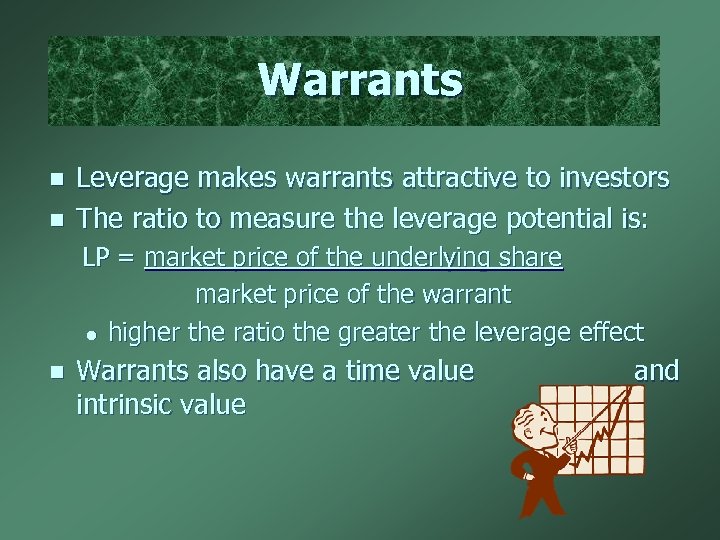 Warrants n n Leverage makes warrants attractive to investors The ratio to measure the leverage potential is: LP = market price of the underlying share market price of the warrant l higher the ratio the greater the leverage effect n Warrants also have a time value intrinsic value and
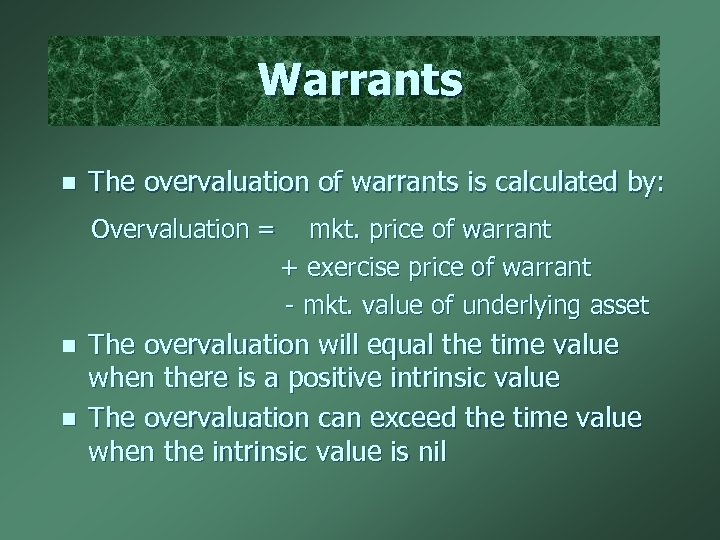 Warrants n The overvaluation of warrants is calculated by: Overvaluation = n n mkt. price of warrant + exercise price of warrant - mkt. value of underlying asset The overvaluation will equal the time value when there is a positive intrinsic value The overvaluation can exceed the time value when the intrinsic value is nil
 Convertibles n n n Convertible instruments – securities that, at the option of the holder, may be converted into common shares of the issuing firm Conversion price or ratio – the basis for switching a convertible security into common shares The conversion ratio is usually set above the market price of the common shares at the time of offering
 Convertibles n Valuing convertible debt: l Straight debt value (SDV) – identifies the value of debt alone Þ l Conversion value (CV) – specifies how much the feature is worth if immediately converted Þ n n calculated by the standard debt valuation formula CV = conversion ratio x current market price per share Convertible debt can not trade for less than the SDV or CV SDV and SV combine to provide a price floor for the convertible
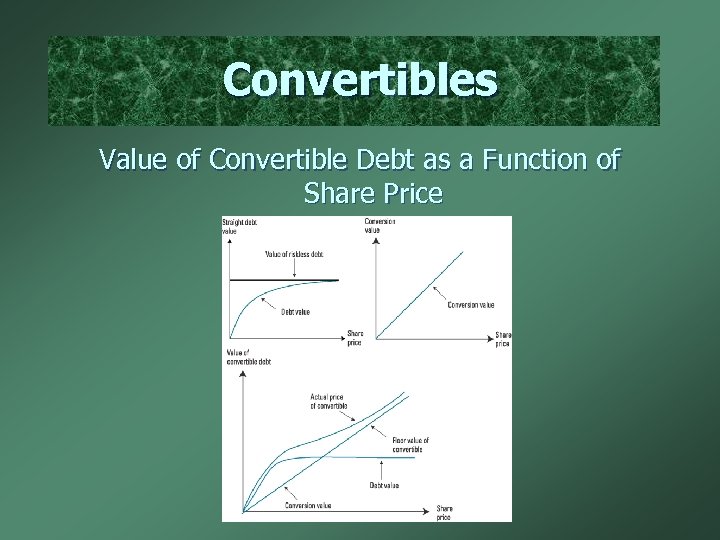 Convertibles Value of Convertible Debt as a Function of Share Price
 Convertibles n Firms issue convertible debt because: l l new equity is required but current market conditions and share prices are unfavourable convertible securities are viewed as deferred equity financing with expectation that conversion will eventually become attractive and dilution will be kept to a minimum call feature built into the convertibles prevent them from exceeding their conversion price underwriting costs tends to be lower than straight equity financing
 Units n n When firms attempt to package two or more types of securities together to make the offering more marketable they are called “units” Units: restrict investors flexibility are complex securities where firms are attempting to create innovative financing instruments l l
 Summary 1. Firms issue options either to provide current stockholders with an opportunity to subscribe to new share offerings on a preferential basis or as “sweeteners” to make new issues of senior securities more marketable.
 Summary 2. Rights are issued when a firm offers new shares to current shareholders on a privileged subscription basis. Normally, one right is issued for each outstanding share and, depending on the number of new shares to be offered, several rights may be required to obtain one new share. Rights generally have a life of only a few weeks and shareholders who choose not to exercise their rights may sell them in the marketplace.
 Summary 3. Warrants are options that are normally offered in conjunction with issues of senior securities. They normally have a life of several years and one warrant may entitle its holder to purchase more than one share. 4. Convertible securities are debt or preferred shares that, at the option of the holder, can be converted into common shares. The basis for the conversion is determined through the conversion price or conversion ratio.
 Summary 5. On occasion, corporations package together two or more different types of securities and options and offer them as a unit in an effort to increase marketability. 6. Common shares generally can be viewed as options on the firm’s assets with an exercise price equal to the value of the firm’s outstanding debt.