


 Скачать презентацию Finance 510 Microeconomic Analysis Monopoly Pricing Techniques
fbbc13c861ff45f434ef0f0b9ec5acfb.ppt
- Количество слайдов: 52
 Finance 510: Microeconomic Analysis Monopoly Pricing Techniques
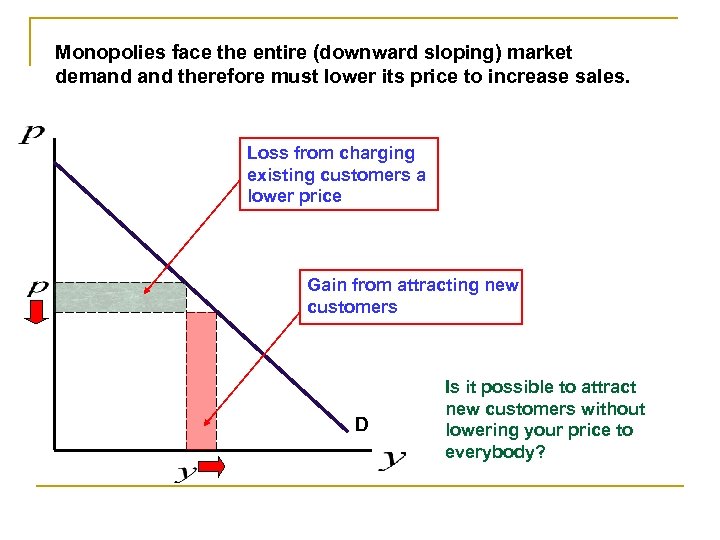 Monopolies face the entire (downward sloping) market demand therefore must lower its price to increase sales. Loss from charging existing customers a lower price Gain from attracting new customers D Is it possible to attract new customers without lowering your price to everybody?
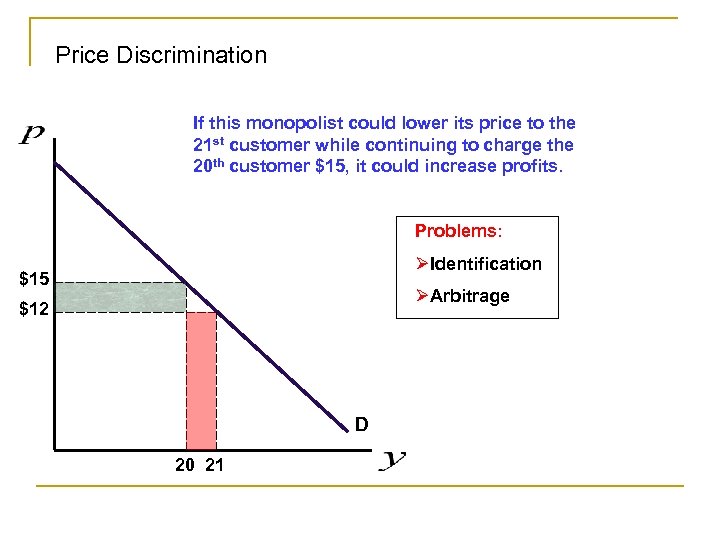 Price Discrimination If this monopolist could lower its price to the 21 st customer while continuing to charge the 20 th customer $15, it could increase profits. Problems: ØIdentification $15 ØArbitrage $12 D 20 21
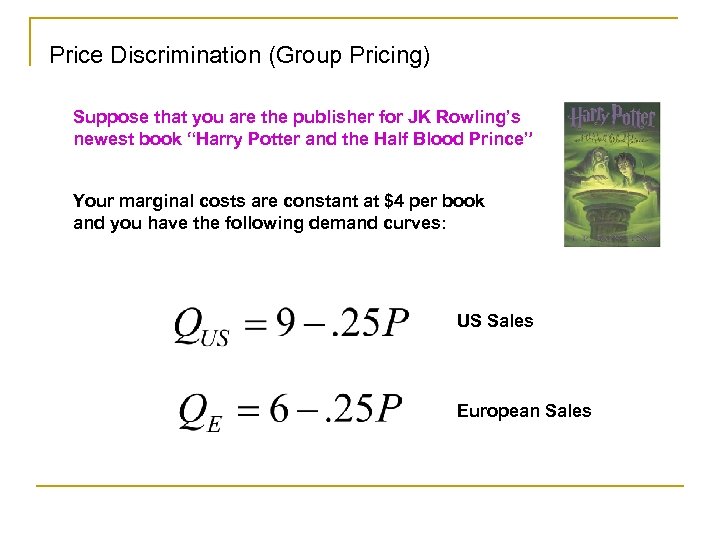 Price Discrimination (Group Pricing) Suppose that you are the publisher for JK Rowling’s newest book “Harry Potter and the Half Blood Prince” Your marginal costs are constant at $4 per book and you have the following demand curves: US Sales European Sales
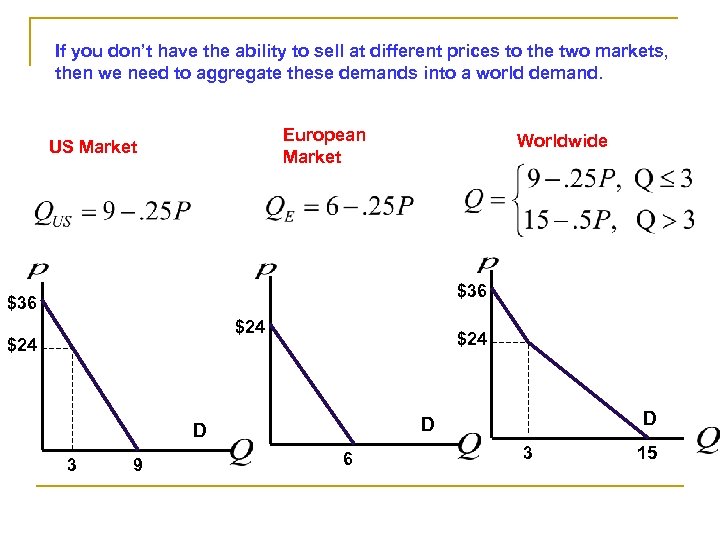 If you don’t have the ability to sell at different prices to the two markets, then we need to aggregate these demands into a world demand. European Market US Market Worldwide $36 $24 $24 3 9 D D D 6 3 15
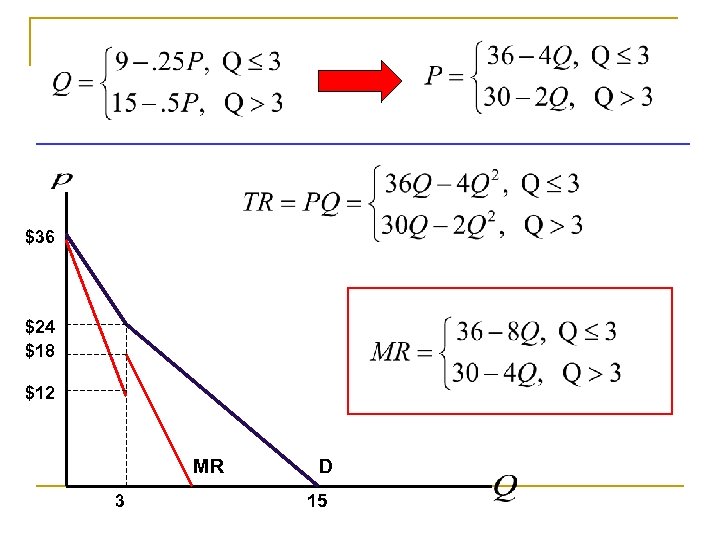 $36 $24 $18 $12 MR 3 D 15
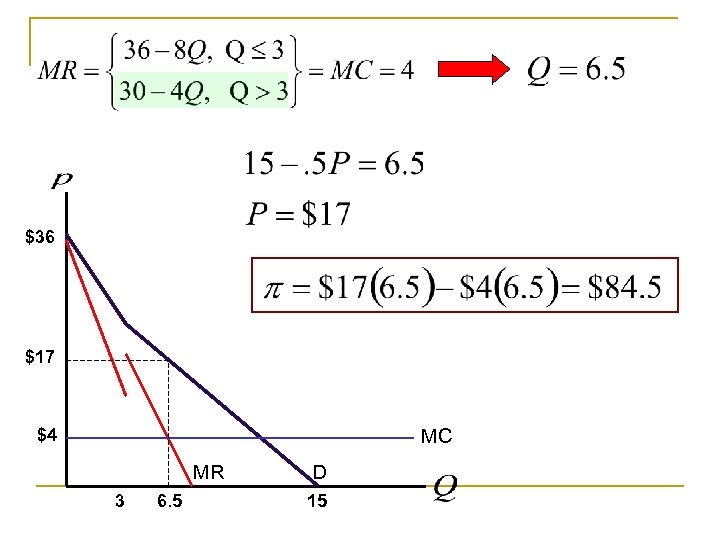 $36 $17 $4 MC MR 3 6. 5 D 15
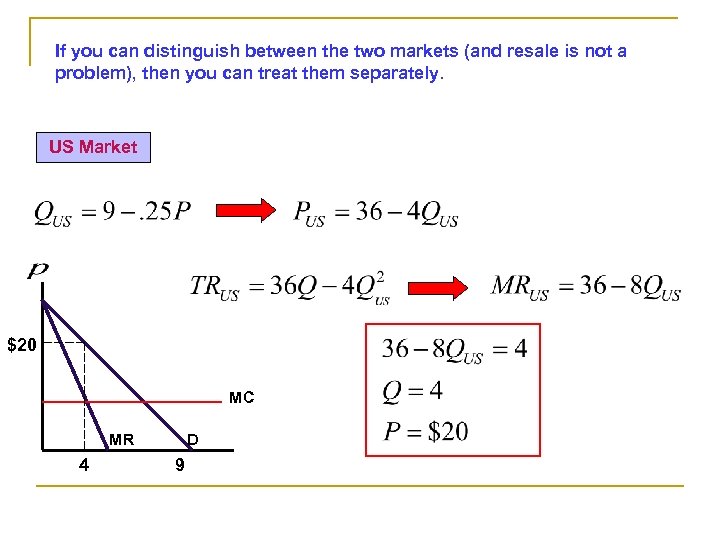 If you can distinguish between the two markets (and resale is not a problem), then you can treat them separately. US Market $20 MC MR 4 D 9
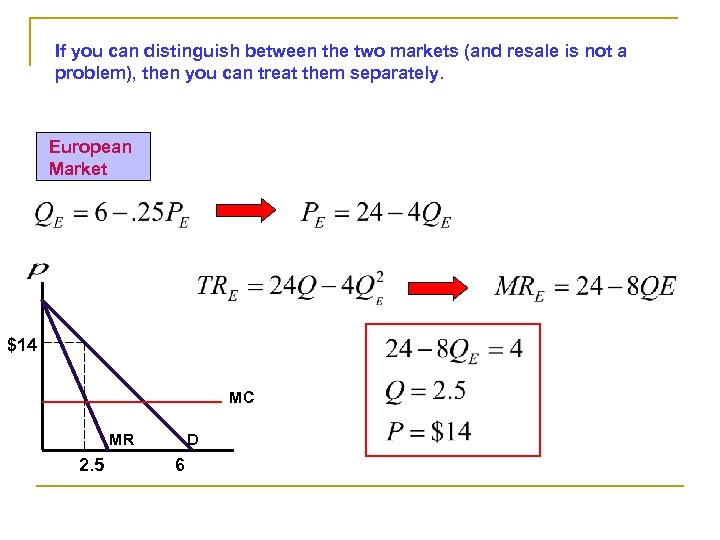 If you can distinguish between the two markets (and resale is not a problem), then you can treat them separately. European Market $14 MC MR 2. 5 D 6
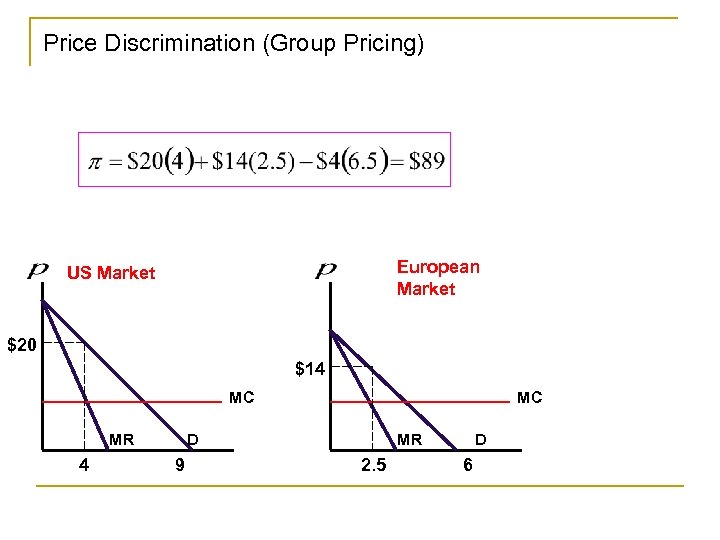 Price Discrimination (Group Pricing) European Market US Market $20 $14 MC MR 4 MC D 9 MR 2. 5 D 6
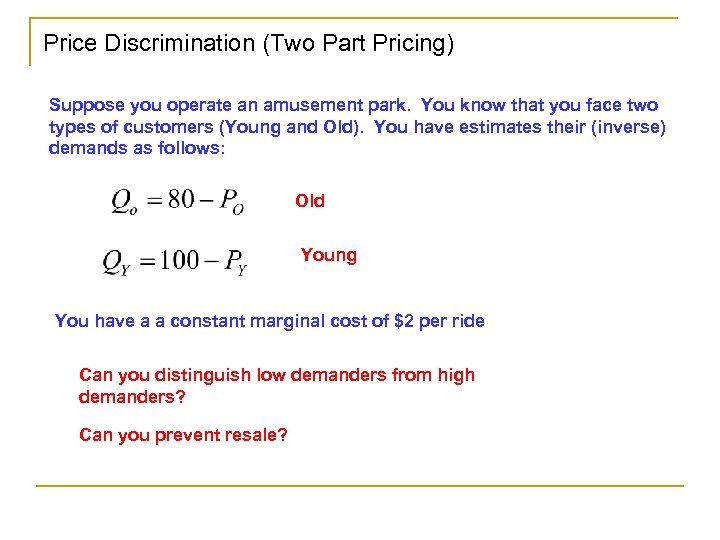 Price Discrimination (Two Part Pricing) Suppose you operate an amusement park. You know that you face two types of customers (Young and Old). You have estimates their (inverse) demands as follows: Old Young You have a a constant marginal cost of $2 per ride Can you distinguish low demanders from high demanders? Can you prevent resale?
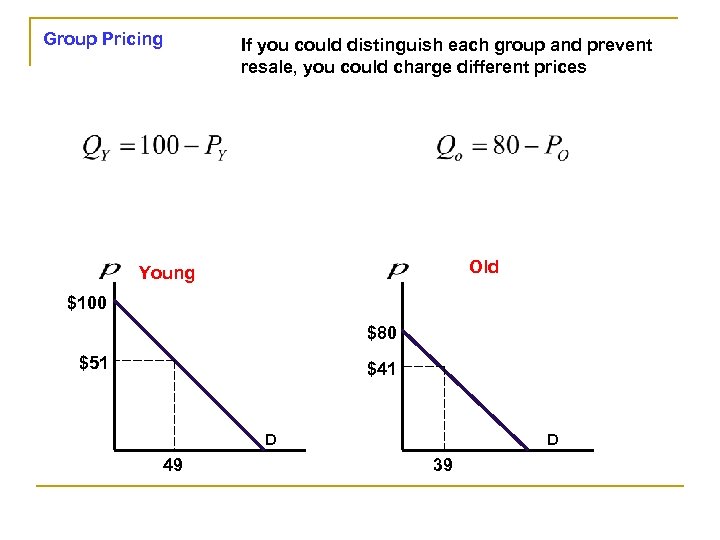 Group Pricing If you could distinguish each group and prevent resale, you could charge different prices Old Young $100 $80 $51 $41 D 49 D 39
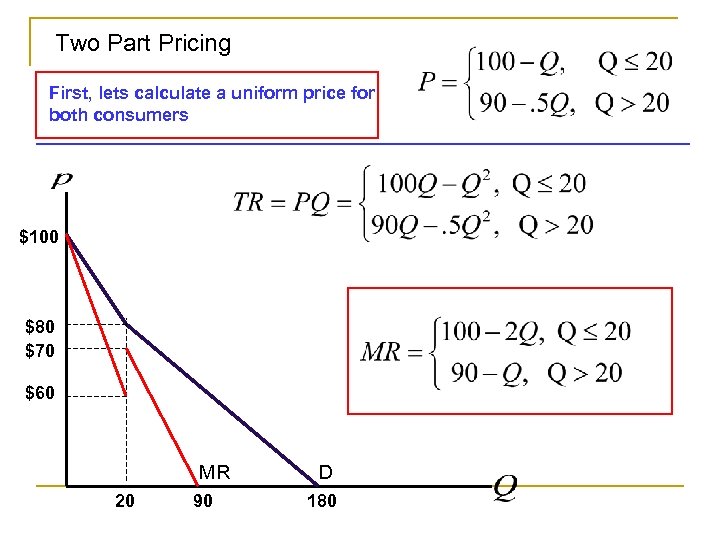 Two Part Pricing First, lets calculate a uniform price for both consumers $100 $80 $70 $60 MR 20 90 D 180
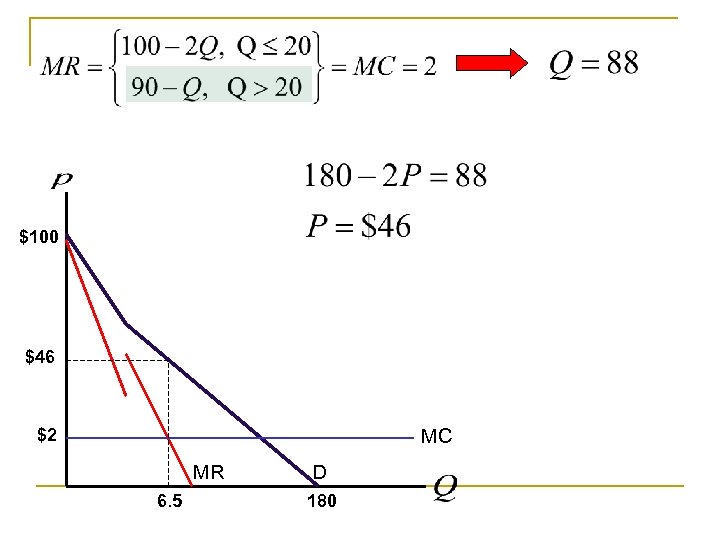 $100 $46 $2 MC MR 6. 5 D 180
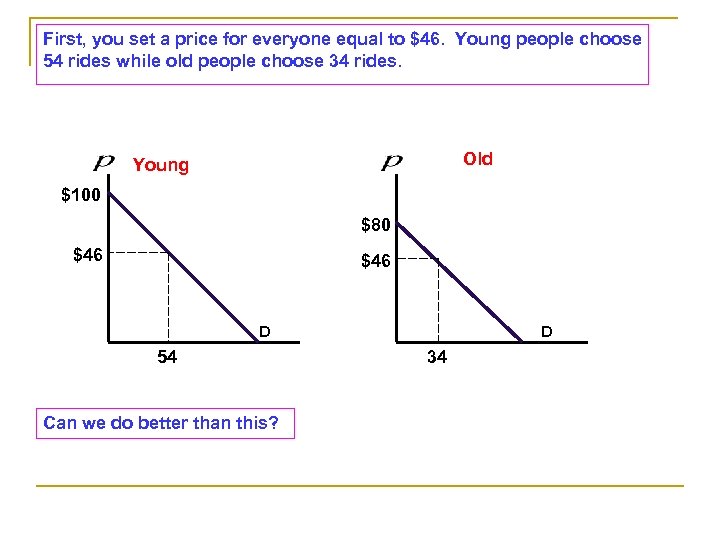 First, you set a price for everyone equal to $46. Young people choose 54 rides while old people choose 34 rides. Old Young $100 $80 $46 D 54 Can we do better than this? D 34
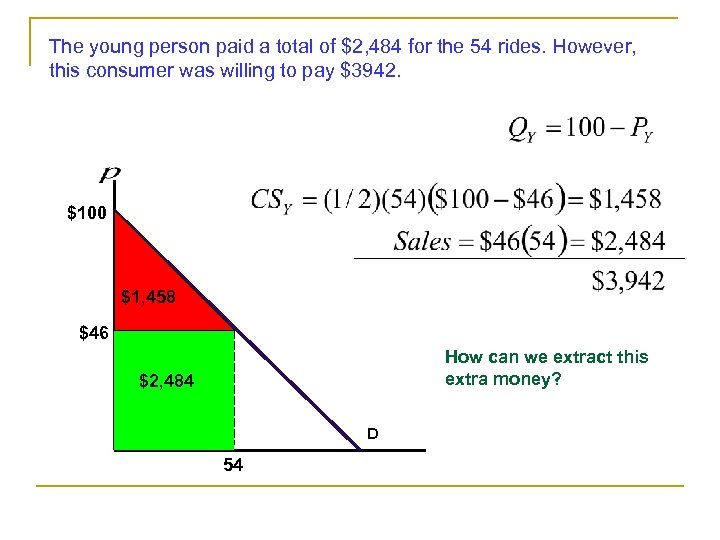 The young person paid a total of $2, 484 for the 54 rides. However, this consumer was willing to pay $3942. $100 $1, 458 $46 How can we extract this extra money? $2, 484 D 54
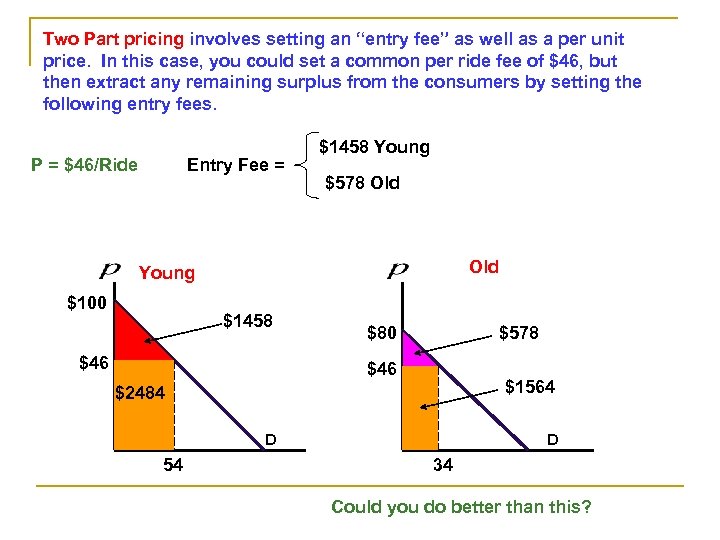 Two Part pricing involves setting an “entry fee” as well as a per unit price. In this case, you could set a common per ride fee of $46, but then extract any remaining surplus from the consumers by setting the following entry fees. P = $46/Ride Entry Fee = $1458 Young $578 Old Young $100 $1458 $46 $80 $578 $46 $1564 $2484 D 54 D 34 Could you do better than this?
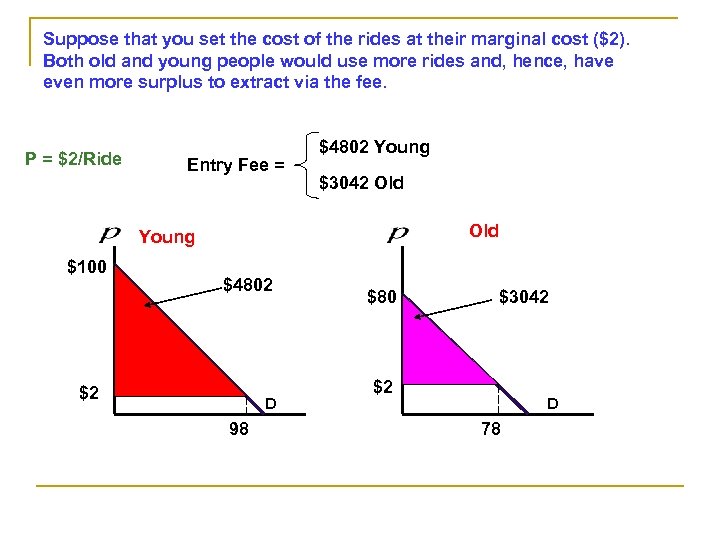 Suppose that you set the cost of the rides at their marginal cost ($2). Both old and young people would use more rides and, hence, have even more surplus to extract via the fee. P = $2/Ride Entry Fee = $4802 Young $3042 Old Young $100 $4802 $2 D 98 $80 $3042 $2 D 78
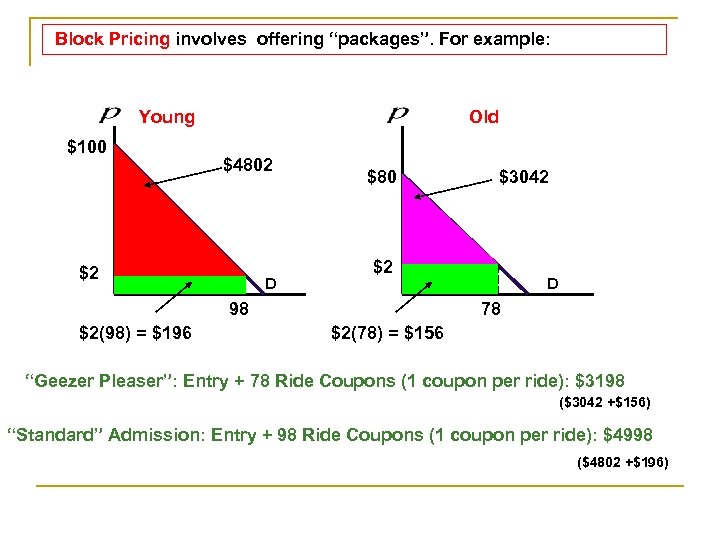 Block Pricing involves offering “packages”. For example: Young $100 Old $4802 $2 D $80 $2 98 $2(98) = $196 $3042 D 78 $2(78) = $156 “Geezer Pleaser”: Entry + 78 Ride Coupons (1 coupon per ride): $3198 ($3042 +$156) “Standard” Admission: Entry + 98 Ride Coupons (1 coupon per ride): $4998 ($4802 +$196)
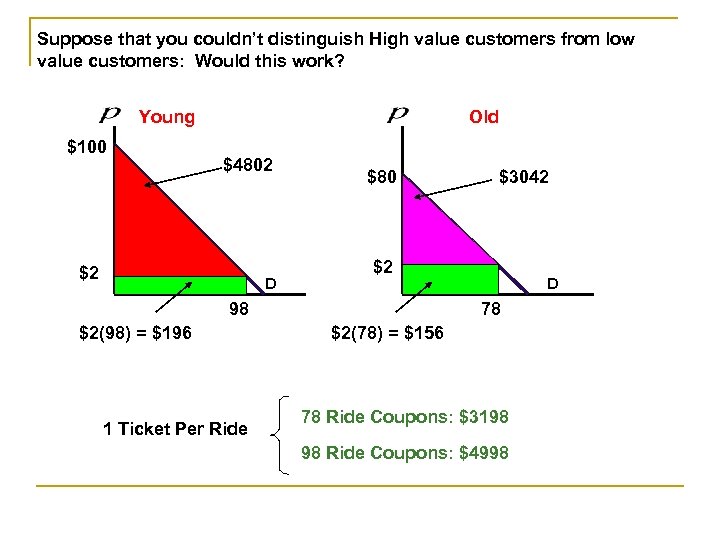 Suppose that you couldn’t distinguish High value customers from low value customers: Would this work? Young $100 Old $4802 $2 D $80 $2 98 $2(98) = $196 1 Ticket Per Ride $3042 D 78 $2(78) = $156 78 Ride Coupons: $3198 98 Ride Coupons: $4998
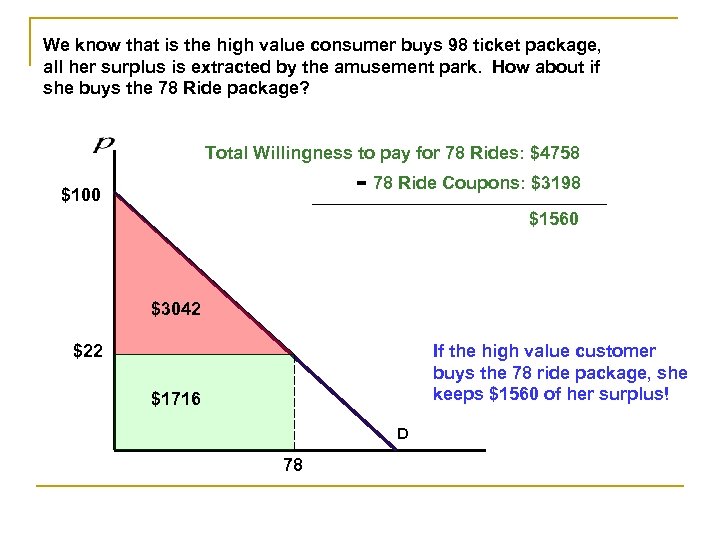 We know that is the high value consumer buys 98 ticket package, all her surplus is extracted by the amusement park. How about if she buys the 78 Ride package? Total Willingness to pay for 78 Rides: $4758 - 78 Ride Coupons: $3198 $100 $1560 $3042 $22 If the high value customer buys the 78 ride package, she keeps $1560 of her surplus! $1716 D 78
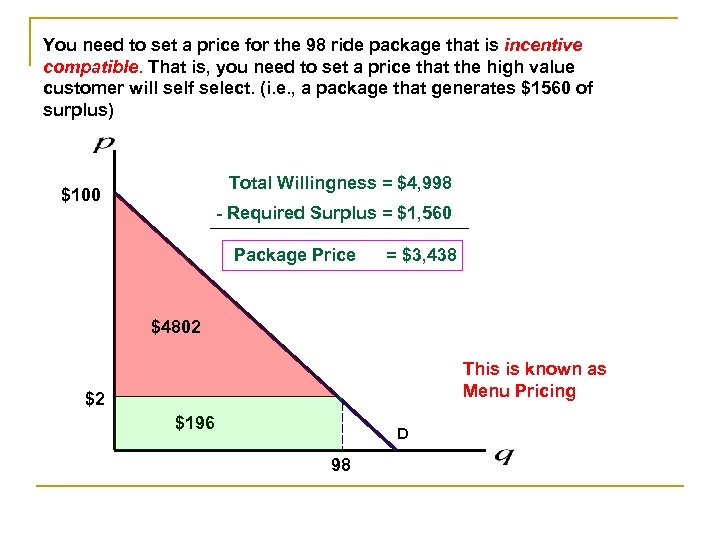 You need to set a price for the 98 ride package that is incentive compatible. That is, you need to set a price that the high value customer will self select. (i. e. , a package that generates $1560 of surplus) Total Willingness = $4, 998 $100 - Required Surplus = $1, 560 Package Price = $3, 438 $4802 This is known as Menu Pricing $2 $196 D 98
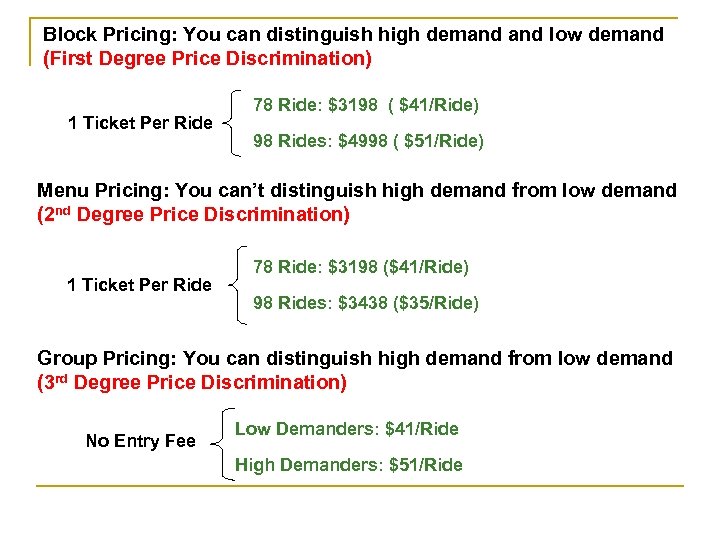 Block Pricing: You can distinguish high demand low demand (First Degree Price Discrimination) 1 Ticket Per Ride 78 Ride: $3198 ( $41/Ride) 98 Rides: $4998 ( $51/Ride) Menu Pricing: You can’t distinguish high demand from low demand (2 nd Degree Price Discrimination) 1 Ticket Per Ride 78 Ride: $3198 ($41/Ride) 98 Rides: $3438 ($35/Ride) Group Pricing: You can distinguish high demand from low demand (3 rd Degree Price Discrimination) No Entry Fee Low Demanders: $41/Ride High Demanders: $51/Ride
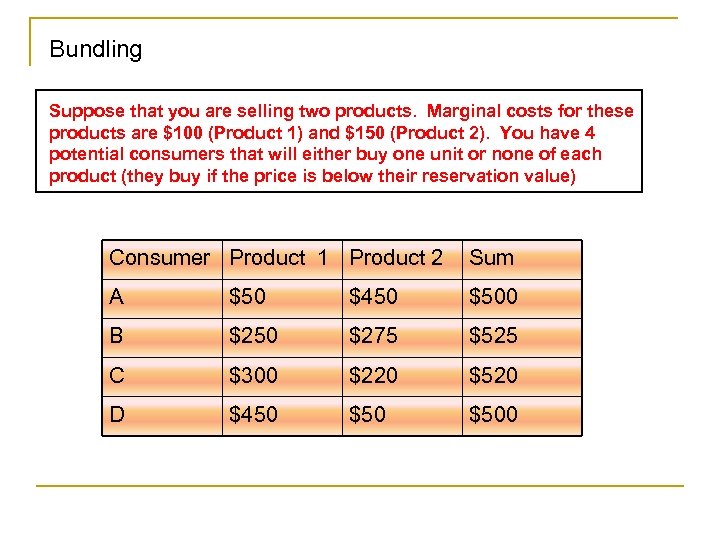 Bundling Suppose that you are selling two products. Marginal costs for these products are $100 (Product 1) and $150 (Product 2). You have 4 potential consumers that will either buy one unit or none of each product (they buy if the price is below their reservation value) Consumer Product 1 Product 2 Sum A $50 $450 $500 B $250 $275 $525 C $300 $220 $520 D $450 $500
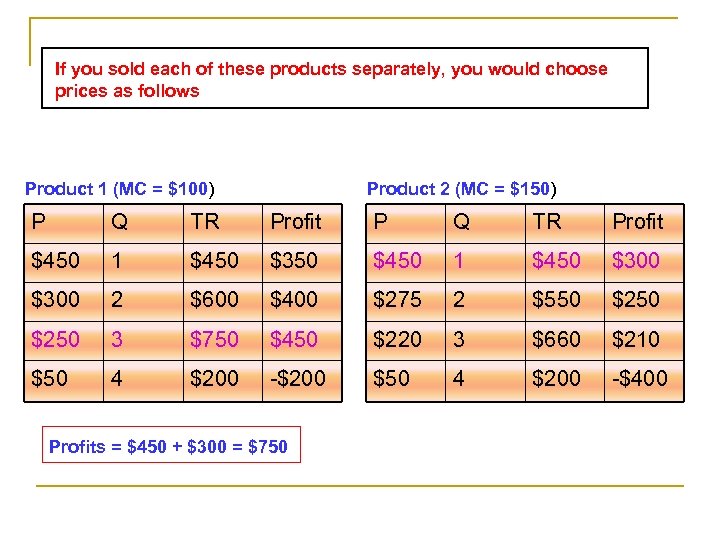 If you sold each of these products separately, you would choose prices as follows Product 1 (MC = $100) Product 2 (MC = $150) P Q TR Profit $450 1 $450 $350 $450 1 $450 $300 2 $600 $400 $275 2 $550 $250 3 $750 $450 $220 3 $660 $210 $50 4 $200 -$200 $50 4 $200 -$400 Profits = $450 + $300 = $750
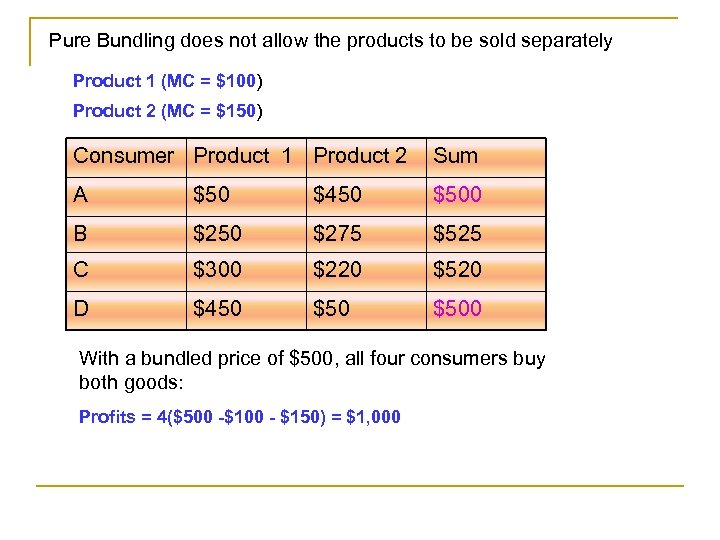 Pure Bundling does not allow the products to be sold separately Product 1 (MC = $100) Product 2 (MC = $150) Consumer Product 1 Product 2 Sum A $50 $450 $500 B $250 $275 $525 C $300 $220 $520 D $450 $500 With a bundled price of $500, all four consumers buy both goods: Profits = 4($500 -$100 - $150) = $1, 000
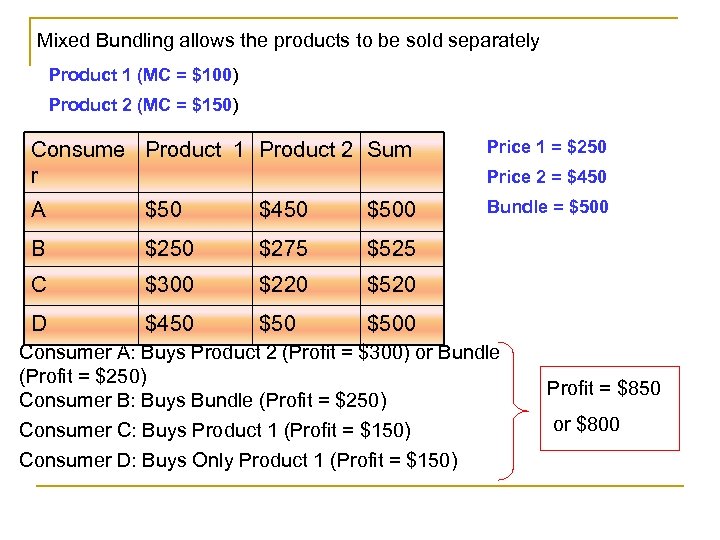 Mixed Bundling allows the products to be sold separately Product 1 (MC = $100) Product 2 (MC = $150) Consume Product 1 Product 2 Sum r Price 1 = $250 A $50 $450 $500 Bundle = $500 B $250 $275 $525 C $300 $220 $520 D $450 $500 Price 2 = $450 Consumer A: Buys Product 2 (Profit = $300) or Bundle (Profit = $250) Consumer B: Buys Bundle (Profit = $250) Consumer C: Buys Product 1 (Profit = $150) Consumer D: Buys Only Product 1 (Profit = $150) Profit = $850 or $800
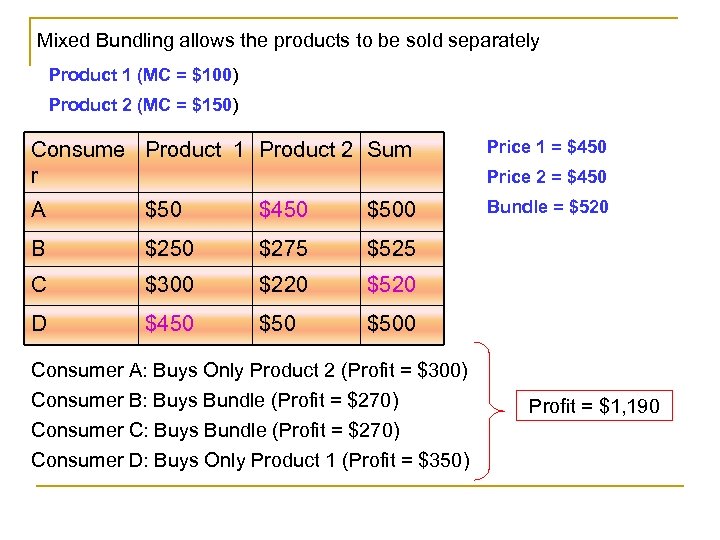 Mixed Bundling allows the products to be sold separately Product 1 (MC = $100) Product 2 (MC = $150) Consume Product 1 Product 2 Sum r Price 1 = $450 A $50 $450 $500 Bundle = $520 B $250 $275 $525 C $300 $220 $520 D $450 $500 Consumer A: Buys Only Product 2 (Profit = $300) Consumer B: Buys Bundle (Profit = $270) Consumer C: Buys Bundle (Profit = $270) Consumer D: Buys Only Product 1 (Profit = $350) Price 2 = $450 Profit = $1, 190
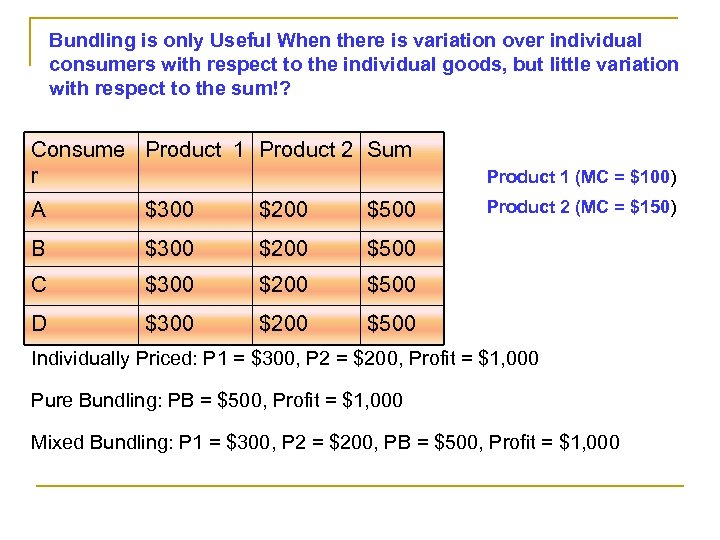 Bundling is only Useful When there is variation over individual consumers with respect to the individual goods, but little variation with respect to the sum!? Consume Product 1 Product 2 Sum r Product 1 (MC = $100) A $300 $200 $500 Product 2 (MC = $150) B $300 $200 $500 C $300 $200 $500 D $300 $200 $500 Individually Priced: P 1 = $300, P 2 = $200, Profit = $1, 000 Pure Bundling: PB = $500, Profit = $1, 000 Mixed Bundling: P 1 = $300, P 2 = $200, PB = $500, Profit = $1, 000
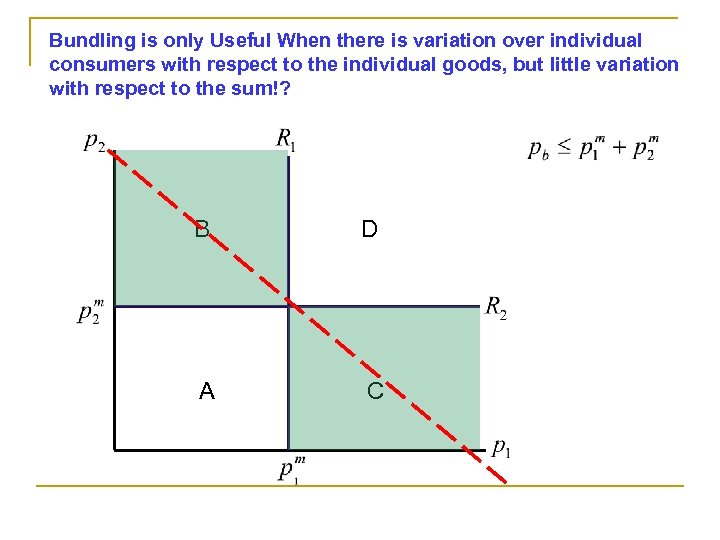 Bundling is only Useful When there is variation over individual consumers with respect to the individual goods, but little variation with respect to the sum!? B D A C
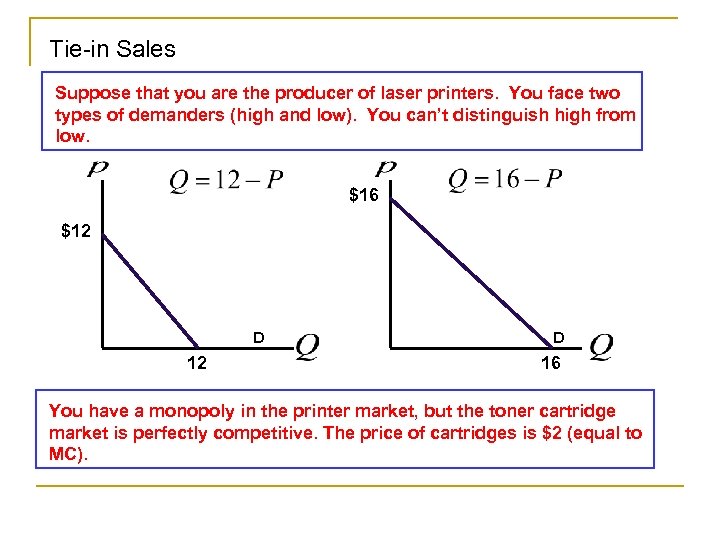 Tie-in Sales Suppose that you are the producer of laser printers. You face two types of demanders (high and low). You can’t distinguish high from low. $16 $12 D 16 You have a monopoly in the printer market, but the toner cartridge market is perfectly competitive. The price of cartridges is $2 (equal to MC).
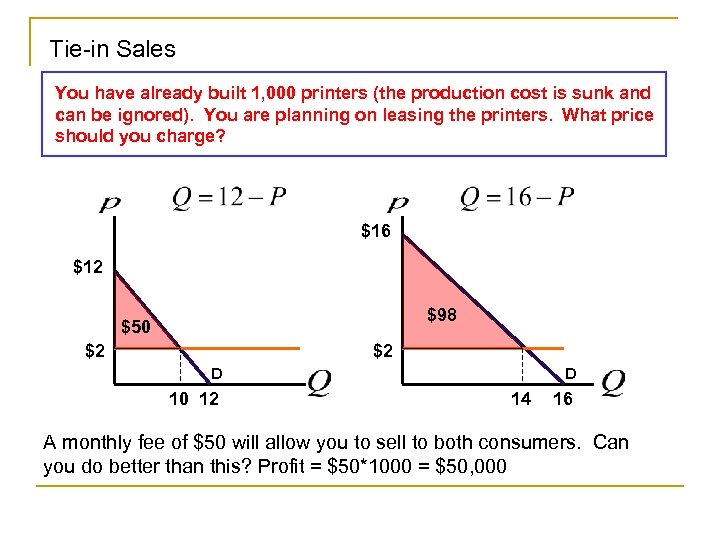 Tie-in Sales You have already built 1, 000 printers (the production cost is sunk and can be ignored). You are planning on leasing the printers. What price should you charge? $16 $12 $98 $50 $2 $2 D 10 12 D 14 16 A monthly fee of $50 will allow you to sell to both consumers. Can you do better than this? Profit = $50*1000 = $50, 000
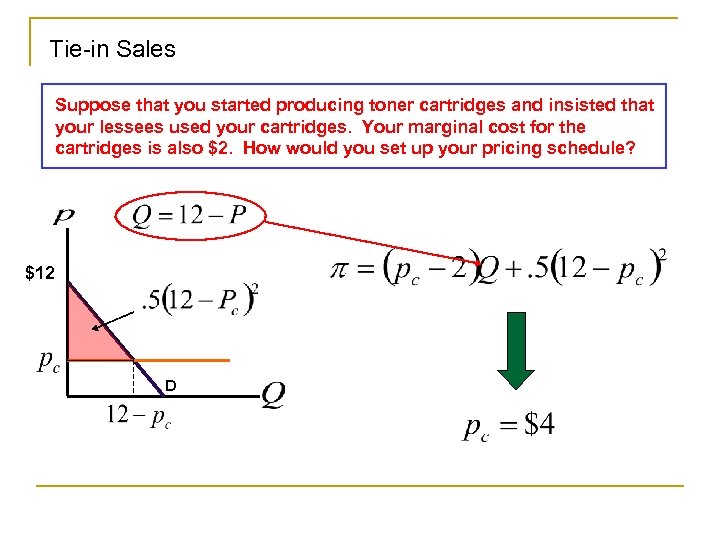 Tie-in Sales Suppose that you started producing toner cartridges and insisted that your lessees used your cartridges. Your marginal cost for the cartridges is also $2. How would you set up your pricing schedule? $12 D
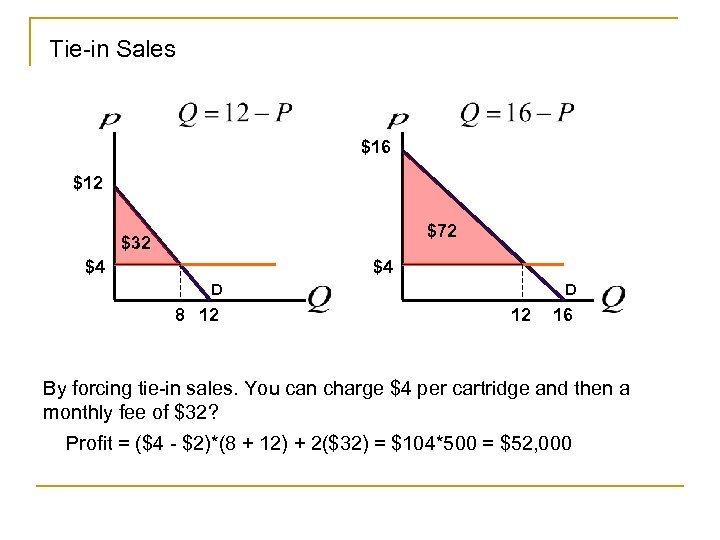 Tie-in Sales $16 $12 $72 $32 $4 $4 D 8 12 D 12 16 By forcing tie-in sales. You can charge $4 per cartridge and then a monthly fee of $32? Profit = ($4 - $2)*(8 + 12) + 2($32) = $104*500 = $52, 000
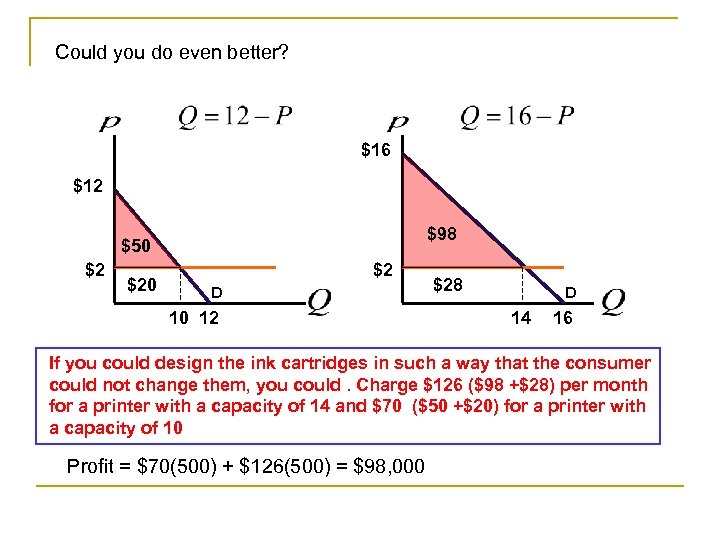 Could you do even better? $16 $12 $98 $50 $2 $20 $2 D 10 12 $28 D 14 16 If you could design the ink cartridges in such a way that the consumer could not change them, you could. Charge $126 ($98 +$28) per month for a printer with a capacity of 14 and $70 ($50 +$20) for a printer with a capacity of 10 Profit = $70(500) + $126(500) = $98, 000
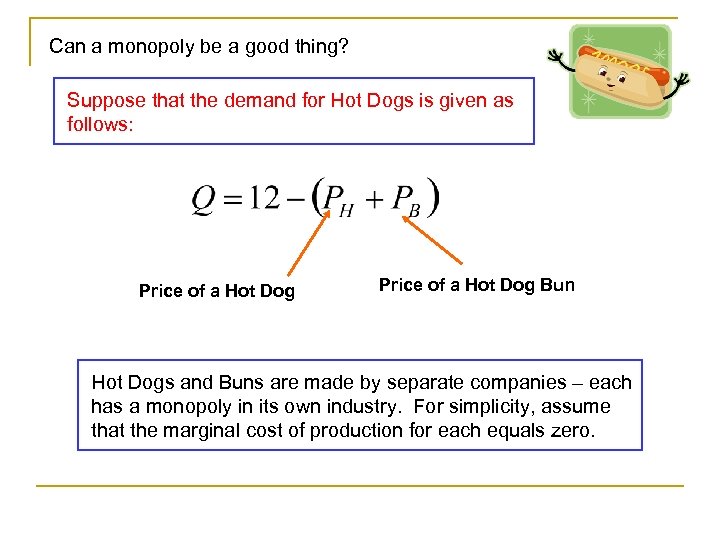 Can a monopoly be a good thing? Suppose that the demand for Hot Dogs is given as follows: Price of a Hot Dog Bun Hot Dogs and Buns are made by separate companies – each has a monopoly in its own industry. For simplicity, assume that the marginal cost of production for each equals zero.
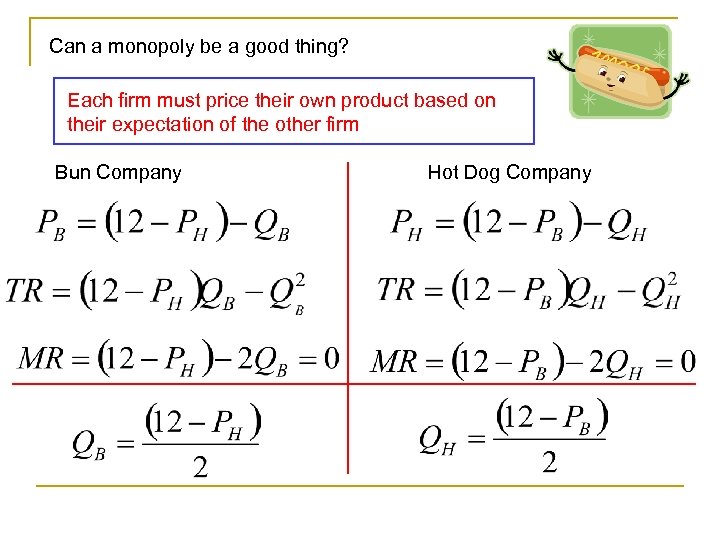 Can a monopoly be a good thing? Each firm must price their own product based on their expectation of the other firm Bun Company Hot Dog Company
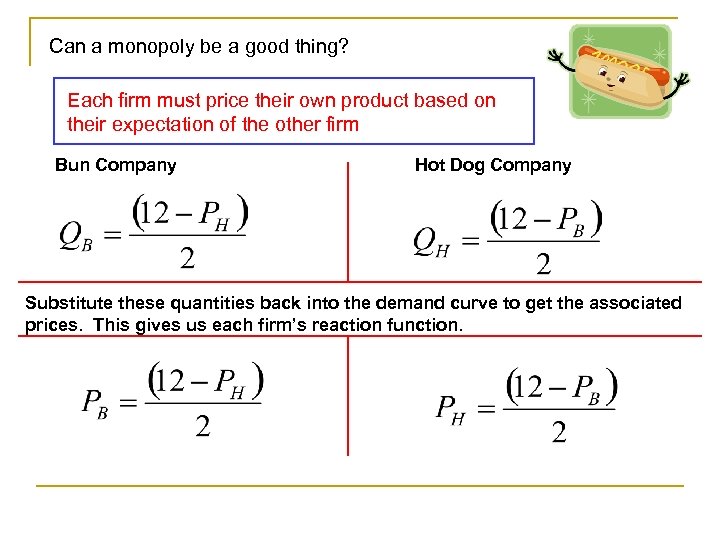 Can a monopoly be a good thing? Each firm must price their own product based on their expectation of the other firm Bun Company Hot Dog Company Substitute these quantities back into the demand curve to get the associated prices. This gives us each firm’s reaction function.
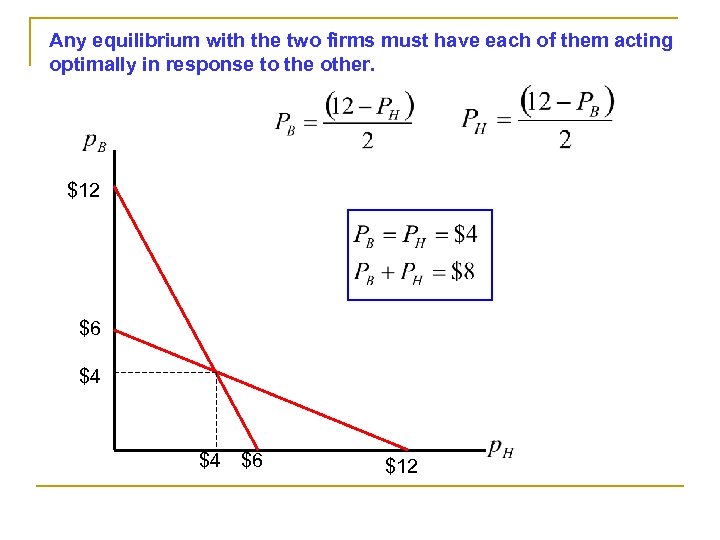 Any equilibrium with the two firms must have each of them acting optimally in response to the other. $12 $6 $4 $4 $6 $12
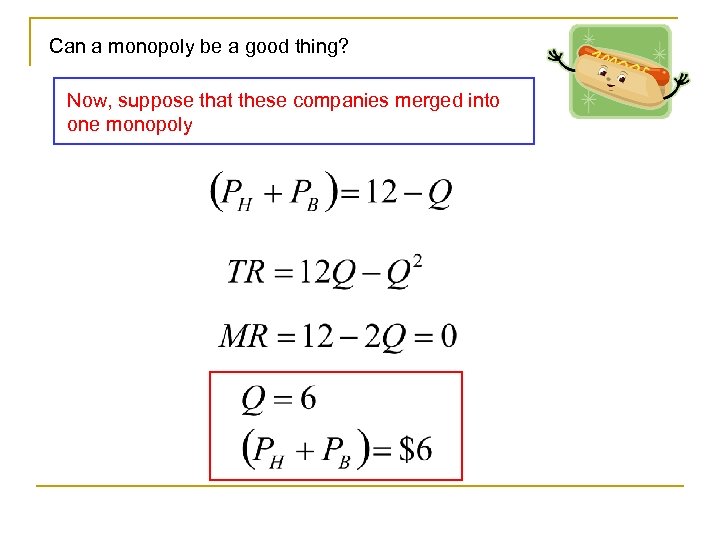 Can a monopoly be a good thing? Now, suppose that these companies merged into one monopoly
 Case Study: Microsoft vs. Netscape The argument against Microsoft was using its monopoly power in the operating system market to force its way into the browser market by “bundling” Internet Explorer with Windows 95. To prove its claim, the government needed to show: • Microsoft did, in fact, possess monopoly power • The browser and the operating system were, in fact, two distinct products that did not need to be integrated • Microsoft’s behavior was an abuse of power that hurt consumers What should Microsoft’s defense be?
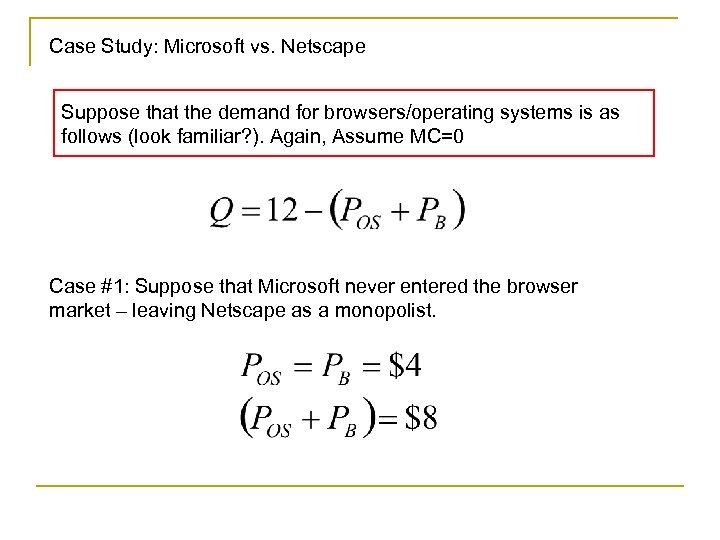 Case Study: Microsoft vs. Netscape Suppose that the demand for browsers/operating systems is as follows (look familiar? ). Again, Assume MC=0 Case #1: Suppose that Microsoft never entered the browser market – leaving Netscape as a monopolist.
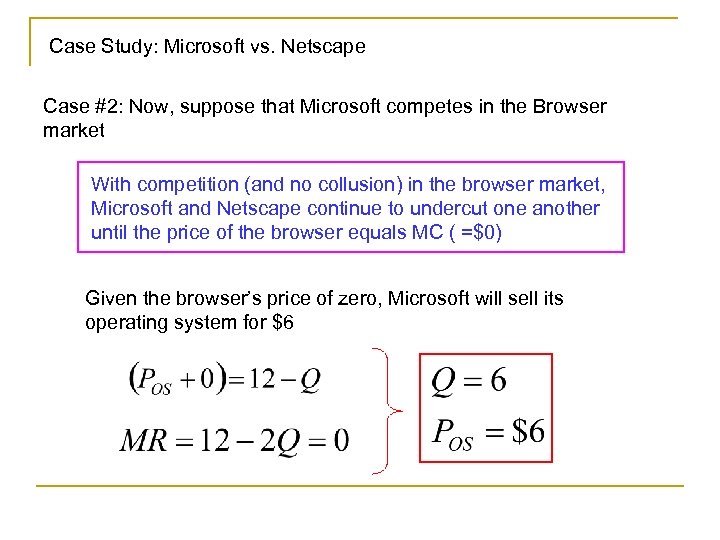 Case Study: Microsoft vs. Netscape Case #2: Now, suppose that Microsoft competes in the Browser market With competition (and no collusion) in the browser market, Microsoft and Netscape continue to undercut one another until the price of the browser equals MC ( =$0) Given the browser’s price of zero, Microsoft will sell its operating system for $6
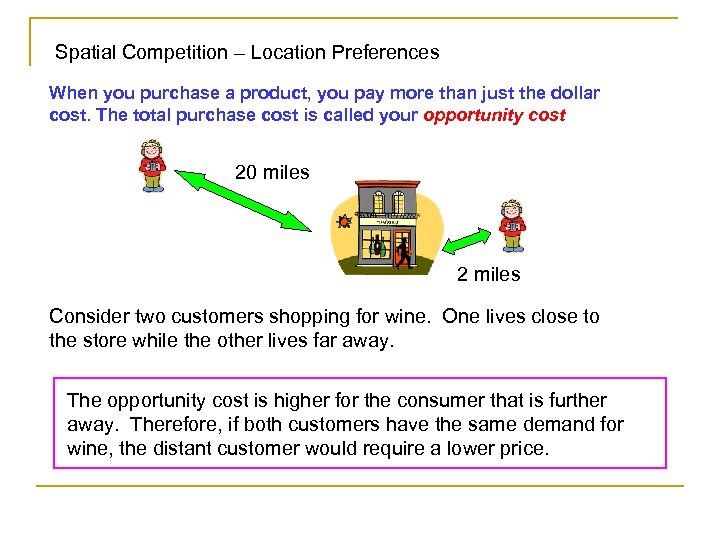 Spatial Competition – Location Preferences When you purchase a product, you pay more than just the dollar cost. The total purchase cost is called your opportunity cost 20 miles 2 miles Consider two customers shopping for wine. One lives close to the store while the other lives far away. The opportunity cost is higher for the consumer that is further away. Therefore, if both customers have the same demand for wine, the distant customer would require a lower price.
 Spatial Competition – Location Preferences Gucci currently has 31 locations in the US Starbucks currently has 5, 200 locations in the US How can we explain this difference?
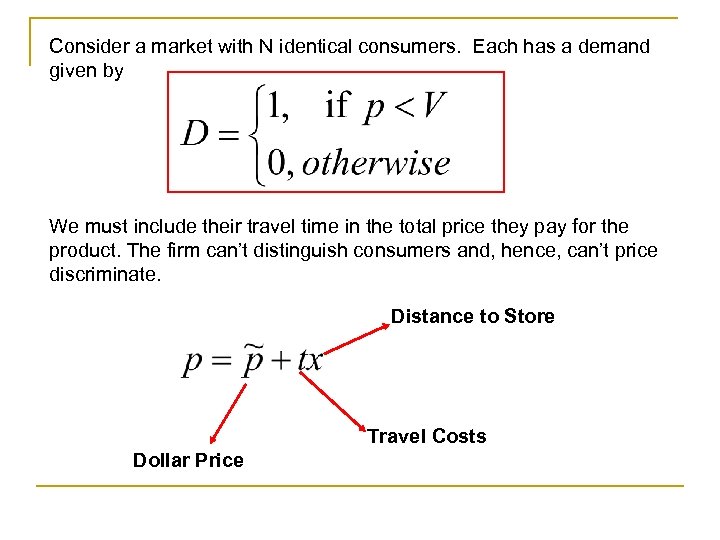 Consider a market with N identical consumers. Each has a demand given by We must include their travel time in the total price they pay for the product. The firm can’t distinguish consumers and, hence, can’t price discriminate. Distance to Store Travel Costs Dollar Price
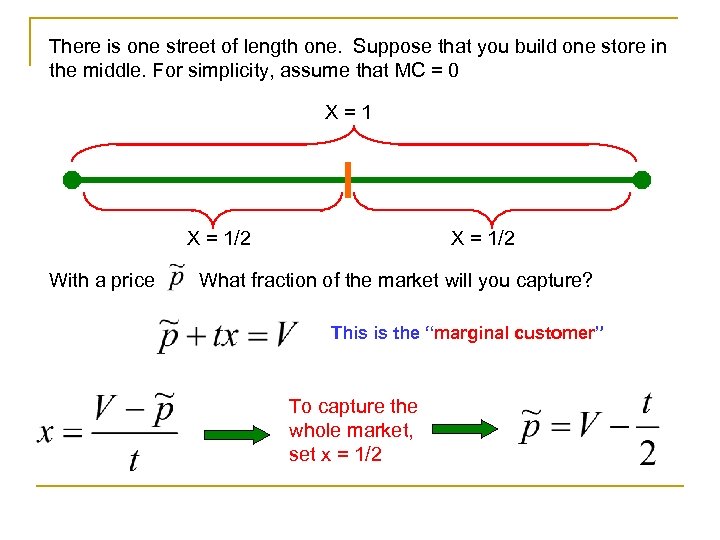 There is one street of length one. Suppose that you build one store in the middle. For simplicity, assume that MC = 0 X=1 X = 1/2 With a price X = 1/2 What fraction of the market will you capture? This is the “marginal customer” To capture the whole market, set x = 1/2
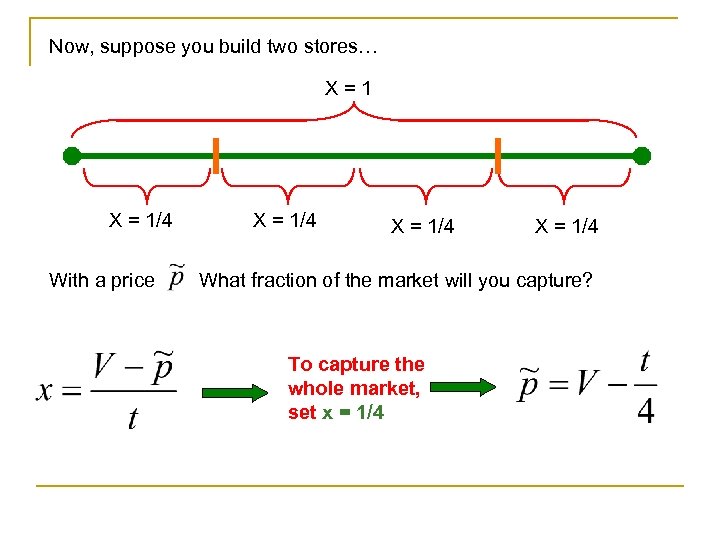 Now, suppose you build two stores… X=1 X = 1/4 With a price X = 1/4 What fraction of the market will you capture? To capture the whole market, set x = 1/4
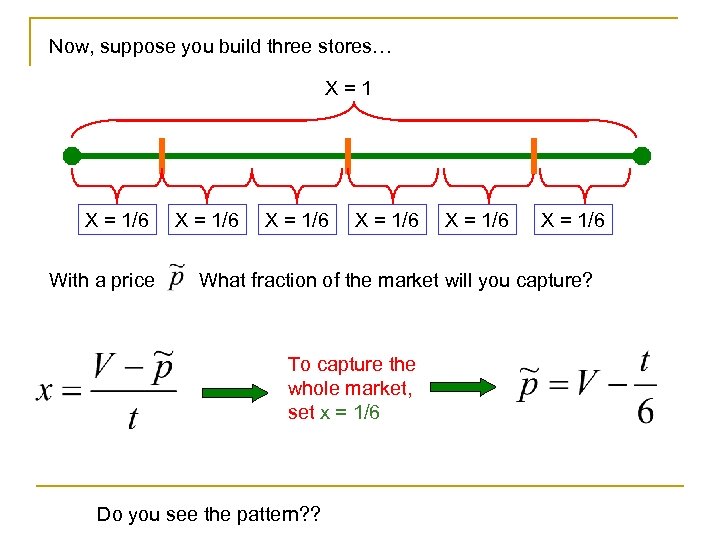 Now, suppose you build three stores… X=1 X = 1/6 With a price X = 1/6 X = 1/6 What fraction of the market will you capture? To capture the whole market, set x = 1/6 Do you see the pattern? ?
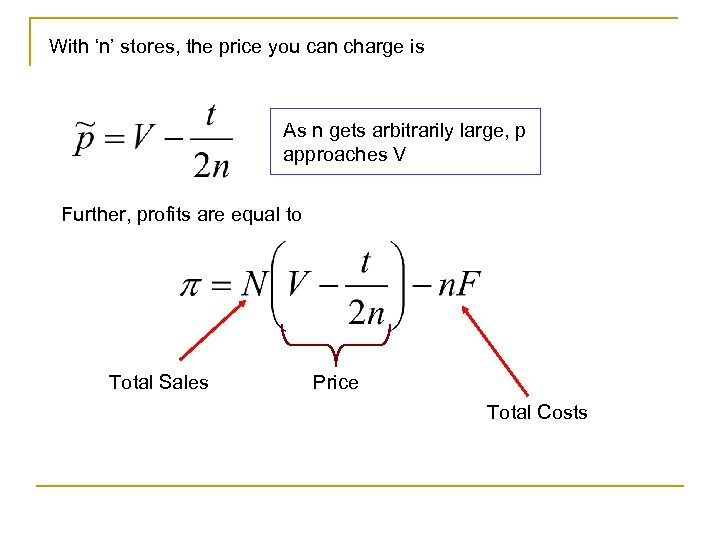 With ‘n’ stores, the price you can charge is As n gets arbitrarily large, p approaches V Further, profits are equal to Total Sales Price Total Costs
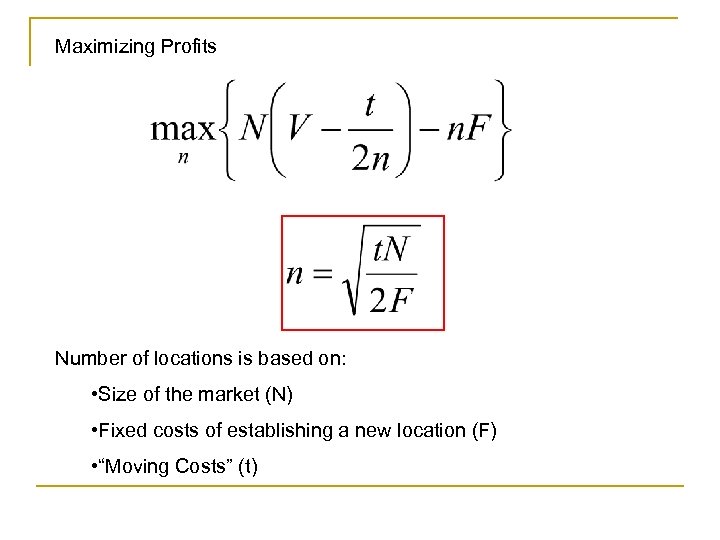 Maximizing Profits Number of locations is based on: • Size of the market (N) • Fixed costs of establishing a new location (F) • “Moving Costs” (t)
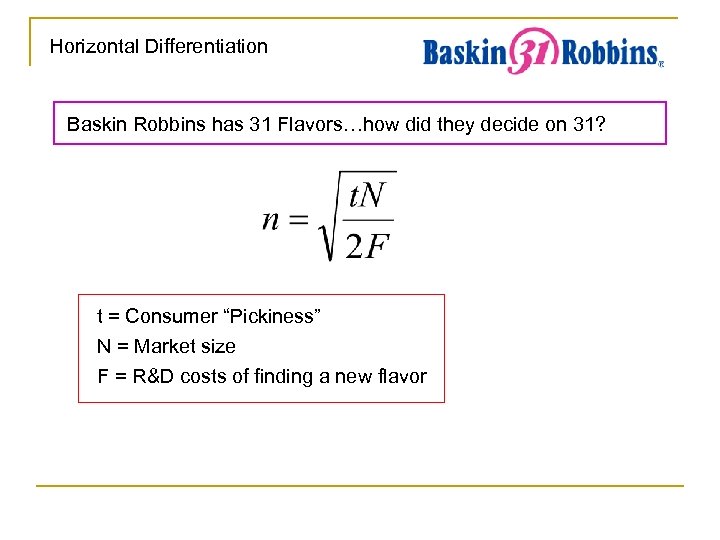 Horizontal Differentiation Baskin Robbins has 31 Flavors…how did they decide on 31? t = Consumer “Pickiness” N = Market size F = R&D costs of finding a new flavor