


 Скачать презентацию FINAL SPRING MULTIPLE CHOICE REVIEW Cane Toad
f7f5c2efd2b4a78b51c80d8be24a39a5.ppt
- Количество слайдов: 97
 FINAL SPRING MULTIPLE CHOICE REVIEW
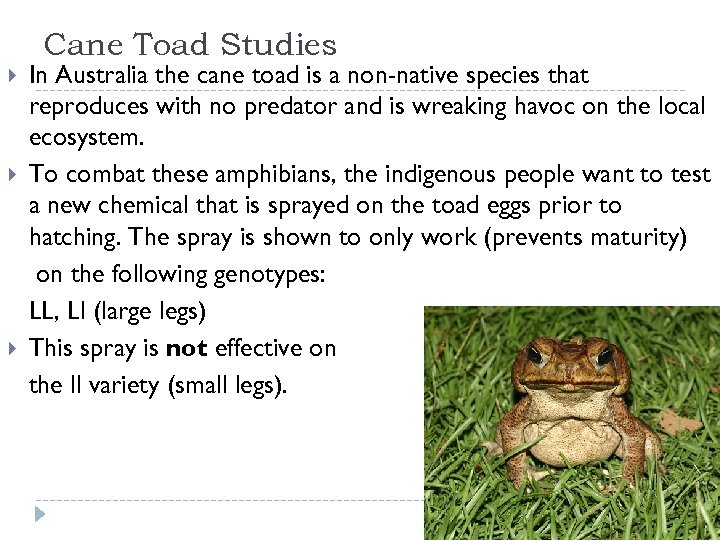 Cane Toad Studies In Australia the cane toad is a non-native species that reproduces with no predator and is wreaking havoc on the local ecosystem. To combat these amphibians, the indigenous people want to test a new chemical that is sprayed on the toad eggs prior to hatching. The spray is shown to only work (prevents maturity) on the following genotypes: LL, Ll (large legs) This spray is not effective on the ll variety (small legs).
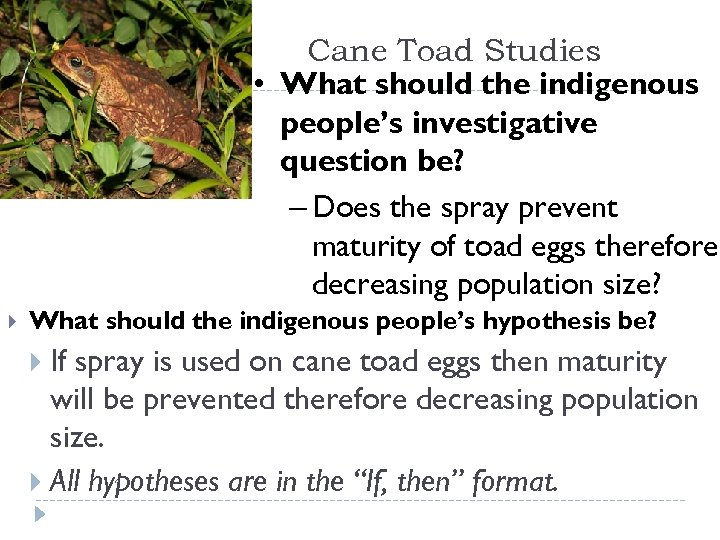 Cane Toad Studies • What should the indigenous people’s investigative question be? – Does the spray prevent maturity of toad eggs therefore decreasing population size? What should the indigenous people’s hypothesis be? If spray is used on cane toad eggs then maturity will be prevented therefore decreasing population size. All hypotheses are in the “If, then” format.
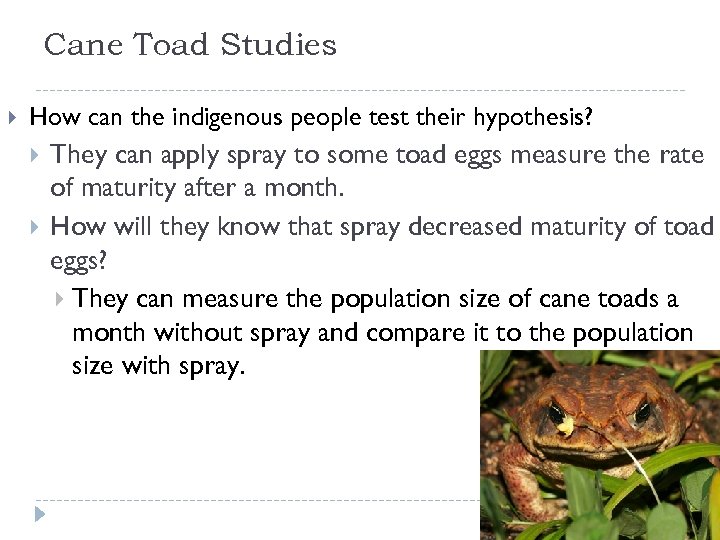 Cane Toad Studies How can the indigenous people test their hypothesis? They can apply spray to some toad eggs measure the rate of maturity after a month. How will they know that spray decreased maturity of toad eggs? They can measure the population size of cane toads a month without spray and compare it to the population size with spray.
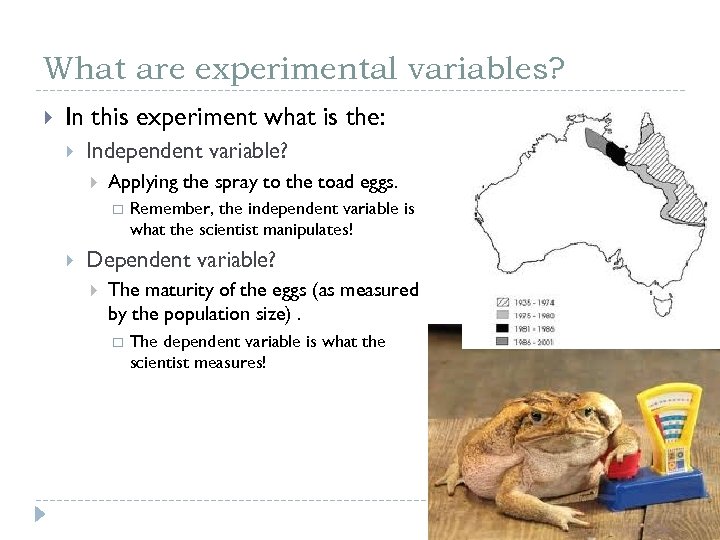 What are experimental variables? In this experiment what is the: Independent variable? Applying the spray to the toad eggs. Remember, the independent variable is what the scientist manipulates! Dependent variable? The maturity of the eggs (as measured by the population size). The dependent variable is what the scientist measures!
 Control? The measurement of egg maturity WITHOUT spray. The control is something you can COMPARE the results to. Constants? The variables that are kept the same in both the control and experimental set up. Constants are kept the same so that you are only testing one variable at a time. Examples: measure egg maturity at the same time of year, apply the spray in the same manner for all eggs, measure data for the same length of time.
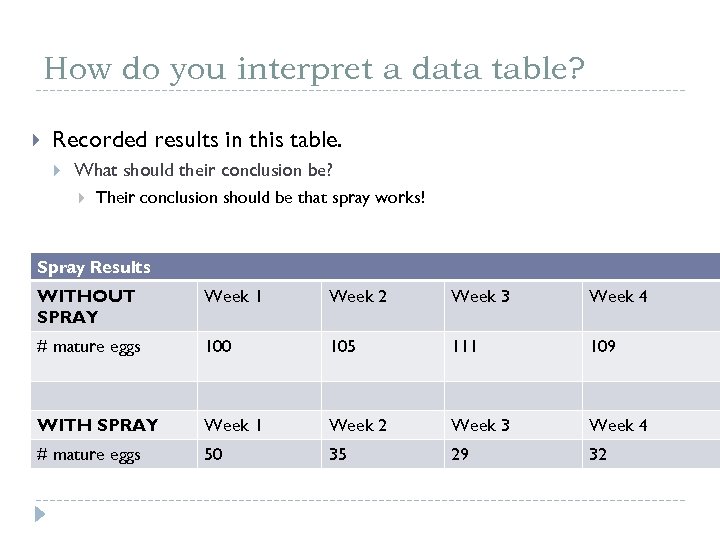 How do you interpret a data table? Recorded results in this table. What should their conclusion be? Their conclusion should be that spray works! Spray Results WITHOUT SPRAY Week 1 Week 2 Week 3 Week 4 # mature eggs 100 105 111 109 WITH SPRAY Week 1 Week 2 Week 3 Week 4 # mature eggs 50 35 29 32
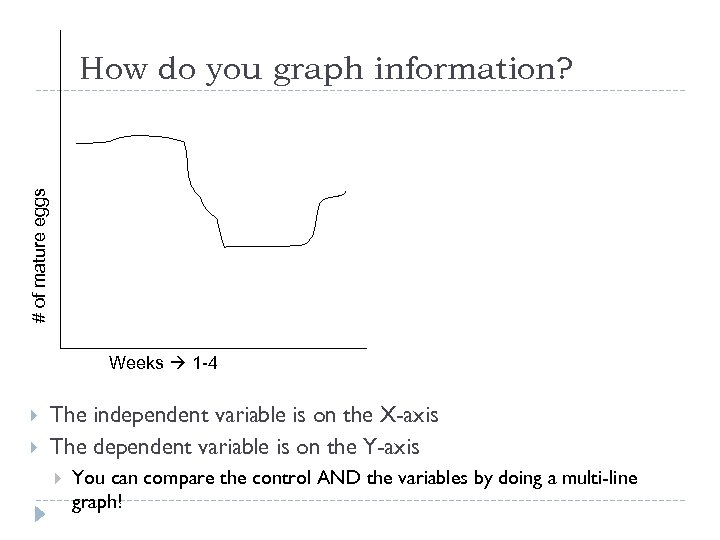 # of mature eggs How do you graph information? Weeks 1 -4 The independent variable is on the X-axis The dependent variable is on the Y-axis You can compare the control AND the variables by doing a multi-line graph!
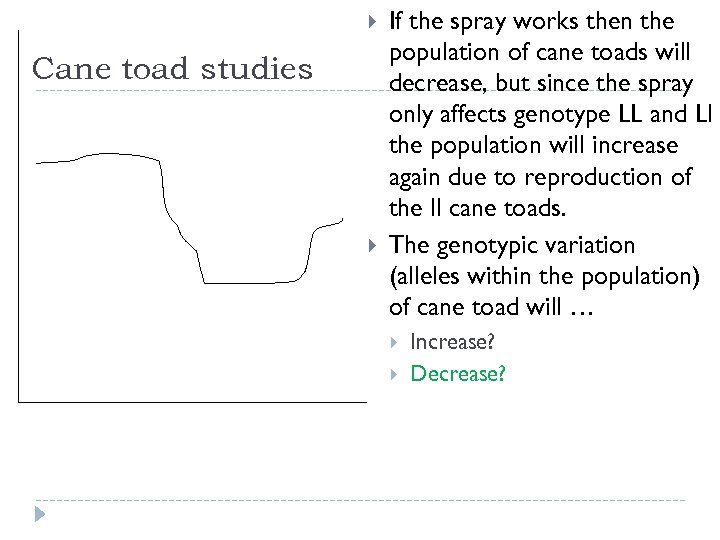 Cane toad studies If the spray works then the population of cane toads will decrease, but since the spray only affects genotype LL and Ll the population will increase again due to reproduction of the ll cane toads. The genotypic variation (alleles within the population) of cane toad will … Increase? Decrease?
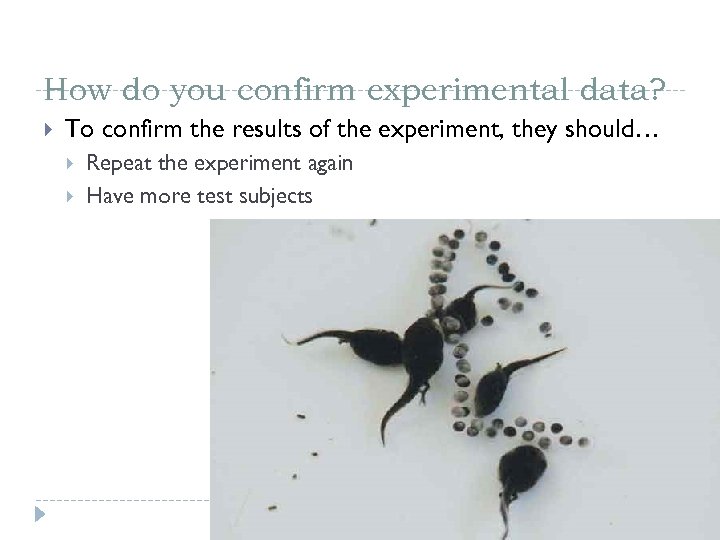 How do you confirm experimental data? To confirm the results of the experiment, they should… Repeat the experiment again Have more test subjects
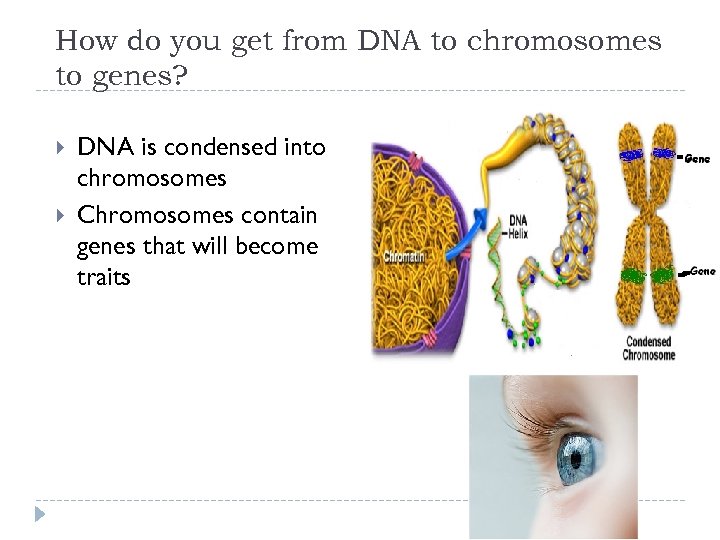 How do you get from DNA to chromosomes to genes? DNA is condensed into chromosomes Chromosomes contain genes that will become traits
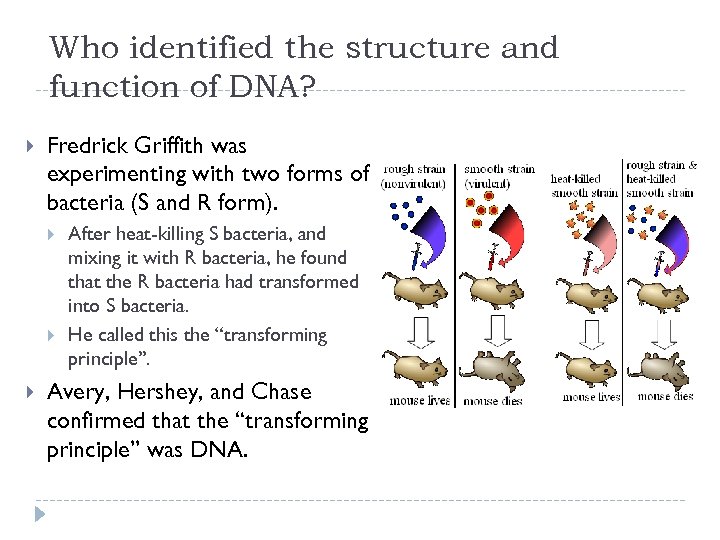 Who identified the structure and function of DNA? Fredrick Griffith was experimenting with two forms of bacteria (S and R form). After heat-killing S bacteria, and mixing it with R bacteria, he found that the R bacteria had transformed into S bacteria. He called this the “transforming principle”. Avery, Hershey, and Chase confirmed that the “transforming principle” was DNA.
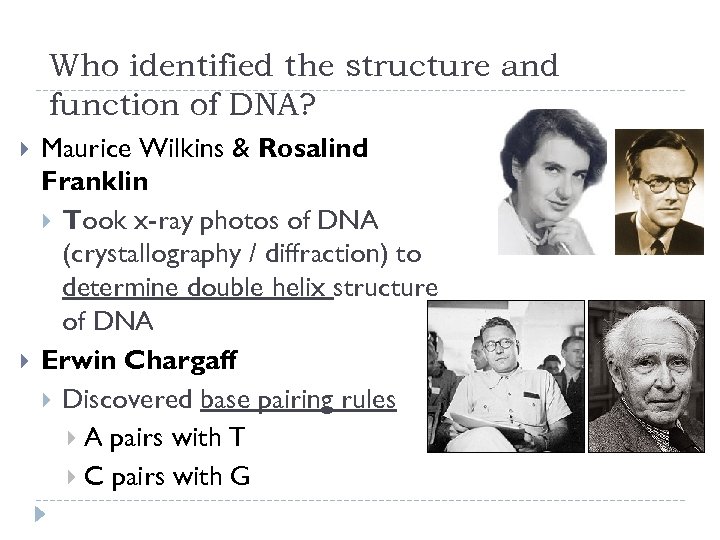 Who identified the structure and function of DNA? Maurice Wilkins & Rosalind Franklin Took x-ray photos of DNA (crystallography / diffraction) to determine double helix structure of DNA Erwin Chargaff Discovered base pairing rules A pairs with T C pairs with G
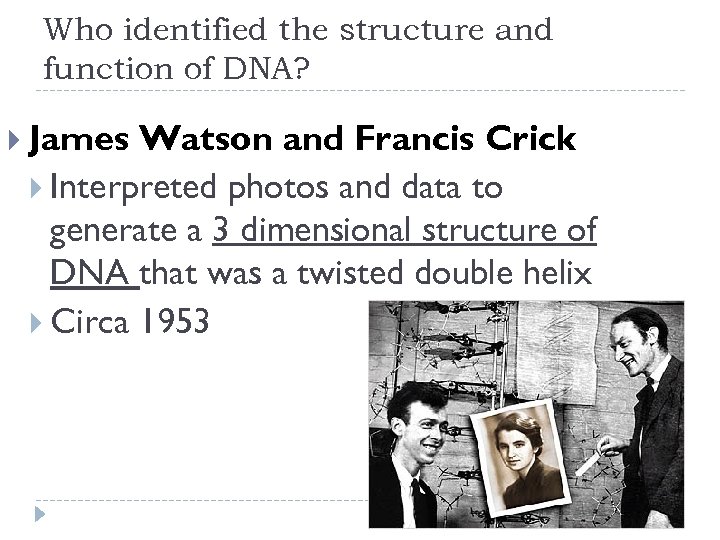 Who identified the structure and function of DNA? James Watson and Francis Crick Interpreted photos and data to generate a 3 dimensional structure of DNA that was a twisted double helix Circa 1953
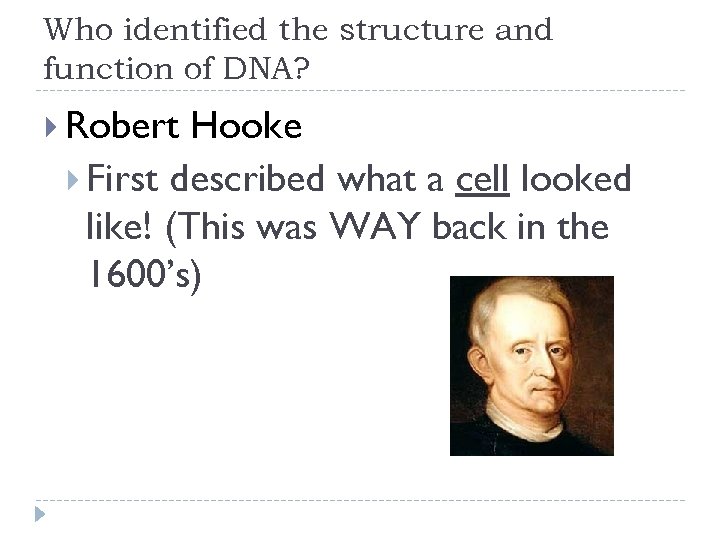 Who identified the structure and function of DNA? Robert Hooke First described what a cell looked like! (This was WAY back in the 1600’s)
 DNA Replication To replicate DNA … Helicase cuts the hydrogen bonds DNA polymerase adds complimentary nucleotides to the two open strands generating two new double helixes. http: //www. youtube. com/watch? v=hf. Z 8 o 9 D 1 tus
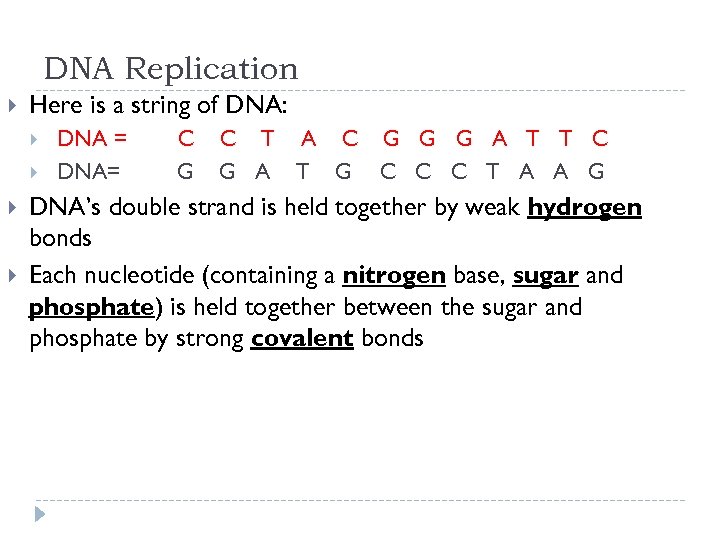 DNA Replication Here is a string of DNA: DNA = DNA= C G C T A C G G G A T T C G A T G C C C T A A G DNA’s double strand is held together by weak hydrogen bonds Each nucleotide (containing a nitrogen base, sugar and phosphate) is held together between the sugar and phosphate by strong covalent bonds
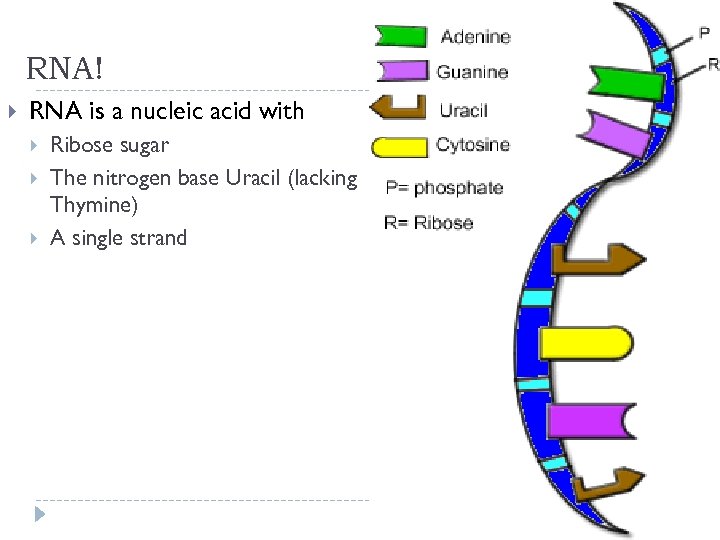 RNA! RNA is a nucleic acid with Ribose sugar The nitrogen base Uracil (lacking Thymine) A single strand
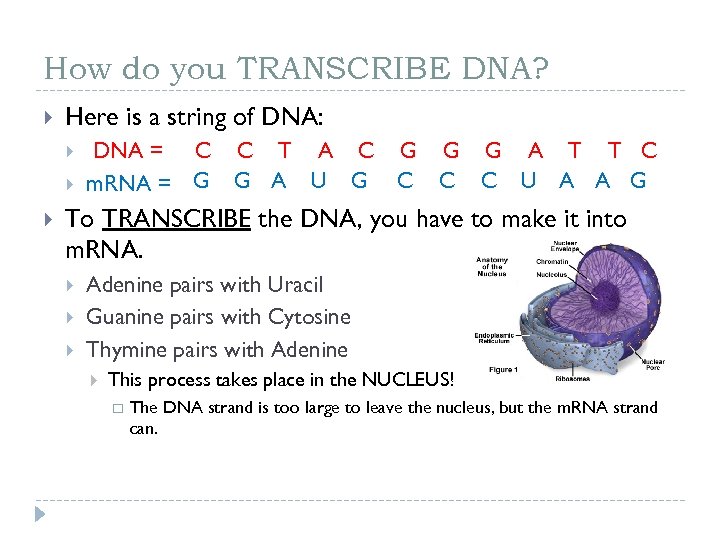 How do you TRANSCRIBE DNA? Here is a string of DNA: DNA = C m. RNA = G C T A C G G G A T T C G A U G C C C U A A G To TRANSCRIBE the DNA, you have to make it into m. RNA. Adenine pairs with Uracil Guanine pairs with Cytosine Thymine pairs with Adenine This process takes place in the NUCLEUS! The DNA strand is too large to leave the nucleus, but the m. RNA strand can.
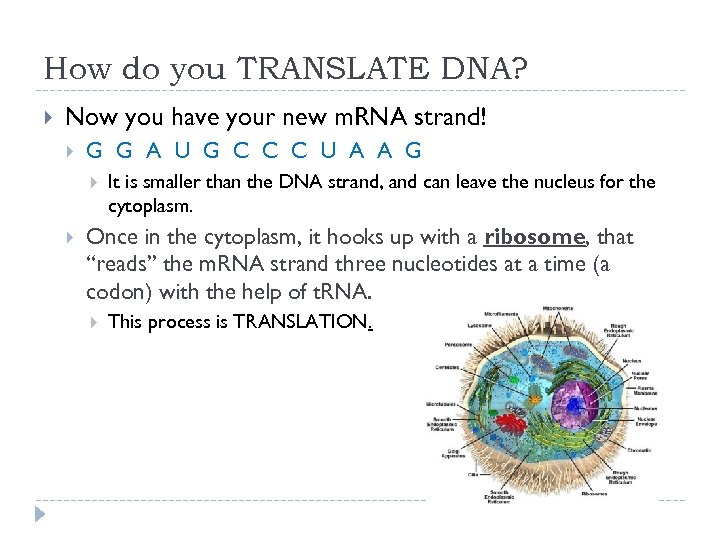 How do you TRANSLATE DNA? Now you have your new m. RNA strand! G G A U G C C C U A A G It is smaller than the DNA strand, and can leave the nucleus for the cytoplasm. Once in the cytoplasm, it hooks up with a ribosome, that “reads” the m. RNA strand three nucleotides at a time (a codon) with the help of t. RNA. This process is TRANSLATION.
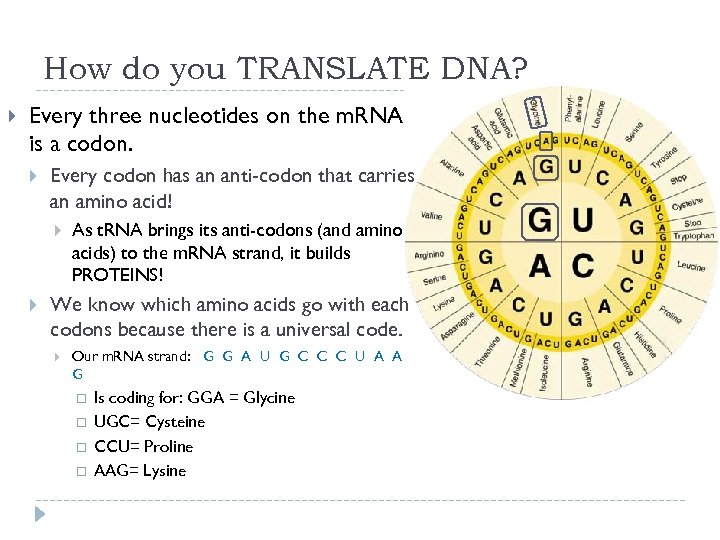 How do you TRANSLATE DNA? Every three nucleotides on the m. RNA is a codon. Every codon has an anti-codon that carries an amino acid! As t. RNA brings its anti-codons (and amino acids) to the m. RNA strand, it builds PROTEINS! We know which amino acids go with each codons because there is a universal code. Our m. RNA strand: G G A U G C C C U A A G Is coding for: GGA = Glycine UGC= Cysteine CCU= Proline AAG= Lysine
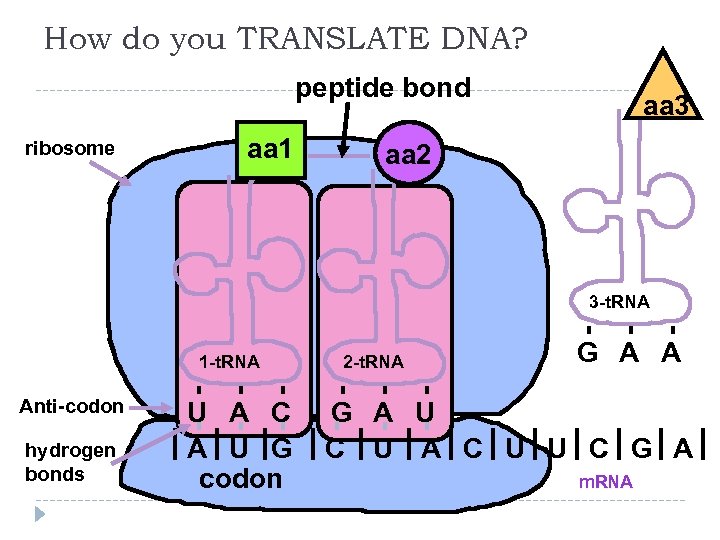 How do you TRANSLATE DNA? peptide bond ribosome aa 1 aa 3 aa 2 3 -t. RNA 1 -t. RNA Anti-codon hydrogen bonds U A C A U G codon 2 -t. RNA G A U C U A C U U C G A m. RNA
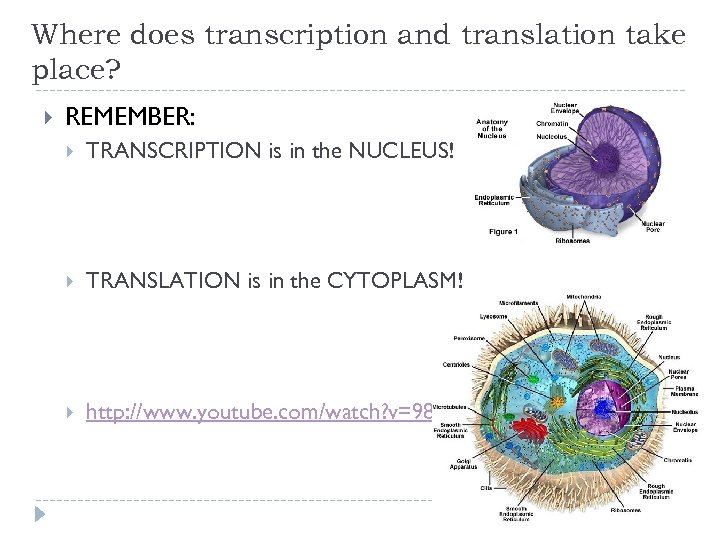 Where does transcription and translation take place? REMEMBER: TRANSCRIPTION is in the NUCLEUS! TRANSLATION is in the CYTOPLASM! http: //www. youtube. com/watch? v=983 lhh 20 r. GY
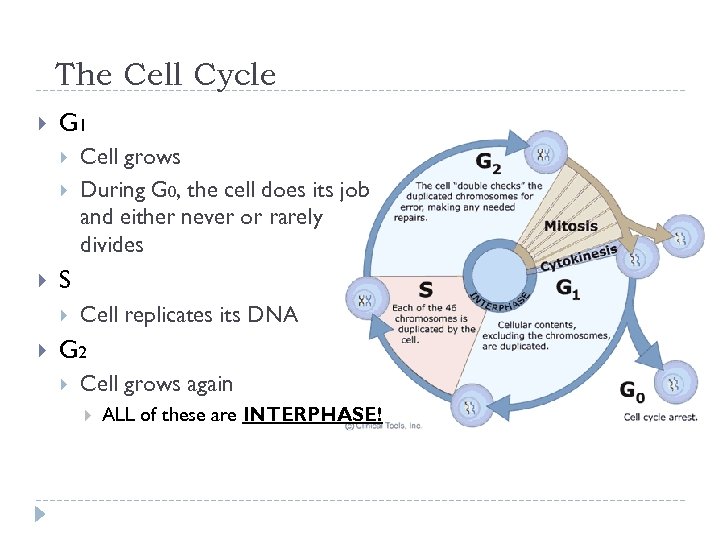 The Cell Cycle G 1 S Cell grows During G 0, the cell does its job and either never or rarely divides Cell replicates its DNA G 2 Cell grows again ALL of these are INTERPHASE!
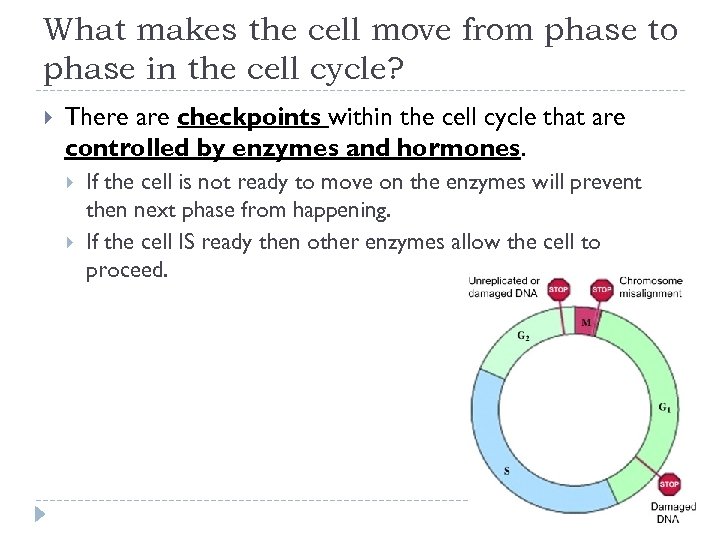 What makes the cell move from phase to phase in the cell cycle? There are checkpoints within the cell cycle that are controlled by enzymes and hormones. If the cell is not ready to move on the enzymes will prevent then next phase from happening. If the cell IS ready then other enzymes allow the cell to proceed.
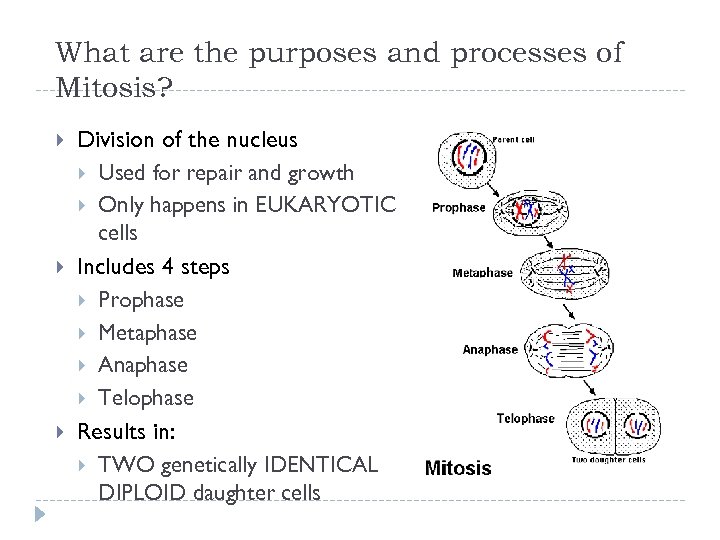 What are the purposes and processes of Mitosis? Division of the nucleus Used for repair and growth Only happens in EUKARYOTIC cells Includes 4 steps Prophase Metaphase Anaphase Telophase Results in: TWO genetically IDENTICAL DIPLOID daughter cells
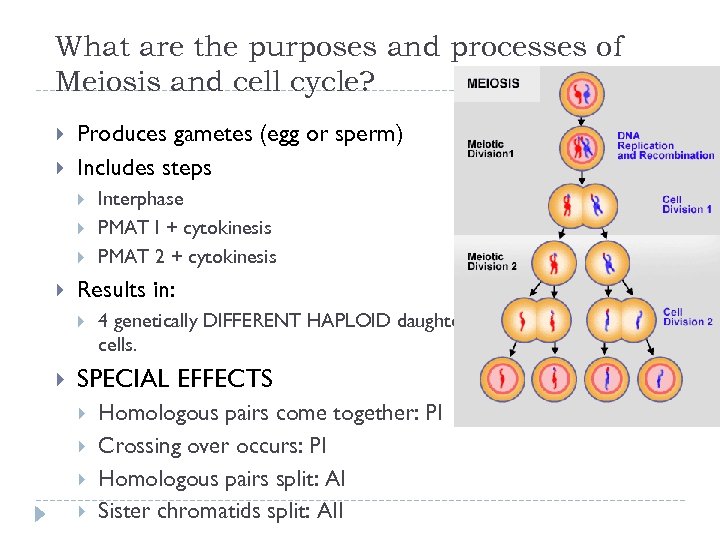 What are the purposes and processes of Meiosis and cell cycle? Produces gametes (egg or sperm) Includes steps Results in: Interphase PMAT I + cytokinesis PMAT 2 + cytokinesis 4 genetically DIFFERENT HAPLOID daughter cells. SPECIAL EFFECTS Homologous pairs come together: PI Crossing over occurs: PI Homologous pairs split: AI Sister chromatids split: AII
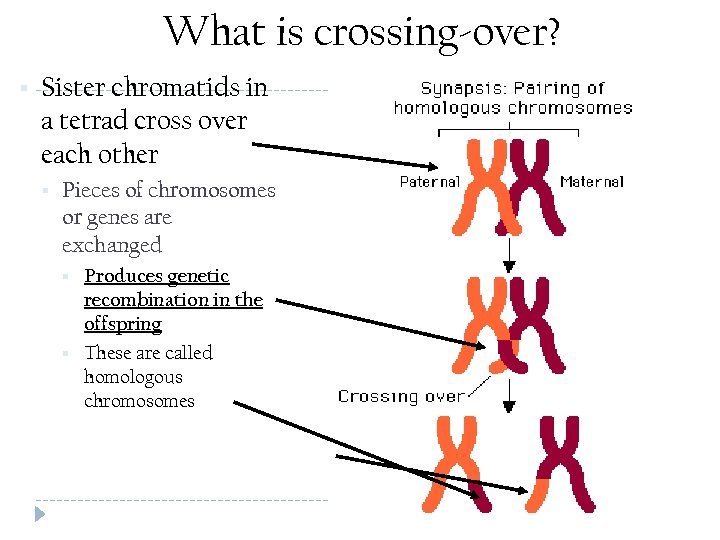 What is crossing-over? § Sister chromatids in a tetrad cross over each other § Pieces of chromosomes or genes are exchanged § § Produces genetic recombination in the offspring These are called homologous chromosomes
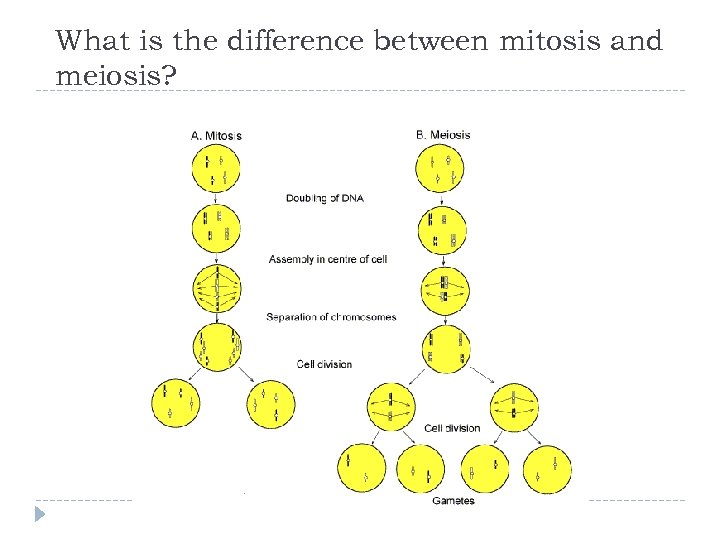 What is the difference between mitosis and meiosis?
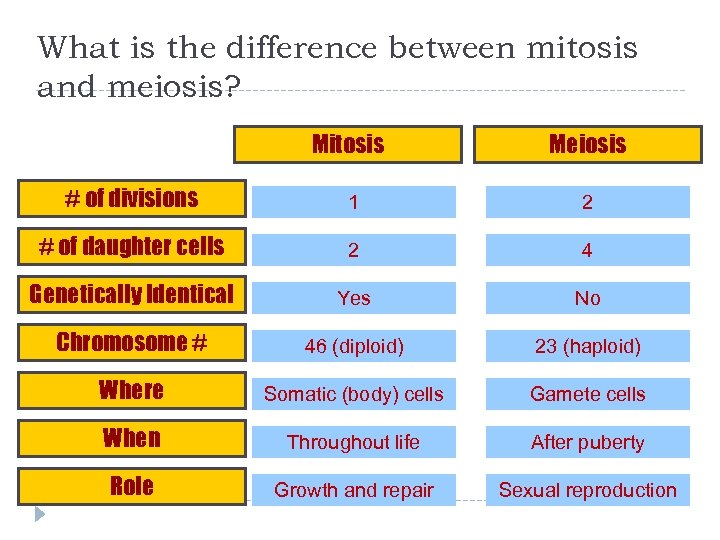 What is the difference between mitosis and meiosis? Mitosis Meiosis # of divisions 1 2 # of daughter cells 2 4 Genetically Identical Yes No Chromosome # 46 (diploid) 23 (haploid) Where Somatic (body) cells Gamete cells When Throughout life After puberty Role Growth and repair Sexual reproduction
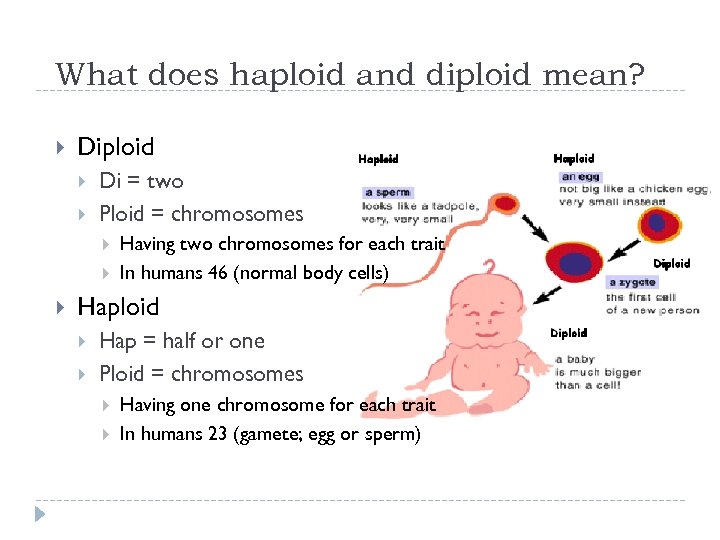 What does haploid and diploid mean? Diploid Di = two Ploid = chromosomes Having two chromosomes for each trait In humans 46 (normal body cells) Haploid Hap = half or one Ploid = chromosomes Having one chromosome for each trait In humans 23 (gamete; egg or sperm)
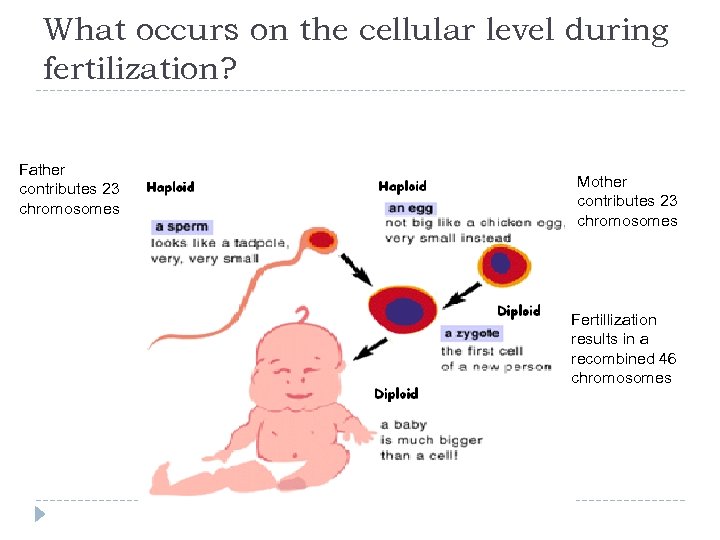 What occurs on the cellular level during fertilization? Father contributes 23 chromosomes Mother contributes 23 chromosomes Fertillization results in a recombined 46 chromosomes
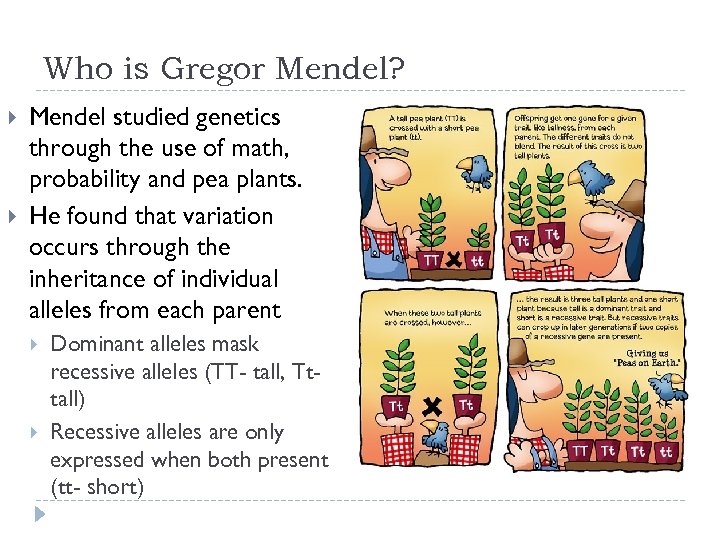 Who is Gregor Mendel? Mendel studied genetics through the use of math, probability and pea plants. He found that variation occurs through the inheritance of individual alleles from each parent Dominant alleles mask recessive alleles (TT- tall, Tttall) Recessive alleles are only expressed when both present (tt- short)
 Gregor Mendel Titled the Father of Genetics due to his numerous studies and detailed notes on the inheritance patterns in Pea Plants Mendel observed the physical characteristics (phenotype) of the offspring to generate his three laws about the genotypes (alleles) Law of Dominance Law of Segregation (alleles separate during meiosis) Law of Independent Assortment (all traits are inherited independently)
 What is the genotypic and phenotypic ratio? A loving couple wants to have children. They are both heterozygous for brown eyes. They want a blue-eyed child. What are their chances? Genotype Gene combination for a trait (Bb, BB, bb) Phenotype The physical feature resulting from the trait. (brown eyes or blue eyes) Mom has the genotype Bb. Dad has the genotype Bb.
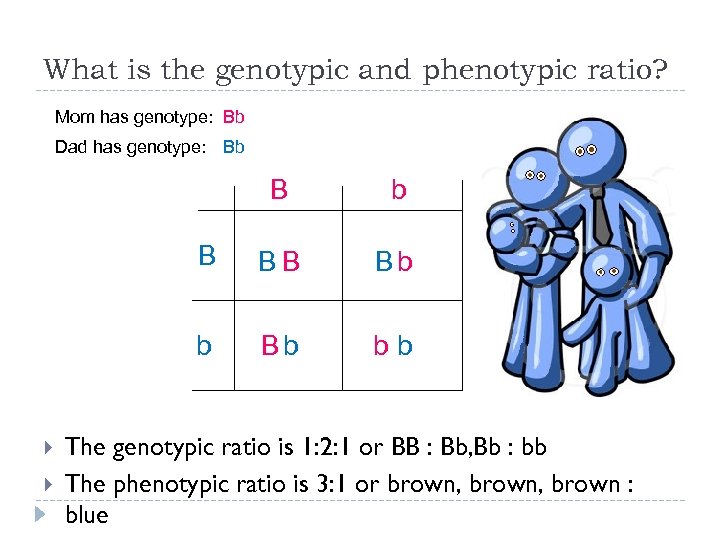 What is the genotypic and phenotypic ratio? Mom has genotype: Bb Dad has genotype: Bb B B BB Bb b b Bb bb The genotypic ratio is 1: 2: 1 or BB : Bb, Bb : bb The phenotypic ratio is 3: 1 or brown, brown : blue
 Dihybrid cross- used to determine probability of cross between two traits http: //www. biology. arizona. edu/mendelian_genetics/proble m_sets/dihybrid_cross/03 t. html
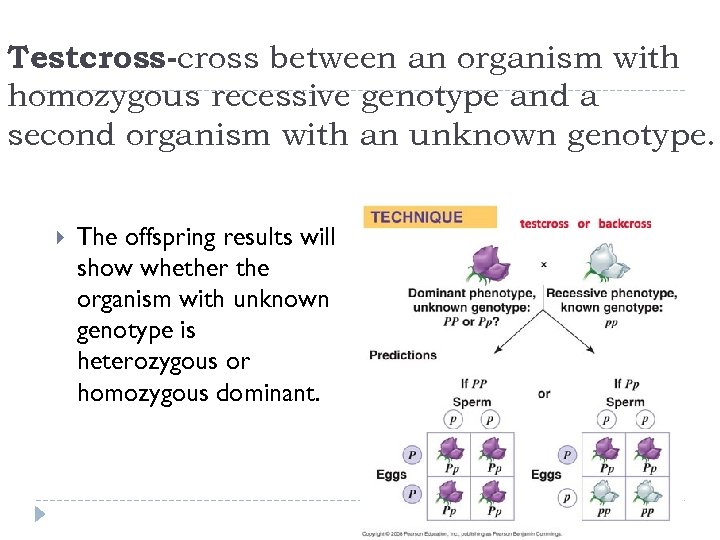 Testcross-cross between an organism with homozygous recessive genotype and a second organism with an unknown genotype. The offspring results will show whether the organism with unknown genotype is heterozygous or homozygous dominant.
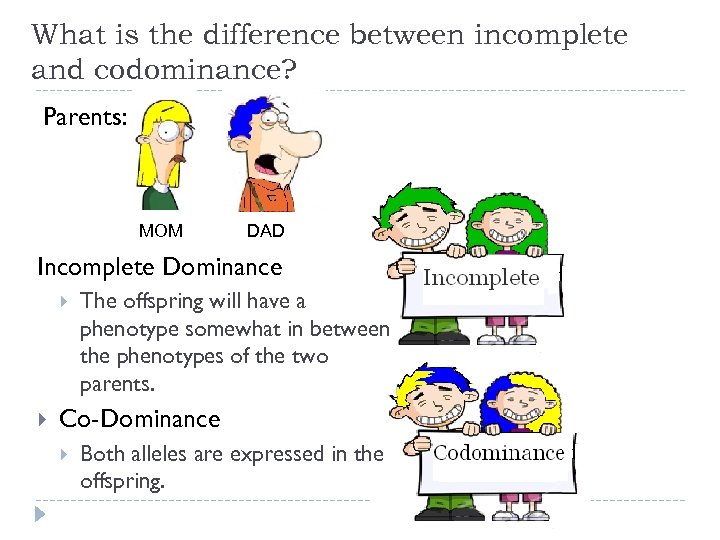 What is the difference between incomplete and codominance? Parents: MOM DAD Incomplete Dominance The offspring will have a phenotype somewhat in between the phenotypes of the two parents. Co-Dominance Both alleles are expressed in the offspring.
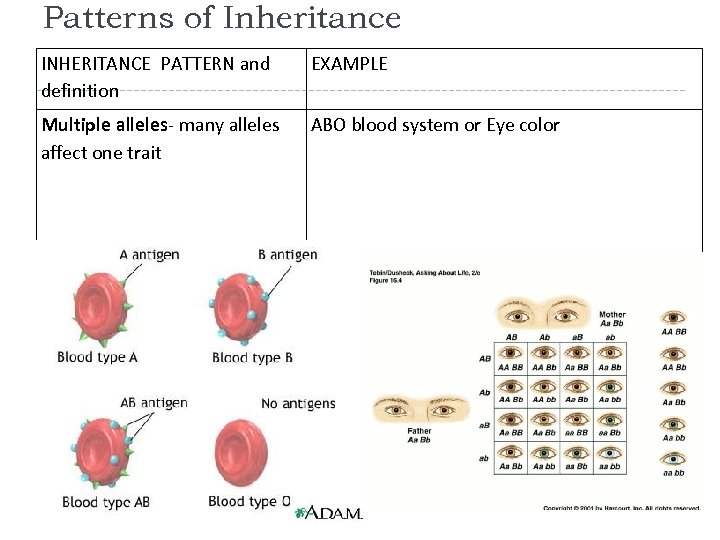 Patterns of Inheritance INHERITANCE PATTERN and definition EXAMPLE Multiple alleles- many alleles affect one trait ABO blood system or Eye color
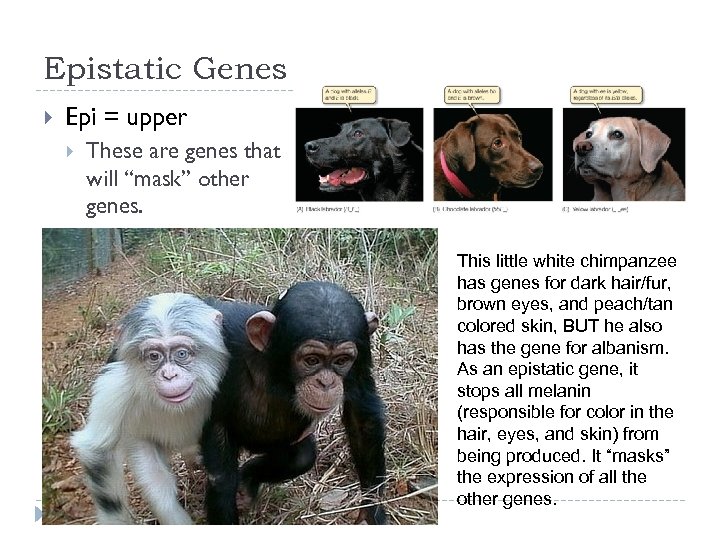 Epistatic Genes Epi = upper These are genes that will “mask” other genes. This little white chimpanzee has genes for dark hair/fur, brown eyes, and peach/tan colored skin, BUT he also has the gene for albanism. As an epistatic gene, it stops all melanin (responsible for color in the hair, eyes, and skin) from being produced. It “masks” the expression of all the other genes.
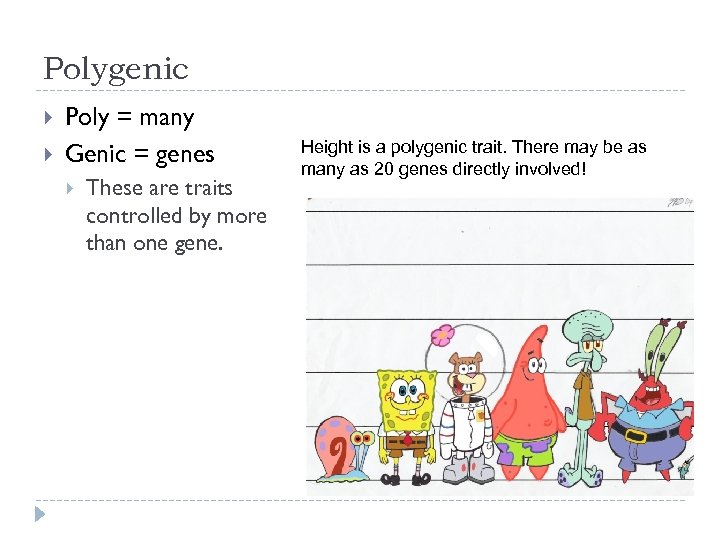 Polygenic Poly = many Genic = genes These are traits controlled by more than one gene. Height is a polygenic trait. There may be as many as 20 genes directly involved!
 Pleiotropy Alleles at one locus affect many traits Sickle cell anemia has many health effects like clotting blood, heart problems, etc
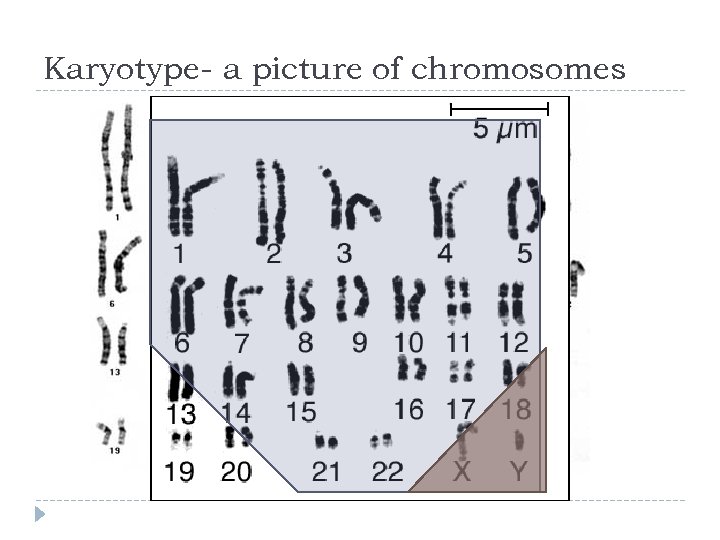 Karyotype- a picture of chromosomes
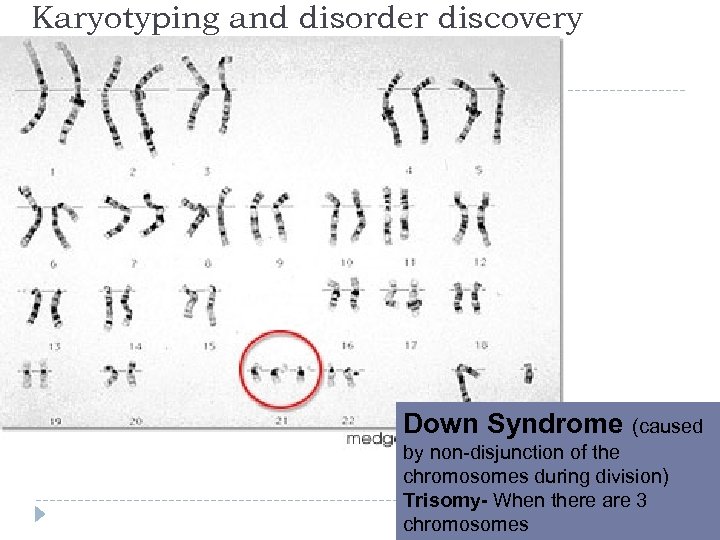 Karyotyping and disorder discovery Down Syndrome (caused by non-disjunction of the chromosomes during division) Trisomy- When there are 3 chromosomes
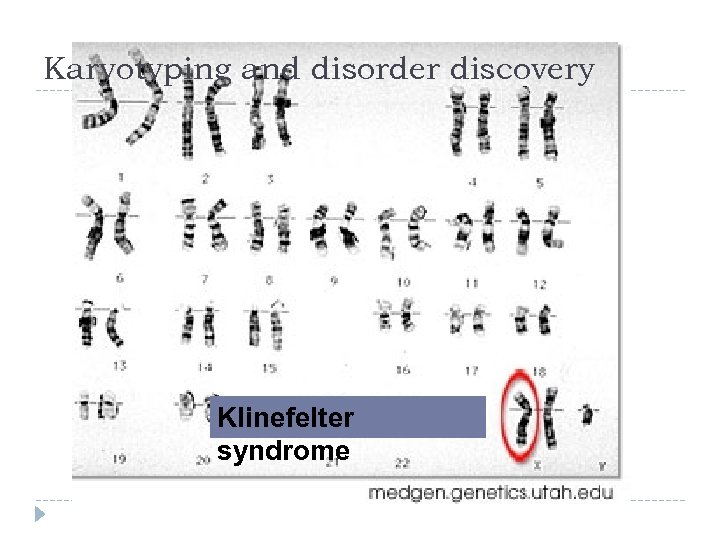 Karyotyping and disorder discovery Klinefelter syndrome
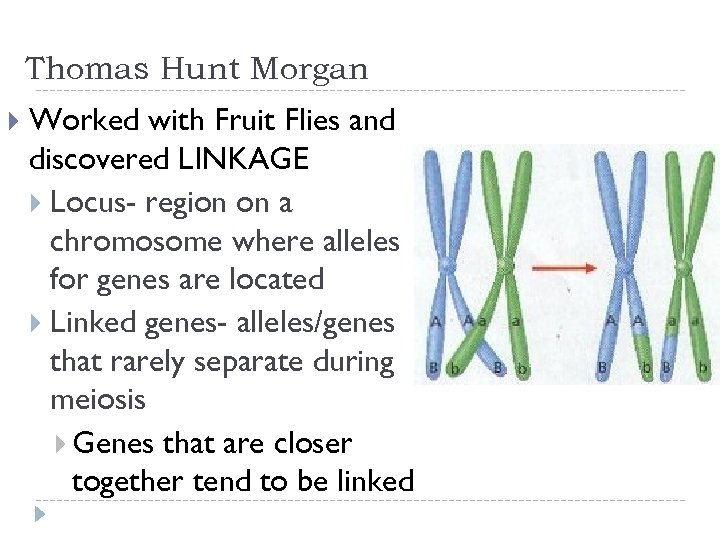 Thomas Hunt Morgan Worked with Fruit Flies and discovered LINKAGE Locus- region on a chromosome where alleles for genes are located Linked genes- alleles/genes that rarely separate during meiosis Genes that are closer together tend to be linked
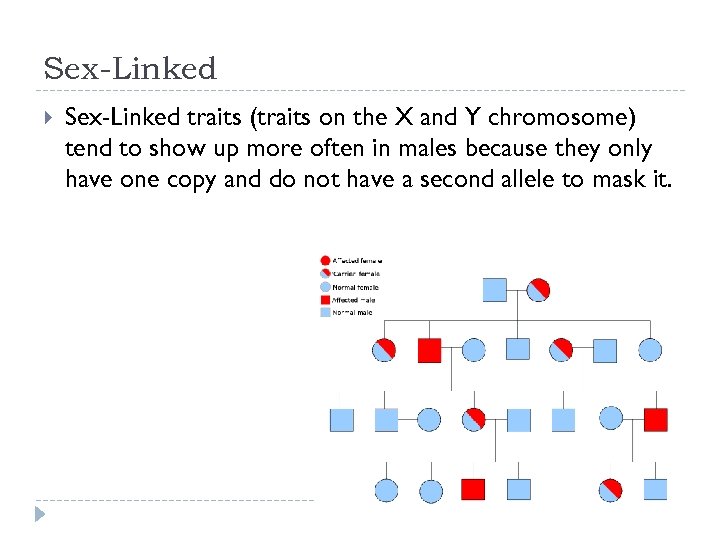 Sex-Linked traits (traits on the X and Y chromosome) tend to show up more often in males because they only have one copy and do not have a second allele to mask it.
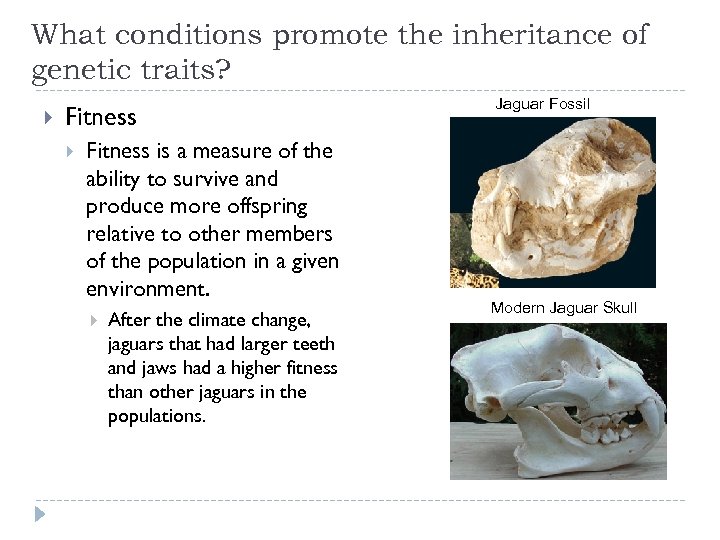 What conditions promote the inheritance of genetic traits? Fitness is a measure of the ability to survive and produce more offspring relative to other members of the population in a given environment. After the climate change, jaguars that had larger teeth and jaws had a higher fitness than other jaguars in the populations. Jaguar Fossil Modern Jaguar Skull
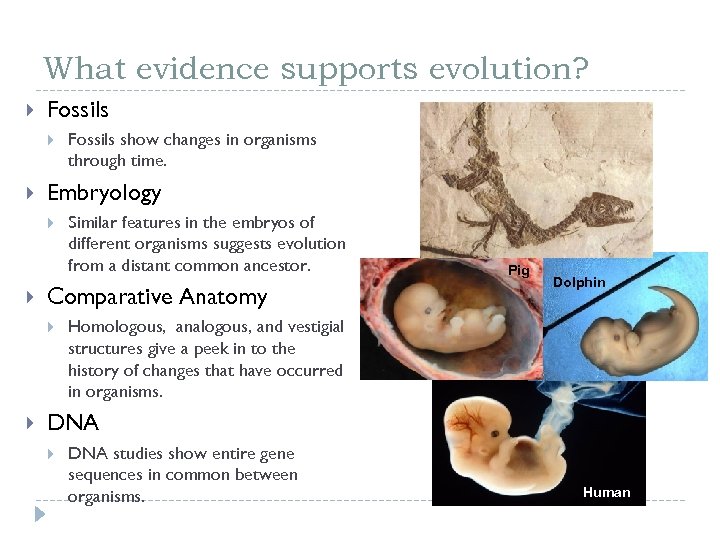 What evidence supports evolution? Fossils Embryology Similar features in the embryos of different organisms suggests evolution from a distant common ancestor. Comparative Anatomy Fossils show changes in organisms through time. Pig Dolphin Homologous, analogous, and vestigial structures give a peek in to the history of changes that have occurred in organisms. DNA studies show entire gene sequences in common between organisms. Human
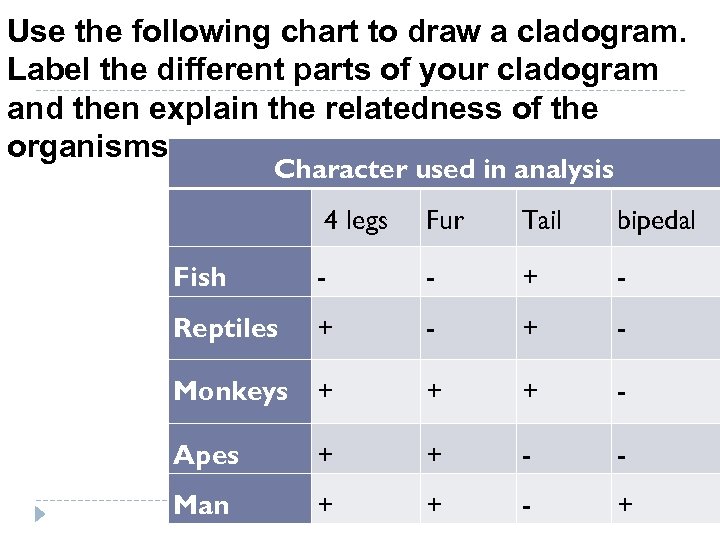 Use the following chart to draw a cladogram. Label the different parts of your cladogram and then explain the relatedness of the organisms. Character used in analysis 4 legs Fur Tail bipedal Fish - - + - Reptiles + - Monkeys + + + - Apes + + - - Man + + - +
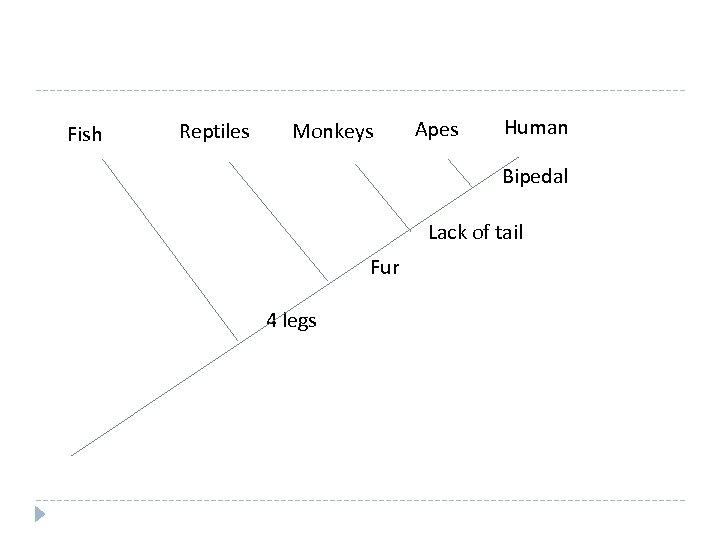 Fish Reptiles Monkeys Apes Human Bipedal Lack of tail Fur 4 legs
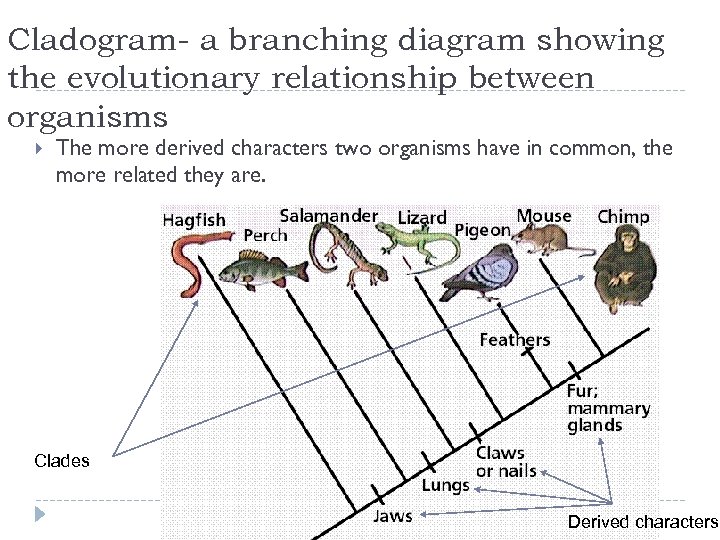 Cladogram- a branching diagram showing the evolutionary relationship between organisms The more derived characters two organisms have in common, the more related they are. Clades Derived characters
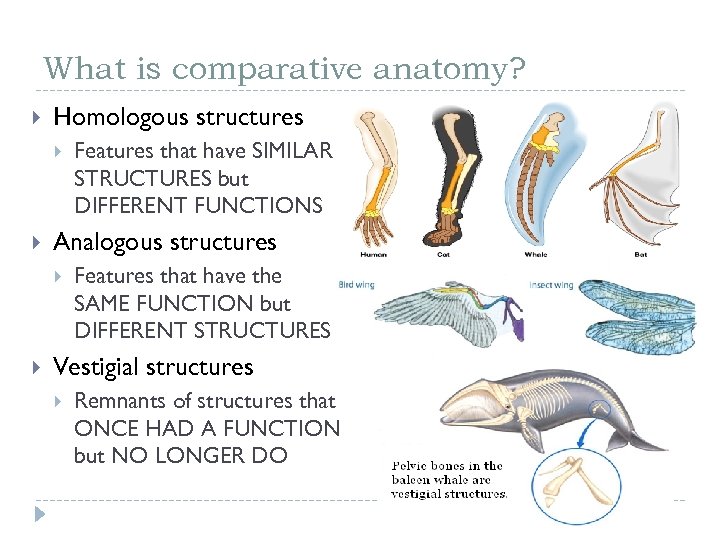 What is comparative anatomy? Homologous structures Analogous structures Features that have SIMILAR STRUCTURES but DIFFERENT FUNCTIONS Features that have the SAME FUNCTION but DIFFERENT STRUCTURES Vestigial structures Remnants of structures that ONCE HAD A FUNCTION but NO LONGER DO
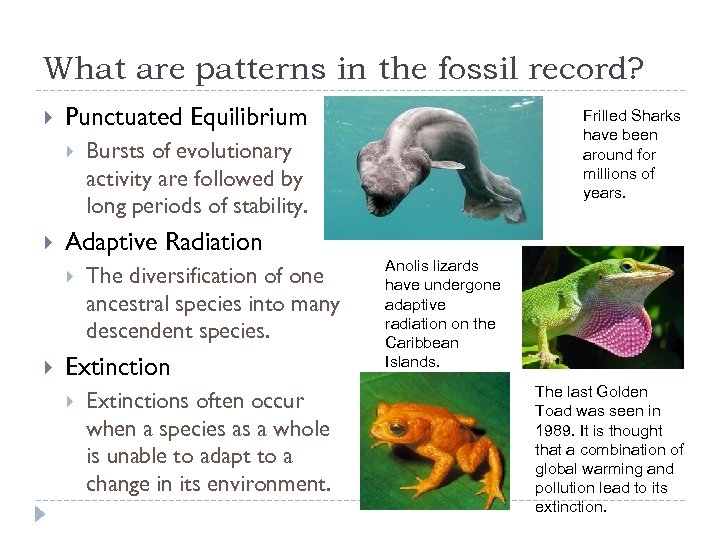 What are patterns in the fossil record? Punctuated Equilibrium Bursts of evolutionary activity are followed by long periods of stability. Adaptive Radiation Frilled Sharks have been around for millions of years. The diversification of one ancestral species into many descendent species. Extinctions often occur when a species as a whole is unable to adapt to a change in its environment. Anolis lizards have undergone adaptive radiation on the Caribbean Islands. The last Golden Toad was seen in 1989. It is thought that a combination of global warming and pollution lead to its extinction.
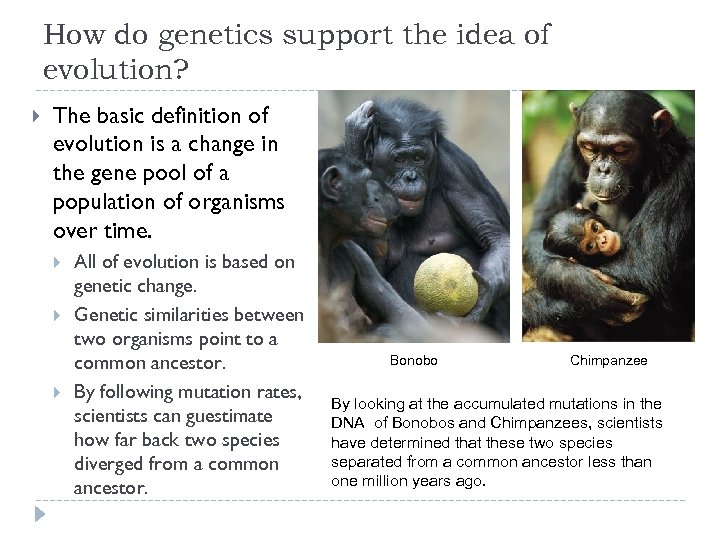 How do genetics support the idea of evolution? The basic definition of evolution is a change in the gene pool of a population of organisms over time. All of evolution is based on genetic change. Genetic similarities between two organisms point to a common ancestor. By following mutation rates, scientists can guestimate how far back two species diverged from a common ancestor. Bonobo Chimpanzee By looking at the accumulated mutations in the DNA of Bonobos and Chimpanzees, scientists have determined that these two species separated from a common ancestor less than one million years ago.
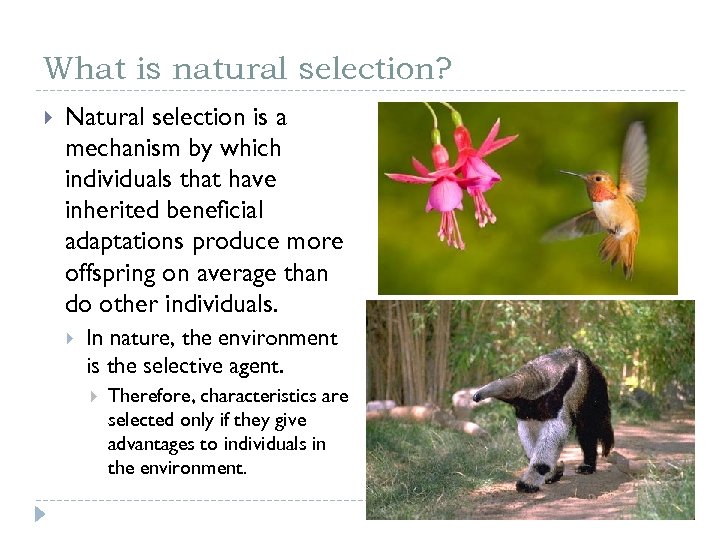 What is natural selection? Natural selection is a mechanism by which individuals that have inherited beneficial adaptations produce more offspring on average than do other individuals. In nature, the environment is the selective agent. Therefore, characteristics are selected only if they give advantages to individuals in the environment.
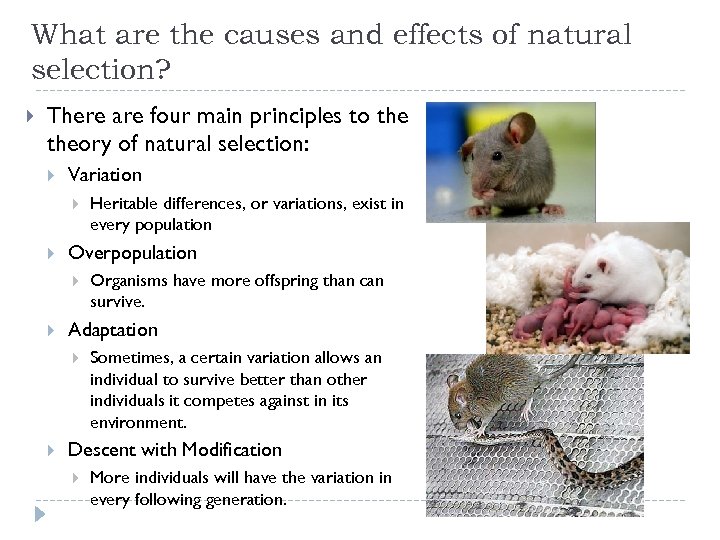 What are the causes and effects of natural selection? There are four main principles to theory of natural selection: Variation Overpopulation Organisms have more offspring than can survive. Adaptation Heritable differences, or variations, exist in every population Sometimes, a certain variation allows an individual to survive better than other individuals it competes against in its environment. Descent with Modification More individuals will have the variation in every following generation.
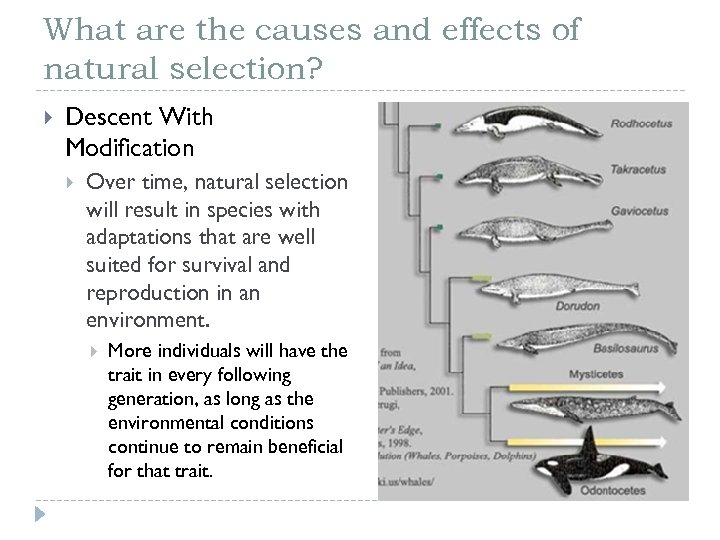 What are the causes and effects of natural selection? Descent With Modification Over time, natural selection will result in species with adaptations that are well suited for survival and reproduction in an environment. More individuals will have the trait in every following generation, as long as the environmental conditions continue to remain beneficial for that trait.
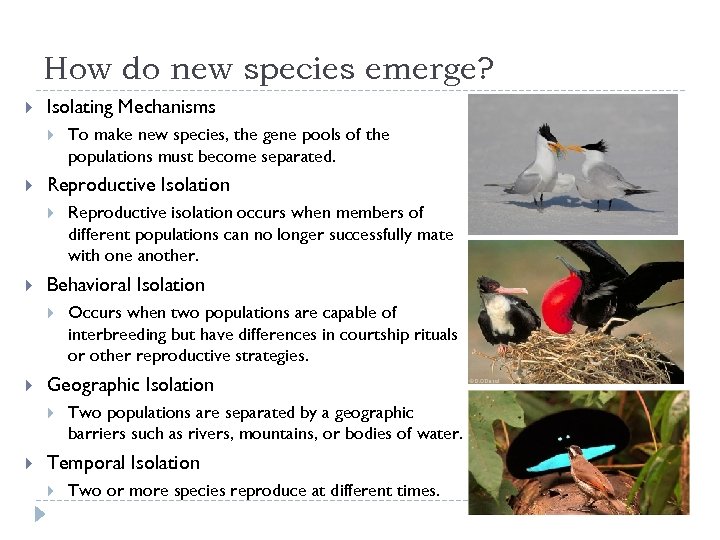 How do new species emerge? Isolating Mechanisms Reproductive Isolation Occurs when two populations are capable of interbreeding but have differences in courtship rituals or other reproductive strategies. Geographic Isolation Reproductive isolation occurs when members of different populations can no longer successfully mate with one another. Behavioral Isolation To make new species, the gene pools of the populations must become separated. Two populations are separated by a geographic barriers such as rivers, mountains, or bodies of water. Temporal Isolation Two or more species reproduce at different times.
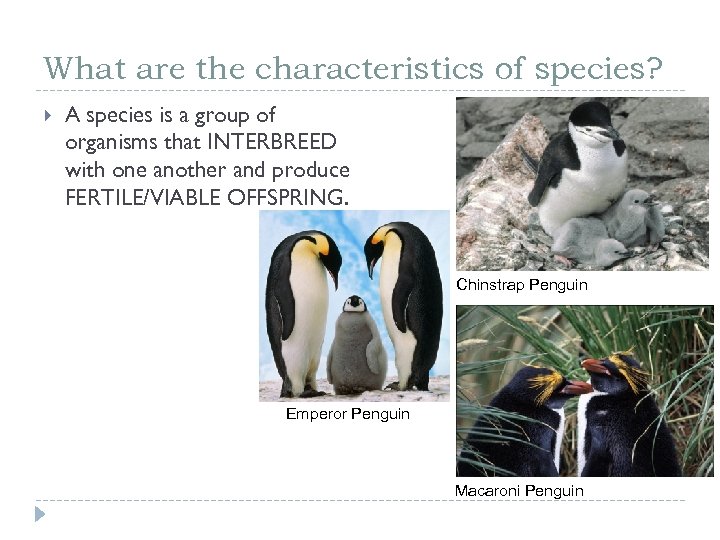 What are the characteristics of species? A species is a group of organisms that INTERBREED with one another and produce FERTILE/VIABLE OFFSPRING. Chinstrap Penguin Emperor Penguin Macaroni Penguin
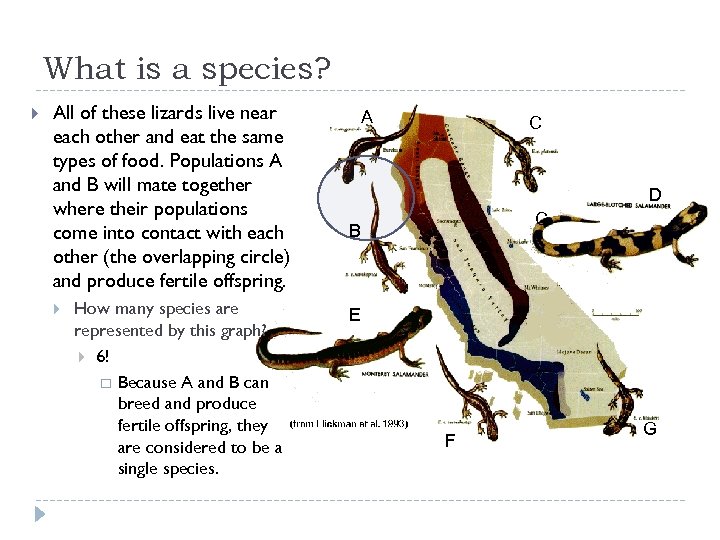 What is a species? All of these lizards live near each other and eat the same types of food. Populations A and B will mate together where their populations come into contact with each other (the overlapping circle) and produce fertile offspring. How many species are represented by this graph? 6! Because A and B can breed and produce fertile offspring, they are considered to be a single species. A C D C B E F G
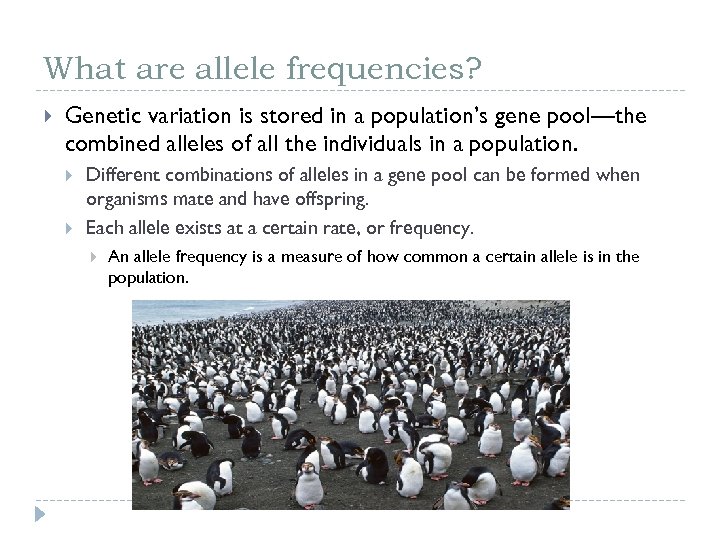 What are allele frequencies? Genetic variation is stored in a population’s gene pool—the combined alleles of all the individuals in a population. Different combinations of alleles in a gene pool can be formed when organisms mate and have offspring. Each allele exists at a certain rate, or frequency. An allele frequency is a measure of how common a certain allele is in the population.
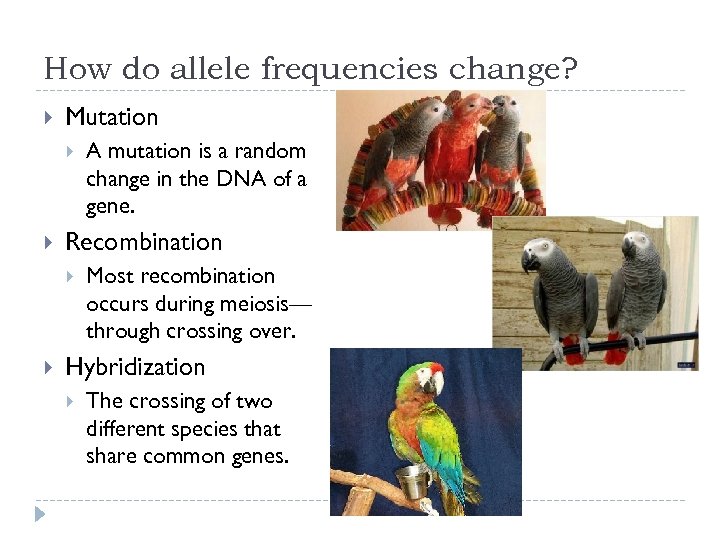 How do allele frequencies change? Mutation Recombination A mutation is a random change in the DNA of a gene. Most recombination occurs during meiosis— through crossing over. Hybridization The crossing of two different species that share common genes.
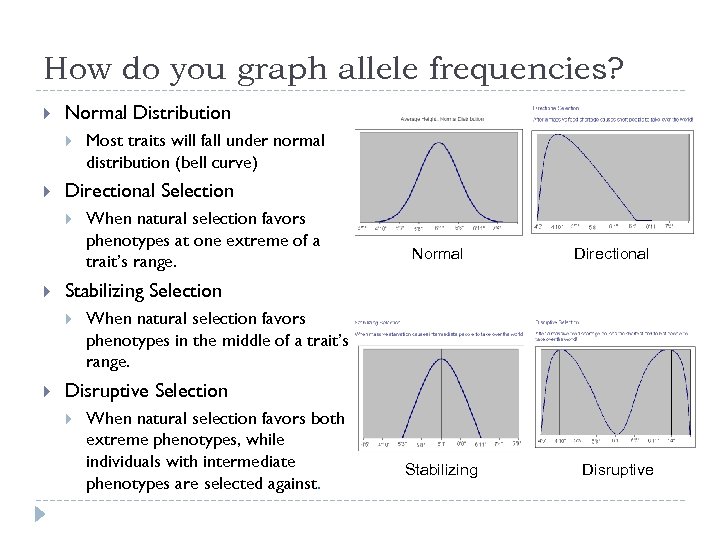 How do you graph allele frequencies? Normal Distribution Directional Selection When natural selection favors phenotypes at one extreme of a trait’s range. Normal Directional Stabilizing Selection Most traits will fall under normal distribution (bell curve) When natural selection favors phenotypes in the middle of a trait’s range. Disruptive Selection When natural selection favors both extreme phenotypes, while individuals with intermediate phenotypes are selected against. Stabilizing Disruptive
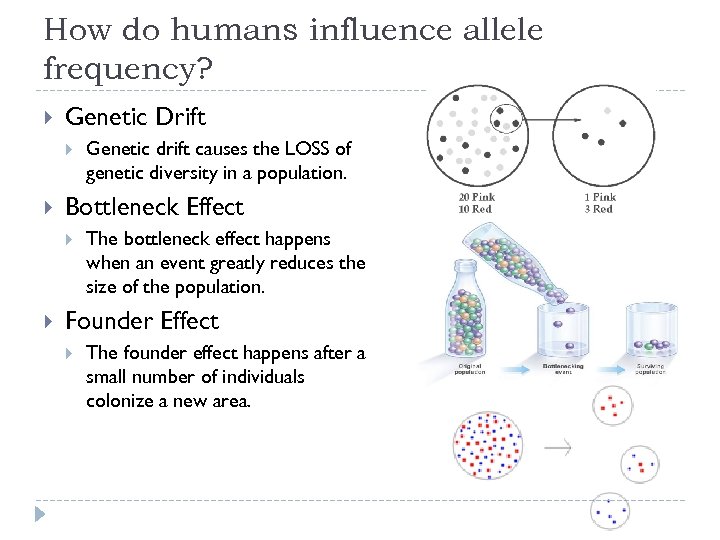 How do humans influence allele frequency? Genetic Drift Bottleneck Effect Genetic drift causes the LOSS of genetic diversity in a population. The bottleneck effect happens when an event greatly reduces the size of the population. Founder Effect The founder effect happens after a small number of individuals colonize a new area.
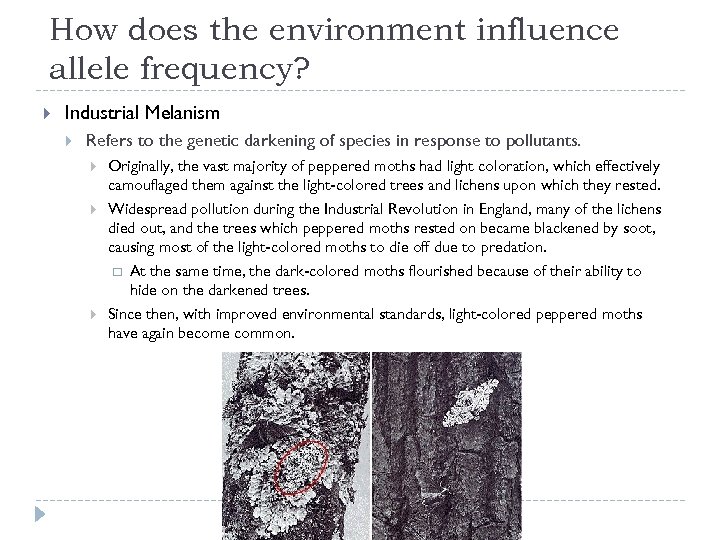 How does the environment influence allele frequency? Industrial Melanism Refers to the genetic darkening of species in response to pollutants. Originally, the vast majority of peppered moths had light coloration, which effectively camouflaged them against the light-colored trees and lichens upon which they rested. Widespread pollution during the Industrial Revolution in England, many of the lichens died out, and the trees which peppered moths rested on became blackened by soot, causing most of the light-colored moths to die off due to predation. At the same time, the dark-colored moths flourished because of their ability to hide on the darkened trees. Since then, with improved environmental standards, light-colored peppered moths have again become common.
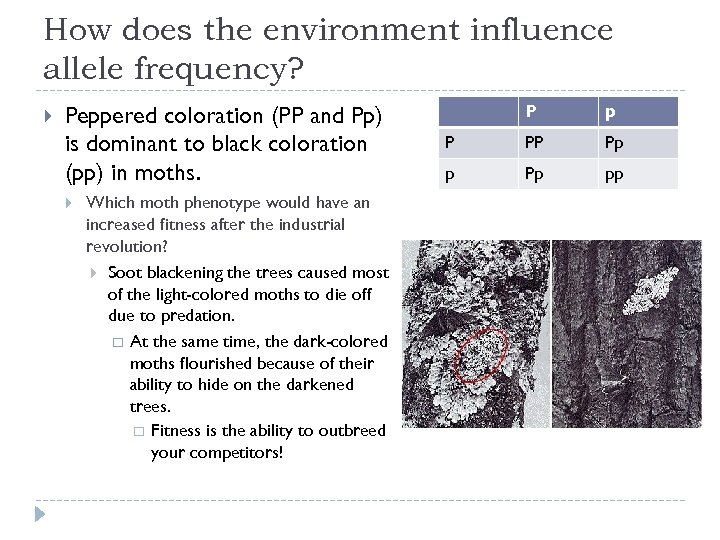 How does the environment influence allele frequency? Peppered coloration (PP and Pp) is dominant to black coloration (pp) in moths. Which moth phenotype would have an increased fitness after the industrial revolution? Soot blackening the trees caused most of the light-colored moths to die off due to predation. At the same time, the dark-colored moths flourished because of their ability to hide on the darkened trees. Fitness is the ability to outbreed your competitors! P p P PP Pp pp
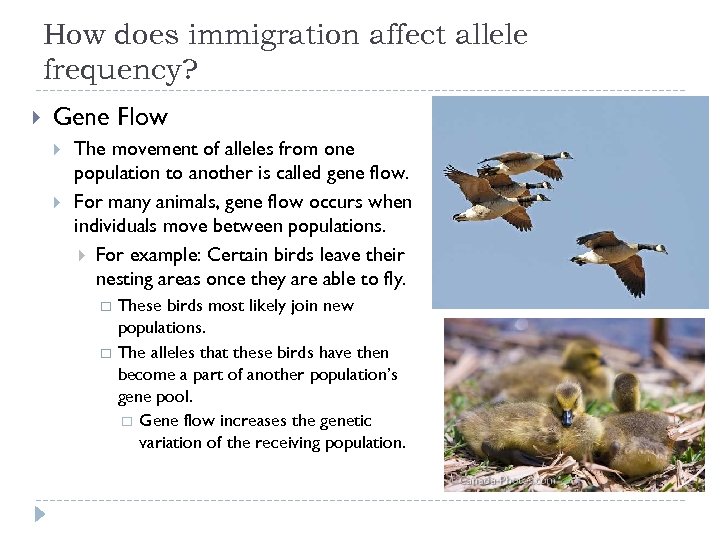 How does immigration affect allele frequency? Gene Flow The movement of alleles from one population to another is called gene flow. For many animals, gene flow occurs when individuals move between populations. For example: Certain birds leave their nesting areas once they are able to fly. These birds most likely join new populations. The alleles that these birds have then become a part of another population’s gene pool. Gene flow increases the genetic variation of the receiving population.
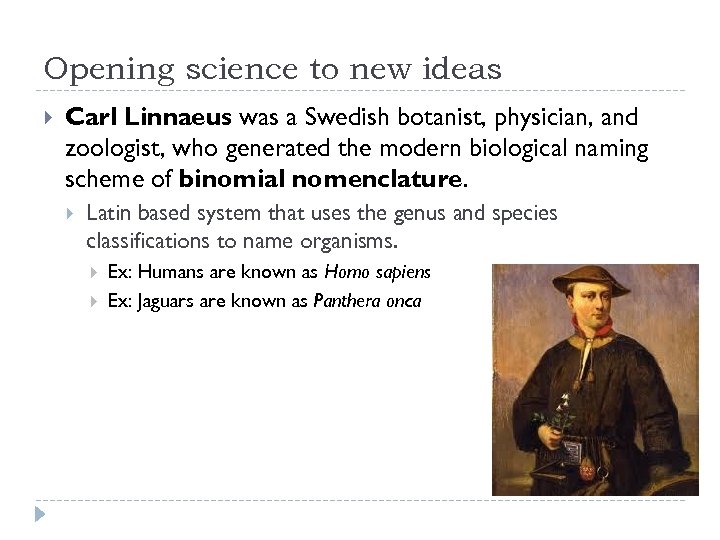 Opening science to new ideas Carl Linnaeus was a Swedish botanist, physician, and zoologist, who generated the modern biological naming scheme of binomial nomenclature. Latin based system that uses the genus and species classifications to name organisms. Ex: Humans are known as Homo sapiens Ex: Jaguars are known as Panthera onca
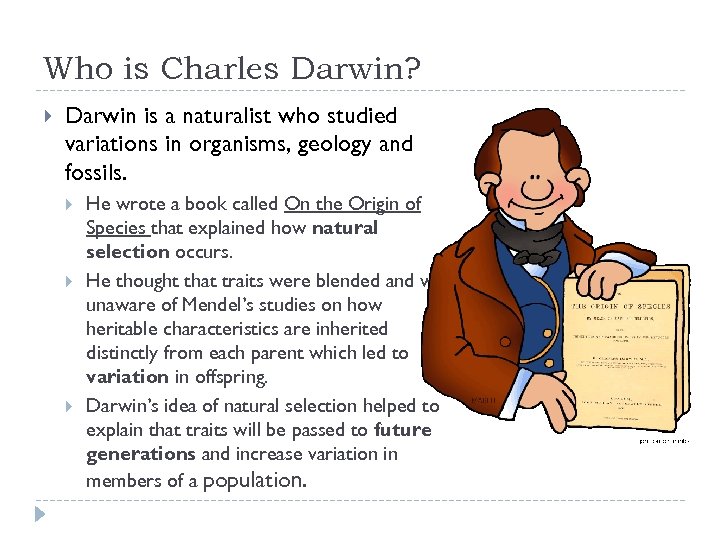 Who is Charles Darwin? Darwin is a naturalist who studied variations in organisms, geology and fossils. He wrote a book called On the Origin of Species that explained how natural selection occurs. He thought that traits were blended and was unaware of Mendel’s studies on how heritable characteristics are inherited distinctly from each parent which led to variation in offspring. Darwin’s idea of natural selection helped to explain that traits will be passed to future generations and increase variation in members of a population.
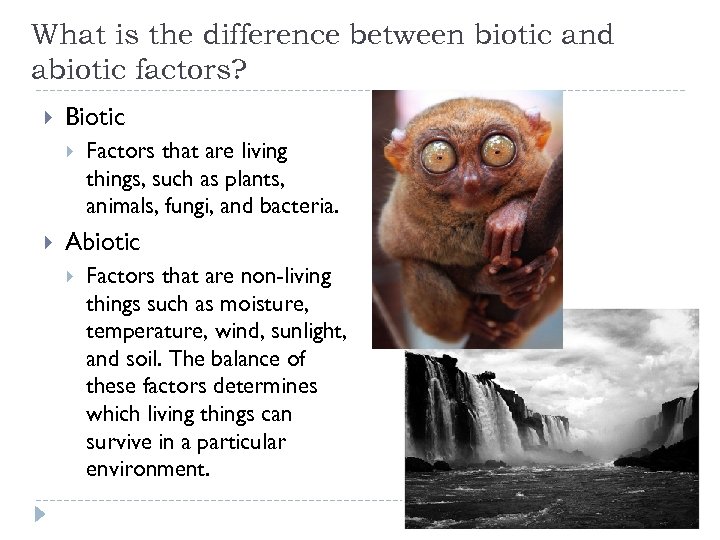 What is the difference between biotic and abiotic factors? Biotic Factors that are living things, such as plants, animals, fungi, and bacteria. Abiotic Factors that are non-living things such as moisture, temperature, wind, sunlight, and soil. The balance of these factors determines which living things can survive in a particular environment.
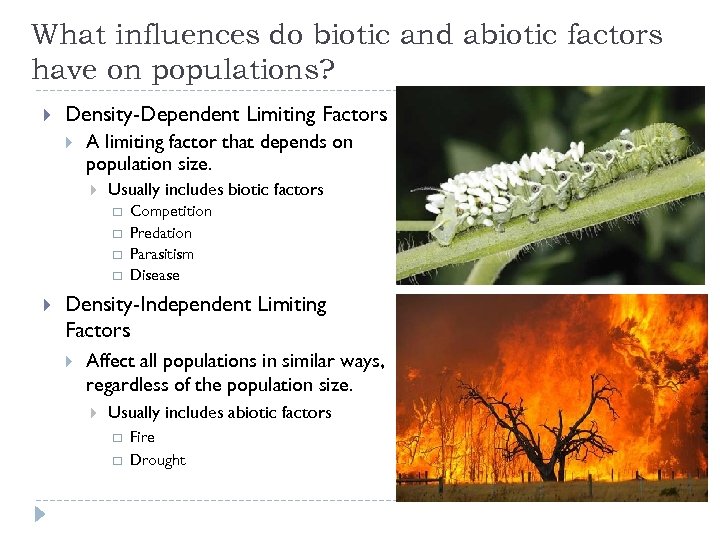 What influences do biotic and abiotic factors have on populations? Density-Dependent Limiting Factors A limiting factor that depends on population size. Usually includes biotic factors Competition Predation Parasitism Disease Density-Independent Limiting Factors Affect all populations in similar ways, regardless of the population size. Usually includes abiotic factors Fire Drought
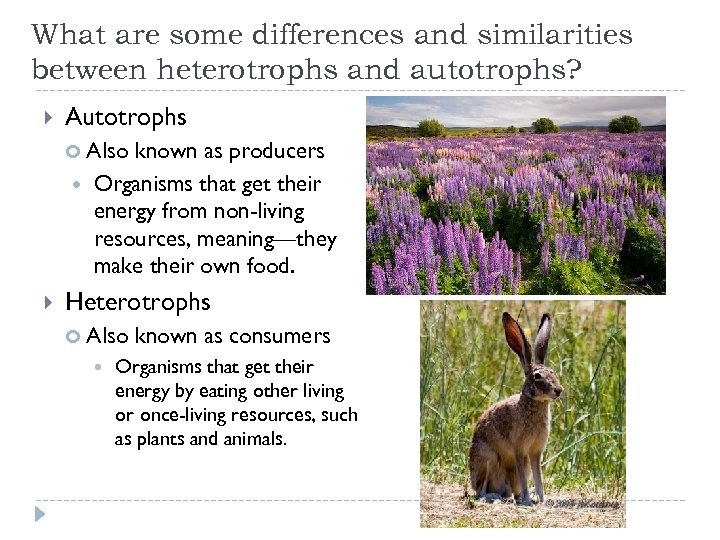 What are some differences and similarities between heterotrophs and autotrophs? Autotrophs Also known as producers Organisms that get their energy from non-living resources, meaning—they make their own food. Heterotrophs Also known as consumers Organisms that get their energy by eating other living or once-living resources, such as plants and animals.
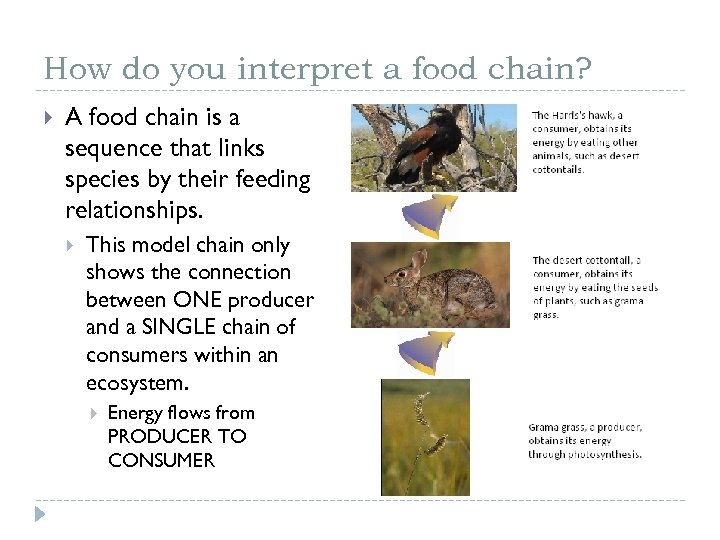 How do you interpret a food chain? A food chain is a sequence that links species by their feeding relationships. This model chain only shows the connection between ONE producer and a SINGLE chain of consumers within an ecosystem. Energy flows from PRODUCER TO CONSUMER
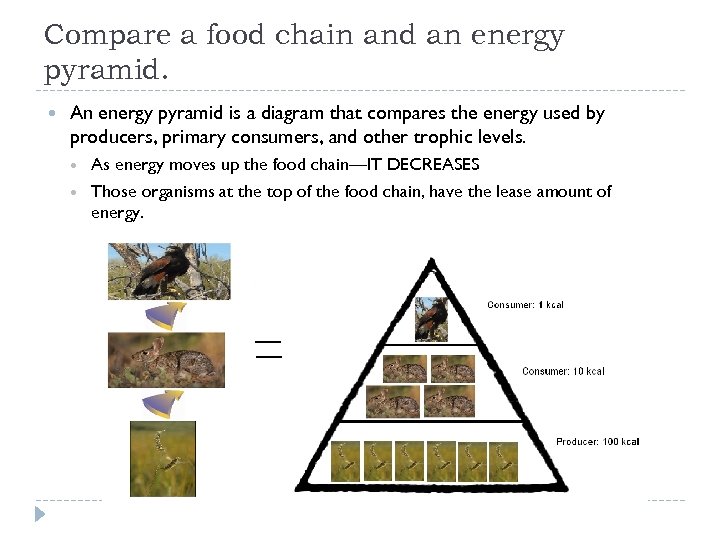 Compare a food chain and an energy pyramid. An energy pyramid is a diagram that compares the energy used by producers, primary consumers, and other trophic levels. As energy moves up the food chain—IT DECREASES Those organisms at the top of the food chain, have the lease amount of energy.
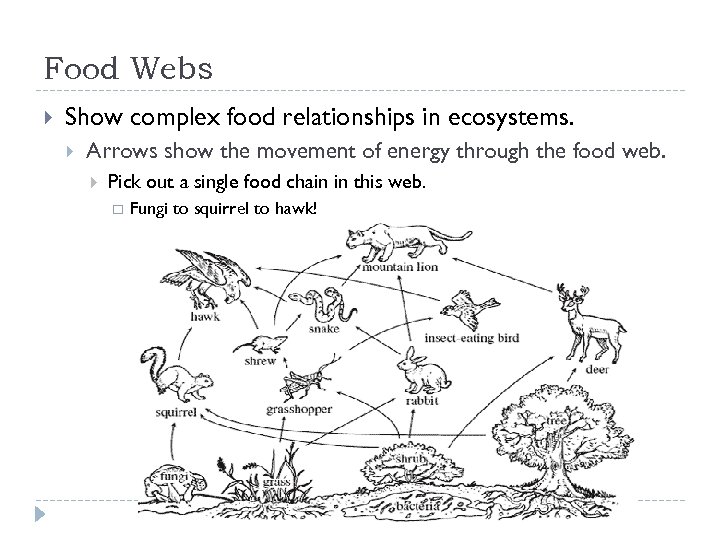 Food Webs Show complex food relationships in ecosystems. Arrows show the movement of energy through the food web. Pick out a single food chain in this web. Fungi to squirrel to hawk!
 How do biomass levels change through food webs and energy pyramids? Biomass pyramid Diagram that compares the biomass of different trophic levels within an ecosystem. It provides a picture of the mass of producers needed to support primary consumers, the mass of primary consumers needed to support secondary consumers, and so on. As you go UP the food chain biomass DECREASES 5 Hawks 5, 000 snakes 500, 000 bunnies 5, 0000 blades of grass
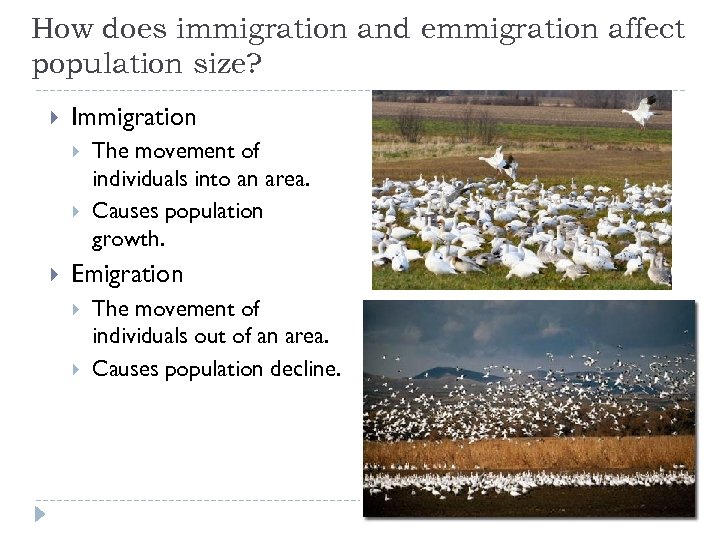 How does immigration and emmigration affect population size? Immigration The movement of individuals into an area. Causes population growth. Emigration The movement of individuals out of an area. Causes population decline.
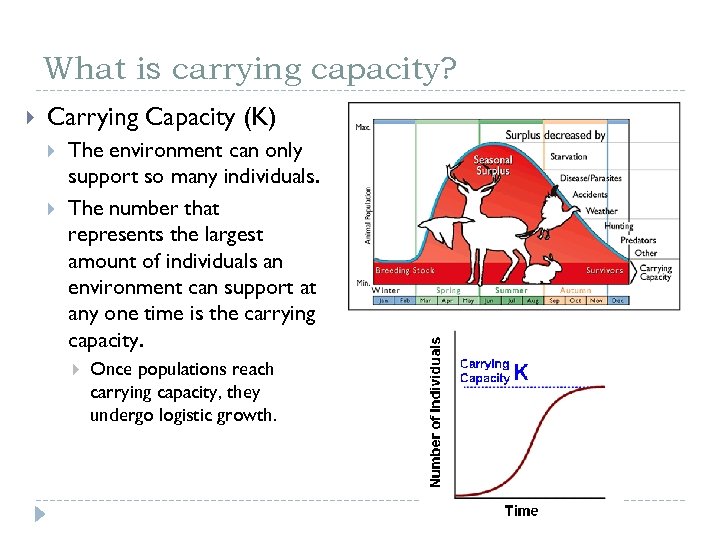 What is carrying capacity? Carrying Capacity (K) The environment can only support so many individuals. The number that represents the largest amount of individuals an environment can support at any one time is the carrying capacity. Once populations reach carrying capacity, they undergo logistic growth.
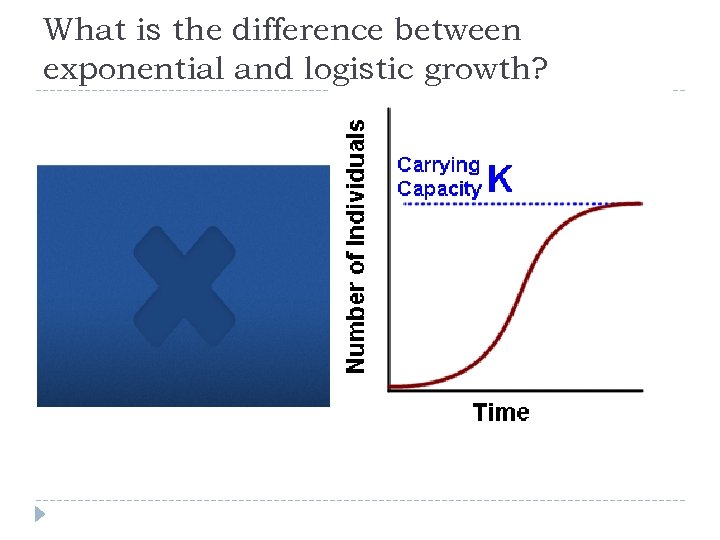 What is the difference between exponential and logistic growth?
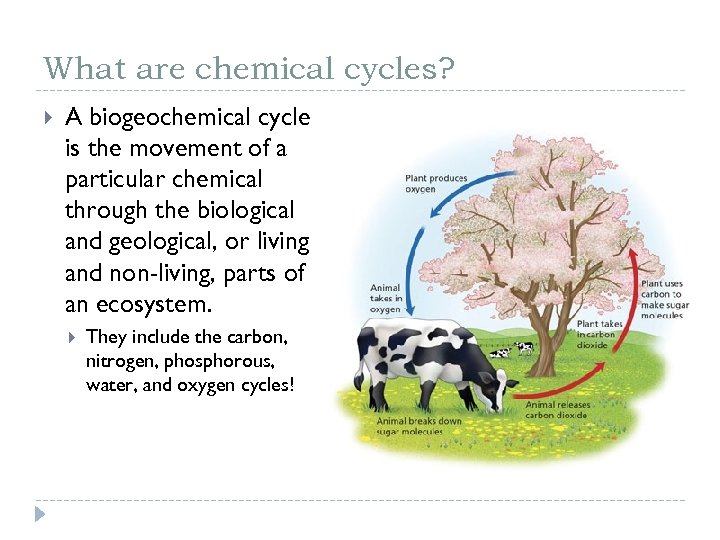 What are chemical cycles? A biogeochemical cycle is the movement of a particular chemical through the biological and geological, or living and non-living, parts of an ecosystem. They include the carbon, nitrogen, phosphorous, water, and oxygen cycles!
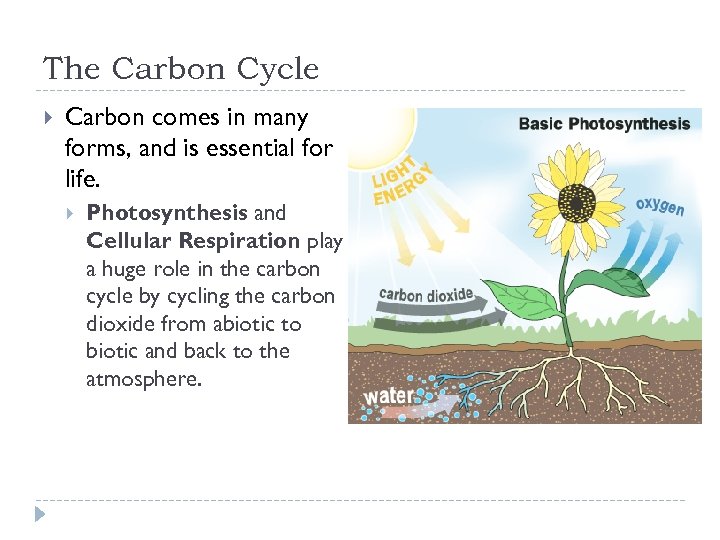 The Carbon Cycle Carbon comes in many forms, and is essential for life. Photosynthesis and Cellular Respiration play a huge role in the carbon cycle by cycling the carbon dioxide from abiotic to biotic and back to the atmosphere.
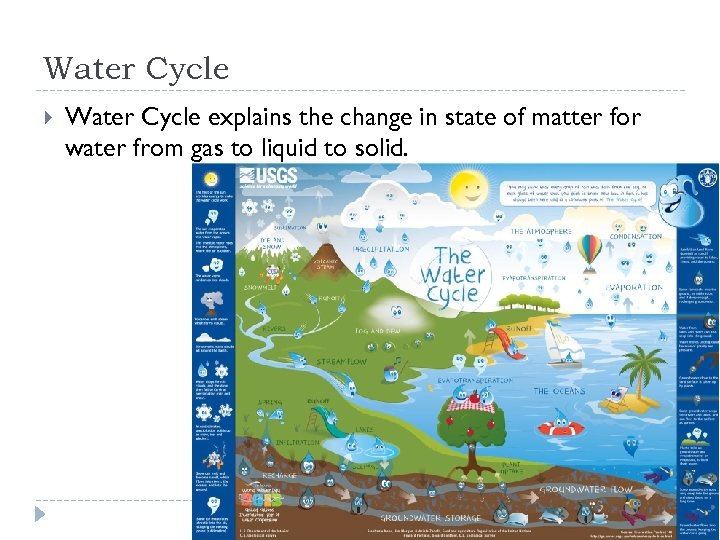 Water Cycle explains the change in state of matter for water from gas to liquid to solid.
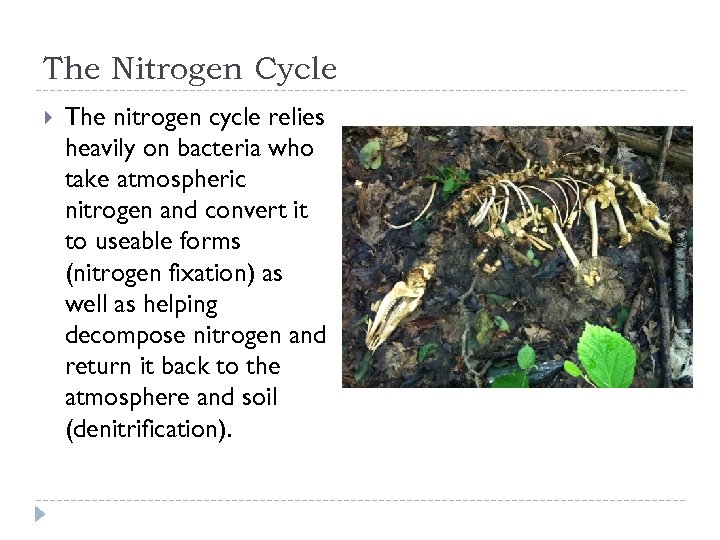 The Nitrogen Cycle The nitrogen cycle relies heavily on bacteria who take atmospheric nitrogen and convert it to useable forms (nitrogen fixation) as well as helping decompose nitrogen and return it back to the atmosphere and soil (denitrification).
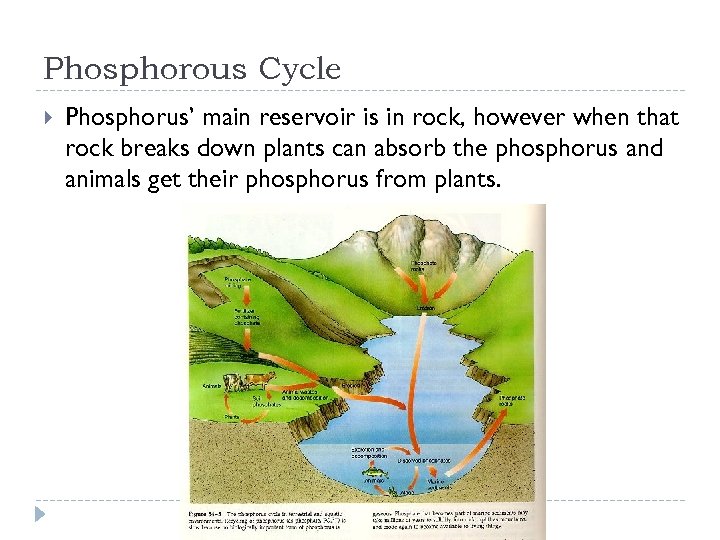 Phosphorous Cycle Phosphorus’ main reservoir is in rock, however when that rock breaks down plants can absorb the phosphorus and animals get their phosphorus from plants.
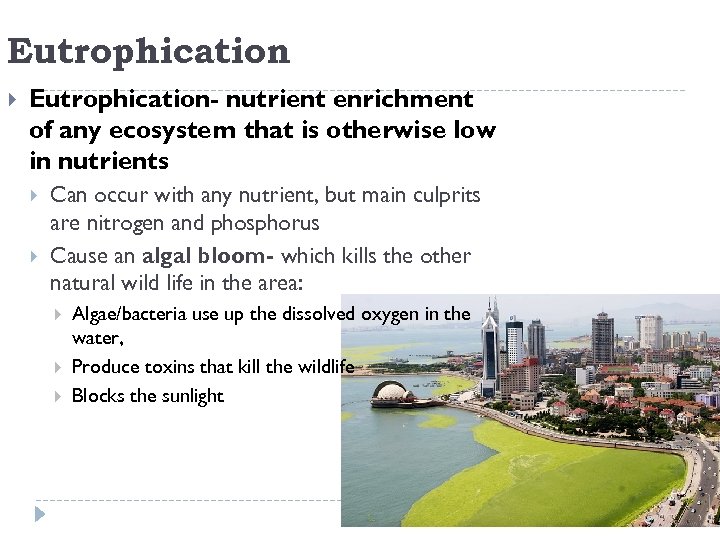 Eutrophication Eutrophication- nutrient enrichment of any ecosystem that is otherwise low in nutrients Can occur with any nutrient, but main culprits are nitrogen and phosphorus Cause an algal bloom- which kills the other natural wild life in the area: Algae/bacteria use up the dissolved oxygen in the water, Produce toxins that kill the wildlife Blocks the sunlight
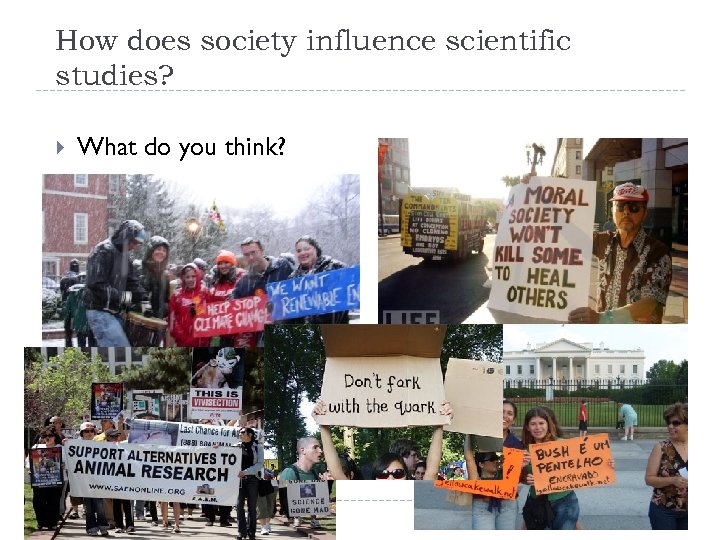 How does society influence scientific studies? What do you think?
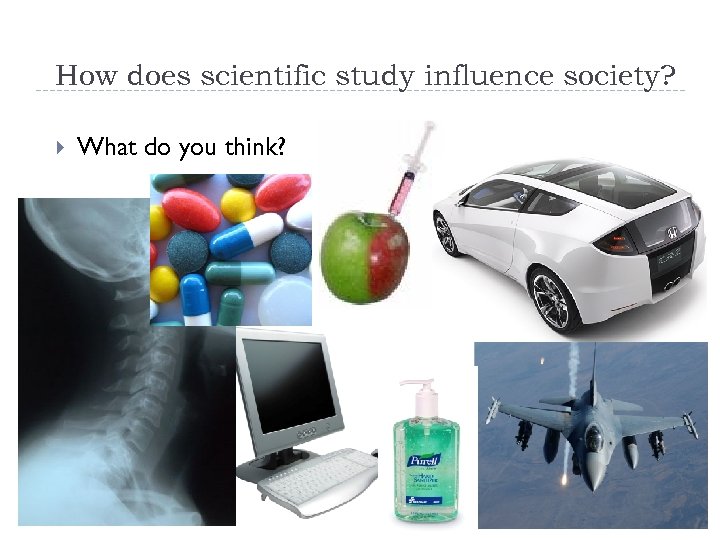 How does scientific study influence society? What do you think?
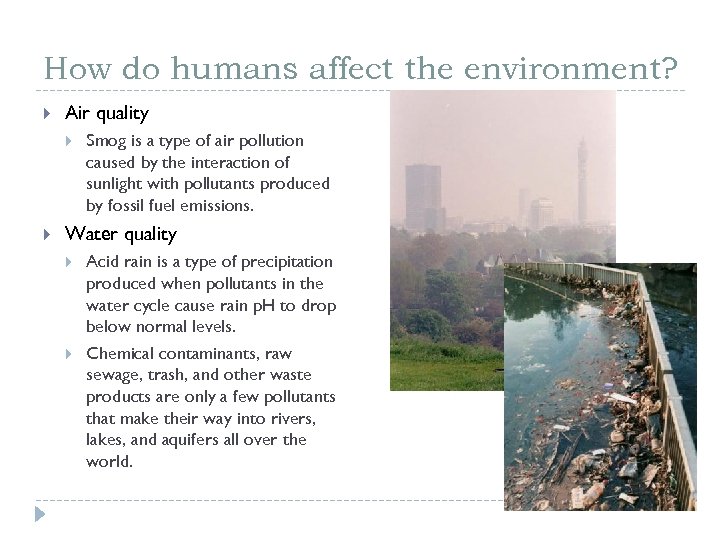 How do humans affect the environment? Air quality Smog is a type of air pollution caused by the interaction of sunlight with pollutants produced by fossil fuel emissions. Water quality Acid rain is a type of precipitation produced when pollutants in the water cycle cause rain p. H to drop below normal levels. Chemical contaminants, raw sewage, trash, and other waste products are only a few pollutants that make their way into rivers, lakes, and aquifers all over the world.
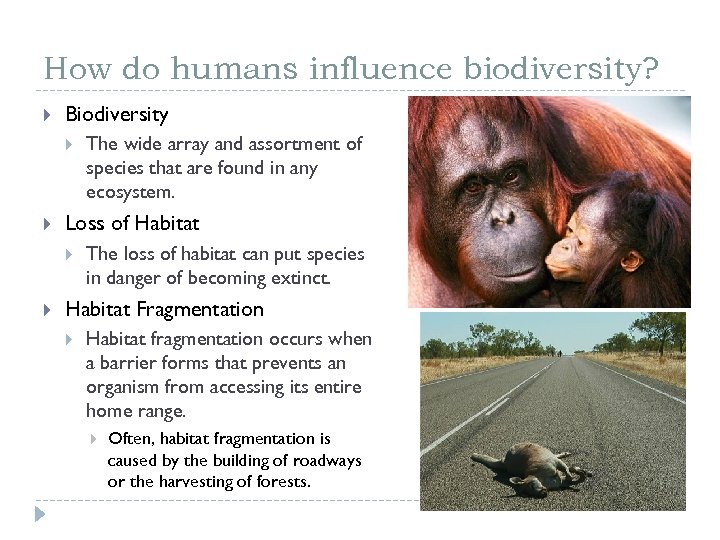 How do humans influence biodiversity? Biodiversity Loss of Habitat The wide array and assortment of species that are found in any ecosystem. The loss of habitat can put species in danger of becoming extinct. Habitat Fragmentation Habitat fragmentation occurs when a barrier forms that prevents an organism from accessing its entire home range. Often, habitat fragmentation is caused by the building of roadways or the harvesting of forests.
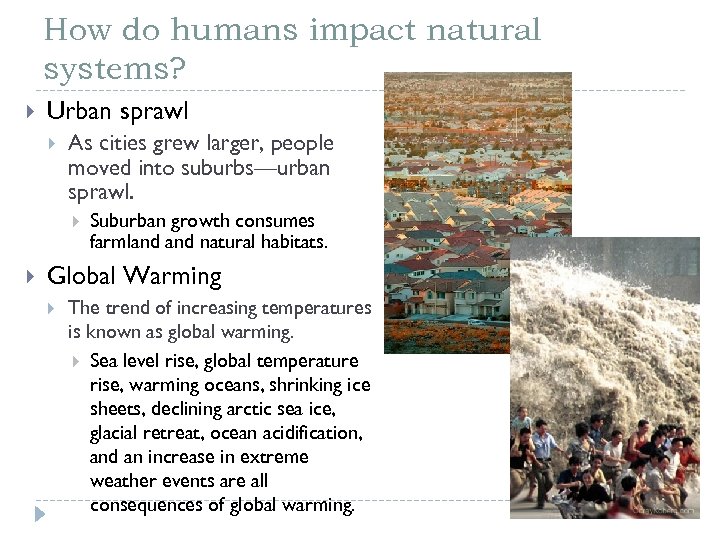 How do humans impact natural systems? Urban sprawl As cities grew larger, people moved into suburbs—urban sprawl. Suburban growth consumes farmland natural habitats. Global Warming The trend of increasing temperatures is known as global warming. Sea level rise, global temperature rise, warming oceans, shrinking ice sheets, declining arctic sea ice, glacial retreat, ocean acidification, and an increase in extreme weather events are all consequences of global warming.
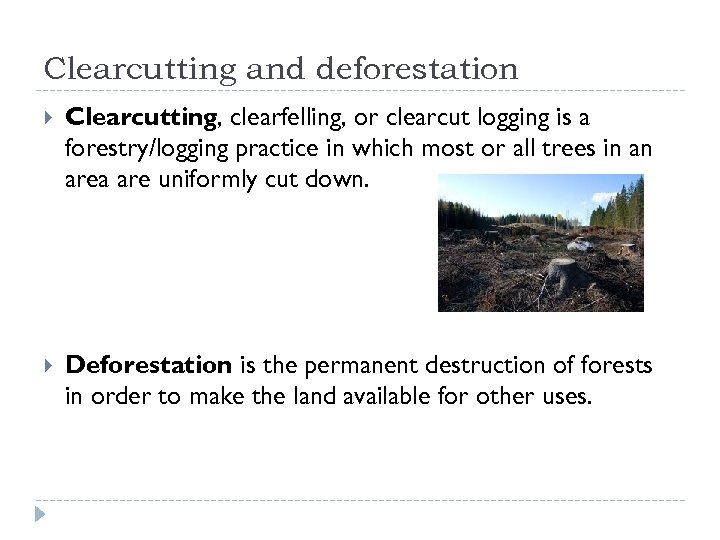 Clearcutting and deforestation Clearcutting, clearfelling, or clearcut logging is a forestry/logging practice in which most or all trees in an area are uniformly cut down. Deforestation is the permanent destruction of forests in order to make the land available for other uses.
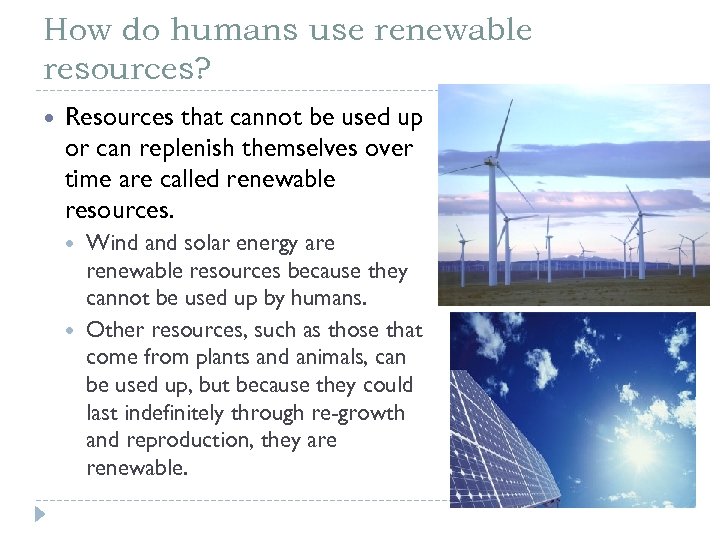 How do humans use renewable resources? Resources that cannot be used up or can replenish themselves over time are called renewable resources. Wind and solar energy are renewable resources because they cannot be used up by humans. Other resources, such as those that come from plants and animals, can be used up, but because they could last indefinitely through re-growth and reproduction, they are renewable.
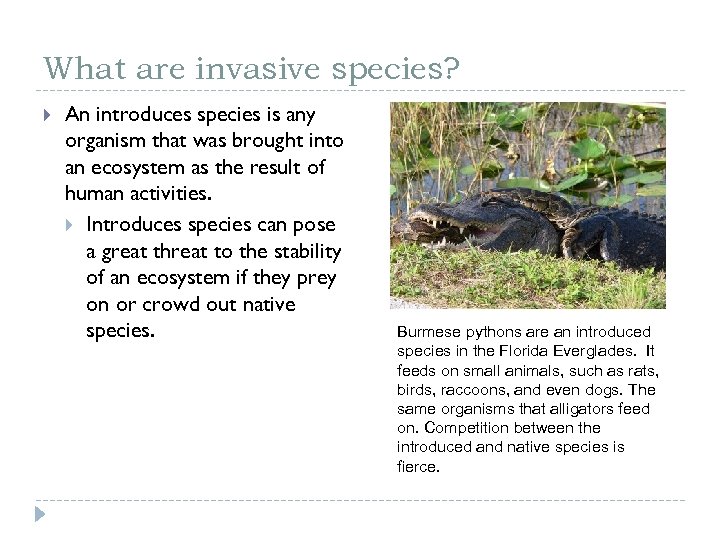 What are invasive species? An introduces species is any organism that was brought into an ecosystem as the result of human activities. Introduces species can pose a great threat to the stability of an ecosystem if they prey on or crowd out native species. Burmese pythons are an introduced species in the Florida Everglades. It feeds on small animals, such as rats, birds, raccoons, and even dogs. The same organisms that alligators feed on. Competition between the introduced and native species is fierce.
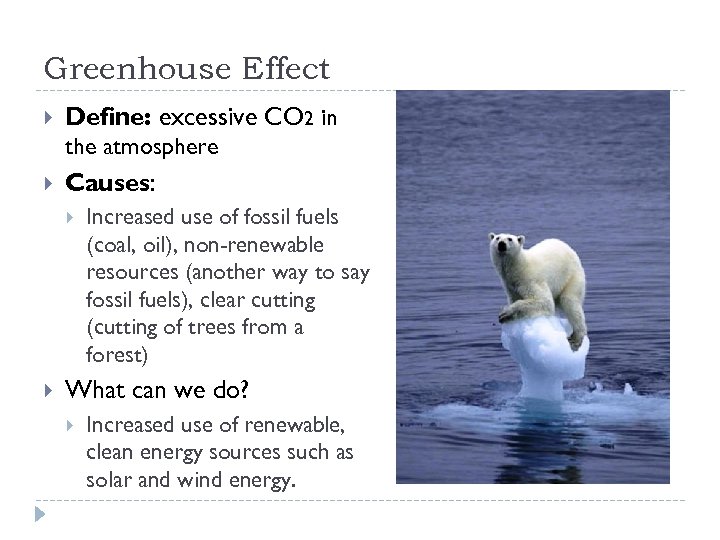 Greenhouse Effect Define: excessive CO 2 in the atmosphere Causes: Increased use of fossil fuels (coal, oil), non-renewable resources (another way to say fossil fuels), clear cutting (cutting of trees from a forest) What can we do? Increased use of renewable, clean energy sources such as solar and wind energy.
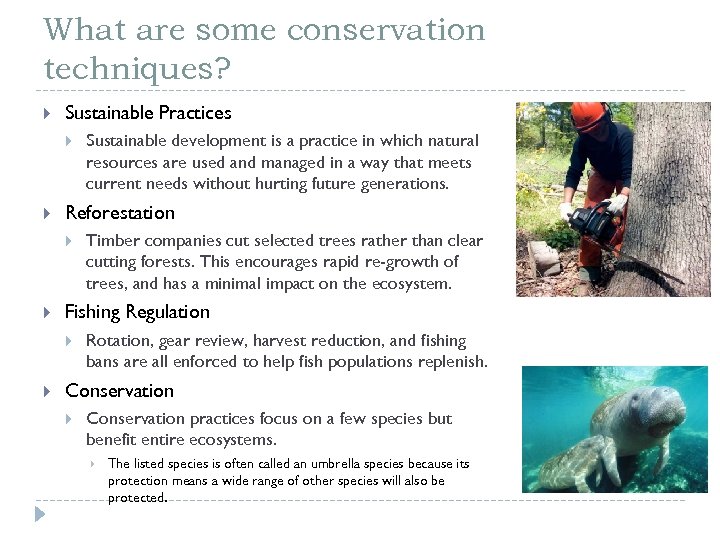 What are some conservation techniques? Sustainable Practices Reforestation Timber companies cut selected trees rather than clear cutting forests. This encourages rapid re-growth of trees, and has a minimal impact on the ecosystem. Fishing Regulation Sustainable development is a practice in which natural resources are used and managed in a way that meets current needs without hurting future generations. Rotation, gear review, harvest reduction, and fishing bans are all enforced to help fish populations replenish. Conservation practices focus on a few species but benefit entire ecosystems. The listed species is often called an umbrella species because its protection means a wide range of other species will also be protected.