


 Скачать презентацию FINAL EXAM NOTES Spring Semester Flip Chart
7ada4dfabedf79947851e66d5438bb06.ppt
- Количество слайдов: 25
 FINAL EXAM NOTES Spring Semester Flip Chart
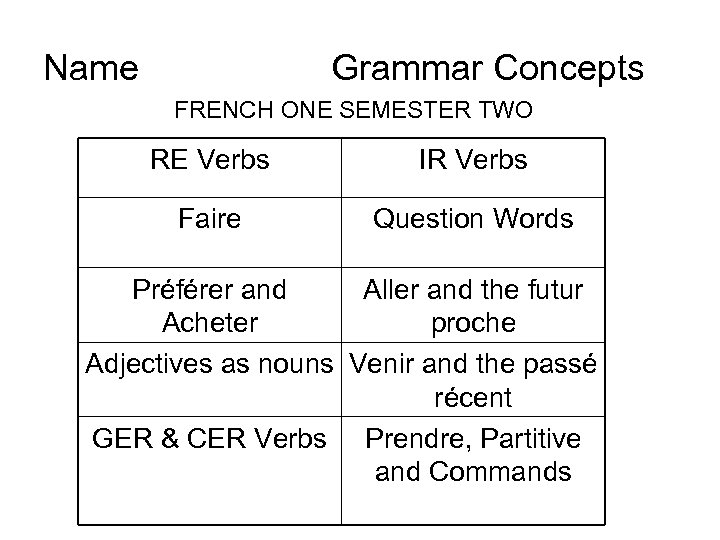 Name Grammar Concepts FRENCH ONE SEMESTER TWO RE Verbs IR Verbs Faire Question Words Préférer and Aller and the futur Acheter proche Adjectives as nouns Venir and the passé récent GER & CER Verbs Prendre, Partitive and Commands
 RE VERBS • Like regular ER verbs, regular verbs that end in RE follow a conjugation pattern. RE VERB ENDINGS Je _s nous _ons Tu _s vous _ez Il/elle _ ils/elles _ent • Example – Nous attendons le bus = We’re waiting for the bus
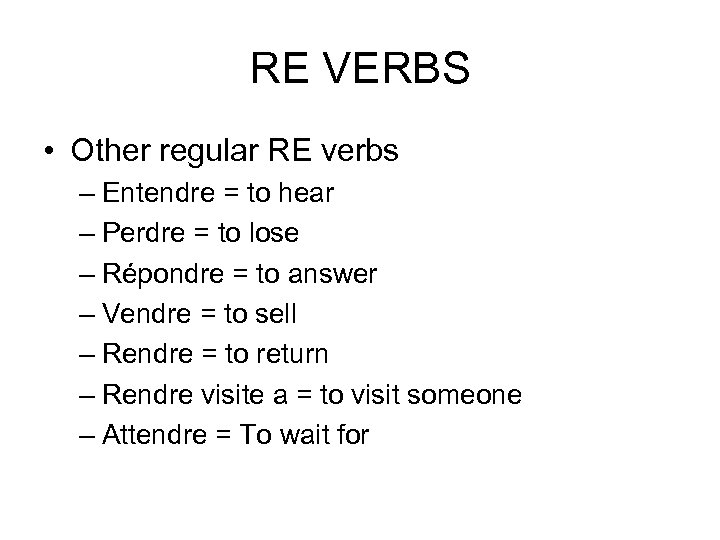 RE VERBS • Other regular RE verbs – Entendre = to hear – Perdre = to lose – Répondre = to answer – Vendre = to sell – Rendre = to return – Rendre visite a = to visit someone – Attendre = To wait for
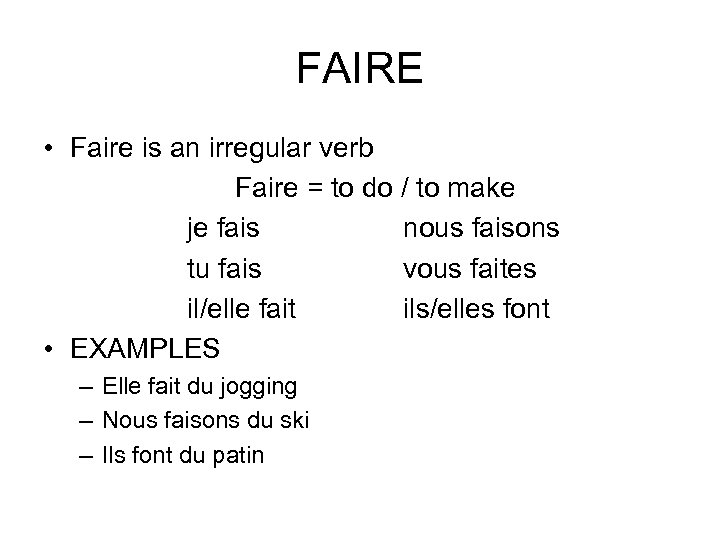 FAIRE • Faire is an irregular verb Faire = to do / to make je fais nous faisons tu fais vous faites il/elle fait ils/elles font • EXAMPLES – Elle fait du jogging – Nous faisons du ski – Ils font du patin
 FAIRE • Faire is often used with weather expressions – Il fait beau – Il fait du soleil • Raining, snowing and freezing do NOT use faire. – Il neige – Il pleut – Il gèle
 GER and CER verbs • Verbs that end in –ger are conjugated like –er verbs in every form except the nous form Manger = to eat Je mange nous mangeons tu manges vous mangez il/elle mange ils/elles mangent • OTHER GER VERBS – – – Changer = to change Echanger = to exchange Corriger = to correct Déranger = to disturb Encourager = to encourage Voyager = to travel
 GER and CER verbs • Verbs that end in –cer are also conjugated like –er verbs in every form except the nous form Commencer = to begin Je commence Nous commençons tu commences vous commencez il/elle commence ils/elles commencent • Other CER verbs – – – Placer = to place/put Prononcer = to pronounce Remplacer = to replace Avancer = to go forward Lancer = to throw
 Préférer and Acheter • The verbs préférer and acheter follow a slightly different pattern from other –er verbs. Préférer = to prefer Je préfère nous préférons tu préfères vous préférez il/elle préfère ils/elles préfèrent • Other verbs like préférer – Espérer – to hope – Répéter – to repeat / rehearse
 Préférer and Acheter = to buy je achète nous achetons tu achètes vous achetez il/elle achète ils/elles achètent • Other verbs like acheter – Amener – to bring along someone – Emmener – to take along someone – Lever – to raise – Promener – to take for a walk
 Adjectives as nouns • To avoid repetition, you can drop a noun leaving an article and an adjective to stand for it. • The article and adjective agree in gender and number with the noun that was dropped. – Le tee-shirt bleu ou le blanc? – Tu aimes le cahier jaune ou le rouge?
 Adjectives as nouns • You often use this when talking about preferences – Est-ce que tu aimes la grande télé ou la petite? – Je préfère la grande.
 Question Words • You know how to ask a yes/no question by using est-ce que and intonation – Tu aimes le base-ball? – Est-ce qu’il fait du jogging? • To ask for other information besides yes or no, use a question word followed by est-ce que then a subject and verb
 Question Words • Question Words – Quand ~ when – Pourquoi ~ why – Que (qu’) ~ what – Comment ~ how – Qui ~ who – Avec Qui ~ with whom – Où ~ Where
 Question Words • Examples – Quand est-ce que tu fais du théâtre? – Avec qui est-ce qu’il joue au tennis? • You DO NOT use est-ce que with a question word when they are followed by the verb être – Où est ton frère? – Comment est ton amie?
 Aller and the Futur Proche • The verb aller is irregular Aller = to go je vais nous allons tu vas vous allez il/elle va ils/elles vont * Je vais au cinéma. • You can use aller plus an infinitive to talk about something that is going to happen in the near future. – Je vais jouer au basket. – Nous allons aller au lac. – Ils vont étudier demain.
 Venir and the Passé Récent • The verb venir is an irregular verb Venir = to come je viens nous venons tu viens vous venez il/elle vient ils/elles viennent • Example – Ils viennent au parc avec Paul • They’re coming to the park with Paul
 Venir and the Passé Récent • You can also use venir plus de plus the infinitive of another verb to say something just happened. • Examples – Je viens de téléphoner a Marie • I just called Marie – Nous venons de manger • We just ate.
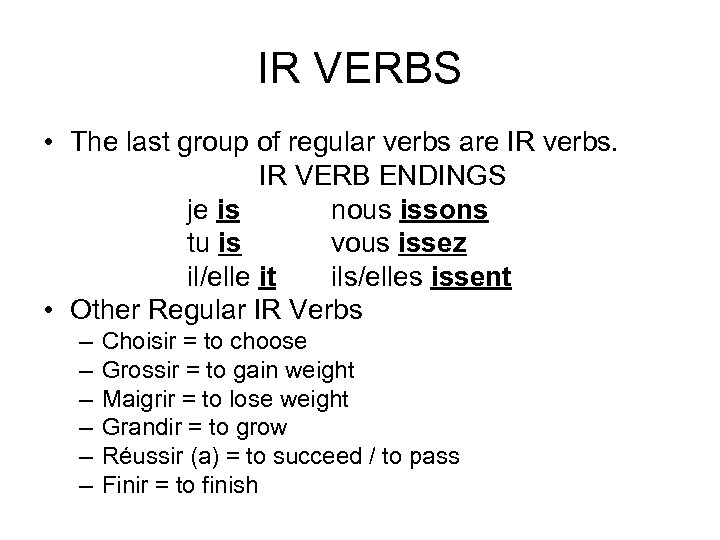 IR VERBS • The last group of regular verbs are IR verbs. IR VERB ENDINGS je is nous issons tu is vous issez il/elle it ils/elles issent • Other Regular IR Verbs – – – Choisir = to choose Grossir = to gain weight Maigrir = to lose weight Grandir = to grow Réussir (a) = to succeed / to pass Finir = to finish
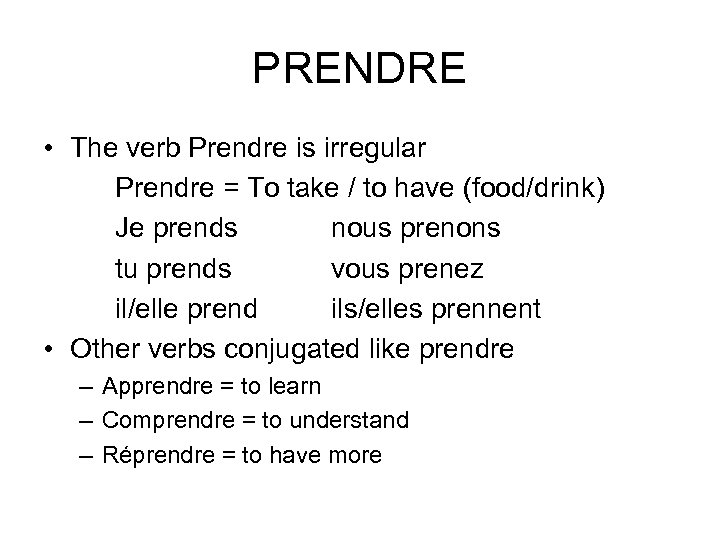 PRENDRE • The verb Prendre is irregular Prendre = To take / to have (food/drink) Je prends nous prenons tu prends vous prenez il/elle prend ils/elles prennent • Other verbs conjugated like prendre – Apprendre = to learn – Comprendre = to understand – Réprendre = to have more
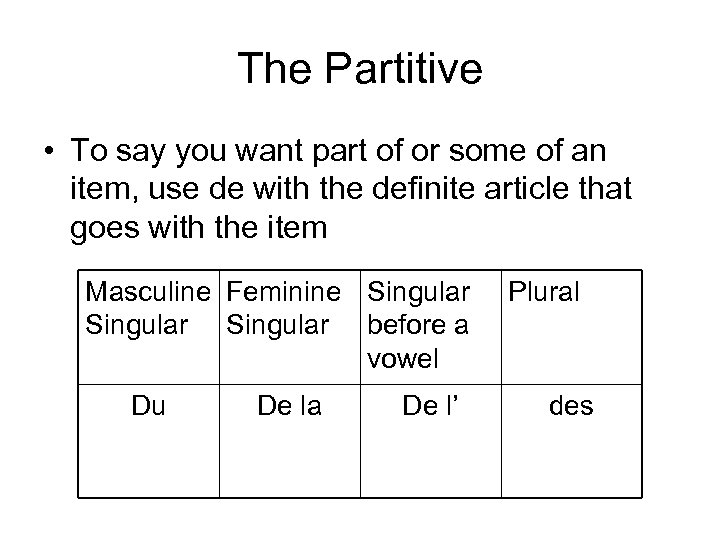 The Partitive • To say you want part of or some of an item, use de with the definite article that goes with the item Masculine Feminine Singular before a vowel Du De la De l’ Plural des
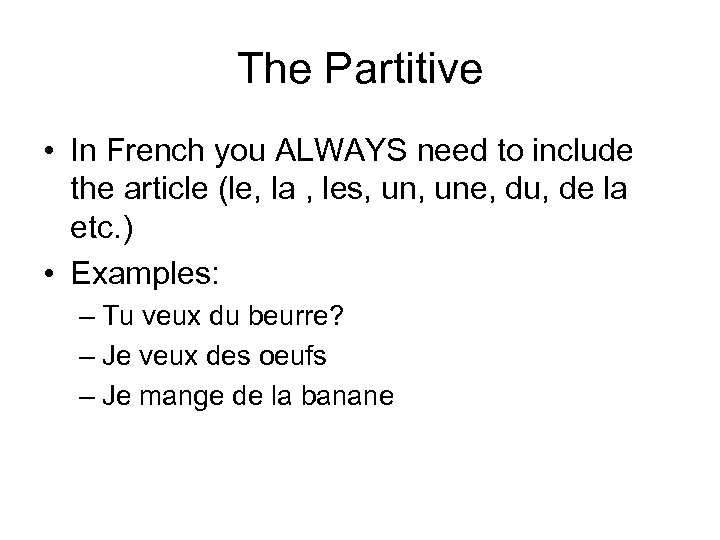 The Partitive • In French you ALWAYS need to include the article (le, la , les, une, du, de la etc. ) • Examples: – Tu veux du beurre? – Je veux des oeufs – Je mange de la banane
 The Partitive • To say you want a whole item use the indefinite articles un or une – Je veux un pamplemousse. – Nous voulons une tarte • The partitive and un/une become just DE in a negative sentence – Je ne veux pas de lait. – Nous ne voulons pas de tart.
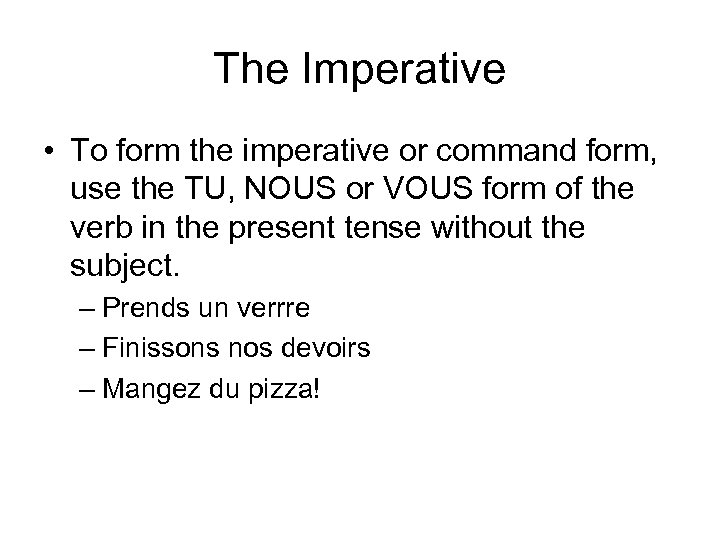 The Imperative • To form the imperative or command form, use the TU, NOUS or VOUS form of the verb in the present tense without the subject. – Prends un verrre – Finissons nos devoirs – Mangez du pizza!
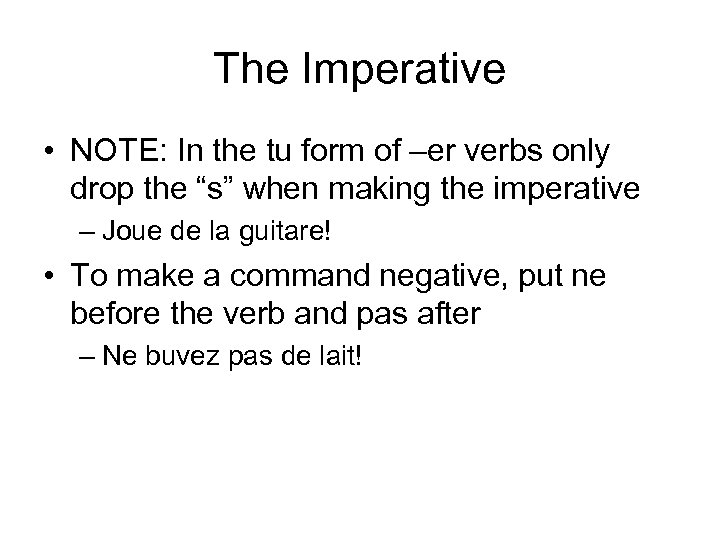 The Imperative • NOTE: In the tu form of –er verbs only drop the “s” when making the imperative – Joue de la guitare! • To make a command negative, put ne before the verb and pas after – Ne buvez pas de lait!