


 Скачать презентацию Final Coordination Meeting on Promoting Self Assessment of
2caddbd0fd547c1457e428a7d7195b57.ppt
- Количество слайдов: 15
 Final Coordination Meeting on Promoting Self Assessment of Regulatory Infrastructures for Safety and Networking of Regulatory Bodies in Africa (AFRA) Review of Achievements and Lessons Learnt 2 -5 December 2013 Arusha IAEA International Atomic Energy Agency
 Project Objective • To enhance and continuously improve the performance of regulatory systems and conform to the requirements of international standards through self-assessment and enhanced regional cooperation IAEA 2
 Planned Activities • Conduct preparatory and capacity building activities for selfassessment • Perform two lifecycles of self-assessement (initial and followup) • Development of regional action plans as a result of selfassessment • Create and operationalize forum of NRBs • Design and launch forum website • Selection of experts, collection of data and upload on website IAEA 3
 Achievements Self-assessment • Ten countries have completed a self-assessment lifecycle (all phases including the action plan using SAT/SARIS) • Twenty four countries are at different stages of implementation (from not started or preparation phase up to completion of the response/analysis phase) • No sufficient information on status of implementation for some countries IAEA 4
 Achievements (cont…) • FNRBA established and operational • Web site of FNRBA launched IAEA 5
 Major Inputs • Three project coordination meetings (including plenary meeting for FNRBA) • Three regional trainings (Francophone, Anglophone, combined) in IAEA self-assessment methodology and tool • Regional experience exchange meeting (included a two day practical session on analysis phase) • Regional workshop on lessons learned (included a three day practical session on self-assessment using SARIS) IAEA 6
 Major Inputs (cont…) • Expert support/advise to one country on the implementation of self-assessment of national regulatory infrastructure for safety • High level sensitization seminar on building comprehensive national radiation safety infrastructure • Provision of software and technical support IAEA 7
 Major Outputs • Core regulatory staff got trained (train-the-trainers) in the IAEA self-assessment methodology and tool (SAT and SARIS) • Capacity to conduct self-assessment of the national regulatory infrastructure for safety established in the majority of the participating states • Awareness and identification of gaps and overlaps in the legislative and regulatory framework • Action plan for improvement in place (in those countries that have completed a full cycle) IAEA 8
 Outputs and benefits (cont…) • Improvement of organizational structure and processes (planned and implemented) • Harmonization of approaches to regulatory control • Better understanding of the IAEA safety standards • Enhanced cooperation among regulatory bodies in the regions (through FNRBA) IAEA 9
 Not achieved • Peer review missions (IRRS) following the self-assessment of the national regulatory infrastructure for safety (ten countries) • 24 countries did not complete all phases IAEA 10
 Challenges • • Human resources Time management Management commitment Technology (few cases) IAEA 11
 Overview of Lessons Learnt • • • FNRBA Established Only 10 (out of 34) MS Completed Phase No IRRS Missions Capacity Transferred to all regulatory bodies Increased understanding of SARIS Methodology • Lack of HR, Time and Commitment IAEA
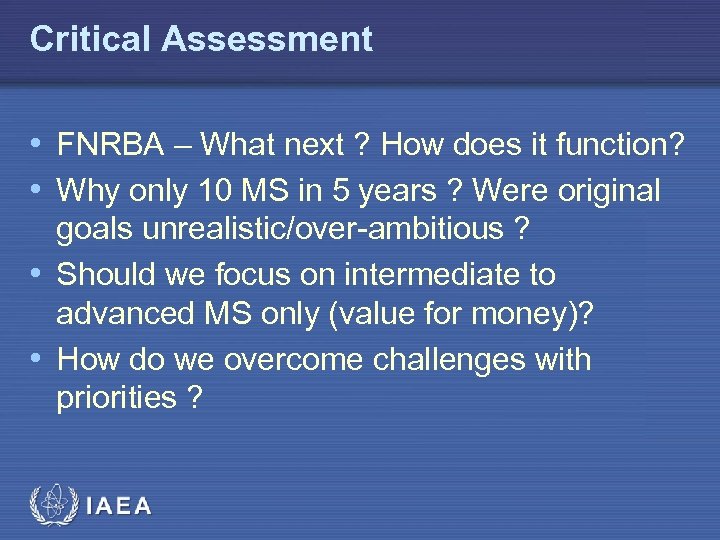 Critical Assessment • FNRBA – What next ? How does it function? • Why only 10 MS in 5 years ? Were original goals unrealistic/over-ambitious ? • Should we focus on intermediate to advanced MS only (value for money)? • How do we overcome challenges with priorities ? IAEA
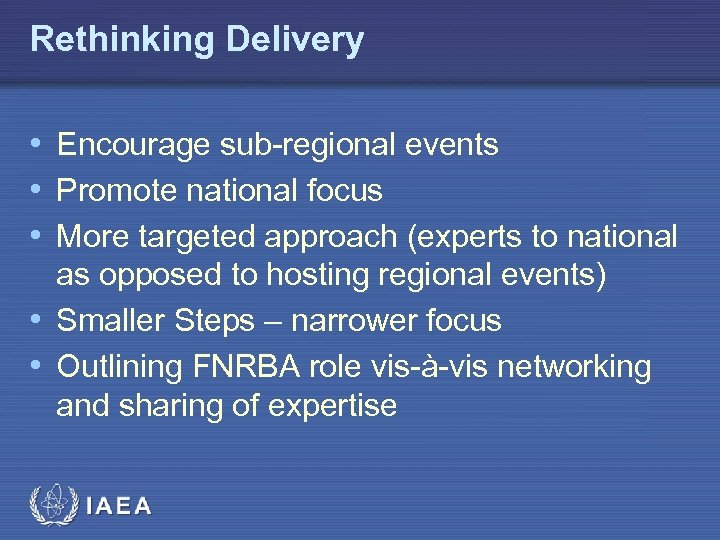 Rethinking Delivery • Encourage sub-regional events • Promote national focus • More targeted approach (experts to national as opposed to hosting regional events) • Smaller Steps – narrower focus • Outlining FNRBA role vis-à-vis networking and sharing of expertise IAEA
 Thank you! IAEA