 Скачать презентацию FINA 3240 A Corporate Property Liability Insurance
bda8df5f123c37de6b9d65ce459b0df6.ppt
- Количество слайдов: 40



FINA 3240 A Corporate Property & Liability Insurance Chapter 1 : Why Insurance? (Brown & Lennox) Jason Yeh, ASA (Society of Actuaries), Ph. D (UW-Madison), Dept. of Finance, CUHK Tel: (852) 3943 -7653 Email: jasonyeh@baf. cuhk. edu. hk
M 6 7 8 9 13 14 15 16 20 21 22 23 27 28 29 30 3 4 5 6 7 11 12 13 14 12 18 19 20 21 24 25 26 27 28 31 1 2 3 4 7 8 9 10 11 15 15 16 17 18 21 22 23 24 25 28 29 30 1 2 5 6 7 8 9 12 Fall 2016 5 10 NOV/DEC F 26 OCT/NOV H 19 OCT W 12 SEP T 13 14 15 16
1. The Evolution of Insurance Humans strive for security: food, warmth, shelter, and … Economic security: minimization of Economic risk or simply “risk”. Risk: variation from the expected outcome If groups “pool” risk, the variance person decreases. Informal insurance arrangements can be found long ago in China, Egypt, Europe, etc. Insurance is just a modern, formal and legal risk pooling program. Fall 2016
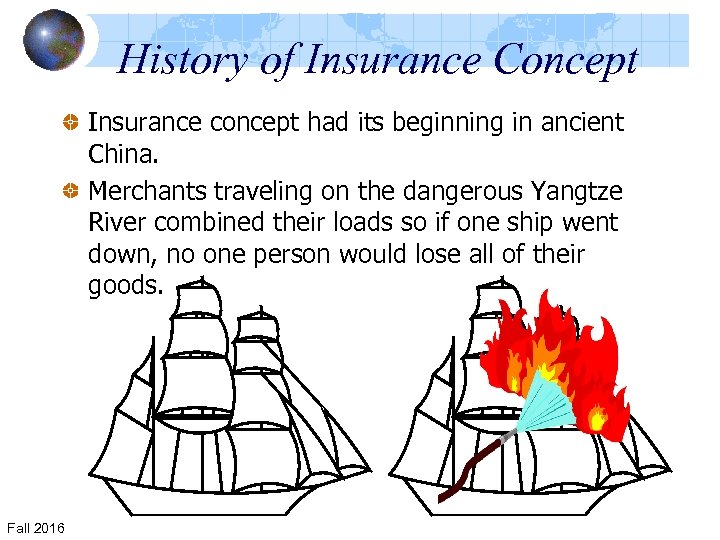
History of Insurance Concept Insurance concept had its beginning in ancient China. Merchants traveling on the dangerous Yangtze River combined their loads so if one ship went down, no one person would lose all of their goods. Fall 2016
2. How Insurance Works Insurer or insurance co. (I. C. ) by pooling a large number of similar but independent policyholders (ph) will end up with less risk than the individual ph. “Law of large numbers”: as # of observations increase, difference between observed frequency and true underlying probability tends to zero. Fall 2016
2. How Insurance Works Law of large numbers Ex: At a certain age, the probability of death within one year is. 001. If we have a sample of 10, 000 lives, we can predict with 95% probability that the number of deaths will be between 4 and 16, a range of 6 away from the mean of 10. If we have a sample of 1, 000 lives, the 95% confidence interval is (938, 1062), a range of 62 away from the mean of 1000. Same effect on observed versus expected severity. Fall 2016
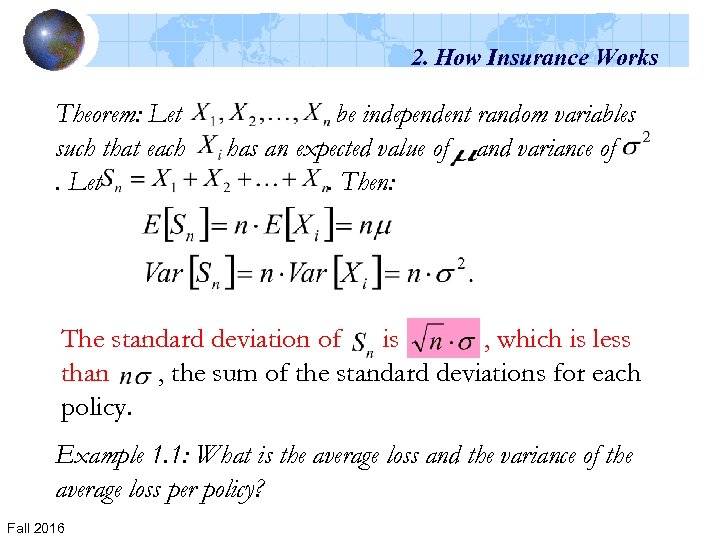
2. How Insurance Works Theorem: Let such that each. Let be independent random variables has an expected value of and variance of. Then: The standard deviation of is , which is less than , the sum of the standard deviations for each policy. Example 1. 1: What is the average loss and the variance of the average loss per policy? Fall 2016
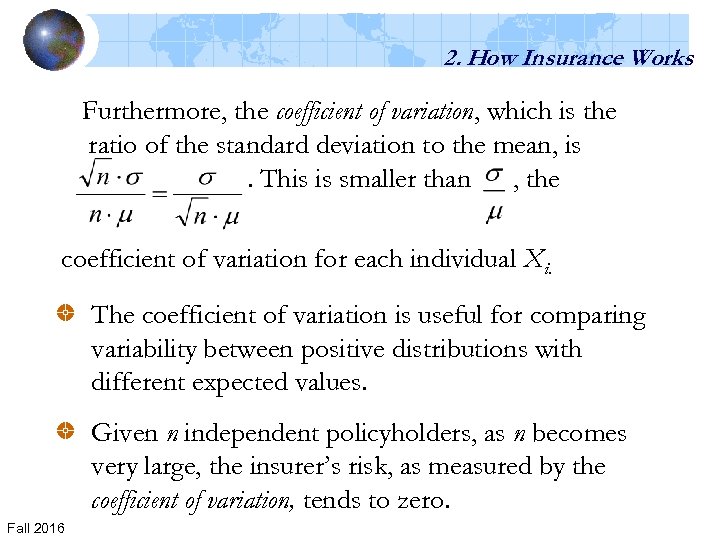
2. How Insurance Works Furthermore, the coefficient of variation, which is the ratio of the standard deviation to the mean, is. This is smaller than , the coefficient of variation for each individual Xi. The coefficient of variation is useful for comparing variability between positive distributions with different expected values. Given n independent policyholders, as n becomes very large, the insurer’s risk, as measured by the coefficient of variation, tends to zero. Fall 2016
An Example: The Law of Large Number Suppose you are in charge of an insurance company and you have a pool of insureds. Historical information on this pool of insureds include the following: (assuming normal distribution) 50 individuals are members of this pool. The annual expected total number of loss incidents generated by this pool is 60. The standard deviation associated with the expected number of loss incidents above is 10. The average expected loss per incident is $1, 000. Fall 2016
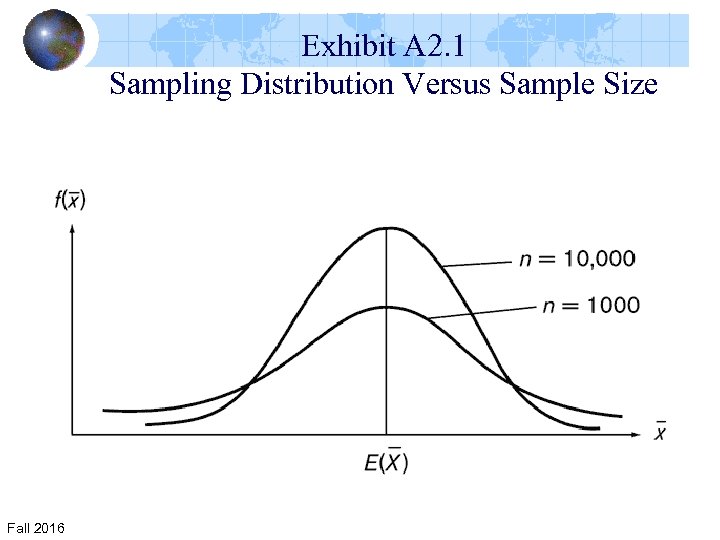
Exhibit A 2. 1 Sampling Distribution Versus Sample Size Fall 2016
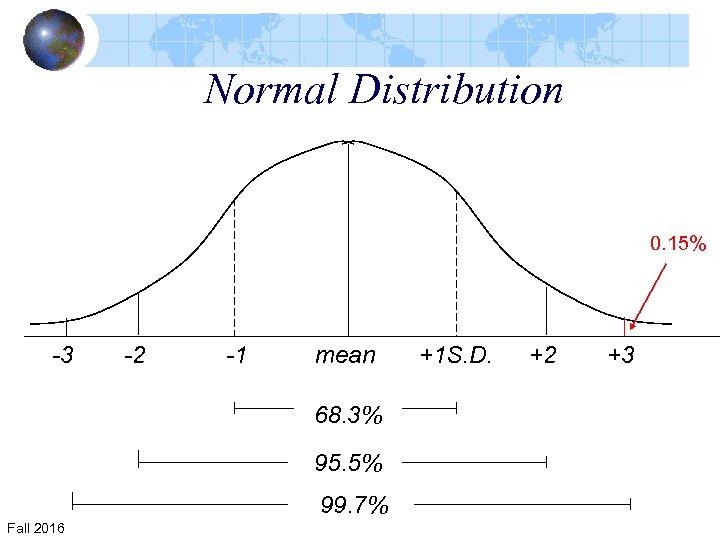
Normal Distribution 0. 15% -3 -2 -1 mean 68. 3% 95. 5% 99. 7% Fall 2016 +1 S. D. +2 +3
An Example: The Law of Large Number Given that there can be variation regarding the actual annual total number of losses incurred by this pool, what premium would you charge each member of this group if you wanted to be 99. 85% sure you will generate enough premium revenue to cover losses for this group? Fall 2016
An Example: The Law of Large Number Now suppose your pool size were to increase to 500, 000 individuals with similar risk characteristics to the smaller group. What is the new annual expected number of loss incidents for this pool? What is the new standard deviation? Fall 2016 Given this new larger pool of insureds, what premium would you charge each person if you wanted to be 99. 85% sure you will generate enough premium revenue to cover losses?
An Example: The Law of Large Number What do we learn from the example? When N = 50, the insurance company needs to charge $1, 800 to maintain 99. 85% solvency!! When N = 500, 000, the insurance company needs only $1, 206 to maintain the same level of solvency. Fall 2016
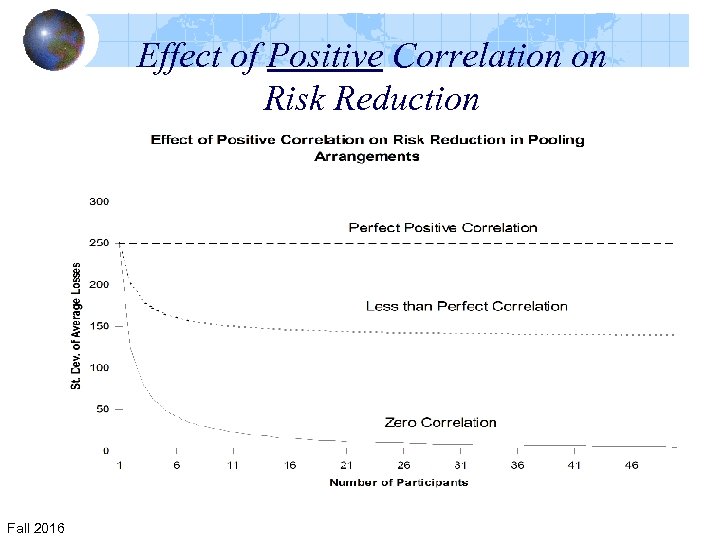
Effect of Positive Correlation on Risk Reduction Fall 2016
3. Insurance and Utility The insuring process does not decrease loss frequency or loss severity. Net premium: P = E[$ Loss] But gross premium G > P [Premium Loading = Gross Premium – Net Premium =G-P] So why buy insurance? Fall 2016
3. Insurance and Utility Risk avoiders have decreasing marginal utility of money whereby early units of income have greater utility than later units (see Fig 1. 1 a & b) Note: for risk avoider, utility, U(x), has following properties: U’(x) > 0 (higher wealth, higher utility) AND U’’ (x) < 0 (decreasing marginal utility). Premium, G, comes out of last unit of wealth, but protects earlier units of wealth which have higher utility (this allows G > P, and a logical person still buys insurance). Also explains why insurance for potential small loss amounts is illogical. Fall 2016
Risk Aversion and Utility Example: Wealth without insurance = $80, 000 or $100, 000 with equal probability, i. e. , there is a 50% chance of a $20, 000 loss for a person with $100, 000 Full insurance can be purchased for a premium of $10, 000 Important Point: • • Insurance reduces wealth if a loss does not occur Insurance increases wealth if a loss does occur Useful perspective when thinking about insurance purchases: Fall 2016 • do I want to give up some wealth when a loss does not occur so that I will receive additional wealth when a loss does occur?
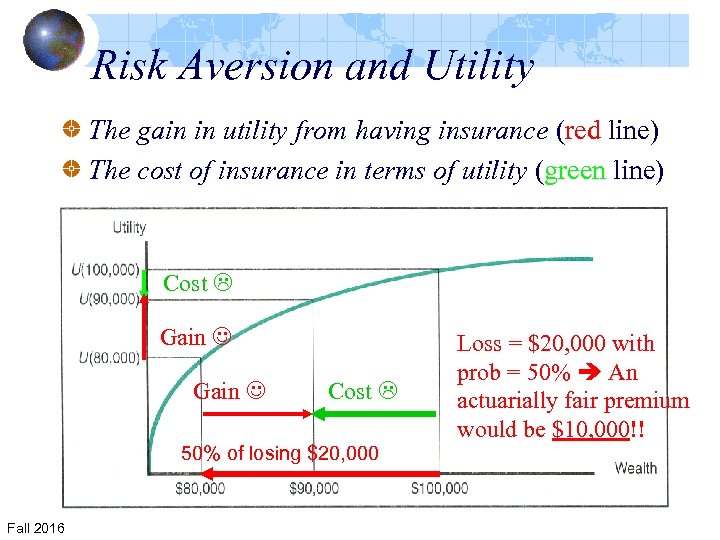
Risk Aversion and Utility The gain in utility from having insurance (red line) The cost of insurance in terms of utility (green line) Cost Gain Cost 50% of losing $20, 000 Fall 2016 Loss = $20, 000 with prob = 50% An actuarially fair premium would be $10, 000!!
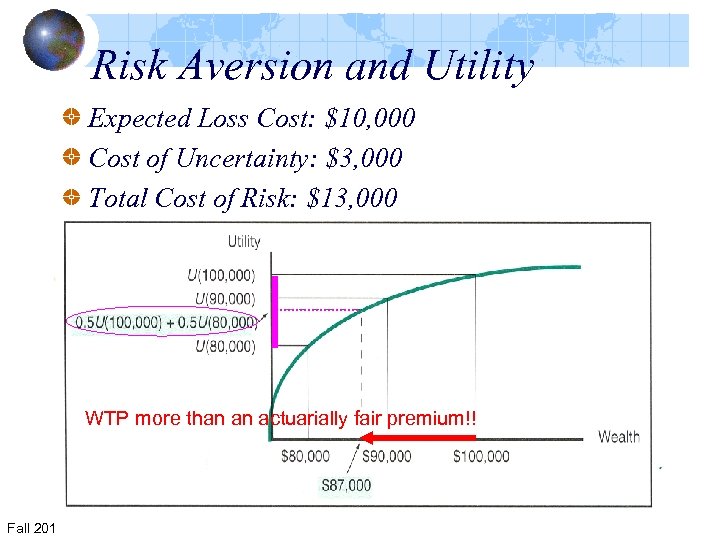
Risk Aversion and Utility Expected Loss Cost: $10, 000 Cost of Uncertainty: $3, 000 Total Cost of Risk: $13, 000 WTP more than an actuarially fair premium!! Fall 2016
Risk Aversion & Demand for Insurance Risk aversion ==> prefer certain outcome to an uncertain outcome with the same expected value Example: Would you accept a 50 -50 chance of winning $1, 000 or losing $1, 000? The gamble does not change a person’s expected wealth, but it makes the person’s wealth uncertain A risk-averse person therefore would choose not to accept the gamble Fall 2016
Risk Aversion & Demand for Insurance By not accepting the gamble, you are saying that the possible loss of $1, 000 hurts more than the possible gain of $1, 000 benefits you This is the essence of risk aversion: • A loss of $X hurts more than a gain of $X benefits you • The loss hurts more than the gain benefits you because money means more to you when you have less of it A risk averse person prefers a certain amount of wealth to a risky situation with the same expected wealth Fall 2016
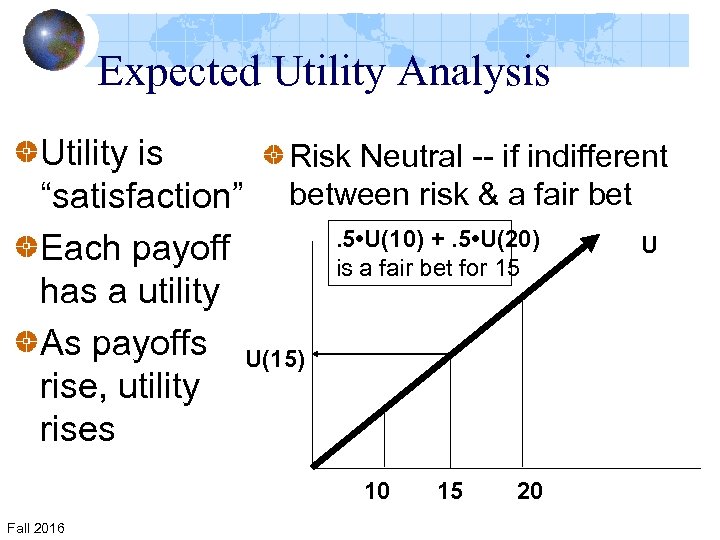
Expected Utility Analysis Utility is Risk Neutral -- if indifferent “satisfaction” between risk & a fair bet. 5 • U(10) +. 5 • U(20) U Each payoff is a fair bet for 15 has a utility As payoffs U(15) rise, utility rises 10 Fall 2016 15 20
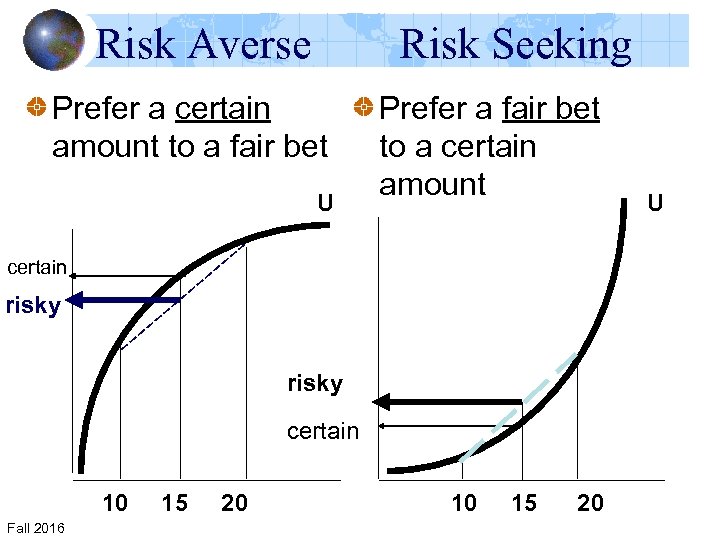
Risk Averse Risk Seeking Prefer a certain amount to a fair bet U Prefer a fair bet to a certain amount certain risky certain 10 Fall 2016 15 20 10 15 20 U
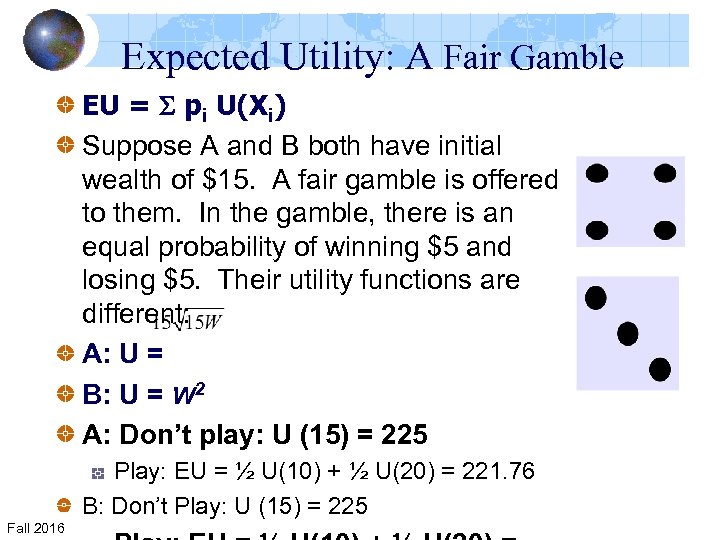
Expected Utility: A Fair Gamble EU = pi U(Xi) Suppose A and B both have initial wealth of $15. A fair gamble is offered to them. In the gamble, there is an equal probability of winning $5 and losing $5. Their utility functions are different: A: U = B: U = W 2 A: Don’t play: U (15) = 225 Play: EU = ½ U(10) + ½ U(20) = 221. 76 B: Don’t Play: U (15) = 225 Fall 2016
Expected Utility: Insurance Suppose that an individual has wealth of $10, 000 and utility function U(W) = ln(W). What is the maximum amount this person would pay for full insurance to cover a loss of $6, 400 with probability 10%? Don’t buy insurance: EU = 90% U(10, 000) + 10% U(3, 600) = Buy Full insurance: Fall 2016 U(W) = ln(W - P) = ln(10, 000 - P)
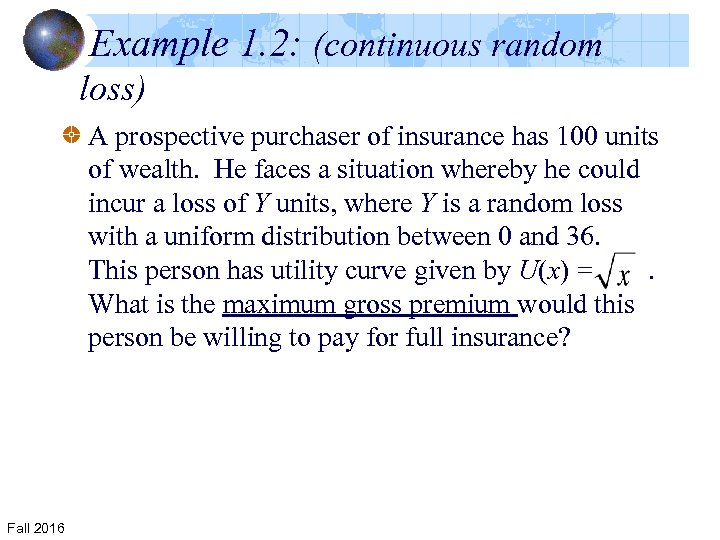
Example 1. 2: (continuous random loss) A prospective purchaser of insurance has 100 units of wealth. He faces a situation whereby he could incur a loss of Y units, where Y is a random loss with a uniform distribution between 0 and 36. This person has utility curve given by U(x) =. What is the maximum gross premium would this person be willing to pay for full insurance? Fall 2016
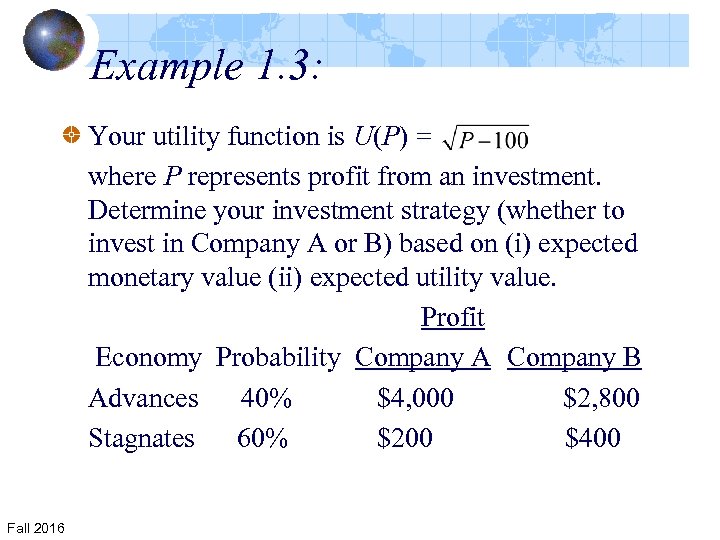
Example 1. 3: Your utility function is U(P) = where P represents profit from an investment. Determine your investment strategy (whether to invest in Company A or B) based on (i) expected monetary value (ii) expected utility value. Profit Economy Probability Company A Company B Advances 40% $4, 000 $2, 800 Stagnates 60% $200 $400 Fall 2016
4. What Makes a Risk Insurable (1) It should be economically feasible: not small loss amounts (2) The economic value of the insurance should be calculable. cases of small frequency, large severity are tough (e. g. Nuclear reactor insurance) (3) The loss must be definite to avoid anti-selection by ph a back injury may not be definite. (4) The loss must be accidental in nature -beyond control of ph. If (3) & (4) exist, actuary of I. C. can assume random sampling regarding ph Fall 2016
4. What Makes a Risk Insurable (5) The exposures in any rate class must be homogeneous. all ph in class have same E[$ Loss] (6) Exposure units should be spatially and temporally independent loss to one unit has no impact on probability of loss to any other unit used to avoid catastrophic risk exposure. Note: rarely does a ph pass all six clearly. Why “Gap Insurance” fails? AXA Sees Red, FORTUNE, 2003 -06 -26. 荷里活「差額保險」失敗的啟示, 香港《太陽報》, 16, p. B 5 Fall 2016 2003 -07 -
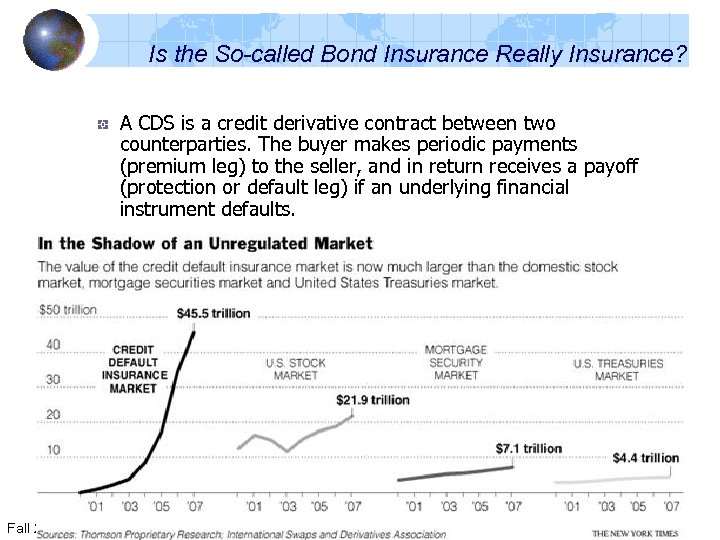
Is the So-called Bond Insurance Really Insurance? A CDS is a credit derivative contract between two counterparties. The buyer makes periodic payments (premium leg) to the seller, and in return receives a payoff (protection or default leg) if an underlying financial instrument defaults. Fall 2016
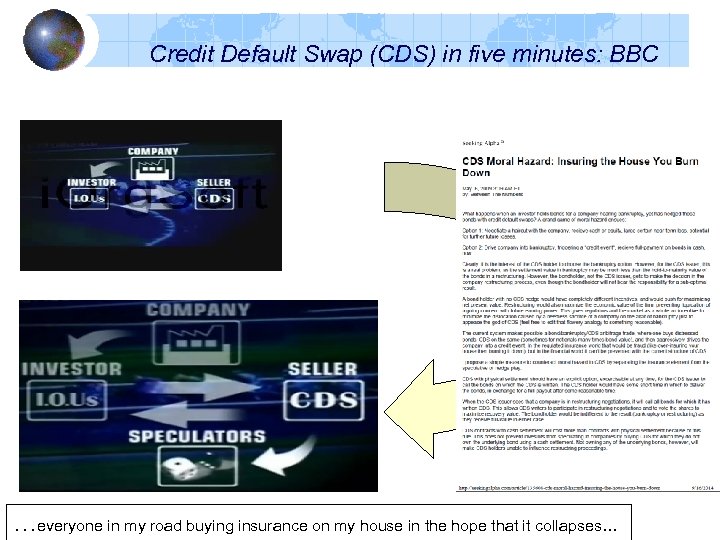
Credit Default Swap (CDS) in five minutes: BBC … everyone in my road buying insurance on my house in the hope that it collapses… Fall 2016
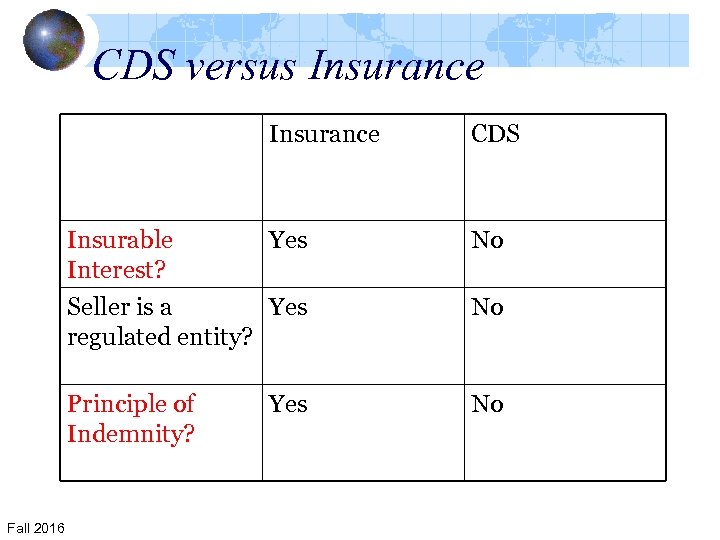
CDS versus Insurance CDS Insurable Yes Interest? Seller is a Yes regulated entity? Principle of Indemnity? Fall 2016 No No Yes No
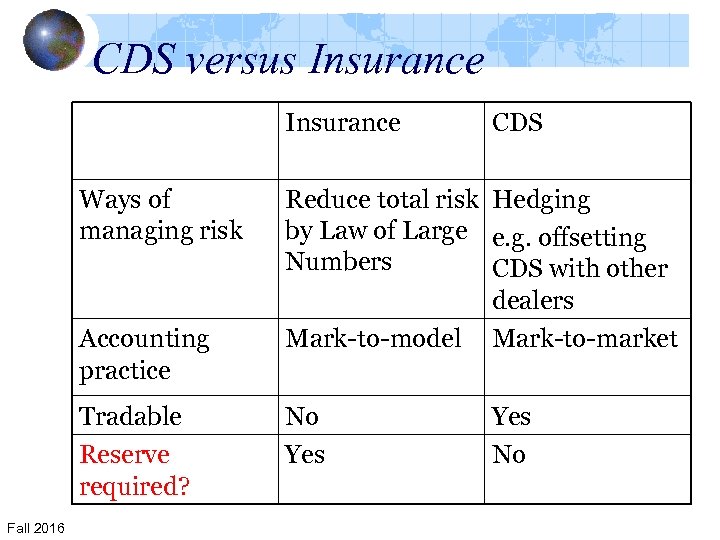
CDS versus Insurance Ways of managing risk Accounting practice Tradable Reserve required? Fall 2016 CDS Reduce total risk Hedging by Law of Large e. g. offsetting Numbers CDS with other dealers Mark-to-model Mark-to-market No Yes No
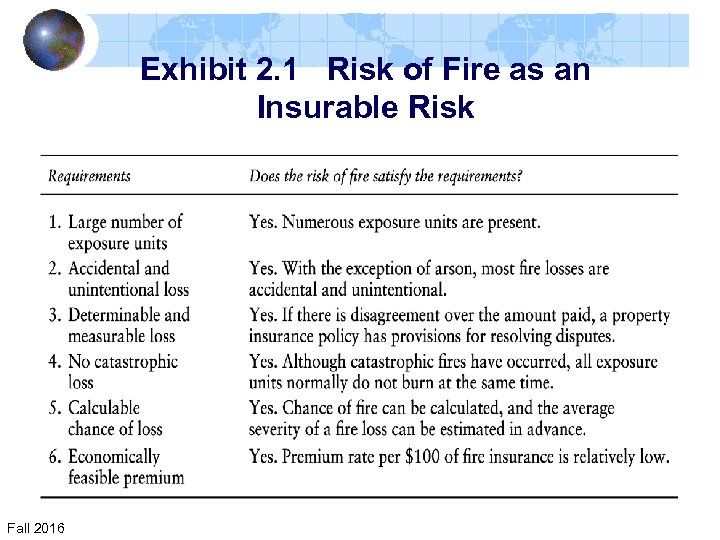
Exhibit 2. 1 Risk of Fire as an Insurable Risk Fall 2016
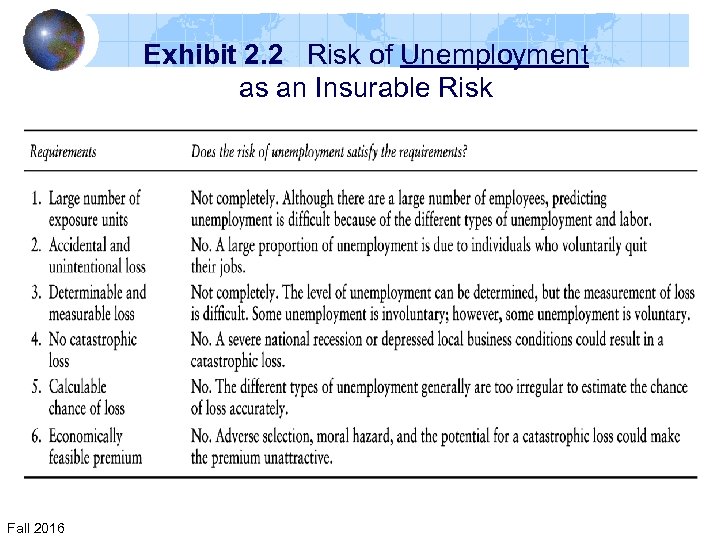
Exhibit 2. 2 Risk of Unemployment as an Insurable Risk Fall 2016
5. What Insurance is and is not Insurance: a method for ph to avoid risk ph cannot profit; faces either loss (if not insured) or no loss (if insured). Speculation: risk is transferred to speculator who hopes to profit as a result (e. g. futures market for grain farmer to guarantee sale price. . . speculator takes risk) Gambling: creates risk where none needed to exist. Fall 2016
6. Risk, Peril and Hazard Risk - possible variation of economic outcome vs. expected. Peril - a cause of risk (e. g. fire, collision, theft, wind). Hazard - a contributing factor to a peril (e. g. oily rags; slippery roads) An insurance contract covers a policyholder for economic loss caused by a peril named in the policy Fall 2016
Hazard Exposure, Peril, Hazard Physical hazard- physical condition that increases the chance or severity of loss Moral hazard- dishonesty or characteristics of an insured individual that increase the chance or severity of loss Morale Hazard- carelessness or indifferences to a loss because of the existence of insurance. Example: Given the following scenario, state which is the hazard, the peril, and the exposure, respectively? A person recently moved from Beijing to Shenzhen and bought a home. A typhoon occurs and it destroys his home. Example: True or False? A house of wood construction burns to the ground resulting in a complete loss. The fact that the construction was of wood is the peril involved in this loss. Fall 2016
7. Purchase of Insurance: Other Reasons (1) Legal requirements – e. g. , auto liability coverage is compulsory. (2) Lender’s requirements – may not be able to get mortgage on property or loan on car unless asset is insured. (3) Commercial requirement – insurance will cover case of service not being provided (e. g. , contract surety). (4) Special expertise – I. C. may provide excellent services at low cost (e. g. , boiler inspections, loss control audits) if you buy insurance. (5) Taxation – some tax advantages to the insurance mechanism (mostly timing). Fall 2016
Скачать презентацию FINA 3240 A Corporate Property Liability Insurance
bda8df5f123c37de6b9d65ce459b0df6.ppt