


 Скачать презентацию Fin 525 Week 5 Mortgages Credit and Project
cd6cd83d2b74cbf9d364f8a1f3659c8b.ppt
- Количество слайдов: 56
 Fin 525 Week 5 Mortgages, Credit, and Project Information Fall 2007 Professor Ross Miller • Fall 2007 University at Albany School of Business Copyright 2007 by Ross M. Miller. All rights reserved
 The Mid-Term and Final Exams are “Open Book” Ø Allowed • Anything in print form, including textbooks, class slides, notes, etc. • Calculators (including financial, scientific, and graphing); however, all problems can be solved with a cheap, minimal calculator Ø Prohibited • Any device remotely capable of communications, including cell phones, PDAs, and computers Professor Ross Miller • Fall 2007 1
 Words of Advice Ø Although the exam is open book to give you access to written course material, you will not have the time necessary to learn new material during the 170 minutes allotted to you for the exam Professor Ross Miller • Fall 2007 2
 Grades Ø Graded exams will be returned in Week 7’s class Ø Mid-term grades are not provided on Web. CT; however, all future grades will be posted there Ø Remember that the course is graded based on the best 3 out of 4 grades Professor Ross Miller • Fall 2007 3
 Mortgages Ø Mortgages are loans to individuals or businesses to purchase a home, land, or other real property Ø Many mortgages are securitized—packaged and sold as assets backing a publicly traded or privately held debt instrument Ø Four basic categories of mortgages • • Single-family home Multifamily dwelling Commercial Farm Professor Ross Miller • Fall 2007 4
 Two Main Types of Mortgages Ø Fixed-rate mortgage - Locks in the borrower’s interest rate and thus the required monthly payment over the life of the mortgage, regardless of market rate changes Ø Adjustable-rate mortgage (ARM) - Interest rate is tied to some market interest rate with potential for change in required monthly payments over the life of the mortgage Professor Ross Miller • Fall 2007 5
 Mortgage Fine Points Ø Discount points • Extra payment made when the loan is issued (at closing). • 1 discount point = 1 percent of the principal value of the mortgage • Points have become unpopular in recent years Ø Amortization schedule • Shows how the monthly mortgage payments are split between principal and interest Professor Ross Miller • Fall 2007 6
 Amortization Ø Shorter maturity means higher mortgage payments • 15 -year vs. 30 -year fixed-rate mortgages Ø Some mortgages start with zero or even negative amortization Ø Even a fully-amortized loan pays back very little principal early in the life of the mortgage Ø Only the interest part of mortgage payments can be deducted from income taxes Professor Ross Miller • Fall 2007 E=mc 2 7
 How to Think About Standard Amortization Ø Get the number of periods and periodic interest rate straight first • The standard 30 -year mortgage has T = 360 monthly periods • The monthly interest rate is usually (but not always) the quoted annual rate divided by 12 Ø The PV of the mortgage cash flows is just the mortgage amount Ø In a fully amortizing mortgage, the “par value” or “principal amount” is 0 because nothing is due at maturity, so it is a “zero principal” bond Professor Ross Miller • Fall 2007 E=mc 2 8
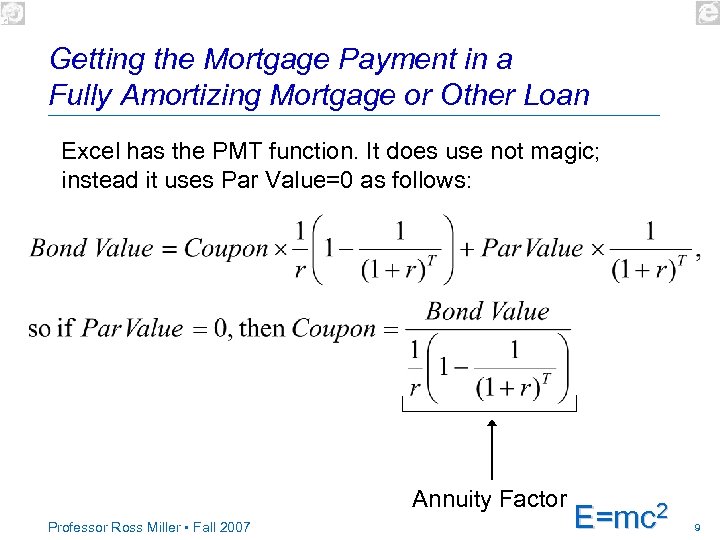 Getting the Mortgage Payment in a Fully Amortizing Mortgage or Other Loan Excel has the PMT function. It does use not magic; instead it uses Par Value=0 as follows: Annuity Factor Professor Ross Miller • Fall 2007 E=mc 2 9
 Interpreting the Previous Slide Ø “Coupon” is just the periodic mortgage payment Ø “Bond Value” is just the size of the mortgage Ø For an example of Excel’s PMT function see this spreadsheet Professor Ross Miller • Fall 2007 E=mc 2 10
 Amortization Schedules Can Be Misleading Ø One a tiny fraction of mortgages pay out for their entire term—virtually all mortgage are full paid up before their term is up Ø This means 30 -year mortgages do not behave like 30 -year bonds; indeed, they are more like 10 -year bonds Professor Ross Miller • Fall 2007 E=mc 2 11
 The Big Deal About Prepayment Ø Mortgages can be prepaid with little or no penalty at any time during the life of the mortgage Ø Reasons to prepay • A drop in interest rates allows the borrower to enter into a new mortgage at a lower interest rate • Moving to a new home (mortgages stopped being assumable by the new owner in the 1970 s) • Life-cycle considerations (Wall Street bonuses, etc. ) Professor Ross Miller • Fall 2007 E=mc 2 12
 Investors Prefer “Bundles” of Mortgages to Single Mortgages Ø Spreads out risk • Prepayment • Default (though mortgage insurance deals with most of this except for “subprime” mortgages) Ø Bundles are easier to analyze and track than individual mortgages Professor Ross Miller • Fall 2007 13
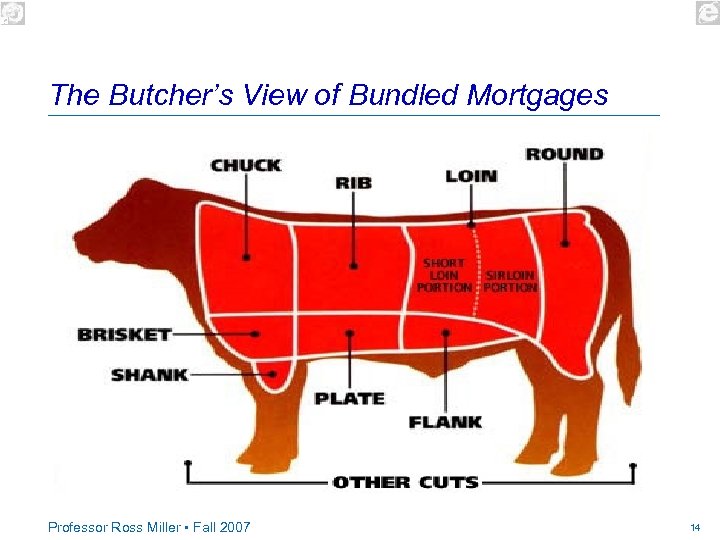 The Butcher’s View of Bundled Mortgages Professor Ross Miller • Fall 2007 14
 Why Butcher Mortgages? Ø Many institutional investors like “filet mignon, ” mortgage-backed securities known as PACs (planned amortization class) that trim off most of the prepayment risk and leave a mortgage bond that is similar to a Treasury note Ø The parts of the bundled mortgages that are left over after the butchering process are known as “toxic waste” Ø Other forms of consumer debt (credit card receivables, auto loans, etc. ) are similarly butchered Professor Ross Miller • Fall 2007 15
 How Mortgage Defaults are Handled Ø Some alternative mechanisms • Large enough down payments to ensure that the property is worth more than the outstanding mortgage • Government agency guarantees • Private insurance on individual mortgages • Private insurance of mortgage bundles • Overcollateralization of mortgage bundles • Equity tranches for mortgage bundles Professor Ross Miller • Fall 2007 16
 Recent Issues with Subprime Mortgages Ø Mortgages reset to a higher (adjustable) interest rates than the borrowers could afford Ø As a result, defaults were much higher than expected Ø Failing home prices quickly wiped out the minimal owner’s equity Ø Mortgage bundles secured with overcollateralization or equity tranches similarly saw their protection evaporate Ø Hedge funds that specialized in the equity pieces of these mortgages (most notably, two funds at Bear Stearns) saw their investments evaporate Professor Ross Miller • Fall 2007 17
 Current Issues in the Mortgage Market Ø Many ARMs are resetting in the next few months Ø Declines in housing prices are steepening and spreading Ø General impact on the economy, although currently minimal, could increase as the problem worsens Ø The economic system is not well-equipped to deal with the problem directly; however, it may not need to do so Professor Ross Miller • Fall 2007 18
 Corporate Bonds Ø Minimum denominations for exchange-traded corporate bonds is $1, 000 Ø Other corporate bonds trade in multiples of $1, 000 Ø Most pay interest semiannually Ø Typical terms for a “plain-vanilla” bond • Mature in 10 years • Callable in 5 years Ø Bond indenture • Legal contract that specifies the rights and obligations of the bond issuer and the bond holder Professor Ross Miller • Fall 2007 19
 Primary and Secondary Markets for Corporate Bonds Ø Primary sales of corporate bonds occur through either a public sale (issue) or a private placement similar to municipal bonds Ø Two secondary markets • Organized exchanges (primarily the New York Stock Exchange) • Over-the-counter (OTC) market Ø OTC electronic market dominates trading in corporate bonds Professor Ross Miller • Fall 2007 20
 Bond Pricing Difficulties Ø Dealers in corporate (and other non-Treasury) bonds are reluctant to provide price quotes, especially for bonds that no dealer maintains in inventory Ø Most bond dealers will only provide a bid or an ask price, not both—the spread between bid and ask is often $1 or more Ø The SEC has moved to make bond prices available over the Internet to individual investors for free at this site Ø The problem: Most of these prices are very “stale” and so completely useless Professor Ross Miller • Fall 2007 E=mc 2 21
 How Do Money Managers Place a Price on the Bonds They Hold? Ø There are several pricing services that provide custom prices that may or may not adequately reflect market conditions Ø Pricing services use “matrix pricing” methods that work by pricing infrequently traded bonds by pricing them off of comparable bonds that trade frequently Ø When the news is likely to be bad, they avoid repricing altogether Professor Ross Miller • Fall 2007 E=mc 2 22
 Bond Ratings Ø Bonds are rated by the issuer’s credit/default risk Ø Large bond investors, traders and managers evaluate default risk by analyzing the issuer’s financial ratios and security prices Ø The three major bond rating agencies are Moody’s, Standard & Poor’s (S&P), and Fitch Ø Bonds assigned a letter grade based on perceived probability of issuer default Professor Ross Miller • Fall 2007 23
 Bond Ratings in a Single Slide Ø AA and AAA • High investment grade • Required for participation in certain financial transactions Ø BBB and A • Investment grade • Required for viable financial institutions Ø B and BB • Speculative grade (junk) bonds Ø CCC and below • Distressed speculative grade (junk) bonds Professor Ross Miller • Fall 2007 24
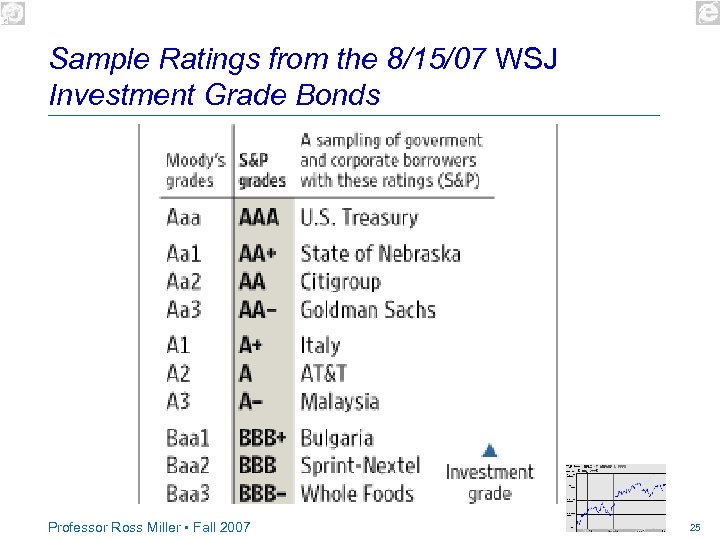 Sample Ratings from the 8/15/07 WSJ Investment Grade Bonds Professor Ross Miller • Fall 2007 25
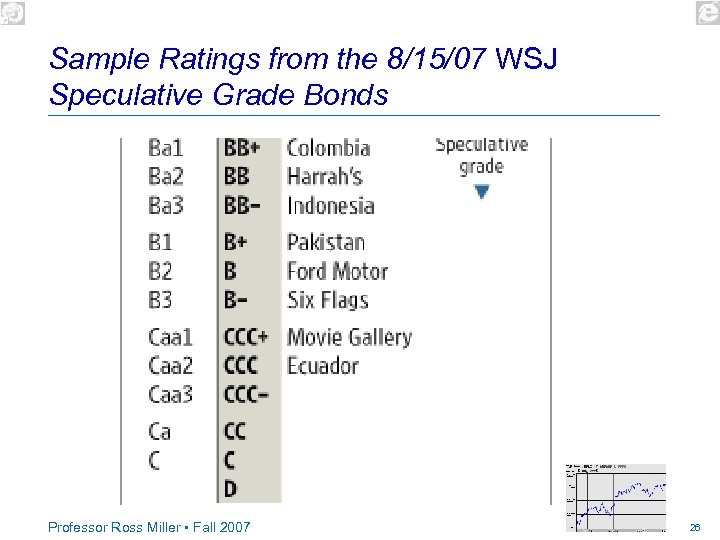 Sample Ratings from the 8/15/07 WSJ Speculative Grade Bonds Professor Ross Miller • Fall 2007 26
 Why Credit Ratings Matter Ø The lower one’s credit rating, the more it costs to borrow Ø Investors looking to get higher yields for their bonds must purchase bonds with lower ratings Ø There are very popular derivative securities known as credit default swaps (CDS) that separate out the default risk from a bond or bank loan Professor Ross Miller • Fall 2007 27
 Credit Spreads Ø A credit spread is the “bonus” that one gets for investing in a risky bond instead of a comparable “risk-free” Treasury security Ø The TED spread covered earlier is one example of a credit spread Ø Credit spreads were not that long ago near alltime low levels—so low that they merited a Business Week cover story Professor Ross Miller • Fall 2007 28
 CDOs and Diversification Ø CDOs (Collateralized Debt Obligations) provide creative ways to butcher bonds with less than high investment grade credit ratings Ø Emerging market debt is more palatable to investors when several countries are bundled together, thereby diversifying risk Professor Ross Miller • Fall 2007 29
 Credit Risk and Equity Ø Credit risk can be viewed as an equity (stock) component of bonds Ø Junk bonds can behave more like common stock than like bonds Ø Bonds differ in the seniority of their claims on the companies assets Ø Common stock ranks below all bonds Professor Ross Miller • Fall 2007 E=mc 2 30
 The Stock Prediction and Hedging Project in Three Parts 1. Predict the closing price of Green Mountain Coffee Roasters: (Nasdaq ticker: GMCR) on Friday, November 16, 2007. (5 pts. ) 2. Create a portfolio that hedges as completely as possible the risk from 10, 000 shares of GMCR for the period from 4 p. m. November 2 through 4 p. m. November 16. Portfolios are graded based on the standard deviations they achieve. (20 pts. ) 3. Write up an explanation of what you did in 1. and 2. in 1, 000 words or less. (75 pts. ) Professor Ross Miller • Fall 2007 31
 Key Dates and Times for the Stock Project Ø Both your prediction and your hedging portfolio are due Sunday, November 4, 2007 at 6 p. m. via e-mail in a standard format to rmmiller@uamail. albany. edu. You can use millerrm@nycap. rr. com as a fallback if the first address does not work for you. Ø Clicking on the above links for many e-mail programs will create an e-mail message this is properly formatting for submission Ø The write-up is due at the beginning of class on November 5 (Monday section) and November 7 (Wednesday section) Professor Ross Miller • Fall 2007 32
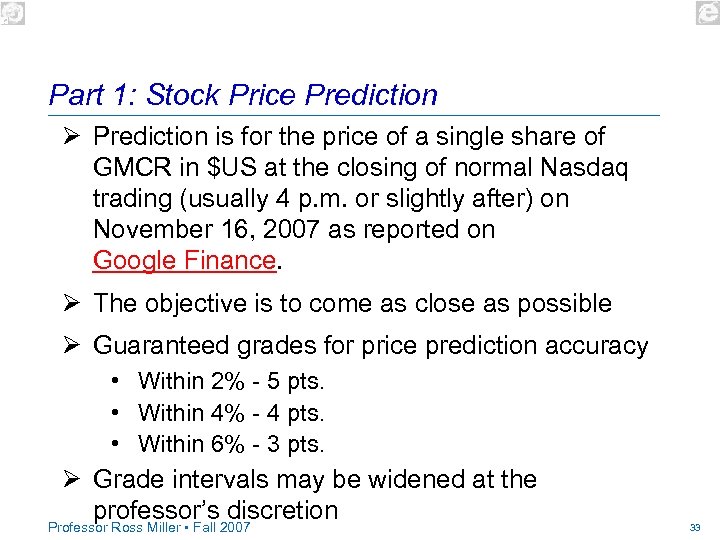 Part 1: Stock Price Prediction Ø Prediction is for the price of a single share of GMCR in $US at the closing of normal Nasdaq trading (usually 4 p. m. or slightly after) on November 16, 2007 as reported on Google Finance. Ø The objective is to come as close as possible Ø Guaranteed grades for price prediction accuracy • Within 2% - 5 pts. • Within 4% - 4 pts. • Within 6% - 3 pts. Ø Grade intervals may be widened at the professor’s discretion Professor Ross Miller • Fall 2007 33
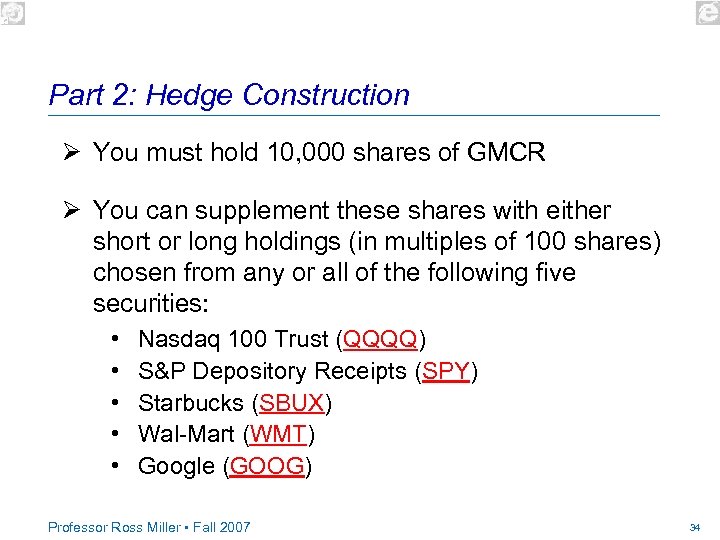 Part 2: Hedge Construction Ø You must hold 10, 000 shares of GMCR Ø You can supplement these shares with either short or long holdings (in multiples of 100 shares) chosen from any or all of the following five securities: • • • Nasdaq 100 Trust (QQQQ) S&P Depository Receipts (SPY) Starbucks (SBUX) Wal-Mart (WMT) Google (GOOG) Professor Ross Miller • Fall 2007 34
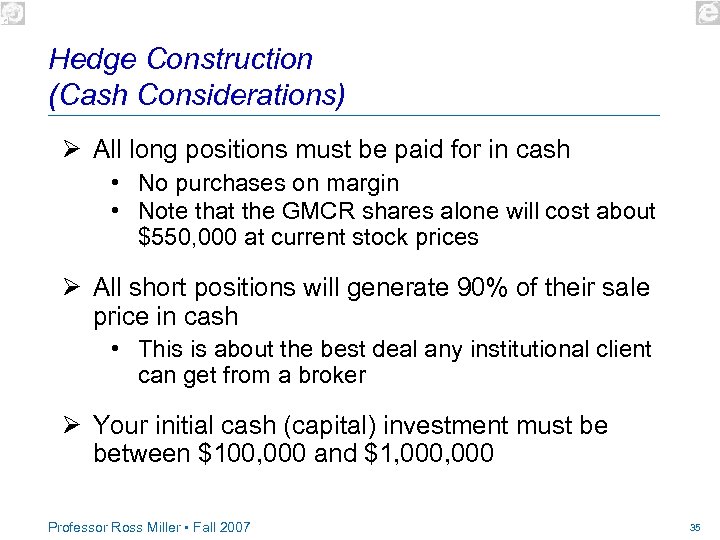 Hedge Construction (Cash Considerations) Ø All long positions must be paid for in cash • No purchases on margin • Note that the GMCR shares alone will cost about $550, 000 at current stock prices Ø All short positions will generate 90% of their sale price in cash • This is about the best deal any institutional client can get from a broker Ø Your initial cash (capital) investment must be between $100, 000 and $1, 000 Professor Ross Miller • Fall 2007 35
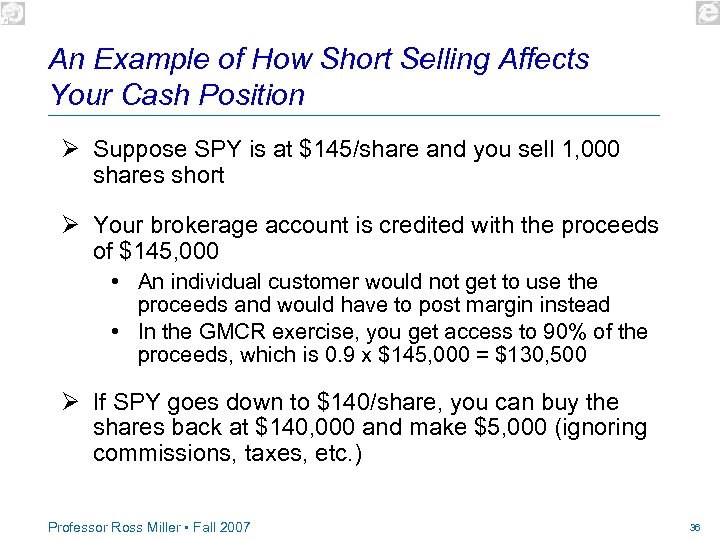 An Example of How Short Selling Affects Your Cash Position Ø Suppose SPY is at $145/share and you sell 1, 000 shares short Ø Your brokerage account is credited with the proceeds of $145, 000 • An individual customer would not get to use the proceeds and would have to post margin instead • In the GMCR exercise, you get access to 90% of the proceeds, which is 0. 9 x $145, 000 = $130, 500 Ø If SPY goes down to $140/share, you can buy the shares back at $140, 000 and make $5, 000 (ignoring commissions, taxes, etc. ) Professor Ross Miller • Fall 2007 36
 Hedge Construction: Leverage Considerations Ø The total “notional amount” of your portfolio cannot exceed $3, 000 Ø The notional amount is the sum of the absolute values of each position (see the next slide for an example) Professor Ross Miller • Fall 2007 37
 Notional Amount Limit of $3, 000: An Example Ø Suppose that GMCR is worth $35/share at the close on Friday, November 2, 2007 Ø Your mandatory 10, 000 shares will generate a notional amount of $350, 000, leaving you with $2, 650, 000 Ø If you were to sell 100, 000 shares of SBUX short at $29/share, that would generate a notional amount of $2, 900, 000—more than the $2, 650, 000 available to you Professor Ross Miller • Fall 2007 38
 How Your Hedges are Evaluated Ø Lower volatilities earn higher grades Ø The portfolio volatility is the daily standard deviation of its return over the two-week period (ten trading days) Ø The spreadsheet with last semester’s results will give you a good idea of how this all works Professor Ross Miller • Fall 2007 39
 How Hedges are Evaluated (continued) Ø The 6 lowest volatilities are guaranteed 20 out of 20 points (both sections of Fin 525 are combined for the purpose of ranking volatilities) Ø The next 12 lowest volatilities are guaranteed at least 19 out of 20 points Professor Ross Miller • Fall 2007 40
 E-mail Submission Ø If you can, use the automated mail entry form on an earlier slide Ø Those unable to use the automated form can simply e-mail their submission to rmmiller@uamail. albany. edu Ø The next slide shows what a submission looks like: • The predicted price is next to GMCR • The portfolio selections are given below it Professor Ross Miller • Fall 2007 41
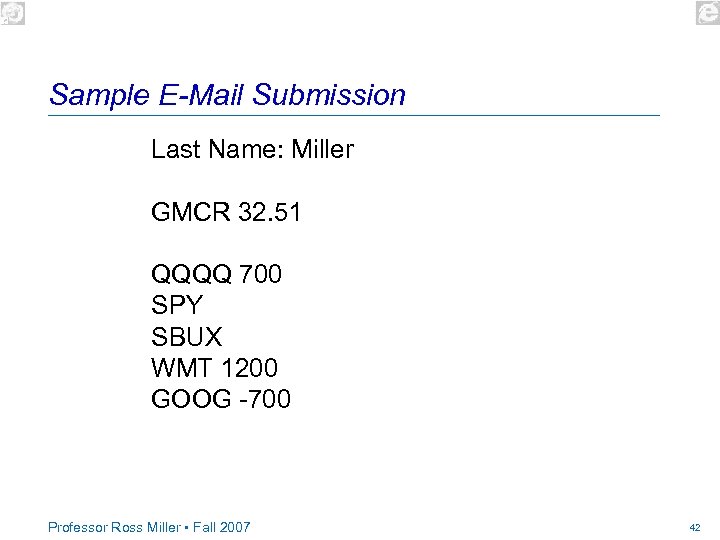 Sample E-Mail Submission Last Name: Miller GMCR 32. 51 QQQQ 700 SPY SBUX WMT 1200 GOOG -700 Professor Ross Miller • Fall 2007 42
 Stock Submission Validation Spreadsheet Ø Shortly after the market closes on Friday, November 2, 2007, an Excel spreadsheet will be made available on Web. CT that you can use to validate your submission before e-mailing it Ø Official closing prices will also be posted on Web. CT Ø The validation spreadsheets checks: • The capital requirement • The notion capital limit • That only multiples of 100 shares are used Professor Ross Miller • Fall 2007 43
 Stock Prediction and Hedging Project Write-Up Ø Try very hard to stay within the 1, 000 -word limit Ø Up to 3 optional tables or figures of reasonable size are allowed in addition to the 1, 000 words Ø Formatting guidelines • Single-spaced within paragraphs and doublespaced between paragraphs • 12 -point standard proportional typeface • Left-hand justified • Margins of at least 1 inch on all sides Professor Ross Miller • Fall 2007 44
 Stock Prediction and Hedging Project Write-Up (continued) Ø The write-up must be submitted as a hard copy in class Ø E-mail submissions are permissible, but only if they are submitted in PDF or DOC (and not DOCX) format Ø In general, while you are free to use Office 2007, Fin 525 will not be supporting it and its data formats until next semester at the earliest Professor Ross Miller • Fall 2007 45
 Stock Project: Some Last Comments Ø Grades for write-ups are available in class on Monday, November 12 and Wednesday, November 14 and through Web. CT those same days Ø Predictions/portfolios will be graded by Monday, November 19 and will only be available through Web. CT Ø You should send a practice e-mail submission to me between Monday, October 29 and Thursday, November 1 and I will reply to it Professor Ross Miller • Fall 2007 46
 The Main Resource for Doing the Project: Fin 525 Fall 2007 Stock. Project. xls Ø It has two years of recent historical stock data for each stock in the exercise Ø A summary of the data and how the stocks are correlated with one another Ø A full computation of beta for GMCR using this data Ø A spreadsheet that shows how different portfolios would have performed over the past two years Professor Ross Miller • Fall 2007 47
 One Final Thing Ø The objective of the hedging exercise may seem pointless, arbitrary, and unrelated to anything that matters Ø The compensation of most professional investment managers similarly absurd Ø They figure out how to adapt, and so should you Professor Ross Miller • Fall 2007 48
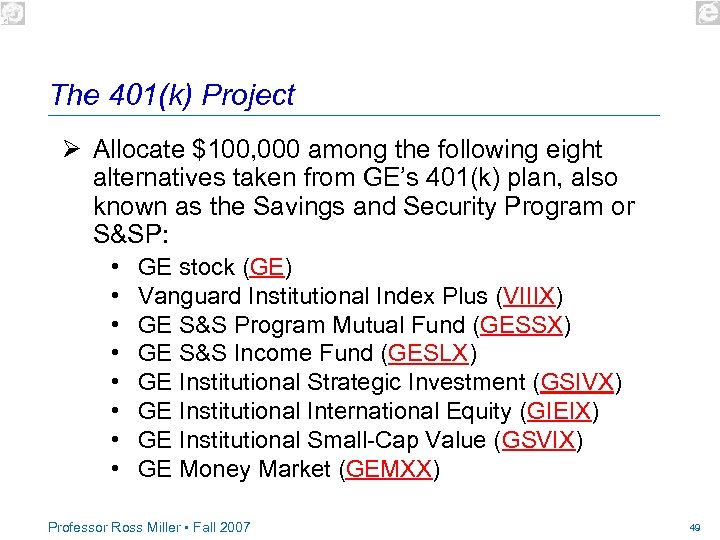 The 401(k) Project Ø Allocate $100, 000 among the following eight alternatives taken from GE’s 401(k) plan, also known as the Savings and Security Program or S&SP: • • GE stock (GE) Vanguard Institutional Index Plus (VIIIX) GE S&S Program Mutual Fund (GESSX) GE S&S Income Fund (GESLX) GE Institutional Strategic Investment (GSIVX) GE Institutional International Equity (GIEIX) GE Institutional Small-Cap Value (GSVIX) GE Money Market (GEMXX) Professor Ross Miller • Fall 2007 49
 Your Target Investor Ø Assume that he or she has at least 30 years until retirement and that his/her job is linked to GE’s fortunes Ø Virtually all of his or her savings are the $100, 000 in GE’s 401(k) plan Ø You can fill any other details to make this challenge as relevant to your own finances as possible Professor Ross Miller • Fall 2007 50
 Final Project Details (continued) Ø Due at the beginning of class on Monday, November 26 and Wednesday, November 28 Ø Same write-up details as the stock project except: • Word limit is raised from 1, 000 words to 2, 000 words • Optional chart/figure limit is raised from 3 to 8 Professor Ross Miller • Fall 2007 51
 Teamwork Parameters Ø You should form teams of 3 to 4 students (smaller or larger teams require the professor’s permission) Ø A team submits a single report and all members receive the same grade Ø A team can have members selected from both sections of Fin 525 and your report is due at the later class meeting Professor Ross Miller • Fall 2007 52
 Grades Ø Grades for both the project and the course will be posted on Web. CT by 5 pm on Friday, November 30 Ø The grade that you will receive if you do not take the final exam will also be posted on Web. CT at that time Professor Ross Miller • Fall 2007 53
 Assignment for Week 6 Ø Review all new material on mortgages and credit Ø Prepare for the mid-term exam Professor Ross Miller • Fall 2007 54
 Assignment for Week 7 Ø Start finding out all you can about Green Mountain Coffee Roasters (GMCR) on the Internet Ø Read Chapter 5 of Bodie, Kane, and Marcus (BKM) Professor Ross Miller • Fall 2007 55