


 Скачать презентацию FIN 3000 Chapter 2 Firms and Financial Markets
1ae2b524fda317c5b999ea5dc00d7b2a.ppt
- Количество слайдов: 24
 FIN 3000 Chapter 2 Firms and Financial Markets Liuren Wu
 Overview/Learning objectives 1. Describe the structure and functions of financial markets. 2. Distinguish between commercial banks and other financial institutions in the financial marketplace. Describe the different securities markets for bonds and stock. 3. 2 FIN 3000, Liuren Wu
 Principles Used in this Chapter Principle 2: There is a Risk-Return Tradeoff. Financial markets are organized to offer investors a wide range of investment opportunities that have different risk and different expected rates of return that reflect those risks. Principle 4: Market Prices Reflect Information. It is through the operations of the financial markets that new information is efficiently impounded in security prices. 3 FIN 3000, Liuren Wu
 Three Players in the Financial Markets There are 3 sets of players that interact within the financial markets: 1. 2. 3. Borrowers: Individuals and businesses that need money to finance their purchases or investments. Savers (lenders, Investors): Those who have money to invest. These are principally individuals although firms also save when they have excess cash. Financial Institutions (Financial Intermediaries): The financial institutions and markets help bring borrowers and savers together. 4 FIN 3000, Liuren Wu
 Financial Intermediaries Financial institutions like commercial banks, finance companies, insurance companies, investment banks, and investment companies are called financial intermediaries as they help bring together those who have money (savers) and those who need money (borrowers). Example: John’s three sons are grown up and are looking to buy their first home. There is no intermediation if John directly gives/lends them the funds they need There is intermediation where a bank doles out the funds and John is free to place his monies in any bank he chooses to do so. 5 FIN 3000, Liuren Wu
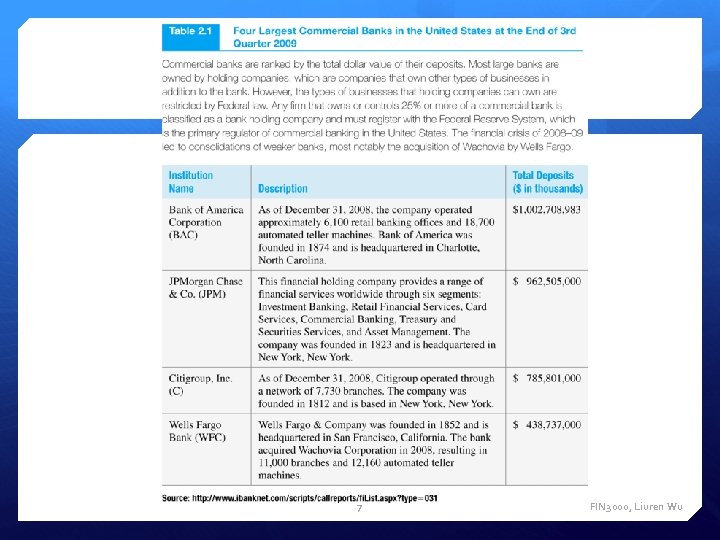
 Commercial Banks Commercial banks collect the savings of individuals as well as businesses and then lend those pooled savings to other individuals and businesses. They make money by charging a rate of interest to borrowers that exceeds the rate they pay to savers. In the United States, banks cannot own industrial corporations. 6 FIN 3000, Liuren Wu
 7 FIN 3000, Liuren Wu
 Non-Bank Financial Intermediaries These include: Financial services corporations, like GE Capital Division; Insurance companies, like Prudential; Investment banks, like Goldman Sachs; Investment companies including mutual funds, hedge funds and private equity firms. 8 FIN 3000, Liuren Wu
 Financial Services Corporations Financial services corporation are in the lending or financing business, but they are not commercial banks. One well known financial service corporation is GE capital, the finance unit of the General Electric Corporation. GE capital provides commercial loans, financing programs, commercial insurance, equipment leasing, and other services in over 35 countries around the world. GE capital also provides credit services to more than 130 million customers that range from retailers, auto dealers, consumers offering products and services from credit cards to debt consolidation to home equity loans. 9 FIN 3000, Liuren Wu
 Insurance Companies Insurance companies sell insurance to individuals and businesses to protect their investments. They collect premium and hold the premium in reserves until there is an insured loss and then pay out claims to the holders of the insurance contracts. Later, these reserves are deployed in various types of investments including loans to individuals, businesses and the government. 10 FIN 3000, Liuren Wu
 Investment Banks Investment banks are specialized financial intermediaries that: help companies and governments raise money provide advisory services to client firms on major transactions such as mergers Firms that provide investment banking services include Bank of America, Goldman Sachs, Morgan Stanley and JP Morgan Chase. 11 FIN 3000, Liuren Wu
 Investment Companies Investment companies are financial institutions that pool the savings of individual savers and invest the money in the securities issued by other companies purely for investment purposes. 12 FIN 3000, Liuren Wu
 Mutual Funds Mutual funds are professionally managed according to a stated investment objective. Individuals can invest in mutual funds by buying shares in the mutual fund at the net asset value (NAV). NAV is calculated daily based on the total value of the fund divided by the number of mutual fund shares outstanding. Mutual funds can either be load or no-load funds. The term load refers to the sales commission that you pay when acquiring ownership shares in the fund. These commissions typically range between 4. 0 to 6. 0%. A mutual fund that does not charge a commission is referred to as a no-load fund. 13 FIN 3000, Liuren Wu
 Exchange Traded Funds (ETFs) An exchange-traded fund (ETF) is similar to a mutual fund except that the ownership shares in the ETF can be bought and sold on the stock exchange. Most ETFs track an index, such as the Dow Jones Industrial Average or the S&P 500, and generally have relatively low expenses. Mutual funds and ETFs provide a cost-effective way to diversify and reduce risk. If you only have limited amount of money and want to spread them in many different stocks. 14 FIN 3000, Liuren Wu
 Hedge Funds Hedge funds are similar to mutual funds but they tend to take more risk and are generally open only to high net worth investors. Management fees also tends to be higher for hedge funds and most funds include an incentive fee based on the fund’s overall performance, which typically runs at 20% of profits. 15 FIN 3000, Liuren Wu
 Private Equity Firms Private equity firms include two major groups: Venture capital (VC) firms and Leveraged buyout firms (LBOs). Venture capital firms raise money from investors (wealthy individuals and other financial institutions) that they then use to provide financing for private start-up companies when they are first founded. For example, Venture capital firm, Kleiner Perkins Caufield & Byers (KPCB) was involved in the initial financing of Google. Leveraged buyout firms acquire established firms that typically have not been performing very well with the objective of making them profitable again and selling them. An LBO typically uses debt to fund the purchase of a firm. LBO transactions grew from $7. 5 billion in 1991 to $500 billion in 2006. Prominent LBO private equity firms include Cerberus Capital Management, L. P. , TPG (formerly Texas Pacific Group), and KKR (Kohlberg, Kravis, and Roberts). 16 FIN 3000, Liuren Wu
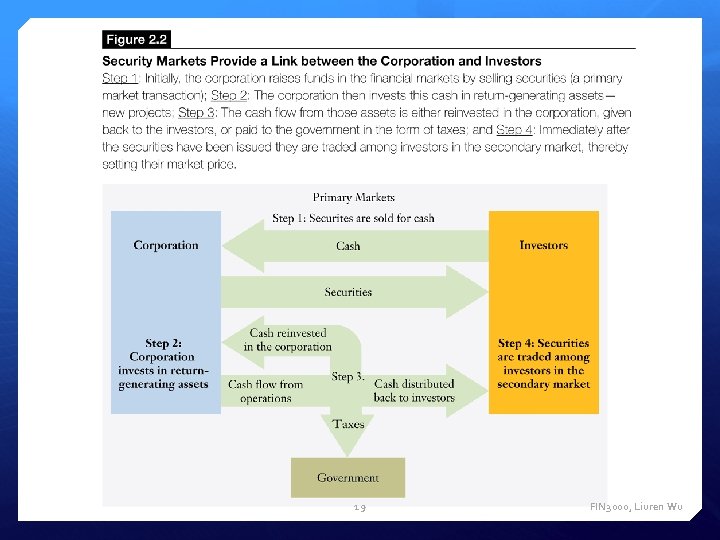
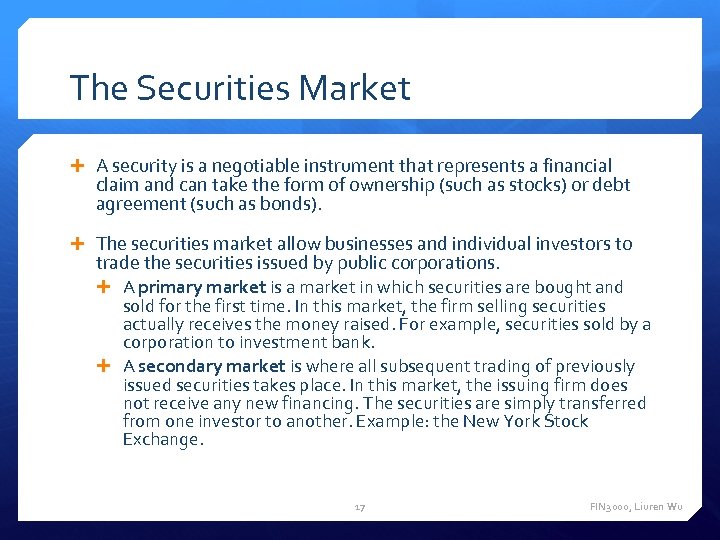 The Securities Market A security is a negotiable instrument that represents a financial claim and can take the form of ownership (such as stocks) or debt agreement (such as bonds). The securities market allow businesses and individual investors to trade the securities issued by public corporations. A primary market is a market in which securities are bought and sold for the first time. In this market, the firm selling securities actually receives the money raised. For example, securities sold by a corporation to investment bank. A secondary market is where all subsequent trading of previously issued securities takes place. In this market, the issuing firm does not receive any new financing. The securities are simply transferred from one investor to another. Example: the New York Stock Exchange. 17 FIN 3000, Liuren Wu
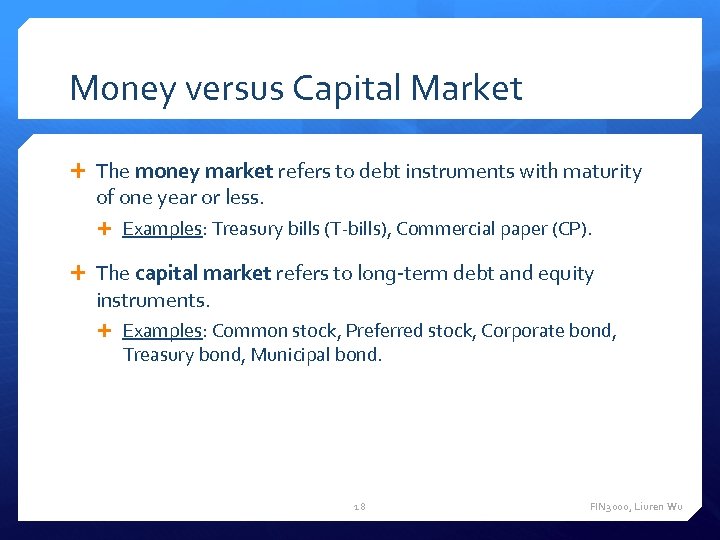 Money versus Capital Market The money market refers to debt instruments with maturity of one year or less. Examples: Treasury bills (T-bills), Commercial paper (CP). The capital market refers to long-term debt and equity instruments. Examples: Common stock, Preferred stock, Corporate bond, Treasury bond, Municipal bond. 18 FIN 3000, Liuren Wu
 19 FIN 3000, Liuren Wu
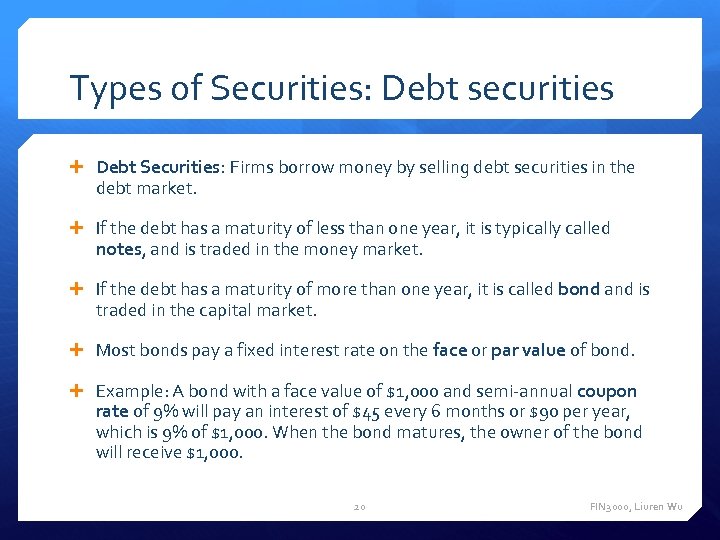 Types of Securities: Debt securities Debt Securities: Firms borrow money by selling debt securities in the debt market. If the debt has a maturity of less than one year, it is typically called notes, and is traded in the money market. If the debt has a maturity of more than one year, it is called bond and is traded in the capital market. Most bonds pay a fixed interest rate on the face or par value of bond. Example: A bond with a face value of $1, 000 and semi-annual coupon rate of 9% will pay an interest of $45 every 6 months or $90 per year, which is 9% of $1, 000. When the bond matures, the owner of the bond will receive $1, 000. 20 FIN 3000, Liuren Wu
 Types of Securities: Equity securities represent ownership of the corporation. Common stock is a security that represents equity ownership in a corporation, provides voting rights, and entitles the holder to a share of the company’s success in the form of dividends and any capital appreciation in the value of the security. Common stockholders are residual owners of the firm. They earn a return only after all other security holder claims (debt and preferred equity) have been satisfied in full. Dividend on common stock are neither fixed nor guaranteed. Thus, a company can choose to reinvest all of the profits in a new project and pay no dividends. Preferred stock is an equity security. However, preferred stockholders have preference with regard to: Dividends: They are paid before the common stockholders. Claim on assets: They are paid before common stockholders if the firm goes bankrupt and sells or liquidates its assets. 21 FIN 3000, Liuren Wu
 Preferred stock is also referred to as a hybrid security as it has features of both common stock and bonds. Preferred stock is similar to common stocks in that: It has no fixed maturity date, The nonpayment of dividends does not result in bankruptcy of the firm, and The dividends are not deductible for tax purposes. Preferred stock is similar to corporate bonds in that: The dividends are typically a fixed amount, and There are no voting rights. 22 FIN 3000, Liuren Wu
 Stock Markets A stock market is a public market in which the stocks of companies is traded. Stock markets are classified as either organized security exchanges or over-the- counter (OTC) market. Organized security exchanges are tangible entities; that is, they physically occupy space and financial instruments are traded on their premises. For example, the New York Stock Exchange (NYSE) is located at 11 Wall Street in Manhattan, NY. The total value of stocks listed on the NYSE fell from $18 trillion in 2007 to just over $10 trillion at the beginning of 2009. The over-the-counter markets include all security market except the organized exchanges. NASDAQ (National Association of Securities Dealers Automated Quotations) is an over-the-counter market and describes itself as a “screenbased, floorless market”. In 2009, nearly 3, 900 companies were listed on NASDAQ, including Starbucks, Google, Intel. 23 FIN 3000, Liuren Wu
 24 FIN 3000, Liuren Wu