 Скачать презентацию Film History Lecture prepared 11 07 09 by John M
Filmstory.ppt
- Количество слайдов: 39



Film History Lecture prepared 11/07/09 by John M. Grace I. A. T. S. E. member and film instructor D. A. T. A. Charter High School Albuquerque, New Mexico Some illustrations and copy courtesy of Cybercollege. com Part 1
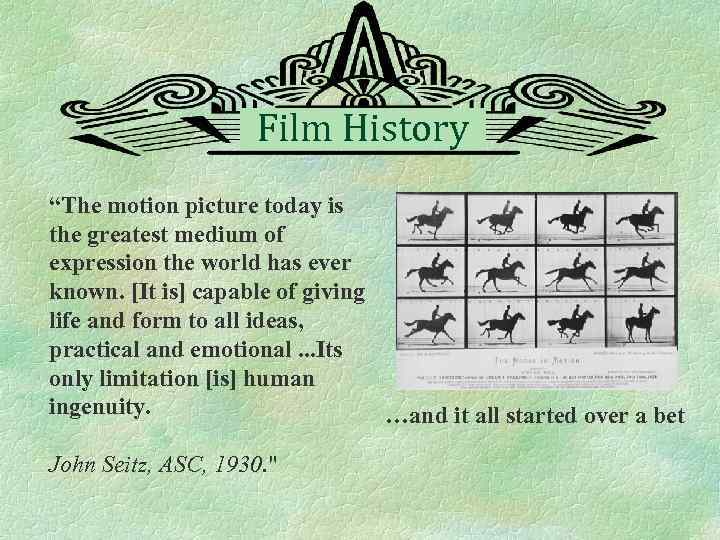
Film History “The motion picture today is the greatest medium of expression the world has ever known. [It is] capable of giving life and form to all ideas, practical and emotional. . . Its only limitation [is] human ingenuity. …and it all started over a bet John Seitz, ASC, 1930. "
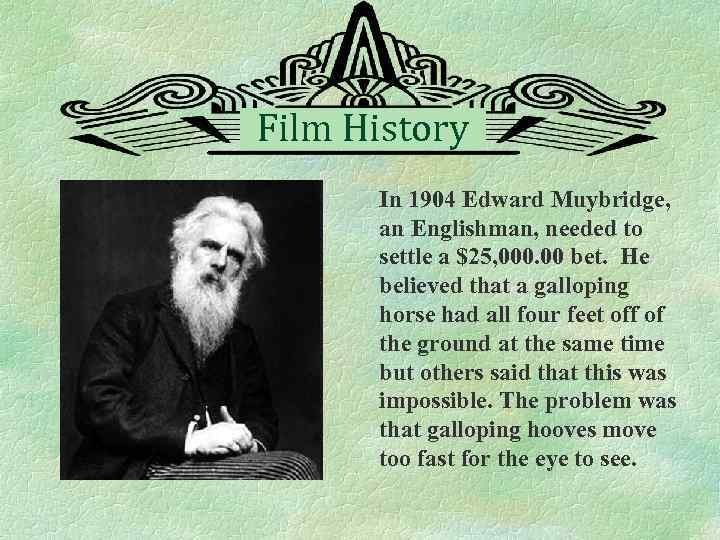
Film History In 1904 Edward Muybridge, an Englishman, needed to settle a $25, 000. 00 bet. He believed that a galloping horse had all four feet off of the ground at the same time but others said that this was impossible. The problem was that galloping hooves move too fast for the eye to see.
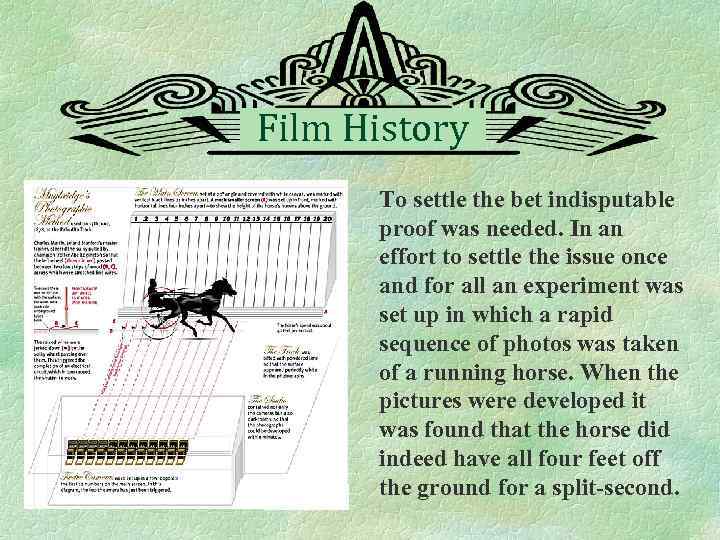
Film History To settle the bet indisputable proof was needed. In an effort to settle the issue once and for all an experiment was set up in which a rapid sequence of photos was taken of a running horse. When the pictures were developed it was found that the horse did indeed have all four feet off the ground for a split-second.
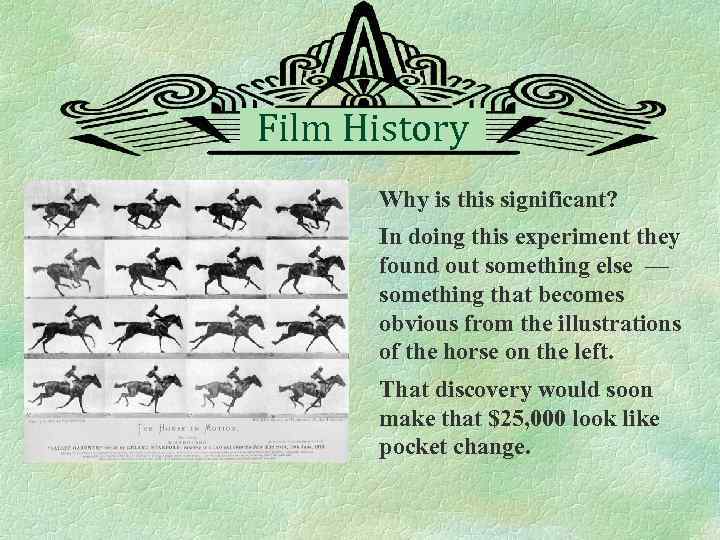
Film History Why is this significant? In doing this experiment they found out something else — something that becomes obvious from the illustrations of the horse on the left. That discovery would soon make that $25, 000 look like pocket change.
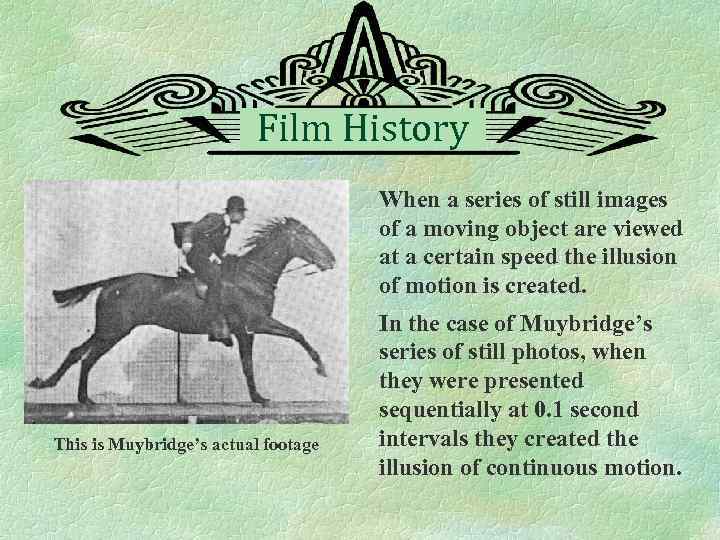
Film History When a series of still images of a moving object are viewed at a certain speed the illusion of motion is created. This is Muybridge’s actual footage In the case of Muybridge’s series of still photos, when they were presented sequentially at 0. 1 second intervals they created the illusion of continuous motion.
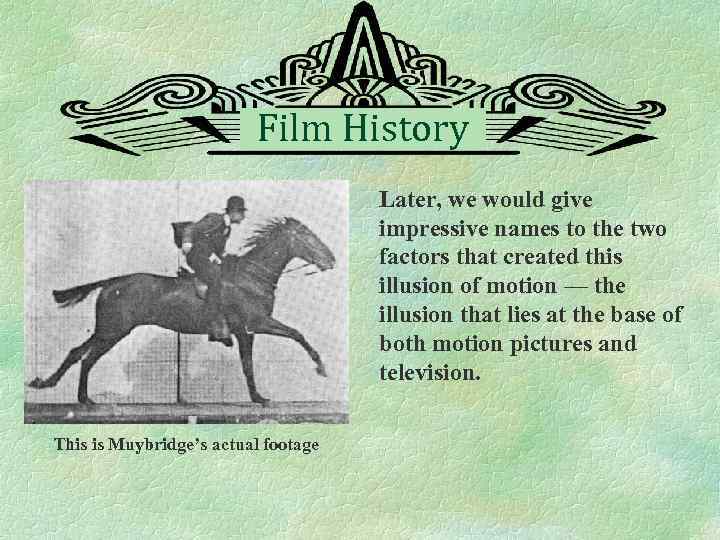
Film History Later, we would give impressive names to the two factors that created this illusion of motion — the illusion that lies at the base of both motion pictures and television. This is Muybridge’s actual footage
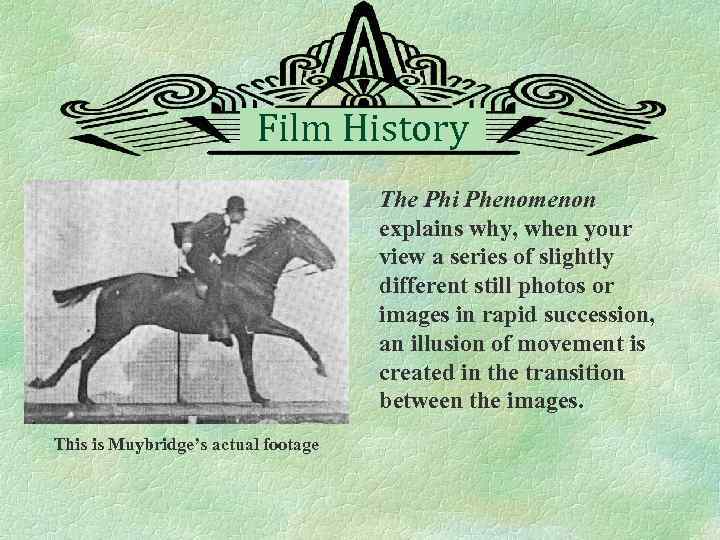
Film History The Phi Phenomenon explains why, when your view a series of slightly different still photos or images in rapid succession, an illusion of movement is created in the transition between the images. This is Muybridge’s actual footage
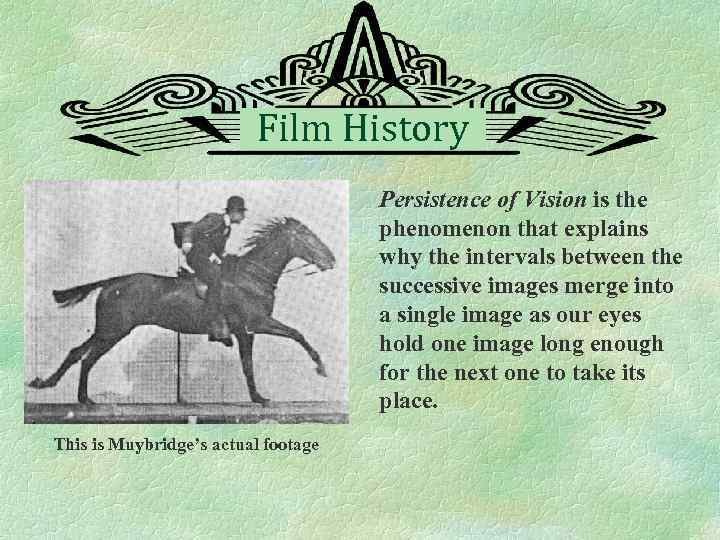
Film History Persistence of Vision is the phenomenon that explains why the intervals between the successive images merge into a single image as our eyes hold one image long enough for the next one to take its place. This is Muybridge’s actual footage
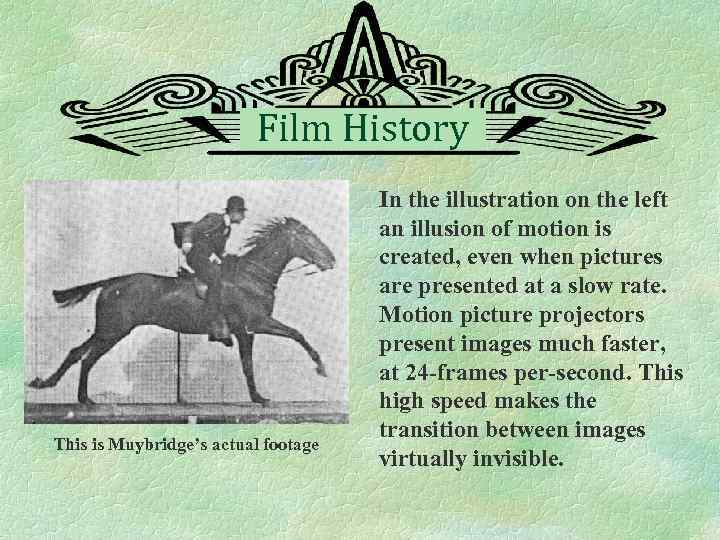
Film History This is Muybridge’s actual footage In the illustration on the left an illusion of motion is created, even when pictures are presented at a slow rate. Motion picture projectors present images much faster, at 24 -frames per-second. This high speed makes the transition between images virtually invisible.
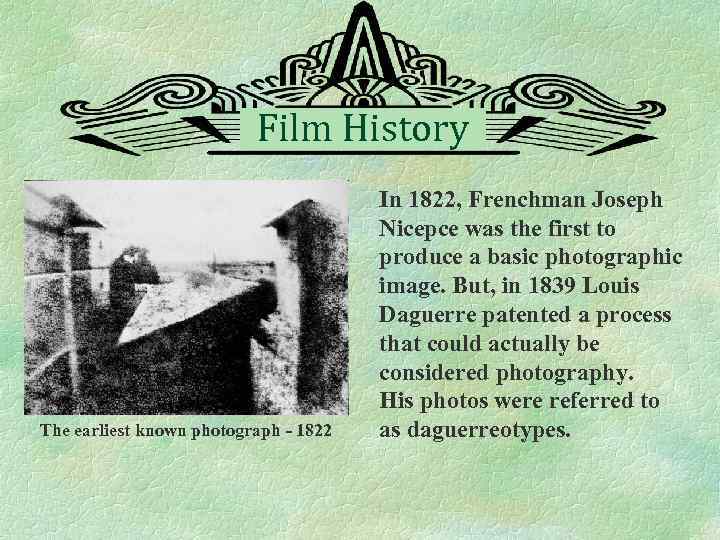
Film History The earliest known photograph - 1822 In 1822, Frenchman Joseph Nicepce was the first to produce a basic photographic image. But, in 1839 Louis Daguerre patented a process that could actually be considered photography. His photos were referred to as daguerreotypes.
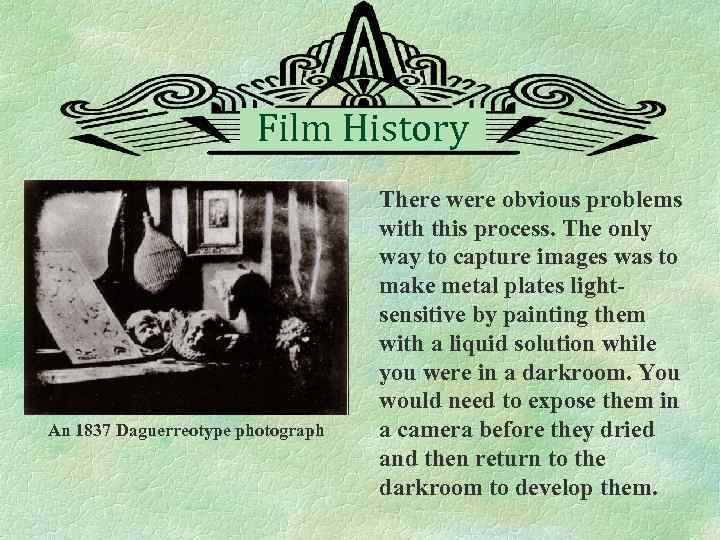
Film History An 1837 Daguerreotype photograph There were obvious problems with this process. The only way to capture images was to make metal plates lightsensitive by painting them with a liquid solution while you were in a darkroom. You would need to expose them in a camera before they dried and then return to the darkroom to develop them.
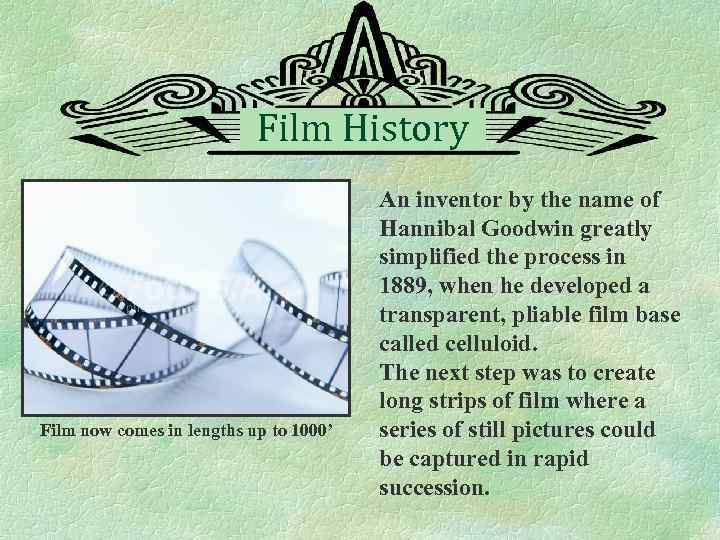
Film History Film now comes in lengths up to 1000’ An inventor by the name of Hannibal Goodwin greatly simplified the process in 1889, when he developed a transparent, pliable film base called celluloid. The next step was to create long strips of film where a series of still pictures could be captured in rapid succession.
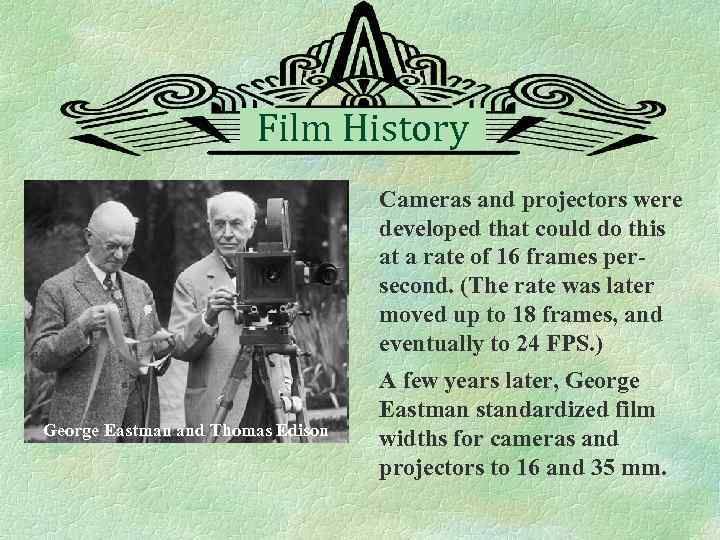
Film History Cameras and projectors were developed that could do this at a rate of 16 frames persecond. (The rate was later moved up to 18 frames, and eventually to 24 FPS. ) George Eastman and Thomas Edison A few years later, George Eastman standardized film widths for cameras and projectors to 16 and 35 mm.
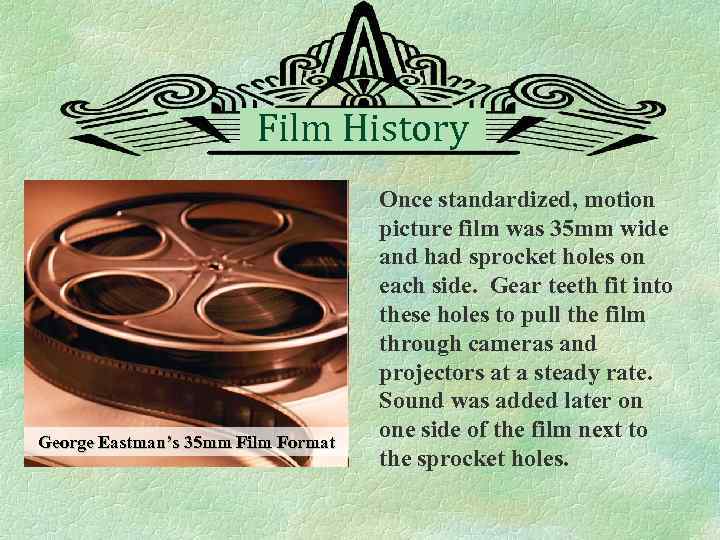
Film History George Eastman’s 35 mm Film Format Once standardized, motion picture film was 35 mm wide and had sprocket holes on each side. Gear teeth fit into these holes to pull the film through cameras and projectors at a steady rate. Sound was added later on one side of the film next to the sprocket holes.
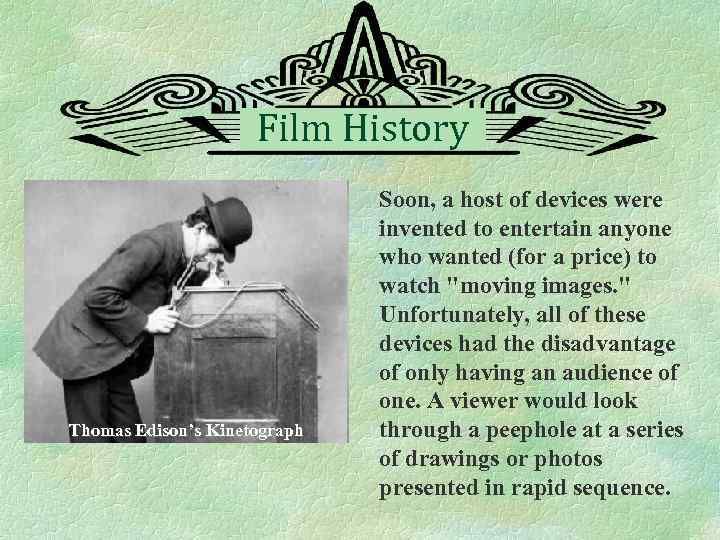
Film History Thomas Edison’s Kinetograph Soon, a host of devices were invented to entertain anyone who wanted (for a price) to watch "moving images. " Unfortunately, all of these devices had the disadvantage of only having an audience of one. A viewer would look through a peephole at a series of drawings or photos presented in rapid sequence.
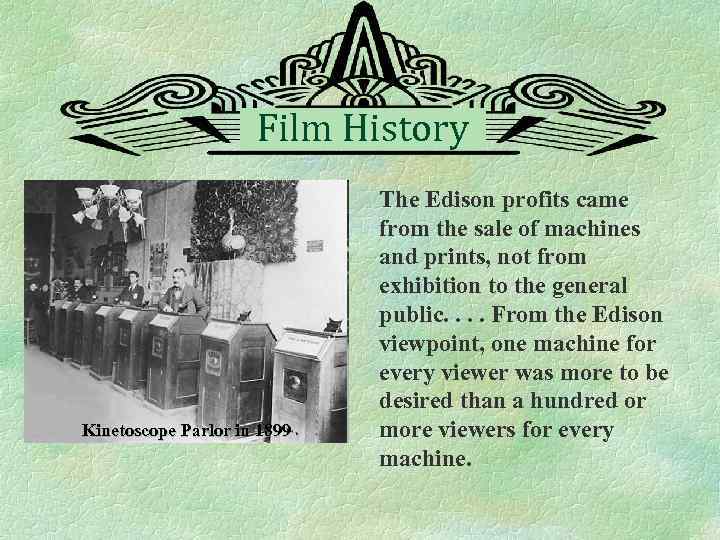
Film History Kinetoscope Parlor in 1899 The Edison profits came from the sale of machines and prints, not from exhibition to the general public. . From the Edison viewpoint, one machine for every viewer was more to be desired than a hundred or more viewers for every machine.
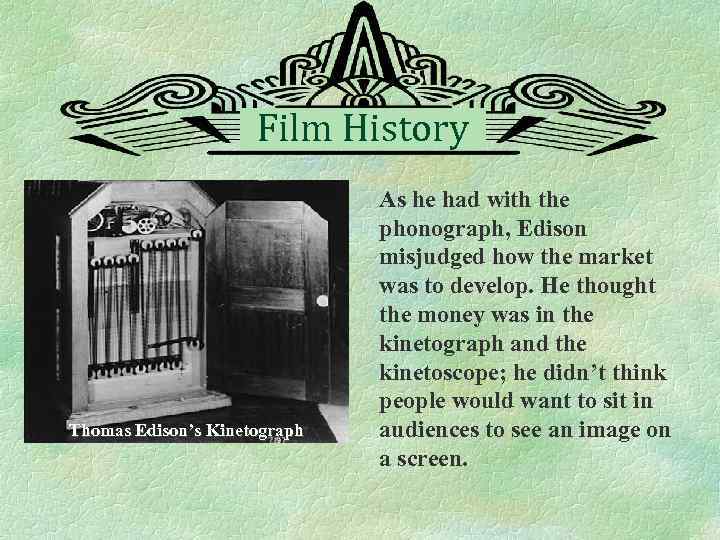
Film History Thomas Edison’s Kinetograph As he had with the phonograph, Edison misjudged how the market was to develop. He thought the money was in the kinetograph and the kinetoscope; he didn’t think people would want to sit in audiences to see an image on a screen.
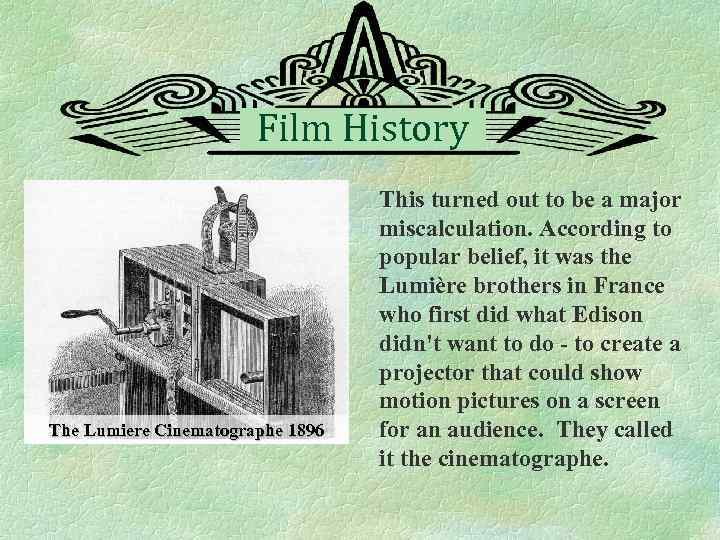
Film History The Lumiere Cinematographe 1896 This turned out to be a major miscalculation. According to popular belief, it was the Lumière brothers in France who first did what Edison didn't want to do - to create a projector that could show motion pictures on a screen for an audience. They called it the cinematographe.
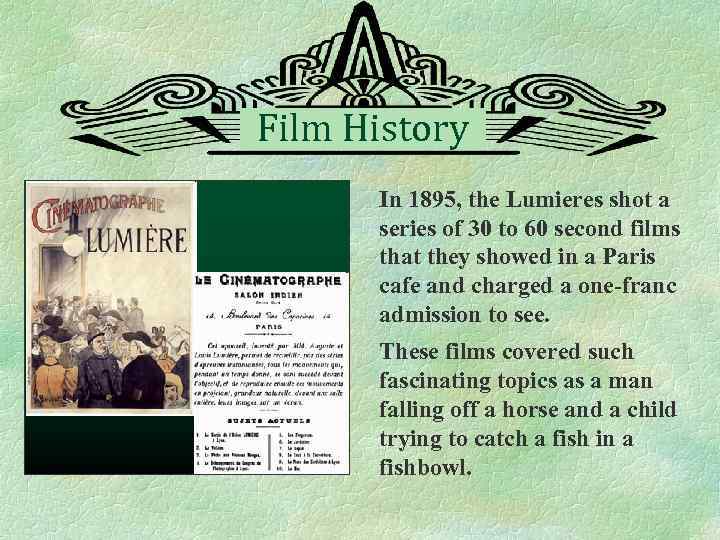
Film History In 1895, the Lumieres shot a series of 30 to 60 second films that they showed in a Paris cafe and charged a one-franc admission to see. These films covered such fascinating topics as a man falling off a horse and a child trying to catch a fish in a fishbowl.
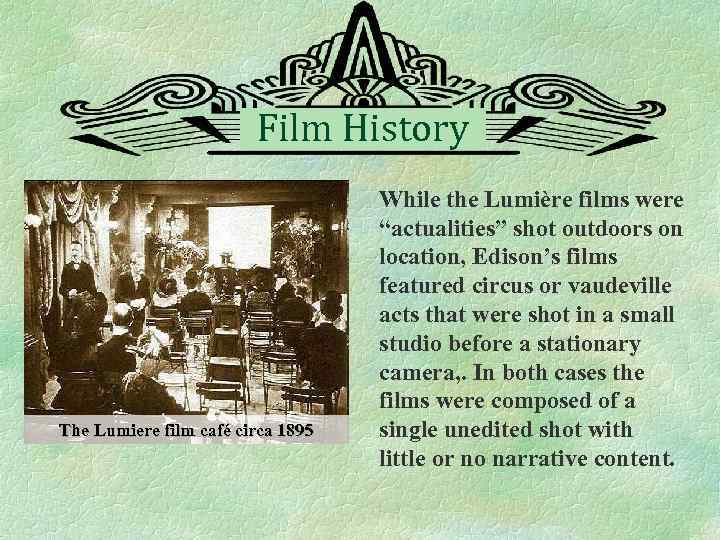
Film History The Lumiere film café circa 1895 While the Lumière films were “actualities” shot outdoors on location, Edison’s films featured circus or vaudeville acts that were shot in a small studio before a stationary camera, . In both cases the films were composed of a single unedited shot with little or no narrative content.
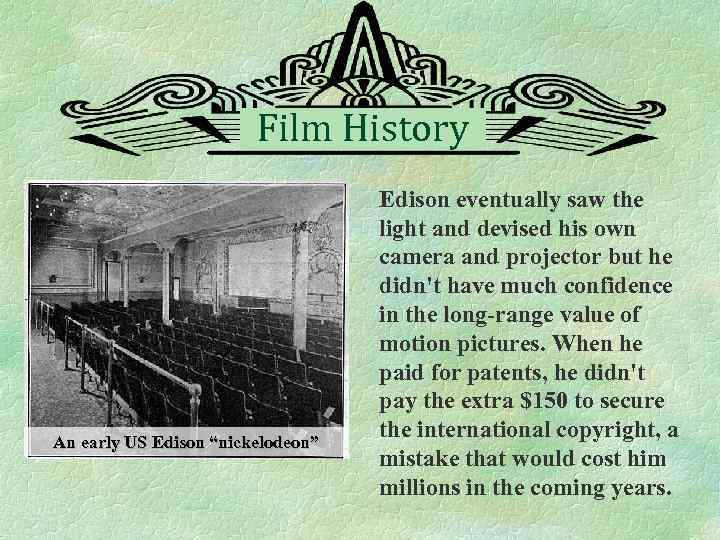
Film History An early US Edison “nickelodeon” Edison eventually saw the light and devised his own camera and projector but he didn't have much confidence in the long-range value of motion pictures. When he paid for patents, he didn't pay the extra $150 to secure the international copyright, a mistake that would cost him millions in the coming years.
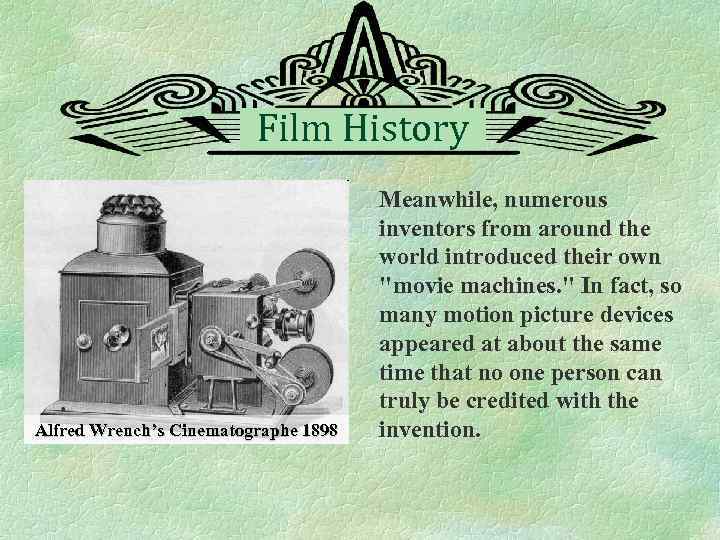
Film History Alfred Wrench’s Cinematographe 1898 Meanwhile, numerous inventors from around the world introduced their own "movie machines. " In fact, so many motion picture devices appeared at about the same time that no one person can truly be credited with the invention.
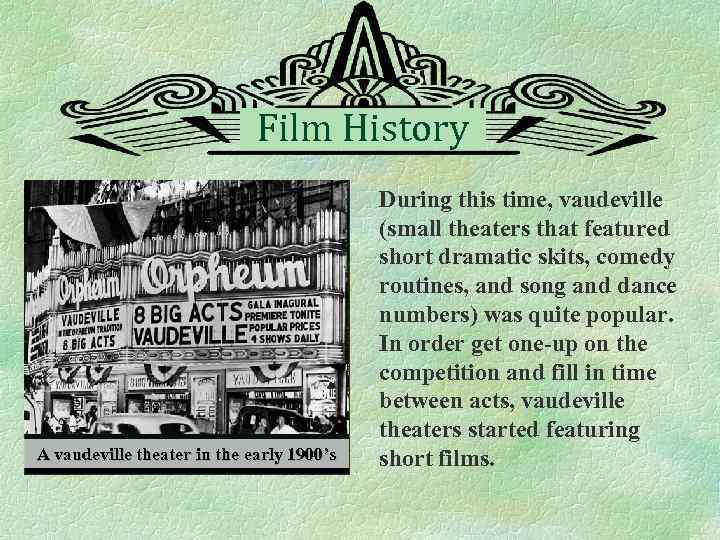
Film History A vaudeville theater in the early 1900’s During this time, vaudeville (small theaters that featured short dramatic skits, comedy routines, and song and dance numbers) was quite popular. In order get one-up on the competition and fill in time between acts, vaudeville theaters started featuring short films.
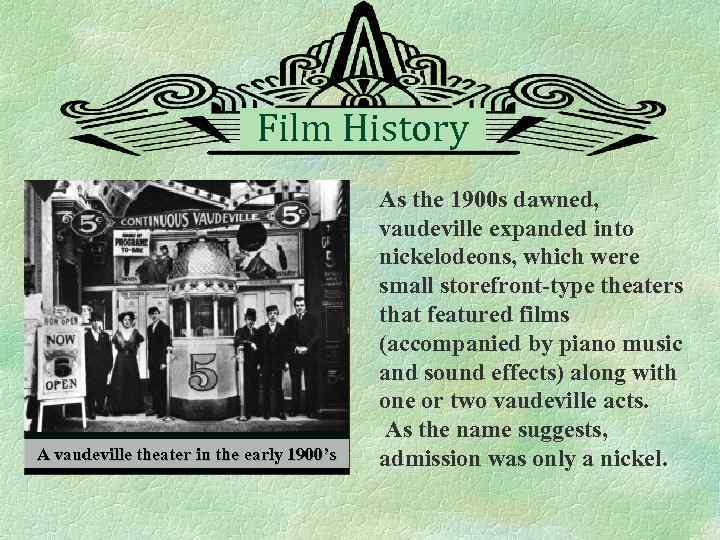
Film History A vaudeville theater in the early 1900’s As the 1900 s dawned, vaudeville expanded into nickelodeons, which were small storefront-type theaters that featured films (accompanied by piano music and sound effects) along with one or two vaudeville acts. As the name suggests, admission was only a nickel.
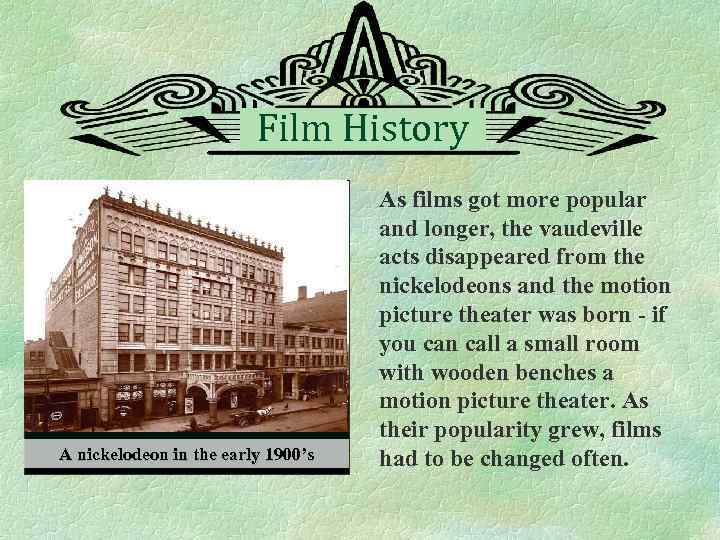
Film History A nickelodeon in the early 1900’s As films got more popular and longer, the vaudeville acts disappeared from the nickelodeons and the motion picture theater was born - if you can call a small room with wooden benches a motion picture theater. As their popularity grew, films had to be changed often.
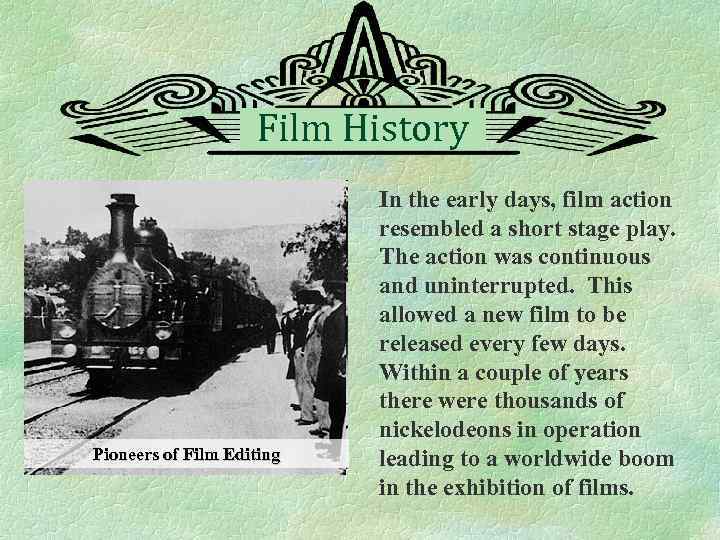
Film History Pioneers of Film Editing In the early days, film action resembled a short stage play. The action was continuous and uninterrupted. This allowed a new film to be released every few days. Within a couple of years there were thousands of nickelodeons in operation leading to a worldwide boom in the exhibition of films.
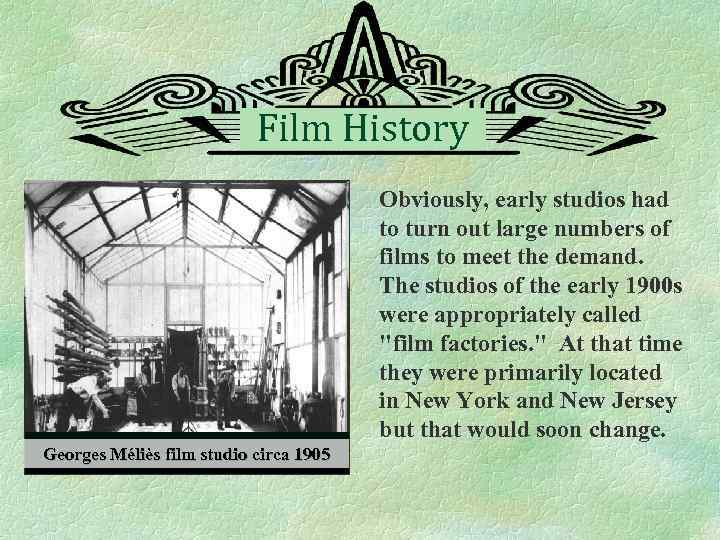
Film History Obviously, early studios had to turn out large numbers of films to meet the demand. The studios of the early 1900 s were appropriately called "film factories. " At that time they were primarily located in New York and New Jersey but that would soon change. Georges Méliès film studio circa 1905
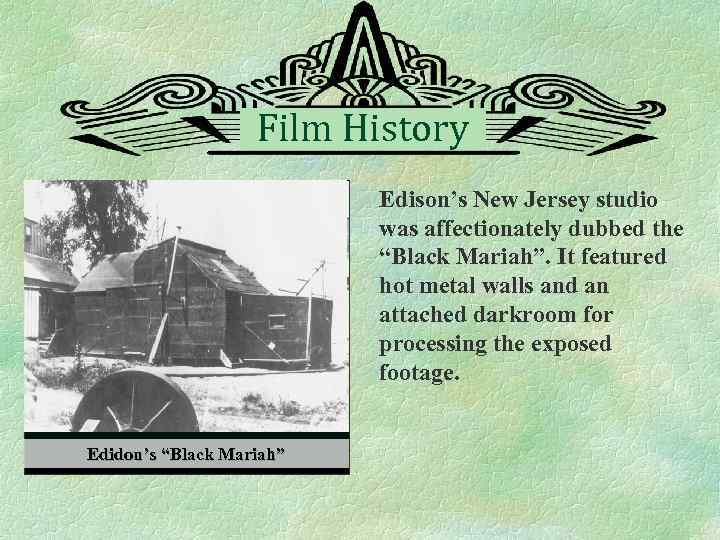
Film History Edison’s New Jersey studio was affectionately dubbed the “Black Mariah”. It featured hot metal walls and an attached darkroom for processing the exposed footage. Edidon’s “Black Mariah”
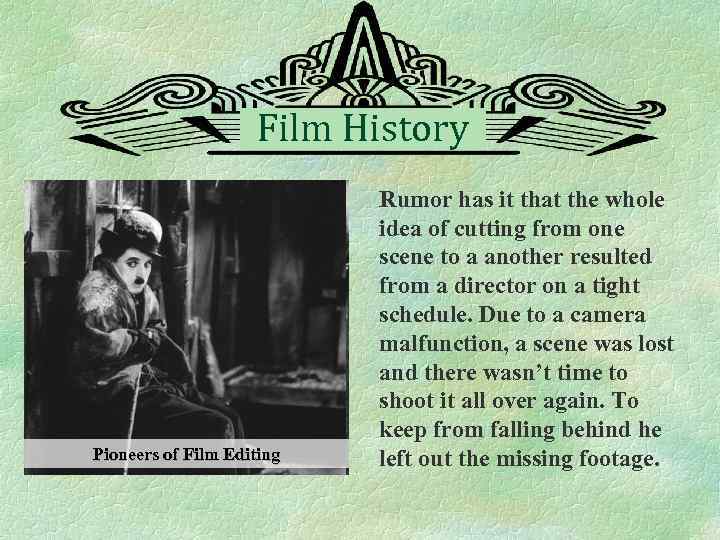
Film History Pioneers of Film Editing Rumor has it that the whole idea of cutting from one scene to a another resulted from a director on a tight schedule. Due to a camera malfunction, a scene was lost and there wasn’t time to shoot it all over again. To keep from falling behind he left out the missing footage.

Film History Pioneers of Film Editing After viewing "the mistake, " it was concluded that the "lost" footage wasn't really necessary and the jump in action actually speeded things along. By the late 1800 s, it was accepted practice to stop and reposition the camera and to cut directly to a totally different scene to tell a story.

Film History Pioneers of Film Editing In 1903, Edwin S. Porter, an employee of Thomas Edison, shot the first narrative film, The Great Train Robbery. The film featured a dramatic story line and cross cutting between different locations and camera angles. It had 14 scenes and lasted 12 minutes, making it an epic of its day.
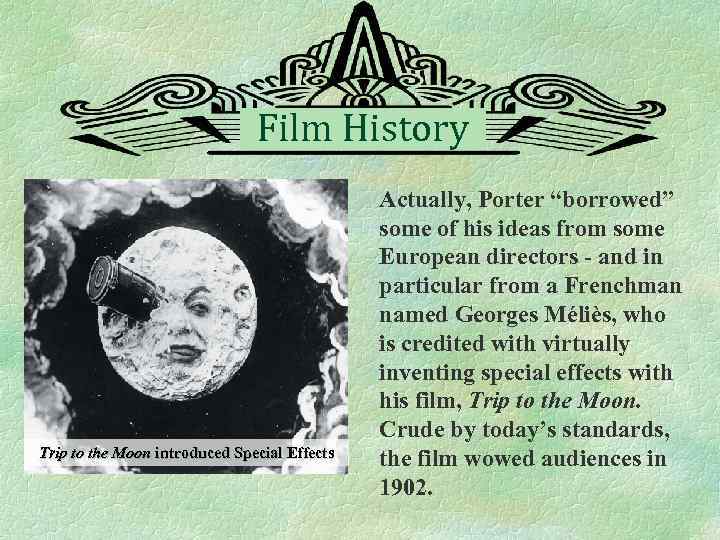
Film History Trip to the Moon introduced Special Effects Actually, Porter “borrowed” some of his ideas from some European directors - and in particular from a Frenchman named Georges Méliès, who is credited with virtually inventing special effects with his film, Trip to the Moon. Crude by today’s standards, the film wowed audiences in 1902.
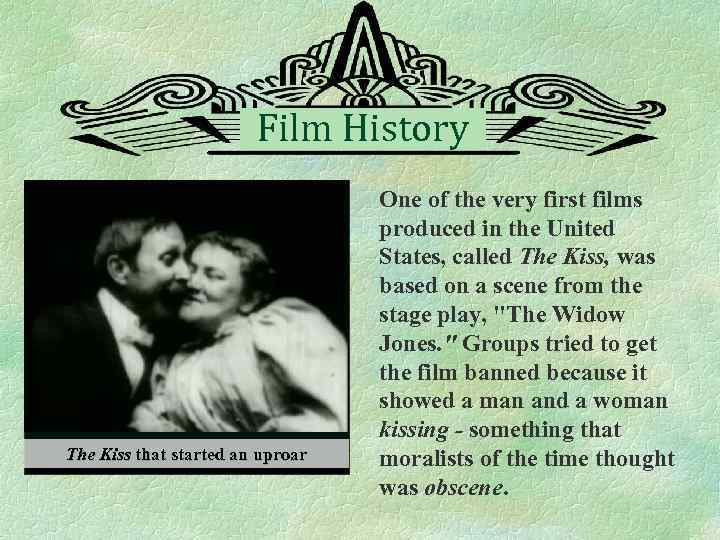
Film History The Kiss that started an uproar One of the very first films produced in the United States, called The Kiss, was based on a scene from the stage play, "The Widow Jones. " Groups tried to get the film banned because it showed a man and a woman kissing - something that moralists of the time thought was obscene.
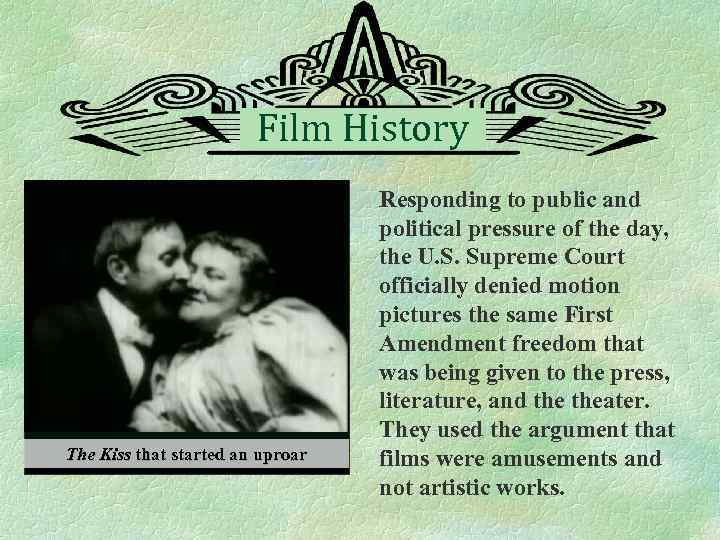
Film History The Kiss that started an uproar Responding to public and political pressure of the day, the U. S. Supreme Court officially denied motion pictures the same First Amendment freedom that was being given to the press, literature, and theater. They used the argument that films were amusements and not artistic works.
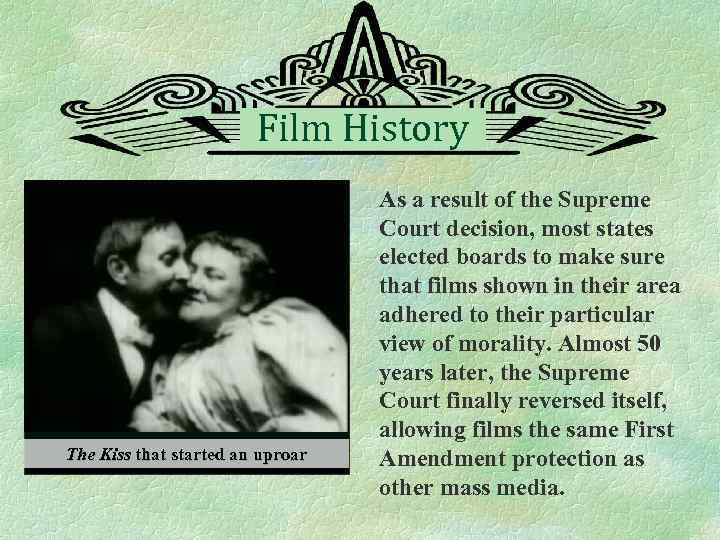
Film History The Kiss that started an uproar As a result of the Supreme Court decision, most states elected boards to make sure that films shown in their area adhered to their particular view of morality. Almost 50 years later, the Supreme Court finally reversed itself, allowing films the same First Amendment protection as other mass media.
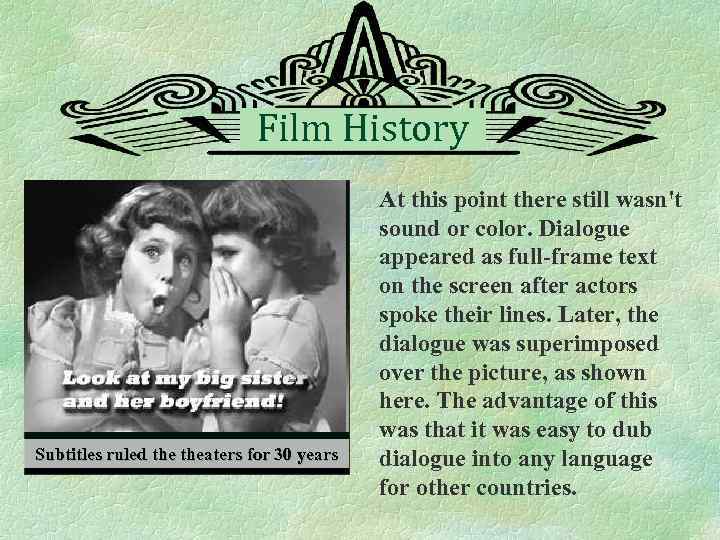
Film History Subtitles ruled theaters for 30 years At this point there still wasn't sound or color. Dialogue appeared as full-frame text on the screen after actors spoke their lines. Later, the dialogue was superimposed over the picture, as shown here. The advantage of this was that it was easy to dub dialogue into any language for other countries.
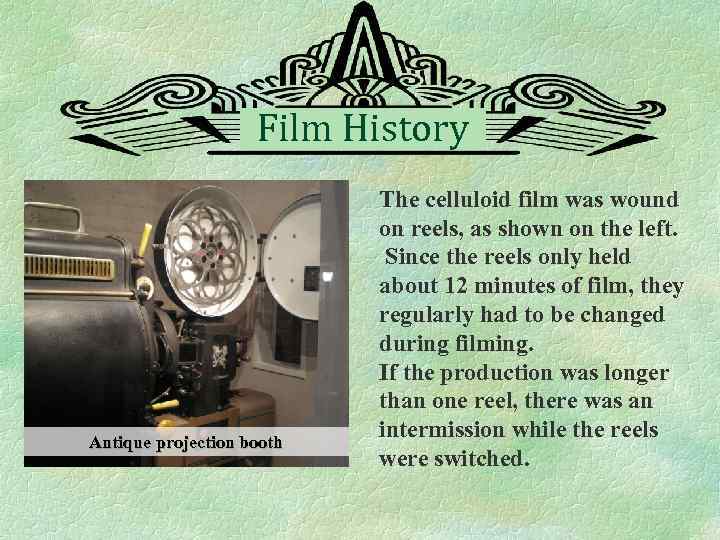
Film History Antique projection booth The celluloid film was wound on reels, as shown on the left. Since the reels only held about 12 minutes of film, they regularly had to be changed during filming. If the production was longer than one reel, there was an intermission while the reels were switched.
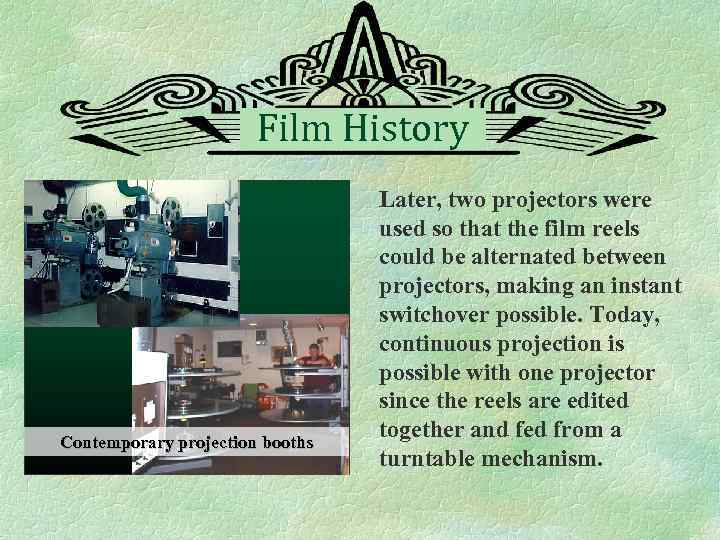
Film History Contemporary projection booths Later, two projectors were used so that the film reels could be alternated between projectors, making an instant switchover possible. Today, continuous projection is possible with one projector since the reels are edited together and fed from a turntable mechanism.
Скачать презентацию Film History Lecture prepared 11 07 09 by John M
Filmstory.ppt