 Скачать презентацию file format registries — a global infrastructure for
255cf803c1a92009c8f43ca3a80ca15f.ppt
- Количество слайдов: 14



file format registries - a global infrastructure for local persistence Andreas Aschenbrenner, ERPANET
overview • motivation • registry features • PRONOM • Global Digital Format Registry
the shared need "documentation for hardware and software. . . become increasing difficult (and in some cases prove impossible) to locate over time. A concerted effort should be undertaken to collect documentation, . . . " ( Ross, Gow: Digital Archaeology, 1999 ) "International cooperation on registration of file formats and their specifications should be supported, preferably through participation in development. " ( recommendation, Clausen: Handling File Formats. May 2004. ) Di. VA - Digital Scientific Archive Uppsala University Library, Sweden /.
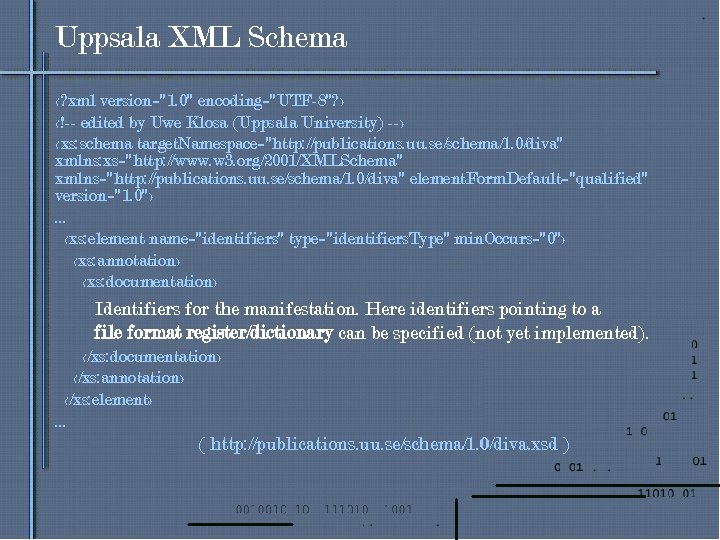
Uppsala XML Schema <? xml version="1. 0" encoding="UTF-8"? > <!-- edited by Uwe Klosa (Uppsala University) --> <xs: schema target. Namespace="http: //publications. uu. se/schema/1. 0/diva" xmlns: xs="http: //www. w 3. org/2001/XMLSchema" xmlns="http: //publications. uu. se/schema/1. 0/diva" element. Form. Default="qualified" version="1. 0">. . . <xs: element name="identifiers" type="identifiers. Type" min. Occurs="0"> <xs: annotation> <xs: documentation> Identifiers for the manifestation. Here identifiers pointing to a file format register/dictionary can be specified (not yet implemented). </xs: documentation> </xs: annotation> </xs: element>. . . ( http: //publications. uu. se/schema/1. 0/diva. xsd )
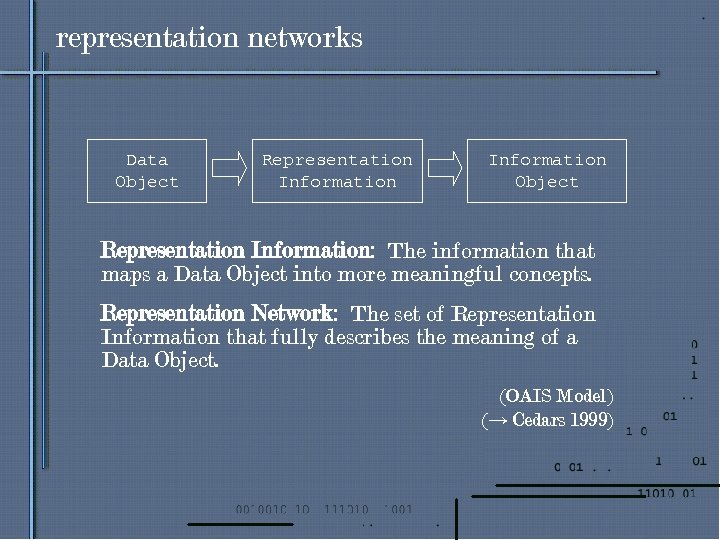
representation networks Data Object Representation Information: The information that maps a Data Object into more meaningful concepts. Representation Network: The set of Representation Information that fully describes the meaning of a Data Object. (OAIS Model) (→ Cedars 1999)
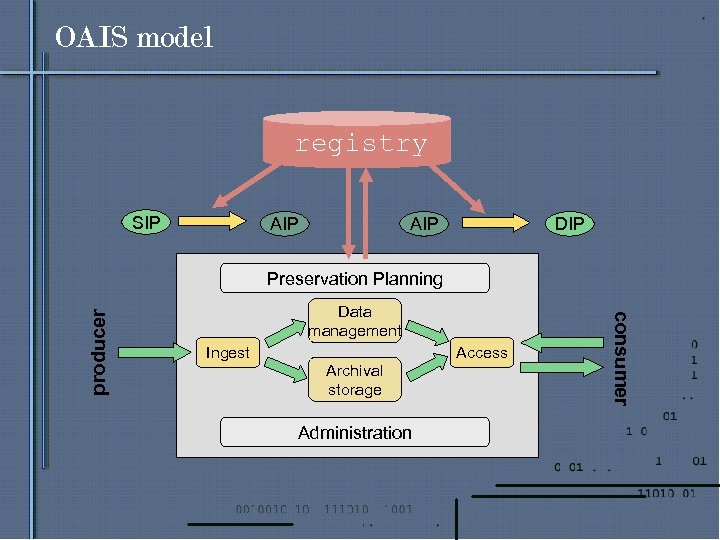
OAIS model registry SIP AIP Data management Ingest Archival storage Administration Access consumer producer Preservation Planning
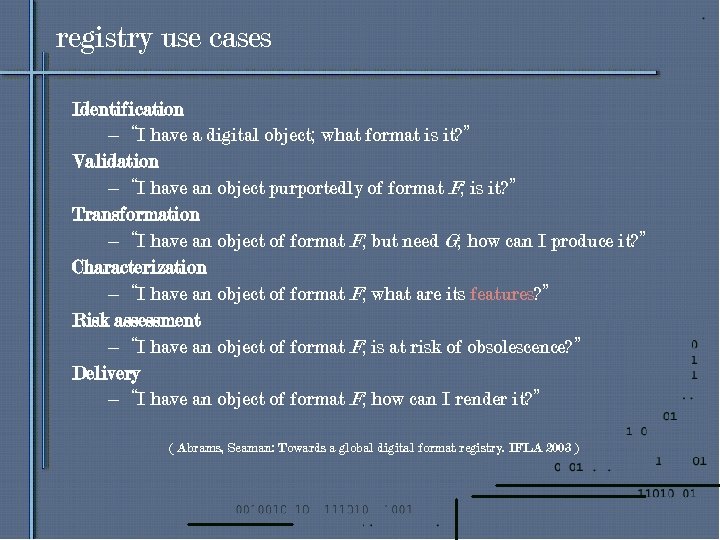
registry use cases Identification – “I have a digital object; what format is it? ” Validation – “I have an object purportedly of format F; is it? ” Transformation – “I have an object of format F, but need G; how can I produce it? ” Characterization – “I have an object of format F; what are its features? ” Risk assessment – “I have an object of format F; is at risk of obsolescence? ” Delivery – “I have an object of format F; how can I render it? ” ( Abrams, Seaman: Towards a global digital format registry. IFLA 2003 )
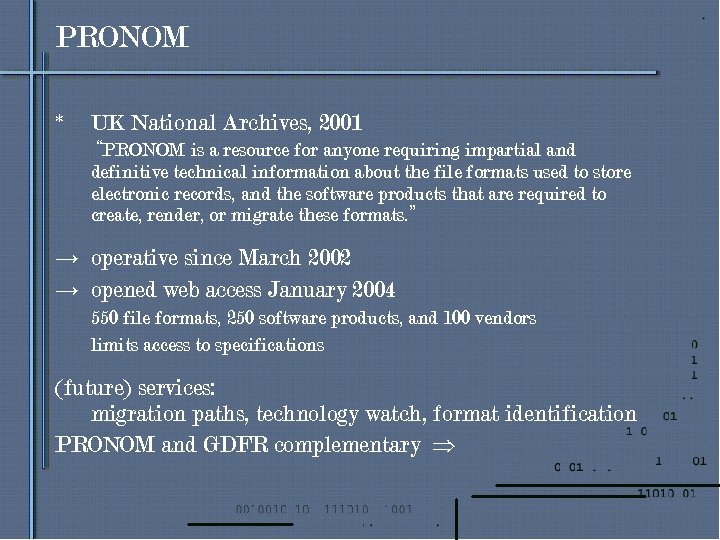
PRONOM * UK National Archives, 2001 “PRONOM is a resource for anyone requiring impartial and definitive technical information about the file formats used to store electronic records, and the software products that are required to create, render, or migrate these formats. ” → operative since March 2002 → opened web access January 2004 550 file formats, 250 software products, and 100 vendors limits access to specifications (future) services: migration paths, technology watch, format identification PRONOM and GDFR complementary
Global Digital Format Registry * Harvard and MIT, Summer 2002 mission statement: "The registry will maintain persistent, unambiguous bindings between public identifiers for digital formats and representation information for those formats. "
Global Digital Format Registry Ad-Hoc Committee Bibliothèque Nationale, France British Library California Digital Library Federation Harvard University IETF Internet Architecture Board JISC JSTOR Library of Congress MIT NARA National Archives of Canada National Archives, UK New York University NIST OCLC University of Pennsylvania RLG Stanford University
Global Digital Format Registry design and implementation phase funded through grants developed data model – descriptive: identifier, ontology, format relationships, – characterisation: specification document, signature operational phase must be trustworthy and sustainable how to populate and maintain registry? centralised vs distributed registry?
added value services conceivable for all use cases listed before and others more TOM - Typed Object Model model for identifying and describing data formats distributed system of ‘type brokers’ JHOVE identification, validation, characterisation extensible framework, plug-in architecture
conclusions • • • a format registry is an essential component of digital preservation solutions a shared concern of preservation initiatives world-wide operational model can build on myriad of existing expertise in adjacent areas (JHove, TOM, OASIS/eb. XML Registry Information Model, etc) • governance of an international registry is key; towards a trusted registry • collaborative registry could become core of an international infrastructure for digital preservation how to make the gears of the clockwork interconnect? → preservation metadata → unique, persistent identifiers for registry information •
further reading * Global Digital Format Registry (GDFR) http: //hul. harvard. edu/gdfr/ * PRONOM, UK National Archives: http: //www. records. pro. gov. uk/pronom/ * University of Pennsylvania Library, John Mark Ockerbloom: TOM - Typed Object Model: http: //tom. library. upenn. edu/ FRED - Format REgistry Demo. : http: //tom. library. upenn. edu/fred/ * JHOVE: http: //hul. harvard. edu/jhove/ * Abrams, Seaman: Towards a global digital format registry. 69 th IFLA 2003. http: //www. ifla. org/IV/ifla 69/papers/128 e-Abrams_Seaman. pdf * Stephen L. Abrams: Global Digital Format Registry. Presentation at RLG/CIMI “Ready to Wear” New York, May 12 -13, 2003. http: //www. rlg. org/events/metadata 2003/abrams. ppt * Representation and Rendering Project: File Format Report. 2003. http: //www. leeds. ac. uk/reprend/
Скачать презентацию file format registries — a global infrastructure for
255cf803c1a92009c8f43ca3a80ca15f.ppt