


 Скачать презентацию Figure 1 Roadmaps Reflect All the Plans Needs
7fd3a54c9d0b54568e714a29c95c856c.ppt
- Количество слайдов: 9
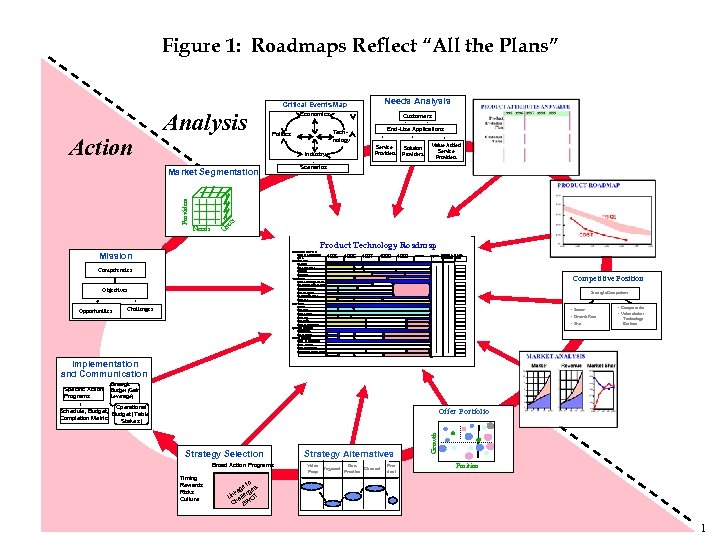 Figure 1: Roadmaps Reflect “All the Plans” Needs Analysis Critical Events Map Action Analysis Economics Customers End-Use Applications Technology Politics Service Providers Industry Value Added Service Providers Scenarios Needs Us er s Providers Market Segmentation Solution Providers Product Technology Roadmap Customer drivers Core technology Area Ease of use Display User interface Keypad Software Talk time Power management Baseband processing Microcontroller Mixed signal Memory devices Batteries Low cost Radio Antenna Power amp Housing Shielding PWB technology System design Standards Accessories Audio quality Voice recognition Voice coders DSP algorithms Transducers/microph. Mission Competencies Objectives Opportunities Challenges 1995 1996 1997 1998 1999 VISION Compet. Import. Position Techn. M/B Competitive Position Strategic Competitors • Sector • Growth Rate • Size • Competencies • Value chains: Technology Business Implementation and Communication Specific Action Programs Strategic Budget (Gain Leverage) Operational Schedule, Budget (Table Completion Metric Stakes) Strategy Selection Broad Action Programs Timing Rewards Risks Culture to es s, t ag ko , ge g n all sn Lie gee OT ka en h W Lin all. C OT S Ch SW Strategy Alternatives Value Bus. Segment Channel Prop Practice Product Growth Offer Portfolio Position 1
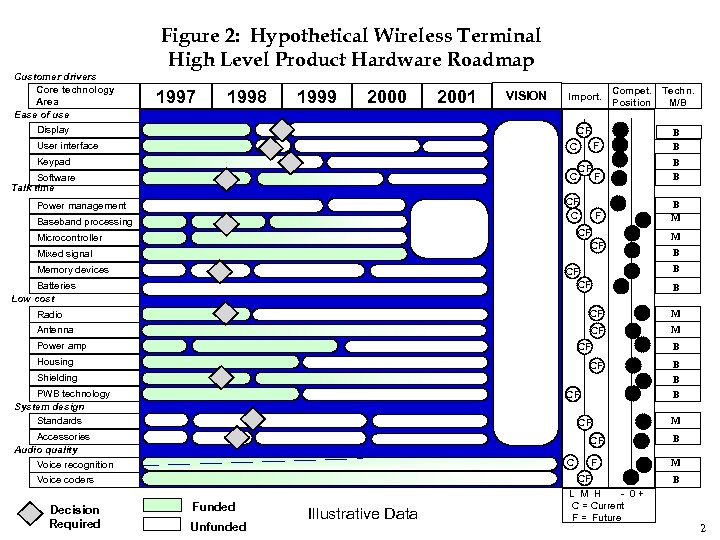 Customer drivers Core technology Area Ease of use Figure 2: Hypothetical Wireless Terminal High Level Product Hardware Roadmap 1997 1998 1999 2000 2001 VISION Import. Display Compet. Position CF User interface F C Software Talk time CF CF C Power management Baseband processing B B F C Keypad B M CF Microcontroller CF Mixed signal Memory devices CF CF Batteries Low cost Techn. M/B M B B B Radio CF M Antenna CF M Power amp CF Housing CF Shielding PWB technology System design Standards CF CF Accessories Audio quality B B B M CF C Voice recognition Voice coders Decision Required B B F M CF Funded Unfunded Illustrative Data L M H - 0+ C = Current F = Future B 2
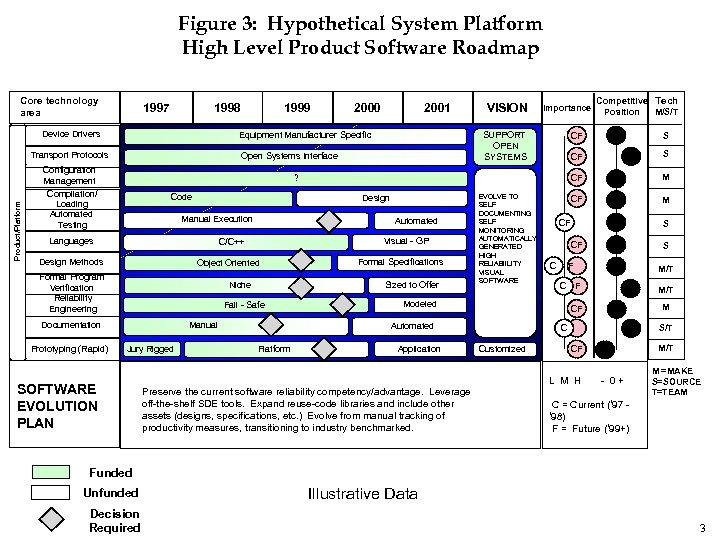 Figure 3: Hypothetical System Platform High Level Product Software Roadmap Core technology area 1997 1998 Device Drivers Product/Platform 2000 2001 Equipment Manufacturer Specific Transport Protocols VISION Importance SUPPORT OPEN SYSTEMS CF Design Manual Execution Languages Automated Visual - GP C/C++ Design Methods Object Oriented Formal Program Verification Reliability Engineering Niche Sized to Offer Fail - Safe Manual Documentation Jury Rigged SOFTWARE EVOLUTION PLAN Formal Specifications EVOLVE TO SELF DOCUMENTING SELF MONITORING AUTOMATICALLY GENERATED HIGH RELIABIILITY VISUAL SOFTWARE Modeled Application Preserve the current software reliability competency/advantage. Leverage off-the-shelf SDE tools. Expand reuse-code libraries and include other assets (designs, specifications, etc. ) Evolve from manual tracking of productivity measures, transitioning to industry benchmarked. S M CF S CF C S F M/T C F M/T M CF Automated Platform S CF ? Code Competitive Tech Position M/S/T CF Open Systems Interface Configuration Management Compilation/ Loading Automated Testing Prototyping (Rapid) 1999 S/T CF Customized M/T CF L M H - 0+ M =MAKE S=SOURCE T=TEAM C = Current (‘ 97 ‘ 98) F = Future (‘ 99+) Funded Unfunded Decision Required Illustrative Data 3
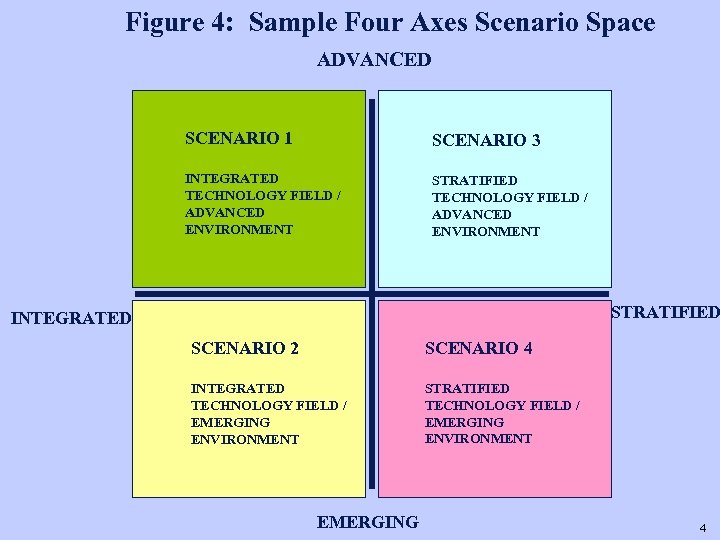 Figure 4: Sample Four Axes Scenario Space ADVANCED SCENARIO 1 SCENARIO 3 INTEGRATED TECHNOLOGY FIELD / ADVANCED ENVIRONMENT STRATIFIED INTEGRATED SCENARIO 2 SCENARIO 4 INTEGRATED TECHNOLOGY FIELD / EMERGING ENVIRONMENT STRATIFIED TECHNOLOGY FIELD / EMERGING ENVIRONMENT EMERGING 4
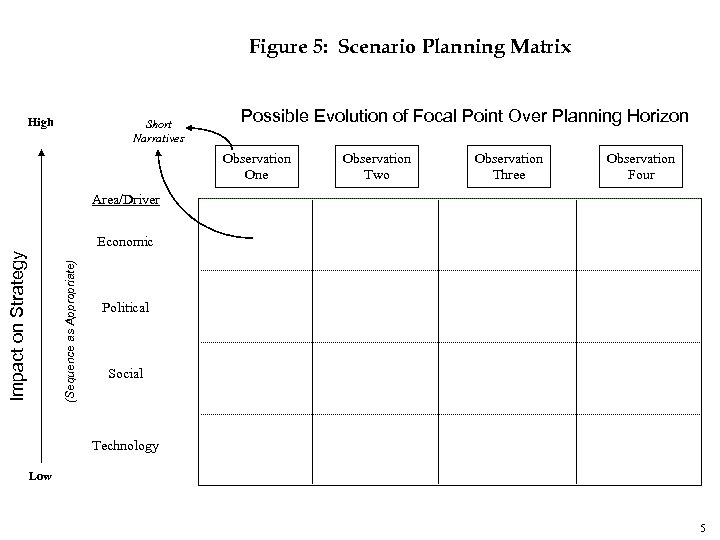 Figure 5: Scenario Planning Matrix High Short Narratives Possible Evolution of Focal Point Over Planning Horizon Observation One Observation Two Observation Three Observation Four Area/Driver (Sequence as Appropriate) Impact on Strategy Economic Political Social Technology Low 5
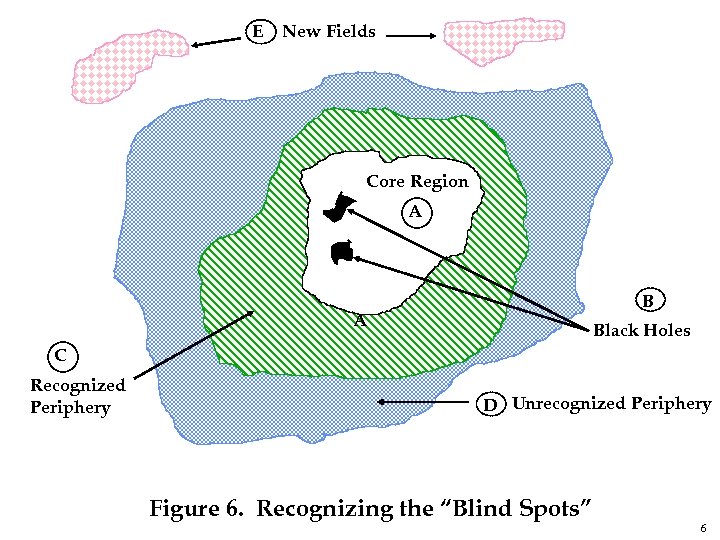 E New Fields Core Region A B A Black Holes C Recognized Periphery D Unrecognized Periphery Figure 6. Recognizing the “Blind Spots” 6
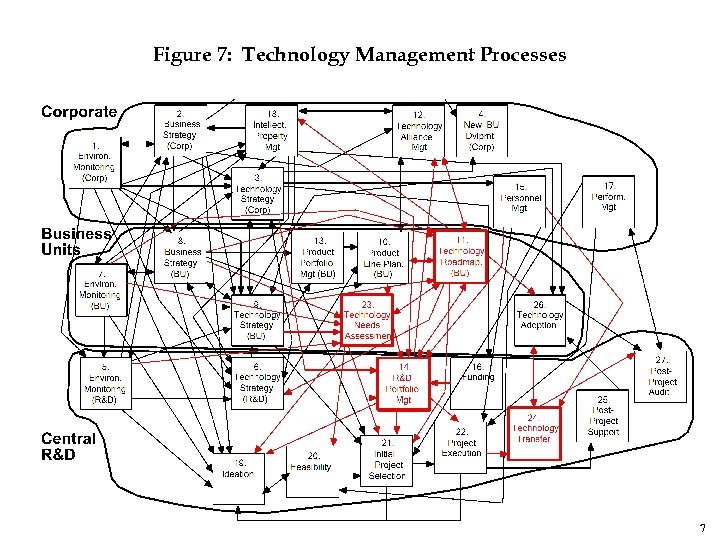 Figure 7: Technology Management Processes 7
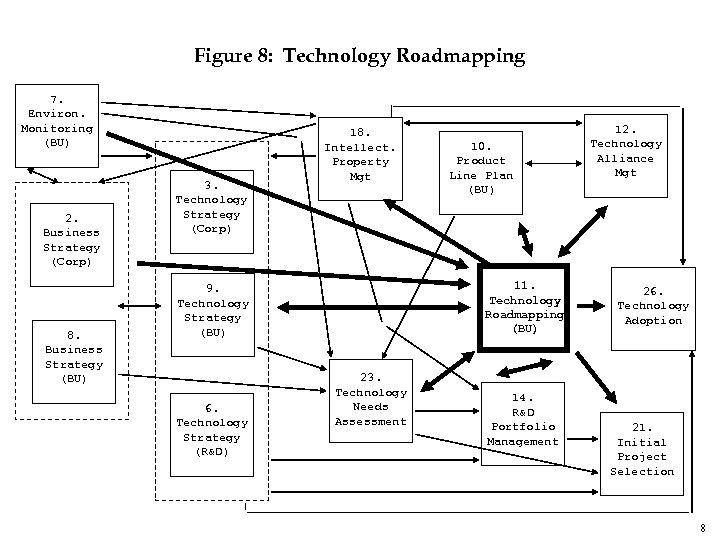 Figure 8: Technology Roadmapping 7. Environ. Monitoring (BU) 2. Business Strategy (Corp) 8. Business Strategy (BU) 3. Technology Strategy (Corp) 18. Intellect. Property Mgt 11. Technology Roadmapping (BU) 9. Technology Strategy (BU) 6. Technology Strategy (R&D) 10. Product Line Plan (BU) 23. Technology Needs Assessment 14. R&D Portfolio Management 12. Technology Alliance Mgt 26. Technology Adoption 21. Initial Project Selection 8
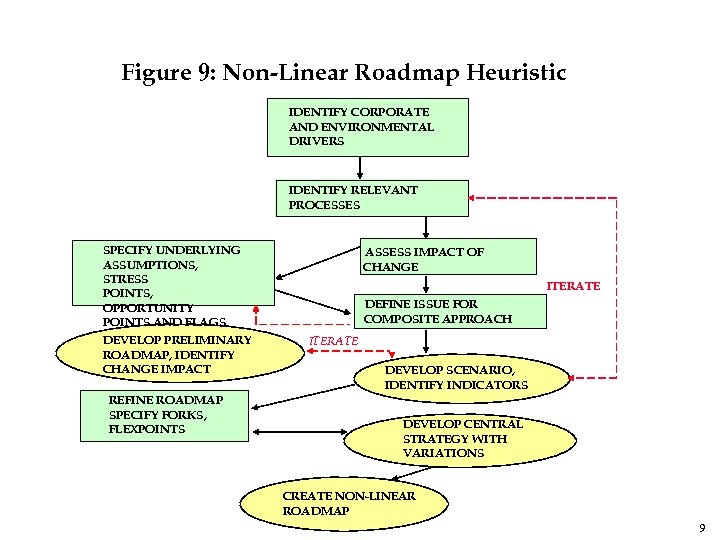 Figure 9: Non-Linear Roadmap Heuristic IDENTIFY CORPORATE AND ENVIRONMENTAL DRIVERS IDENTIFY RELEVANT PROCESSES SPECIFY UNDERLYING ASSUMPTIONS, STRESS POINTS, OPPORTUNITY POINTS AND FLAGS DEVELOP PRELIMINARY ROADMAP, IDENTIFY CHANGE IMPACT REFINE ROADMAP SPECIFY FORKS, FLEXPOINTS ASSESS IMPACT OF CHANGE ITERATE DEFINE ISSUE FOR COMPOSITE APPROACH ITERATE DEVELOP SCENARIO, IDENTIFY INDICATORS DEVELOP CENTRAL STRATEGY WITH VARIATIONS CREATE NON-LINEAR ROADMAP 9