


 Скачать презентацию Figure 1 46 Million Uninsured in 2008 Increase
93e84822648bfad7906e646fc196a548.ppt
- Количество слайдов: 28
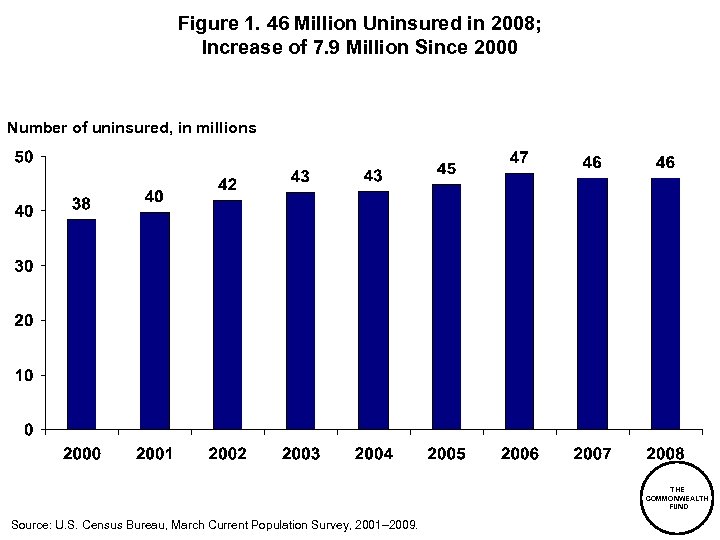 Figure 1. 46 Million Uninsured in 2008; Increase of 7. 9 Million Since 2000 Number of uninsured, in millions THE COMMONWEALTH FUND Source: U. S. Census Bureau, March Current Population Survey, 2001– 2009.
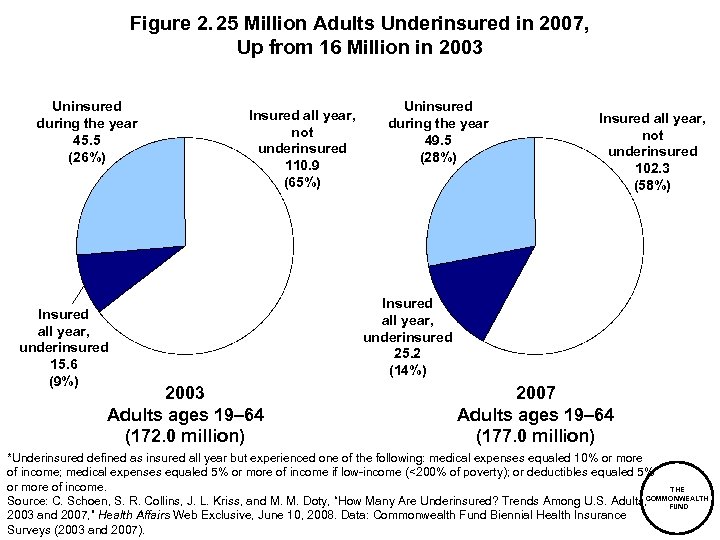 Figure 2. 25 Million Adults Underinsured in 2007, Up from 16 Million in 2003 Uninsured during the year 45. 5 (26%) Insured all year, underinsured 15. 6 (9%) Insured all year, not underinsured 110. 9 (65%) 2003 Adults ages 19– 64 (172. 0 million) Uninsured during the year 49. 5 (28%) Insured all year, not underinsured 102. 3 (58%) Insured all year, underinsured 25. 2 (14%) 2007 Adults ages 19– 64 (177. 0 million) *Underinsured defined as insured all year but experienced one of the following: medical expenses equaled 10% or more of income; medical expenses equaled 5% or more of income if low-income (<200% of poverty); or deductibles equaled 5% or more of income. THE Source: C. Schoen, S. R. Collins, J. L. Kriss, and M. M. Doty, “How Many Are Underinsured? Trends Among U. S. Adults, COMMONWEALTH FUND 2003 and 2007, ” Health Affairs Web Exclusive, June 10, 2008. Data: Commonwealth Fund Biennial Health Insurance Surveys (2003 and 2007).
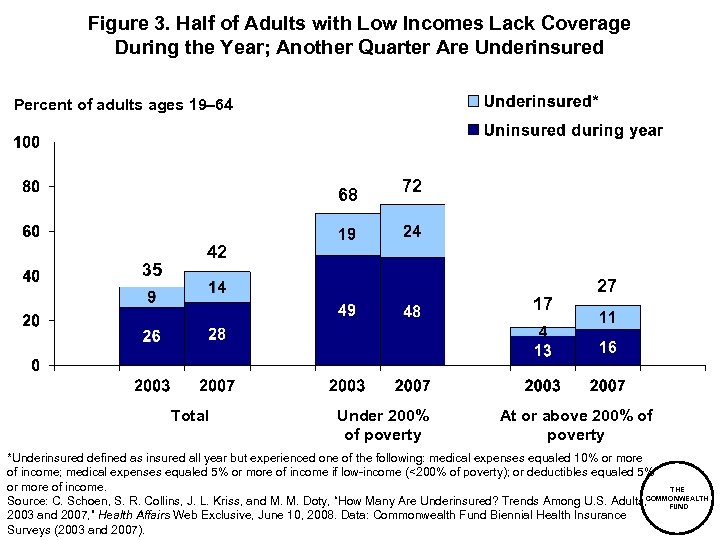 Figure 3. Half of Adults with Low Incomes Lack Coverage During the Year; Another Quarter Are Underinsured Percent of adults ages 19– 64 68 35 72 42 17 Total Under 200% of poverty 27 At or above 200% of poverty *Underinsured defined as insured all year but experienced one of the following: medical expenses equaled 10% or more of income; medical expenses equaled 5% or more of income if low-income (<200% of poverty); or deductibles equaled 5% or more of income. THE Source: C. Schoen, S. R. Collins, J. L. Kriss, and M. M. Doty, “How Many Are Underinsured? Trends Among U. S. Adults, COMMONWEALTH FUND 2003 and 2007, ” Health Affairs Web Exclusive, June 10, 2008. Data: Commonwealth Fund Biennial Health Insurance Surveys (2003 and 2007).
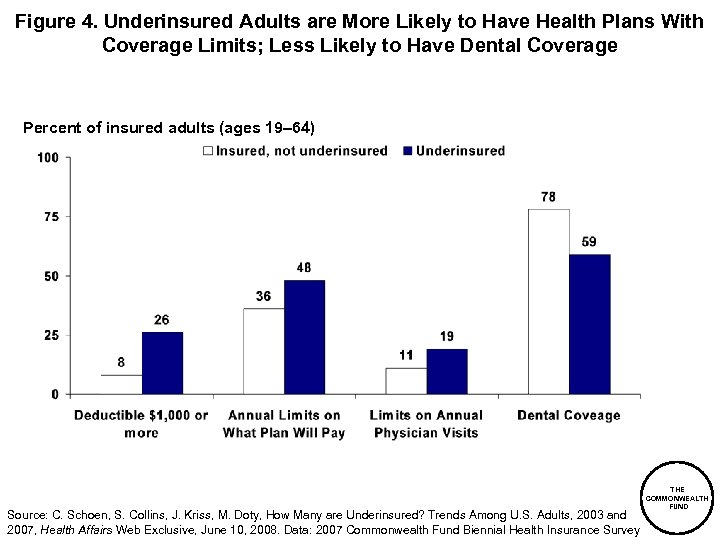 Figure 4. Underinsured Adults are More Likely to Have Health Plans With Coverage Limits; Less Likely to Have Dental Coverage Percent of insured adults (ages 19– 64) Source: C. Schoen, S. Collins, J. Kriss, M. Doty, How Many are Underinsured? Trends Among U. S. Adults, 2003 and 2007, Health Affairs Web Exclusive, June 10, 2008. Data: 2007 Commonwealth Fund Biennial Health Insurance Survey THE COMMONWEALTH FUND
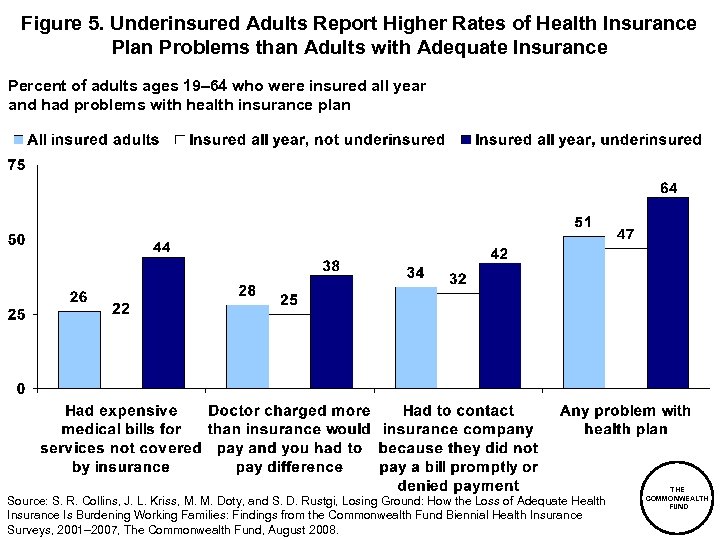 Figure 5. Underinsured Adults Report Higher Rates of Health Insurance Plan Problems than Adults with Adequate Insurance Percent of adults ages 19– 64 who were insured all year and had problems with health insurance plan Source: S. R. Collins, J. L. Kriss, M. M. Doty, and S. D. Rustgi, Losing Ground: How the Loss of Adequate Health Insurance Is Burdening Working Families: Findings from the Commonwealth Fund Biennial Health Insurance Surveys, 2001– 2007, The Commonwealth Fund, August 2008. THE COMMONWEALTH FUND
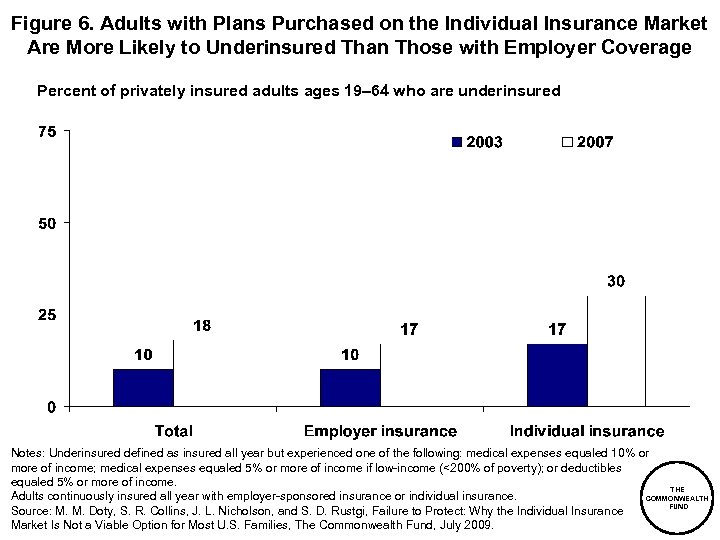 Figure 6. Adults with Plans Purchased on the Individual Insurance Market Are More Likely to Underinsured Than Those with Employer Coverage Percent of privately insured adults ages 19– 64 who are underinsured Notes: Underinsured defined as insured all year but experienced one of the following: medical expenses equaled 10% or more of income; medical expenses equaled 5% or more of income if low-income (<200% of poverty); or deductibles equaled 5% or more of income. THE Adults continuously insured all year with employer-sponsored insurance or individual insurance. COMMONWEALTH FUND Source: M. M. Doty, S. R. Collins, J. L. Nicholson, and S. D. Rustgi, Failure to Protect: Why the Individual Insurance Market Is Not a Viable Option for Most U. S. Families, The Commonwealth Fund, July 2009.
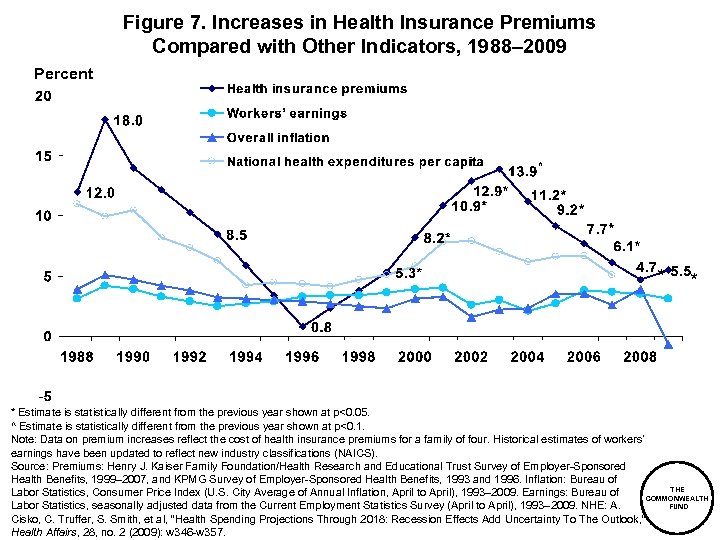 Figure 7. Increases in Health Insurance Premiums Compared with Other Indicators, 1988– 2009 Percent * * * Estimate is statistically different from the previous year shown at p<0. 05. ^ Estimate is statistically different from the previous year shown at p<0. 1. Note: Data on premium increases reflect the cost of health insurance premiums for a family of four. Historical estimates of workers’ earnings have been updated to reflect new industry classifications (NAICS). Source: Premiums: Henry J. Kaiser Family Foundation/Health Research and Educational Trust Survey of Employer-Sponsored Health Benefits, 1999– 2007, and KPMG Survey of Employer-Sponsored Health Benefits, 1993 and 1996. Inflation: Bureau of THE Labor Statistics, Consumer Price Index (U. S. City Average of Annual Inflation, April to April), 1993– 2009. Earnings: Bureau of COMMONWEALTH FUND Labor Statistics, seasonally adjusted data from the Current Employment Statistics Survey (April to April), 1993– 2009. NHE: A. Cisko, C. Truffer, S. Smith, et al, “Health Spending Projections Through 2018: Recession Effects Add Uncertainty To The Outlook, ” Health Affairs, 28, no. 2 (2009): w 346 -w 357.
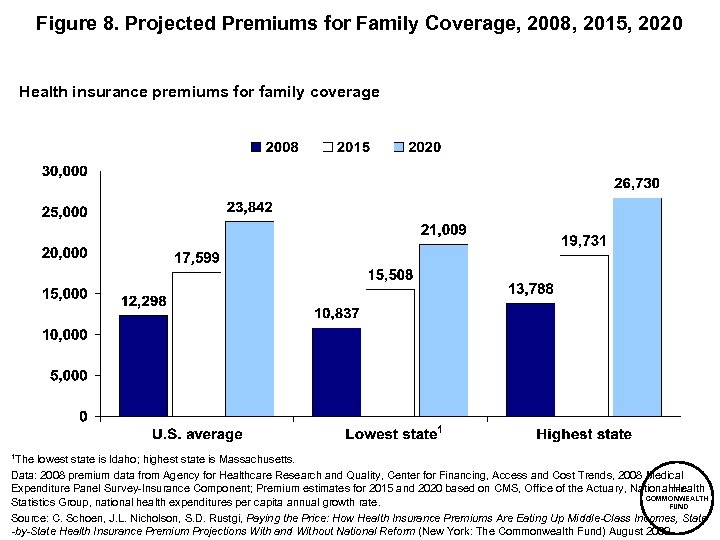 Figure 8. Projected Premiums for Family Coverage, 2008, 2015, 2020 Health insurance premiums for family coverage 1 1 The lowest state is Idaho; highest state is Massachusetts. Data: 2008 premium data from Agency for Healthcare Research and Quality, Center for Financing, Access and Cost Trends, 2008 Medical Expenditure Panel Survey-Insurance Component; Premium estimates for 2015 and 2020 based on CMS, Office of the Actuary, National. THE Health COMMONWEALTH Statistics Group, national health expenditures per capita annual growth rate. FUND Source: C. Schoen, J. L. Nicholson, S. D. Rustgi, Paying the Price: How Health Insurance Premiums Are Eating Up Middle-Class Incomes, State -by-State Health Insurance Premium Projections With and Without National Reform (New York: The Commonwealth Fund) August 2009.
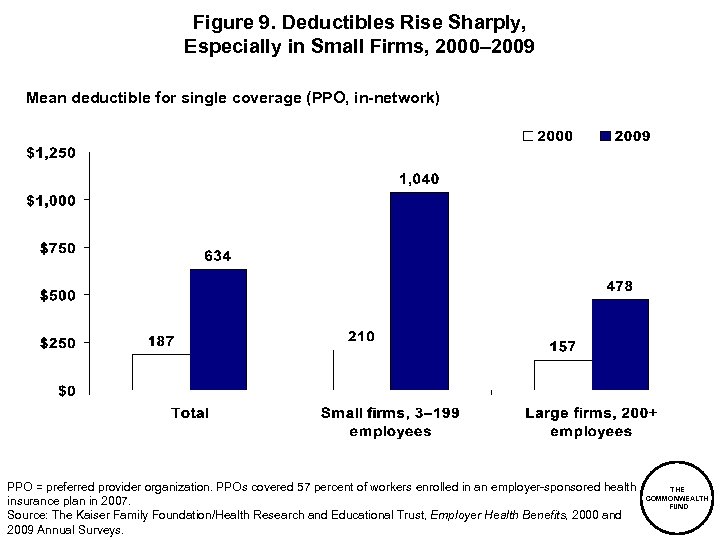 Figure 9. Deductibles Rise Sharply, Especially in Small Firms, 2000– 2009 Mean deductible for single coverage (PPO, in-network) PPO = preferred provider organization. PPOs covered 57 percent of workers enrolled in an employer-sponsored health insurance plan in 2007. Source: The Kaiser Family Foundation/Health Research and Educational Trust, Employer Health Benefits, 2000 and 2009 Annual Surveys. THE COMMONWEALTH FUND
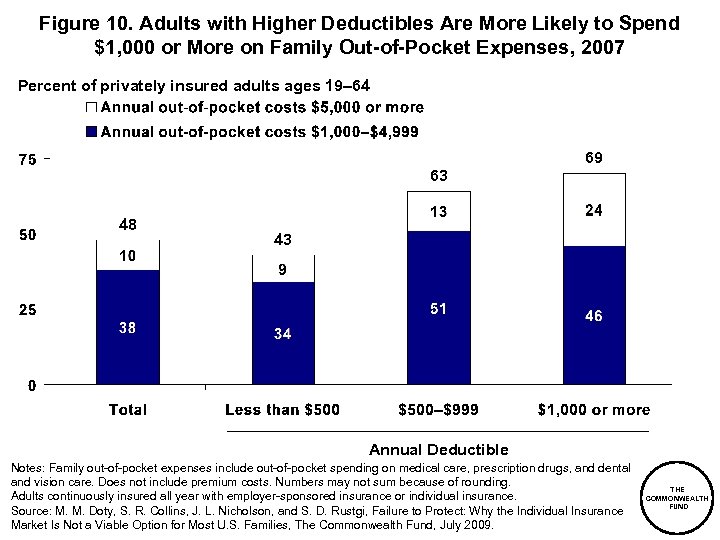 Figure 10. Adults with Higher Deductibles Are More Likely to Spend $1, 000 or More on Family Out-of-Pocket Expenses, 2007 Percent of privately insured adults ages 19– 64 69 63 48 43 Annual Deductible Notes: Family out-of-pocket expenses include out-of-pocket spending on medical care, prescription drugs, and dental and vision care. Does not include premium costs. Numbers may not sum because of rounding. Adults continuously insured all year with employer-sponsored insurance or individual insurance. Source: M. M. Doty, S. R. Collins, J. L. Nicholson, and S. D. Rustgi, Failure to Protect: Why the Individual Insurance Market Is Not a Viable Option for Most U. S. Families, The Commonwealth Fund, July 2009. THE COMMONWEALTH FUND
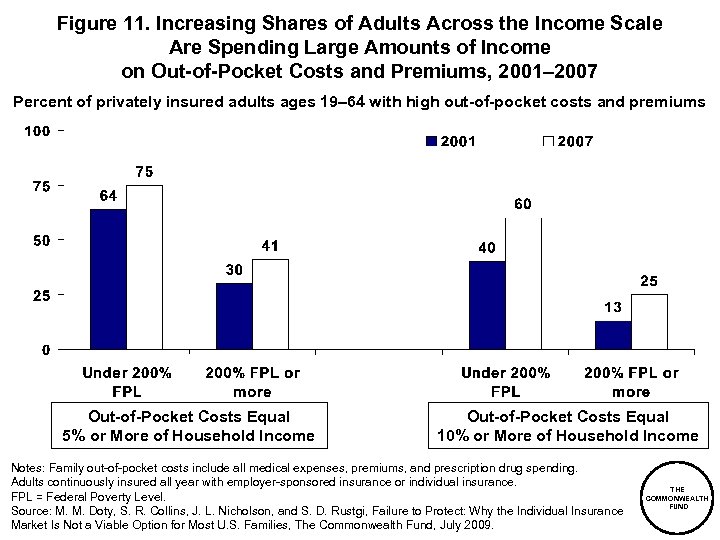 Figure 11. Increasing Shares of Adults Across the Income Scale Are Spending Large Amounts of Income on Out-of-Pocket Costs and Premiums, 2001– 2007 Percent of privately insured adults ages 19– 64 with high out-of-pocket costs and premiums Out-of-Pocket Costs Equal 5% or More of Household Income Out-of-Pocket Costs Equal 10% or More of Household Income Notes: Family out-of-pocket costs include all medical expenses, premiums, and prescription drug spending. Adults continuously insured all year with employer-sponsored insurance or individual insurance. FPL = Federal Poverty Level. Source: M. M. Doty, S. R. Collins, J. L. Nicholson, and S. D. Rustgi, Failure to Protect: Why the Individual Insurance Market Is Not a Viable Option for Most U. S. Families, The Commonwealth Fund, July 2009. THE COMMONWEALTH FUND
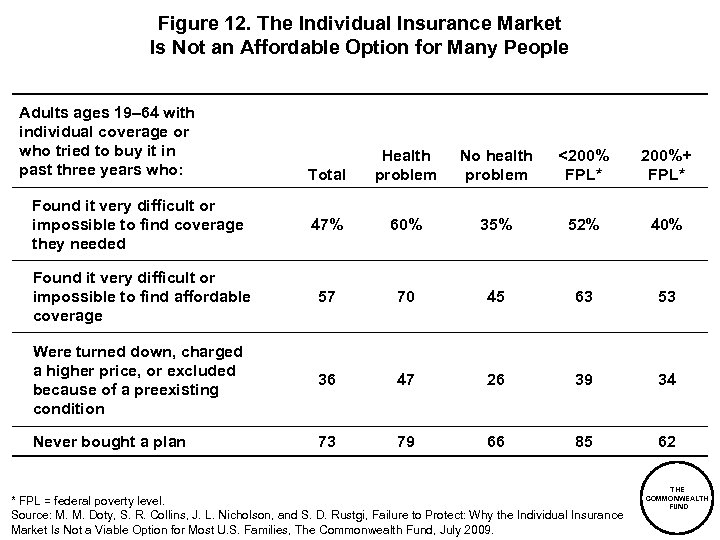 Figure 12. The Individual Insurance Market Is Not an Affordable Option for Many People Adults ages 19– 64 with individual coverage or who tried to buy it in past three years who: Total Health problem No health problem <200% FPL* 200%+ FPL* Found it very difficult or impossible to find coverage they needed 47% 60% 35% 52% 40% Found it very difficult or impossible to find affordable coverage 57 70 45 63 53 Were turned down, charged a higher price, or excluded because of a preexisting condition 36 47 26 39 34 Never bought a plan 73 79 66 85 62 * FPL = federal poverty level. Source: M. M. Doty, S. R. Collins, J. L. Nicholson, and S. D. Rustgi, Failure to Protect: Why the Individual Insurance Market Is Not a Viable Option for Most U. S. Families, The Commonwealth Fund, July 2009. THE COMMONWEALTH FUND
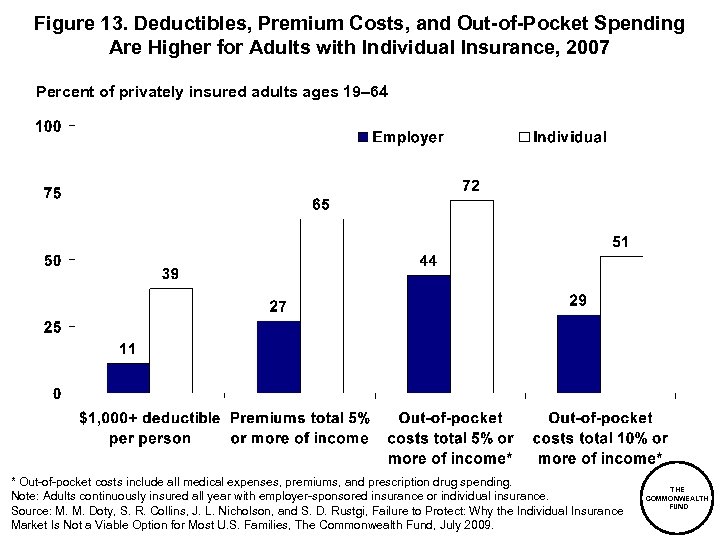 Figure 13. Deductibles, Premium Costs, and Out-of-Pocket Spending Are Higher for Adults with Individual Insurance, 2007 Percent of privately insured adults ages 19– 64 * Out-of-pocket costs include all medical expenses, premiums, and prescription drug spending. Note: Adults continuously insured all year with employer-sponsored insurance or individual insurance. Source: M. M. Doty, S. R. Collins, J. L. Nicholson, and S. D. Rustgi, Failure to Protect: Why the Individual Insurance Market Is Not a Viable Option for Most U. S. Families, The Commonwealth Fund, July 2009. THE COMMONWEALTH FUND
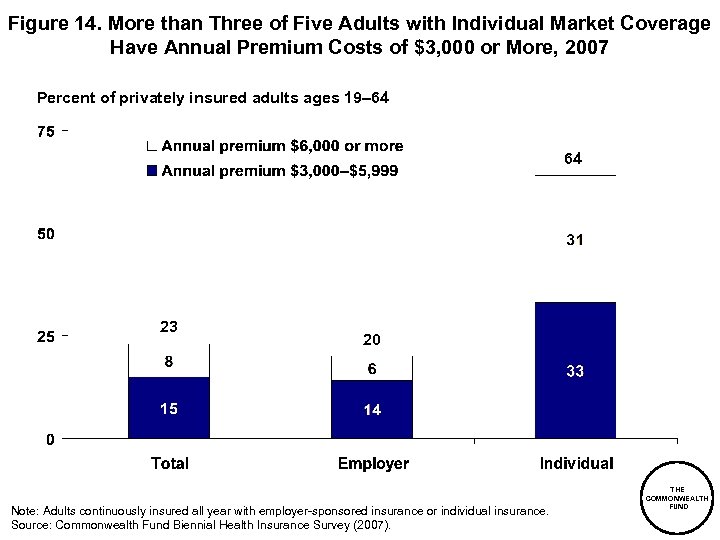 Figure 14. More than Three of Five Adults with Individual Market Coverage Have Annual Premium Costs of $3, 000 or More, 2007 Percent of privately insured adults ages 19– 64 64 23 20 Note: Adults continuously insured all year with employer-sponsored insurance or individual insurance. Source: Commonwealth Fund Biennial Health Insurance Survey (2007). THE COMMONWEALTH FUND
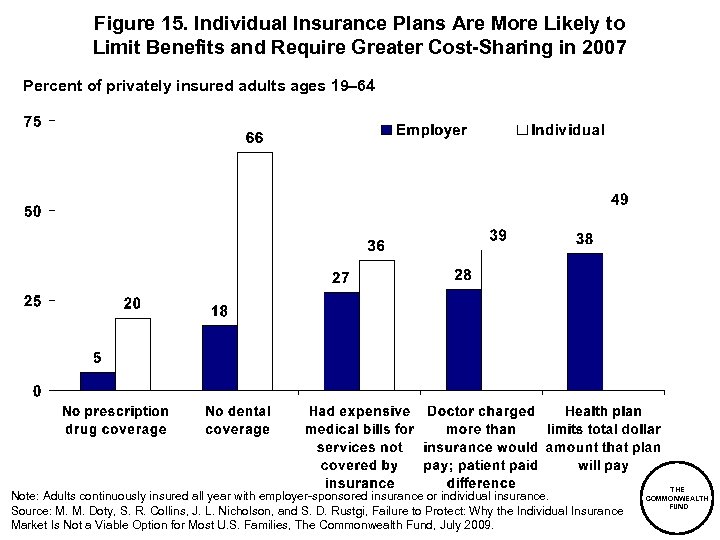 Figure 15. Individual Insurance Plans Are More Likely to Limit Benefits and Require Greater Cost-Sharing in 2007 Percent of privately insured adults ages 19– 64 Note: Adults continuously insured all year with employer-sponsored insurance or individual insurance. Source: M. M. Doty, S. R. Collins, J. L. Nicholson, and S. D. Rustgi, Failure to Protect: Why the Individual Insurance Market Is Not a Viable Option for Most U. S. Families, The Commonwealth Fund, July 2009. THE COMMONWEALTH FUND
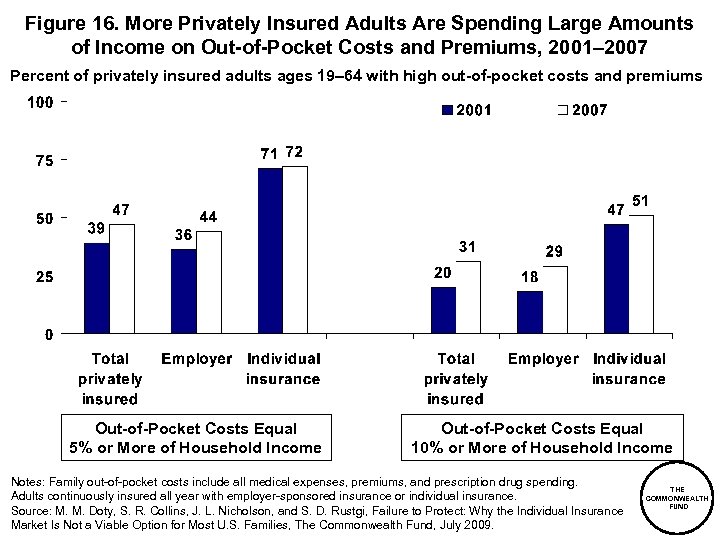 Figure 16. More Privately Insured Adults Are Spending Large Amounts of Income on Out-of-Pocket Costs and Premiums, 2001– 2007 Percent of privately insured adults ages 19– 64 with high out-of-pocket costs and premiums Out-of-Pocket Costs Equal 5% or More of Household Income Out-of-Pocket Costs Equal 10% or More of Household Income Notes: Family out-of-pocket costs include all medical expenses, premiums, and prescription drug spending. Adults continuously insured all year with employer-sponsored insurance or individual insurance. Source: M. M. Doty, S. R. Collins, J. L. Nicholson, and S. D. Rustgi, Failure to Protect: Why the Individual Insurance Market Is Not a Viable Option for Most U. S. Families, The Commonwealth Fund, July 2009. THE COMMONWEALTH FUND
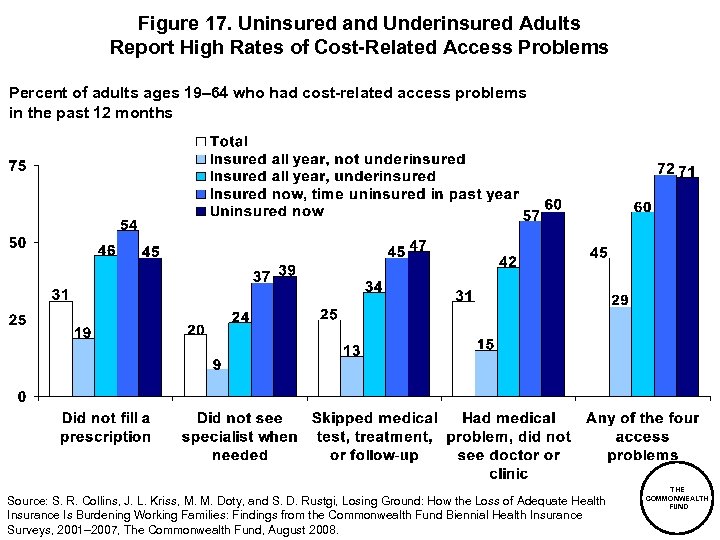 Figure 17. Uninsured and Underinsured Adults Report High Rates of Cost-Related Access Problems Percent of adults ages 19– 64 who had cost-related access problems in the past 12 months Source: S. R. Collins, J. L. Kriss, M. M. Doty, and S. D. Rustgi, Losing Ground: How the Loss of Adequate Health Insurance Is Burdening Working Families: Findings from the Commonwealth Fund Biennial Health Insurance Surveys, 2001– 2007, The Commonwealth Fund, August 2008. THE COMMONWEALTH FUND
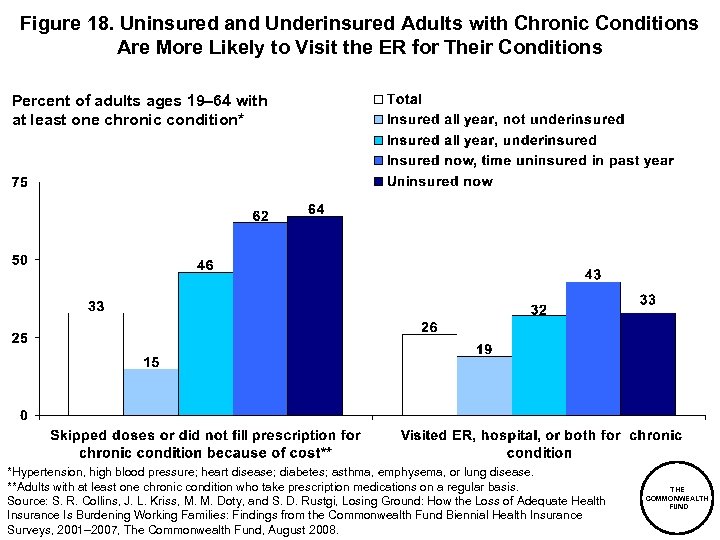 Figure 18. Uninsured and Underinsured Adults with Chronic Conditions Are More Likely to Visit the ER for Their Conditions Percent of adults ages 19– 64 with at least one chronic condition* *Hypertension, high blood pressure; heart disease; diabetes; asthma, emphysema, or lung disease. **Adults with at least one chronic condition who take prescription medications on a regular basis. Source: S. R. Collins, J. L. Kriss, M. M. Doty, and S. D. Rustgi, Losing Ground: How the Loss of Adequate Health Insurance Is Burdening Working Families: Findings from the Commonwealth Fund Biennial Health Insurance Surveys, 2001– 2007, The Commonwealth Fund, August 2008. THE COMMONWEALTH FUND
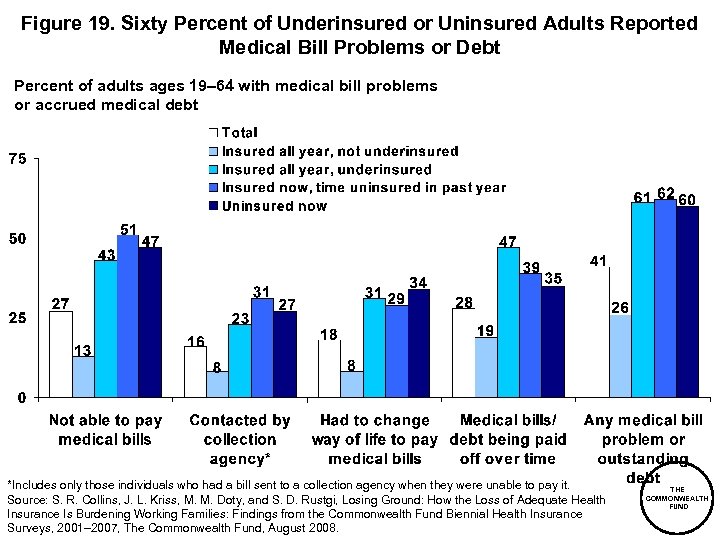 Figure 19. Sixty Percent of Underinsured or Uninsured Adults Reported Medical Bill Problems or Debt Percent of adults ages 19– 64 with medical bill problems or accrued medical debt *Includes only those individuals who had a bill sent to a collection agency when they were unable to pay it. Source: S. R. Collins, J. L. Kriss, M. M. Doty, and S. D. Rustgi, Losing Ground: How the Loss of Adequate Health Insurance Is Burdening Working Families: Findings from the Commonwealth Fund Biennial Health Insurance Surveys, 2001– 2007, The Commonwealth Fund, August 2008. THE COMMONWEALTH FUND
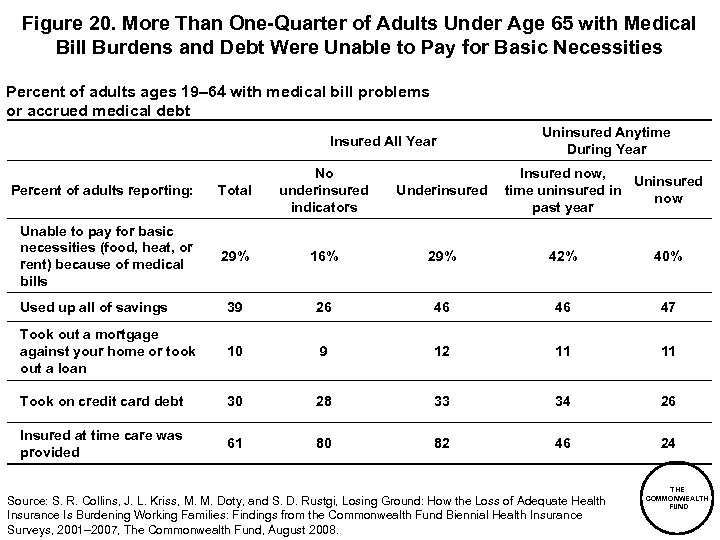 Figure 20. More Than One-Quarter of Adults Under Age 65 with Medical Bill Burdens and Debt Were Unable to Pay for Basic Necessities Percent of adults ages 19– 64 with medical bill problems or accrued medical debt Insured All Year Uninsured Anytime During Year Percent of adults reporting: Total No underinsured indicators Unable to pay for basic necessities (food, heat, or rent) because of medical bills 29% 16% 29% 42% 40% Used up all of savings 39 26 46 46 47 Took out a mortgage against your home or took out a loan 10 9 12 11 11 Took on credit card debt 30 28 33 34 26 Insured at time care was provided 61 80 82 46 24 Underinsured Insured now, Uninsured time uninsured in now past year Source: S. R. Collins, J. L. Kriss, M. M. Doty, and S. D. Rustgi, Losing Ground: How the Loss of Adequate Health Insurance Is Burdening Working Families: Findings from the Commonwealth Fund Biennial Health Insurance Surveys, 2001– 2007, The Commonwealth Fund, August 2008. THE COMMONWEALTH FUND
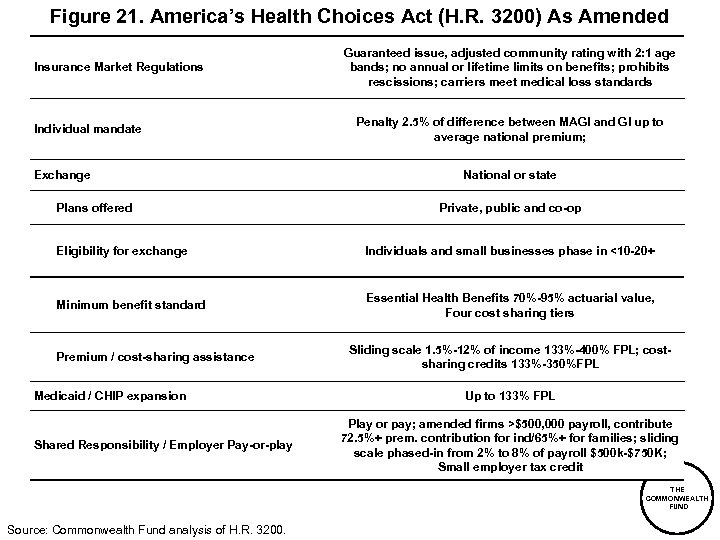 Figure 21. America’s Health Choices Act (H. R. 3200) As Amended Insurance Market Regulations Individual mandate Exchange Plans offered Guaranteed issue, adjusted community rating with 2: 1 age bands; no annual or lifetime limits on benefits; prohibits rescissions; carriers meet medical loss standards Penalty 2. 5% of difference between MAGI and GI up to average national premium; National or state Private, public and co-op Eligibility for exchange Individuals and small businesses phase in <10 -20+ Minimum benefit standard Essential Health Benefits 70%-95% actuarial value, Four cost sharing tiers Premium / cost-sharing assistance Medicaid / CHIP expansion Shared Responsibility / Employer Pay-or-play Sliding scale 1. 5%-12% of income 133%-400% FPL; costsharing credits 133%-350%FPL Up to 133% FPL Play or pay; amended firms >$500, 000 payroll, contribute 72. 5%+ prem. contribution for ind/65%+ for families; sliding scale phased-in from 2% to 8% of payroll $500 k-$750 K; Small employer tax credit THE COMMONWEALTH FUND Source: Commonwealth Fund analysis of H. R. 3200.
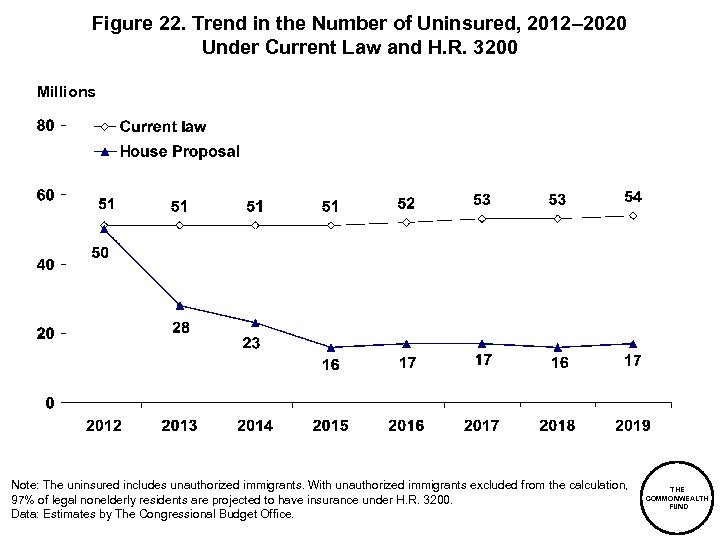 Figure 22. Trend in the Number of Uninsured, 2012– 2020 Under Current Law and H. R. 3200 Millions Note: The uninsured includes unauthorized immigrants. With unauthorized immigrants excluded from the calculation, 97% of legal nonelderly residents are projected to have insurance under H. R. 3200. Data: Estimates by The Congressional Budget Office. THE COMMONWEALTH FUND
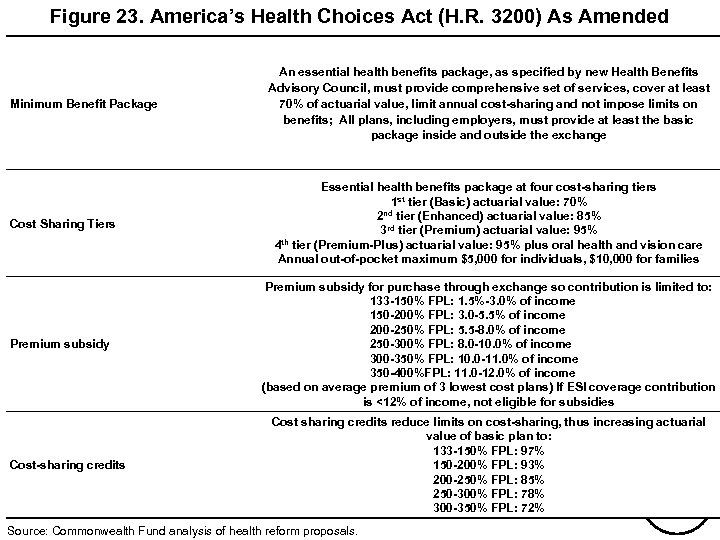 Figure 23. America’s Health Choices Act (H. R. 3200) As Amended Minimum Benefit Package An essential health benefits package, as specified by new Health Benefits Advisory Council, must provide comprehensive set of services, cover at least 70% of actuarial value, limit annual cost-sharing and not impose limits on benefits; All plans, including employers, must provide at least the basic package inside and outside the exchange Cost Sharing Tiers Essential health benefits package at four cost-sharing tiers 1 st tier (Basic) actuarial value: 70% 2 nd tier (Enhanced) actuarial value: 85% 3 rd tier (Premium) actuarial value: 95% 4 th tier (Premium-Plus) actuarial value: 95% plus oral health and vision care Annual out-of-pocket maximum $5, 000 for individuals, $10, 000 for families Premium subsidy for purchase through exchange so contribution is limited to: 133 -150% FPL: 1. 5%-3. 0% of income 150 -200% FPL: 3. 0 -5. 5% of income 200 -250% FPL: 5. 5 -8. 0% of income 250 -300% FPL: 8. 0 -10. 0% of income 300 -350% FPL: 10. 0 -11. 0% of income 350 -400%FPL: 11. 0 -12. 0% of income (based on average premium of 3 lowest cost plans) If ESI coverage contribution is <12% of income, not eligible for subsidies Cost-sharing credits Cost sharing credits reduce limits on cost-sharing, thus increasing actuarial value of basic plan to: 133 -150% FPL: 97% 150 -200% FPL: 93% 200 -250% FPL: 85% THE 250 -300% FPL: 78% COMMONWEALTH FUND 300 -350% FPL: 72% Source: Commonwealth Fund analysis of health reform proposals.
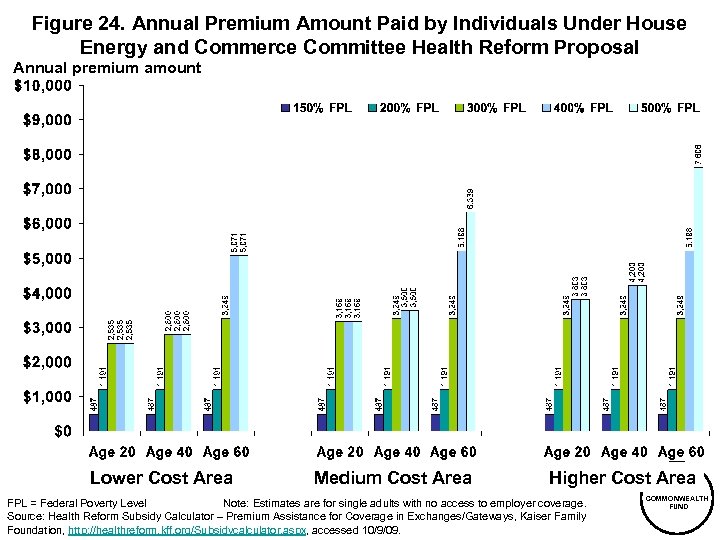 Figure 24. Annual Premium Amount Paid by Individuals Under House Energy and Commerce Committee Health Reform Proposal Annual premium amount Lower Cost Area Medium Cost Area Higher Cost Area FPL = Federal Poverty Level Note: Estimates are for single adults with no access to employer coverage. Source: Health Reform Subsidy Calculator – Premium Assistance for Coverage in Exchanges/Gateways, Kaiser Family Foundation, http: //healthreform. kff. org/Subsidycalculator. aspx, accessed 10/9/09. THE COMMONWEALTH FUND
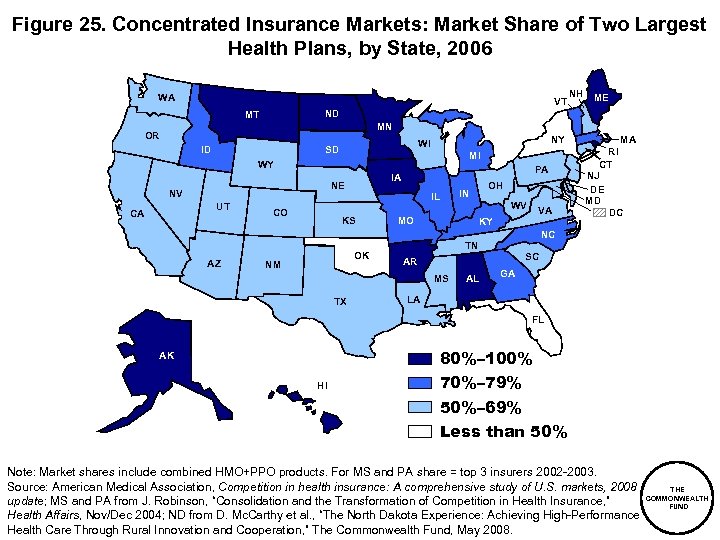 Figure 25. Concentrated Insurance Markets: Market Share of Two Largest Health Plans, by State, 2006 WA VT NH ME ND MT MN OR NY WI SD ID MI WY NE NV UT CA AZ CO IL KS OK NM PA IA WV MO VA KY NC TN SC AR MS TX OH IN MA RI CT NJ DE MD DC AL GA LA FL 80%– 100% AK HI 70%– 79% 50%– 69% Less than 50% Note: Market shares include combined HMO+PPO products. For MS and PA share = top 3 insurers 2002 -2003. Source: American Medical Association, Competition in health insurance: A comprehensive study of U. S. markets, 2008 update; MS and PA from J. Robinson, “Consolidation and the Transformation of Competition in Health Insurance, ” Health Affairs, Nov/Dec 2004; ND from D. Mc. Carthy et al. , “The North Dakota Experience: Achieving High-Performance Health Care Through Rural Innovation and Cooperation, ” The Commonwealth Fund, May 2008. THE COMMONWEALTH FUND
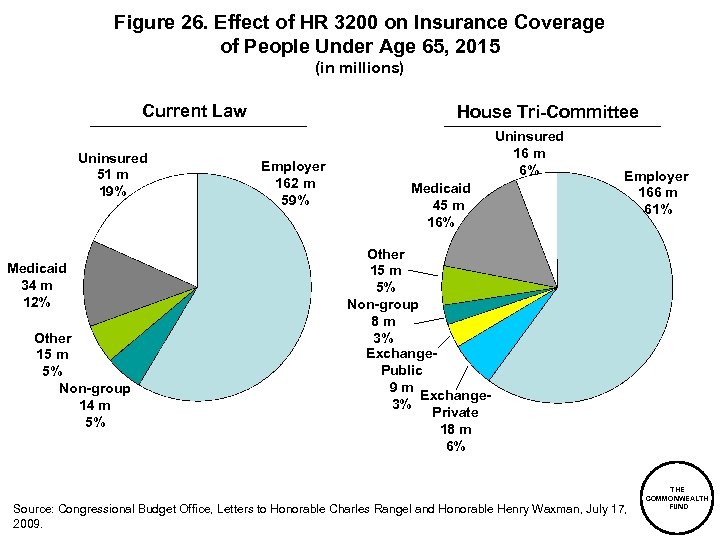 Figure 26. Effect of HR 3200 on Insurance Coverage of People Under Age 65, 2015 (in millions) Current Law Uninsured 51 m 19% Medicaid 34 m 12% Other 15 m 5% Non-group 14 m 5% House Tri-Committee Employer 162 m 59% Uninsured 16 m 6% Medicaid 45 m 16% Employer 166 m 61% Other 15 m 5% Non-group 8 m 3% Exchange. Public 9 m Exchange 3% Private 18 m 6% Source: Congressional Budget Office, Letters to Honorable Charles Rangel and Honorable Henry Waxman, July 17, 2009. THE COMMONWEALTH FUND
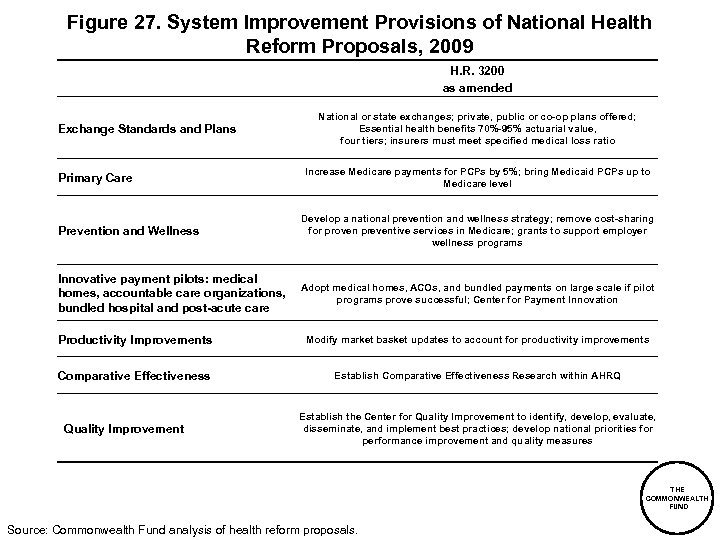 Figure 27. System Improvement Provisions of National Health Reform Proposals, 2009 H. R. 3200 as amended Exchange Standards and Plans Primary Care National or state exchanges; private, public or co-op plans offered; Essential health benefits 70%-95% actuarial value, four tiers; insurers must meet specified medical loss ratio Increase Medicare payments for PCPs by 5%; bring Medicaid PCPs up to Medicare level Prevention and Wellness Develop a national prevention and wellness strategy; remove cost-sharing for proven preventive services in Medicare; grants to support employer wellness programs Innovative payment pilots: medical homes, accountable care organizations, bundled hospital and post-acute care Adopt medical homes, ACOs, and bundled payments on large scale if pilot programs prove successful; Center for Payment Innovation Productivity Improvements Modify market basket updates to account for productivity improvements Comparative Effectiveness Establish Comparative Effectiveness Research within AHRQ Quality Improvement Establish the Center for Quality Improvement to identify, develop, evaluate, disseminate, and implement best practices; develop national priorities for performance improvement and quality measures THE COMMONWEALTH FUND Source: Commonwealth Fund analysis of health reform proposals.
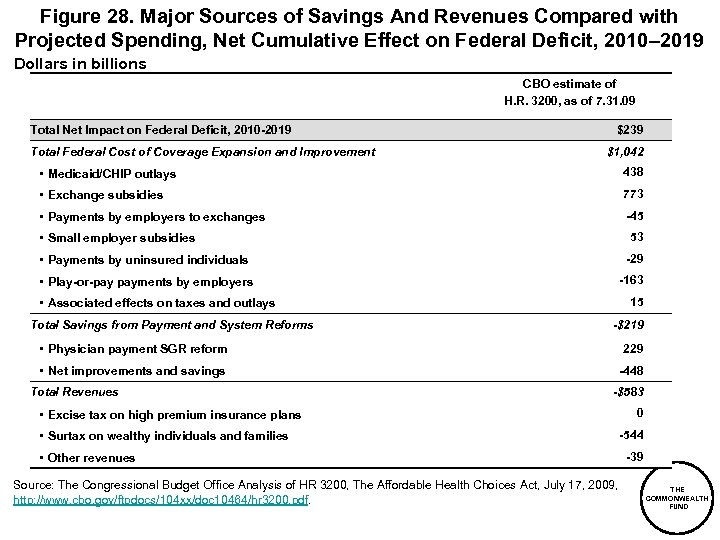 Figure 28. Major Sources of Savings And Revenues Compared with Projected Spending, Net Cumulative Effect on Federal Deficit, 2010– 2019 Dollars in billions CBO estimate of H. R. 3200, as of 7. 31. 09 Total Net Impact on Federal Deficit, 2010 -2019 Total Federal Cost of Coverage Expansion and Improvement $239 $1, 042 • Medicaid/CHIP outlays 438 • Exchange subsidies 773 • Payments by employers to exchanges -45 53 • Small employer subsidies • Payments by uninsured individuals -29 • Play-or-pay payments by employers -163 15 • Associated effects on taxes and outlays Total Savings from Payment and System Reforms -$219 • Physician payment SGR reform 229 • Net improvements and savings -448 Total Revenues -$583 • Excise tax on high premium insurance plans • Surtax on wealthy individuals and families • Other revenues Source: The Congressional Budget Office Analysis of HR 3200, The Affordable Health Choices Act, July 17, 2009, http: //www. cbo. gov/ftpdocs/104 xx/doc 10464/hr 3200. pdf. 0 -544 -39 THE COMMONWEALTH FUND