


 Скачать презентацию Fifth CW and High Average Power RF Workshop
605aed5d73cd471afa95a1417dcb5aed.ppt
- Количество слайдов: 14
 Fifth CW and High Average Power RF Workshop - 2008 25 - 28 March 2008, CERN - Geneva OPERATIONAL EXPERIENCE WITH THE SOLEIL 352 MHZ RF SYSTEMS P. Marchand
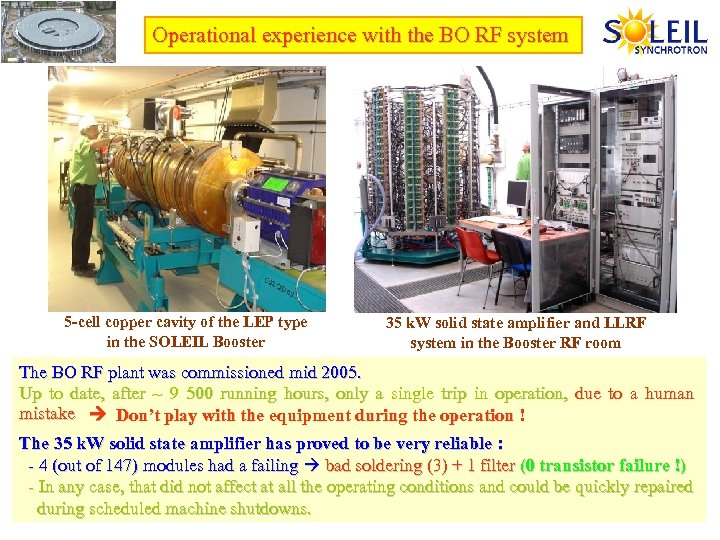 Operational experience with the BO RF system 5 -cell copper cavity of the LEP type in the SOLEIL Booster 35 k. W solid state amplifier and LLRF system in the Booster RF room The BO RF plant was commissioned mid 2005. Up to date, after ~ 9 500 running hours, only a single trip in operation, due to a human mistake Don’t play with the equipment during the operation ! The 35 k. W solid state amplifier has proved to be very reliable : - 4 (out of 147) modules had a failing bad soldering (3) + 1 filter (0 transistor failure !) - In any case, that did not affect at all the operating conditions and could be quickly repaired during scheduled machine shutdowns.
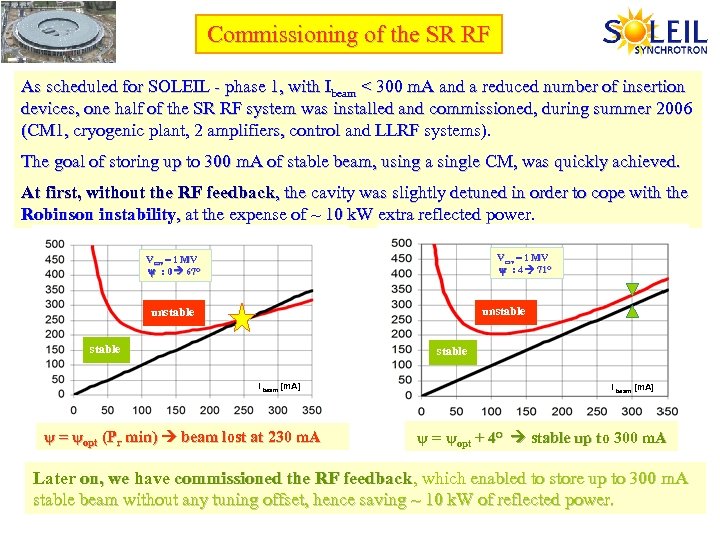 Commissioning of the SR RF As scheduled for SOLEIL - phase 1, with Ibeam < 300 m. A and a reduced number of insertion devices, one half of the SR RF system was installed and commissioned, during summer 2006 (CM 1, cryogenic plant, 2 amplifiers, control and LLRF systems). (CM 1, cryogenic plant, 2 amplifiers, The goal of storing up to 300 m. A of stable beam, using a single CM, was quickly achieved. At first, without the RF feedback, the cavity was slightly detuned in order to cope with the Robinson instability, at the expense of ~ 10 k. W extra reflected power. Vcav = 1 MV cav : 4 71° : 4 Vcav = 1 MV cav : 0 67° : 0 unstable I beam [m. A] ψ = ψopt (Pr min) beam lost at 230 m. A I beam [m. A] ψ = ψopt + 4° stable up to 300 m. A Later on, we have commissioned the RF feedback, which enabled to store up to 300 m. A stable beam without any tuning offset, hence saving ~ 10 k. W of reflected power.
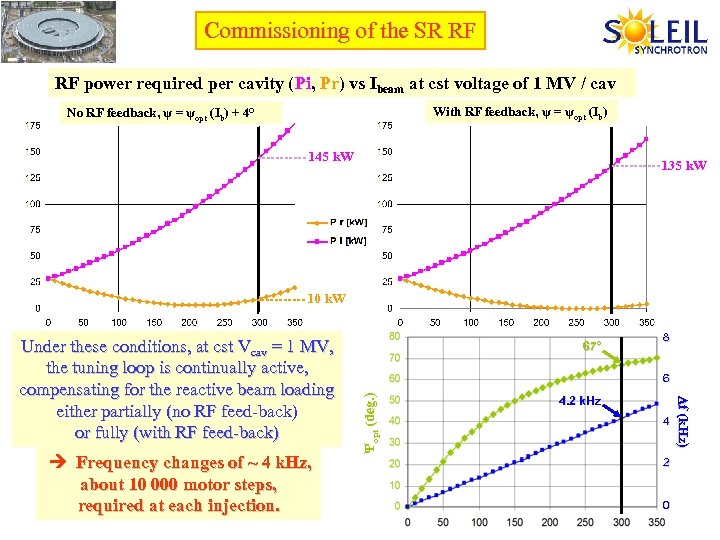 Commissioning of the SR RF RF power required per cavity (Pi, Pr) vs Ibeam at cst voltage of 1 MV / cav With RF feedback, ψ = ψopt (Ib) No RF feedback, ψ = ψopt (Ib) + 4° 145 k. W 135 k. W 10 k. W 8 6 Ψopt (deg. ) Frequency changes of ~ 4 k. Hz, about 10 000 motor steps, required at each injection. 67° 4. 2 k. Hz 4 2 0 Df (k. Hz) Under these conditions, at cst Vcav = 1 MV, the tuning loop is continually active, compensating for the reactive beam loading either partially (no RF feed-back) or fully (with RF feed-back)
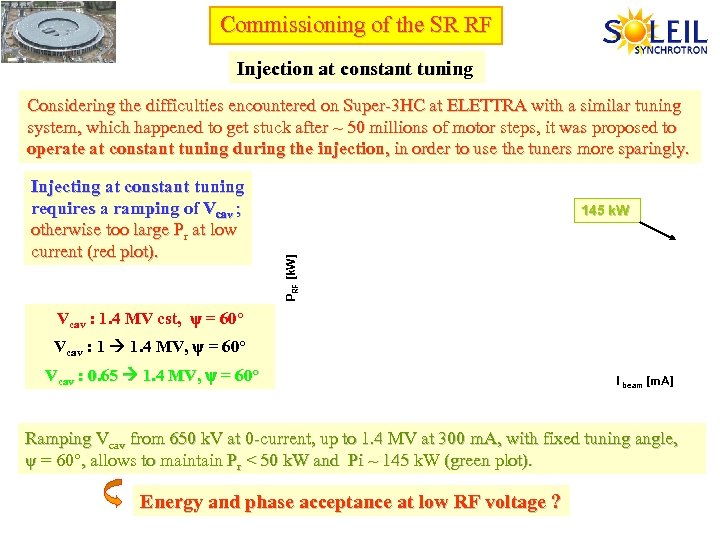 Commissioning of the SR RF Injection at constant tuning Considering the difficulties encountered on Super-3 HC at ELETTRA with a similar tuning system, which happened to get stuck after ~ 50 millions of motor steps, it was proposed to operate at constant tuning during the injection, in order to use the tuners more sparingly. 145 k. W PRF [k. W] Injecting at constant tuning requires a ramping of Vcav ; cav otherwise too large Pr at low current (red plot). Vcav : 1. 4 MV cst, = 60° Vcav : 1 1. 4 MV, = 60° Vcav : 0. 65 1. 4 MV, = 60° I beam [m. A] Ramping Vcav from 650 k. V at 0 -current, up to 1. 4 MV at 300 m. A, with fixed tuning angle, ψ = 60°, allows to maintain Pr < 50 k. W and Pi ~ 145 k. W (green plot). Energy and phase acceptance at low RF voltage ?
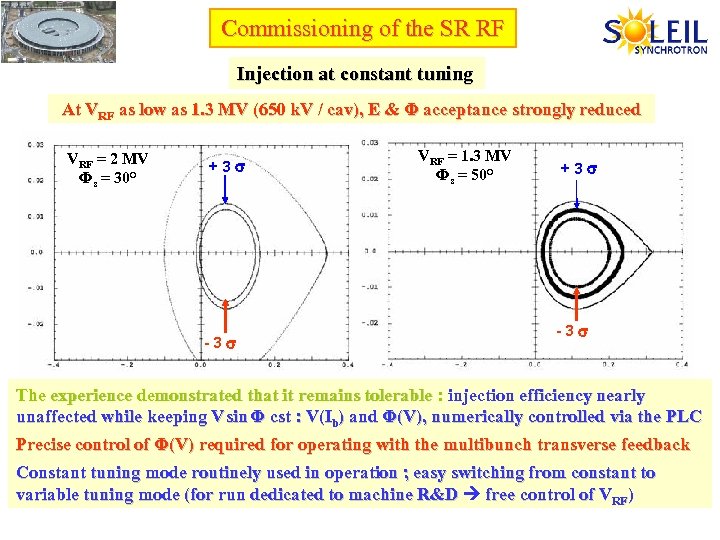 Commissioning of the SR RF Injection at constant tuning At VRF as low as 1. 3 MV (650 k. V / cav), E & Φ acceptance strongly reduced VRF = 2 MV Фs = 30° + 3 - 3 VRF = 1. 3 MV Фs = 50° + 3 - 3 The experience demonstrated that it remains tolerable : injection efficiency nearly unaffected while keeping V sin Φ cst : V(Ib) and Φ(V), numerically controlled via the PLC Precise control of Φ(V) required for operating with the multibunch transverse feedback Constant tuning mode routinely used in operation ; easy switching from constant to variable tuning mode (for run dedicated to machine R&D free control of VRF)
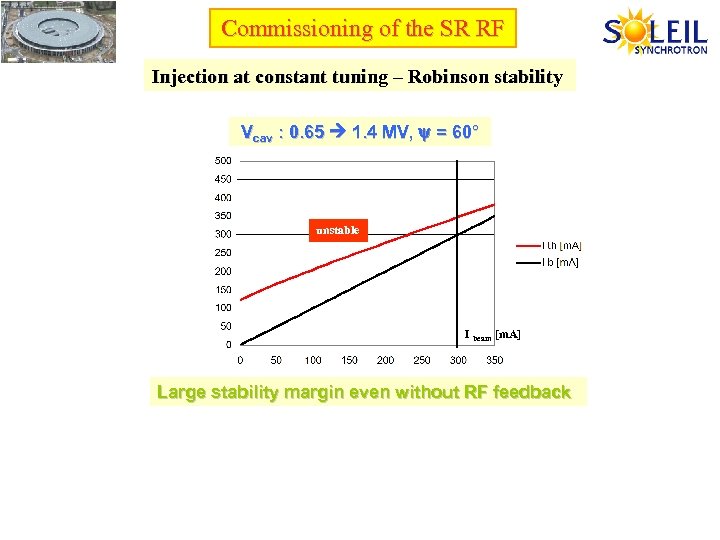 Commissioning of the SR RF Injection at constant tuning – Robinson stability Vcav : 0. 65 1. 4 MV, = 60° unstable I beam [m. A] Large stability margin even without RF feedback
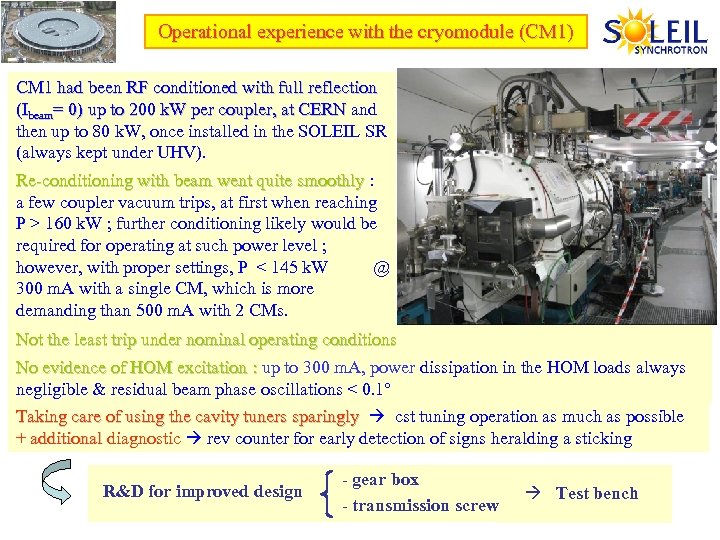 Operational experience with the cryomodule (CM 1) CM 1 had been RF conditioned with full reflection (Ibeam= 0) up to 200 k. W per coupler, at CERN and = 0) up to 200 k. W per coupler, at CERN then up to 80 k. W, once installed in the SOLEIL SR (always kept under UHV). Re-conditioning with beam went quite smoothly : Re-conditioning with beam went quite smoothly a few coupler vacuum trips, at first when reaching P > 160 k. W ; further conditioning likely would be required for operating at such power level ; however, with proper settings, P < 145 k. W @ 300 m. A with a single CM, which is more demanding than 500 m. A with 2 CMs. Not the least trip under nominal operating conditions No evidence of HOM excitation : up to 300 m. A, power dissipation in the HOM loads always No evidence of HOM excitation : negligible & residual beam phase oscillations < 0. 1° Taking care of using the cavity tuners sparingly cst tuning operation as much as possible Taking care of using the cavity tuners sparingly + additional diagnostic rev counter for early detection of signs heralding a sticking + additional diagnostic R&D for improved design - gear box - transmission screw Test bench
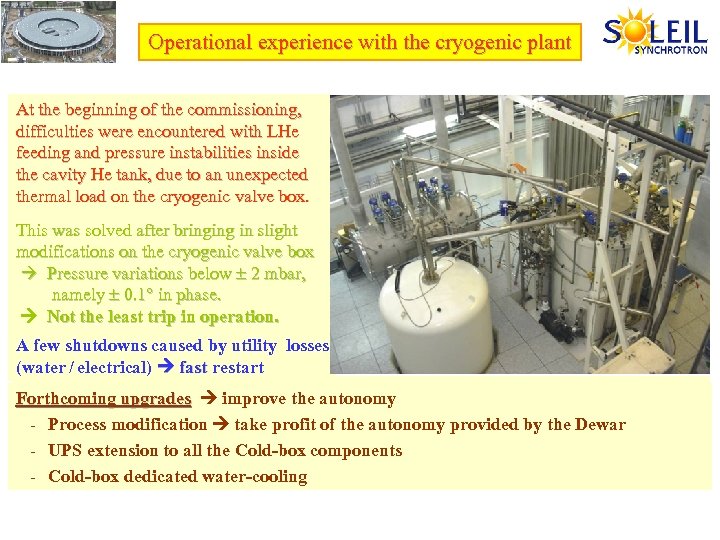 Operational experience with the cryogenic plant At the beginning of the commissioning, difficulties were encountered with LHe feeding and pressure instabilities inside the cavity He tank, due to an unexpected thermal load on the cryogenic valve box. This was solved after bringing in slight modifications on the cryogenic valve box Pressure variations below 2 mbar, namely 0. 1° in phase. Not the least trip in operation. A few shutdowns caused by utility losses (water / electrical) fast restart Forthcoming upgrades improve the autonomy Forthcoming upgrades - Process modification take profit of the autonomy provided by the Dewar - UPS extension to all the Cold-box components - Cold-box dedicated water-cooling
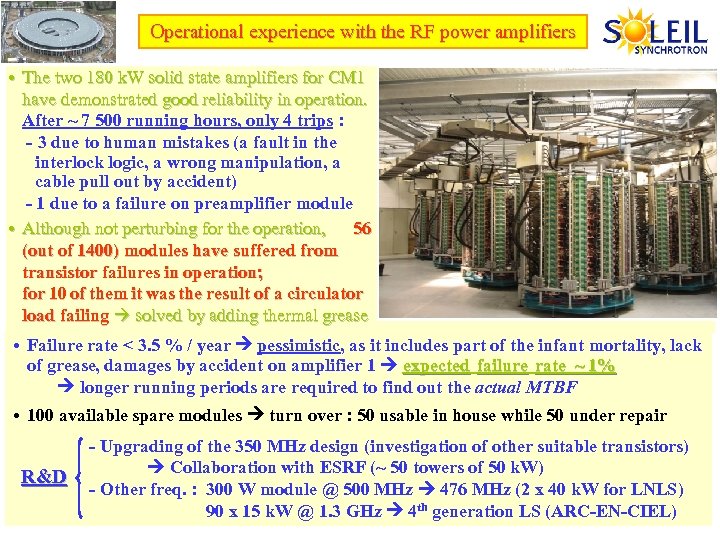 Operational experience with the RF power amplifiers • The two 180 k. W solid state amplifiers for CM 1 have demonstrated good reliability in operation. After ~ 7 500 running hours, only 4 trips : - 3 due to human mistakes (a fault in the interlock logic, a wrong manipulation, a cable pull out by accident) - 1 due to a failure on preamplifier module • Although not perturbing for the operation, 56 (out of 1400) modules have suffered from transistor failures in operation; for 10 of them it was the result of a circulator load failing solved by adding thermal grease • Failure rate < 3. 5 % / year pessimistic, as it includes part of the infant mortality, lack of grease, damages by accident on amplifier 1 expected failure rate ~ 1% longer running periods are required to find out the actual MTBF • 100 available spare modules turn over : 50 usable in house while 50 under repair R&D - Upgrading of the 350 MHz design (investigation of other suitable transistors) Collaboration with ESRF (~ 50 towers of 50 k. W) - Other freq. : 300 W module @ 500 MHz 476 MHz (2 x 40 k. W for LNLS) 90 x 15 k. W @ 1. 3 GHz 4 th generation LS (ARC-EN-CIEL)
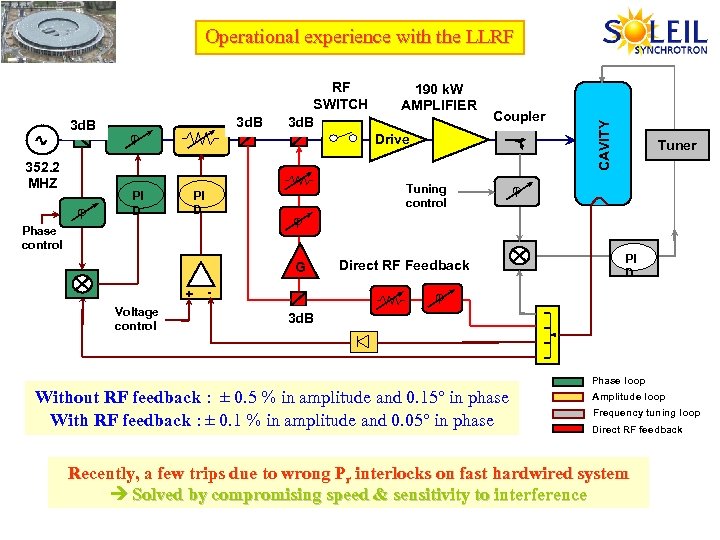 3 d. B 352. 2 MHZ 3 d. B RF SWITCH 3 d. B Coupler Drive PI D Phase control G + Voltage control 190 k. W AMPLIFIER - Tuning control Direct RF Feedback CAVITY Operational experience with the LLRF Tuner PI D 3 d. B Phase loop Without RF feedback : ± 0. 5 % in amplitude and 0. 15° in phase With RF feedback : ± 0. 1 % in amplitude and 0. 05° in phase Amplitude loop Frequency tuning loop Direct RF feedback Recently, a few trips due to wrong Pr interlocks on fast hardwired system Solved by compromising speed & sensitivity to interference
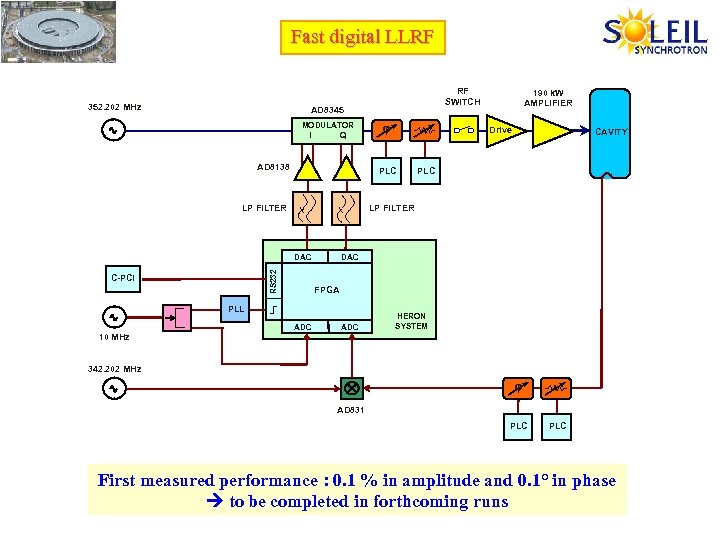 Fast digital LLRF 352. 202 MHz AD 8345 MODULATOR I Q AD 8138 190 k. W AMPLIFIER Drive CAVITY PLC LP FILTER RS 232 DAC C-PCI PLC LP FILTER DAC FPGA PLL 10 MHz RF SWITCH ADC HERON SYSTEM 342. 202 MHz AD 831 PLC First measured performance : 0. 1 % in amplitude and 0. 1° in phase to be completed in forthcoming runs
 Summary & conclusions • Up to date, the BO and half of the SR RF systems have been commissioned • The technological choices, sc cavities and high power solid state amplifiers, both designed in house, were quite challenging • The first operational experience is fully satisfactory : after ~ 9 500 running hours in the BO and 7 500 in the SR, only a few trips in operation due to minor incidents CM : Improve the frequency tuning system Amplifiers : MTBF of transistors (? ) • Several laboratories are about to adopt the solid state technology “à la SOLEIL” @ 352 MHz : CEA and ESRF @ 500 MHz : LNL-Legnaro, LNLS-Brazil, SLS-PSI, NSLS II-Brookhaven (? ) Collaborations under discussion R&D is going on at SOLEIL L - Band • The 2 nd half of the SR RF system, which is under fabrication, should be implemented in May 2008 nominal performance (4. 4 MV and 500 m. A)
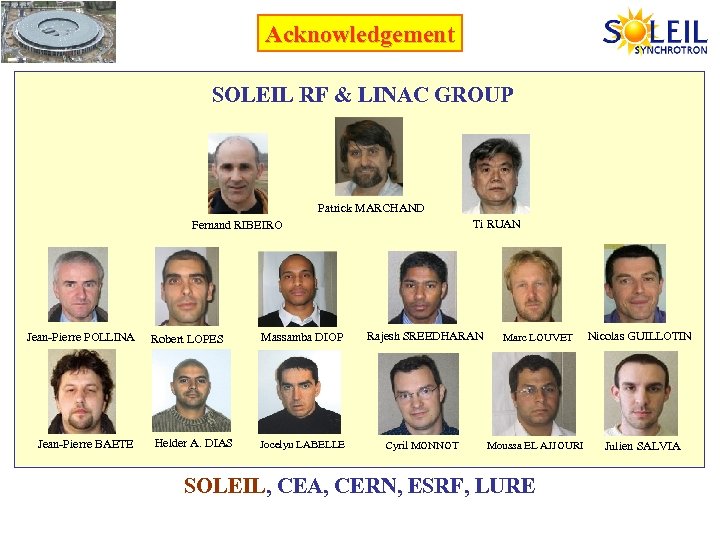 Acknowledgement SOLEIL RF & LINAC GROUP Patrick MARCHAND Ti RUAN Fernand RIBEIRO Jean-Pierre POLLINA Robert LOPES Jean-Pierre BAETE Helder A. DIAS Massamba DIOP Jocelyn LABELLE Rajesh SREEDHARAN Cyril MONNOT Marc LOUVET Nicolas GUILLOTIN Moussa EL AJJOURI Julien SALVIA SOLEIL, CEA, CERN, ESRF, LURE