 Скачать презентацию Fieldwork investigation based on Unit G 1 Theme
36acd1f5a145bbbc30bac90fd041f078.ppt
- Количество слайдов: 37



Fieldwork investigation based on Unit G 1 Theme 2 Sections 2. 4 -2. 6 The River Conwy
Background • • The Conwy Valley is a place of contrast and beauty. The Conwy River flows through the valley down to the estuary at Conwy, from where it flows into Liverpool Bay. The lower Conwy River was in the past navigable up to a point just below Llanrwst. Boats carried slate and materials from the mines down river, with cargo consisting mainly of coal, salt, and provisions being brought up stream. The main river channel is 55 km long and the drainage basin covers an area of 396 sq. km. • The river starts it journey through tributary streams high in the desolate Migneint Moors. This high moorland area, inhabited by sheep in summer, was formed in the Silurian period some 420 million years ago. The area is covered in the most part by thin acid soils where mainly moor grass grows. The waters entering the river in this area tend to be acidic in nature. As the river flows north it is joined by the tributaries of the Machno and Lledr rivers. On reaching Betws y Coed it is joined by the Llugwy. • To the west of the valley, lies the more craggy and majestic scenery of the mountains of Northern Snowdonia (Carneddau). This area is underlined by rock of the Cambrian period, formed some 500 million years ago. From here rivers and waterfalls cascade down often steep rocky outcrops into the River Conwy.
Photographic location • Using OS sheets OL 17 and OL 18 sort the photographs on the next slides according to the section of the River Conwy that they were taken in – Upper, Middle and Lower course. The maps will help you to interpret landforms and the photographs should give you clues as to where they might be found.
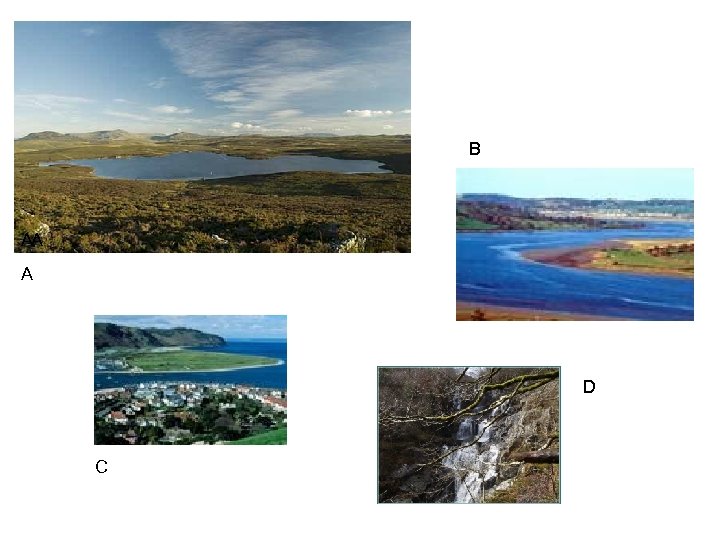
B A A A D C
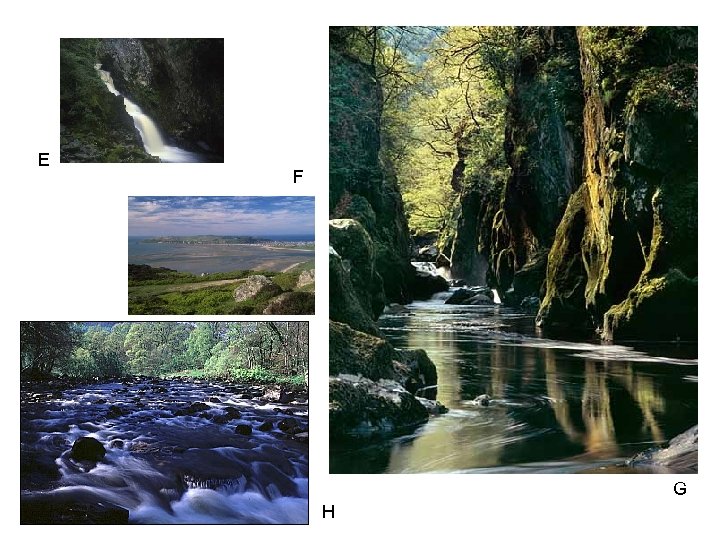
E F G H
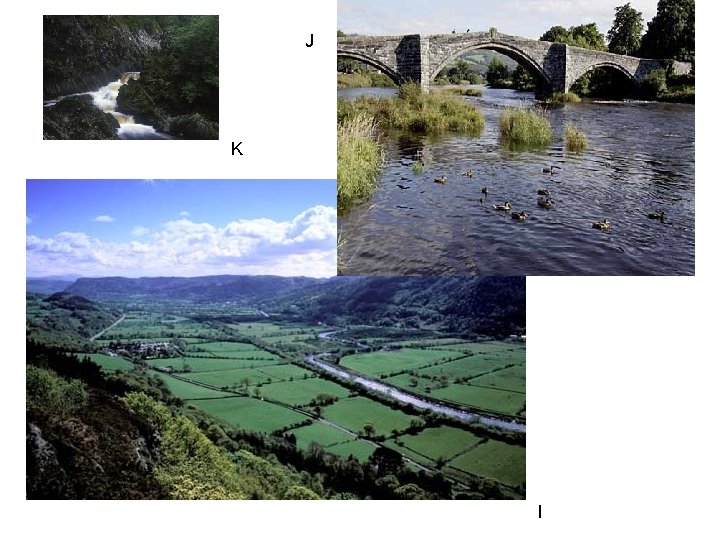
J K I
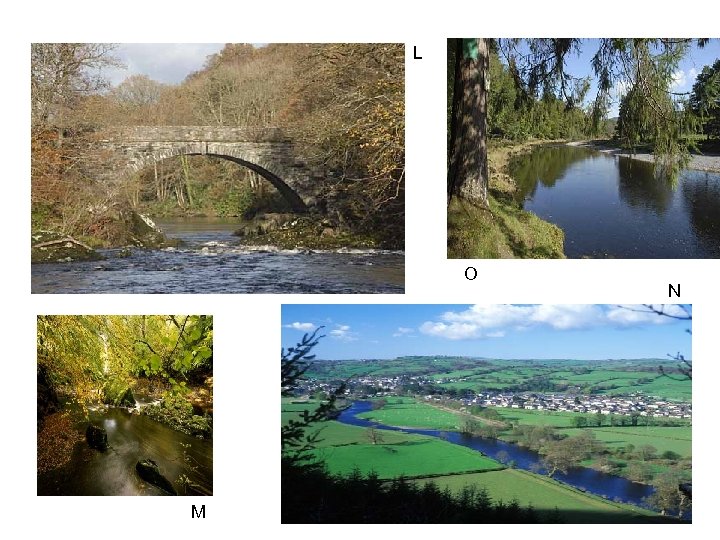
L O M N
The photographs are all of the River Conwy along its course and provide you with a good visual interpretation of what the river looks like. Task 1 - Take photograph I and produce a field sketch of the scene. Remember to annotate the sketch to indicate fluvial landforms. ----------------------It was decided to undertake some fieldwork along the River Conwy to look at some of the physical characteristics that may influence the river regime and its flooding potential. The 3 sites were chosen based on a number of features and results were noted on the Recording sheets. Before going out into the field, students were asked to design their enquiry and to develop three hypotheses to test. A risk assessment was also carried out. Task 2 - Write down three hypotheses that you would choose to test on the sheet. Task 3 - Now complete a risk assessment based on the 4 stages on the sheet.
River Conwy Enquiry Hypotheses to test 1. 2. 3.
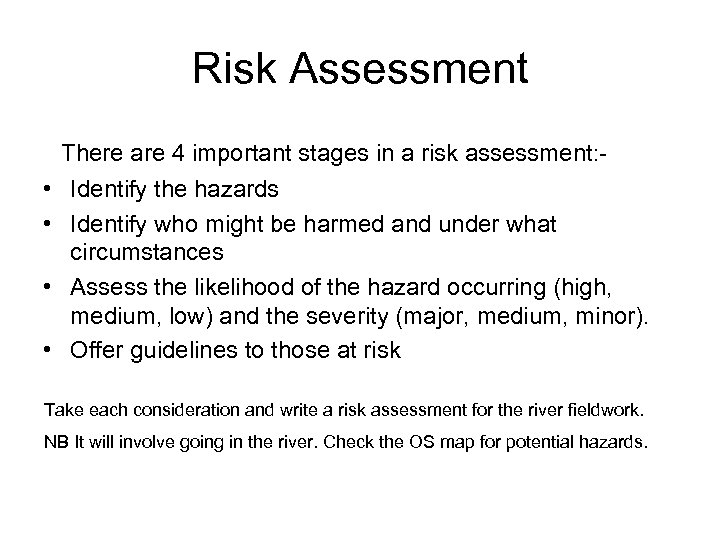
Risk Assessment There are 4 important stages in a risk assessment: • Identify the hazards • Identify who might be harmed and under what circumstances • Assess the likelihood of the hazard occurring (high, medium, low) and the severity (major, medium, minor). • Offer guidelines to those at risk Take each consideration and write a risk assessment for the river fieldwork. NB It will involve going in the river. Check the OS map for potential hazards.
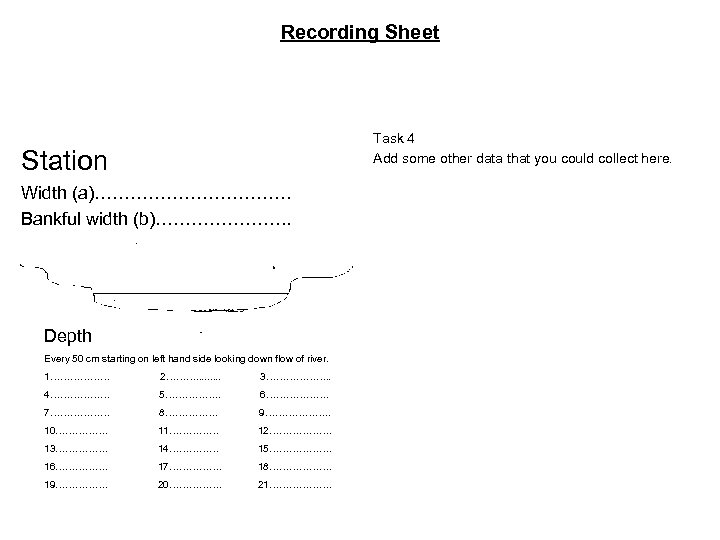
Recording Sheet Task 4 Add some other data that you could collect here. Station Width (a)……………… Bankful width (b)…………………. . Depth Every 50 cm starting on left hand side looking down flow of river. 1……………… 2………. . 3………………. . 4……………… 5……………. . 6………………. 7……………… 8……………. 9………………. . 10……………. 11…………… 12………………. 13……………. 14…………… 15………………. 16……………. 17……………. 18………………. 19……………. 20……………. 21……………….
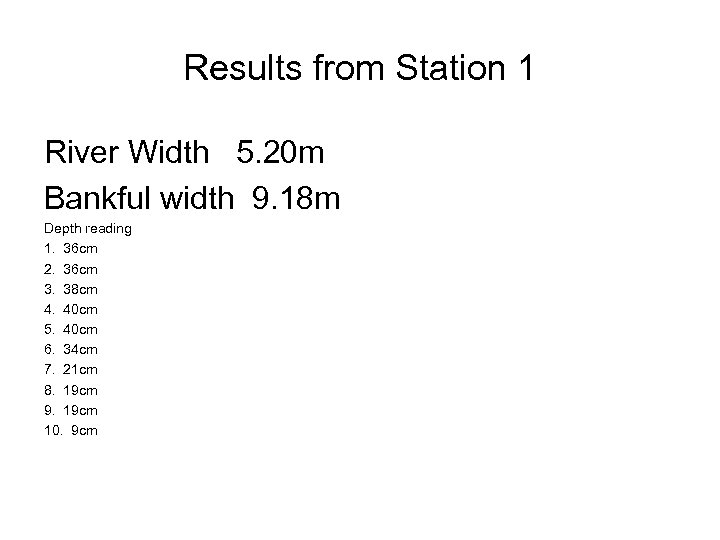
Results from Station 1 River Width 5. 20 m Bankful width 9. 18 m Depth reading 1. 36 cm 2. 36 cm 3. 38 cm 4. 40 cm 5. 40 cm 6. 34 cm 7. 21 cm 8. 19 cm 9. 19 cm 10. 9 cm
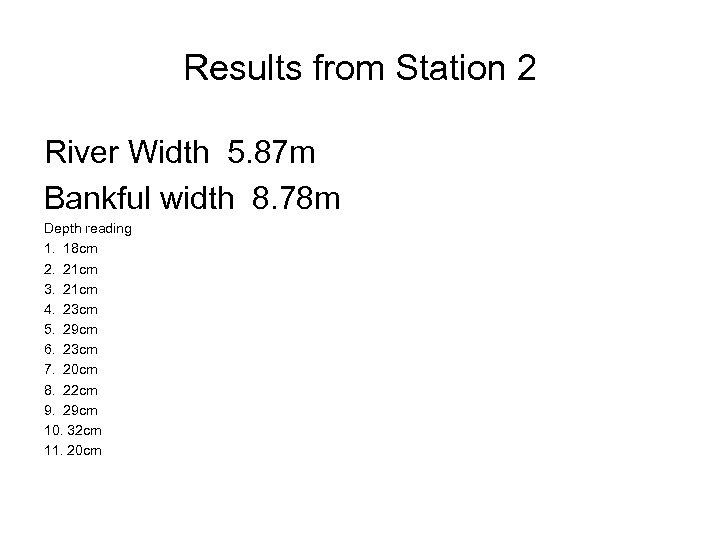
Results from Station 2 River Width 5. 87 m Bankful width 8. 78 m Depth reading 1. 18 cm 2. 21 cm 3. 21 cm 4. 23 cm 5. 29 cm 6. 23 cm 7. 20 cm 8. 22 cm 9. 29 cm 10. 32 cm 11. 20 cm
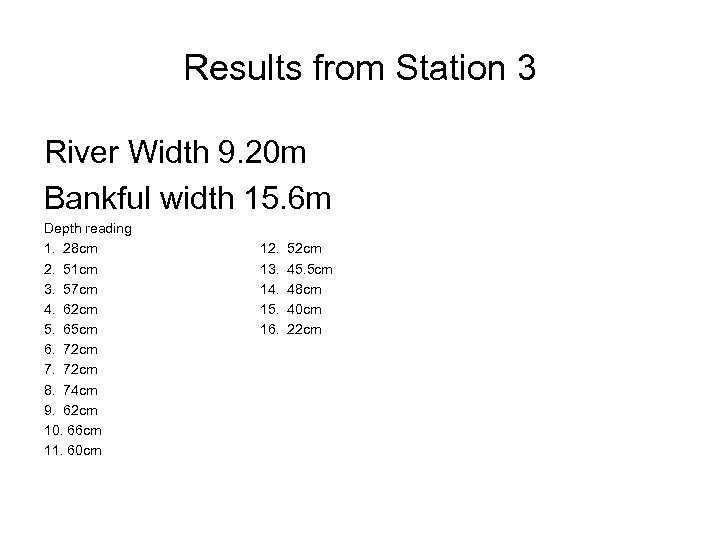
Results from Station 3 River Width 9. 20 m Bankful width 15. 6 m Depth reading 1. 28 cm 2. 51 cm 3. 57 cm 4. 62 cm 5. 65 cm 6. 72 cm 7. 72 cm 8. 74 cm 9. 62 cm 10. 66 cm 11. 60 cm 12. 52 cm 13. 45. 5 cm 14. 48 cm 15. 40 cm 16. 22 cm
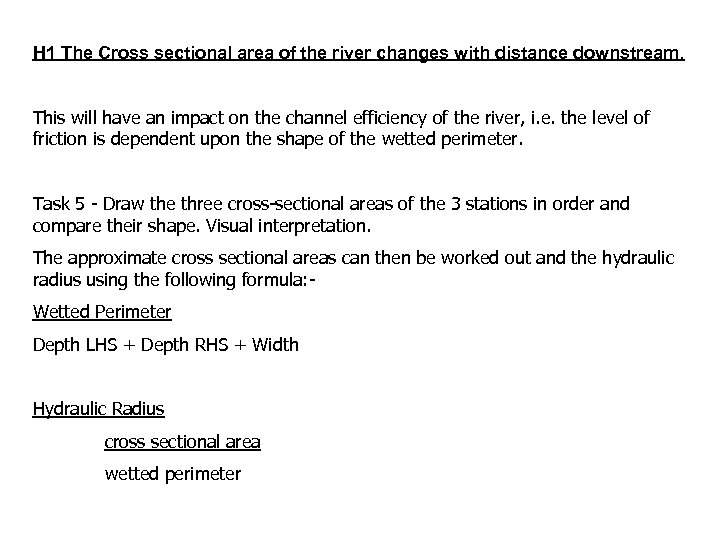
H 1 The Cross sectional area of the river changes with distance downstream. This will have an impact on the channel efficiency of the river, i. e. the level of friction is dependent upon the shape of the wetted perimeter. Task 5 - Draw the three cross-sectional areas of the 3 stations in order and compare their shape. Visual interpretation. The approximate cross sectional areas can then be worked out and the hydraulic radius using the following formula: Wetted Perimeter Depth LHS + Depth RHS + Width Hydraulic Radius cross sectional area wetted perimeter
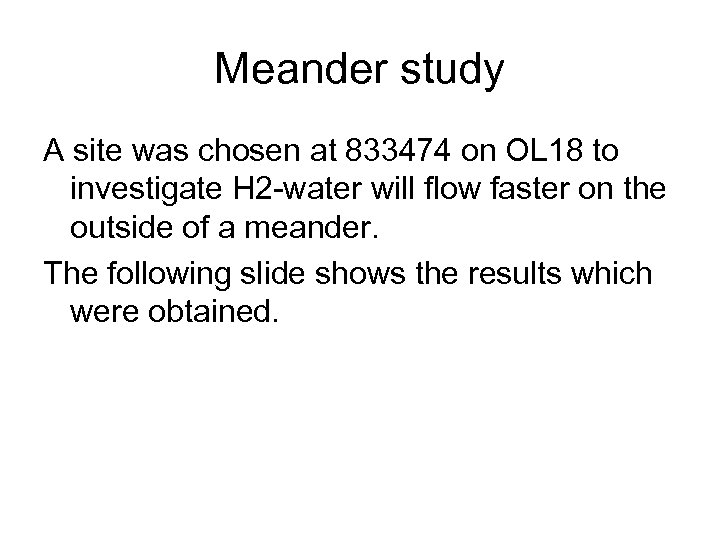
Meander study A site was chosen at 833474 on OL 18 to investigate H 2 -water will flow faster on the outside of a meander. The following slide shows the results which were obtained.
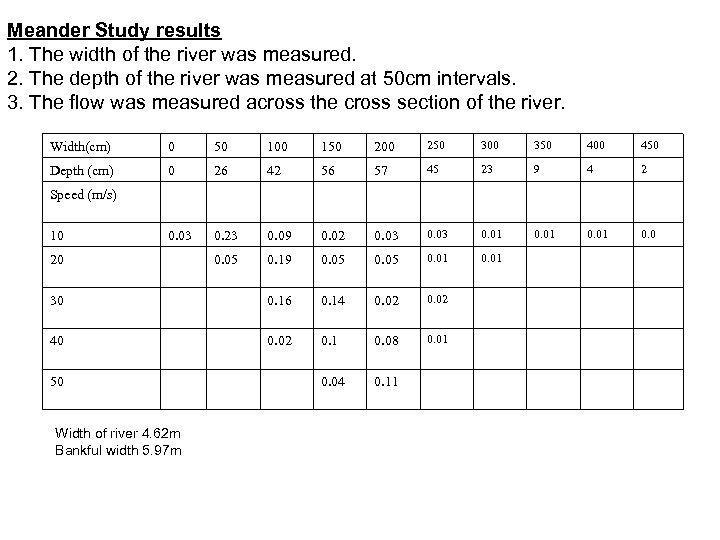
Meander Study results 1. The width of the river was measured. 2. The depth of the river was measured at 50 cm intervals. 3. The flow was measured across the cross section of the river. Width(cm) 0 50 100 150 200 250 300 350 400 450 Depth (cm) 0 26 42 56 57 45 23 9 4 2 0. 03 0. 23 0. 09 0. 02 0. 03 0. 01 0. 05 0. 19 0. 05 0. 01 30 0. 16 0. 14 0. 02 40 0. 02 0. 1 0. 08 0. 01 0. 04 0. 11 Speed (m/s) 10 20 50 Width of river 4. 62 m Bankful width 5. 97 m
Task 6 Draw a cross sectional diagram of the meander. Plot the velocity of the water on the diagram Draw in the isovels (an isovel is an isoline that joins places of equal velocity). What do you notice about the pattern that you have drawn? Do you accept or reject the hypothesis?
Flooding in the Conwy Valley The Conwy Valley has flooded on a number of occasions due to a number of physical and human factors. The following slides show some of the factors which may have contributed to the flooding. Slides 20 and 21 show the river regime over a period of years and details of the percentage of times there is over flow according to season. Slides 22 and 23 are typical weather reports. Slides 24 map extract of area. Slides 25 - 28 are photographs of the floods. Slides 29 -31 are a collection of news reports about flooding in the area. Look at the maps and all the evidence provided Task 7 - Describe and explain the physical and human factors which may have led to flooding in the valley.
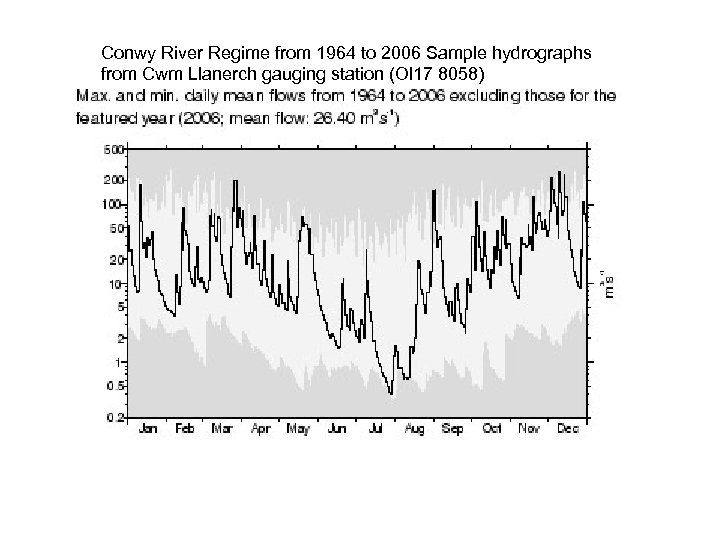
Conwy River Regime from 1964 to 2006 Sample hydrographs from Cwm Llanerch gauging station (Ol 17 8058)
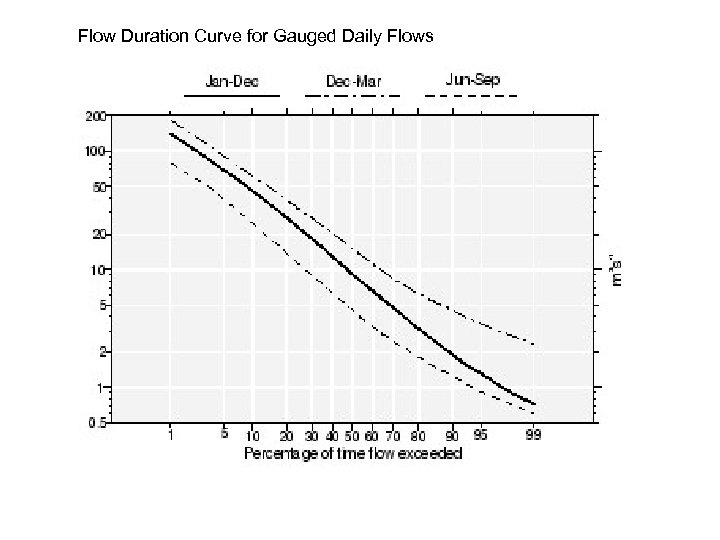
Flow Duration Curve for Gauged Daily Flows
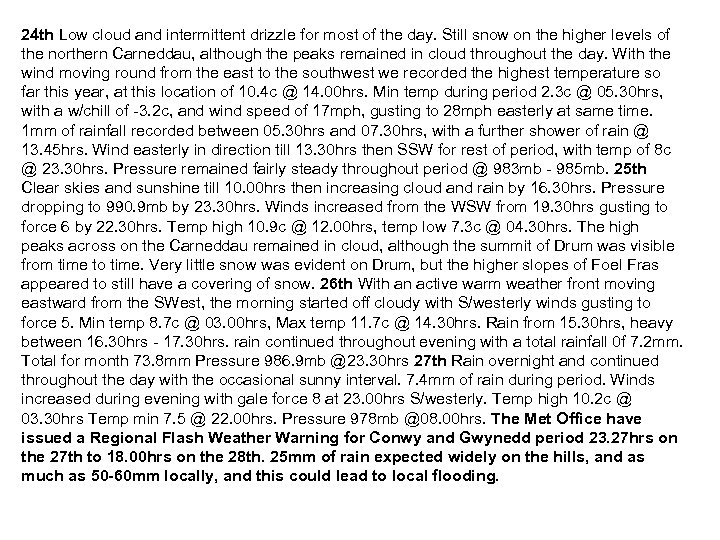
24 th Low cloud and intermittent drizzle for most of the day. Still snow on the higher levels of the northern Carneddau, although the peaks remained in cloud throughout the day. With the wind moving round from the east to the southwest we recorded the highest temperature so far this year, at this location of 10. 4 c @ 14. 00 hrs. Min temp during period 2. 3 c @ 05. 30 hrs, with a w/chill of -3. 2 c, and wind speed of 17 mph, gusting to 28 mph easterly at same time. 1 mm of rainfall recorded between 05. 30 hrs and 07. 30 hrs, with a further shower of rain @ 13. 45 hrs. Wind easterly in direction till 13. 30 hrs then SSW for rest of period, with temp of 8 c @ 23. 30 hrs. Pressure remained fairly steady throughout period @ 983 mb - 985 mb. 25 th Clear skies and sunshine till 10. 00 hrs then increasing cloud and rain by 16. 30 hrs. Pressure dropping to 990. 9 mb by 23. 30 hrs. Winds increased from the WSW from 19. 30 hrs gusting to force 6 by 22. 30 hrs. Temp high 10. 9 c @ 12. 00 hrs, temp low 7. 3 c @ 04. 30 hrs. The high peaks across on the Carneddau remained in cloud, although the summit of Drum was visible from time to time. Very little snow was evident on Drum, but the higher slopes of Foel Fras appeared to still have a covering of snow. 26 th With an active warm weather front moving eastward from the SWest, the morning started off cloudy with S/westerly winds gusting to force 5. Min temp 8. 7 c @ 03. 00 hrs, Max temp 11. 7 c @ 14. 30 hrs. Rain from 15. 30 hrs, heavy between 16. 30 hrs - 17. 30 hrs. rain continued throughout evening with a total rainfall 0 f 7. 2 mm. Total for month 73. 8 mm Pressure 986. 9 mb @23. 30 hrs 27 th Rain overnight and continued throughout the day with the occasional sunny interval. 7. 4 mm of rain during period. Winds increased during evening with gale force 8 at 23. 00 hrs S/westerly. Temp high 10. 2 c @ 03. 30 hrs Temp min 7. 5 @ 22. 00 hrs. Pressure 978 mb @08. 00 hrs. The Met Office have issued a Regional Flash Weather Warning for Conwy and Gwynedd period 23. 27 hrs on the 27 th to 18. 00 hrs on the 28 th. 25 mm of rain expected widely on the hills, and as much as 50 -60 mm locally, and this could lead to local flooding.
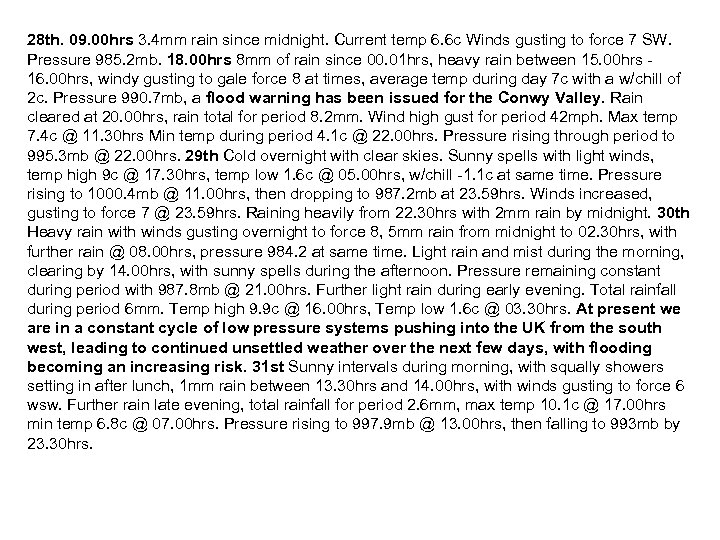
28 th. 09. 00 hrs 3. 4 mm rain since midnight. Current temp 6. 6 c Winds gusting to force 7 SW. Pressure 985. 2 mb. 18. 00 hrs 8 mm of rain since 00. 01 hrs, heavy rain between 15. 00 hrs - 16. 00 hrs, windy gusting to gale force 8 at times, average temp during day 7 c with a w/chill of 2 c. Pressure 990. 7 mb, a flood warning has been issued for the Conwy Valley. Rain cleared at 20. 00 hrs, rain total for period 8. 2 mm. Wind high gust for period 42 mph. Max temp 7. 4 c @ 11. 30 hrs Min temp during period 4. 1 c @ 22. 00 hrs. Pressure rising through period to 995. 3 mb @ 22. 00 hrs. 29 th Cold overnight with clear skies. Sunny spells with light winds, temp high 9 c @ 17. 30 hrs, temp low 1. 6 c @ 05. 00 hrs, w/chill -1. 1 c at same time. Pressure rising to 1000. 4 mb @ 11. 00 hrs, then dropping to 987. 2 mb at 23. 59 hrs. Winds increased, gusting to force 7 @ 23. 59 hrs. Raining heavily from 22. 30 hrs with 2 mm rain by midnight. 30 th Heavy rain with winds gusting overnight to force 8, 5 mm rain from midnight to 02. 30 hrs, with further rain @ 08. 00 hrs, pressure 984. 2 at same time. Light rain and mist during the morning, clearing by 14. 00 hrs, with sunny spells during the afternoon. Pressure remaining constant during period with 987. 8 mb @ 21. 00 hrs. Further light rain during early evening. Total rainfall during period 6 mm. Temp high 9. 9 c @ 16. 00 hrs, Temp low 1. 6 c @ 03. 30 hrs. At present we are in a constant cycle of low pressure systems pushing into the UK from the south west, leading to continued unsettled weather over the next few days, with flooding becoming an increasing risk. 31 st Sunny intervals during morning, with squally showers setting in after lunch, 1 mm rain between 13. 30 hrs and 14. 00 hrs, with winds gusting to force 6 wsw. Further rain late evening, total rainfall for period 2. 6 mm, max temp 10. 1 c @ 17. 00 hrs min temp 6. 8 c @ 07. 00 hrs. Pressure rising to 997. 9 mb @ 13. 00 hrs, then falling to 993 mb by 23. 30 hrs.
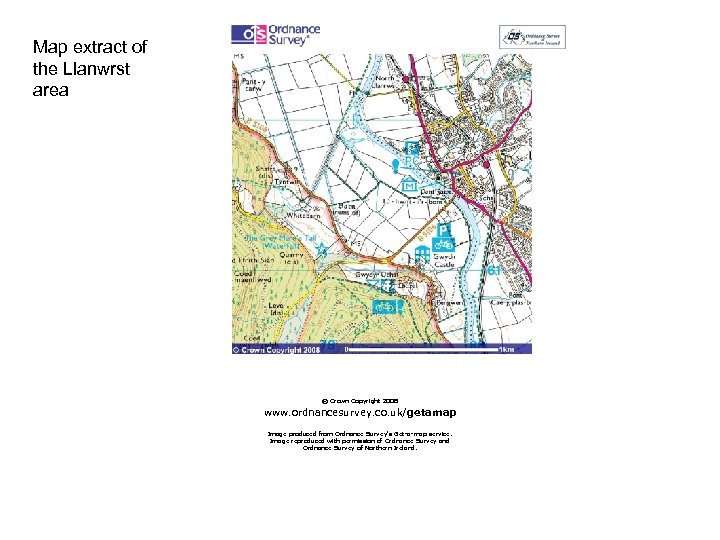
Map extract of the Llanwrst area © Crown Copyright 2008 www. ordnancesurvey. co. uk/getamap Image produced from Ordnance Survey's Get-a-map service. Image reproduced with permission of Ordnance Survey and Ordnance Survey of Northern Ireland.
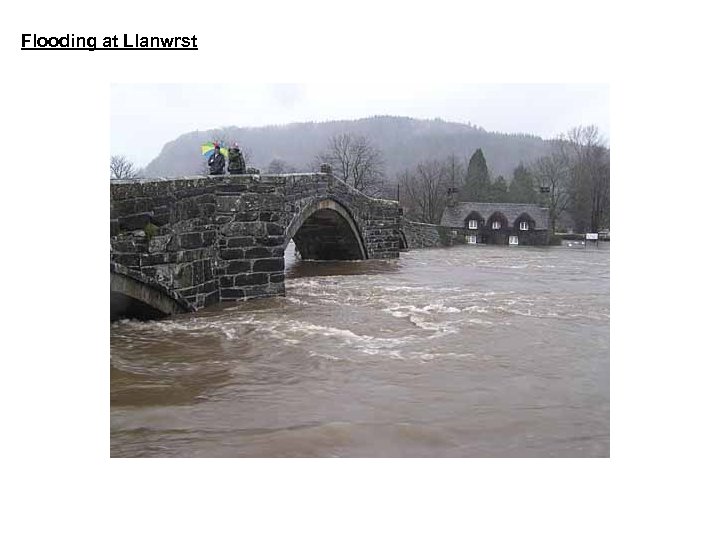
Flooding at Llanwrst
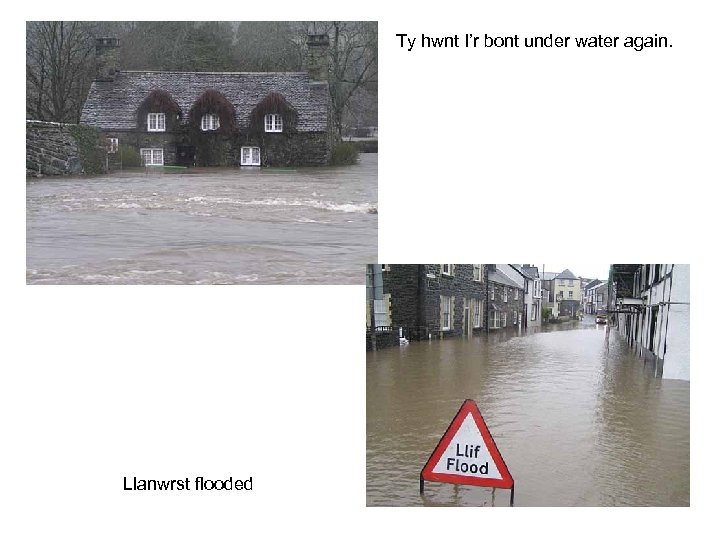
Ty hwnt I’r bont under water again. Llanwrst flooded
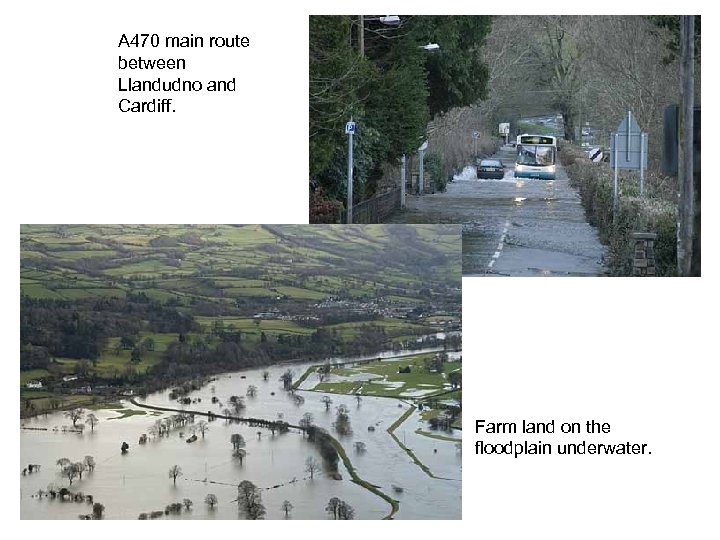
A 470 main route between Llandudno and Cardiff. Farm land on the floodplain underwater.
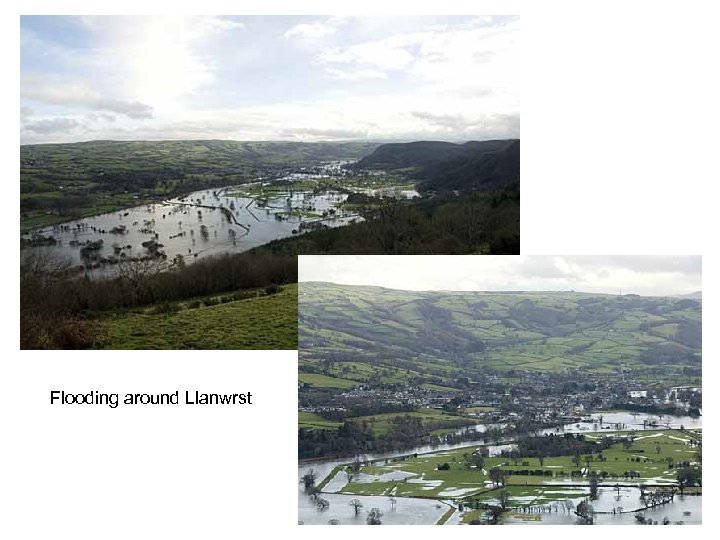
Flooding around Llanwrst
Minister calls for flood answers : Wednesday, 12 January, 2005, 07: 21 GMT Flooding in the Conwy Valley on Sunday Welsh Environment Minister Carwyn Jones is to visit the parts of the Conwy Valley on Friday affected by flooding last weekend. Mr Jones told the assembly that "it Watch the short video clip of must be very the Llanwrst Floods on distressing to be flooded for a second http: //www. youtube. com/wat time within a year". ch? v=nbh. M 2 Yakvt. A Weather forecaster Jeremy Plester, of the Press Association’s weather arm Meteogroup, said yesterday: “Over the weekend there will be heavy rain in North Wales at times. “There is going to be an awful lot of water in the North Wales’ hills and that is going to be entering the rivers. It’s been raining for the last 24 hours in North Wales and they have had several inches of rain in the last few days. He added: “You’re going to be looking at, in the high points of North Wales, up in Snowdonia, a good couple of inches over the next 24 hours and probably similar amounts for the 24 hours after that.
Conwy Valley - The communities of Llanrwst and Trefriw adjacent to the River Conwy have a recent history of flooding, with a major flood event occurring in February 2004, during which 125 mm of rainfall was recorded over a 14 hour period. A total of up to 50 properties flooded in Llanrwst and the villages of Trefriw, Dolwyddelan and Betws y Coed. Other flooding events occurred in September 2004 and January 2005. A search resumed yesterday for Sean Alexander Laxen, aged nine, who fell into a river while on a family holiday. Sean, from Norwich, who was with his mother and brother in Snowdonia, North Wales, fell into the River Conwy in Betws-y-Coed on Monday. A police underwater search team was joined by crews from Ogwen Valley mountain rescue team, the RAF and North Wales fire and rescue. The river is believed to be swollen after heavy rain. Carwyn Jones said: "I have witnessed the devastating emotional and economic effects of flooding on homes and businesses, and want everything possible to be done to ensure we minimise the increasing risk of flood damage. "As a result of flooding, communities may suffer from reduced property prices, increased insurance costs and low confidence, leading to a lack of investment and development. "Climate change is expected to lead to an increased risk of flooding in the future and in Wales, due to its particular geography, we are at risk from damaging floods with little or no prior warning. "
Professor Roger Falconer says climate change means incidents of such severe weather will increase so we must take flooding "much more seriously". He said Wales's mountainous terrain meant floods would happen faster than in flatter counties recently affected. And those living on flood plains should be encouraged to protect themselves. Emergency crews were bracing themselves for more floods in north west Wales as the river Conwy in Llanrwst rose nearly four feet in under two hours on Wednesday morning. More rain was forecast for later in the day, and an emergency team was making plans in the event of river levels continuing to rise. Mountainous Wales was very different to flatter counties across the border, such as Gloucestershire and Worcestershire, which were flooded. Of Wales's terrain, Prof Falconer said: "Water runs off quite quickly and runs down to the coast. This is an advantage for short-duration storms because the water washes away quickly. "The disadvantage is water gets into the river quickly. And floods occur much sooner. "
Possible strategies Forestry Commission At Llanrwst, they saw how floodplain woodlands can help to alleviate flooding problems in the Conwy Valley. 'Through the management of riparian woodlands in small streams and tributaries, water can be held up, reducing the chance of flooding further downstream, ' said Chris Jones, of Forest Research, an agency of Forestry Commission Wales. 'And obviously for a town like Llanrwst, which has suffered major flooding problems in recent times, this kind of work could make a real difference to future flood -defence measures and costs. ' From The National Trust In a new project, the trust is already working with farmers in the Upper Conwy area by changing land management to help restore the Migneint blanket bog, the source of the River Conwy. “This will help reduce erosion and the amount of peat entering the water course, ” he added. “A wetter bog will also be more resilient to climate change. ”
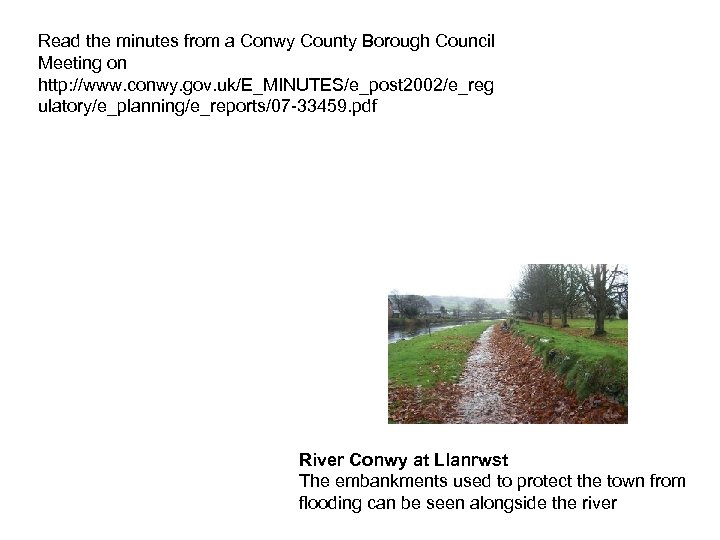
Read the minutes from a Conwy County Borough Council Meeting on http: //www. conwy. gov. uk/E_MINUTES/e_post 2002/e_reg ulatory/e_planning/e_reports/07 -33459. pdf River Conwy at Llanrwst The embankments used to protect the town from flooding can be seen alongside the river
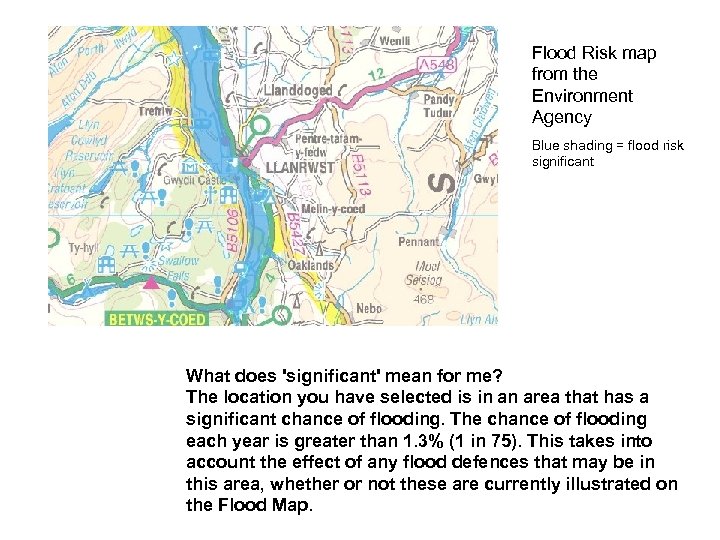
Flood Risk map from the Environment Agency Blue shading = flood risk significant What does 'significant' mean for me? The location you have selected is in an area that has a significant chance of flooding. The chance of flooding each year is greater than 1. 3% (1 in 75). This takes into account the effect of any flood defences that may be in this area, whether or not these are currently illustrated on the Flood Map.
Flood Preparedness – a guide Many more people in the UK are having problems with the damage caused from floods. This can be dangerous to them and it can cause a lot of damage to their homes and property. In some cases people may already know that their house is in an area at risk of flooding or may already have been flooded before. In these instances many people have already taken measures to protect their property against the effects of flooding again in the future. Some of these solutions will be permanent and some will be used if flooding becomes likely. For example, many people in this situation will: Buy barriers and/or sandbags that can be positioned outside a property to stop water getting in. Buy air brick covers that can be clipped on if flooding occurs. Buy flood boards that can be placed across doors and windows. Have silicone sealants at hand to seal up windows, doors and brickwork. Buy toilet/bathroom appliance covers/locks to stop water coming up through these appliances
If you live in an area where there has been flooding or you are at high risk then you can also look at having electrical outlets placed at a higher level on the ground floor to avoid problems if your ground floor does get flooded. If you are given a flood warning for your area then it is wise to plan ahead to try and protect your home's contents as much as possible. So, for example, you could: Move all of your valuables (i. e. electrical equipment, personal possessions and items of sentimental value) upstairs. Move as much of your furniture upstairs as you can. Heavy items can be raised on to blocks. Push your curtains to loop over their rail to keep them out of way of water. Take up any carpets or rugs that you can and put them upstairs. Drive your car somewhere with higher ground to get it out of the way. Move anything outside that might float off such as bins, plant pots, bikes and so on. Make sure that your pets are moved to a safer place.
Finally Task 8 Look at slides 32 to 36 – they illustrate some of the strategies which are being considered for the Conwy Valley and its flooding problems. Conduct your own research into strategies which may be used to alleviate flooding in an area. You may use the Conwy Valley or another drainage basin that has experienced flooding in the past. Write a report for your local newspaper including details of these flood management schemes and examine the effectiveness of them.
Скачать презентацию Fieldwork investigation based on Unit G 1 Theme
36acd1f5a145bbbc30bac90fd041f078.ppt