


 Скачать презентацию Field Of View Introductory Presentation Opening Activity
fee053fcbcb3e3582378f0e804ac7f80.ppt
- Количество слайдов: 12
 Field Of View Introductory Presentation
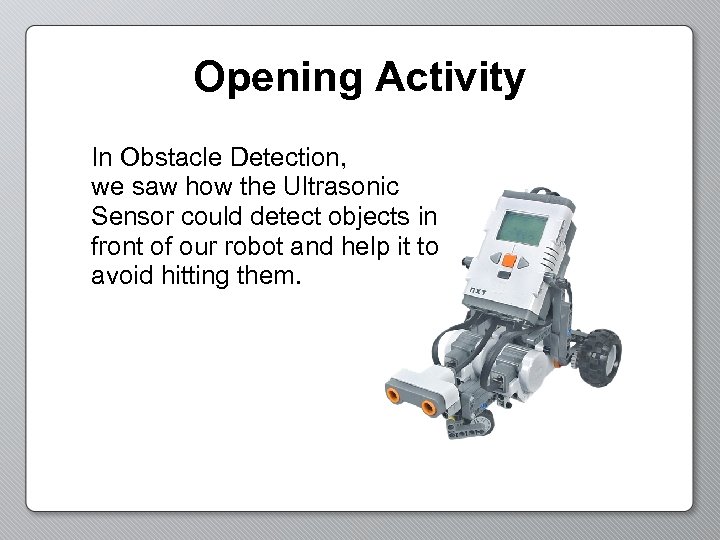 Opening Activity In Obstacle Detection, we saw how the Ultrasonic Sensor could detect objects in front of our robot and help it to avoid hitting them.
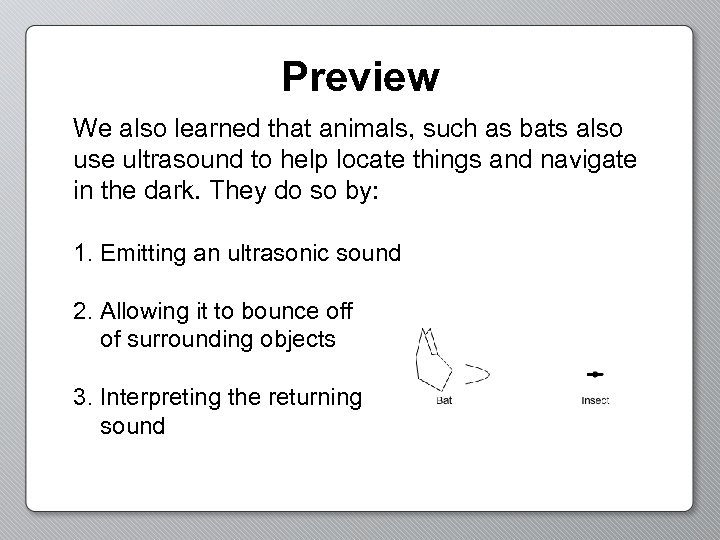 Preview We also learned that animals, such as bats also use ultrasound to help locate things and navigate in the dark. They do so by: 1. Emitting an ultrasonic sound 2. Allowing it to bounce off of surrounding objects 3. Interpreting the returning sound
 Preview How does the bat know what is around it? 1. How long it takes the sound to return 2. If the sound has changed in frequency 3. Which ear heard the returning sound first
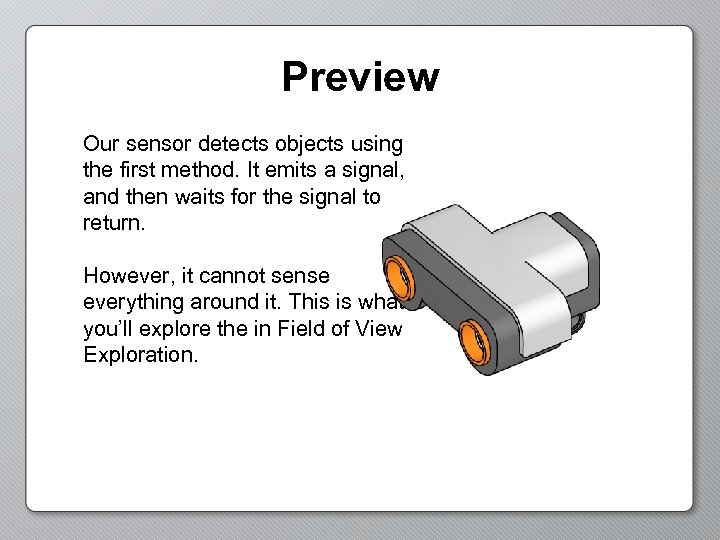 Preview Our sensor detects objects using the first method. It emits a signal, and then waits for the signal to return. However, it cannot sense everything around it. This is what you’ll explore the in Field of View Exploration.
 Preview: Scale Before you start the activity, you’ll need to be familiar with creating scale models. A scale model is a representation of an actual object that is different in size.
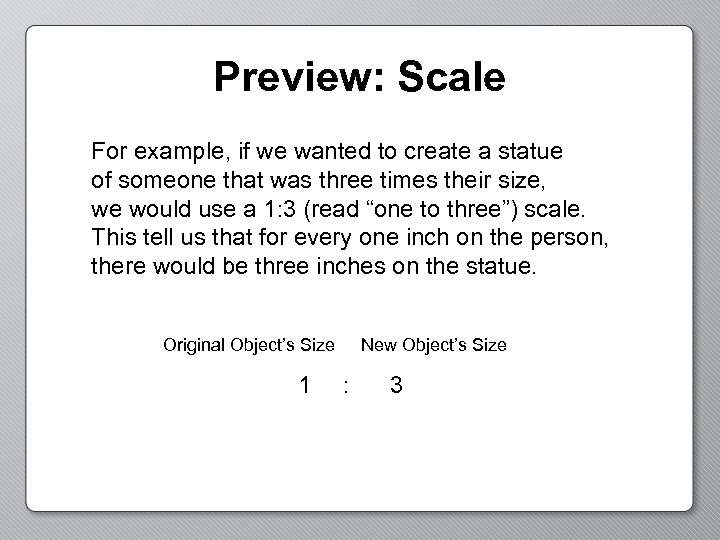 Preview: Scale For example, if we wanted to create a statue of someone that was three times their size, we would use a 1: 3 (read “one to three”) scale. This tell us that for every one inch on the person, there would be three inches on the statue. Original Object’s Size 1 New Object’s Size : 3
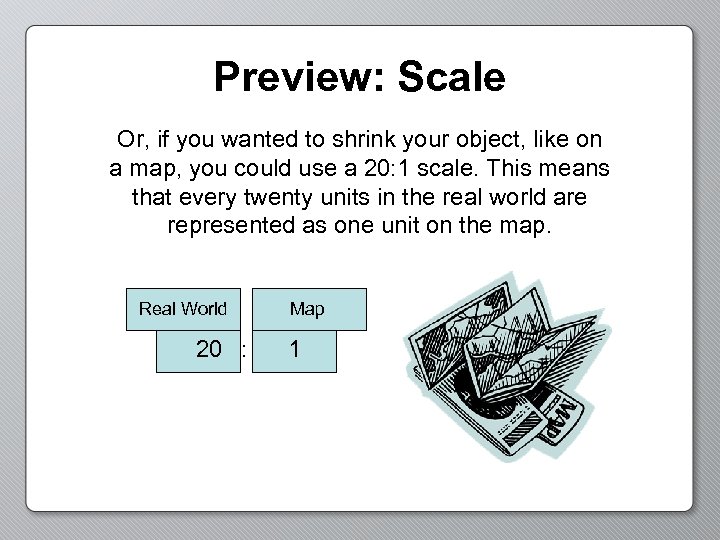 Preview: Scale Or, if you wanted to shrink your object, like on a map, you could use a 20: 1 scale. This means that every twenty units in the real world are represented as one unit on the map. Real World 20 : Map 1
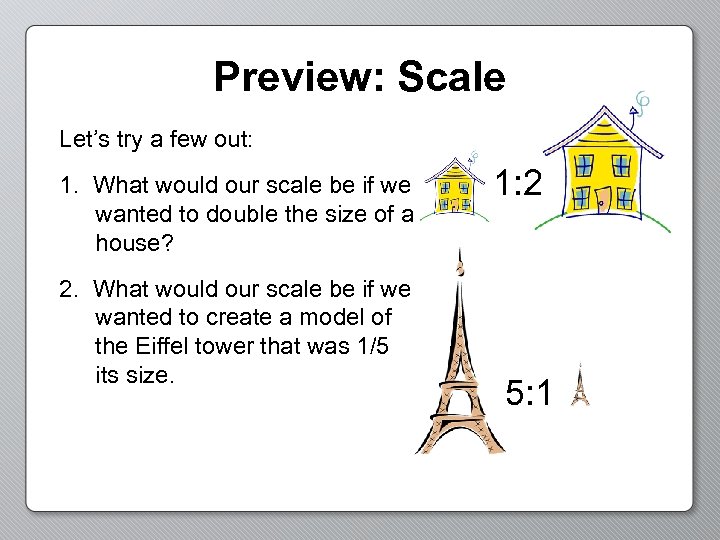 Preview: Scale Let’s try a few out: 1. What would our scale be if we wanted to double the size of a house? 2. What would our scale be if we wanted to create a model of the Eiffel tower that was 1/5 its size. 1: 2 5: 1
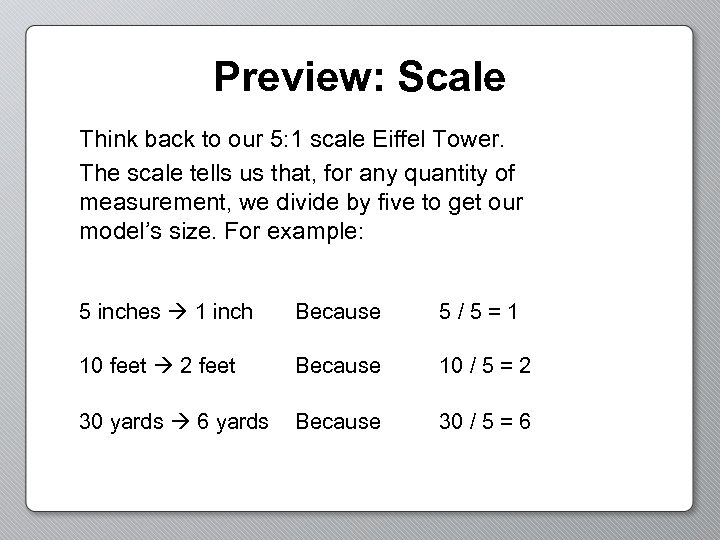 Preview: Scale Think back to our 5: 1 scale Eiffel Tower. The scale tells us that, for any quantity of measurement, we divide by five to get our model’s size. For example: 5 inches 1 inch Because 5/5=1 10 feet 2 feet Because 10 / 5 = 2 30 yards 6 yards Because 30 / 5 = 6
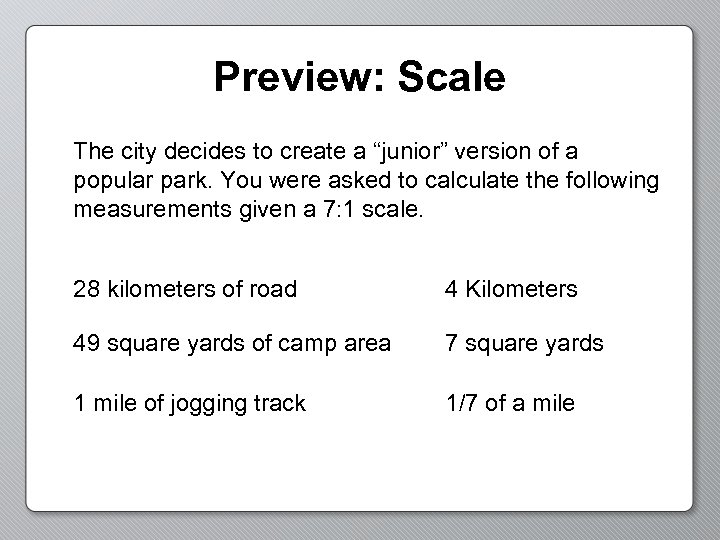 Preview: Scale The city decides to create a “junior” version of a popular park. You were asked to calculate the following measurements given a 7: 1 scale. 28 kilometers of road 4 Kilometers 49 square yards of camp area 7 square yards 1 mile of jogging track 1/7 of a mile
 Good Luck! Now you have the necessary knowledge to get started in the Field Of View Exploration.