 Скачать презентацию Field evaluation of an advanced brake warning system
0d629e9273901e0f6cd2456309cb875d.ppt
- Количество слайдов: 13



Field evaluation of an advanced brake warning system David Shinar Human Factors 1995 Presented by: Derrick Smets
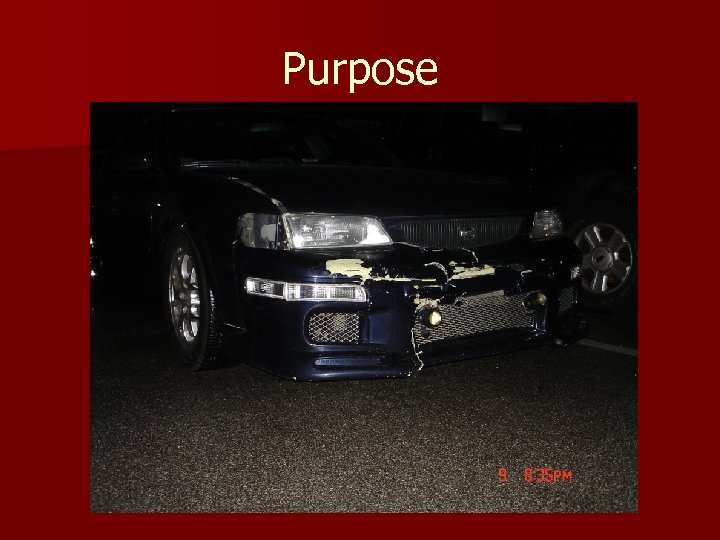
Overview n With rear end collisions constituting more than ¼ of all multiple vehicle crashes, new research into preventative measures is needed n One possible solution is an Advanced Brake Warning system (ABW) n This study presents the facts regarding the Red Alert ABW system manufactured by Baran Advance Technologies in Isreal
Purpose
Purpose
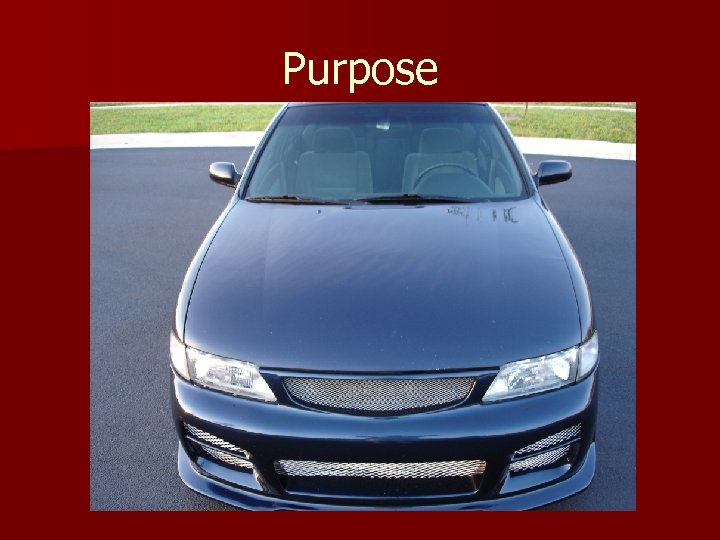
Purpose n To validate the use of an ABW system to aid the existing warning systems. – Third Brake Light n To test the ABW system in different vehicles with different transmissions (auto and manual) to see if there is a significant difference in use of the ABW system between vehicle types
Background n For over 25 years researchers have been developing and testing ideas for ways to prevent traffic accidents from occurring n Many improvements have been implemented, such as the high mounted third brake light, but there is still need to further develop ways to prevent accidents from occuring
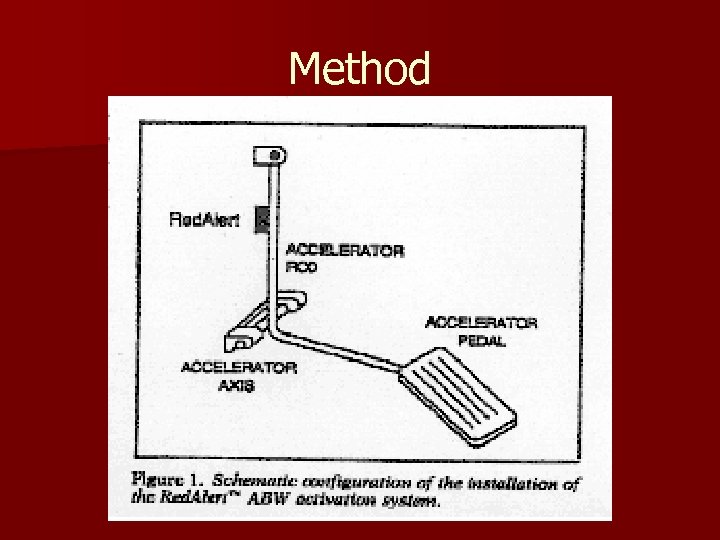
Method
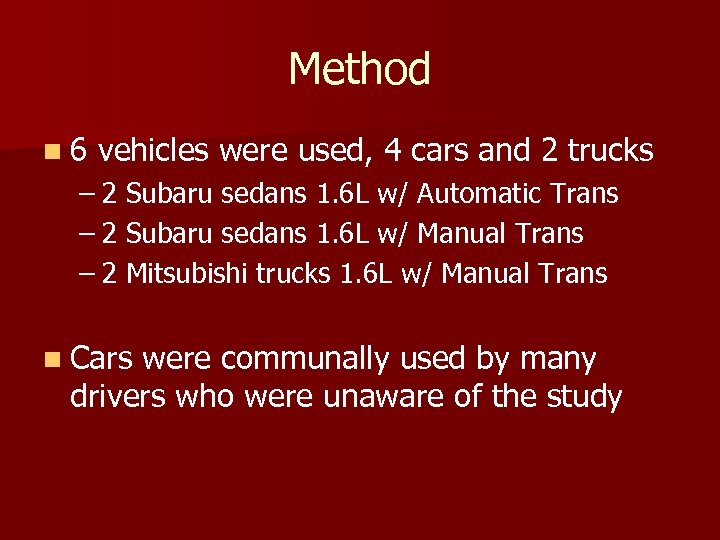
Method n 6 vehicles were used, 4 cars and 2 trucks – 2 Subaru sedans 1. 6 L w/ Automatic Trans – 2 Subaru sedans 1. 6 L w/ Manual Trans – 2 Mitsubishi trucks 1. 6 L w/ Manual Trans n Cars were communally used by many drivers who were unaware of the study
Method n 5 things recorded – Total number of braking actions – Total number of ABW activations – Number of braking actions lasting less that 1 second – Number of ABW activations followed by braking lasting less than 1 second
Results
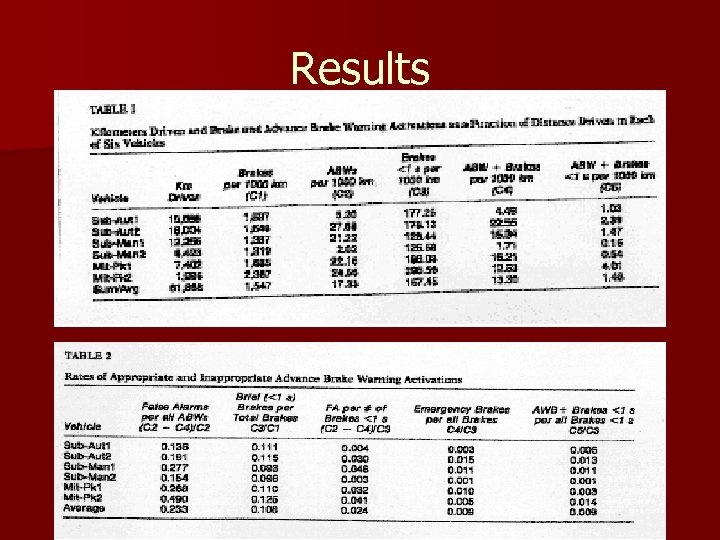
Analysis n Tests were run to determine the significance of parameters – Brake applications and short brake applications were significantly correlated to distance driven (r=0. 96 and r=0. 89) – Abrupt braking and distance where not significantly correlated, due to either frequency of emergency braking needed, or driving style
Conclusions n Over a period of 61, 668 km (38319 miles) the false alarm rate of this ABW system was only 4 times per 1000 km n Compared to the average number of times the brakes were pressed for less than a second, which was 167 times per 1000, this system did not pose a threat to traffic safety, and could be a big benefit to any following motorist
Future n Study with this ABW system to determine if it statistically improves traffic safety n Radar based sensors for detecting rapid change in surrounding vehicle speed – Mercedes new S class – Cruise control
Скачать презентацию Field evaluation of an advanced brake warning system
0d629e9273901e0f6cd2456309cb875d.ppt