


 Скачать презентацию Field emission in SRF Cavities With the European
bcde822cd3fb926db286f9a04ceedf40.ppt
- Количество слайдов: 32
 Field emission in SRF Cavities With the European XFEL + FLASH cavities (beta=1) as reference Svem Lederer, Detlef Reschke Berlin, Dec 18, 2012
 Outline > Introduction § Practical limitations of SRF cavities § Field emission > Cavity surface preparation > Handling and assembly > Some results of RF tests Sven Lederer, Detlef Reschke| Field emission in SRF cavities| Dec 18 th, 2012 | Page 2
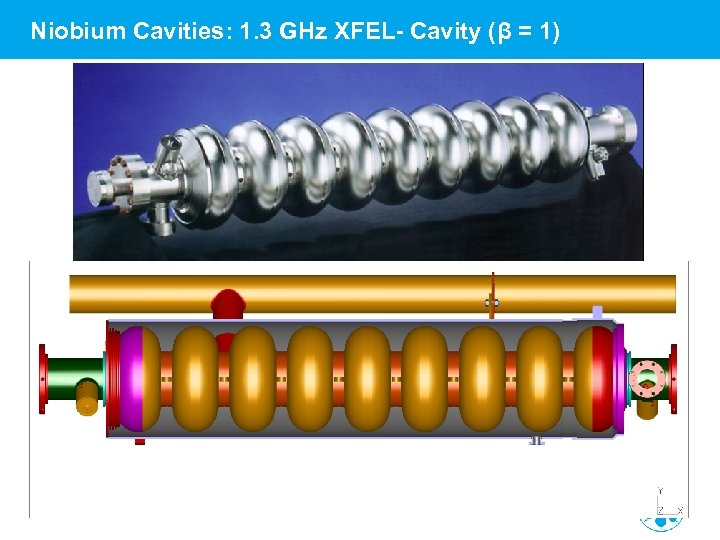 Niobium Cavities: 1. 3 GHz XFEL- Cavity (β = 1) Detlef Reschke| High Gradients in SRF Cavities | April 3 rd, 2012 | Page 3
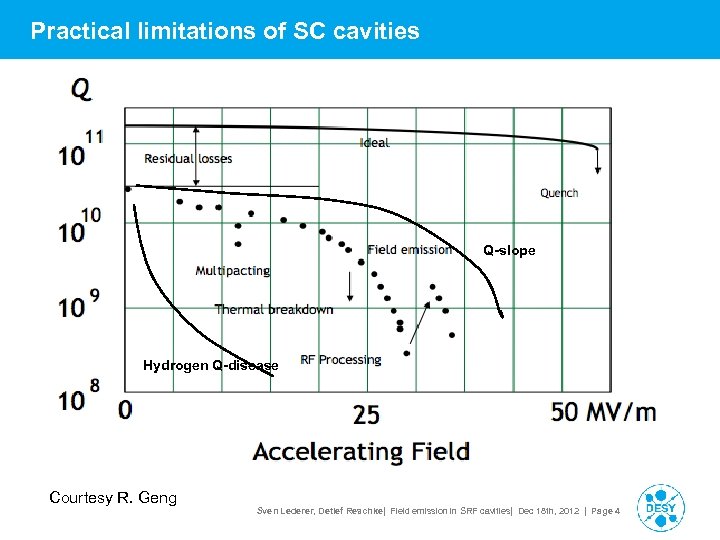 Practical limitations of SC cavities > text Q-slope Hydrogen Q-disease Courtesy R. Geng Sven Lederer, Detlef Reschke| Field emission in SRF cavities| Dec 18 th, 2012 | Page 4
 Practical limitations > Local thermal (or magnetic) breakdown => “Quench” > Q-drop (without field emission) + Q-slope (at medium field) > Field emission > Multipacting > Hydrogen Q-disease > Increased residual resistance Sven Lederer, Detlef Reschke| Field emission in SRF cavities| Dec 18 th, 2012 | Page 5
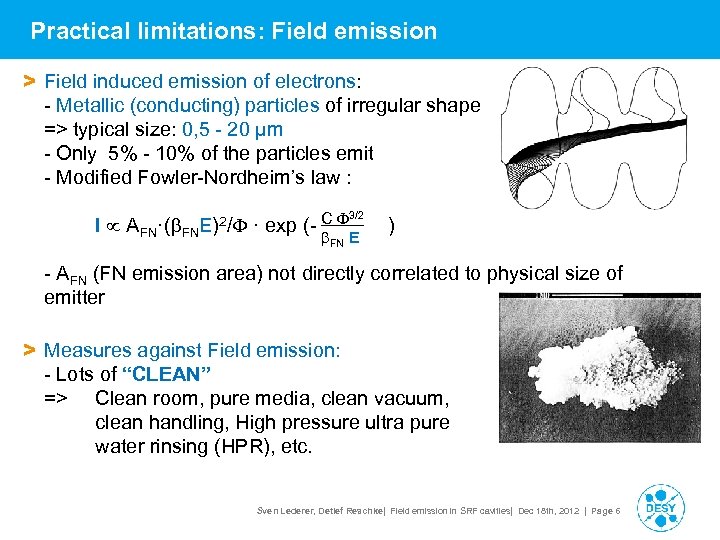 Practical limitations: Field emission > Field induced emission of electrons: - Metallic (conducting) particles of irregular shape; => typical size: 0, 5 - 20 µm - Only 5% - 10% of the particles emit - Modified Fowler-Nordheim’s law : I AFN·( FN E)2/ · exp (- C 3/2 FN E ) - AFN (FN emission area) not directly correlated to physical size of emitter > Measures against Field emission: - Lots of “CLEAN” => Clean room, pure media, clean vacuum, clean handling, High pressure ultra pure water rinsing (HPR), etc. Sven Lederer, Detlef Reschke| Field emission in SRF cavities| Dec 18 th, 2012 | Page 6
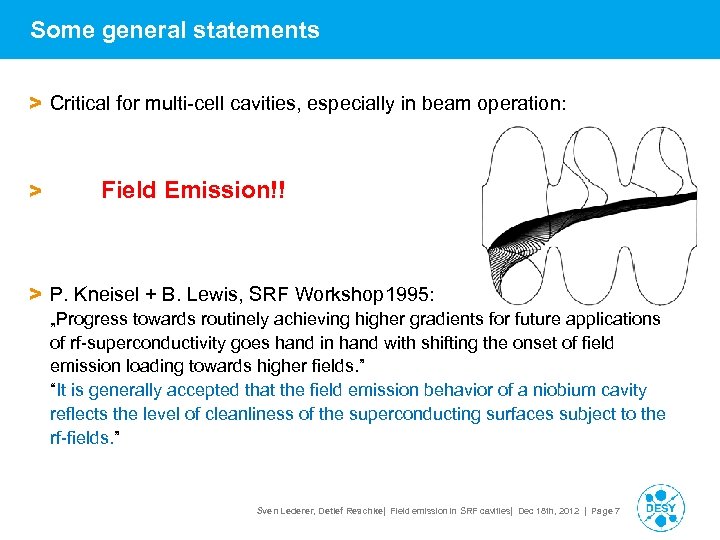 Some general statements > Critical for multi-cell cavities, especially in beam operation: > Field Emission!! > P. Kneisel + B. Lewis, SRF Workshop 1995: „Progress towards routinely achieving higher gradients for future applications of rf-superconductivity goes hand in hand with shifting the onset of field emission loading towards higher fields. ” “It is generally accepted that the field emission behavior of a niobium cavity reflects the level of cleanliness of the superconducting surfaces subject to the rf-fields. ” Sven Lederer, Detlef Reschke| Field emission in SRF cavities| Dec 18 th, 2012 | Page 7
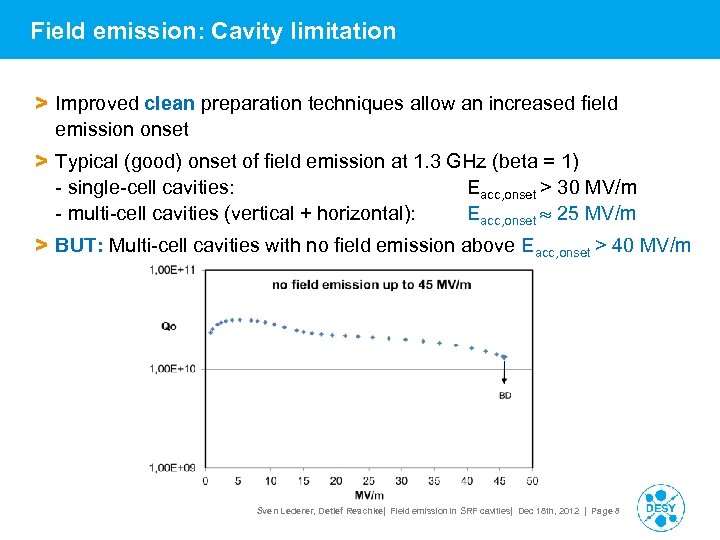 Field emission: Cavity limitation > Improved clean preparation techniques allow an increased field emission onset > Typical (good) onset of field emission at 1. 3 GHz (beta = 1) - single-cell cavities: Eacc, onset > 30 MV/m - multi-cell cavities (vertical + horizontal): Eacc, onset 25 MV/m > BUT: Multi-cell cavities with no field emission above Eacc, onset > 40 MV/m Sven Lederer, Detlef Reschke| Field emission in SRF cavities| Dec 18 th, 2012 | Page 8
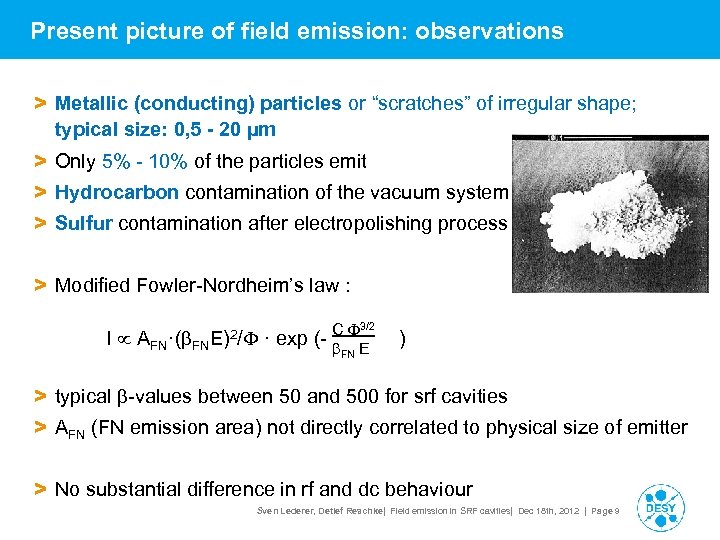 Present picture of field emission: observations > Metallic (conducting) particles or “scratches” of irregular shape; typical size: 0, 5 - 20 µm > Only 5% - 10% of the particles emit > Hydrocarbon contamination of the vacuum system > Sulfur contamination after electropolishing process > Modified Fowler-Nordheim’s law : I AFN·( FN E)2/ · exp (- C 3/2 FN E ) > typical -values between 50 and 500 for srf cavities > AFN (FN emission area) not directly correlated to physical size of emitter > No substantial difference in rf and dc behaviour Sven Lederer, Detlef Reschke| Field emission in SRF cavities| Dec 18 th, 2012 | Page 9
 Cavity surface preparation > Standard process for FLASH and European XFEL cavities: - US: Ultrasonic cleaning (very important for pre-cleaning and components) - BCP/EP: etching/electropolishing - HPR: High pressure ultra pure water rinse - pumping systems, leak check and venting installations - tooling for handling and assembly - furnaces: 120 C “bake” (=> Q-drop cure), 800 C firing (=> hydrogen degassing, mechanical stress release (>1200 C postpurification with getter material) > Alternative process approaches: - Tumbling (Centrifugal barrel polishing) - Megasonic - Dry-ice cleaning Sven Lederer, Detlef Reschke| Field emission in SRF cavities| Dec 18 th, 2012 | Page 10
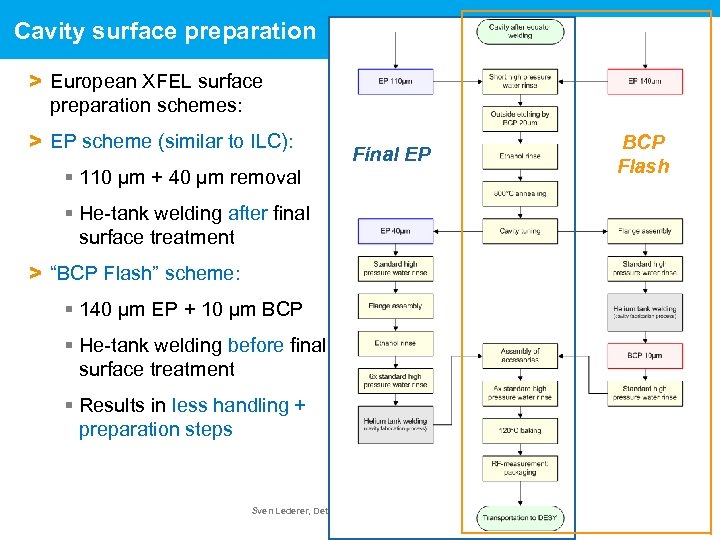 Cavity surface preparation > European XFEL surface preparation schemes: > EP scheme (similar to ILC): § 110 µm + 40 µm removal Final EP BCP Flash § He-tank welding after final surface treatment > “BCP Flash” scheme: § 140 µm EP + 10 µm BCP § He-tank welding before final surface treatment § Results in less handling + preparation steps Sven Lederer, Detlef Reschke| Field emission in SRF cavities| Dec 18 th, 2012 | Page 11
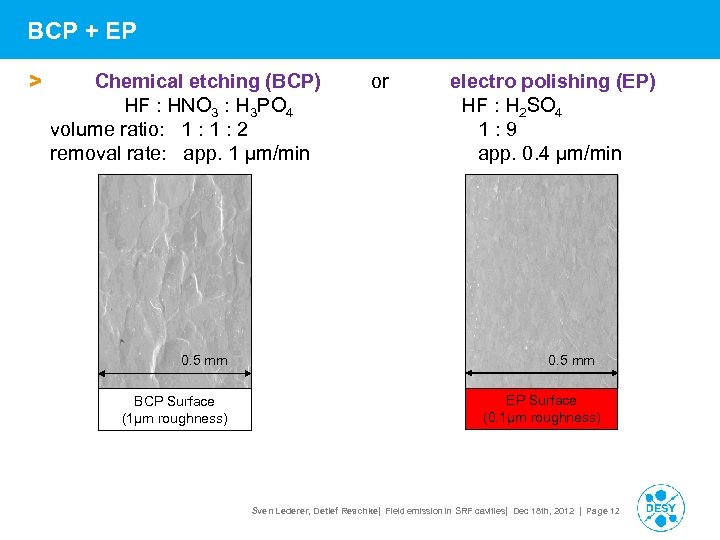 BCP + EP > Chemical etching (BCP) HF : HNO 3 : H 3 PO 4 volume ratio: 1 : 2 removal rate: app. 1 µm/min 0. 5 mm BCP Surface (1µm roughness) or electro polishing (EP) HF : H 2 SO 4 1: 9 app. 0. 4 µm/min 0. 5 mm EP Surface (0. 1µm roughness) Sven Lederer, Detlef Reschke| Field emission in SRF cavities| Dec 18 th, 2012 | Page 12
 BCP + EP (ctd. ) > no cleaning, but surface removal > Typically: “main” treatment: 100 – 140 µm final removal 10 - 40 µm > no (weak) removal of e. g. grease, plastics > closed system with integrated DI-/pure water rinsing > acid quality: “pro analysi” or better > Systems are well established, but environmental and safety critical > EP requires ethanol (or special detergent) rinse in order to remove sulphur contamination Sven Lederer, Detlef Reschke| Field emission in SRF cavities| Dec 18 th, 2012 | Page 13
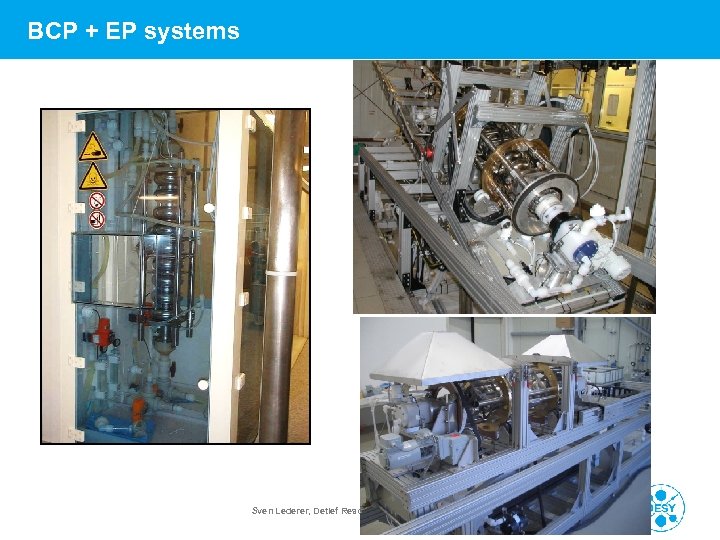 BCP + EP systems Sven Lederer, Detlef Reschke| Field emission in SRF cavities| Dec 18 th, 2012 | Page 14
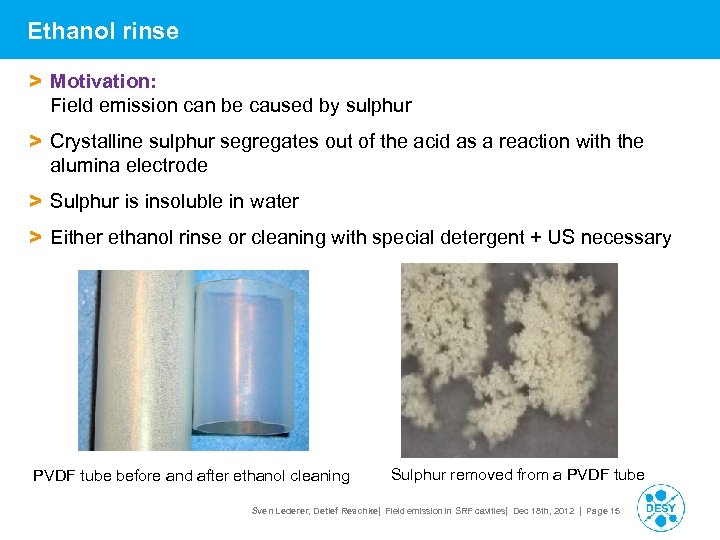 Ethanol rinse > Motivation: Field emission can be caused by sulphur > Crystalline sulphur segregates out of the acid as a reaction with the alumina electrode > Sulphur is insoluble in water > Either ethanol rinse or cleaning with special detergent + US necessary PVDF tube before and after ethanol cleaning Sulphur removed from a PVDF tube Sven Lederer, Detlef Reschke| Field emission in SRF cavities| Dec 18 th, 2012 | Page 15
 High pressure ultra pure water rinsing > High pressure ultra pure water rinsing (cleanroom cl. 10 - 100) § repeated inside rinsing i) after final surface treatment (1 x) ii) after final assembly of cavity (> 3 x) § ultra pure water with p = (80 - 150) bar § no moving parts inside the cavity § well adjusted amount of water for high cleaning efficiency § outside rinsing maybe helpful to avoid transport of contamination into the assembly area > check of particles (+ TOC) of HPR supply water check of drain water as QC of rinsing effect ? Sven Lederer, Detlef Reschke| Field emission in SRF cavities| Dec 18 th, 2012 | Page 16
 High pressure ultra pure water rinsing (HPR) > HPR is the final cleaning step of the cavity preparation process > What does that mean? § If have not removed the critical contamination up to now, it will stay § Afterwards it will not become better, only worse > Set-up § HPR stand in ISO 4 / 5 § no moving parts inside the cavity § adequate materials (HPR pump!) for high pressure + ultra pure water => not all stainless steels are qualified § final filter (< 0. 1 µm) between HPR pump + spraying head > outside rinsing maybe helpful to avoid transport of contamination into the assembly area Sven Lederer, Detlef Reschke| Field emission in SRF cavities| Dec 18 th, 2012 | Page 17
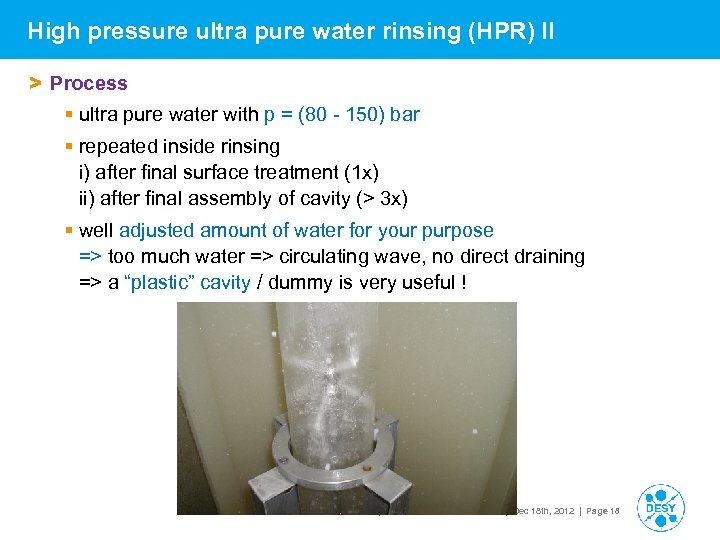 High pressure ultra pure water rinsing (HPR) II > Process § ultra pure water with p = (80 - 150) bar § repeated inside rinsing i) after final surface treatment (1 x) ii) after final assembly of cavity (> 3 x) § well adjusted amount of water for your purpose => too much water => circulating wave, no direct draining => a “plastic” cavity / dummy is very useful ! Sven Lederer, Detlef Reschke| Field emission in SRF cavities| Dec 18 th, 2012 | Page 18
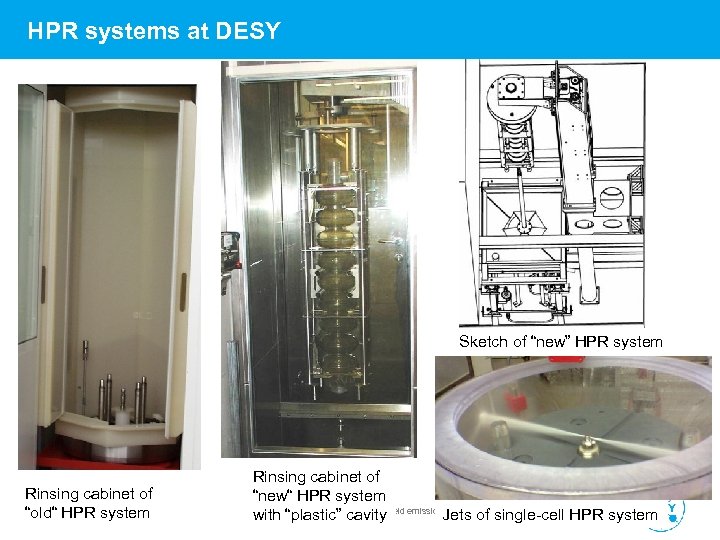 HPR systems at DESY Sketch of “new” HPR system Rinsing cabinet of “old“ HPR system Rinsing cabinet of “new“ HPR system Sven Lederer, Detlef Reschke| Field emission in SRF cavities| Dec 18 th, 2012 | Page 19 Jets of single-cell HPR system with “plastic” cavity
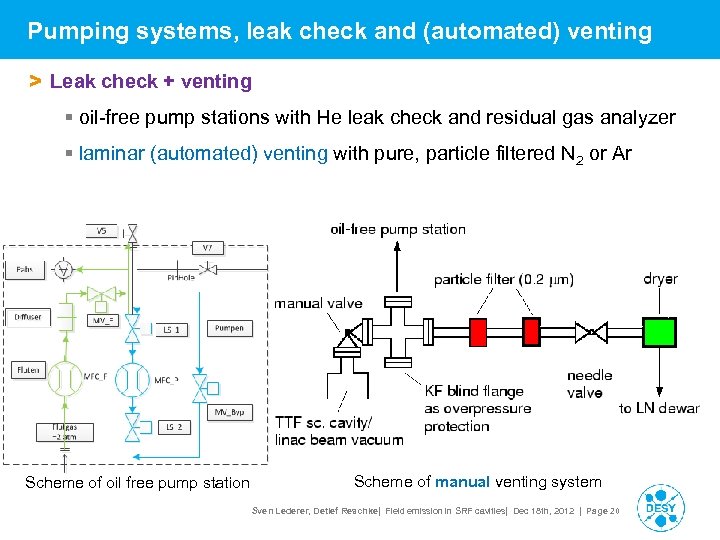 Pumping systems, leak check and (automated) venting > Leak check + venting § oil-free pump stations with He leak check and residual gas analyzer § laminar (automated) venting with pure, particle filtered N 2 or Ar Scheme of oil free pump station Scheme of manual venting system Sven Lederer, Detlef Reschke| Field emission in SRF cavities| Dec 18 th, 2012 | Page 20
 Automated venting + pumping > Motivation of automated venting + pumping § Avoid particle transport from outside into the vacuum system and particles already in the vacuum system should not be moved § For abs. pressure p > 1 mbar and differential pressure Δp > 1 mbar (e. g. opening of valves, start pumping) => movement of particles observed § For abs. pressure p < 1 mbar => no movement of particles observed § Manual needle valves cannot safely avoid particle transport Sven Lederer, Detlef Reschke| Field emission in SRF cavities| Dec 18 th, 2012 | Page 21
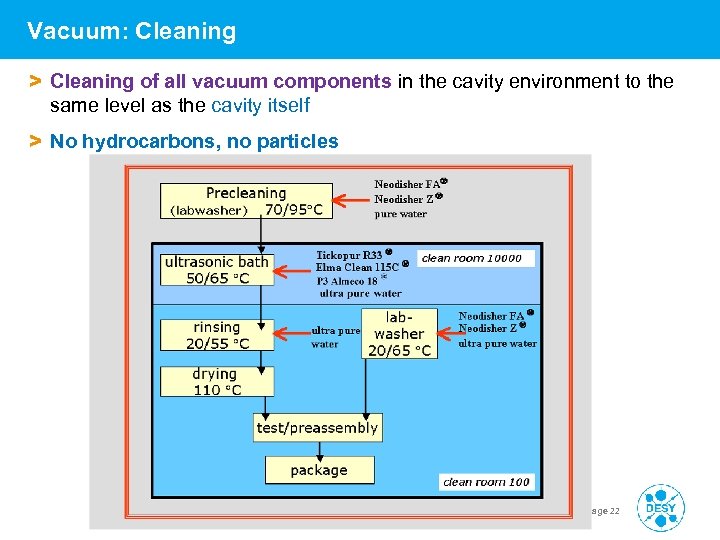 Vacuum: Cleaning > Cleaning of all vacuum components in the cavity environment to the same level as the cavity itself > No hydrocarbons, no particles Sven Lederer, Detlef Reschke| Field emission in SRF cavities| Dec 18 th, 2012 | Page 22
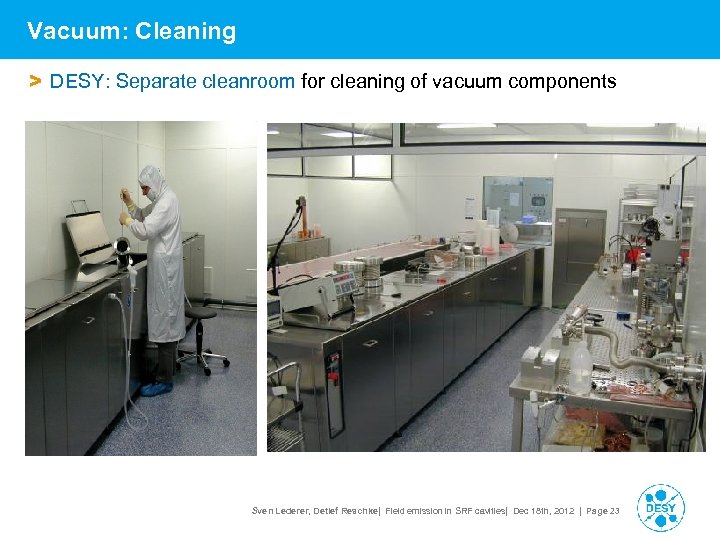 Vacuum: Cleaning > DESY: Separate cleanroom for cleaning of vacuum components Sven Lederer, Detlef Reschke| Field emission in SRF cavities| Dec 18 th, 2012 | Page 23
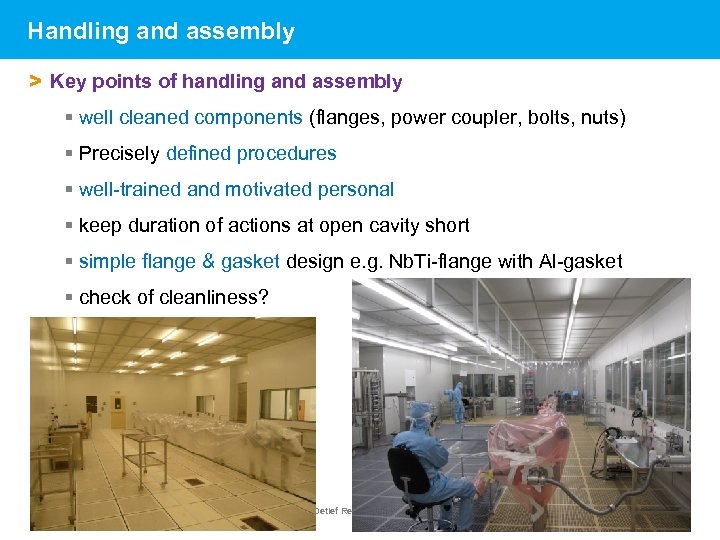 Handling and assembly > Key points of handling and assembly § well cleaned components (flanges, power coupler, bolts, nuts) § Precisely defined procedures § well-trained and motivated personal § keep duration of actions at open cavity short § simple flange & gasket design e. g. Nb. Ti-flange with Al-gasket § check of cleanliness? Sven Lederer, Detlef Reschke| Field emission in SRF cavities| Dec 18 th, 2012 | Page 24
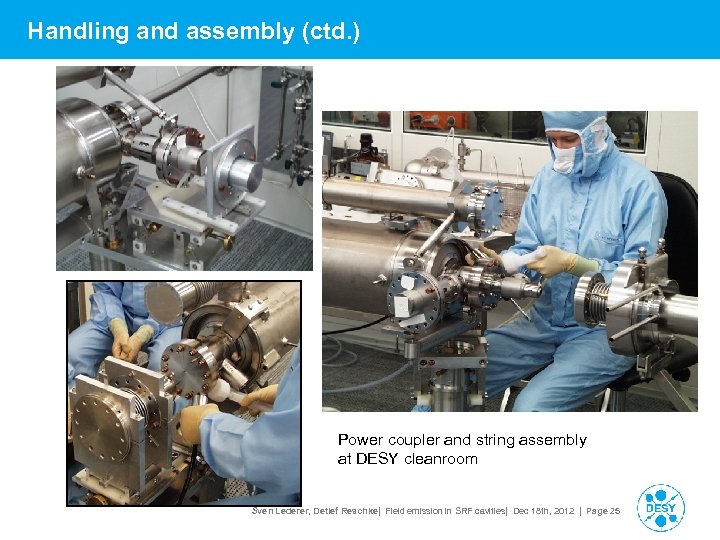 Handling and assembly (ctd. ) Power coupler and string assembly at DESY cleanroom Sven Lederer, Detlef Reschke| Field emission in SRF cavities| Dec 18 th, 2012 | Page 25
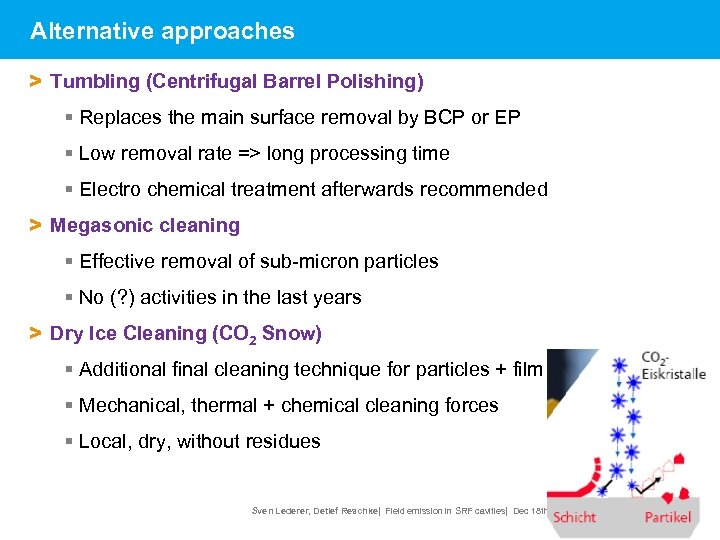 Alternative approaches > Tumbling (Centrifugal Barrel Polishing) § Replaces the main surface removal by BCP or EP § Low removal rate => long processing time § Electro chemical treatment afterwards recommended > Megasonic cleaning § Effective removal of sub-micron particles § No (? ) activities in the last years > Dry Ice Cleaning (CO 2 Snow) § Additional final cleaning technique for particles + film contaminations § Mechanical, thermal + chemical cleaning forces § Local, dry, without residues Sven Lederer, Detlef Reschke| Field emission in SRF cavities| Dec 18 th, 2012 | Page 26
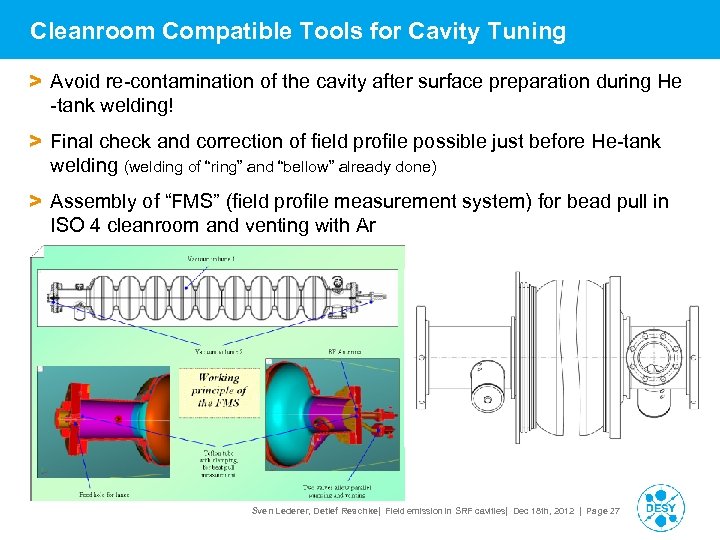 Cleanroom Compatible Tools for Cavity Tuning > Avoid re-contamination of the cavity after surface preparation during He -tank welding! > Final check and correction of field profile possible just before He-tank welding (welding of “ring” and “bellow” already done) > Assembly of “FMS” (field profile measurement system) for bead pull in ISO 4 cleanroom and venting with Ar Sven Lederer, Detlef Reschke| Field emission in SRF cavities| Dec 18 th, 2012 | Page 27
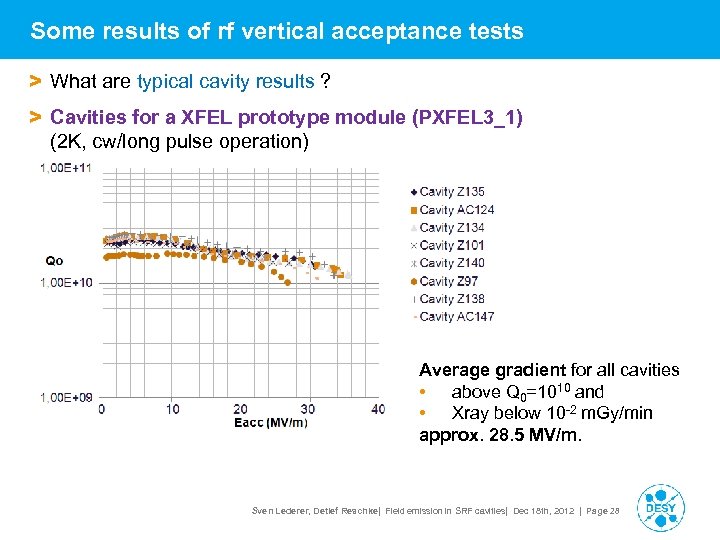 Some results of rf vertical acceptance tests > What are typical cavity results ? > Cavities for a XFEL prototype module (PXFEL 3_1) (2 K, cw/long pulse operation) Average gradient for all cavities • above Q 0=1010 and • Xray below 10 -2 m. Gy/min approx. 28. 5 MV/m. Sven Lederer, Detlef Reschke| Field emission in SRF cavities| Dec 18 th, 2012 | Page 28
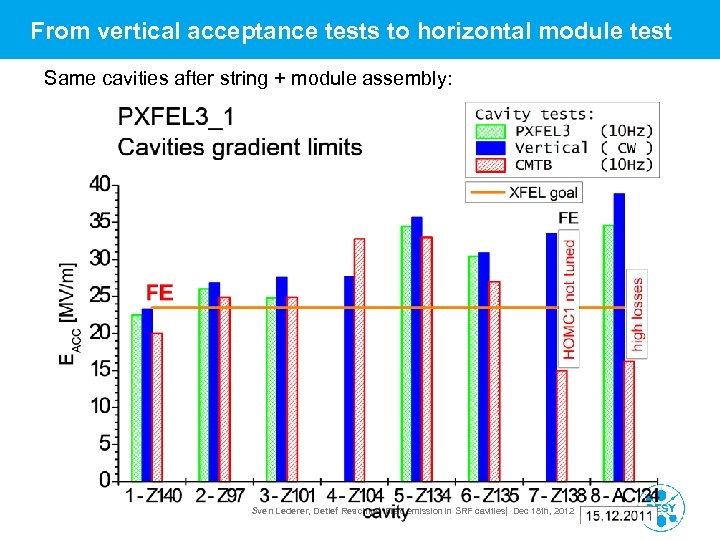 From vertical acceptance tests to horizontal module test Same cavities after string + module assembly: Sven Lederer, Detlef Reschke| Field emission in SRF cavities| Dec 18 th, 2012 | Page 29
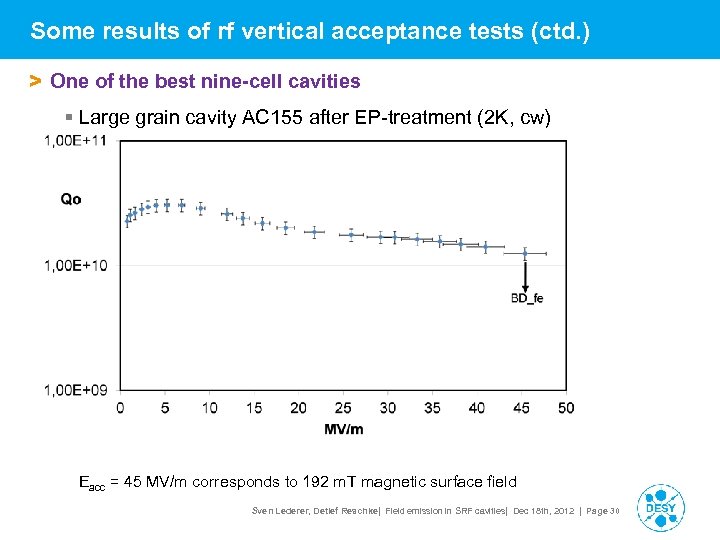 Some results of rf vertical acceptance tests (ctd. ) > One of the best nine-cell cavities § Large grain cavity AC 155 after EP-treatment (2 K, cw) Eacc = 45 MV/m corresponds to 192 m. T magnetic surface field Sven Lederer, Detlef Reschke| Field emission in SRF cavities| Dec 18 th, 2012 | Page 30
 Conclusion > Field emission may limit SRF cavity performance > Essential countermeasures § Cleaning § Handling § Proper pumping and venting > By means of the current established procedures the required quality of SRF cavities for XFEL is achieved. Sven Lederer, Detlef Reschke| Field emission in SRF cavities| Dec 18 th, 2012 | Page 31
 Thank you ! Thanks to all colleagues for their support and transparencies. The end ! Sven Lederer, Detlef Reschke| Field emission in SRF cavities| Dec 18 th, 2012 | Page 32