 Скачать презентацию ФГБОУ ВПО Ярославский государственный педагогический университет им К
Stylistics as a Branch of Linguistics.pptx
- Количество слайдов: 28



ФГБОУ ВПО Ярославский государственный педагогический университет им. К. Д. Ушинского Кафедра английского языка СЛАЙД-ЛЕКЦИЯ по дисциплине «Стилистике английского языка» на тему «Стилистика как раздел языкознания» Разработала: ст. пр. Слободская Ю. В.
Traditional Branches of Linguistics • phonetics deals with speech sounds and intonation, • lexicology treats words, their meaning and vocabulary structure, • grammar analyses forms of words and their function in a sentence which is studied by syntax.
Definition of ‘style’ by Academician V. V. Vinogradov Style is "socially recognized and functionally conditioned internally united totality of the ways of using, selecting and combining the means of lingual intercourse in the sphere of one national language or another. . . "
Definition of ‘style’ by Prof. I. R. Galperin Style is "a system of interrelated language means which serves a definite aim in communication. "
Definition of ‘style’ by Prof. Y. M. Skrebnev “Style is what differentiates a group of homogeneous texts (an individual text) from all other groups (other texts). . . Style can be roughly defined as the peculiarity, the set of specific features of a text type or of a specific text. "
Prof. I. R. Galperin’s Classification of Styles 1) belles-lettres style: poetry, emotive prose, and drama; 2) publicist style: oratory and speeches, essay, articles; 3) newspaper style: brief news items, headlines, advertisements, editorial; 4) scientific prose style; 5) official documents style.
Prof. I. V. Arnold ’s Classification of Styles 1) poetic style; 2) scientific style; 3) newspaper style; 4) colloquial style.
Definition of Stylistics is a branch of linguistics which studies the principles, and effect of choice and usage of different language elements in rendering thought and emotion under different conditions of communication.
Issues of Stylistics 1) the aesthetic function of language; 2) expressive means in language; 3) synonymous ways of rendering one and the same idea; 4) emotional colouring in language; 5) a system of special devices called stylistic devices; 6) the splitting of the literary language into separate systems called style; 7) the interrelation between language and thought; 8) the individual manner of an author in making use of the language
Types of Stylistics 1) Stylistics of language or linguistic stylistics analyses permanent or inherent stylistic properties of language elements. 2) Stylistics of speech or literary stylistics studies stylistic properties, which appear in a context or adherent stylistic properties of language elements.
The Dichotomy of "language and speech" • language is a system of elementary and complex signs: phonemes, morphemes, word combinations, utterances and combinations of utterances. • speech is a process of combining these linguistic elements into linear linguistic units.
Types of Stylistic Research • literary stylistics • lingua-stylistics
Areas of Cross-reference between Types of Stylistic Research 1) the literary language from the point of view of its variability; 2) the idiolect (individual speech) of a writer; 3) poetic speech that has its own specific laws
Literary Stylistics a) functional styles (in their development and current state); b) the linguistic nature of the expressive means of the language, their systematic character and their functions.
Lingua-stylistics a) the composition of a work of art; b) various literary genres; c) the writer's outlook.
Branches of Stylistics • • • Comparative stylistics Decoding stylistics Functional stylistics Stylistic lexicology Stylistic phonetics Stylistic grammar
Stylistics and other linguistic disciplines • • Semasiology; Onomasiology; The theory of functional styles; literary studies (the theory of imagery, literary genres, the art of composition); • culture studies (the history of art, aesthetic trends and even information theory).
Stylistic Neutrality and Stylistic Colouring • style is deviation from the lingual norm (G. Leech, M. Riffaterre, M. Halliday, R. Jacobson ); • since there is a variety of sublanguages within a national language each of them has a norm of its own (Y. M. Skrebnev).
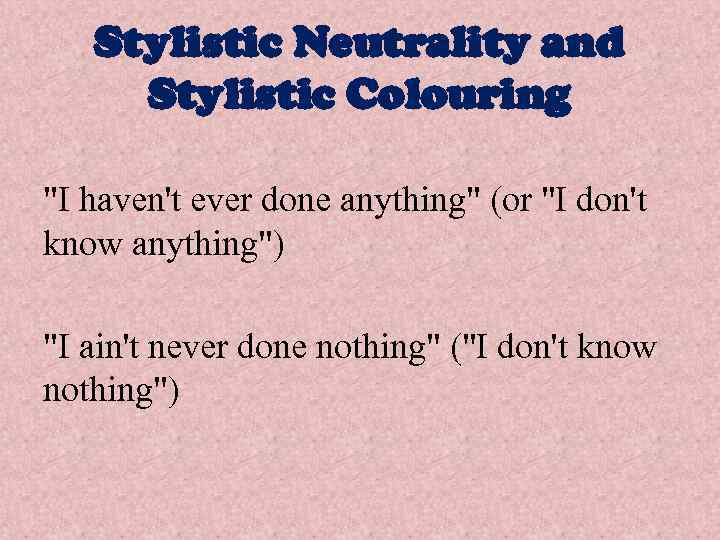
Stylistic Neutrality and Stylistic Colouring "I haven't ever done anything" (or "I don't know anything") "I ain't never done nothing" ("I don't know nothing")
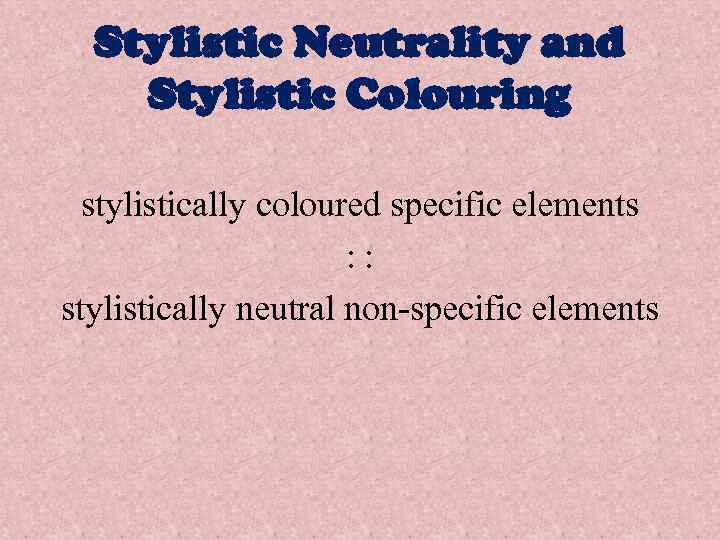
Stylistic Neutrality and Stylistic Colouring stylistically coloured specific elements : : stylistically neutral non-specific elements
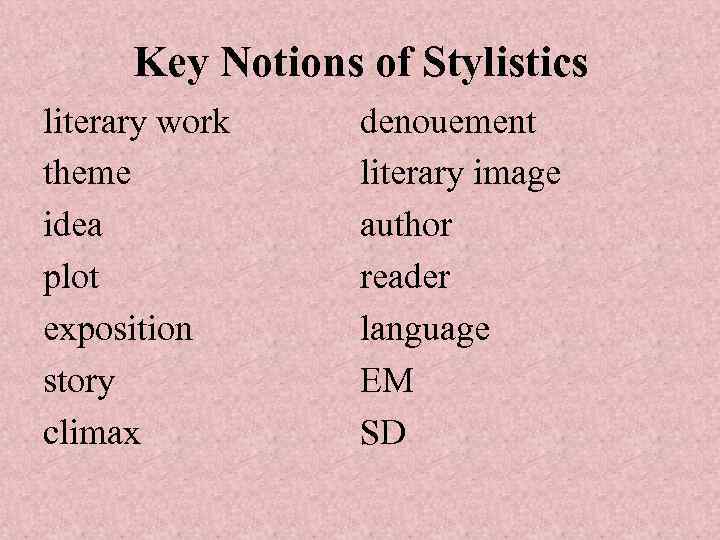
Key Notions of Stylistics literary work theme idea plot exposition story climax denouement literary image author reader language EM SD
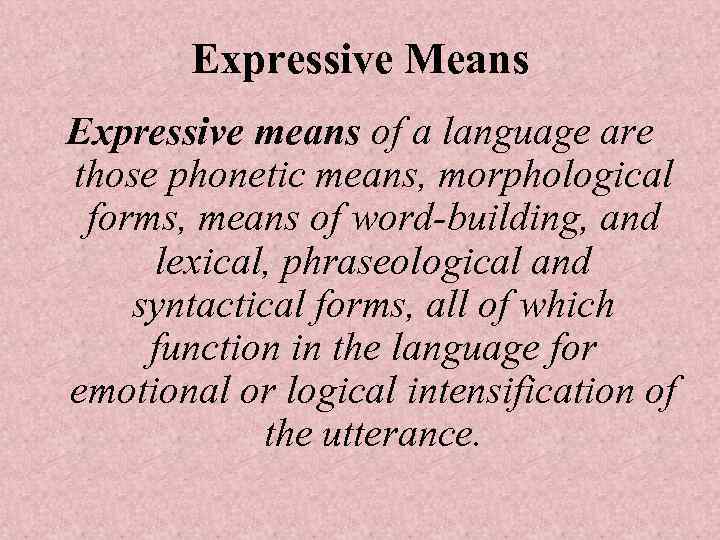
Expressive Means Expressive means of a language are those phonetic means, morphological forms, means of word-building, and lexical, phraseological and syntactical forms, all of which function in the language for emotional or logical intensification of the utterance.
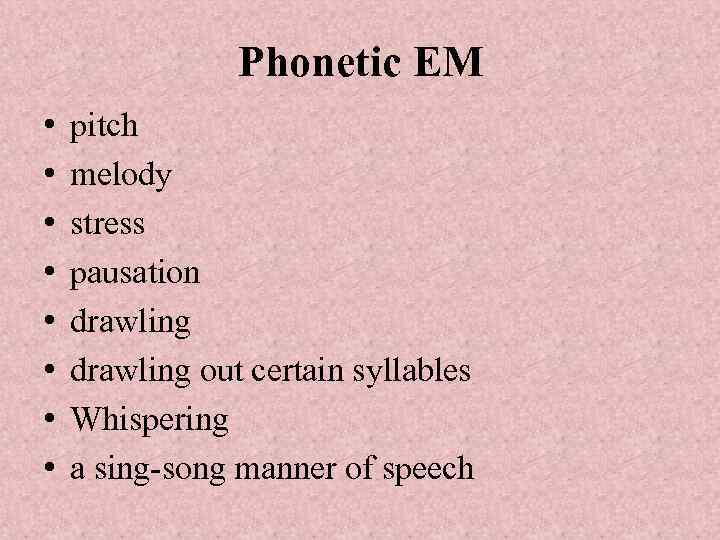
Phonetic EM • • pitch melody stress pausation drawling out certain syllables Whispering a sing-song manner of speech
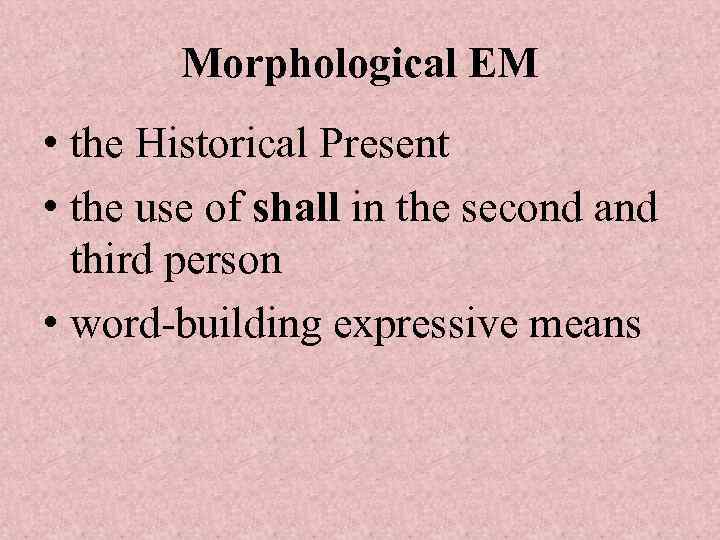
Morphological EM • the Historical Present • the use of shall in the second and third person • word-building expressive means
Lexical EM • words with emotive meaning (interjections) • words which have both referential and emotive meaning (qualitative adjectives) • words which retain a twofold meaning (denotative and connotative) • words belonging to special groups of literary • set expressions (proverbs, sayings)
Syntactical EM constructions with a certain degree of logical or emotional emphasis • I have never seen such a film. - Never have I seen such a film. • Mr. Smith came in first. - It was Mr. Smith who came in first. • I know you. - I do know you. • He is a brute of a man, is John. That you should deceive me! If only I could help you! Isn't she cute! Fool that he was!
Stylistic Devices A stylistic device (SD) is a conscious and intentional literary use of some of the facts of the language (including expressive means), it is a conscious and intentional intensification of some typical structural or semantic property of a language unit, promoted to a generalized status and thus becoming a generative model (Professor I. R. Galperin ).
Classification of EM and SD 1. Phonetic expressive means and stylistic devices. 2. Lexical expressive means and stylistic devices. 3. Syntactical expressive means and stylistic devices.
Скачать презентацию ФГБОУ ВПО Ярославский государственный педагогический университет им К
Stylistics as a Branch of Linguistics.pptx