


 Скачать презентацию FETHPC Call for Proposals 2016 -2017 Topics FETHPC-01
a4eb98763067b13b19654399b5c91291.ppt
- Количество слайдов: 22
 FETHPC Call for Proposals 2016 -2017 Topics FETHPC-01 -2016, FETHPC-02 -2017 and FETHPC-03 -2017
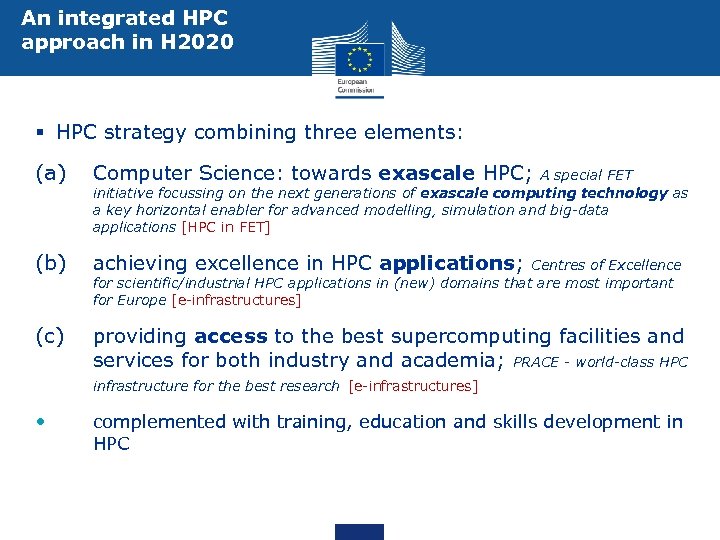 An integrated HPC approach in H 2020 § HPC strategy combining three elements: (a) Computer Science: towards exascale HPC; (b) achieving excellence in HPC applications; (c) providing access to the best supercomputing facilities and services for both industry and academia; PRACE - world-class HPC A special FET initiative focussing on the next generations of exascale computing technology as a key horizontal enabler for advanced modelling, simulation and big-data applications [HPC in FET] Centres of Excellence for scientific/industrial HPC applications in (new) domains that are most important for Europe [e-infrastructures] infrastructure for the best research [e-infrastructures] • complemented with training, education and skills development in HPC
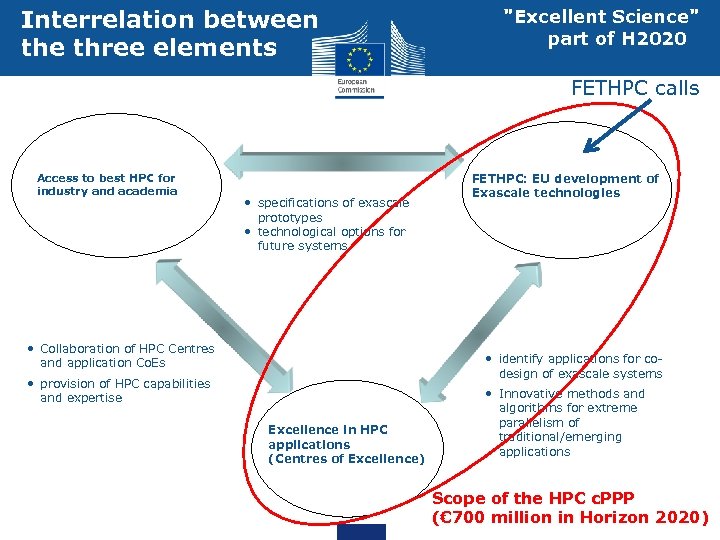 Interrelation between the three elements "Excellent Science" part of H 2020 FETHPC calls Access to best HPC for industry and academia • specifications of exascale prototypes • technological options for future systems • Collaboration of HPC Centres and application Co. Es FETHPC: EU development of Exascale technologies • identify applications for codesign of exascale systems • provision of HPC capabilities and expertise Excellence in HPC applications (Centres of Excellence) • Innovative methods and algorithms for extreme parallelism of traditional/emerging applications Scope of the HPC c. PPP (€ 700 million in Horizon 2020)
 FETHPC Call 2016 -2017
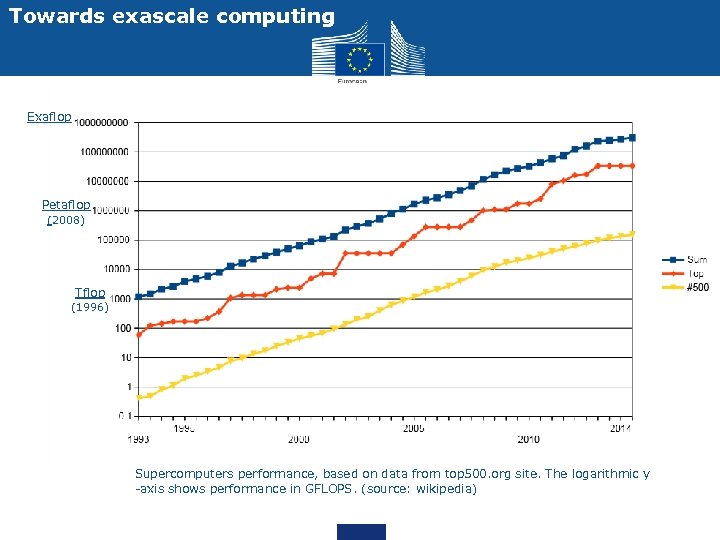 Towards exascale computing Exaflop Petaflop (2008) Tflop (1996) Supercomputers performance, based on data from top 500. org site. The logarithmic y -axis shows performance in GFLOPS. (source: wikipedia)
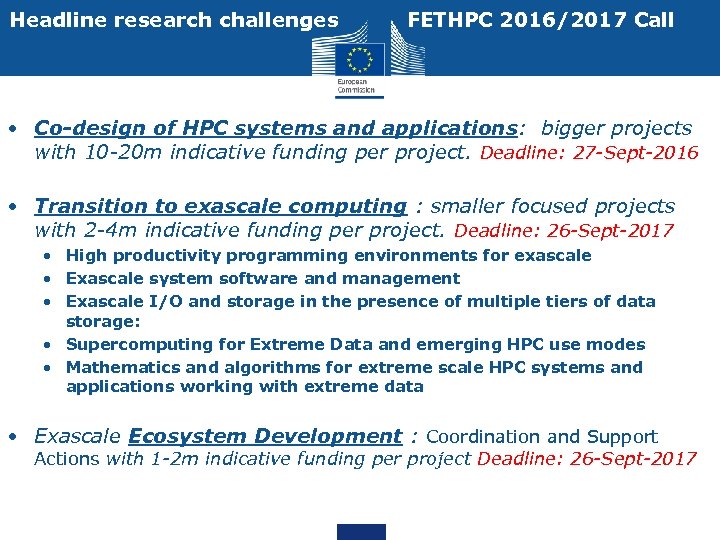 Headline research challenges FETHPC 2016/2017 Call • Co-design of HPC systems and applications: bigger projects with 10 -20 m indicative funding per project. Deadline: 27 -Sept-2016 • Transition to exascale computing : smaller focused projects with 2 -4 m indicative funding per project. Deadline: 26 -Sept-2017 • High productivity programming environments for exascale • Exascale system software and management • Exascale I/O and storage in the presence of multiple tiers of data storage: • Supercomputing for Extreme Data and emerging HPC use modes • Mathematics and algorithms for extreme scale HPC systems and applications working with extreme data • Exascale Ecosystem Development : Coordination and Support Actions with 1 -2 m indicative funding per project Deadline: 26 -Sept-2017
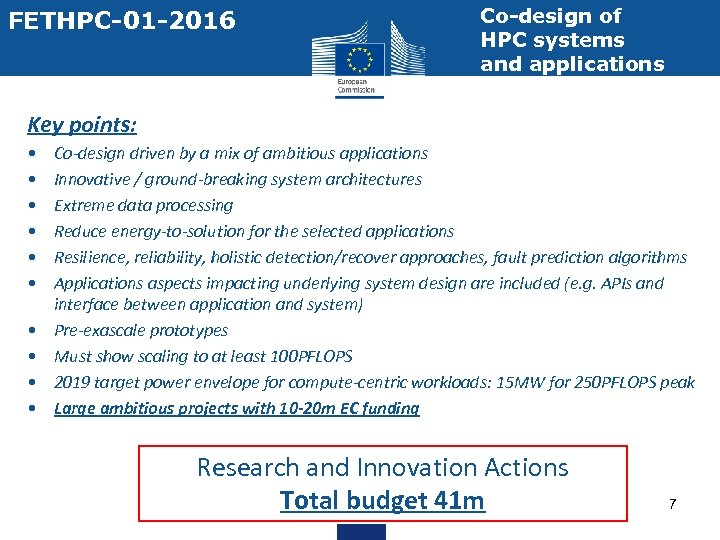 FETHPC-01 -2016 Co-design of HPC systems and applications Key points: • • • Co-design driven by a mix of ambitious applications Innovative / ground-breaking system architectures Extreme data processing Reduce energy-to-solution for the selected applications Resilience, reliability, holistic detection/recover approaches, fault prediction algorithms Applications aspects impacting underlying system design are included (e. g. APIs and interface between application and system) Pre-exascale prototypes Must show scaling to at least 100 PFLOPS 2019 target power envelope for compute-centric workloads: 15 MW for 250 PFLOPS peak Large ambitious projects with 10 -20 m EC funding Research and Innovation Actions Total budget 41 m 7
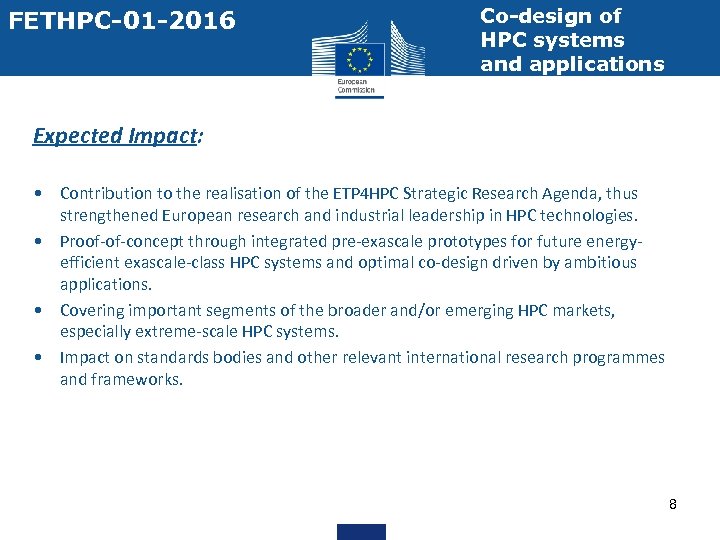 FETHPC-01 -2016 Co-design of HPC systems and applications Expected Impact: • Contribution to the realisation of the ETP 4 HPC Strategic Research Agenda, thus strengthened European research and industrial leadership in HPC technologies. • Proof-of-concept through integrated pre-exascale prototypes for future energyefficient exascale-class HPC systems and optimal co-design driven by ambitious applications. • Covering important segments of the broader and/or emerging HPC markets, especially extreme-scale HPC systems. • Impact on standards bodies and other relevant international research programmes and frameworks. 8
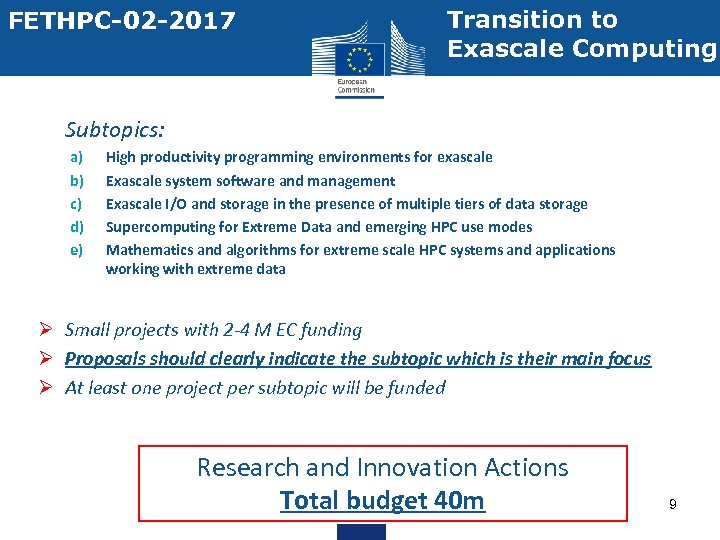 FETHPC-02 -2017 Transition to Exascale Computing • Subtopics: a) b) c) d) e) High productivity programming environments for exascale Exascale system software and management Exascale I/O and storage in the presence of multiple tiers of data storage Supercomputing for Extreme Data and emerging HPC use modes Mathematics and algorithms for extreme scale HPC systems and applications working with extreme data Ø Small projects with 2 -4 M EC funding Ø Proposals should clearly indicate the subtopic which is their main focus Ø At least one project per subtopic will be funded Research and Innovation Actions Total budget 40 m 9
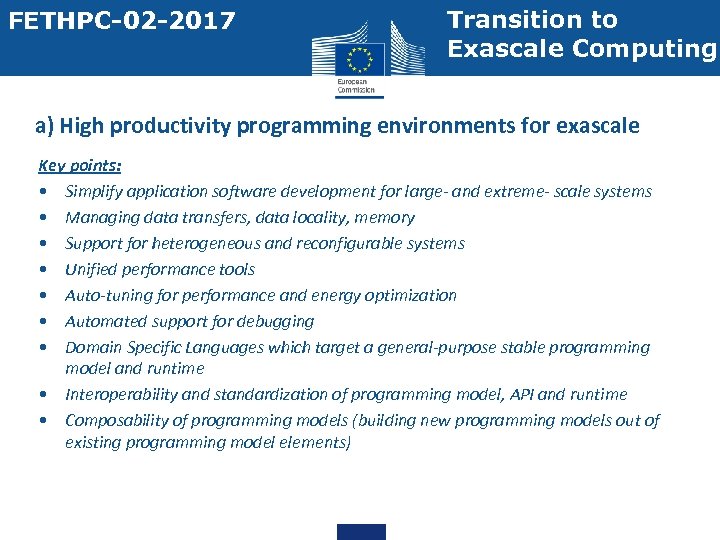 FETHPC-02 -2017 Transition to Exascale Computing a) High productivity programming environments for exascale Key points: • Simplify application software development for large- and extreme- scale systems • Managing data transfers, data locality, memory • Support for heterogeneous and reconfigurable systems • Unified performance tools • Auto-tuning for performance and energy optimization • Automated support for debugging • Domain Specific Languages which target a general-purpose stable programming model and runtime • Interoperability and standardization of programming model, API and runtime • Composability of programming models (building new programming models out of existing programming model elements)
 FETHPC-02 -2017 Transition to Exascale Computing b) Exascale system software and management Key points: • Targeting drastically more complex node architectures • Hardware abstraction through run-time handling of all types of resources and controls • For applications, multi-criteria resource allocation capabilities and interaction during task execution • On-the-fly analysis methods to cope with extreme data (beyond sequential analysis) • Real-time features for graphical simulation interaction • Evolution of configuration and deployment tools
 FETHPC-02 -2017 Transition to Exascale Computing c) Exascale I/O and storage in the presence of multiple tiers of data storage Key points: • I/O with multiple tiers of storage including non-volatile memory • Fine-grain data access prioritization • Data replication and data layout transformations • Adaptively provide optimal performance and reliability in the presence of millions of simultaneous I/O processes • Interoperability and standardized APIs • On-the-fly data management supporting data processing in multi-tiered storage with real-time in-situ / in-transit processing
 FETHPC-02 -2017 Transition to Exascale Computing d) Supercomputing for Extreme Data and emerging HPC use modes Key points: • HPC architectures for real-time and in-situ data analytics • Real-time in-memory analysis and direct processing of compressed data • Interactive 3 -D visualisation of large scale data • Interactive supercomputing for complex workflows to support urgent decision making • Adapting operational procedures of HPC infrastructures • Efficient co-scheduling techniques • Improving checkpoint/restart
 FETHPC-02 -2017 Transition to Exascale Computing e) Mathematics and algorithms for extreme scale HPC systems and applications working with extreme data Key points: • Quantification of uncertainties and noise, multi-scale, multi-physics, extreme data • Mathematics, numerical analysis, algorithms, software engineering for extreme parallelism • Minimise data movement and number of communication/ synchronization instances • Parallel in-time methods • Unified European Verification, Validation and Uncertainty Quantification framework
 FETHPC-02 -2017 Transition to Exascale Computing • Expected Impact: • Contribution to the realisation of the ETP 4 HPC Strategic Research Agenda, thus strengthened European research and industrial leadership in HPC technologies. • Successful transition to practical exascale computing for the addressed specific element of the HPC stack. • Covering important segments of the broader and/or emerging HPC markets, especially extreme-computing, emerging use modes and extreme-data HPC systems. • Impact on standards bodies and other relevant international research programmes and frameworks. • European excellence in mathematics and algorithms for extreme parallelism and extreme data applications to boost research and innovation in scientific areas such as physics, chemistry, biology, life sciences, materials, climate, geosciences, etc. 15
 Exascale HPC ecosystem development FETHPC-03 -2017 • Subtopics: a) Coordination of the Exascale HPC strategy and International Collaboration b) Excellence in Exascale Computing Systems Coordination and Support Actions with 1 -2 m EC funding Separate proposals per subtopic Total Budget 4 m 16
 FETHPC-03 -2017 Exascale HPC ecosystem development a) Coordination of the Exascale HPC strategy and International Collaboration • • joint community structuring and synchronisation further development and update of the Strategic Research Agenda for High Performance Computing as well as the application and applied mathematics exascale roadmaps; prepare the ground for targeted international research collaboration on specific aspects of the exascale challenges. create synergies with other HPC-related activities in H 2020
 FETHPC-03 -2017 Exascale HPC ecosystem development b) Excellence in Exascale Computing Systems • • • boost European HPC academic research excellence in future exascaleclass computing cutting across all levels – hardware, architectures, programming, applications include specific actions to better structure the European academic HPC research create stronger links with HPC providers and HPC users attract venture capital promote entrepreneurship foster industry take-up
 FETHPC-03 -2017 Exascale HPC ecosystem development • Expected Impact: • Strengthened European research and industrial leadership in the supply, operation and use of HPC systems. • Contribution to the realisation of the ETP 4 HPC Strategic Research Agenda. • Development of a competitive European ecosystem for building and exploiting a wide range of next-generation extreme performance computing systems. • Structuring the efforts of stakeholders for implementing the European HPC strategy. • Reinforced cooperation in international endeavours on HPC software and systems towards exascale. • European Excellence in Exascale Computing systems. 19
 Headline research challenges (recap) FETHPC 2016/2017 Calls • Co-design of HPC systems and applications: bigger projects with 10 -20 m indicative funding per project. Deadline: 27 -Sept-2016 • Transition to exascale computing : smaller focused projects with 2 -4 m indicative funding per project. Deadline: 26 -Sept-2017 • High productivity programming environments for exascale • Exascale system software and management • Exascale I/O and storage in the presence of multiple tiers of data storage: • Supercomputing for Extreme Data and emerging HPC use modes • Mathematics and algorithms for extreme scale HPC systems and applications working with extreme data • Exascale Ecosystem Development : Coordination and Support Actions with 1 -2 m indicative funding per project Deadline: 26 -Sept-2017
 Thank you for your attention! Single point of access to all information about the EC HPC strategy, work programmes and HPC related news: ec. europa. eu/horizon 2020 -hpc
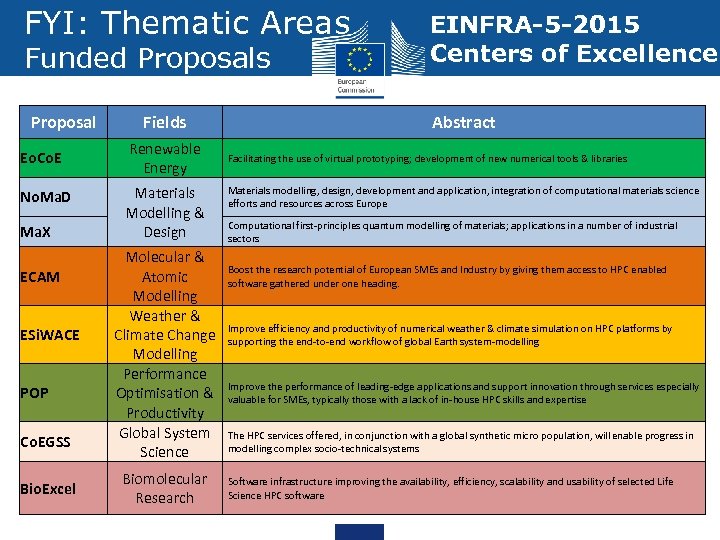 FYI: Thematic Areas Funded Proposals Proposal Eo. Co. E No. Ma. D Ma. X ECAM ESi. WACE POP Co. EGSS Bio. Excel Fields Renewable Energy Materials Modelling & Design Molecular & Atomic Modelling Weather & Climate Change Modelling Performance Optimisation & Productivity Global System Science Biomolecular Research EINFRA-5 -2015 Centers of Excellence Abstract Facilitating the use of virtual prototyping; development of new numerical tools & libraries Materials modelling, design, development and application, integration of computational materials science efforts and resources across Europe Computational first-principles quantum modelling of materials; applications in a number of industrial sectors Boost the research potential of European SMEs and Industry by giving them access to HPC enabled software gathered under one heading. Improve efficiency and productivity of numerical weather & climate simulation on HPC platforms by supporting the end-to-end workflow of global Earth system-modelling Improve the performance of leading-edge applications and support innovation through services especially valuable for SMEs, typically those with a lack of in-house HPC skills and expertise The HPC services offered, in conjunction with a global synthetic micro population, will enable progress in modelling complex socio-technical systems Software infrastructure improving the availability, efficiency, scalability and usability of selected Life Science HPC software