


 Скачать презентацию FESP Forum for European Structural Proteomics Partners Lucia
2291b3293babbaaedcd1fe62a1b2c78b.ppt
- Количество слайдов: 15
 FESP Forum for European Structural Proteomics Partners: Lucia Banci Gunter Schneider CERM, Italy Karolinska Institute, Sweden Wolfgang Baumeister Israel Silman MPI, Germany Weizmann Institute, Israel Udo Heinemann Joel L. Sussman, Coordinator MDC, Germany Weizmann Institute, Israel http: //www. ec-fesp. org *Funded by the EC as a SSA (specific support action)
 FESP Forum for European Structural Proteomics “A policy-oriented forum for European structural genomics to assess infrastructures and set a strategic research agenda. ” What do we plan? • • • Assess Structural Genomics/Proteomics projects Assess Infrastructures with respect to the needs for Structural Genomics/Proteomics in Europe and the rest of the world Develop strategic plans for an European policy in Structural Genomics/ Proteomics a position paper on assessment and a strategic roadmap for future directions
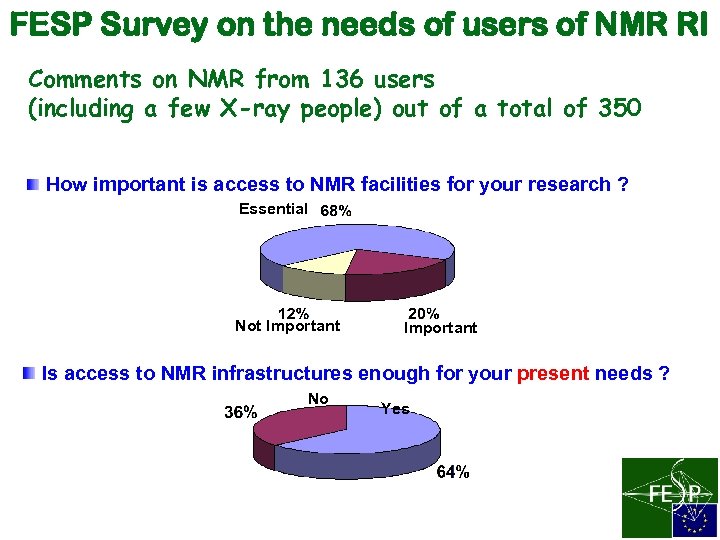 FESP Survey on the needs of users of NMR RI Comments on NMR from 136 users (including a few X-ray people) out of a total of 350 How important is access to NMR facilities for your research ? Essential Not Important Is access to NMR infrastructures enough for your present needs ? No Yes
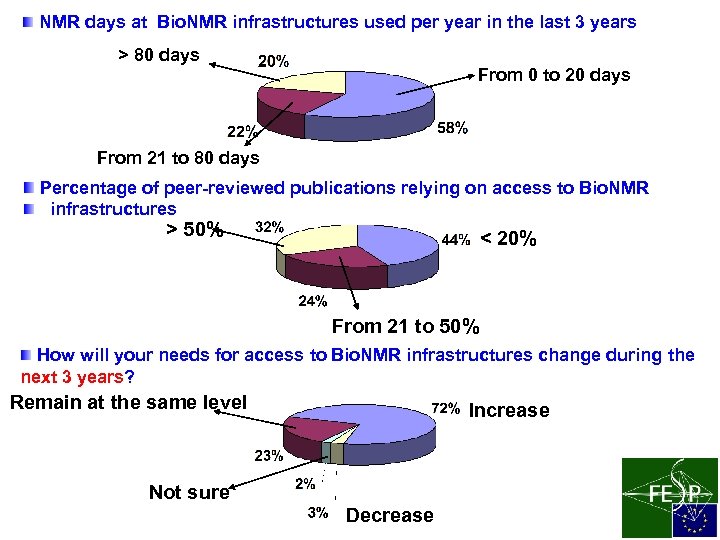 NMR days at Bio. NMR infrastructures used per year in the last 3 years > 80 days From 0 to 20 days From 21 to 80 days Percentage of peer-reviewed publications relying on access to Bio. NMR infrastructures > 50% < 20% From 21 to 50% How will your needs for access to Bio. NMR infrastructures change during the next 3 years? Remain at the same level Increase Not sure Decrease
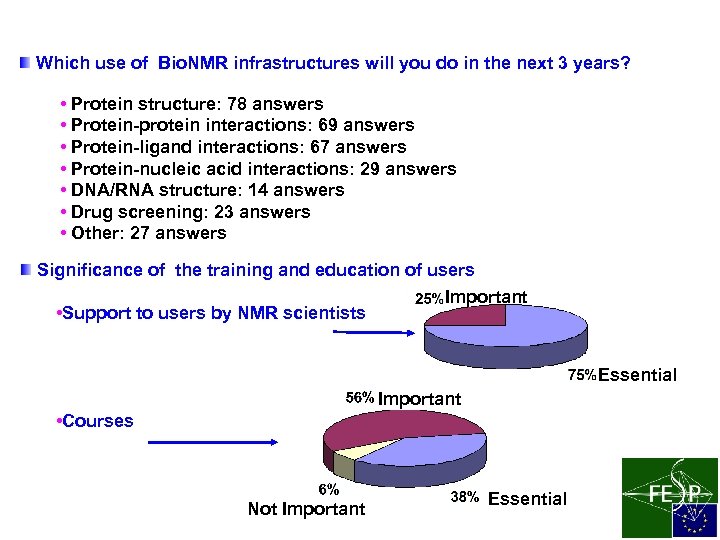 Which use of Bio. NMR infrastructures will you do in the next 3 years? • Protein structure: 78 answers • Protein-protein interactions: 69 answers • Protein-ligand interactions: 67 answers • Protein-nucleic acid interactions: 29 answers • DNA/RNA structure: 14 answers • Drug screening: 23 answers • Other: 27 answers Significance of the training and education of users Important • Support to users by NMR scientists Essential Important • Courses Not Important Essential
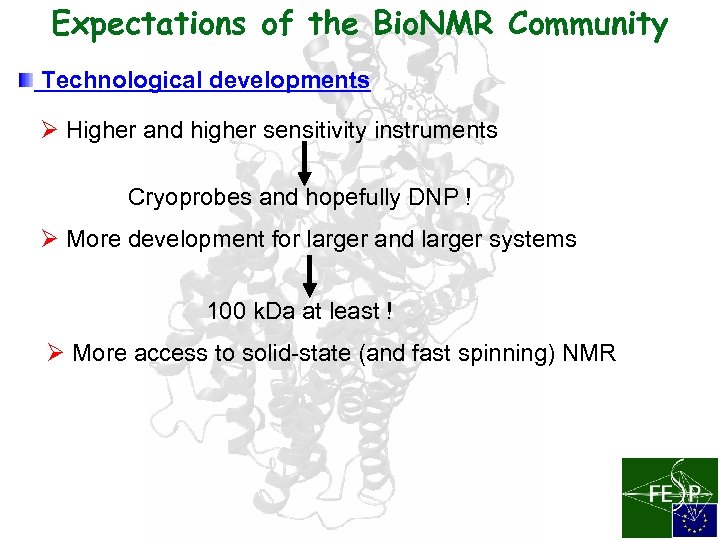 Expectations of the Bio. NMR Community Technological developments Ø Higher and higher sensitivity instruments Cryoprobes and hopefully DNP ! Ø More development for larger and larger systems 100 k. Da at least ! Ø More access to solid-state (and fast spinning) NMR
 Expectations of the Bio. NMR Community Role of Bio. NMR RI in the scientific community Ø NMR infrastructures are essential for researchers coming from less favored countries where no high field NMR spectrometers nor the necessary expertise are available Ø NMR infrastructures are important not only for giving access to high fields but: v should play a role in “increasing the knowledge of NMR users relative to the new frontiers experiments in the field of structural biology” v should develop new approaches and technologies necessary to solve scientific problems Ø NMR infrastructures need to standardize and harmonize the various operations (experiments, software etc…) like the crystallographers did.
 Expectations of the Bio. NMR Community Role of Bio. NMR in the scientific community Ø Training courses and meetings need to be organized on a regular basis to spread good practice, reinforce interactions among European scientists and develop collaborations “Therefore, funding and development actions of these Bio. NMR infrastructures not only assist researchers to their activities but also provide them the opportunity to transfer knowledge and experience to their home countries” Ø Travel should be limited as much as possible: remote access and access to the closest Research Infrastructure independently of its national location Bio. NMR Infrastructures should act as catalysts of NMR technological and methodological developments
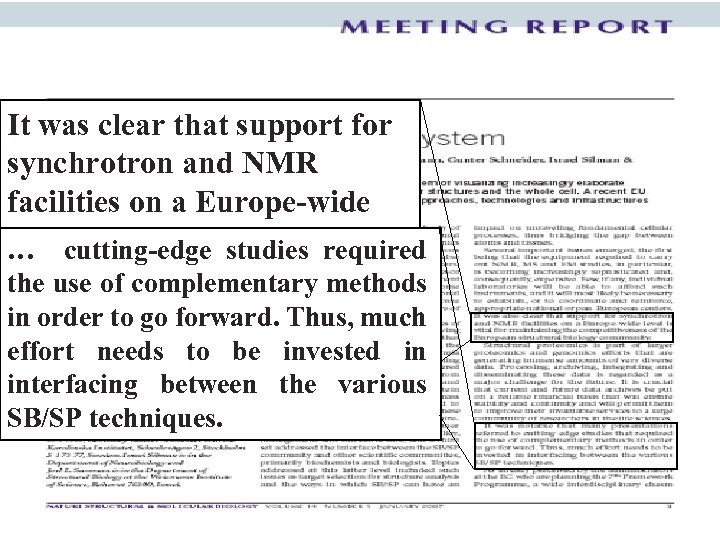 It was clear that support for synchrotron and NMR facilities on a Europe-wide levelcutting-edge maintaining is vital for studies required … the use of complementarythe competitiveness of methods in order to structural biology Europeango forward. Thus, much effort needs community. to be invested in interfacing between the various SB/SP techniques.
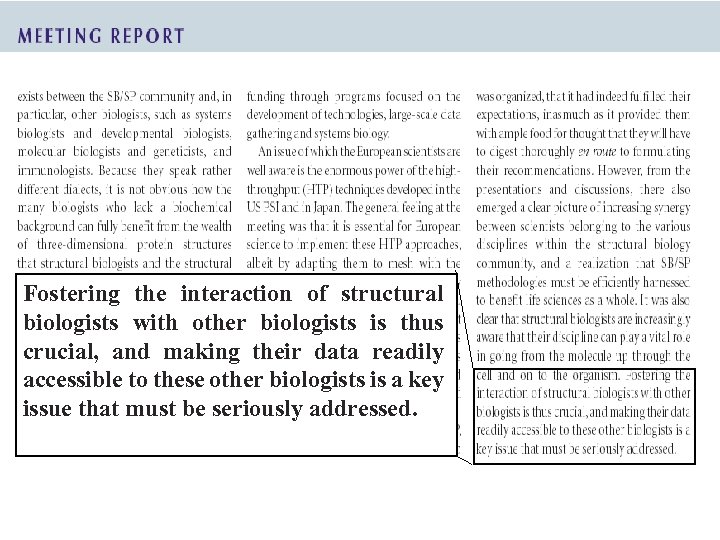 Fostering the interaction of structural biologists with other biologists is thus crucial, and making their data readily accessible to these other biologists is a key issue that must be seriously addressed.
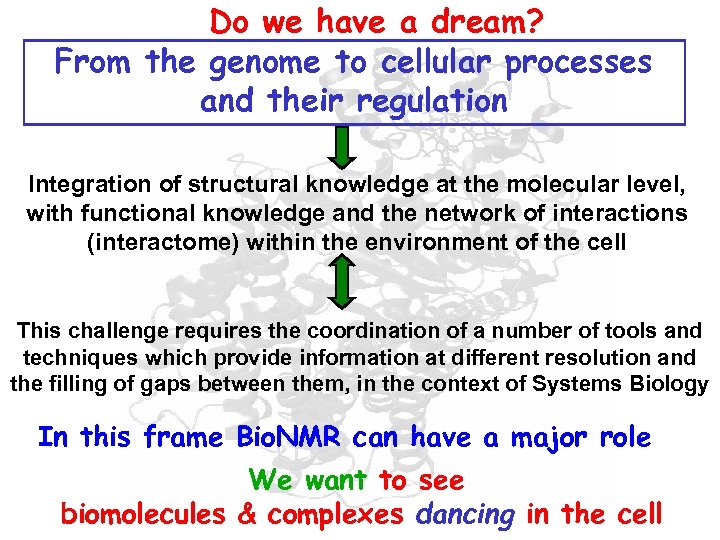 Do we have a dream? From the genome to cellular processes and their regulation Integration of structural knowledge at the molecular level, with functional knowledge and the network of interactions (interactome) within the environment of the cell This challenge requires the coordination of a number of tools and techniques which provide information at different resolution and the filling of gaps between them, in the context of Systems Biology In this frame Bio. NMR can have a major role We want to see biomolecules & complexes dancing in the cell
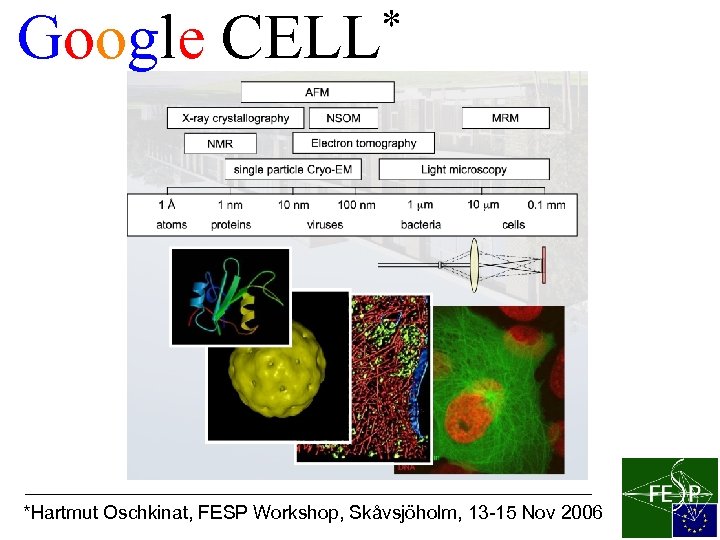 Google * CELL *Hartmut Oschkinat, FESP Workshop, Skåvsjöholm, 13 -15 Nov 2006

 Top quality science requires long-term support to infrastructures