


 Скачать презентацию Fertility and the Real Exchange Rate Andrew K
df6514ced10f3df3ce98dd44b8a8c51d.ppt
- Количество слайдов: 47
 Fertility and the Real Exchange Rate Andrew K. Rose and Saktiandi Supaat Suktiandi Supaat with Jacob Braude
 Simple Intuition: What effect should fertility have on real exchange rate? • Suppose fertility rate declines exogenously (e. g. , improvement in female education, or decrease in contraception cost). • Child-rearing associated with increased consumption. So decline in fertility means increased savings. • Investment may drop with decline in future equilibrium capital stock. • If savings rise and investment falls, current account improves • Children consume non-tradeables (education) disproportionately. The relative price of non-tradeables should fall. • Conclusion: real depreciation of the exchange rate part of equilibrium response to decline in fertility.
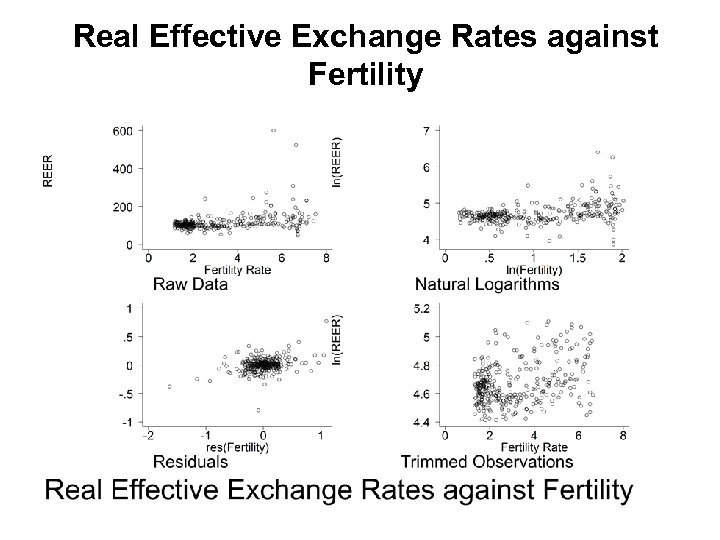
 Actual Finding: fertility has positive, significant effect on real exchange rate • 1 -point increase in fertility rate (from say 2 to 3 children/woman) results in equilibrium appreciation of 15%, ceteris paribus • Consistent with theory, plausible in sign/size • Robust results
 Why Should We Care? Motivation 1 • Exchange Rates Matter, can’t be Modeled! – Lane and Milesi-Ferretti: big impact on NFA, international adjustment • Exchange Rate Determination: A Literature of Failure – Dates back to at least Meese and Rogoff (1983): random walk model out-forecasts structural models, even given actual future fundamentals – Huge Negative Implications for International Finance as a Field • Depressing inability to explain our most basic prices! • Many major universities have no senior presence in international finance
 The Negative Results Continue • Cheung, Chinn and Pascual (2005) “Empirical Exchange Rate Models of the Nineties: Are Any Fit to Survive? ” – “… we conclude that the answer to the question posed in the title of this paper is a bold ‘perhaps’ …” • Taylor and Taylor (2005) in JEP Survey: – “short run PPP does not hold … long run PPP may hold …”
 … through the present … • Rogoff (2007) commenting on Engel, Mark and West: – “Is the glass ten percent full or ninety percent empty? ”
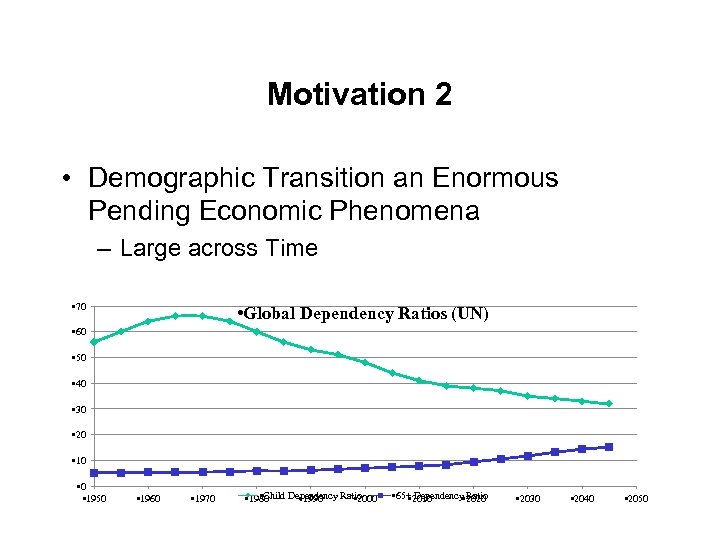 Motivation 2 • Demographic Transition an Enormous Pending Economic Phenomena – Large across Time • 70 • Global Dependency Ratios (UN) • 60 • 50 • 40 • 30 • 20 • 10 • 1950 • 1960 • 1970 • Child Dependency Ratio • 1980 • 1990 • 2000 • 65+2010 Ratio • Dependency • 2020 • 2030 • 2040 • 2050
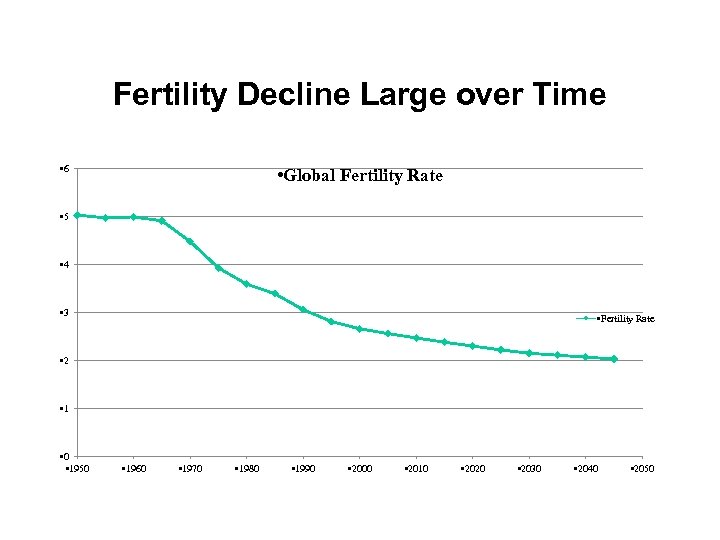 Fertility Decline Large over Time • 6 • Global Fertility Rate • 5 • 4 • 3 • Fertility Rate • 2 • 1 • 0 • 1950 • 1960 • 1970 • 1980 • 1990 • 2000 • 2010 • 2020 • 2030 • 2040 • 2050
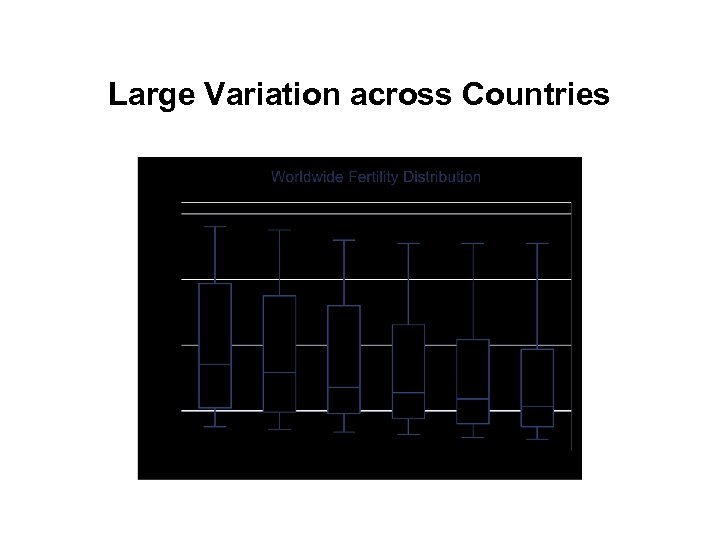 Large Variation across Countries
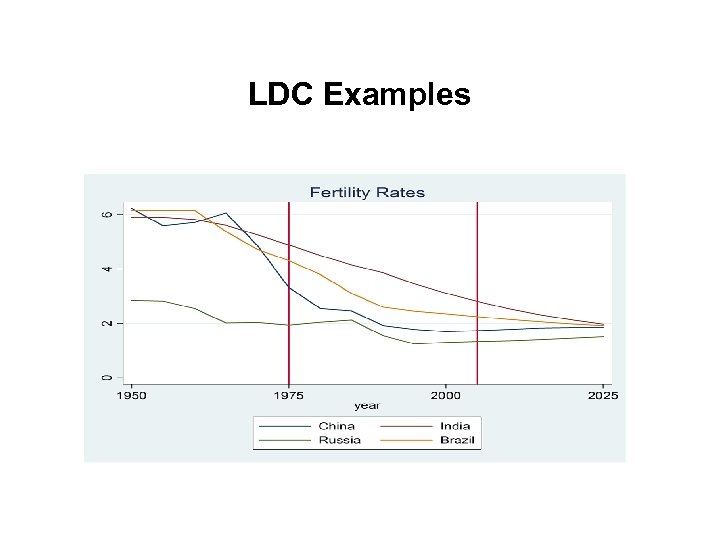 LDC Examples
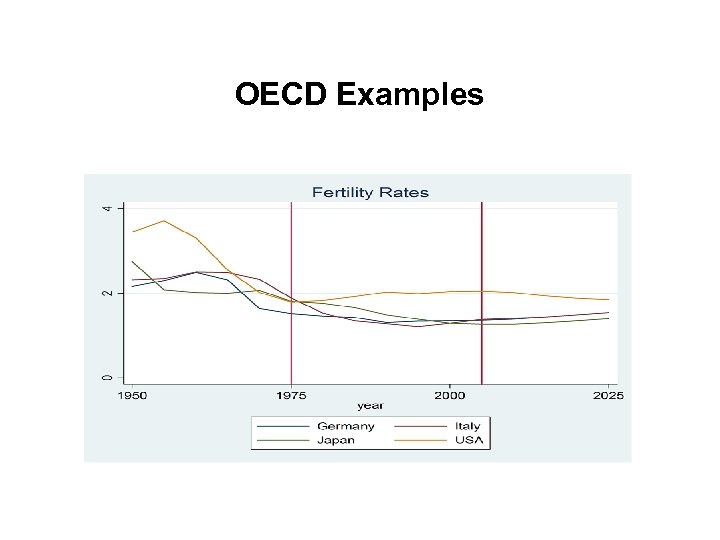 OECD Examples
 Quick Survey of the Literature • Little empirical work; much analysis theoretical/uses simulations • Most empirical work concerned with macroeconomic quantities (such as the current account, or savings and investment rates), not prices. • Exceptions: • Andersson and Österholm (2005) link age-distribution in Sweden to real exchange rate. • Helps in forecasting. • No controls • Andersson and Österholm (2006) extend to OECD, with more limited success.
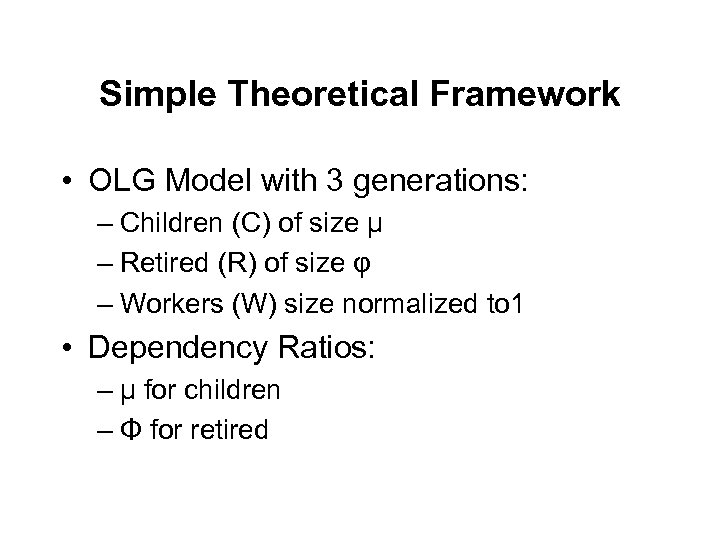 Simple Theoretical Framework • OLG Model with 3 generations: – Children (C) of size μ – Retired (R) of size φ – Workers (W) size normalized to 1 • Dependency Ratios: – μ for children – Φ for retired
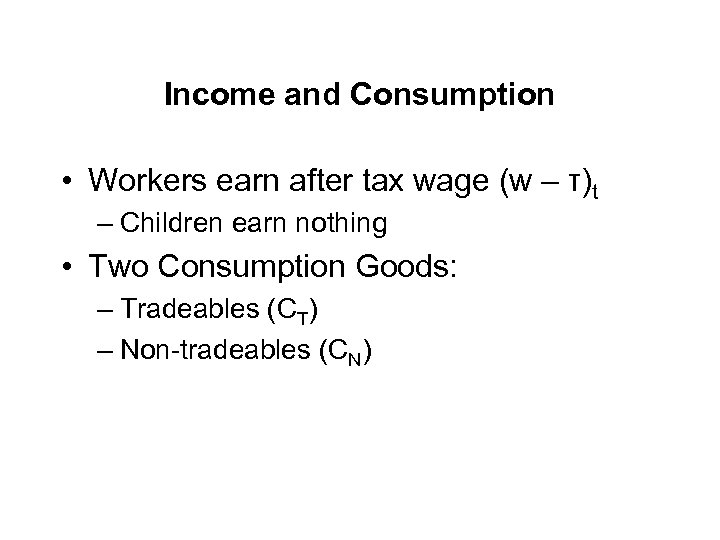 Income and Consumption • Workers earn after tax wage (w – τ)t – Children earn nothing • Two Consumption Goods: – Tradeables (CT) – Non-tradeables (CN)
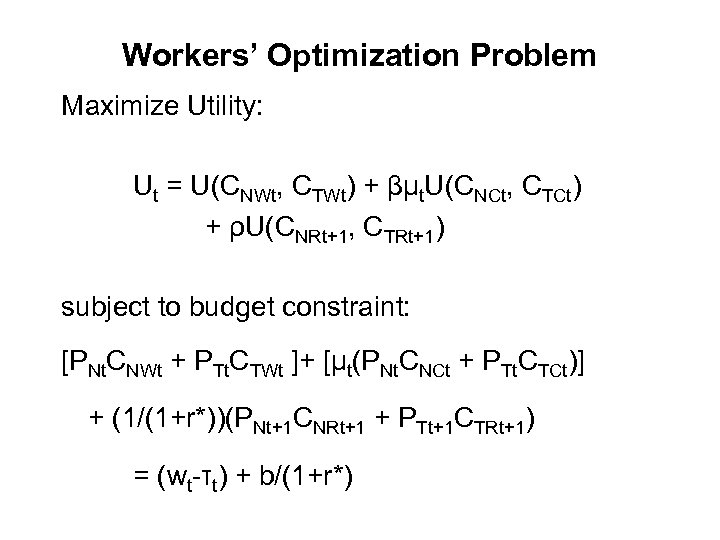 Workers’ Optimization Problem Maximize Utility: Ut = U(CNWt, CTWt) + βμt. U(CNCt, CTCt) + ρU(CNRt+1, CTRt+1) subject to budget constraint: [PNt. CNWt + PTt. CTWt ]+ [μt(PNt. CNCt + PTt. CTCt)] + (1/(1+r*))(PNt+1 CNRt+1 + PTt+1 CTRt+1) = (wt-τt) + b/(1+r*)
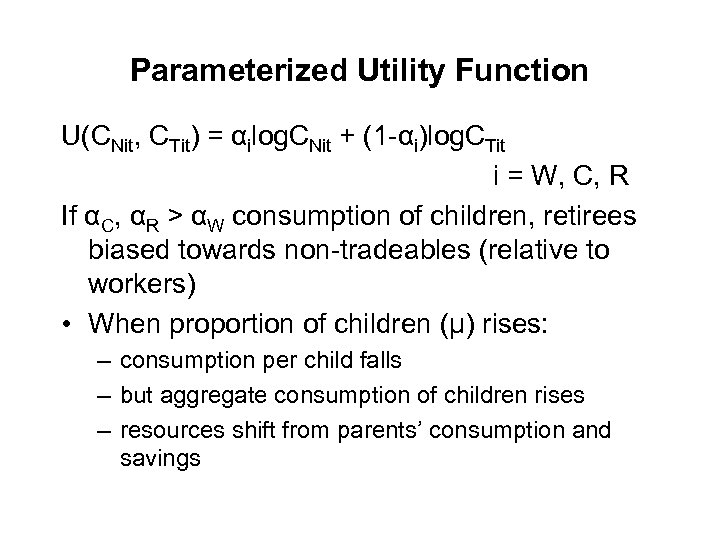 Parameterized Utility Function U(CNit, CTit) = αilog. CNit + (1 -αi)log. CTit i = W, C, R If αC, αR > αW consumption of children, retirees biased towards non-tradeables (relative to workers) • When proportion of children (μ) rises: – consumption per child falls – but aggregate consumption of children rises – resources shift from parents’ consumption and savings
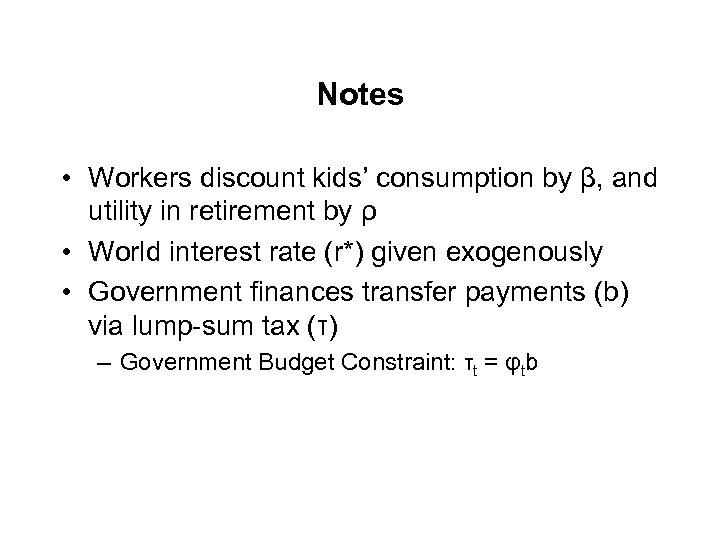 Notes • Workers discount kids’ consumption by β, and utility in retirement by ρ • World interest rate (r*) given exogenously • Government finances transfer payments (b) via lump-sum tax (τ) – Government Budget Constraint: τt = φtb
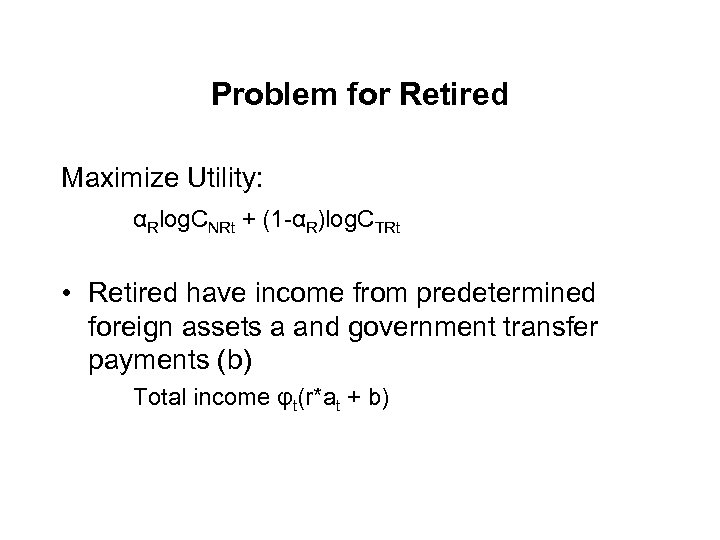 Problem for Retired Maximize Utility: αRlog. CNRt + (1 -αR)log. CTRt • Retired have income from predetermined foreign assets a and government transfer payments (b) Total income φt(r*at + b)
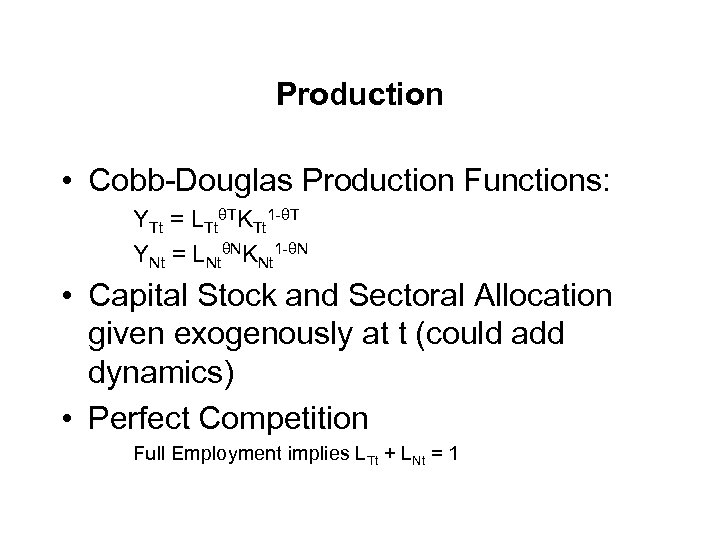 Production • Cobb-Douglas Production Functions: YTt = LTtθTKTt 1 -θT YNt = LNtθNKNt 1 -θN • Capital Stock and Sectoral Allocation given exogenously at t (could add dynamics) • Perfect Competition Full Employment implies LTt + LNt = 1
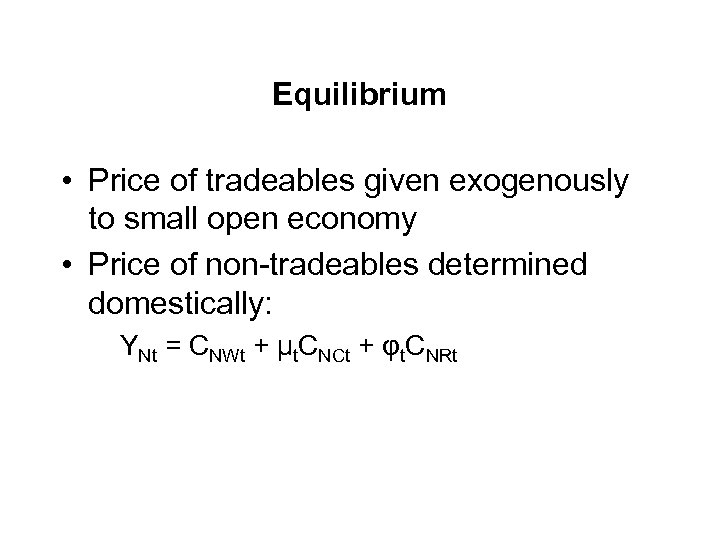 Equilibrium • Price of tradeables given exogenously to small open economy • Price of non-tradeables determined domestically: YNt = CNWt + μt. CNCt + φt. CNRt
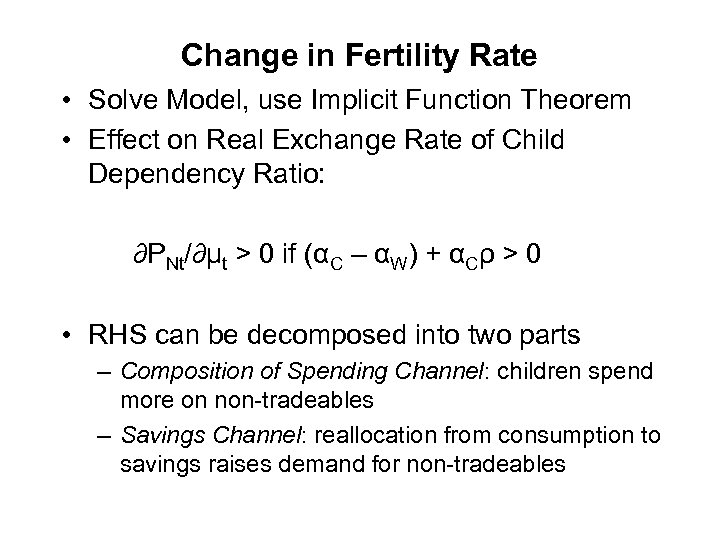 Change in Fertility Rate • Solve Model, use Implicit Function Theorem • Effect on Real Exchange Rate of Child Dependency Ratio: ∂PNt/∂μt > 0 if (αC – αW) + αCρ > 0 • RHS can be decomposed into two parts – Composition of Spending Channel: children spend more on non-tradeables – Savings Channel: reallocation from consumption to savings raises demand for non-tradeables
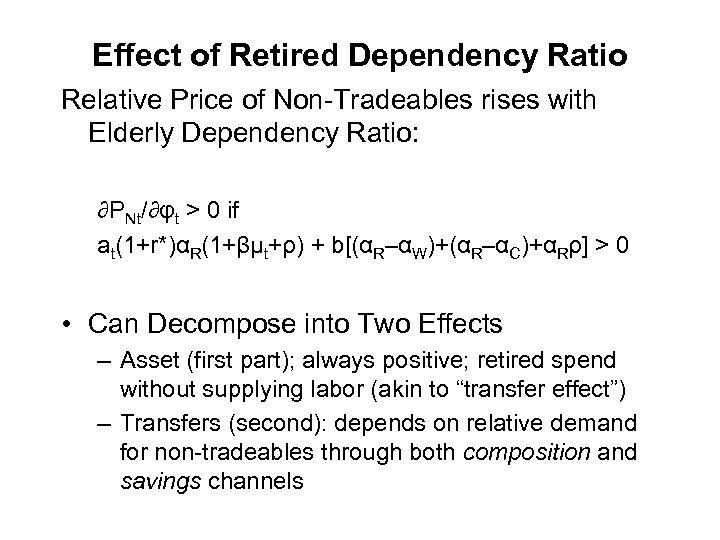 Effect of Retired Dependency Ratio Relative Price of Non-Tradeables rises with Elderly Dependency Ratio: ∂PNt/∂φt > 0 if at(1+r*)αR(1+βμt+ρ) + b[(αR–αW)+(αR–αC)+αRρ] > 0 • Can Decompose into Two Effects – Asset (first part); always positive; retired spend without supplying labor (akin to “transfer effect”) – Transfers (second): depends on relative demand for non-tradeables through both composition and savings channels
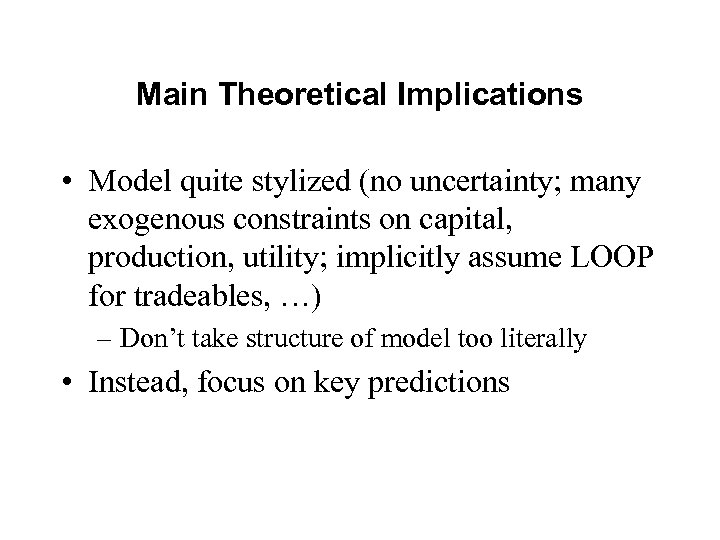 Main Theoretical Implications • Model quite stylized (no uncertainty; many exogenous constraints on capital, production, utility; implicitly assume LOOP for tradeables, …) – Don’t take structure of model too literally • Instead, focus on key predictions
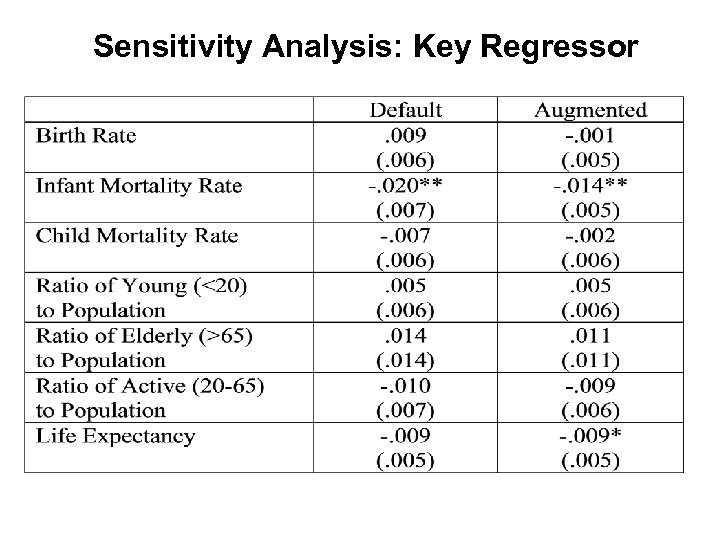
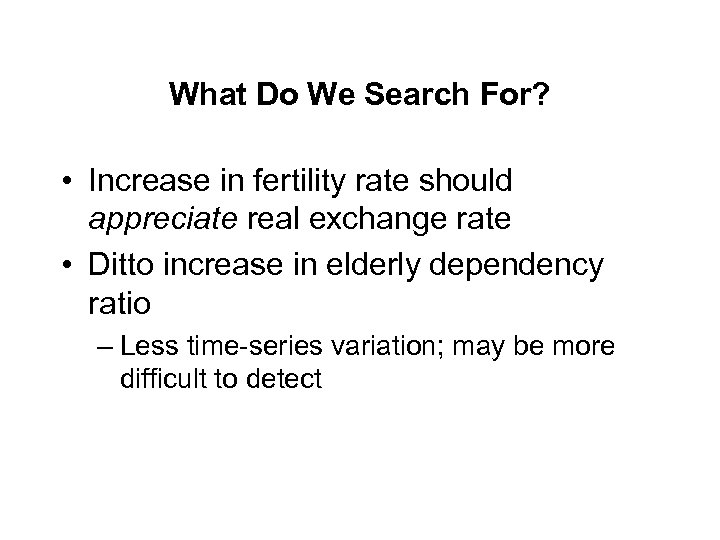 What Do We Search For? • Increase in fertility rate should appreciate real exchange rate • Ditto increase in elderly dependency ratio – Less time-series variation; may be more difficult to detect
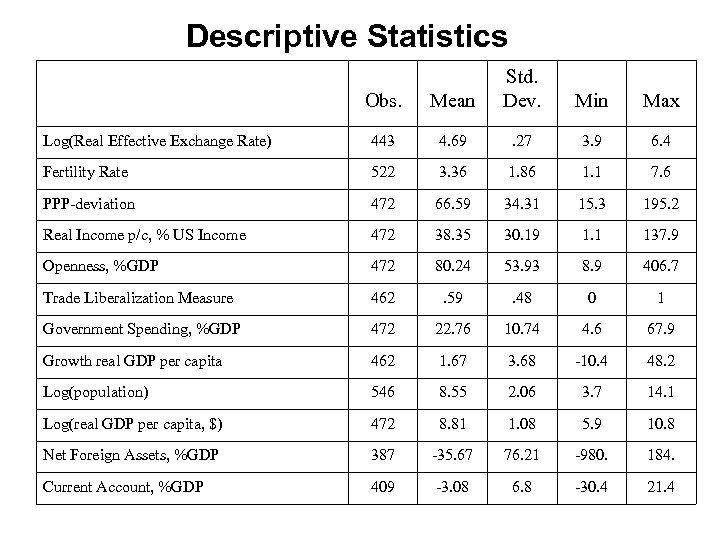
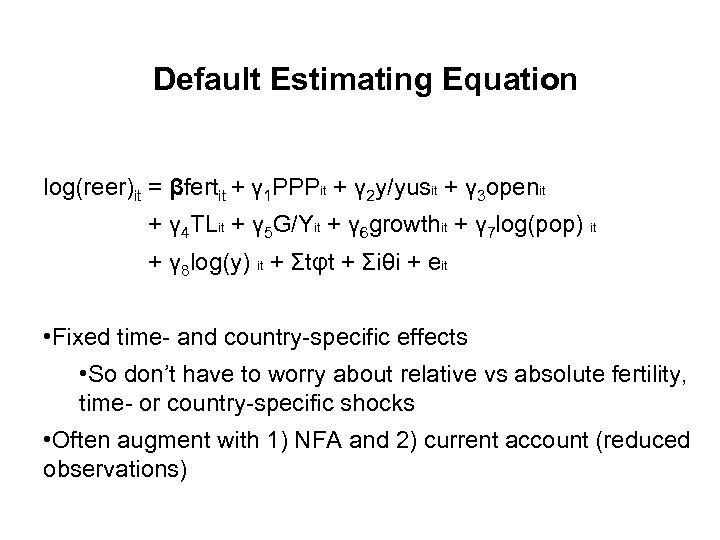 Default Estimating Equation log(reer)it = βfertit + γ 1 PPPit + γ 2 y/yusit + γ 3 openit + γ 4 TLit + γ 5 G/Yit + γ 6 growthit + γ 7 log(pop) it + γ 8 log(y) it + Σtφt + Σiθi + eit • Fixed time- and country-specific effects • So don’t have to worry about relative vs absolute fertility, time- or country-specific shocks • Often augment with 1) NFA and 2) current account (reduced observations)
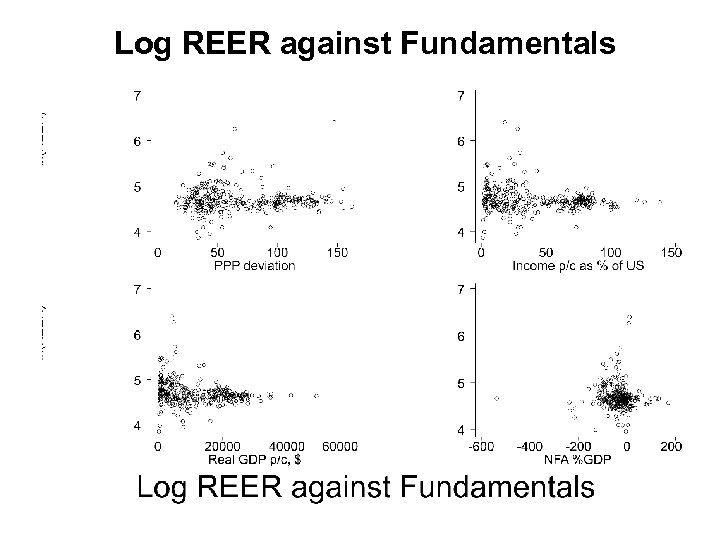
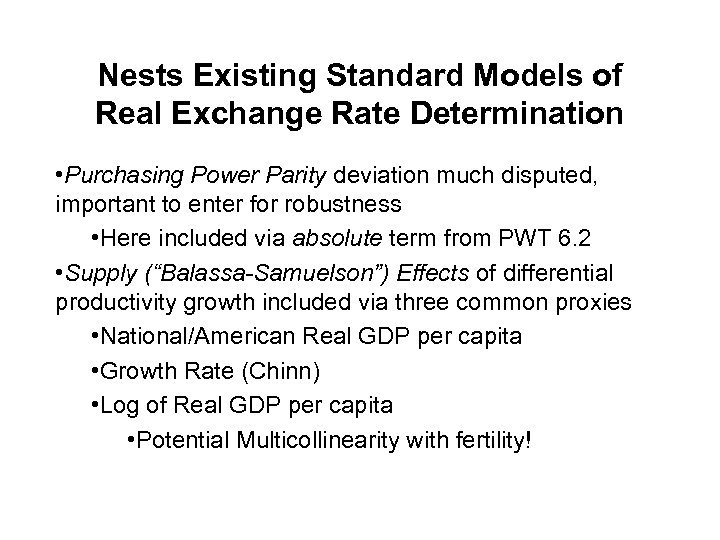 Nests Existing Standard Models of Real Exchange Rate Determination • Purchasing Power Parity deviation much disputed, important to enter for robustness • Here included via absolute term from PWT 6. 2 • Supply (“Balassa-Samuelson”) Effects of differential productivity growth included via three common proxies • National/American Real GDP per capita • Growth Rate (Chinn) • Log of Real GDP per capita • Potential Multicollinearity with fertility!
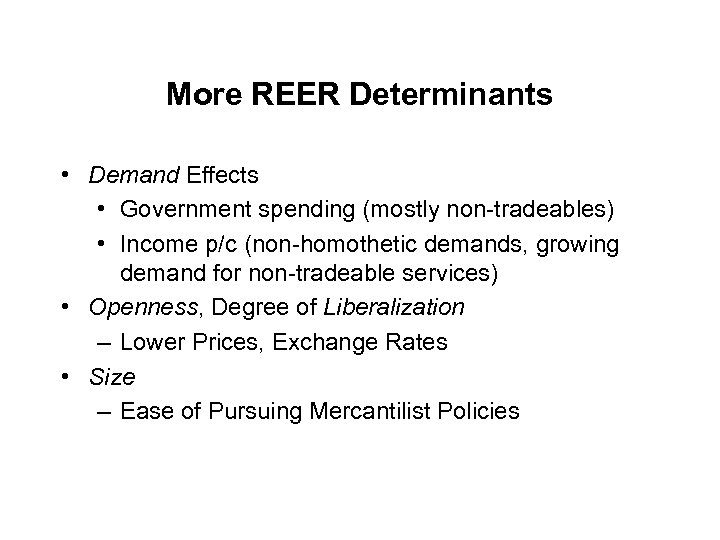 More REER Determinants • Demand Effects • Government spending (mostly non-tradeables) • Income p/c (non-homothetic demands, growing demand for non-tradeable services) • Openness, Degree of Liberalization – Lower Prices, Exchange Rates • Size – Ease of Pursuing Mercantilist Policies
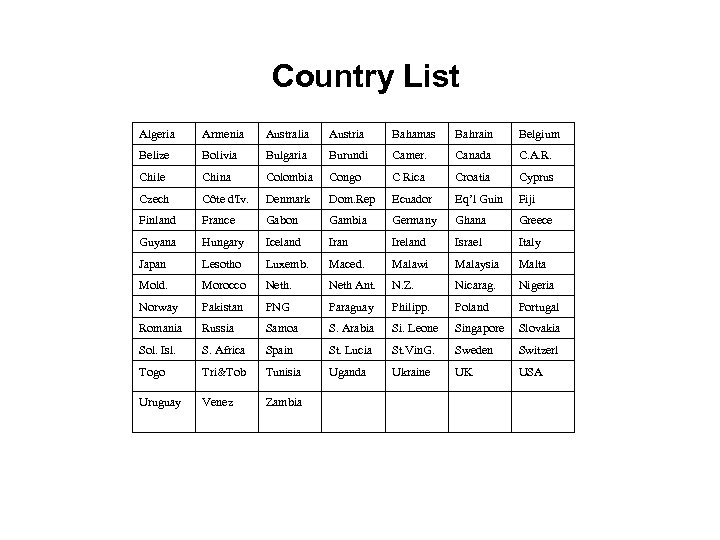
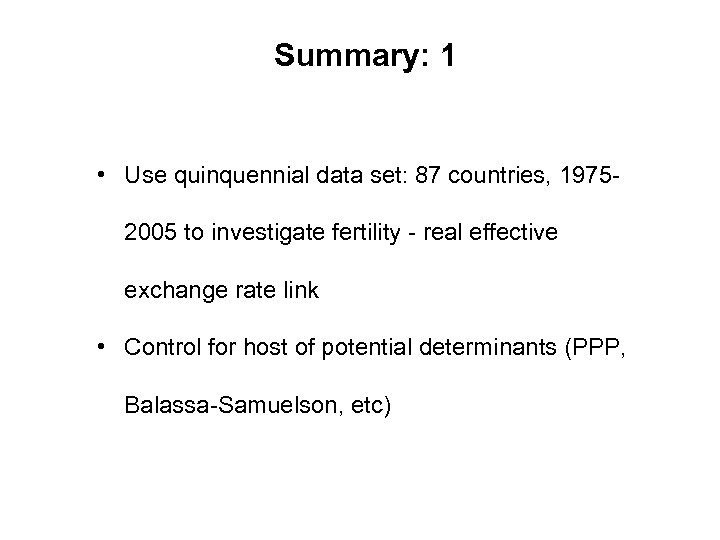
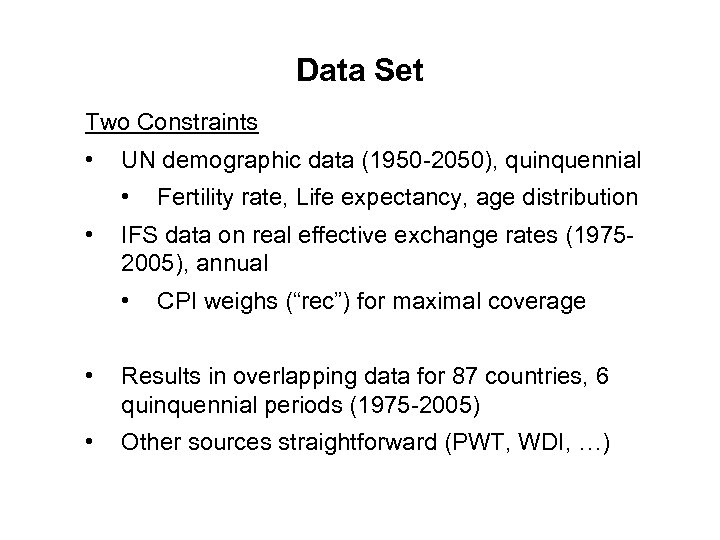 Data Set Two Constraints • UN demographic data (1950 -2050), quinquennial • • Fertility rate, Life expectancy, age distribution IFS data on real effective exchange rates (19752005), annual • CPI weighs (“rec”) for maximal coverage • Results in overlapping data for 87 countries, 6 quinquennial periods (1975 -2005) • Other sources straightforward (PWT, WDI, …)
 Country List Algeria Armenia Australia Austria Bahamas Bahrain Belgium Belize Bolivia Bulgaria Burundi Camer. Canada C. A. R. Chile China Colombia Congo C Rica Croatia Cyprus Czech Côte d'Iv. Denmark Dom. Rep Ecuador Eq’l Guin Fiji Finland France Gabon Gambia Germany Ghana Greece Guyana Hungary Iceland Iran Ireland Israel Italy Japan Lesotho Luxemb. Maced. Malawi Malaysia Malta Mold. Morocco Neth Ant. N. Z. Nicarag. Nigeria Norway Pakistan PNG Paraguay Philipp. Poland Portugal Romania Russia Samoa S. Arabia Si. Leone Singapore Slovakia Sol. Isl. S. Africa Spain St. Lucia St. Vin. G. Sweden Switzerl Togo Tri&Tob Tunisia Uganda Ukraine UK USA Uruguay Venez Zambia
 Real Effective Exchange Rates against Fertility
 Log REER against Fundamentals
 Descriptive Statistics Obs. Mean Std. Dev. Log(Real Effective Exchange Rate) 443 4. 69 . 27 3. 9 6. 4 Fertility Rate 522 3. 36 1. 86 1. 1 7. 6 PPP-deviation 472 66. 59 34. 31 15. 3 195. 2 Real Income p/c, % US Income 472 38. 35 30. 19 1. 1 137. 9 Openness, %GDP 472 80. 24 53. 93 8. 9 406. 7 Trade Liberalization Measure 462 . 59 . 48 0 1 Government Spending, %GDP 472 22. 76 10. 74 4. 6 67. 9 Growth real GDP per capita 462 1. 67 3. 68 -10. 4 48. 2 Log(population) 546 8. 55 2. 06 3. 7 14. 1 Log(real GDP per capita, $) 472 8. 81 1. 08 5. 9 10. 8 Net Foreign Assets, %GDP 387 -35. 67 76. 21 -980. 184. Current Account, %GDP 409 -3. 08 6. 8 -30. 4 21. 4 Min Max
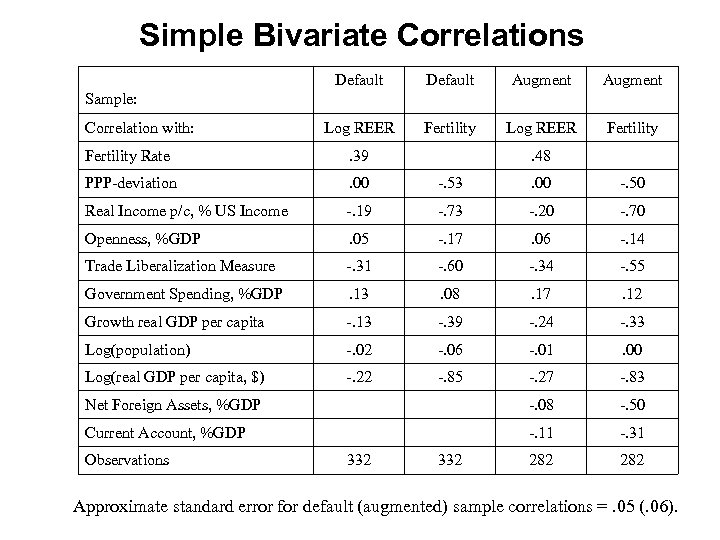 Simple Bivariate Correlations Default Augment Log REER Fertility Sample: Correlation with: Fertility Rate . 39 PPP-deviation . 00 -. 53 . 00 -. 50 Real Income p/c, % US Income -. 19 -. 73 -. 20 -. 70 Openness, %GDP . 05 -. 17 . 06 -. 14 Trade Liberalization Measure -. 31 -. 60 -. 34 -. 55 Government Spending, %GDP . 13 . 08 . 17 . 12 Growth real GDP per capita -. 13 -. 39 -. 24 -. 33 Log(population) -. 02 -. 06 -. 01 . 00 Log(real GDP per capita, $) -. 22 -. 85 -. 27 -. 83 Net Foreign Assets, %GDP -. 08 -. 50 Current Account, %GDP -. 11 -. 31 282 Observations 332 . 48 332 Approximate standard error for default (augmented) sample correlations =. 05 (. 06).
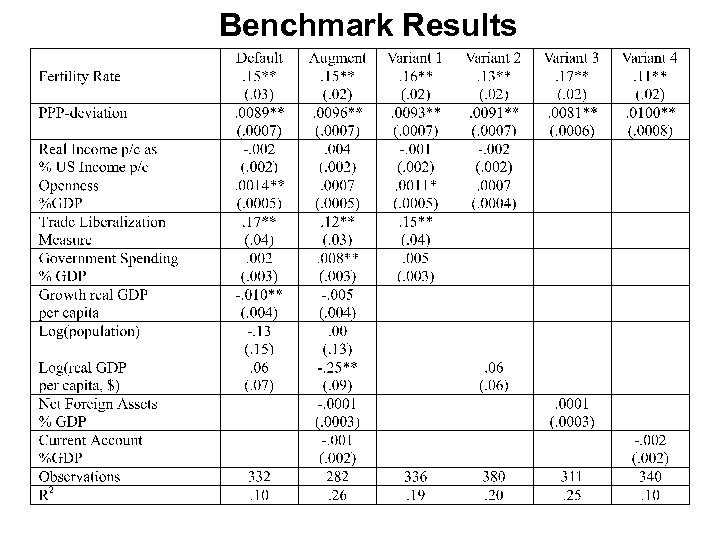 Benchmark Results
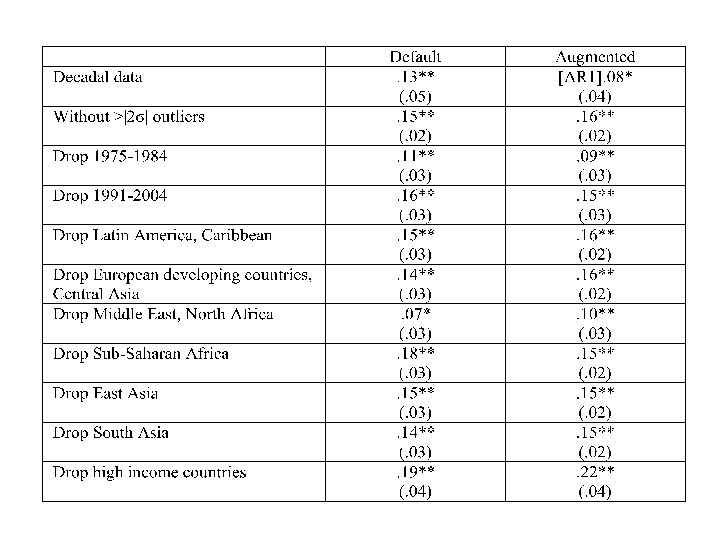
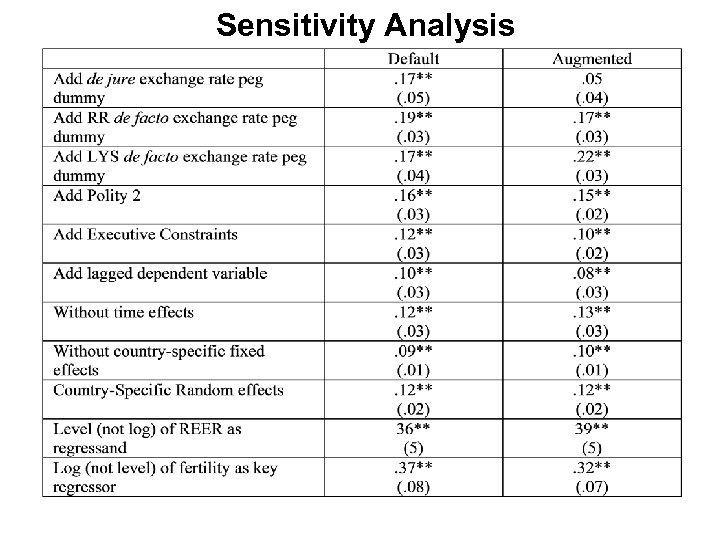 Sensitivity Analysis
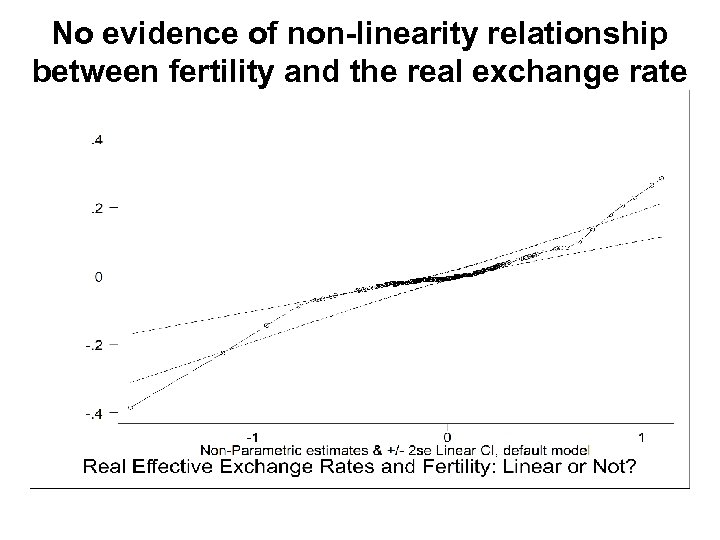 No evidence of non-linearity relationship between fertility and the real exchange rate
 Simultaneity/Measurement Error • Measurement error a potential issue (probably not simultaneity) • • Little seems to drive real exchange rate empirically! Barro and Lee (“Sources of Economic Growth” 1994): “We also find that female educational attainment has a pronounced negative effect on fertility …” • Three instruments used: 1) the percentage of 15+ females without schooling; 2) the percentage of 15+ females who attained secondary school; and 3) the average years of school for 15+ females.
 “Deeper” IV Rationalizations • Technological Progress implies Rise in Return to, Demand for Human Capital – Hence increased preference for offspring quality instead of quantity? • Knowledge of Birth Control?
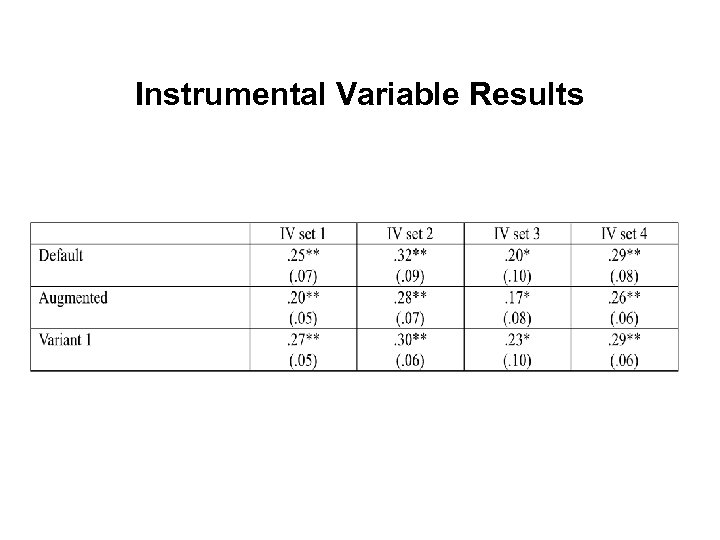 Instrumental Variable Results
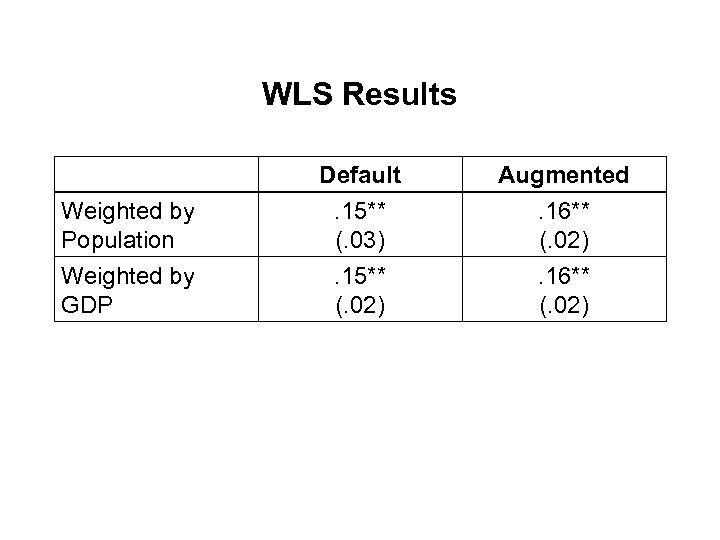 WLS Results Weighted by Population Default. 15** (. 03) Augmented. 16** (. 02) Weighted by GDP . 15** (. 02) . 16** (. 02)
 Sensitivity Analysis: Key Regressor
 Adding Different Age Cohorts to the RER Equation
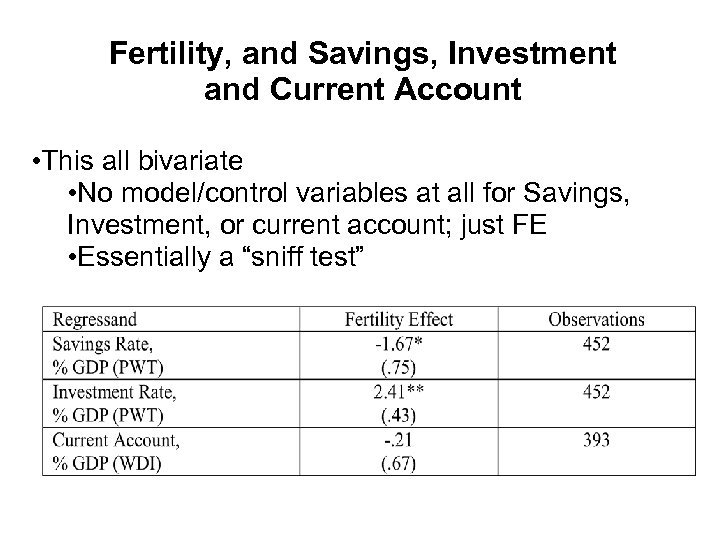 Fertility, and Savings, Investment and Current Account • This all bivariate • No model/control variables at all for Savings, Investment, or current account; just FE • Essentially a “sniff test”
 Summary: 1 • Use quinquennial data set: 87 countries, 19752005 to investigate fertility - real effective exchange rate link • Control for host of potential determinants (PPP, Balassa-Samuelson, etc)
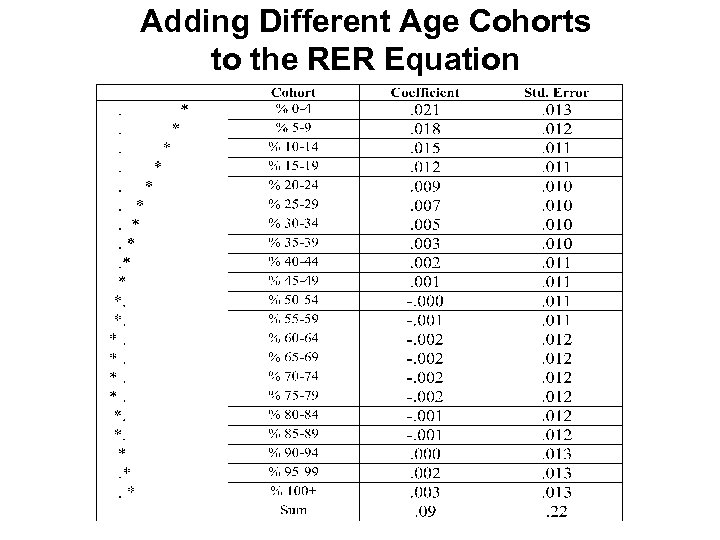
 Summary: 2 • Some Positive Results! • Find statistically significant and robust link between fertility and the exchange rate. • No non-linearities • Robust results • Instrument variables just raises estimate • Other demographic effects estimated sensibly but with less precision (sample variation? )
 Conclusion • Decrease in fertility rate of one child per woman associated with 15% depreciation in the real effective exchange rate • Such fertility rate changes common in sample • Enormous wealth transfers! – Using Gourinchas and Rey (2007) estimates: 15% depreciation results in transfer of 8% US GDP from Ro. W