 Скачать презентацию Fermilab ILC Simulation for RDR Kirti Ranjan
86ad9a50f464f9aa80dd8690b568d19a.ppt
- Количество слайдов: 19



@ Fermilab ILC Simulation for RDR Kirti Ranjan Fermilab May 15 -17, 2006, FNAL KIRTI RANJAN – DOE Review 1
OVERVIEW @ Fermilab q Scope: ü Study the emittance preservation and developing further tools ü Specification of alignment tolerances of the components ü Static tuning and alignment studies ü Main Linac (ML) lattice design ü Benchmarking among various codes ü Wakefield calculations § Dynamic effects and Feedback studies § Integrated simulations of static and dynamic effects across all subsystems from DR exit to IP § Specifications for Instrumentation and diagnostics q Collaboration: Within the American region, Fermilab is collaborating with SLAC and Cornell; and outside with CERN, DESY and KEK on the ML studies q Personnel involved: Mike Church, Ivan Gonin, Timer Khabiboullin, Paul Lebrun, Leo Michelotti, Shekhar Mishra, Sergei Nagaitsev, Francois Ostiguy, Kirti Ranjan, Nikolay Solyak, Panagiotis Spentzouris, Alex Valishev May 15 -17, 2006, FNAL KIRTI RANJAN – DOE Review 2
@ Fermilab Emittance Preservation E Main Linac Simulation ü Before Baseline Configuration Document (BCD) ð Results presented in Snowmass, ’ 05 Ø Study single-bunch emittance dilution in Main Linac Ø Compare the emittance dilution performance of two different “beam-based steering” algorithms : “ 1: 1” & “Dispersion Free Steering” under nominal conditions of static misalignments of the various beamline elements Ø Compare the sensitivity of the steering algorithms for conditions different from the nominal Ø Compare the different lattice configurations (with different Quad spacing) ü After ILC BCD ð Preliminary results for the ILC BCD curved Linac May 15 -17, 2006, FNAL KIRTI RANJAN – DOE Review 3
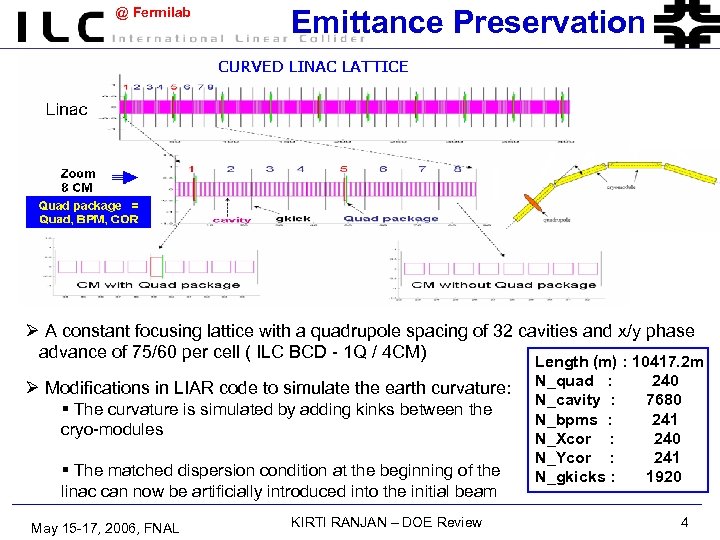
@ Fermilab Emittance Preservation Ø A constant focusing lattice with a quadrupole spacing of 32 cavities and x/y phase advance of 75/60 per cell ( ILC BCD - 1 Q / 4 CM) Length (m) : 10417. 2 m Ø Modifications in LIAR code to simulate the earth curvature: § The curvature is simulated by adding kinks between the cryo-modules § The matched dispersion condition at the beginning of the linac can now be artificially introduced into the initial beam May 15 -17, 2006, FNAL KIRTI RANJAN – DOE Review N_quad : N_cavity : N_bpms : N_Xcor : N_Ycor : N_gkicks : 240 7680 241 240 241 1920 4
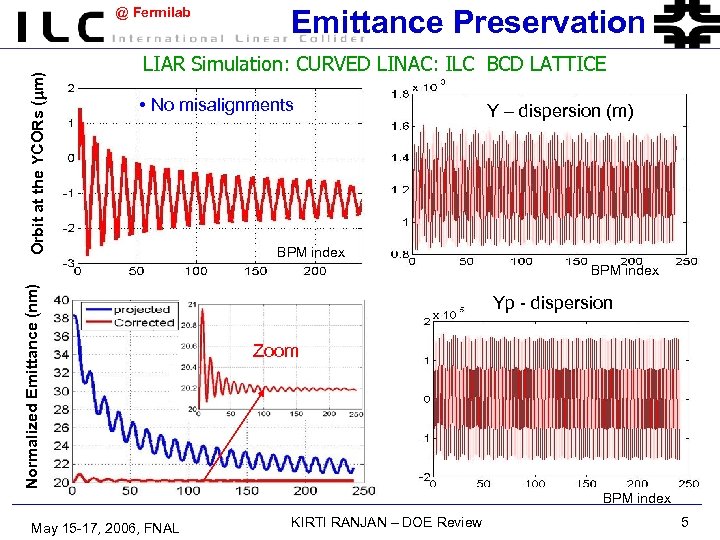
Orbit at the YCORs (mm) @ Fermilab Emittance Preservation LIAR Simulation: CURVED LINAC: ILC BCD LATTICE • No misalignments Y – dispersion (m) BPM index Normalized Emittance (nm) BPM index Yp - dispersion Zoom BPM index May 15 -17, 2006, FNAL KIRTI RANJAN – DOE Review 5
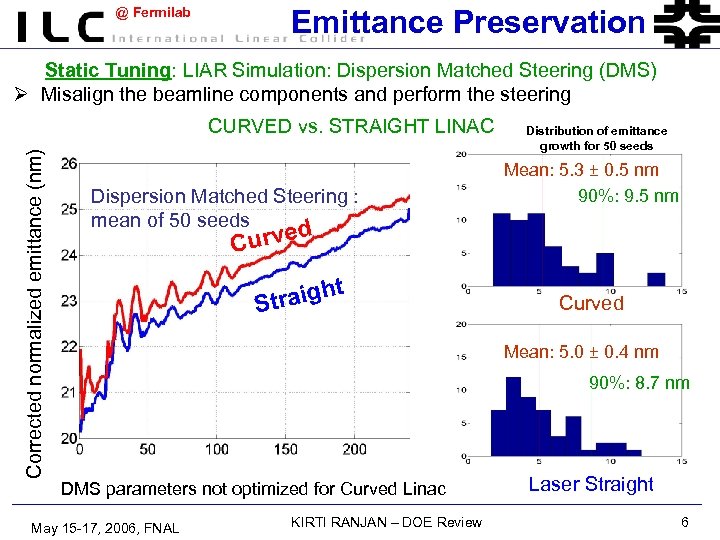
@ Fermilab Emittance Preservation Static Tuning: LIAR Simulation: Dispersion Matched Steering (DMS) Ø Misalign the beamline components and perform the steering Corrected normalized emittance (nm) CURVED vs. STRAIGHT LINAC Dispersion Matched Steering : mean of 50 seeds Distribution of emittance growth for 50 seeds Mean: 5. 3 ± 0. 5 nm 90%: 9. 5 nm urved C t traigh S Curved Mean: 5. 0 ± 0. 4 nm 90%: 8. 7 nm DMS parameters not optimized for Curved Linac May 15 -17, 2006, FNAL KIRTI RANJAN – DOE Review Laser Straight 6
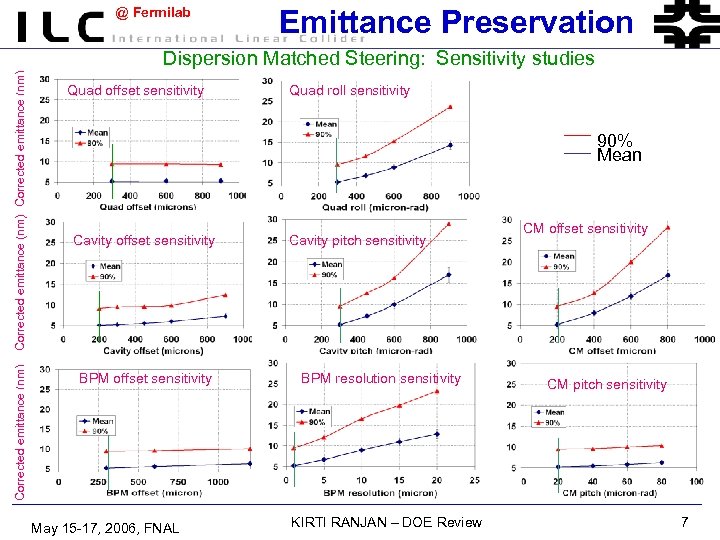
@ Fermilab Emittance Preservation Corrected emittance (nm) Dispersion Matched Steering: Sensitivity studies Quad offset sensitivity Quad roll sensitivity 90% Mean Cavity offset sensitivity BPM offset sensitivity May 15 -17, 2006, FNAL Cavity pitch sensitivity BPM resolution sensitivity KIRTI RANJAN – DOE Review CM offset sensitivity CM pitch sensitivity 7
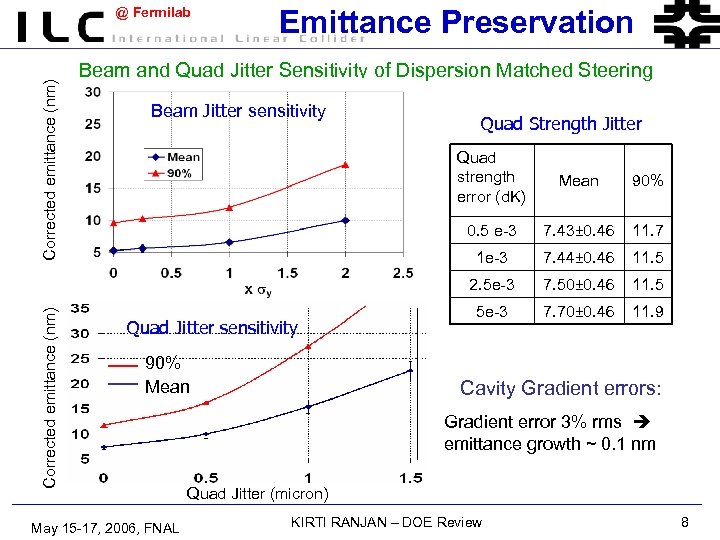
Corrected emittance (nm) @ Fermilab Emittance Preservation Beam and Quad Jitter Sensitivity of Dispersion Matched Steering Beam Jitter sensitivity Quad strength error (d. K) 90% Mean May 15 -17, 2006, FNAL 90% 7. 43± 0. 46 11. 7 1 e-3 Quad Jitter sensitivity Mean 0. 5 e-3 Beam jitter (sigma) Corrected emittance (nm) Quad Strength Jitter 7. 44± 0. 46 11. 5 2. 5 e-3 7. 50± 0. 46 11. 5 5 e-3 7. 70± 0. 46 11. 9 Cavity Gradient errors: Gradient error 3% rms emittance growth ~ 0. 1 nm Quad Jitter (micron) KIRTI RANJAN – DOE Review 8
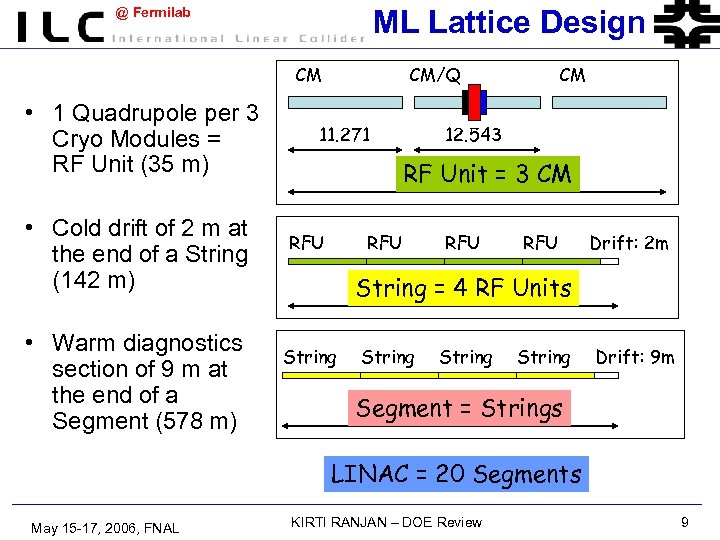
ML Lattice Design @ Fermilab CM • 1 Quadrupole per 3 Cryo Modules = RF Unit (35 m) • Cold drift of 2 m at the end of a String (142 m) • Warm diagnostics section of 9 m at the end of a Segment (578 m) CM/Q 11. 271 CM 12. 543 RF Unit = 3 CM RFU RFU Drift: 2 m String = 4 RF Units String Drift: 9 m Segment = Strings LINAC = 20 Segments May 15 -17, 2006, FNAL KIRTI RANJAN – DOE Review 9
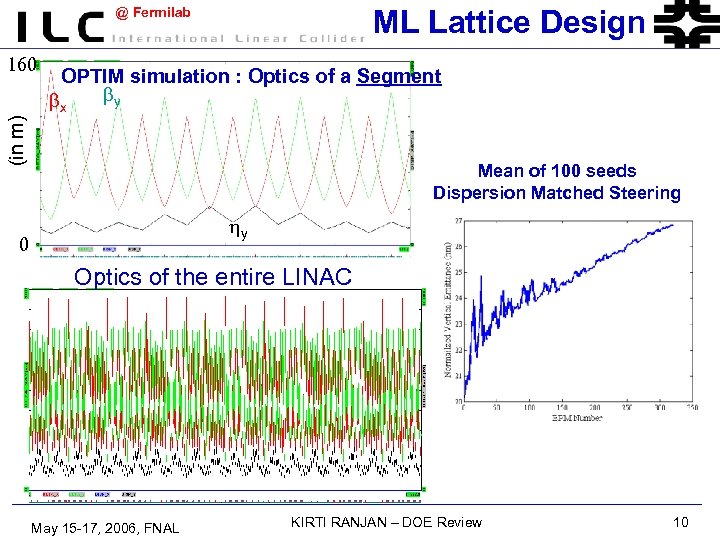
ML Lattice Design @ Fermilab 160 OPTIM simulation : Optics of a Segment by b (in m) x Mean of 100 seeds Dispersion Matched Steering hy 0 Optics of the entire LINAC May 15 -17, 2006, FNAL KIRTI RANJAN – DOE Review 10
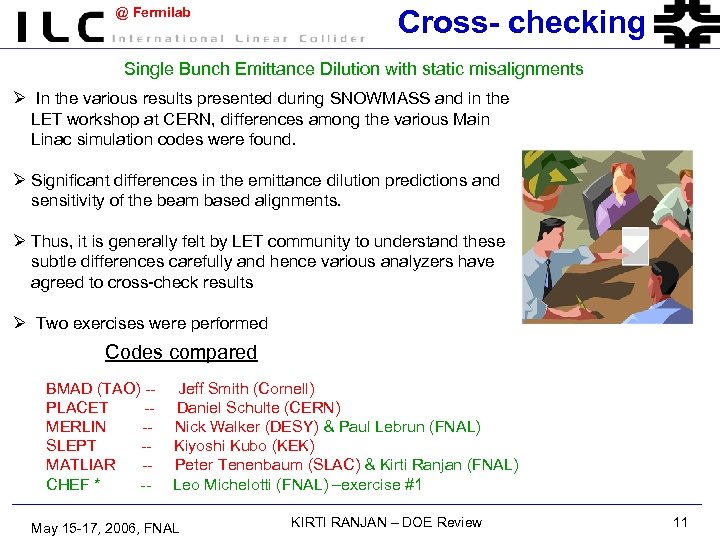
@ Fermilab Cross- checking Single Bunch Emittance Dilution with static misalignments Ø In the various results presented during SNOWMASS and in the LET workshop at CERN, differences among the various Main Linac simulation codes were found. Ø Significant differences in the emittance dilution predictions and sensitivity of the beam based alignments. Ø Thus, it is generally felt by LET community to understand these subtle differences carefully and hence various analyzers have agreed to cross-check results Ø Two exercises were performed Codes compared BMAD (TAO) -PLACET -MERLIN -SLEPT -MATLIAR -CHEF * -- Jeff Smith (Cornell) Daniel Schulte (CERN) Nick Walker (DESY) & Paul Lebrun (FNAL) Kiyoshi Kubo (KEK) Peter Tenenbaum (SLAC) & Kirti Ranjan (FNAL) Leo Michelotti (FNAL) –exercise #1 May 15 -17, 2006, FNAL KIRTI RANJAN – DOE Review 11
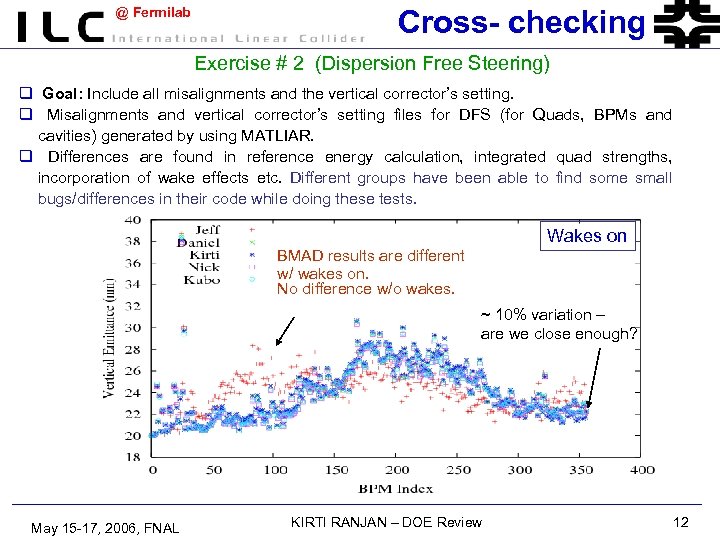
@ Fermilab Cross- checking Exercise # 2 (Dispersion Free Steering) q Goal: Include all misalignments and the vertical corrector’s setting. q Misalignments and vertical corrector’s setting files for DFS (for Quads, BPMs and cavities) generated by using MATLIAR. q Differences are found in reference energy calculation, integrated quad strengths, incorporation of wake effects etc. Different groups have been able to find some small bugs/differences in their code while doing these tests. Wakes on BMAD results are different w/ wakes on. No difference w/o wakes. ~ 10% variation – are we close enough? May 15 -17, 2006, FNAL KIRTI RANJAN – DOE Review 12
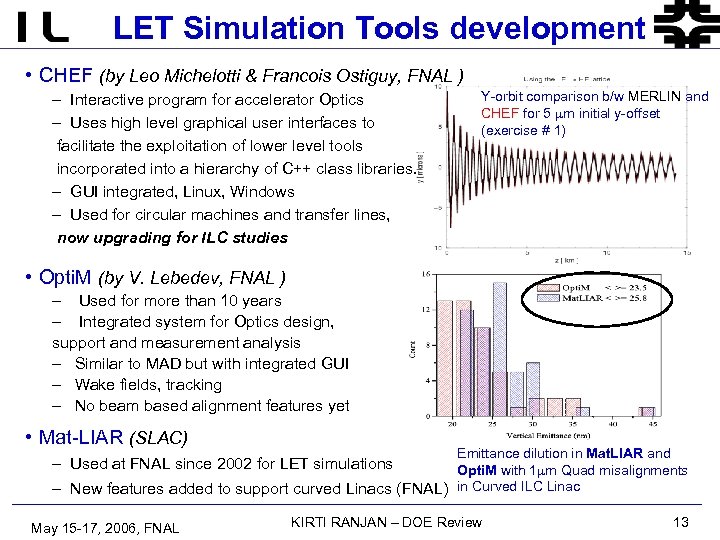
@ Fermilab LET Simulation Tools development • CHEF (by Leo Michelotti & Francois Ostiguy, FNAL ) – Interactive program for accelerator Optics – Uses high level graphical user interfaces to facilitate the exploitation of lower level tools incorporated into a hierarchy of C++ class libraries. – GUI integrated, Linux, Windows – Used for circular machines and transfer lines, now upgrading for ILC studies Y-orbit comparison b/w MERLIN and CHEF for 5 mm initial y-offset (exercise # 1) • Opti. M (by V. Lebedev, FNAL ) – Used for more than 10 years – Integrated system for Optics design, support and measurement analysis – Similar to MAD but with integrated GUI – Wake fields, tracking – No beam based alignment features yet • Mat-LIAR (SLAC) Emittance dilution in Mat. LIAR and Opti. M with 1 mm Quad misalignments – New features added to support curved Linacs (FNAL) in Curved ILC Linac – Used at FNAL since 2002 for LET simulations May 15 -17, 2006, FNAL KIRTI RANJAN – DOE Review 13
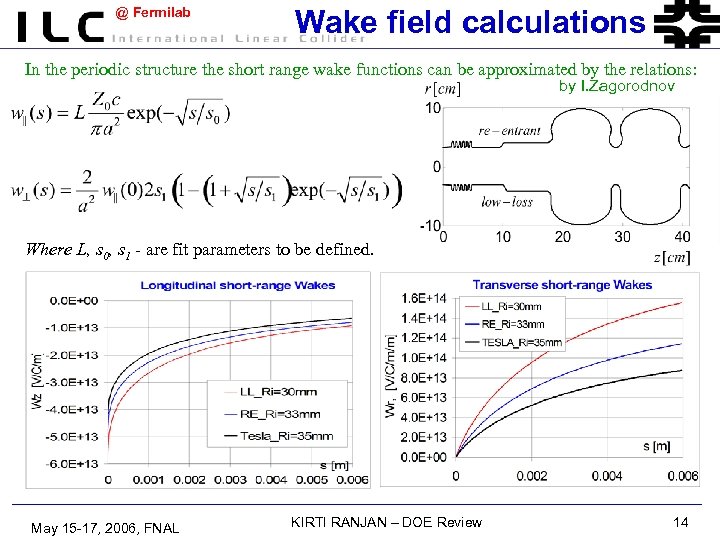
@ Fermilab Wake field calculations In the periodic structure the short range wake functions can be approximated by the relations: by I. Zagorodnov Where L, s 0, s 1 - are fit parameters to be defined. May 15 -17, 2006, FNAL KIRTI RANJAN – DOE Review 14
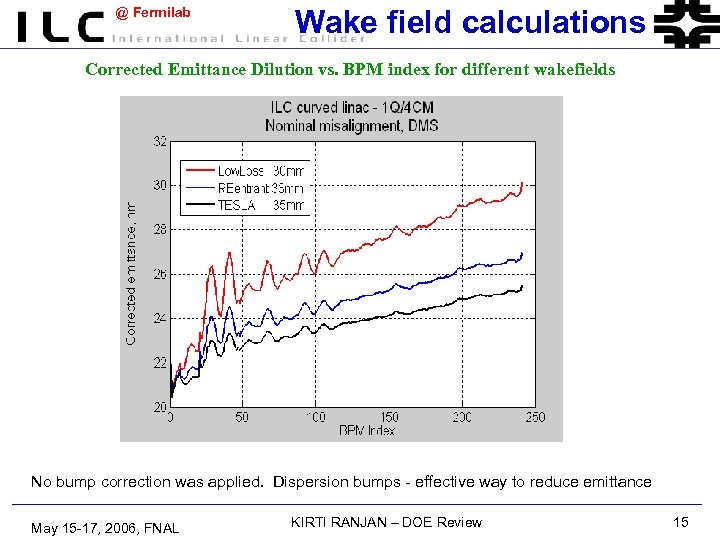
@ Fermilab Wake field calculations Corrected Emittance Dilution vs. BPM index for different wakefields No bump correction was applied. Dispersion bumps - effective way to reduce emittance May 15 -17, 2006, FNAL KIRTI RANJAN – DOE Review 15
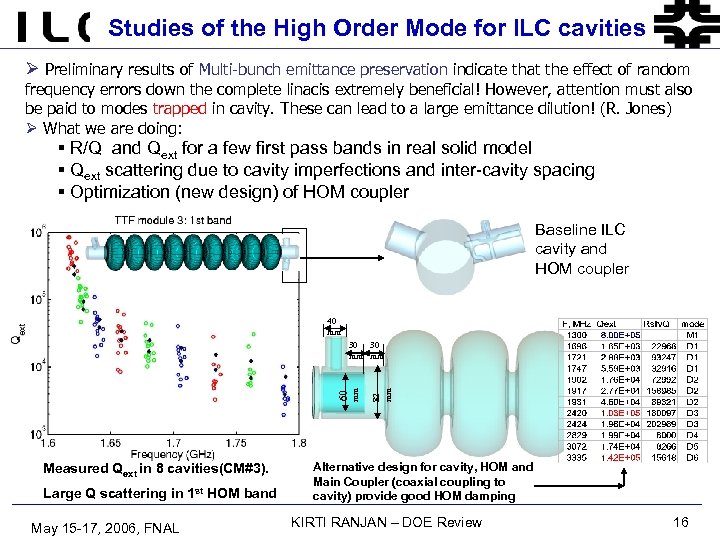
@ Fermilab Studies of the High Order Mode for ILC cavities Ø Preliminary results of Multi-bunch emittance preservation indicate that the effect of random frequency errors down the complete linacis extremely beneficial! However, attention must also be paid to modes trapped in cavity. These can lead to a large emittance dilution! (R. Jones) Ø What we are doing: § R/Q and Qext for a few first pass bands in real solid model § Qext scattering due to cavity imperfections and inter-cavity spacing § Optimization (new design) of HOM coupler Baseline ILC cavity and HOM coupler 40 mm Measured Qext in 8 cavities(CM#3). Large Q scattering in 1 st HOM band May 15 -17, 2006, FNAL 82 mm mm 60 30 30 mm mm Alternative design for cavity, HOM and Main Coupler (coaxial coupling to cavity) provide good HOM damping KIRTI RANJAN – DOE Review 16
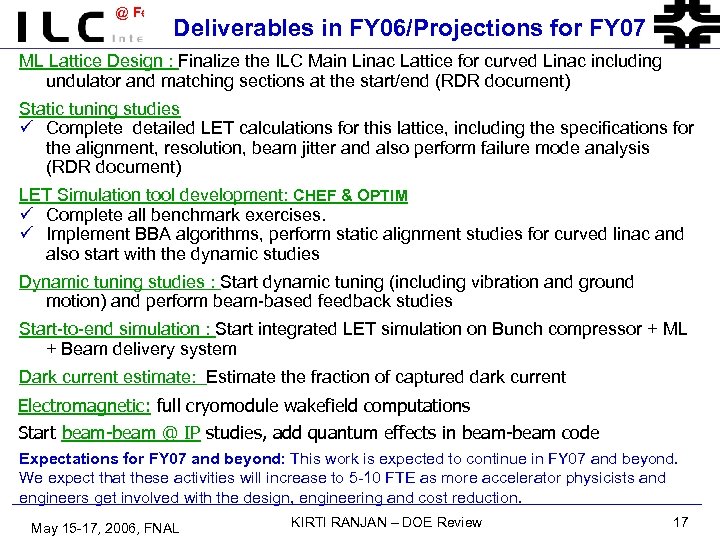
@ Fermilab Deliverables in FY 06/Projections for FY 07 ML Lattice Design : Finalize the ILC Main Linac Lattice for curved Linac including undulator and matching sections at the start/end (RDR document) Static tuning studies ü Complete detailed LET calculations for this lattice, including the specifications for the alignment, resolution, beam jitter and also perform failure mode analysis (RDR document) LET Simulation tool development: CHEF & OPTIM ü Complete all benchmark exercises. ü Implement BBA algorithms, perform static alignment studies for curved linac and also start with the dynamic studies Dynamic tuning studies : Start dynamic tuning (including vibration and ground motion) and perform beam-based feedback studies Start-to-end simulation : Start integrated LET simulation on Bunch compressor + ML + Beam delivery system Dark current estimate: Estimate the fraction of captured dark current Electromagnetic: full cryomodule wakefield computations Start beam-beam @ IP studies, add quantum effects in beam-beam code Expectations for FY 07 and beyond: This work is expected to continue in FY 07 and beyond. We expect that these activities will increase to 5 -10 FTE as more accelerator physicists and engineers get involved with the design, engineering and cost reduction. May 15 -17, 2006, FNAL KIRTI RANJAN – DOE Review 17
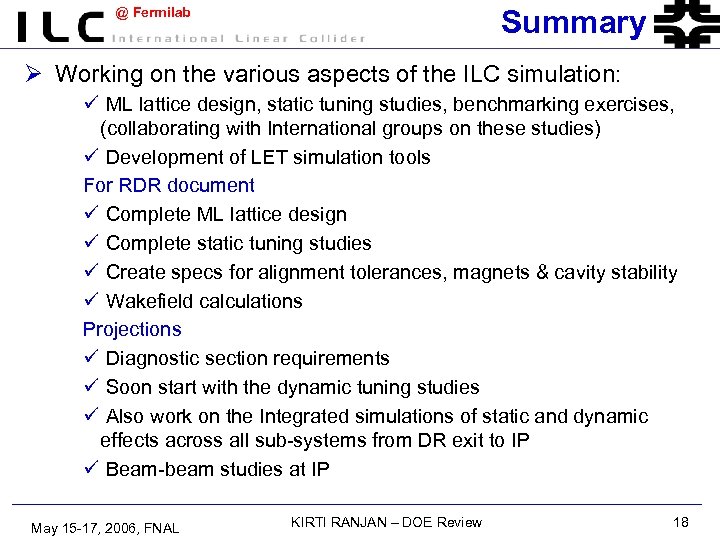
Summary @ Fermilab Ø Working on the various aspects of the ILC simulation: ü ML lattice design, static tuning studies, benchmarking exercises, (collaborating with International groups on these studies) ü Development of LET simulation tools For RDR document ü Complete ML lattice design ü Complete static tuning studies ü Create specs for alignment tolerances, magnets & cavity stability ü Wakefield calculations Projections ü Diagnostic section requirements ü Soon start with the dynamic tuning studies ü Also work on the Integrated simulations of static and dynamic effects across all sub-systems from DR exit to IP ü Beam-beam studies at IP May 15 -17, 2006, FNAL KIRTI RANJAN – DOE Review 18
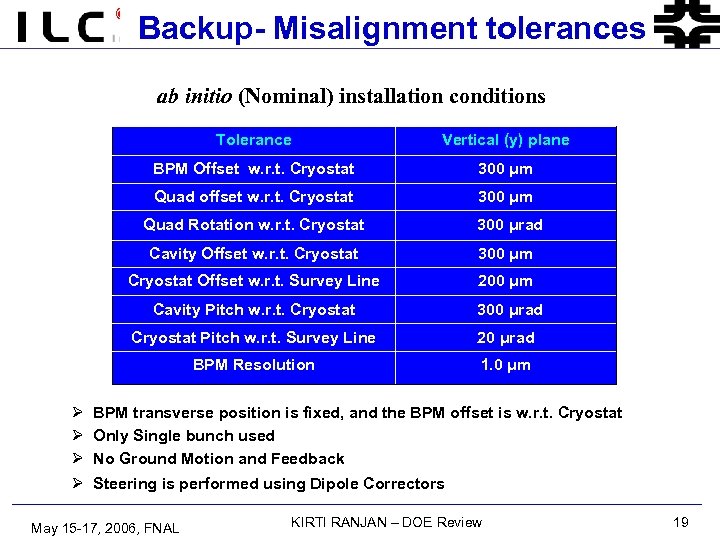
@ Fermilab Backup- Misalignment tolerances ab initio (Nominal) installation conditions Tolerance Vertical (y) plane BPM Offset w. r. t. Cryostat 300 μm Quad offset w. r. t. Cryostat 300 μm Quad Rotation w. r. t. Cryostat 300 μrad Cavity Offset w. r. t. Cryostat 300 μm Cryostat Offset w. r. t. Survey Line 200 μm Cavity Pitch w. r. t. Cryostat 300 μrad Cryostat Pitch w. r. t. Survey Line 20 μrad BPM Resolution 1. 0 μm Ø BPM transverse position is fixed, and the BPM offset is w. r. t. Cryostat Ø Only Single bunch used Ø No Ground Motion and Feedback Ø Steering is performed using Dipole Correctors May 15 -17, 2006, FNAL KIRTI RANJAN – DOE Review 19
Скачать презентацию Fermilab ILC Simulation for RDR Kirti Ranjan
86ad9a50f464f9aa80dd8690b568d19a.ppt