 Скачать презентацию Fermilab Accelerator Ph D Program Eric Prebys FNAL
667fa641ee428b4f5c212a59f3aad46d.ppt
- Количество слайдов: 48



Fermilab Accelerator Ph. D Program Eric Prebys FNAL Accelerator Division E. Prebys, Austin Student Seminar, May 2, 2007 E. Prebys, NMSU th
Outline § § § History Basic accelerator physics concepts The Fermilab accelerator complex Other projects at Fermilab Ph. D Program E. Prebys, Student Seminar, UT Austin, May 2, 2007 2
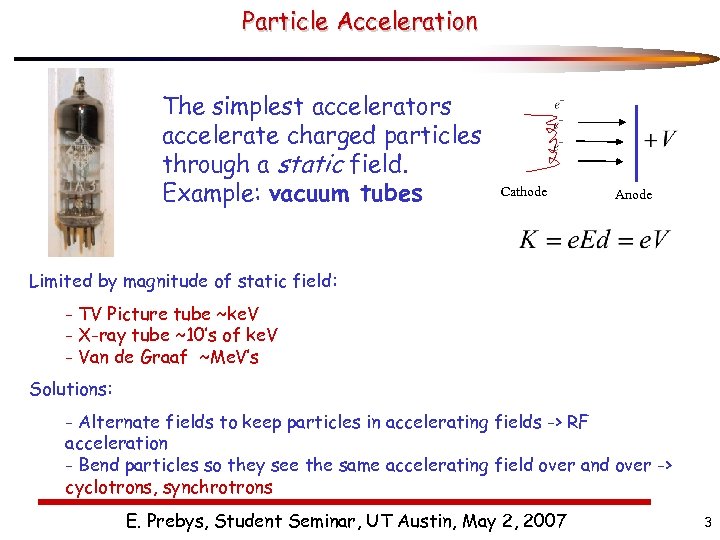
Particle Acceleration The simplest accelerators accelerate charged particles through a static field. Example: vacuum tubes Cathode Anode Limited by magnitude of static field: - TV Picture tube ~ke. V - X-ray tube ~10’s of ke. V - Van de Graaf ~Me. V’s Solutions: - Alternate fields to keep particles in accelerating fields -> RF acceleration - Bend particles so they see the same accelerating field over and over -> cyclotrons, synchrotrons E. Prebys, Student Seminar, UT Austin, May 2, 2007 3
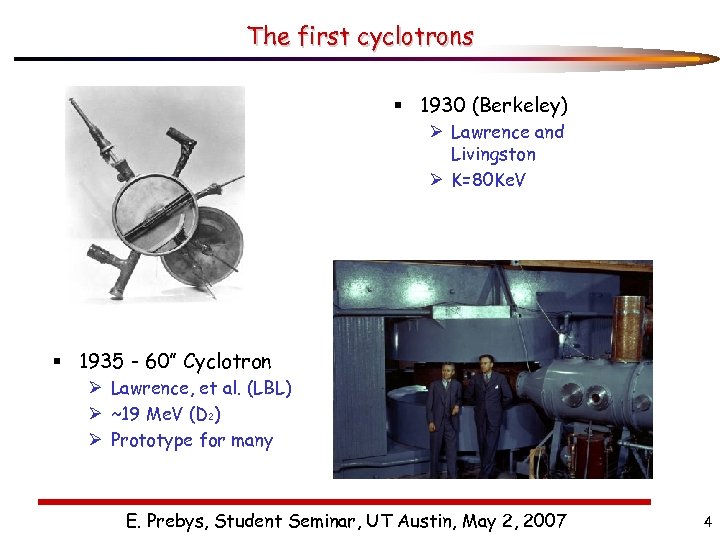
The first cyclotrons § 1930 (Berkeley) Ø Lawrence and Livingston Ø K=80 Ke. V § 1935 - 60” Cyclotron Ø Lawrence, et al. (LBL) Ø ~19 Me. V (D 2) Ø Prototype for many E. Prebys, Student Seminar, UT Austin, May 2, 2007 4
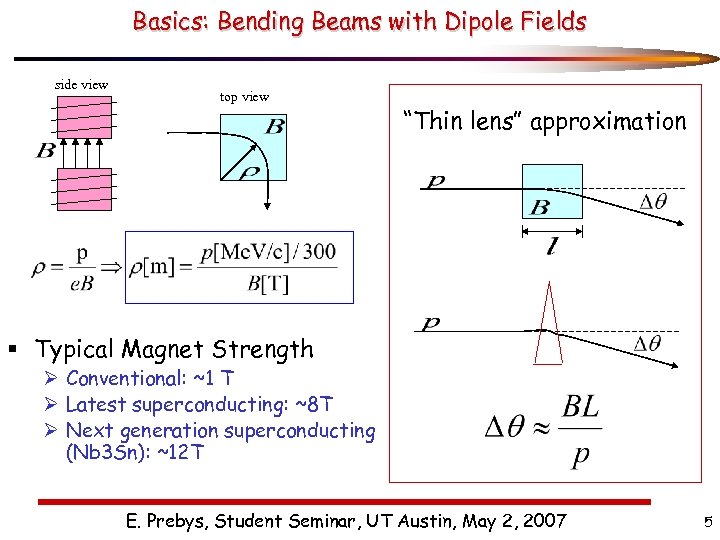
Basics: Bending Beams with Dipole Fields side view top view “Thin lens” approximation § Typical Magnet Strength Ø Conventional: ~1 T Ø Latest superconducting: ~8 T Ø Next generation superconducting (Nb 3 Sn): ~12 T E. Prebys, Student Seminar, UT Austin, May 2, 2007 5
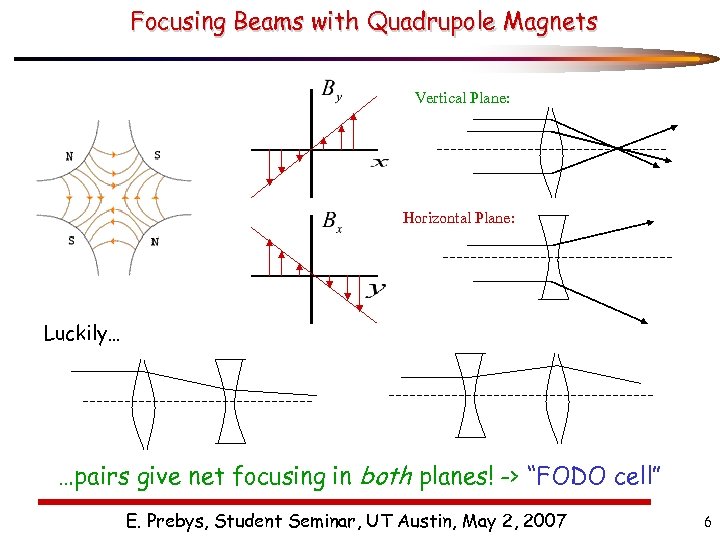
Focusing Beams with Quadrupole Magnets Vertical Plane: Horizontal Plane: Luckily… …pairs give net focusing in both planes! -> “FODO cell” E. Prebys, Student Seminar, UT Austin, May 2, 2007 6
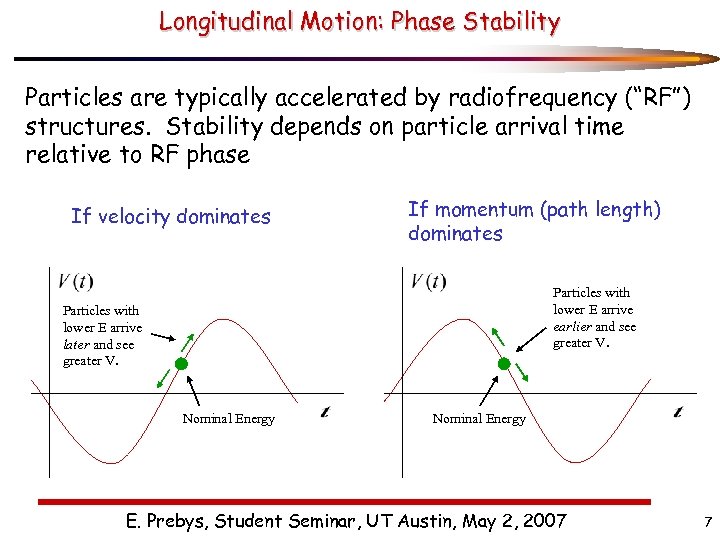
Longitudinal Motion: Phase Stability Particles are typically accelerated by radiofrequency (“RF”) structures. Stability depends on particle arrival time relative to RF phase If velocity dominates If momentum (path length) dominates Particles with lower E arrive earlier and see greater V. Particles with lower E arrive later and see greater V. Nominal Energy E. Prebys, Student Seminar, UT Austin, May 2, 2007 7
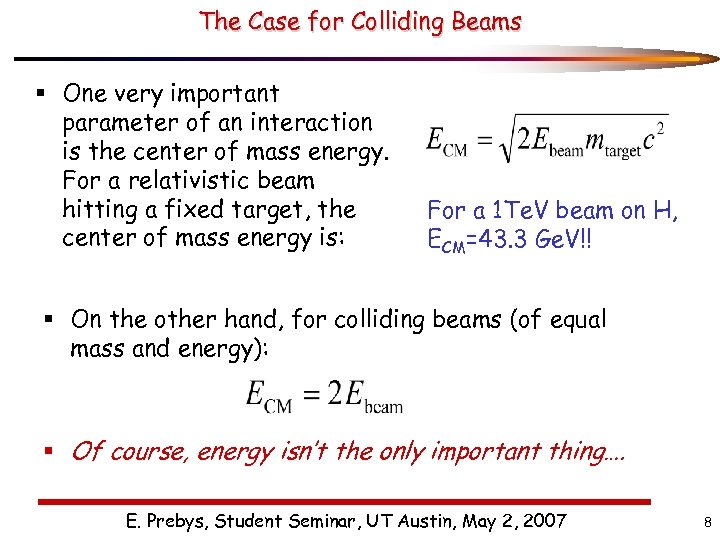
The Case for Colliding Beams § One very important parameter of an interaction is the center of mass energy. For a relativistic beam hitting a fixed target, the center of mass energy is: For a 1 Te. V beam on H, ECM=43. 3 Ge. V!! § On the other hand, for colliding beams (of equal mass and energy): § Of course, energy isn’t the only important thing…. E. Prebys, Student Seminar, UT Austin, May 2, 2007 8
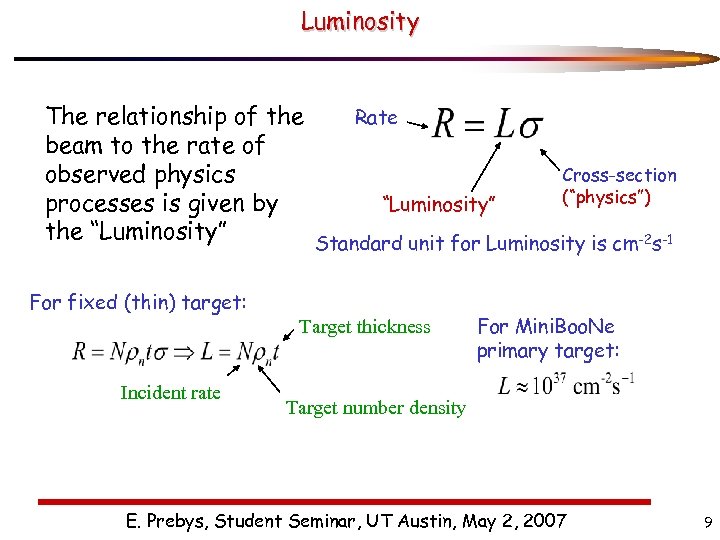
Luminosity Rate The relationship of the beam to the rate of Cross-section observed physics (“physics”) processes is given by “Luminosity” the “Luminosity” Standard unit for Luminosity is cm-2 s-1 For fixed (thin) target: Target thickness Incident rate For Mini. Boo. Ne primary target: Target number density E. Prebys, Student Seminar, UT Austin, May 2, 2007 9
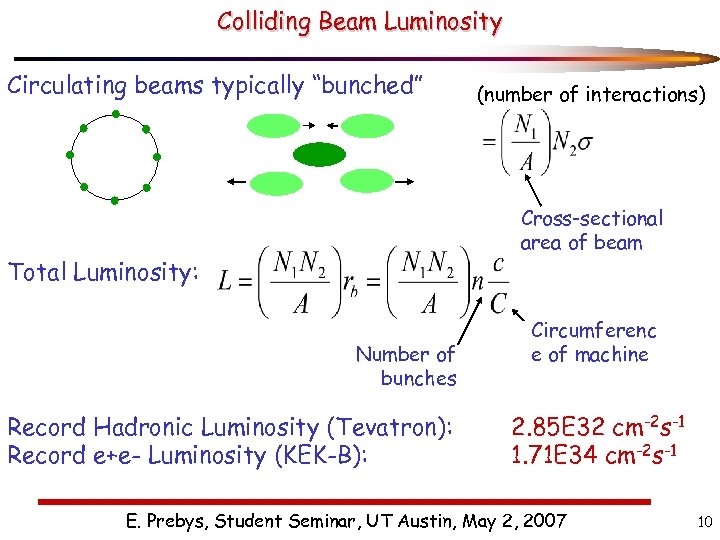
Colliding Beam Luminosity Circulating beams typically “bunched” (number of interactions) Cross-sectional area of beam Total Luminosity: Number of bunches Record Hadronic Luminosity (Tevatron): Record e+e- Luminosity (KEK-B): Circumferenc e of machine 2. 85 E 32 cm-2 s-1 1. 71 E 34 cm-2 s-1 E. Prebys, Student Seminar, UT Austin, May 2, 2007 10
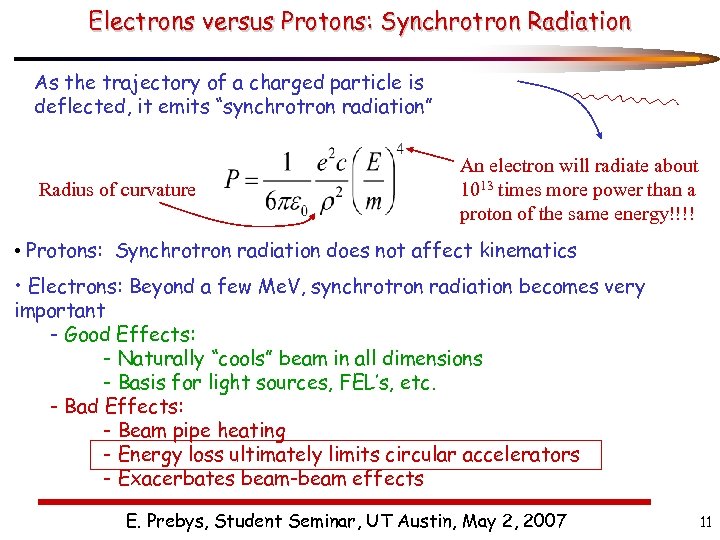
Electrons versus Protons: Synchrotron Radiation As the trajectory of a charged particle is deflected, it emits “synchrotron radiation” Radius of curvature An electron will radiate about 1013 times more power than a proton of the same energy!!!! • Protons: Synchrotron radiation does not affect kinematics • Electrons: Beyond a few Me. V, synchrotron radiation becomes very important - Good Effects: - Naturally “cools” beam in all dimensions - Basis for light sources, FEL’s, etc. - Bad Effects: - Beam pipe heating - Energy loss ultimately limits circular accelerators - Exacerbates beam-beam effects E. Prebys, Student Seminar, UT Austin, May 2, 2007 11
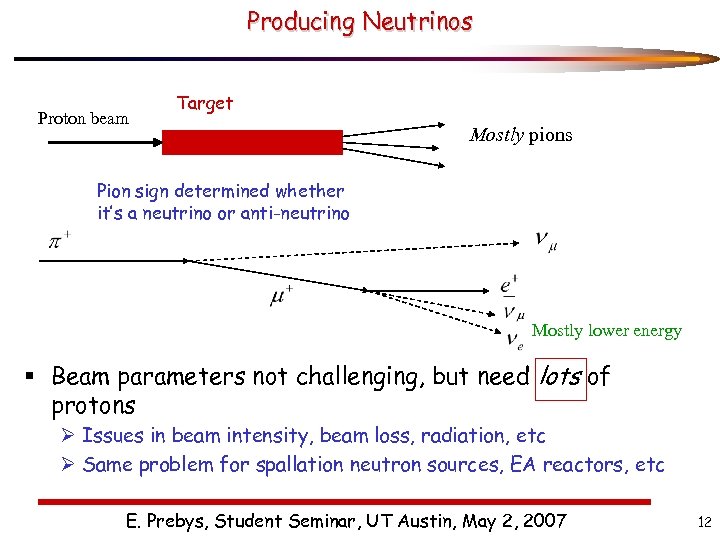
Producing Neutrinos Proton beam Target Mostly pions Pion sign determined whether it’s a neutrino or anti-neutrino Mostly lower energy § Beam parameters not challenging, but need lots of protons Ø Issues in beam intensity, beam loss, radiation, etc Ø Same problem for spallation neutron sources, EA reactors, etc E. Prebys, Student Seminar, UT Austin, May 2, 2007 12
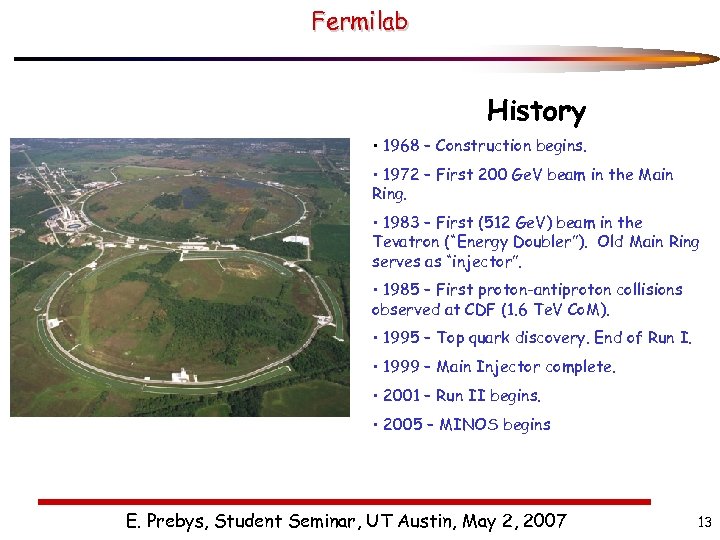
Fermilab History • 1968 – Construction begins. • 1972 – First 200 Ge. V beam in the Main Ring. • 1983 – First (512 Ge. V) beam in the Tevatron (“Energy Doubler”). Old Main Ring serves as “injector”. • 1985 – First proton-antiproton collisions observed at CDF (1. 6 Te. V Co. M). • 1995 – Top quark discovery. End of Run I. • 1999 – Main Injector complete. • 2001 – Run II begins. • 2005 – MINOS begins E. Prebys, Student Seminar, UT Austin, May 2, 2007 13
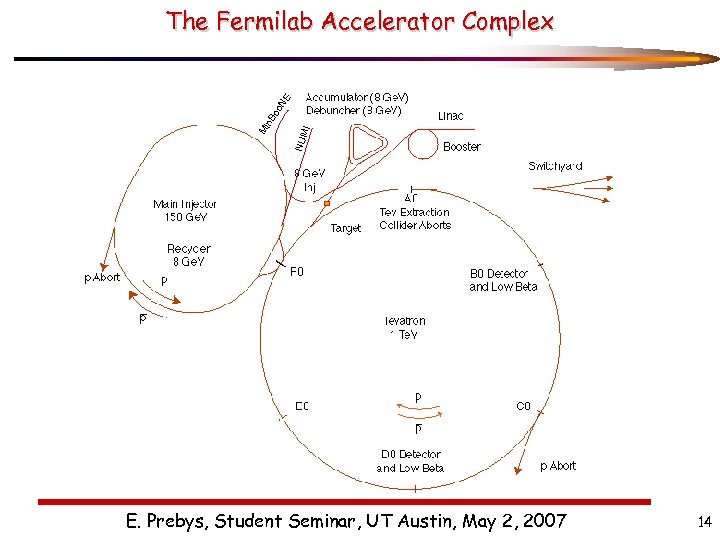
I NUM Mi n. B oo NE The Fermilab Accelerator Complex E. Prebys, Student Seminar, UT Austin, May 2, 2007 14
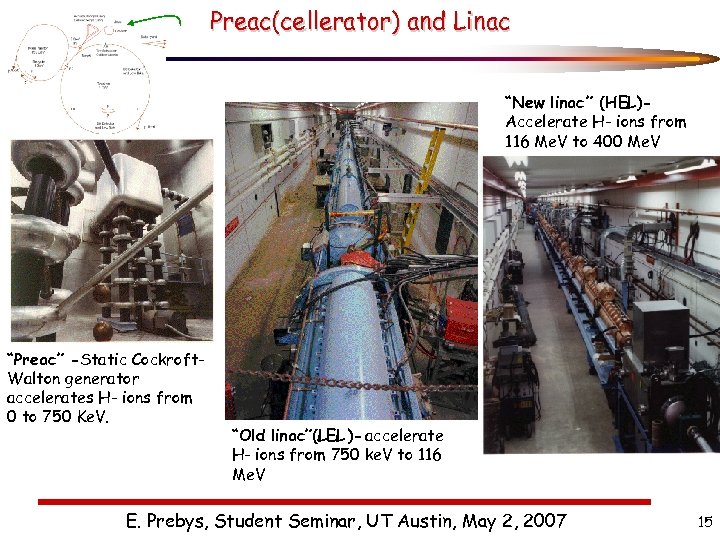
Preac(cellerator) and Linac “New linac” (HEL)Accelerate H- ions from 116 Me. V to 400 Me. V “Preac” -Static Cockroft. Walton generator accelerates H- ions from 0 to 750 Ke. V. “Old linac”(LEL )- accelerate H- ions from 750 ke. V to 116 Me. V E. Prebys, Student Seminar, UT Austin, May 2, 2007 15
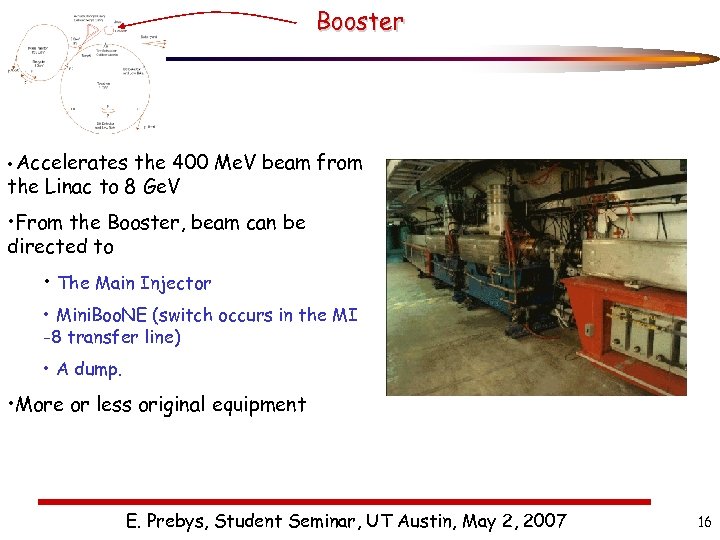
Booster • Accelerates the 400 Me. V beam from the Linac to 8 Ge. V • From the Booster, beam can be directed to • The Main Injector • Mini. Boo. NE (switch occurs in the MI -8 transfer line) • A dump. • More or less original equipment E. Prebys, Student Seminar, UT Austin, May 2, 2007 16
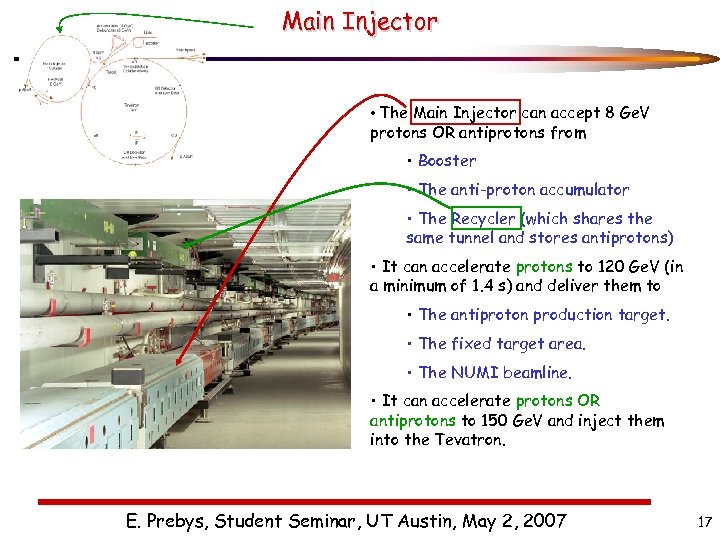
Main Injector • The Main Injector can accept 8 Ge. V protons OR antiprotons from • Booster • The anti-proton accumulator • The Recycler (which shares the same tunnel and stores antiprotons) • It can accelerate protons to 120 Ge. V (in a minimum of 1. 4 s) and deliver them to • The antiproton production target. • The fixed target area. • The NUMI beamline. • It can accelerate protons OR antiprotons to 150 Ge. V and inject them into the Tevatron. E. Prebys, Student Seminar, UT Austin, May 2, 2007 17
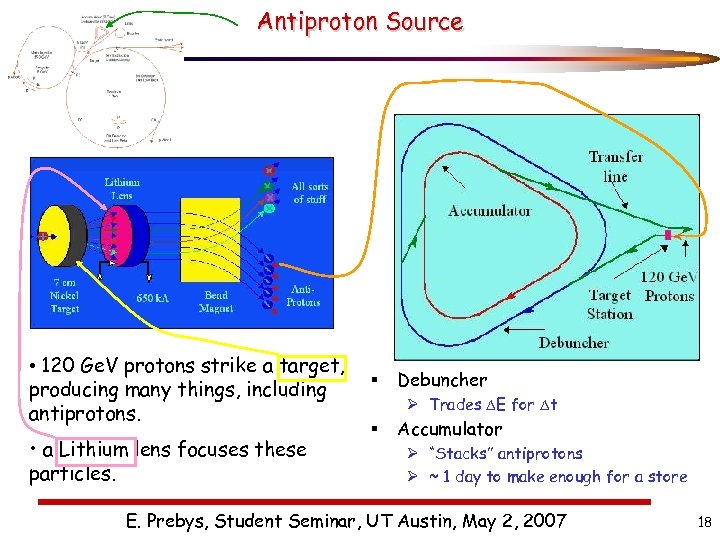
Antiproton Source • 120 Ge. V protons strike a target, producing many things, including antiprotons. • a Lithium lens focuses these particles. § Debuncher Ø Trades DE for Dt § Accumulator Ø “Stacks” antiprotons Ø ~ 1 day to make enough for a store E. Prebys, Student Seminar, UT Austin, May 2, 2007 18
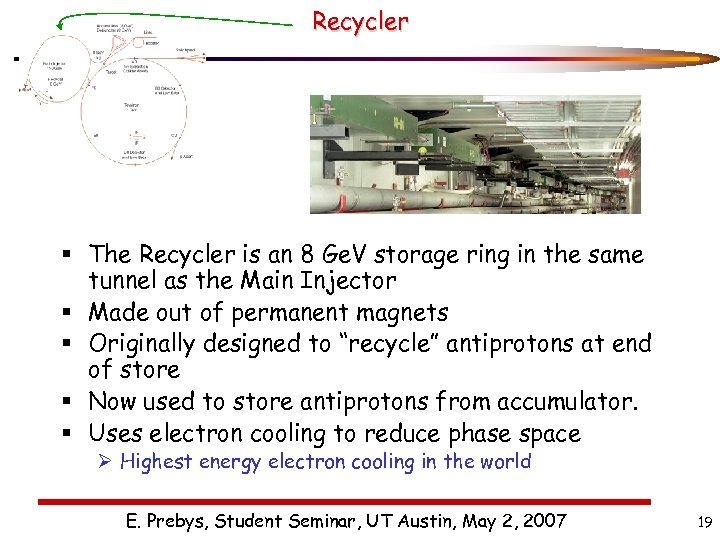
Recycler § The Recycler is an 8 Ge. V storage ring in the same tunnel as the Main Injector § Made out of permanent magnets § Originally designed to “recycle” antiprotons at end of store § Now used to store antiprotons from accumulator. § Uses electron cooling to reduce phase space Ø Highest energy electron cooling in the world E. Prebys, Student Seminar, UT Austin, May 2, 2007 19
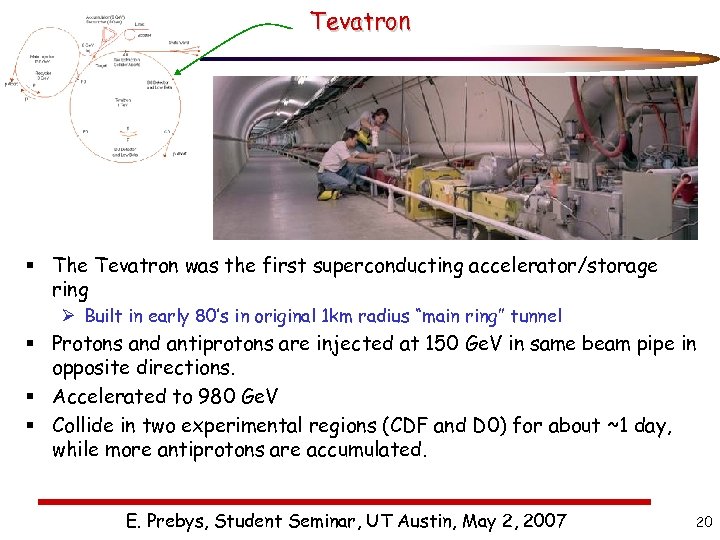
Tevatron § The Tevatron was the first superconducting accelerator/storage ring Ø Built in early 80’s in original 1 km radius “main ring” tunnel § Protons and antiprotons are injected at 150 Ge. V in same beam pipe in opposite directions. § Accelerated to 980 Ge. V § Collide in two experimental regions (CDF and D 0) for about ~1 day, while more antiprotons are accumulated. E. Prebys, Student Seminar, UT Austin, May 2, 2007 20
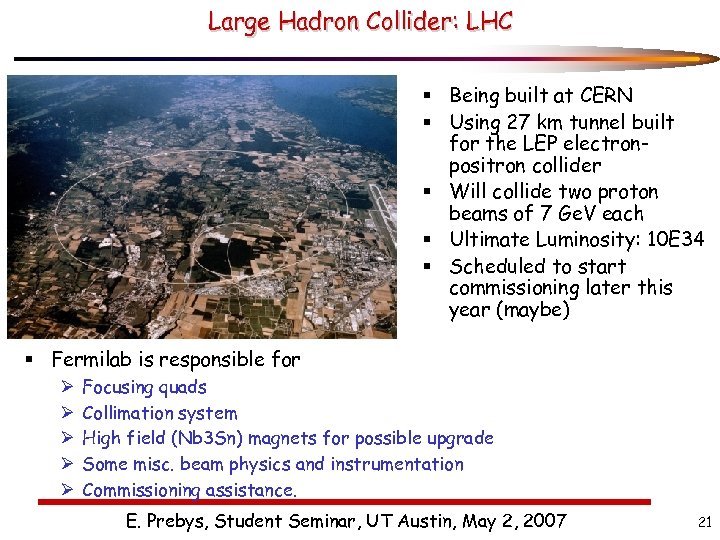
Large Hadron Collider: LHC § Being built at CERN § Using 27 km tunnel built for the LEP electronpositron collider § Will collide two proton beams of 7 Ge. V each § Ultimate Luminosity: 10 E 34 § Scheduled to start commissioning later this year (maybe) § Fermilab is responsible for Ø Ø Ø Focusing quads Collimation system High field (Nb 3 Sn) magnets for possible upgrade Some misc. beam physics and instrumentation Commissioning assistance. E. Prebys, Student Seminar, UT Austin, May 2, 2007 21
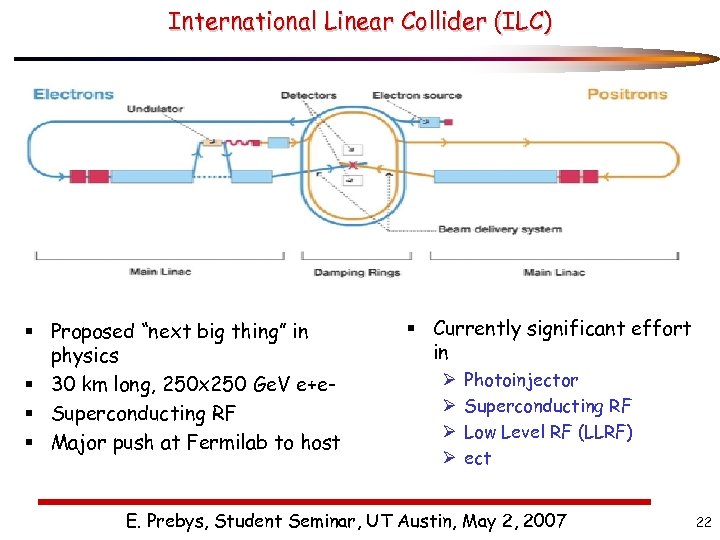
International Linear Collider (ILC) § Proposed “next big thing” in physics § 30 km long, 250 x 250 Ge. V e+e§ Superconducting RF § Major push at Fermilab to host § Currently significant effort in Ø Ø Photoinjector Superconducting RF Low Level RF (LLRF) ect E. Prebys, Student Seminar, UT Austin, May 2, 2007 22
(Some) Accelerator Physics Challenges at FNAL Tevatron Luminosity Improvements Stochastic and Electron Beam Cooling Beam-Beam and Space Charge compensation Accelerator Modeling and Simulation Linear Electron Colliders Large Hadron Collider Upgrades Muon Colliders and Neutrino Sources Advanced Accelerator R&D Medical Accelerators and Beams Conventional and Superconducting Magnet Technology Conventional and Superconducting Radio Frequency Accelerating Structures § Beam Instrumentation and Diagnostics § Beam Transport and Magnetic Optics § Non-linear Beam Dynamics § § § Need students, but we’re not a university! E. Prebys, Student Seminar, UT Austin, May 2, 2007 23
Fermilab Accelerator Ph. D Program § Started in 1985 by Leon Lederman in response to diminishing number of students going into the field. § A student works with an advisor at his or her home institution and a local advisor at Fermilab. § After completing the formal course requirements at the home institution, the student comes to the lab to work on thesis research. § Fermilab pays for tuition, stipend, and housing allowance. § Degree is granted by home institution. § Fermilab Ph. D Committee regularly reviews progress. E. Prebys, Student Seminar, UT Austin, May 2, 2007 24
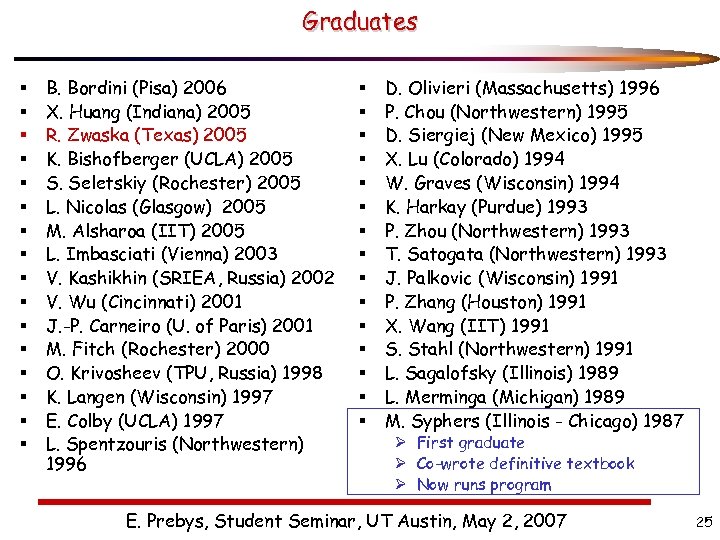
Graduates § § § § B. Bordini (Pisa) 2006 X. Huang (Indiana) 2005 R. Zwaska (Texas) 2005 K. Bishofberger (UCLA) 2005 S. Seletskiy (Rochester) 2005 L. Nicolas (Glasgow) 2005 M. Alsharoa (IIT) 2005 L. Imbasciati (Vienna) 2003 V. Kashikhin (SRIEA, Russia) 2002 V. Wu (Cincinnati) 2001 J. -P. Carneiro (U. of Paris) 2001 M. Fitch (Rochester) 2000 O. Krivosheev (TPU, Russia) 1998 K. Langen (Wisconsin) 1997 E. Colby (UCLA) 1997 L. Spentzouris (Northwestern) 1996 § § § § D. Olivieri (Massachusetts) 1996 P. Chou (Northwestern) 1995 D. Siergiej (New Mexico) 1995 X. Lu (Colorado) 1994 W. Graves (Wisconsin) 1994 K. Harkay (Purdue) 1993 P. Zhou (Northwestern) 1993 T. Satogata (Northwestern) 1993 J. Palkovic (Wisconsin) 1991 P. Zhang (Houston) 1991 X. Wang (IIT) 1991 S. Stahl (Northwestern) 1991 L. Sagalofsky (Illinois) 1989 L. Merminga (Michigan) 1989 M. Syphers (Illinois - Chicago) 1987 Ø First graduate Ø Co-wrote definitive textbook Ø Now runs program E. Prebys, Student Seminar, UT Austin, May 2, 2007 25
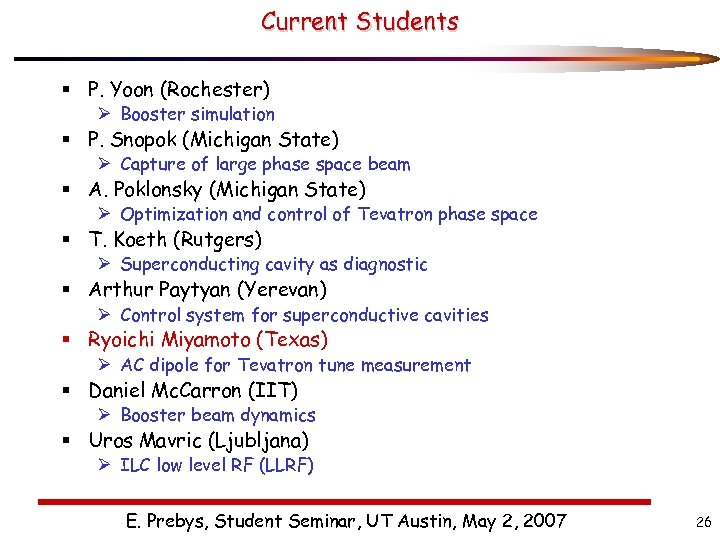
Current Students § P. Yoon (Rochester) Ø Booster simulation § P. Snopok (Michigan State) Ø Capture of large phase space beam § A. Poklonsky (Michigan State) Ø Optimization and control of Tevatron phase space § T. Koeth (Rutgers) Ø Superconducting cavity as diagnostic § Arthur Paytyan (Yerevan) Ø Control system for superconductive cavities § Ryoichi Miyamoto (Texas) Ø AC dipole for Tevatron tune measurement § Daniel Mc. Carron (IIT) Ø Booster beam dynamics § Uros Mavric (Ljubljana) Ø ILC low level RF (LLRF) E. Prebys, Student Seminar, UT Austin, May 2, 2007 26
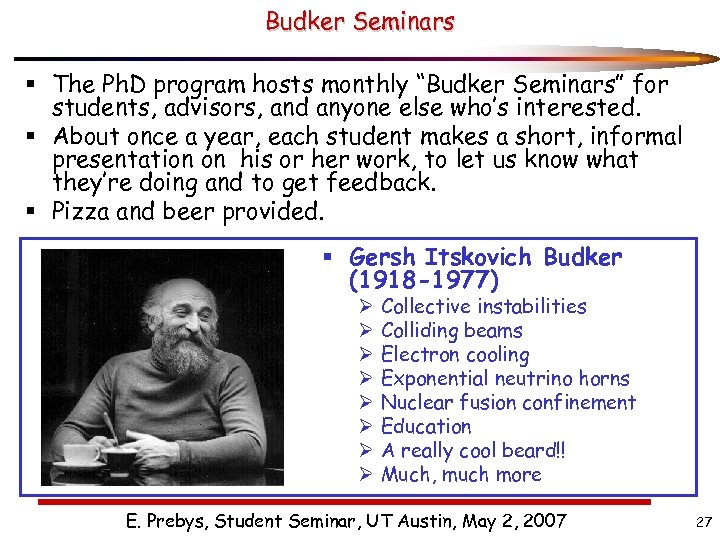
Budker Seminars § The Ph. D program hosts monthly “Budker Seminars” for students, advisors, and anyone else who’s interested. § About once a year, each student makes a short, informal presentation on his or her work, to let us know what they’re doing and to get feedback. § Pizza and beer provided. § Gersh Itskovich Budker (1918 -1977) Ø Ø Ø Ø Collective instabilities Colliding beams Electron cooling Exponential neutrino horns Nuclear fusion confinement Education A really cool beard!! Much, much more E. Prebys, Student Seminar, UT Austin, May 2, 2007 27
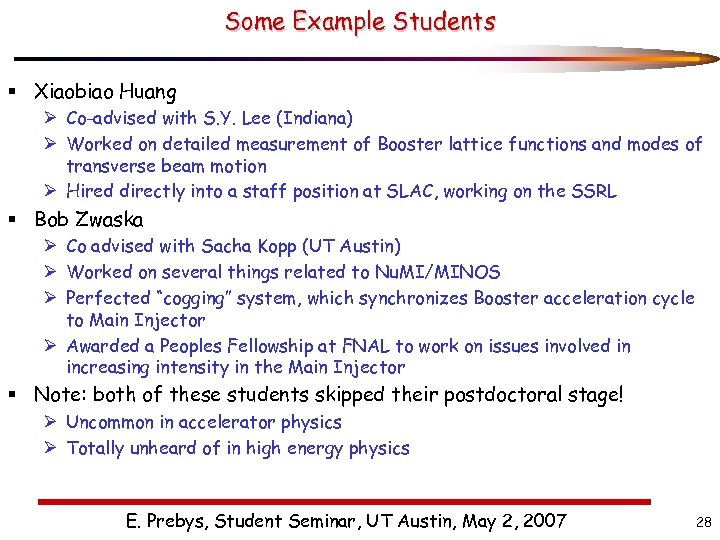
Some Example Students § Xiaobiao Huang Ø Co-advised with S. Y. Lee (Indiana) Ø Worked on detailed measurement of Booster lattice functions and modes of transverse beam motion Ø Hired directly into a staff position at SLAC, working on the SSRL § Bob Zwaska Ø Co advised with Sacha Kopp (UT Austin) Ø Worked on several things related to Nu. MI/MINOS Ø Perfected “cogging” system, which synchronizes Booster acceleration cycle to Main Injector Ø Awarded a Peoples Fellowship at FNAL to work on issues involved in increasing intensity in the Main Injector § Note: both of these students skipped their postdoctoral stage! Ø Uncommon in accelerator physics Ø Totally unheard of in high energy physics E. Prebys, Student Seminar, UT Austin, May 2, 2007 28
A Few Pet Project Ideas § Notch creation in Linac Ø Create “notch” in beam near the source, so less beam is lost later (and at higher energy) at extraction from the Booster. Ø Would involve calculations, modeling, experiments and hardware § Harmonic resonance control in Booster Ø We’re installing an enhanced correction system in the Booster to better control position and tune. Ø It will also allow much better control of resonant instabilities. Ø Need to develop a systematic approach to doing that. Ø Would involve calculation modeling, experiments, and code development § Efficient resonant extraction Ø For years, it’s been standard practice to slowly excite resonant instabilities in beams as a means to gradually extract beam. Ø This process typically has an inefficiency of about 2%, which is unacceptable in high intensity environments. Ø There a number of ideas that could potentially reduce the inefficiency. E. Prebys, Student Seminar, UT Austin, May 2, 2007 29
Accelerators as a Career: Pros § Accelerators are very complex, yet largely ideal, physical systems. Fun to play with. § Accelerators allow a close interaction with hardware (this is a plus or minus, depending on your taste). § Can make contributions to a broad range of physics programs, or even industry. § Many people end up doing a wide variety of things in their careers. § Still lots of small scale, short time, interesting things to be done. § Can be involved with HEP without joining a zillion member collaboration. E. Prebys, Student Seminar, UT Austin, May 2, 2007 30
Accelerator Physics as a Career: Cons § Accelerator physics is not fundamental, in the sense that finding the Higgs or neutrino mass is. Ø Although it’s a vital part of that research § Accelerator physics is a means to an end, not an end in itself. § Limited faculty opportunities Ø That may be changing E. Prebys, Student Seminar, UT Austin, May 2, 2007 31
For More Information § Talk to Prof. Sacha Kopp Ø Sacha has had one student graduate from the program and is currently advising a second § Contact me Ø prebys@fnal. gov § Visit the program web site: Ø http: //www-ap. fnal. gov/Ph. DProgram/ E. Prebys, Student Seminar, UT Austin, May 2, 2007 32
Backup Slides E. Prebys, Austin Student Seminar, May 2, 2007 E. Prebys, NMSU th
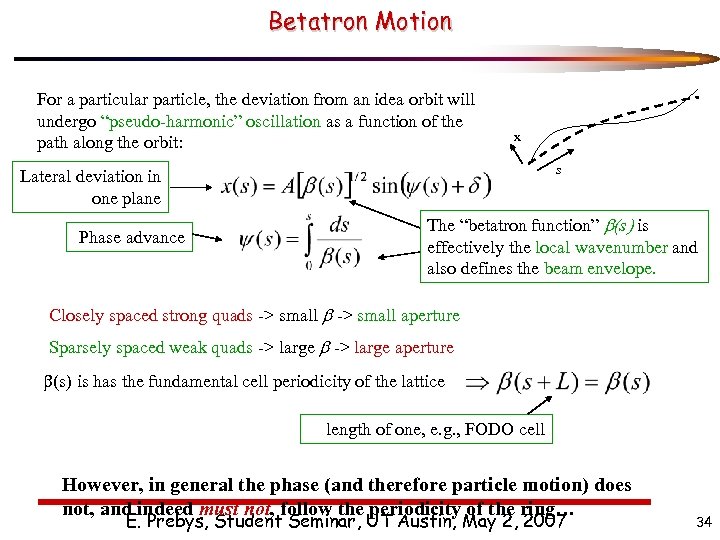
Betatron Motion For a particular particle, the deviation from an idea orbit will undergo “pseudo-harmonic” oscillation as a function of the path along the orbit: x s Lateral deviation in one plane Phase advance The “betatron function” b(s) is effectively the local wavenumber and also defines the beam envelope. Closely spaced strong quads -> small b -> small aperture Sparsely spaced weak quads -> large b -> large aperture b(s) is has the fundamental cell periodicity of the lattice length of one, e. g. , FODO cell However, in general the phase (and therefore particle motion) does not, and indeed must not, follow the periodicity of the ring… E. Prebys, Student Seminar, UT Austin, May 2, 2007 34
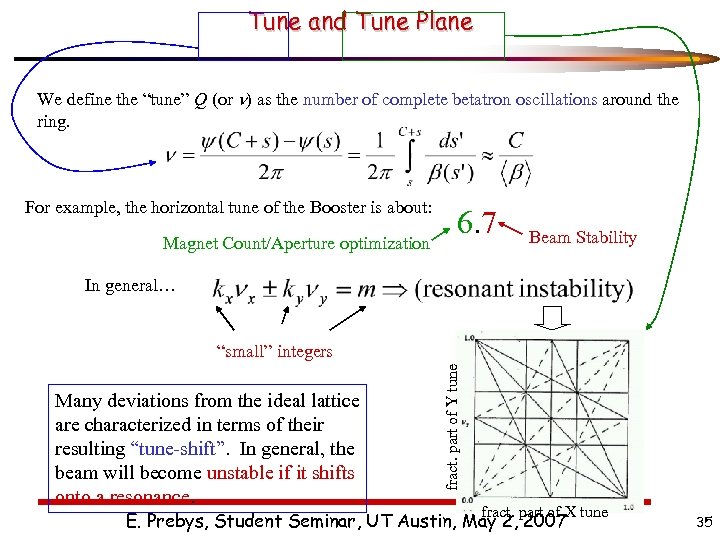
Tune and Tune Plane We define the “tune” Q (or n) as the number of complete betatron oscillations around the ring. For example, the horizontal tune of the Booster is about: Magnet Count/Aperture optimization 6. 7 Beam Stability In general… Many deviations from the ideal lattice are characterized in terms of their resulting “tune-shift”. In general, the beam will become unstable if it shifts onto a resonance. fract. part of Y tune “small” integers fract. part of X tune E. Prebys, Student Seminar, UT Austin, May 2, 2007 35
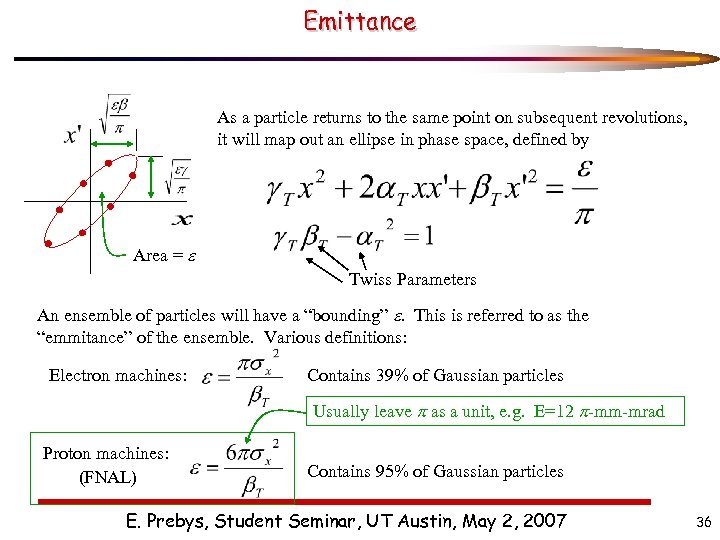
Emittance As a particle returns to the same point on subsequent revolutions, it will map out an ellipse in phase space, defined by Area = e Twiss Parameters An ensemble of particles will have a “bounding” e. This is referred to as the “emmitance” of the ensemble. Various definitions: Electron machines: Contains 39% of Gaussian particles Usually leave p as a unit, e. g. E=12 p-mm-mrad Proton machines: (FNAL) Contains 95% of Gaussian particles E. Prebys, Student Seminar, UT Austin, May 2, 2007 36
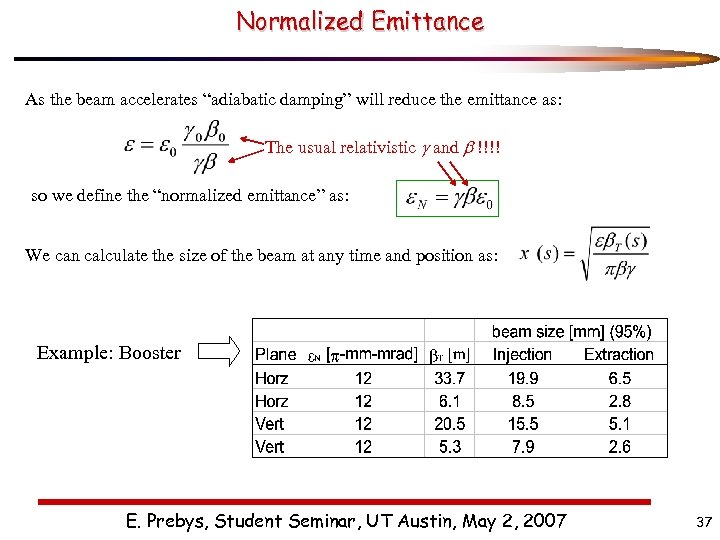
Normalized Emittance As the beam accelerates “adiabatic damping” will reduce the emittance as: The usual relativistic g and b !!!! so we define the “normalized emittance” as: We can calculate the size of the beam at any time and position as: Example: Booster E. Prebys, Student Seminar, UT Austin, May 2, 2007 37
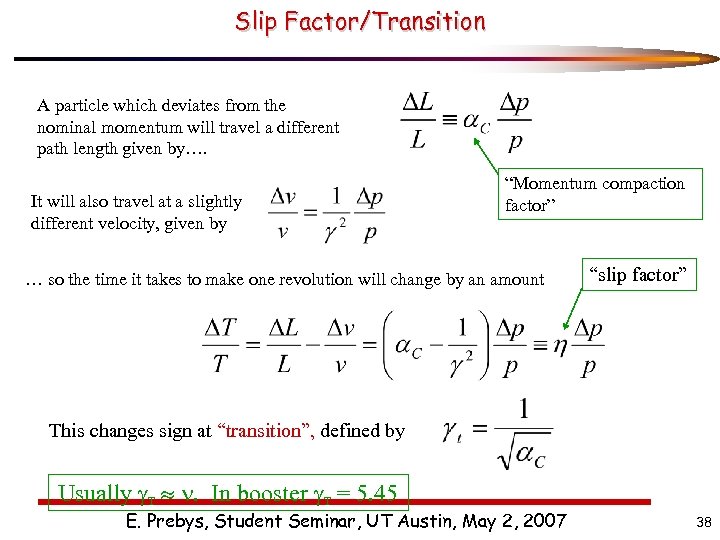
Slip Factor/Transition A particle which deviates from the nominal momentum will travel a different path length given by…. It will also travel at a slightly different velocity, given by “Momentum compaction factor” … so the time it takes to make one revolution will change by an amount “slip factor” This changes sign at “transition”, defined by Usually g. T n. In booster g. T = 5. 45 E. Prebys, Student Seminar, UT Austin, May 2, 2007 38
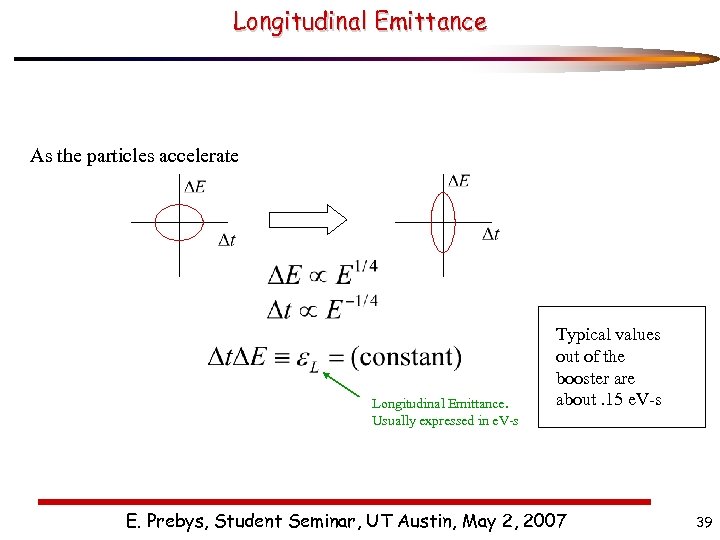
Longitudinal Emittance As the particles accelerate Longitudinal Emittance. Usually expressed in e. V-s Typical values out of the booster are about. 15 e. V-s E. Prebys, Student Seminar, UT Austin, May 2, 2007 39
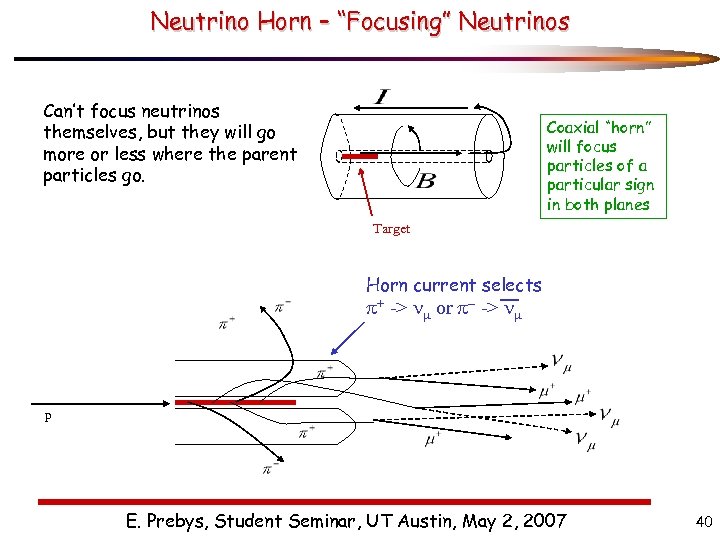
Neutrino Horn – “Focusing” Neutrinos Can’t focus neutrinos themselves, but they will go more or less where the parent particles go. Coaxial “horn” will focus particles of a particular sign in both planes Target Horn current selects p+ -> nm or p- -> nm p E. Prebys, Student Seminar, UT Austin, May 2, 2007 40
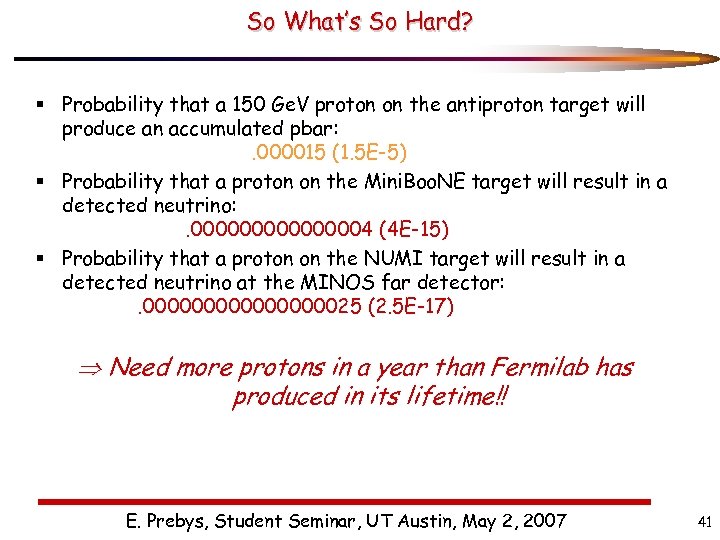
So What’s So Hard? § Probability that a 150 Ge. V proton on the antiproton target will produce an accumulated pbar: . 000015 (1. 5 E-5) § Probability that a proton on the Mini. Boo. NE target will result in a detected neutrino: . 00000004 (4 E-15) § Probability that a proton on the NUMI target will result in a detected neutrino at the MINOS far detector: . 0000000025 (2. 5 E-17) Need more protons in a year than Fermilab has produced in its lifetime!! E. Prebys, Student Seminar, UT Austin, May 2, 2007 41
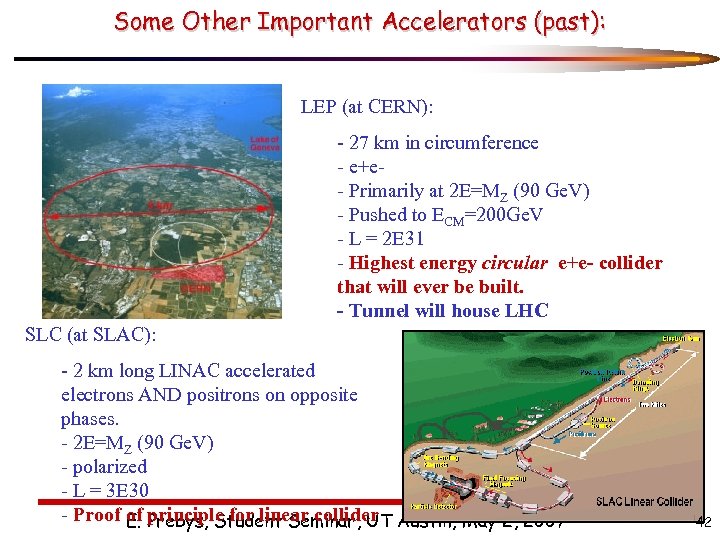
Some Other Important Accelerators (past): LEP (at CERN): - 27 km in circumference - e+e- Primarily at 2 E=MZ (90 Ge. V) - Pushed to ECM=200 Ge. V - L = 2 E 31 - Highest energy circular e+e- collider that will ever be built. - Tunnel will house LHC SLC (at SLAC): - 2 km long LINAC accelerated electrons AND positrons on opposite phases. - 2 E=MZ (90 Ge. V) - polarized - L = 3 E 30 - Proof of Prebys, Student Seminar, UT Austin, May 2, 2007 E. principle for linear collider 42
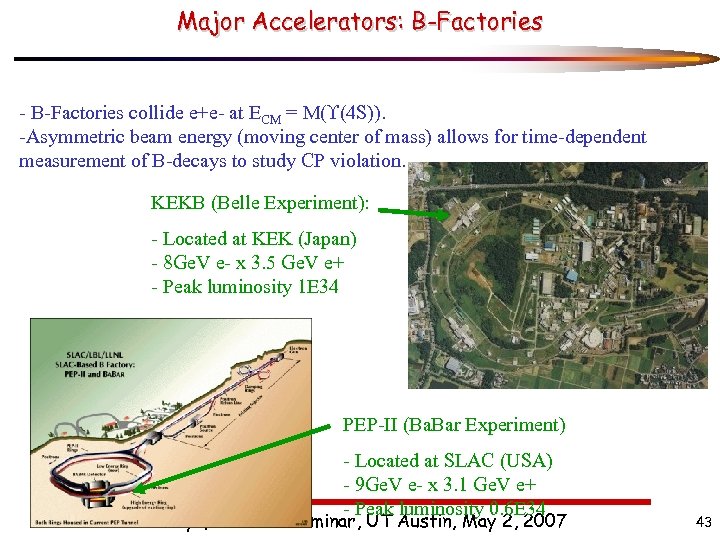
Major Accelerators: B-Factories - B-Factories collide e+e- at ECM = M( (4 S)). -Asymmetric beam energy (moving center of mass) allows for time-dependent measurement of B-decays to study CP violation. KEKB (Belle Experiment): - Located at KEK (Japan) - 8 Ge. V e- x 3. 5 Ge. V e+ - Peak luminosity 1 E 34 PEP-II (Ba. Bar Experiment) - Located at SLAC (USA) - 9 Ge. V e- x 3. 1 Ge. V e+ - Peak luminosity 0. 6 E 34 E. Prebys, Student Seminar, UT Austin, May 2, 2007 43
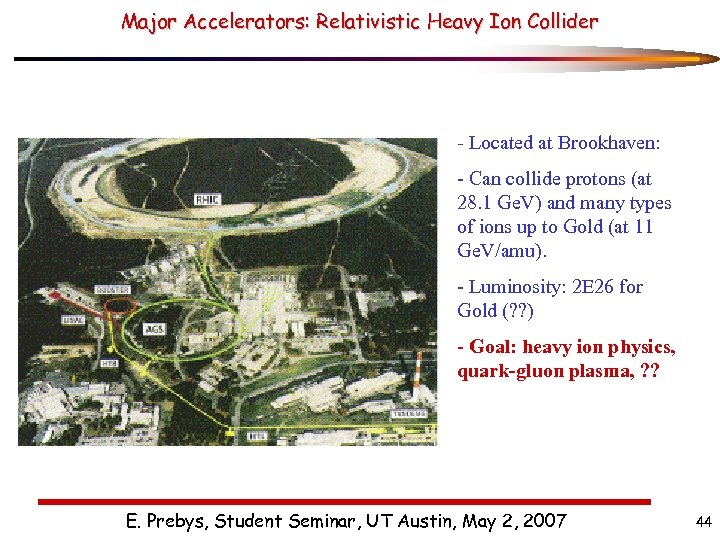
Major Accelerators: Relativistic Heavy Ion Collider - Located at Brookhaven: - Can collide protons (at 28. 1 Ge. V) and many types of ions up to Gold (at 11 Ge. V/amu). - Luminosity: 2 E 26 for Gold (? ? ) - Goal: heavy ion physics, quark-gluon plasma, ? ? E. Prebys, Student Seminar, UT Austin, May 2, 2007 44
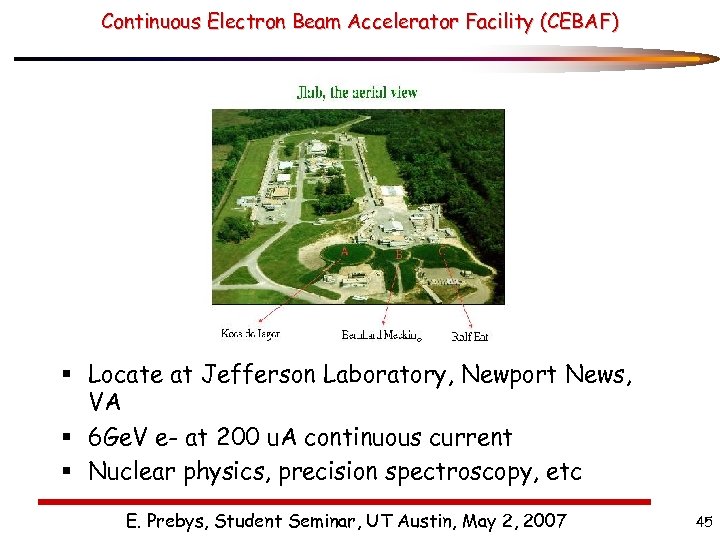
Continuous Electron Beam Accelerator Facility (CEBAF) § Locate at Jefferson Laboratory, Newport News, VA § 6 Ge. V e- at 200 u. A continuous current § Nuclear physics, precision spectroscopy, etc E. Prebys, Student Seminar, UT Austin, May 2, 2007 45
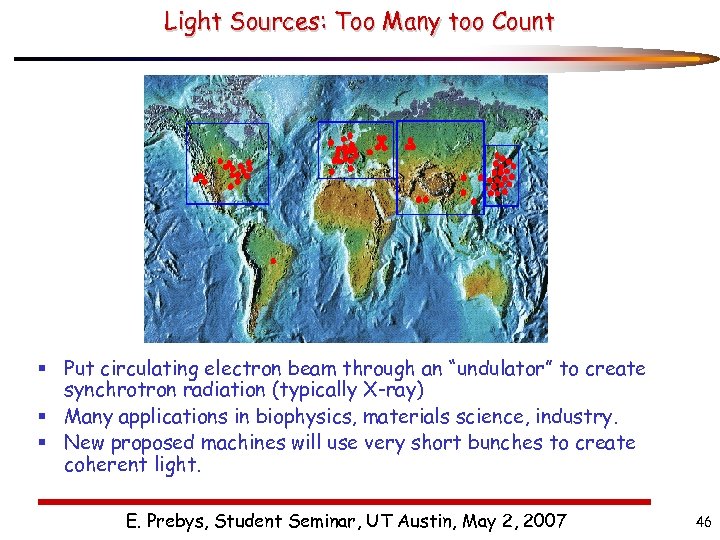
Light Sources: Too Many too Count § Put circulating electron beam through an “undulator” to create synchrotron radiation (typically X-ray) § Many applications in biophysics, materials science, industry. § New proposed machines will use very short bunches to create coherent light. E. Prebys, Student Seminar, UT Austin, May 2, 2007 46
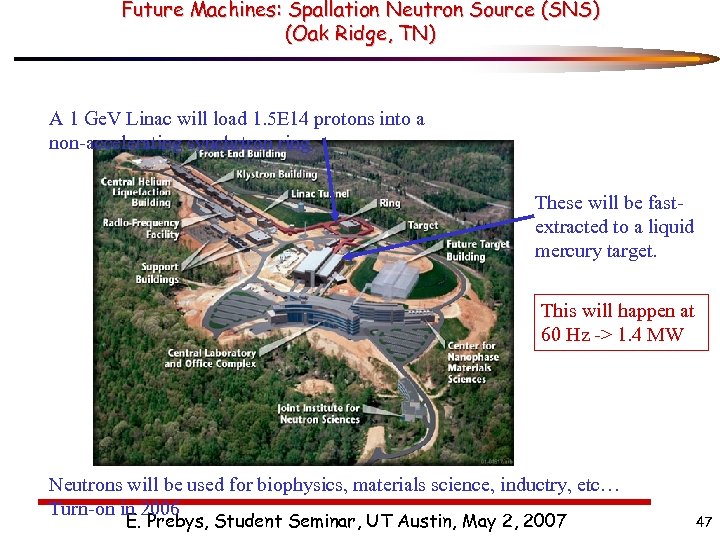
Future Machines: Spallation Neutron Source (SNS) (Oak Ridge, TN) A 1 Ge. V Linac will load 1. 5 E 14 protons into a non-accelerating synchrtron ring. These will be fastextracted to a liquid mercury target. This will happen at 60 Hz -> 1. 4 MW Neutrons will be used for biophysics, materials science, inductry, etc… Turn-on in 2006 E. Prebys, Student Seminar, UT Austin, May 2, 2007 47
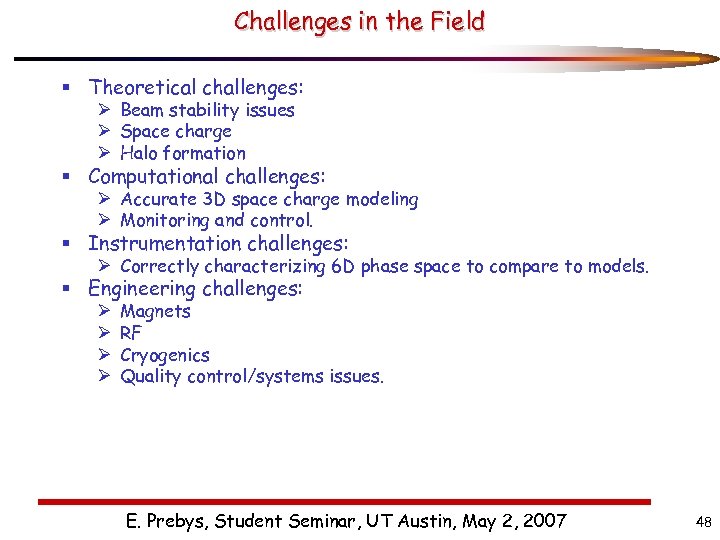
Challenges in the Field § Theoretical challenges: Ø Beam stability issues Ø Space charge Ø Halo formation § Computational challenges: Ø Accurate 3 D space charge modeling Ø Monitoring and control. § Instrumentation challenges: Ø Correctly characterizing 6 D phase space to compare to models. § Engineering challenges: Ø Ø Magnets RF Cryogenics Quality control/systems issues. E. Prebys, Student Seminar, UT Austin, May 2, 2007 48
Скачать презентацию Fermilab Accelerator Ph D Program Eric Prebys FNAL
667fa641ee428b4f5c212a59f3aad46d.ppt