


 Скачать презентацию Female-to-Male FTM Transgender Gynecological and Sexual Health Jennifer
38e075b0b575a333cb376ff275138cef.ppt
- Количество слайдов: 18
 Female-to-Male (FTM) Transgender Gynecological and Sexual Health Jennifer L. Curry, MPH Rollins School of Public Health Emory University November 7, 2007
 Introduction n Language to describe gender identity varied n interchangeable n perpetually evolving n not mutually exclusive n
 Background n Transgender Health Care n Underserved Population n Barriers to health care utilization n Denial of medical services n Lack of Research = Lack of Knowledge Lombardi, 2001; Kenagy, 2005; Feinberg, 2001
 Background n FTM Sexual Health n Diseases related to biological sex n Risks associated with gender transition n LGBT umbrella n Lesbian sexual health & Women Who Have Sex with Women (WSW) n Urgent need for comprehensive, culturallycompetent sexual health care Gooren, 1999; Hage et al. , 2000
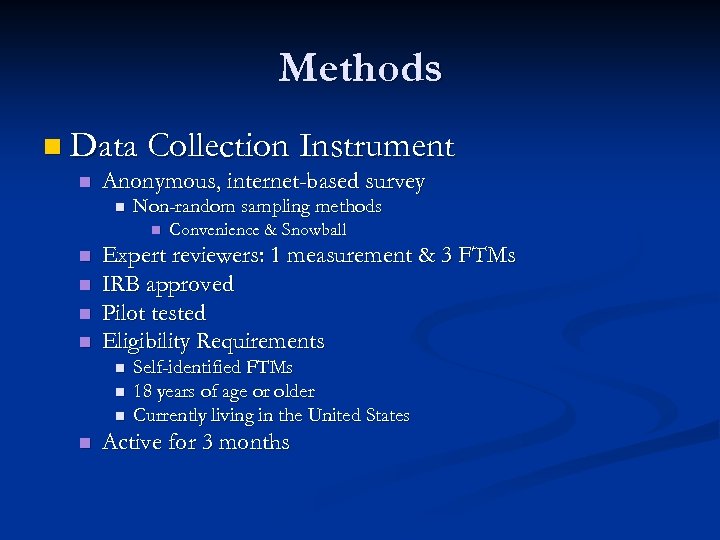 Methods n Data Collection Instrument n Anonymous, internet-based survey n Non-random sampling methods n n n Expert reviewers: 1 measurement & 3 FTMs IRB approved Pilot tested Eligibility Requirements n n Convenience & Snowball Self-identified FTMs 18 years of age or older Currently living in the United States Active for 3 months
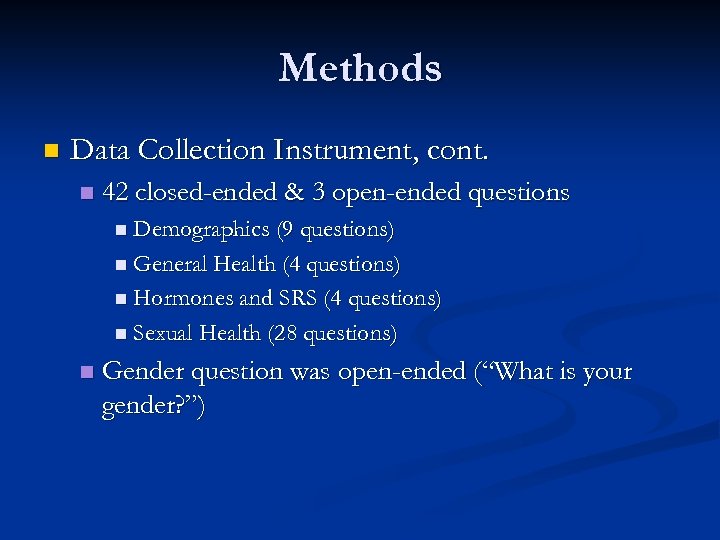 Methods n Data Collection Instrument, cont. n 42 closed-ended & 3 open-ended questions n Demographics (9 questions) n General Health (4 questions) n Hormones and SRS (4 questions) n Sexual Health (28 questions) n Gender question was open-ended (“What is your gender? ”)
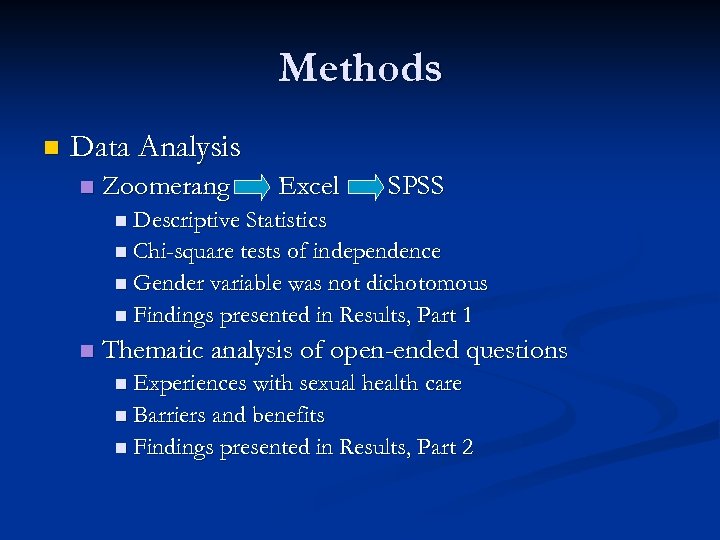 Methods n Data Analysis n Zoomerang Excel SPSS n Descriptive Statistics n Chi-square tests of independence n Gender variable was not dichotomous n Findings presented in Results, Part 1 n Thematic analysis of open-ended questions n Experiences with sexual health care n Barriers and benefits n Findings presented in Results, Part 2
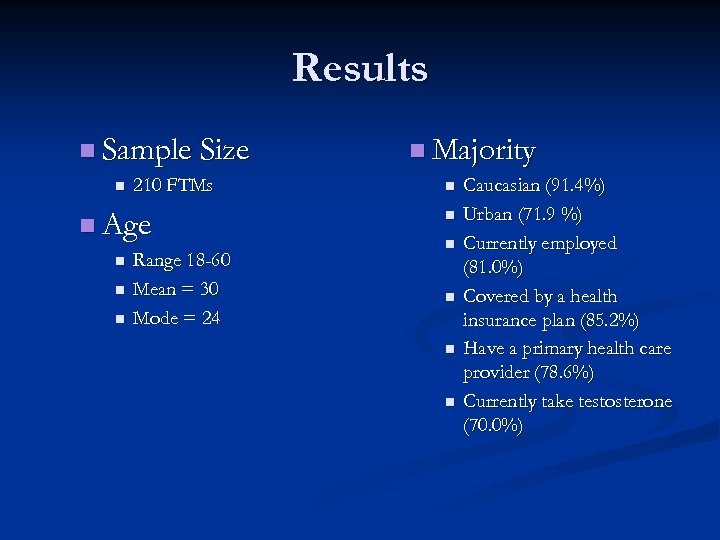 Results n Sample Size n 210 FTMs n Age n n n Range 18 -60 Mean = 30 Mode = 24 n Majority n n n Caucasian (91. 4%) Urban (71. 9 %) Currently employed (81. 0%) Covered by a health insurance plan (85. 2%) Have a primary health care provider (78. 6%) Currently take testosterone (70. 0%)
 Results n RQ 1: Do FTMs perceive themselves to be susceptible to gynecological/sexual health conditions? n Survey question: n “Do you consider yourself to be at risk for any of the following? ”
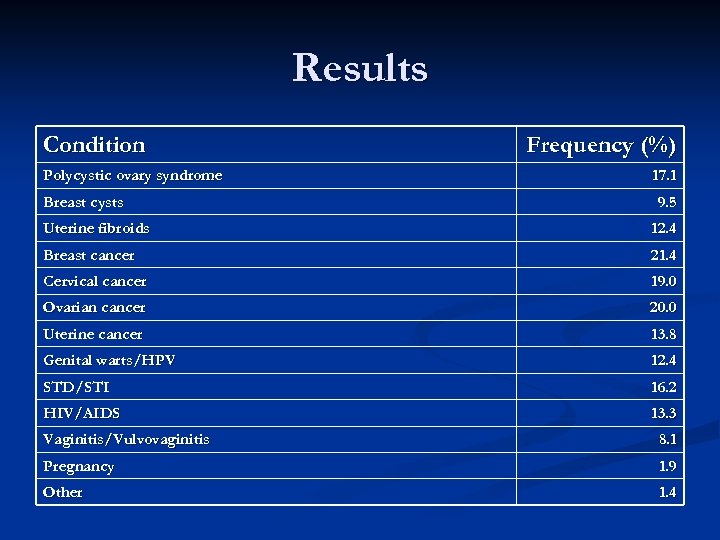 Results Condition Polycystic ovary syndrome Breast cysts Frequency (%) 17. 1 9. 5 Uterine fibroids 12. 4 Breast cancer 21. 4 Cervical cancer 19. 0 Ovarian cancer 20. 0 Uterine cancer 13. 8 Genital warts/HPV 12. 4 STD/STI 16. 2 HIV/AIDS 13. 3 Vaginitis/Vulvovaginitis 8. 1 Pregnancy 1. 9 Other 1. 4
 Results n RQ 2: What are FTMs’ perceived barriers to gynecological/sexual health care? n Survey question: n “If you have not received any of the above-listed services since identifying as trans, what are your reasons for not doing so? (Check all that apply. )”
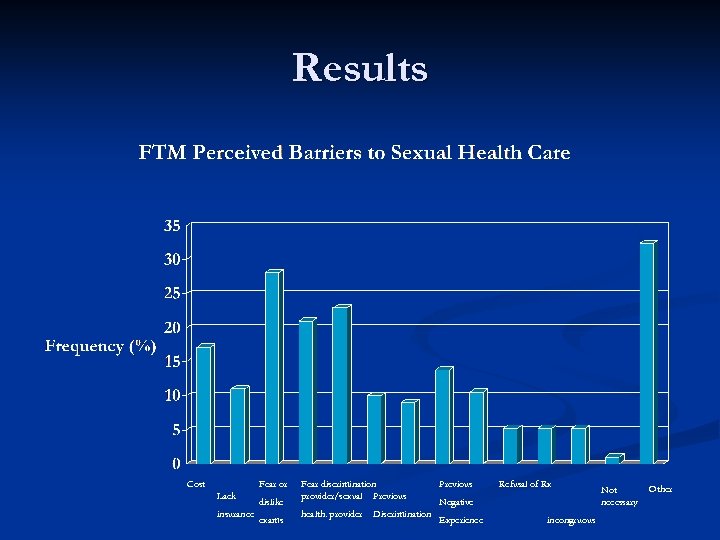 Results Cost Fear or Lack insurance dislike exams Fear discrimination provider/sexual Previous health. provider Discrimination Previous Refusal of Rx Negative Experience incongruous Not necessary Other
 Results n Negative Experiences/Perceived Barriers n n Lack of sensitivity/respect by office staff Physical & Psychological Discomfort Difficulties Finding Trans-Friendly Providers Lack of Knowledge “Many providers do not understand the need to continue to perform reproductive/genital/gyn exams, even after a person has started on testosterone. “It’s not very clear if you need to continue ob/gyn after hysterectomy and chest surgery. My current doc says no, past docs said yes. I'm going to go with the no, since I have less parts and do not pass as female anymore. ”
 Results n Positive Experiences/Perceived Benefits n Services important & beneficial despite barriers “I still seek out all the healthcare I need since I still have female anatomy. Although pelvic exams and PAP smears aren't fun for anyone, I still do them because I care about my health. ” “I have a fear of exams and misunderstanding from providers, but I have gotten care anyway. ”
 Discussion n Strengths & Limitations FTM involvement in survey design n Internet research n Sample size n Convenience & snowball sampling n Generalizability n
 Discussion n Implications for Public Health Low perceived susceptibility to STDs/STIs n Low perceived susceptibility to PCOS n Lack of knowledge and inconsistencies in FTM health care delivery n Underrepresented FTMs n
 Discussion n Recommendations n n FTMs as health educators & advocates (patient level) Recommendations for providers & public health practitioners (provider level) n n n n Continuing education Sensitivity training Smaller instruments for sexual health exams Partner or patient advocate in the exam room Outreach to FTMs Culturally-competent public health education Research (institutional level) n n Clinical research for standards of care Surveillance and population-based research
 References Feinberg, L. (2001). Trans health crisis: for us it’s life or death. American Journal of Public Health, 91, 897 -900. Gooren, L. (1999). Hormonal sex reassignment. International Journal of Transgenderism, 3. Retrieved April 15, 2005, from http: //symposion. com/ijt 990301. htm Hage, J. J. , Dekker, J. J. , Karim, R. B. , Verheijen, R. H. , & Bloemena, E. (2000). Ovarian cancer in female-to-male transsexuals: report of two cases. Gynecologic Oncology, 76, 413 -415. Janz, N. K. , Champion, V. L. , & Strecher, V. J. (2002). The health belief model. In K. Glanz, B. K. Rimer, & F. M. Lewis (Eds. ), Health behavior and health education: theory, research, and practice (pp. 45 -66), 3 rd ed. San Francisco: Jossey-Bass. Kenagy, G. P. (2005). Transgender health: findings from two needs assessment studies in Philadelphia. Health and Social Work, 30, 19 -26. Lombardi, E. (2001). Enhancing transgender health care. American Journal of Public Health, 91, 869 -872. Marrazzo, J. M. (2004). Barriers to infectious disease care among lesbians. Emerging Infectious Diseases, 10, 1974 -1978. Marrazzo, J. M. , Stine, K. , & Koutsky, L. A. (2000). Genital human papillomavirus infection in women who have sex with women: a review. American Journal of Obstetrics and Gynecology, 183, 770 -774. Marrazzo, J. M. & Stine, K. (2004). Reproductive health history of lesbians: implications for care. American Journal of Obstetrics and Gynecology, 190, 1298 -1304. Saslow, D. , Runowicz, C. D. , Solomon, D. , Moscicki, A. , Smith, R. A. , Eyre, H. J. & Cohen, C. (2002). American Cancer Society guidelines for the early detection of cervical neoplasia and cancer. CA: A Cancer Journal for Clinicians, 52, 342 -362.