 Скачать презентацию Female Sterilization Robert D Auerbach M D FACOG
190c21df0f4d650889cc2555f711a49a.ppt
- Количество слайдов: 51



Female Sterilization Robert D. Auerbach, M. D. FACOG Senior Vice President & Chief Medical Officer Cooper. Surgical, Inc. Associate Clinical Professor Yale University School of Medicine
Objectives • Female Sterilization Overview • Methods of Female Sterilization • Studies and Findings: • Sterilization failure rate • Ectopic pregnancy rate with failure • Other Considerations • Summary of Female Sterilization • Male Sterilization 2
Female Sterilization Overview • Sterilization is the most widely used means of permanent contraception in the United States • Over 700, 000 sterilizations are performed annually in the United States • #1 method of birth control for women ages 35 to 44 • Younger women (ages 20 -29) are more likely to undergo postpartum sterilization procedures • Approximately 50% of the tubal ligations performed annually are postpartum • Most postpartum procedures are performed within 24 hours • Older women (ages 35 -49) are more likely to undergo interval procedures Data quoted: Grimes, DA. Update on female sterilization: Failure rates, counseling issues, and post sterilization regret. The Contraception Report. 1996. 7(3): 4 -11 Quoted Data from: Grimes DA. Update on female sterilization: Failure rates, counseling issues, and post sterilization regret. The Contraception Report. 1996; 7(3): 4 -11 3
Female Sterilization Overview The History of Female Sterilization 1823 – First proposed by James Brundell in London 1880 – First published report of procedure by Lungren in Toledo, Ohio 1930 – First publication of the Pomeroy Technique, Pomeroy, New York State Journal of Medicine 1936 – Bosch performed the first laparoscopic tubal occlusion in Switzerland 4
Female Sterilization Overview Sterilization as a method of contraception • Prior to 1960, sterilization of females was performed primarily as a result of medical indications • Increased interest in family planning coupled with safer and more effective methods allowed sterilization to become a viable method of contraception during the 1960 s • Widespread acceptance of laparoscopy led to the development of several methods • Electrocautery (mono-polar and bi-polar) • Clips (Hulka and Filshie) • Bands (Yoon Band, Falope Ring) Data Quoted From: Hulka J and Stepian A. Laparoscopic sterilization. In: Gordon AG, Hulka JF, Walker DM, and Campana A, eds. Practical Training and Research in Gynecologic Endoscopy. 2003. Sklar AJ. Tubal Sterilization. e. Medicine. November 15, 2002. Available at http: www. emedicine. com/med/topic/3313. htm. 5
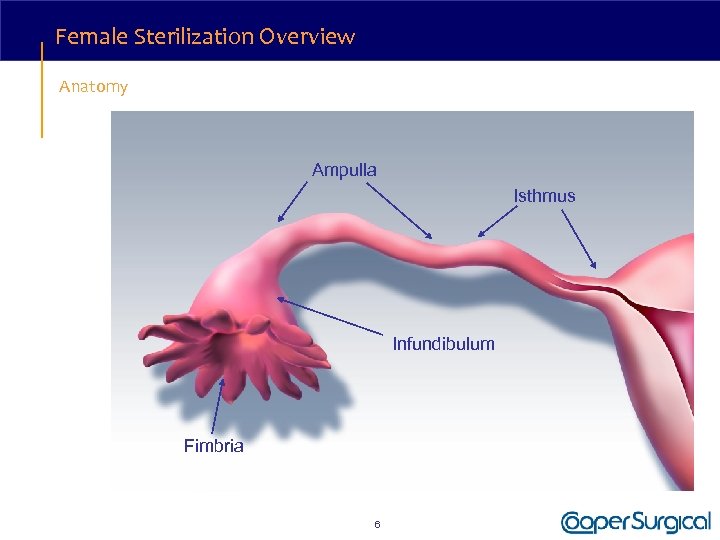
Female Sterilization Overview Anatomy Ampulla Isthmus Infundibulum Fimbria 6
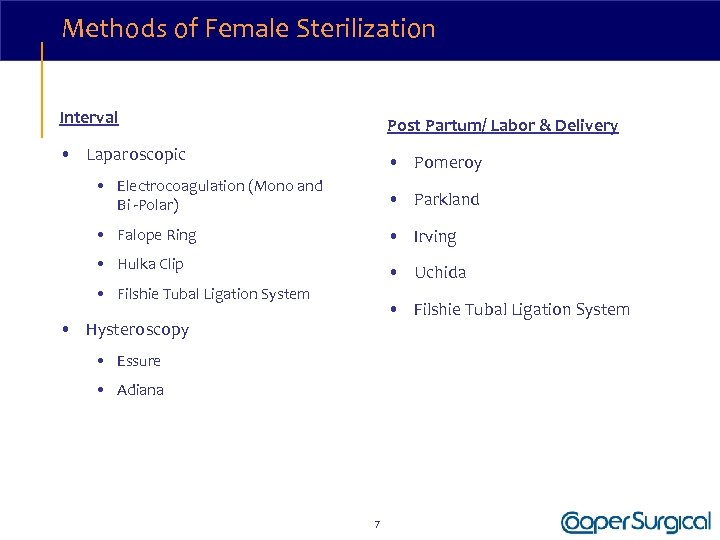
Methods of Female Sterilization Interval Post Partum/ Labor & Delivery • Laparoscopic • Pomeroy • Electrocoagulation (Mono and Bi -Polar) • Parkland • Falope Ring • Irving • Hulka Clip • Uchida • Filshie Tubal Ligation System • Hysteroscopy • Essure • Adiana 7
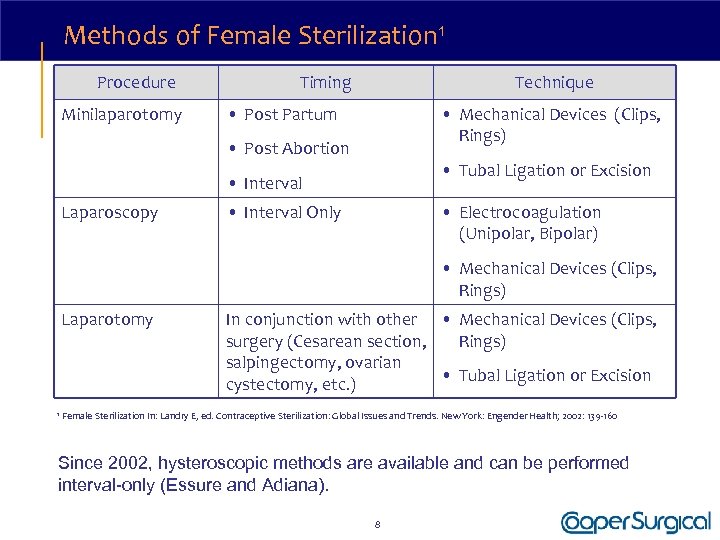
Methods of Female Sterilization 1 Procedure Minilaparotomy Timing Technique • Post Partum • Mechanical Devices (Clips, Rings) • Post Abortion • Tubal Ligation or Excision • Interval Laparoscopy • Interval Only • Electrocoagulation (Unipolar, Bipolar) • Mechanical Devices (Clips, Rings) Laparotomy 1 In conjunction with other • Mechanical Devices (Clips, surgery (Cesarean section, Rings) salpingectomy, ovarian • Tubal Ligation or Excision cystectomy, etc. ) Female Sterilization In: Landry E, ed. Contraceptive Sterilization: Global Issues and Trends. New York: Engender Health; 2002: 139 -160 Since 2002, hysteroscopic methods are available and can be performed interval-only (Essure and Adiana). 8
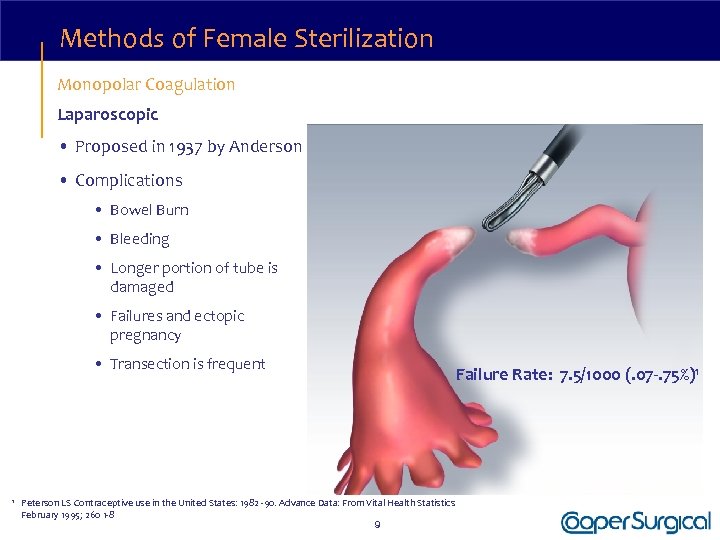
Methods of Female Sterilization Monopolar Coagulation Laparoscopic • Proposed in 1937 by Anderson • Complications • Bowel Burn • Bleeding • Longer portion of tube is damaged • Failures and ectopic pregnancy • Transection is frequent 1 Failure Rate: 7. 5/1000 (. 07 -. 75%)1 Peterson LS Contraceptive use in the United States: 1982 -90. Advance Data: From Vital Health Statistics February 1995; 260 1 -8 9
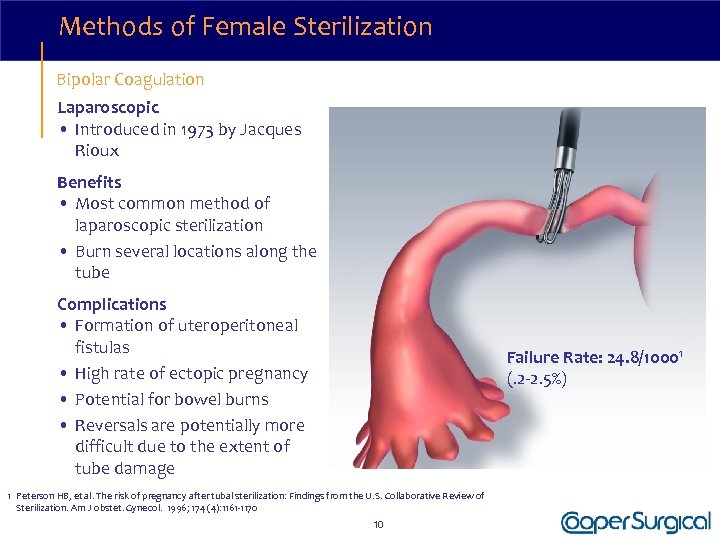
Methods of Female Sterilization Bipolar Coagulation Laparoscopic • Introduced in 1973 by Jacques Rioux Benefits • Most common method of laparoscopic sterilization • Burn several locations along the tube Complications • Formation of uteroperitoneal fistulas • High rate of ectopic pregnancy • Potential for bowel burns • Reversals are potentially more difficult due to the extent of tube damage Failure Rate: 24. 8/10001 (. 2 -2. 5%) 1 Peterson HB, et al. The risk of pregnancy after tubal sterilization: Findings from the U. S. Collaborative Review of Sterilization. Am J obstet. Gynecol. 1996; 174 (4): 1161 -1170 10
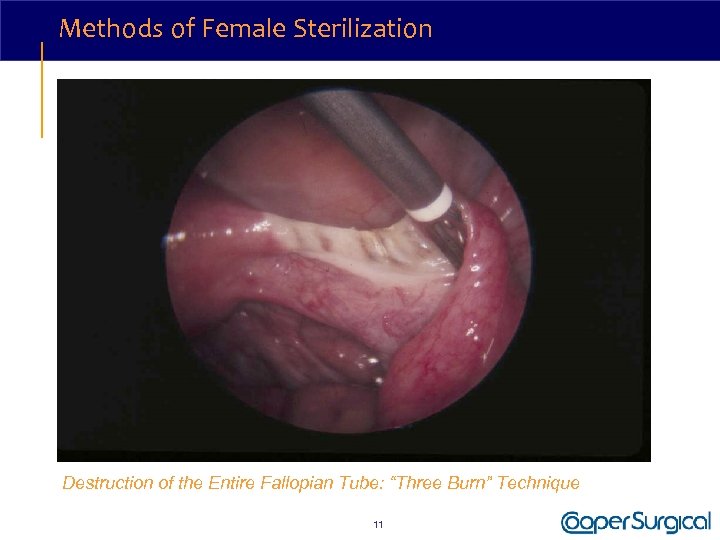
Methods of Female Sterilization Destruction of the Entire Fallopian Tube: “Three Burn” Technique 11
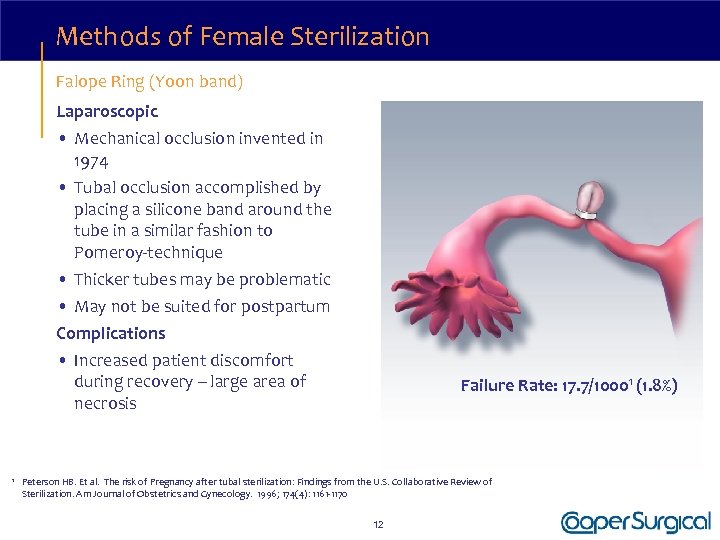
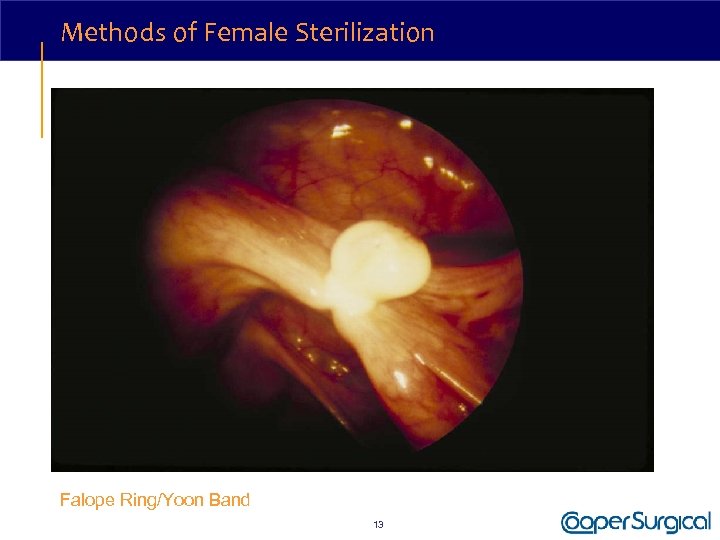
Methods of Female Sterilization Falope Ring (Yoon band) Laparoscopic • Mechanical occlusion invented in 1974 • Tubal occlusion accomplished by placing a silicone band around the tube in a similar fashion to Pomeroy-technique • Thicker tubes may be problematic • May not be suited for postpartum Complications • Increased patient discomfort during recovery – large area of necrosis 1 Failure Rate: 17. 7/10001 (1. 8%) Peterson HB. Et al. The risk of Pregnancy after tubal sterilization: Findings from the U. S. Collaborative Review of Sterilization. Am Journal of Obstetrics and Gynecology. 1996; 174(4): 1161 -1170 12
Methods of Female Sterilization Falope Ring/Yoon Band 13
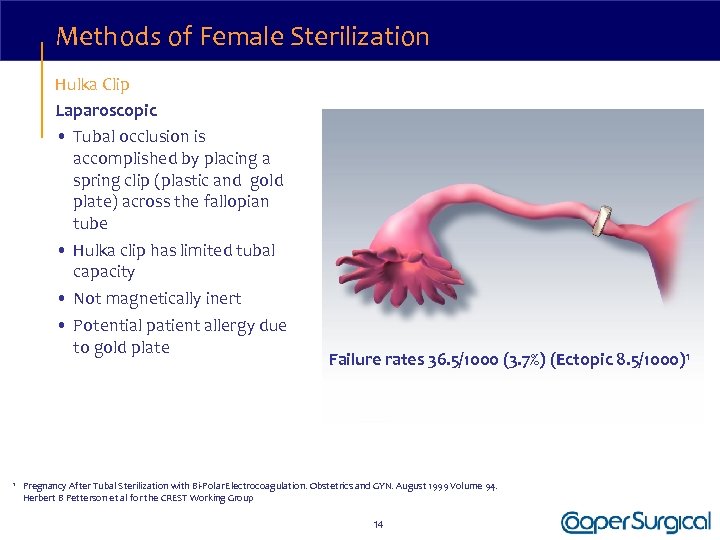
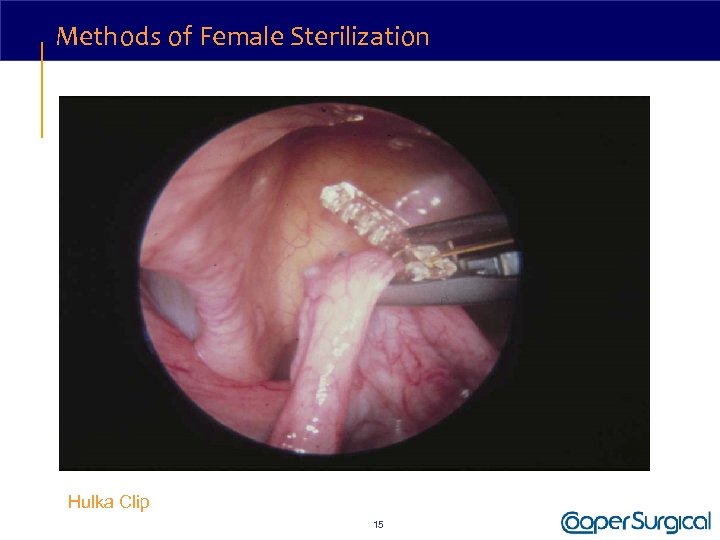
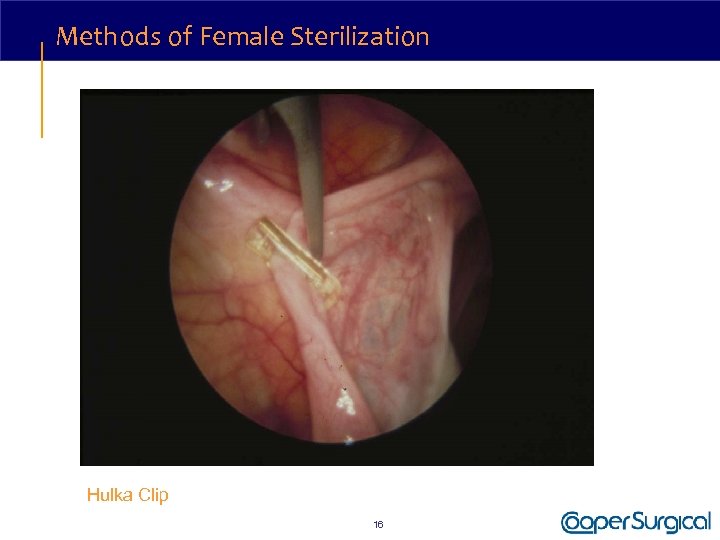
Methods of Female Sterilization Hulka Clip Laparoscopic • Tubal occlusion is accomplished by placing a spring clip (plastic and gold plate) across the fallopian tube • Hulka clip has limited tubal capacity • Not magnetically inert • Potential patient allergy due to gold plate 1 Failure rates 36. 5/1000 (3. 7%) (Ectopic 8. 5/1000)1 Pregnancy After Tubal Sterilization with Bi-Polar Electrocoagulation. Obstetrics and GYN. August 1999 Volume 94. Herbert B Petterson et al for the CREST Working Group 14
Methods of Female Sterilization Hulka Clip 15
Methods of Female Sterilization Hulka Clip 16
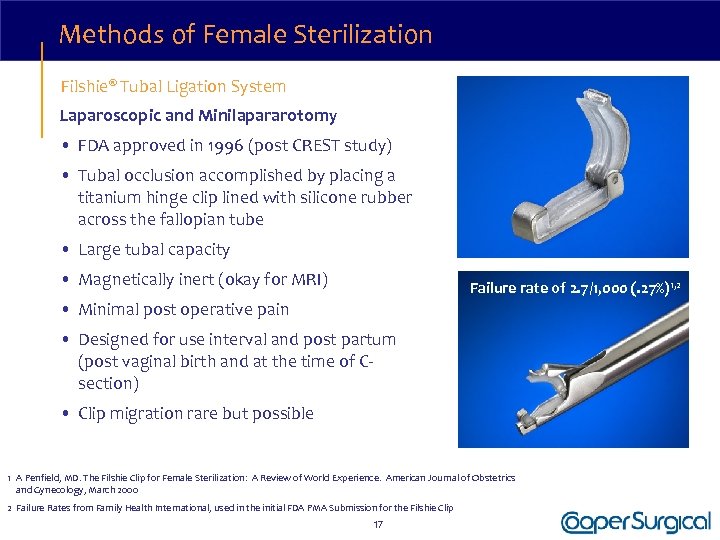
Methods of Female Sterilization Filshie® Tubal Ligation System Laparoscopic and Minilapararotomy • FDA approved in 1996 (post CREST study) • Tubal occlusion accomplished by placing a titanium hinge clip lined with silicone rubber across the fallopian tube • Large tubal capacity • Magnetically inert (okay for MRI) Failure rate of 2. 7/1, 000 (. 27%)1, 2 • Minimal post operative pain • Designed for use interval and post partum (post vaginal birth and at the time of Csection) • Clip migration rare but possible 1 A Penfield, MD. The Filshie Clip for Female Sterilization: A Review of World Experience. American Journal of Obstetrics and Gynecology, March 2000 2 Failure Rates from Family Health International, used in the initial FDA PMA Submission for the Filshie Clip 17
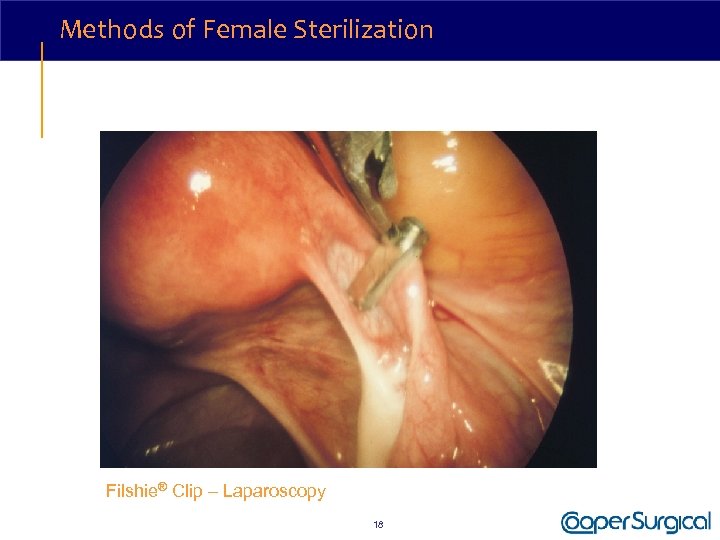
Methods of Female Sterilization Filshie® Clip – Laparoscopy 18
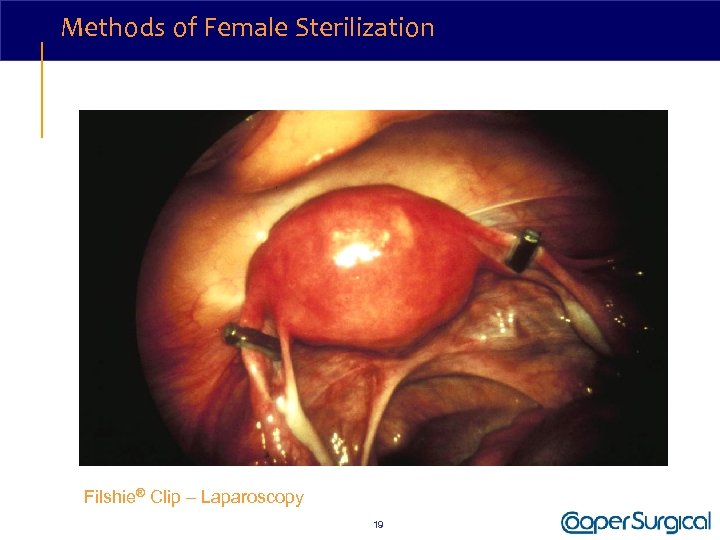
Methods of Female Sterilization Filshie® Clip – Laparoscopy 19
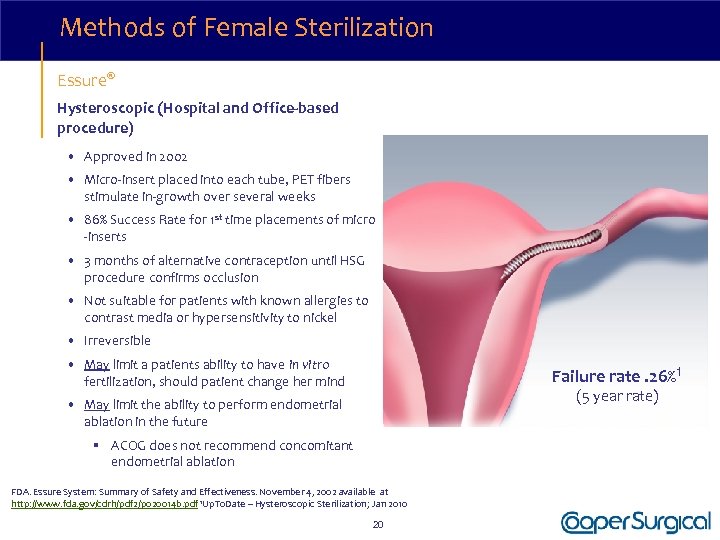
Methods of Female Sterilization Essure® Hysteroscopic (Hospital and Office-based procedure) • Approved in 2002 • Micro-insert placed into each tube, PET fibers stimulate in-growth over several weeks • 86% Success Rate for 1 st time placements of micro -inserts • 3 months of alternative contraception until HSG procedure confirms occlusion • Not suitable for patients with known allergies to contrast media or hypersensitivity to nickel • Irreversible • May limit a patients ability to have in vitro fertilization, should patient change her mind Failure rate. 26%1 (5 year rate) • May limit the ability to perform endometrial ablation in the future § ACOG does not recommend concomitant endometrial ablation FDA. Essure System: Summary of Safety and Effectiveness. November 4, 2002 available at http: //www. fda. gov/cdrh/pdf 2/p 020014 b. pdf 1 Up. To. Date – Hysteroscopic Sterilization; Jan 2010 20
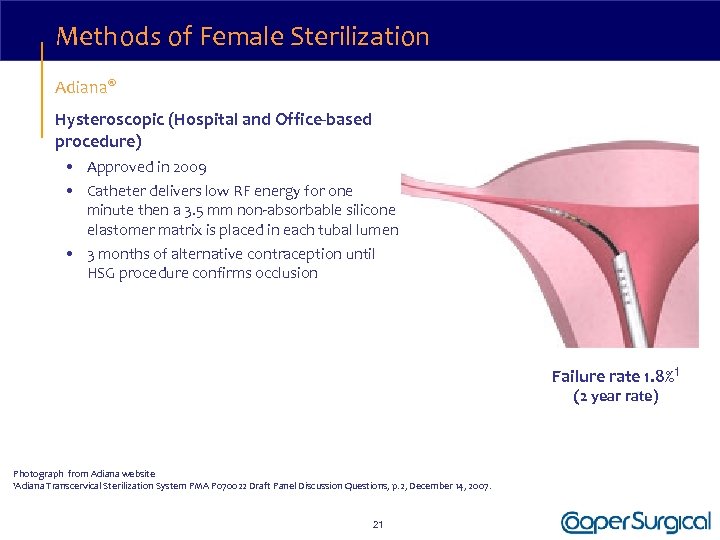
Methods of Female Sterilization Adiana® Hysteroscopic (Hospital and Office-based procedure) • Approved in 2009 • Catheter delivers low RF energy for one minute then a 3. 5 mm non-absorbable silicone elastomer matrix is placed in each tubal lumen • 3 months of alternative contraception until HSG procedure confirms occlusion Failure rate 1. 8%1 (2 year rate) Photograph from Adiana website 1 Adiana Transcervical Sterilization System PMA P 070022 Draft Panel Discussion Questions, p. 2, December 14, 2007. 21
Methods of Female Sterilization Postpartum • Pomeroy • Parkland • Irving • Uchida • Filshie® Tubal Ligation System 22
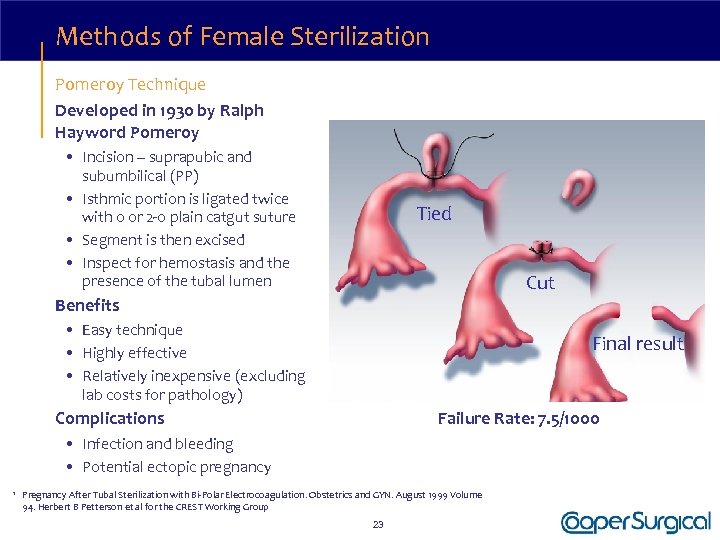
Methods of Female Sterilization Pomeroy Technique Developed in 1930 by Ralph Hayword Pomeroy • Incision – suprapubic and subumbilical (PP) • Isthmic portion is ligated twice with 0 or 2 -0 plain catgut suture • Segment is then excised • Inspect for hemostasis and the presence of the tubal lumen Tied Cut Benefits • Easy technique • Highly effective • Relatively inexpensive (excluding lab costs for pathology) Final result Failure Rate: 7. 5/1000 Complications • Infection and bleeding • Potential ectopic pregnancy 1 Pregnancy After Tubal Sterilization with Bi-Polar Electrocoagulation. Obstetrics and GYN. August 1999 Volume 94. Herbert B Petterson et al for the CREST Working Group 23
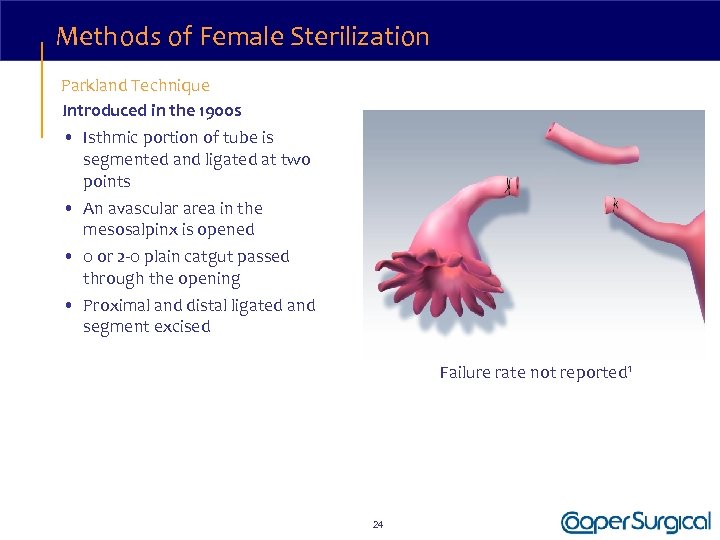
Methods of Female Sterilization Parkland Technique Introduced in the 1900 s • Isthmic portion of tube is segmented and ligated at two points • An avascular area in the mesosalpinx is opened • 0 or 2 -0 plain catgut passed through the opening • Proximal and distal ligated and segment excised Failure rate not reported 1 24
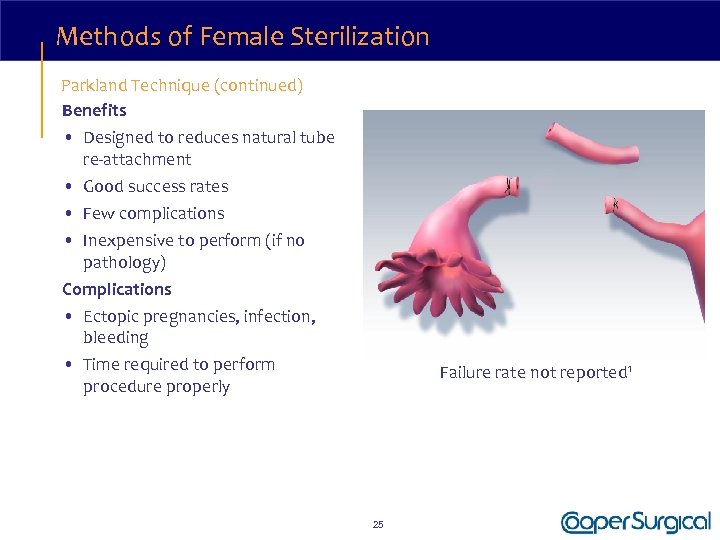
Methods of Female Sterilization Parkland Technique (continued) Benefits • Designed to reduces natural tube re-attachment • Good success rates • Few complications • Inexpensive to perform (if no pathology) Complications • Ectopic pregnancies, infection, bleeding • Time required to perform procedure properly Failure rate not reported 1 25
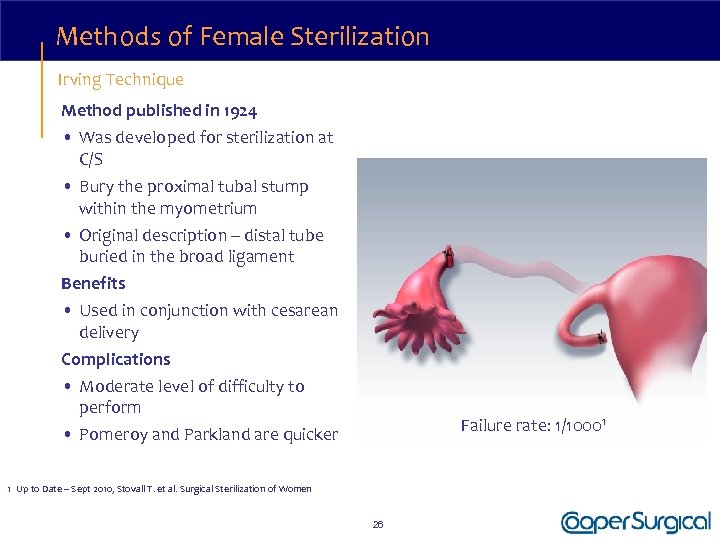
Methods of Female Sterilization Irving Technique Method published in 1924 • Was developed for sterilization at C/S • Bury the proximal tubal stump within the myometrium • Original description – distal tube buried in the broad ligament Benefits • Used in conjunction with cesarean delivery Complications • Moderate level of difficulty to perform • Pomeroy and Parkland are quicker Failure rate: 1/10001 1 Up to Date – Sept 2010, Stovall T. et al. Surgical Sterilization of Women 1. Sterilization. The University of Kentucky Department of OB-GYN Women’s Health Curriculum. 26
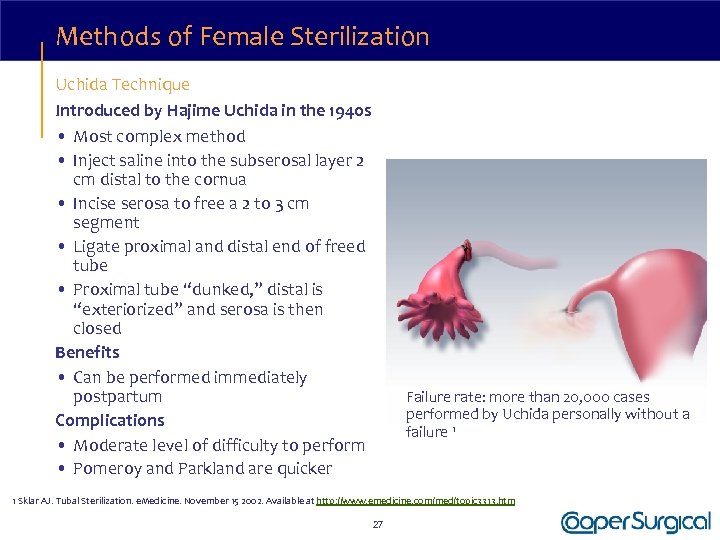
Methods of Female Sterilization Uchida Technique Introduced by Hajime Uchida in the 1940 s • Most complex method • Inject saline into the subserosal layer 2 cm distal to the cornua • Incise serosa to free a 2 to 3 cm segment • Ligate proximal and distal end of freed tube • Proximal tube “dunked, ” distal is “exteriorized” and serosa is then closed Benefits • Can be performed immediately postpartum Complications • Moderate level of difficulty to perform • Pomeroy and Parkland are quicker Failure rate: more than 20, 000 cases performed by Uchida personally without a failure 1 1 Sklar AJ. Tubal Sterilization. e. Medicine. November 15 2002. Available at http: //www. emedicine. com/med/topic 3313. htm 27
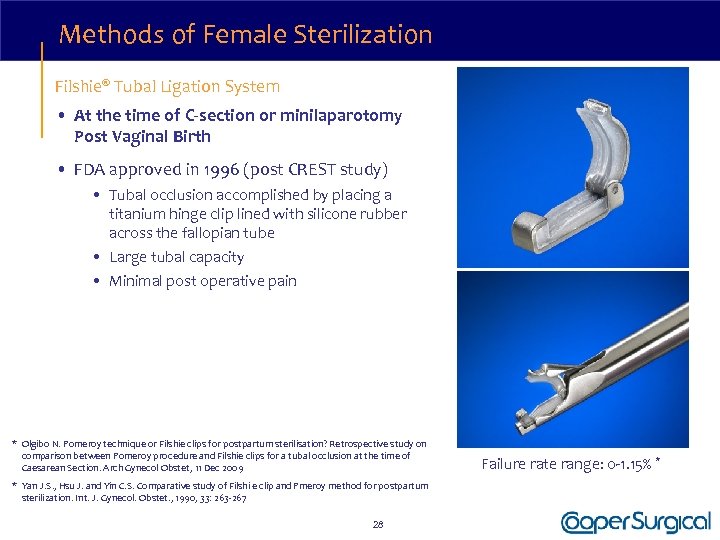
Methods of Female Sterilization Filshie® Tubal Ligation System • At the time of C-section or minilaparotomy Post Vaginal Birth • FDA approved in 1996 (post CREST study) • Tubal occlusion accomplished by placing a titanium hinge clip lined with silicone rubber across the fallopian tube • Large tubal capacity • Minimal post operative pain * Olgibo N. Pomeroy technique or Filshie clips for postpartum sterilisation? Retrospective study on comparison between Pomeroy procedure and Filshie clips for a tubal occlusion at the time of Caesarean Section. Arch Gynecol Obstet, 11 Dec 2009 * Yan J. S. , Hsu J. and Yin C. S. Comparative study of Filshi e clip and Pmeroy method for postpartum sterilization. Int. J. Gynecol. Obstet. , 1990, 33: 263 -267 28 Failure rate range: 0 -1. 15% *
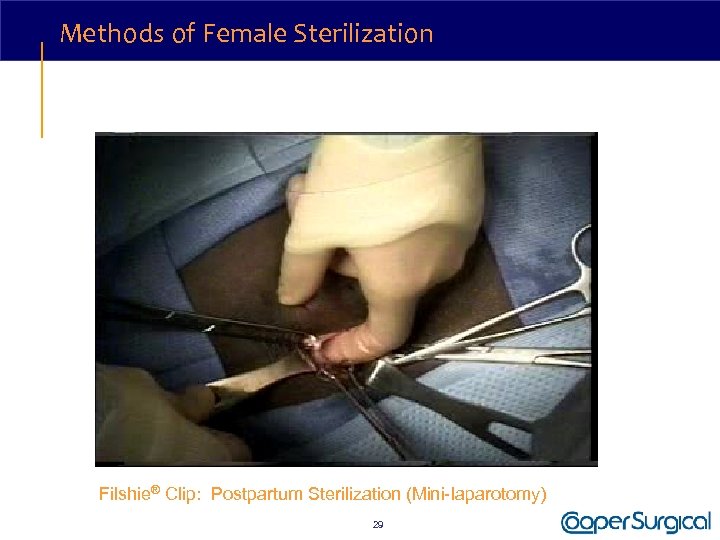
Methods of Female Sterilization Filshie® Clip: Postpartum Sterilization (Mini-laparotomy) 29
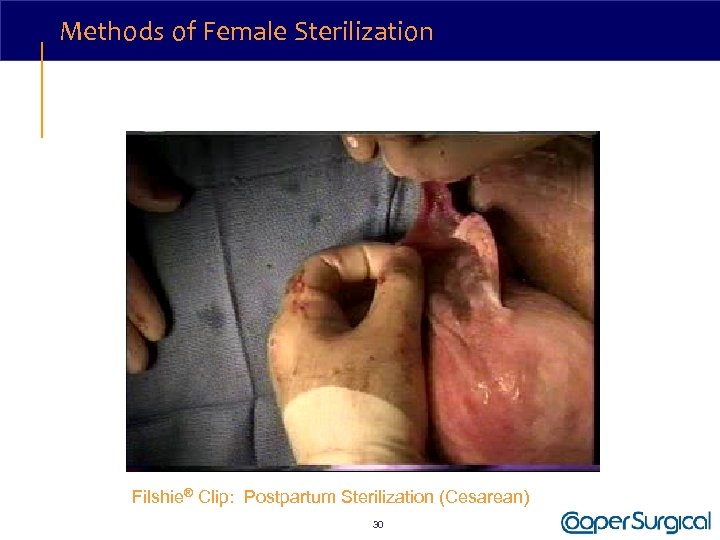
Methods of Female Sterilization Filshie® Clip: Postpartum Sterilization (Cesarean) 30
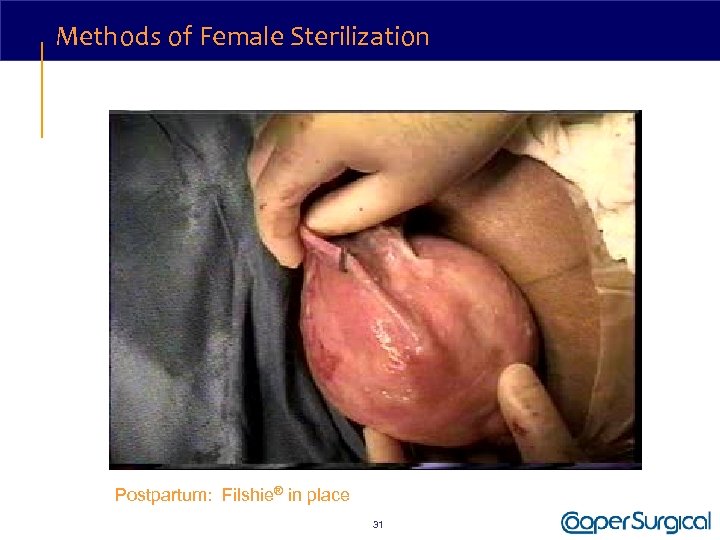
Methods of Female Sterilization Postpartum: Filshie® in place 31
Methods of Female Sterilization Filshie® Tubal Ligation System and Pomeroy Postpartum Randomized Trial to compare perioperative outcomes of Filshie clip vs. Pomeroy technique for postpartum and intraoperative Cesarean tubal sterilization: a pilot study. Kaunitz et al • 32 Randomized Patients were sterilized by Filshie Clip or Pomeroy § Filshie mean duration 7 min faster (p=0. 08) § Filshie rated as easier by the operator (p=0. 03) • 70% of surgeons preferred the Filshie clip 32
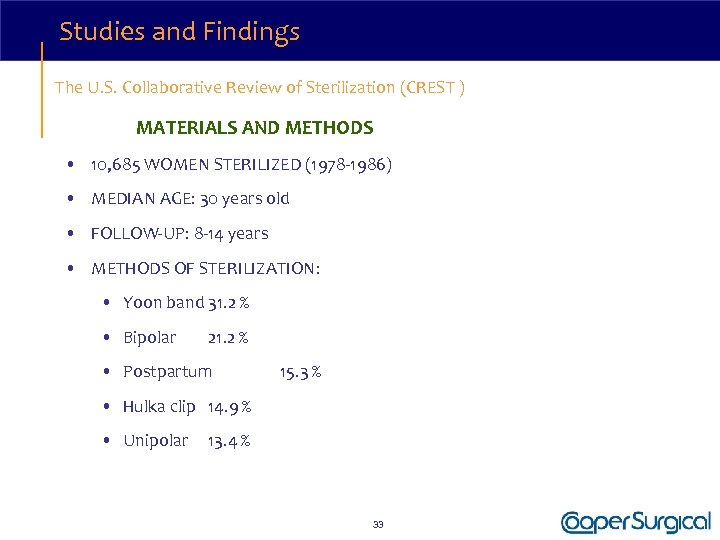
Studies and Findings The U. S. Collaborative Review of Sterilization (CREST ) MATERIALS AND METHODS • 10, 685 WOMEN STERILIZED (1978 -1986) • MEDIAN AGE: 30 years old • FOLLOW-UP: 8 -14 years • METHODS OF STERILIZATION: • Yoon band 31. 2 % • Bipolar 21. 2 % • Postpartum 15. 3 % • Hulka clip 14. 9 % • Unipolar 13. 4 % 33
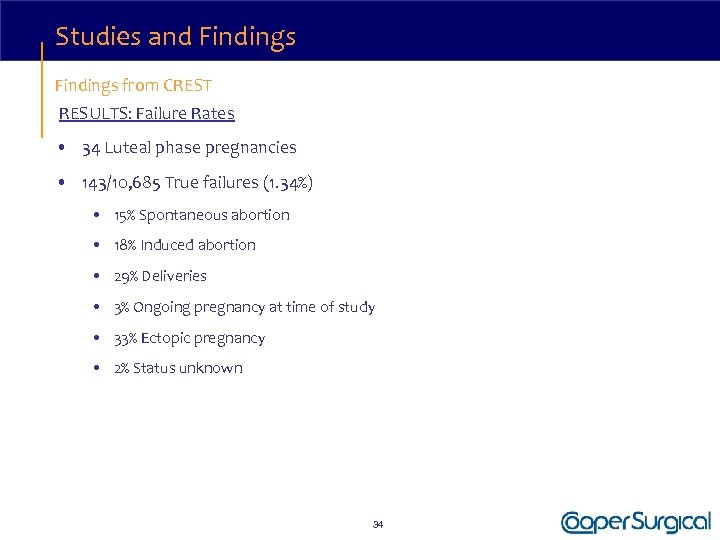
Studies and Findings from CREST RESULTS: Failure Rates • 34 Luteal phase pregnancies • 143/10, 685 True failures (1. 34%) • 15% Spontaneous abortion • 18% Induced abortion • 29% Deliveries • 3% Ongoing pregnancy at time of study • 33% Ectopic pregnancy • 2% Status unknown 34
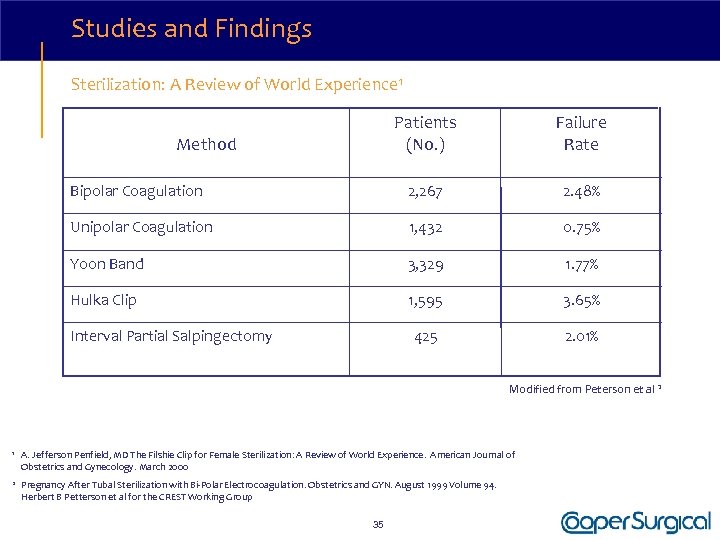
Studies and Findings Sterilization: A Review of World Experience 1 Patients (No. ) Failure Rate Bipolar Coagulation 2, 267 2. 48% Unipolar Coagulation 1, 432 0. 75% Yoon Band 3, 329 1. 77% Hulka Clip 1, 595 3. 65% 425 2. 01% Method Interval Partial Salpingectomy Modified from Peterson et al 2 1 A. Jefferson Penfield, MD The Filshie Clip for Female Sterilization: A Review of World Experience. American Journal of Obstetrics and Gynecology. March 2000 2 Pregnancy After Tubal Sterilization with Bi-Polar Electrocoagulation. Obstetrics and GYN. August 1999 Volume 94. Herbert B Petterson et al for the CREST Working Group 35
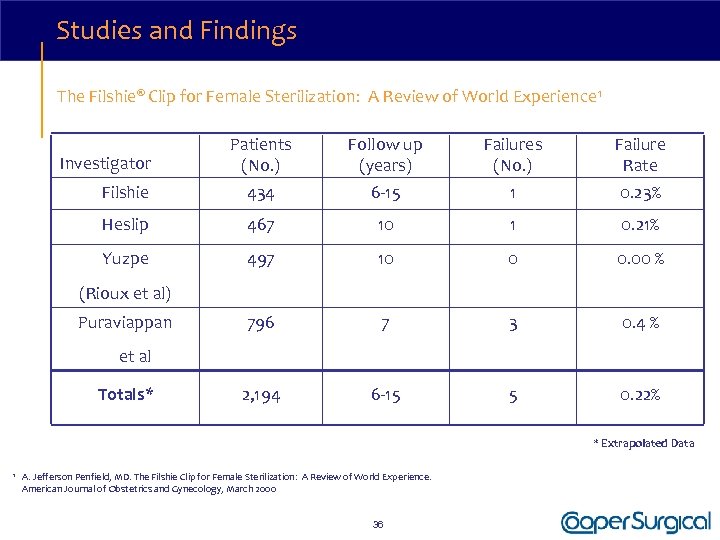
Studies and Findings The Filshie® Clip for Female Sterilization: A Review of World Experience 1 Filshie Patients (No. ) 434 Follow up (years) 6 -15 Failures (No. ) 1 Failure Rate 0. 23% Heslip 467 10 1 0. 21% Yuzpe 497 10 0 0. 00 % 796 7 3 0. 4 % 2, 194 6 -15 5 0. 22% Investigator (Rioux et al) Puraviappan et al Totals* * Extrapolated Data 1 A. Jefferson Penfield, MD. The Filshie Clip for Female Sterilization: A Review of World Experience. American Journal of Obstetrics and Gynecology, March 2000 36
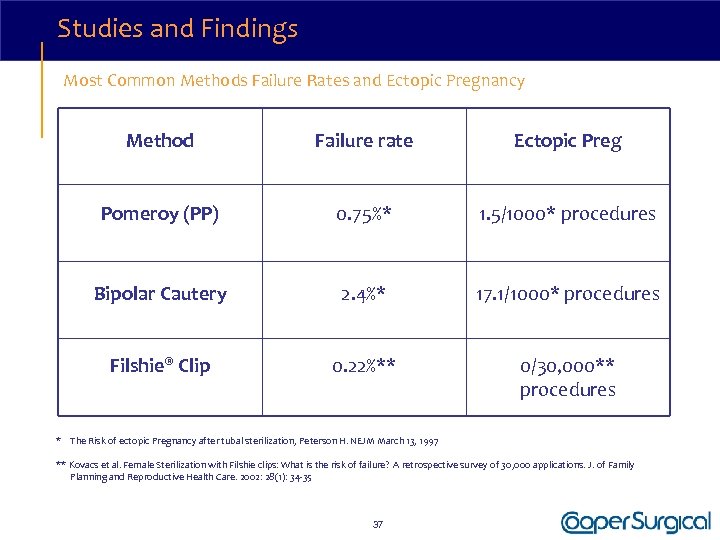
Studies and Findings Most Common Methods Failure Rates and Ectopic Pregnancy Method Failure rate Ectopic Preg Pomeroy (PP) 0. 75%* 1. 5/1000* procedures Bipolar Cautery 2. 4%* 17. 1/1000* procedures Filshie® Clip 0. 22%** 0/30, 000** procedures * The Risk of ectopic Pregnancy after tubal sterilization, Peterson H. NEJM March 13, 1997 ** Kovacs et al. Female Sterilization with Filshie clips: What is the risk of failure? A retrospective survey of 30, 000 applications. J. of Family Planning and Reproductive Health Care. 2002: 28(1): 34 -35 37
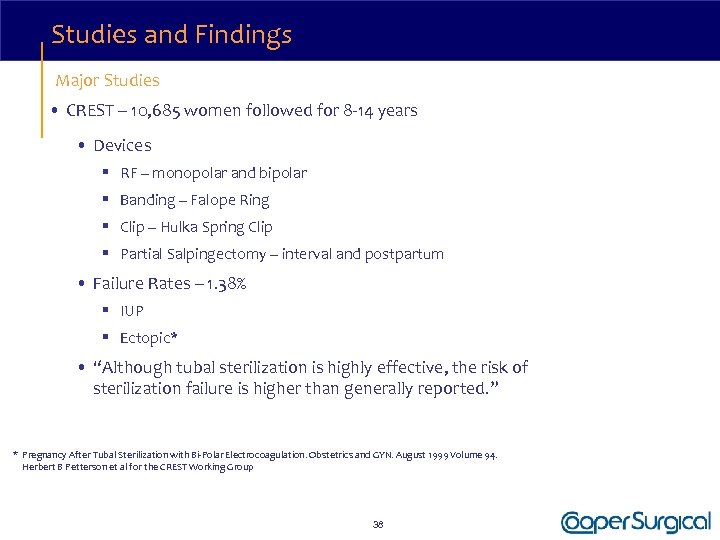
Studies and Findings Major Studies • CREST – 10, 685 women followed for 8 -14 years • Devices § RF – monopolar and bipolar § Banding – Falope Ring § Clip – Hulka Spring Clip § Partial Salpingectomy – interval and postpartum • Failure Rates – 1. 38% § IUP § Ectopic* • “Although tubal sterilization is highly effective, the risk of sterilization failure is higher than generally reported. ” * Pregnancy After Tubal Sterilization with Bi-Polar Electrocoagulation. Obstetrics and GYN. August 1999 Volume 94. Herbert B Petterson et al for the CREST Working Group 38
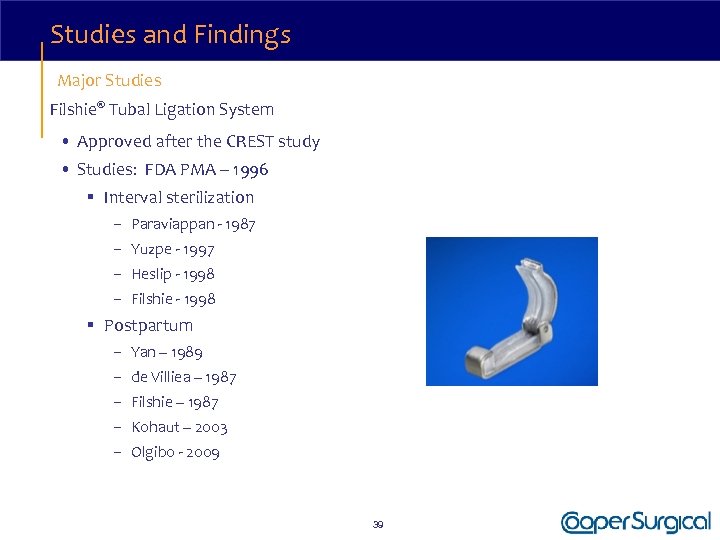
Studies and Findings Major Studies Filshie® Tubal Ligation System • Approved after the CREST study • Studies: FDA PMA – 1996 § Interval sterilization - Paraviappan - 1987 - Yuzpe - 1997 - Heslip - 1998 - Filshie - 1998 § Postpartum - Yan – 1989 - de Villiea – 1987 - Filshie – 1987 - Kohaut – 2003 - Olgibo - 2009 39
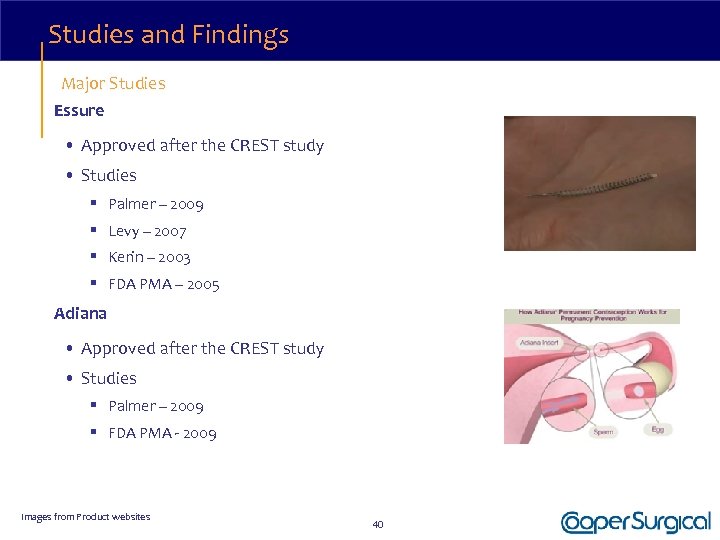
Studies and Findings Major Studies Essure • Approved after the CREST study • Studies § Palmer – 2009 § Levy – 2007 § Kerin – 2003 § FDA PMA – 2005 Adiana • Approved after the CREST study • Studies § Palmer – 2009 § FDA PMA - 2009 Images from Product websites 40
Other Considerations Informed Consent Discussion with patient must take place and cover the following details: • It must be a voluntary decision • Discussion of other options • Discussion of method of sterilization • Sterilization is permanent • Must be 21 years of age or older • Probability of failure • Discussion about methods of contraception for prevention of STDs • Special consideration for women with mental disabilities Information taken from the Dept. of Health and Human Services Form: http: //www. hhs. gov/forms/HHS-687. pdf 41
Other Considerations Regret Women may experience regret post-procedure • 2 -26% of women express regret post-sterilization • 1 -2% will seek reversal • Sterilization is permanent • Association with age at time of sterilization, change in marital status and future regret • Requests for reversals and/or IVF possible * Chi, I. C. , Jones D. B. Incidence, risk factors, and prevention of poststerilization regret: an updated international review from an epidemiological perspective. Obstet Gynecol Surv 1994; 49: 722 -32 * Van Voorhis BJ. Comparison of tubal ligation reversal procedures. Clin Obstet Gynecol 2000; 43: 641 -9 Curtis, K. , Mohllajee, A. P. , and Peterson, H. B. Regret Following Female Sterilization at a Young Age: A Systematic Review. Contracep 2006; 73: 2. P 205 -210 42
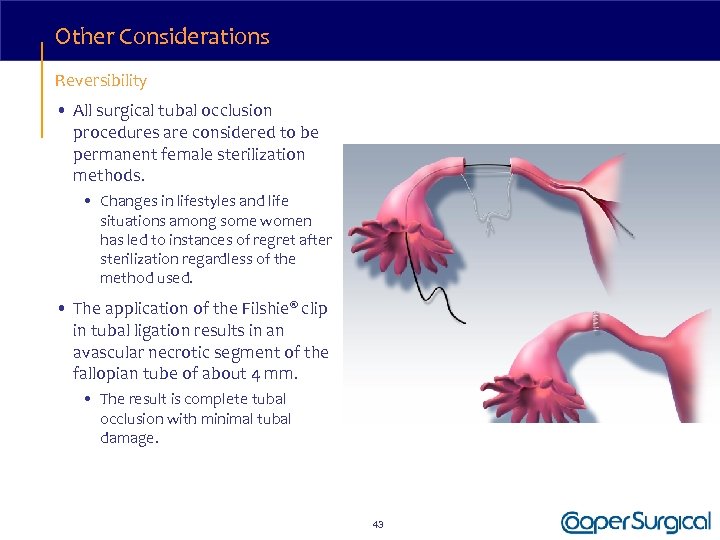
Other Considerations Reversibility • All surgical tubal occlusion procedures are considered to be permanent female sterilization methods. • Changes in lifestyles and life situations among some women has led to instances of regret after sterilization regardless of the method used. • The application of the Filshie® clip in tubal ligation results in an avascular necrotic segment of the fallopian tube of about 4 mm. • The result is complete tubal occlusion with minimal tubal damage. 43
Summary of Female Sterilization • Tubal occlusion is an effective method of female sterilization regardless of method chosen • Failures will occur in some percentage female sterilization procedures regardless of method utilized. • IUP • Ectopic Pregnancy 44
Male Sterilization Vasectomy • Safe and permanent birth control procedure • US: 1 of 5 men over age 35 has had a vasectomy • 500, 000 vasectomies in the US each year • 4 million world wide each year • Cost (US) of procedure $500 -$1000 45
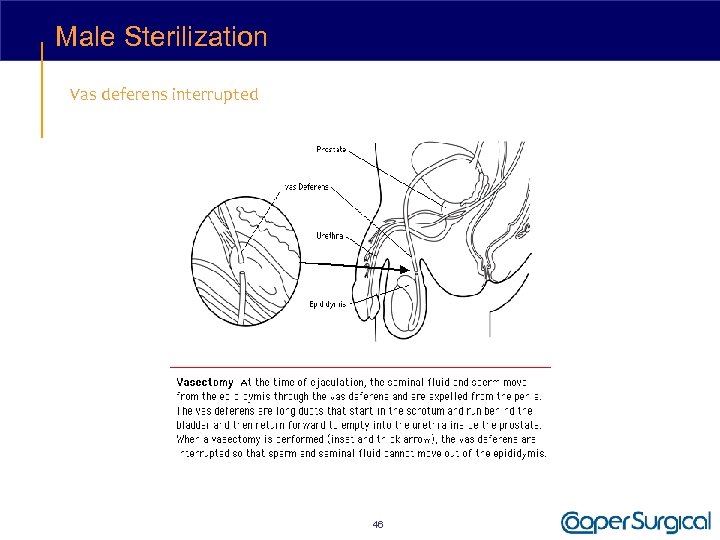
Male Sterilization Vas deferens interrupted 46
Male Sterilization Vasectomy Procedure • Office visit – approximately 1 hour • Local anesthetic to the overlying skin • Clamp the vas through the skin • Incision made • Small segment removed (3 mm) • Cut segments § Tied § Cauterized § Clipped 47
Male Sterilization Post Vasectomy • Instructions • Athletic supporter • Decreased activity 1 -2 days • Avoid strenuous exercise for 1 week • Complications • Bleeding: 1. 6 -4. 6% • Infection: 2. 2 -6. 0% • Sperm granuloma: 15 -40% (treat with NSAIDs) • Antibodies: 40% (issue after reversal) • Chronic pain: 0 -6% 48
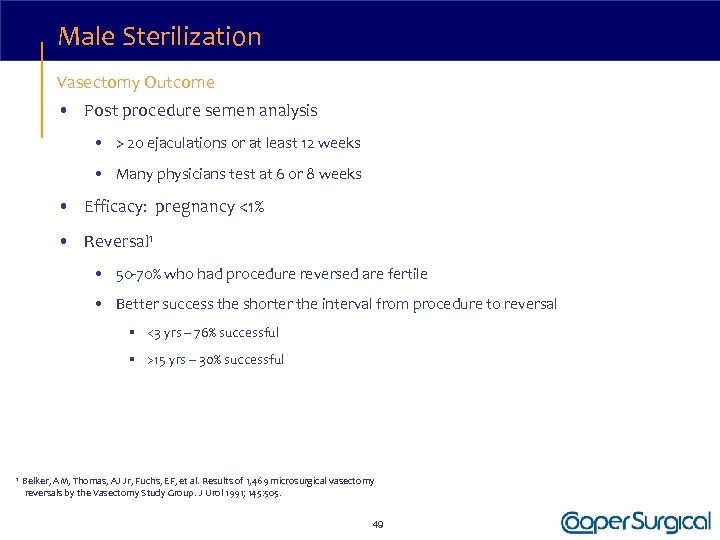
Male Sterilization Vasectomy Outcome • Post procedure semen analysis • > 20 ejaculations or at least 12 weeks • Many physicians test at 6 or 8 weeks • Efficacy: pregnancy <1% • Reversal 1 • 50 -70% who had procedure reversed are fertile • Better success the shorter the interval from procedure to reversal § <3 yrs – 76% successful § >15 yrs – 30% successful 1 Belker, AM, Thomas, AJ Jr, Fuchs, EF, et al. Results of 1, 469 microsurgical vasectomy reversals by the Vasectomy Study Group. J Urol 1991; 145: 505. 49
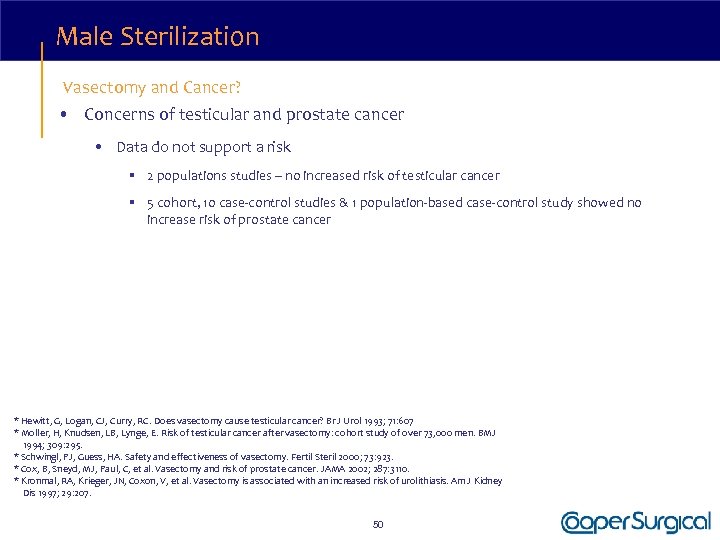
Male Sterilization Vasectomy and Cancer? • Concerns of testicular and prostate cancer • Data do not support a risk § 2 populations studies – no increased risk of testicular cancer § 5 cohort, 10 case-control studies & 1 population-based case-control study showed no increase risk of prostate cancer * Hewitt, G, Logan, CJ, Curry, RC. Does vasectomy cause testicular cancer? Br J Urol 1993; 71: 607 * Moller, H, Knudsen, LB, Lynge, E. Risk of testicular cancer after vasectomy: cohort study of over 73, 000 men. BMJ 1994; 309: 295. * Schwingl, PJ, Guess, HA. Safety and effectiveness of vasectomy. Fertil Steril 2000; 73: 923. * Cox, B, Sneyd, MJ, Paul, C, et al. Vasectomy and risk of prostate cancer. JAMA 2002; 287: 3110. * Kronmal, RA, Krieger, JN, Coxon, V, et al. Vasectomy is associated with an increased risk of urolithiasis. Am J Kidney Dis 1997; 29: 207. 50

Thank you for your attention 51
Скачать презентацию Female Sterilization Robert D Auerbach M D FACOG
190c21df0f4d650889cc2555f711a49a.ppt