


 Скачать презентацию Feeding During a Drought Johnny Rossi Extension Animal
9d3a6d7e20fcb514fd09cffa6da28f6e.ppt
- Количество слайдов: 27
 Feeding During a Drought Johnny Rossi Extension Animal Scientist – Tifton
 Feed Costs • Feed costs are about 65% of total costs of beef production • Harvested feed costs for winter = $150 This is 40 to 50% of total costs • Drought – today’s drylot feeding costs are 3 to 4 times higher than grazing costs in a normal year
 TDN and Protein Requirements • Lactating cow requires about 11% protein and 58 to 60% TDN (RFQ = 115) • Dry cow requires about 8% protein and 55% TDN (RFQ = 90) in late gestation • Dry cow needs 8% protein and 50% TDN in mid-pregnancy – This represents a large part of our herds at this time
 Conserve the Hay You Have • Use ring feeders – least amount of waste • Roll only 1 days or less supply of hay out • Store hay under a cover • Wasted hay costs 2 to 3 times what it did just a couple or year’s age
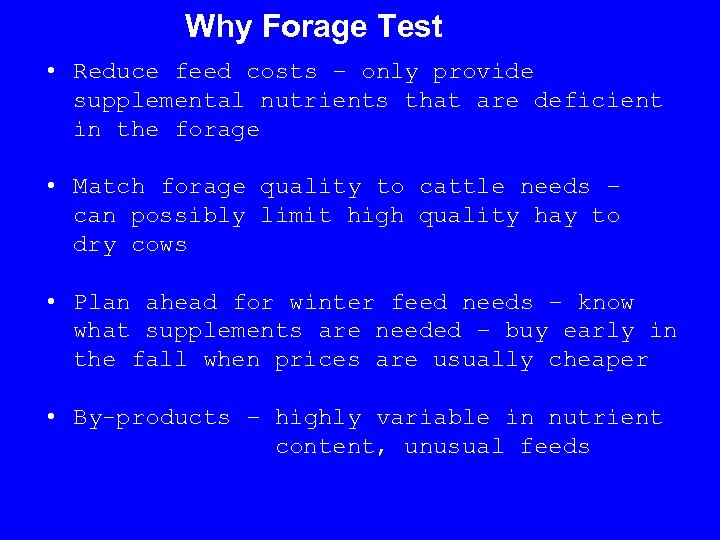 Why Forage Test • Reduce feed costs – only provide supplemental nutrients that are deficient in the forage • Match forage quality to cattle needs – can possibly limit high quality hay to dry cows • Plan ahead for winter feed needs – know what supplements are needed – buy early in the fall when prices are usually cheaper • By-products – highly variable in nutrient content, unusual feeds
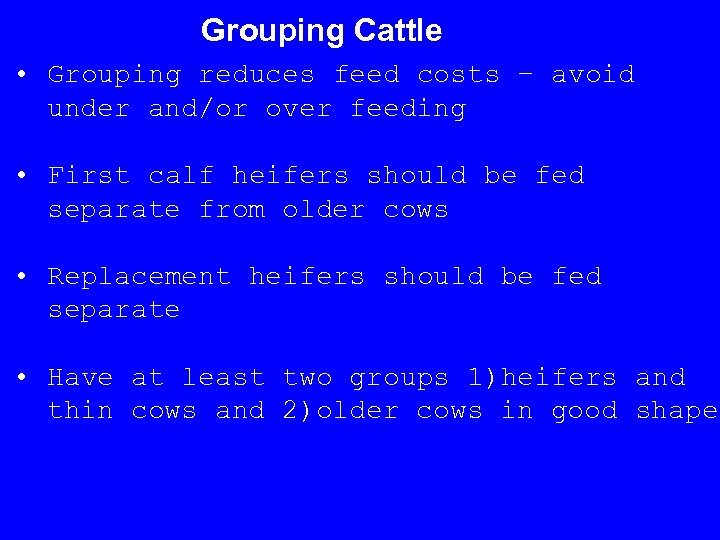 Grouping Cattle • Grouping reduces feed costs – avoid under and/or over feeding • First calf heifers should be fed separate from older cows • Replacement heifers should be fed separate • Have at least two groups 1)heifers and thin cows and 2)older cows in good shape
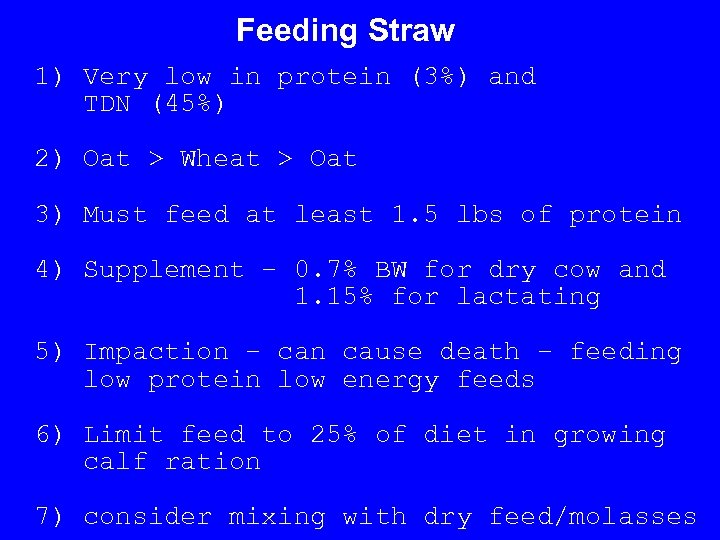 Feeding Straw 1) Very low in protein (3%) and TDN (45%) 2) Oat > Wheat > Oat 3) Must feed at least 1. 5 lbs of protein 4) Supplement – 0. 7% BW for dry cow and 1. 15% for lactating 5) Impaction – can cause death – feeding low protein low energy feeds 6) Limit feed to 25% of diet in growing calf ration 7) consider mixing with dry feed/molasses
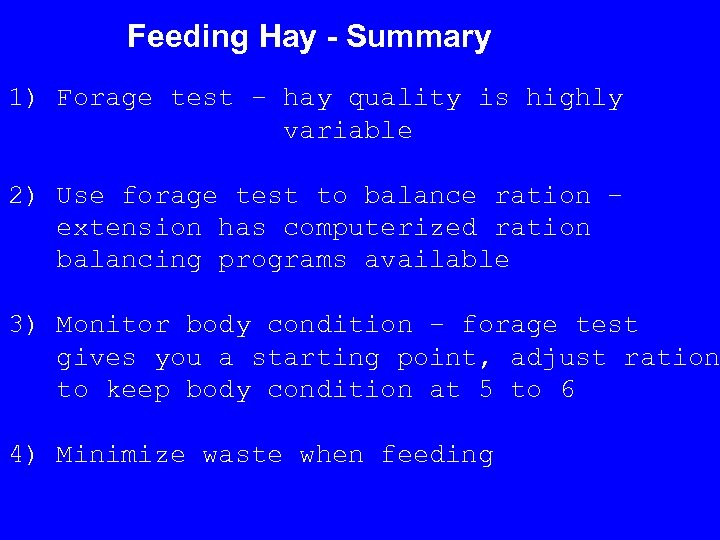 Feeding Hay - Summary 1) Forage test – hay quality is highly variable 2) Use forage test to balance ration – extension has computerized ration balancing programs available 3) Monitor body condition – forage test gives you a starting point, adjust ration to keep body condition at 5 to 6 4) Minimize waste when feeding
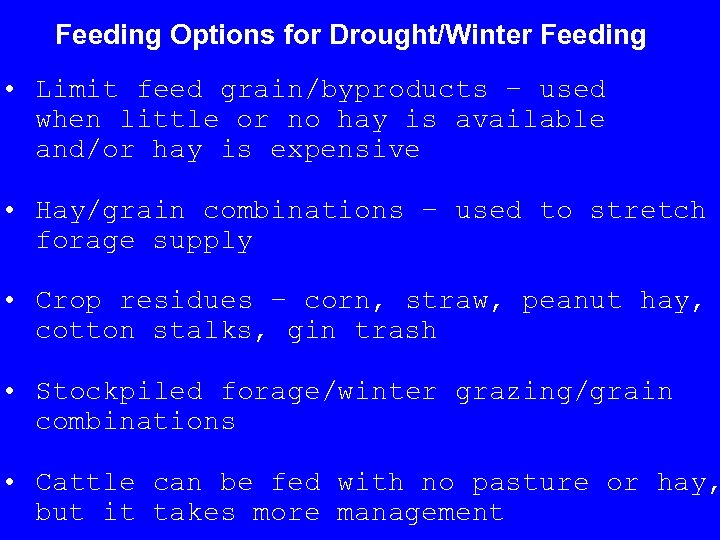 Feeding Options for Drought/Winter Feeding • Limit feed grain/byproducts – used when little or no hay is available and/or hay is expensive • Hay/grain combinations – used to stretch forage supply • Crop residues – corn, straw, peanut hay, cotton stalks, gin trash • Stockpiled forage/winter grazing/grain combinations • Cattle can be fed with no pasture or hay, but it takes more management
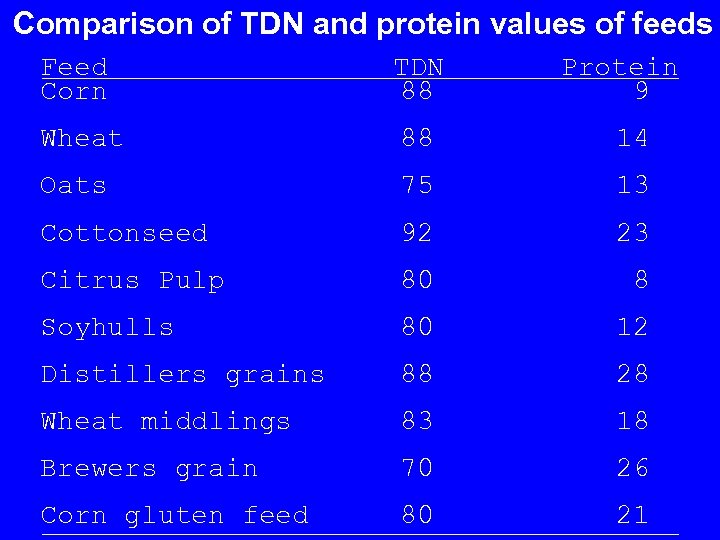 Comparison of TDN and protein values of feeds Feed Corn TDN 88 Protein 9 Wheat 88 14 Oats 75 13 Cottonseed 92 23 Citrus Pulp 80 8 Soyhulls 80 12 Distillers grains 88 28 Wheat middlings 83 18 Brewers grain 70 26 Corn gluten feed 80 21
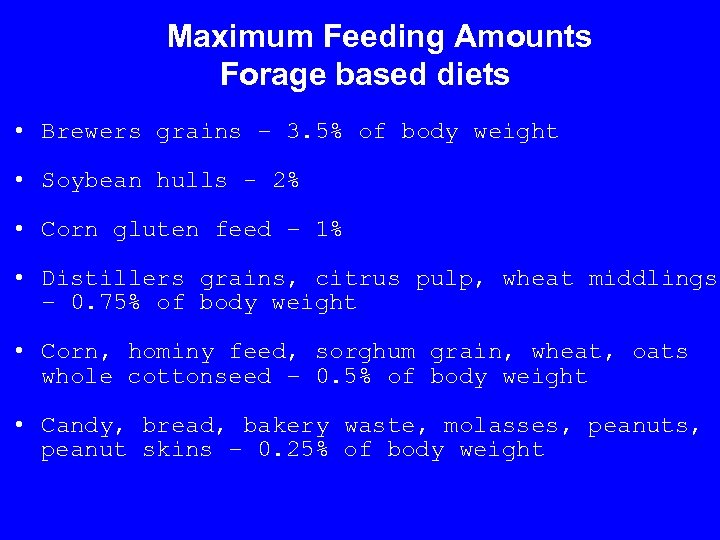 Maximum Feeding Amounts Forage based diets • Brewers grains – 3. 5% of body weight • Soybean hulls - 2% • Corn gluten feed – 1% • Distillers grains, citrus pulp, wheat middlings – 0. 75% of body weight • Corn, hominy feed, sorghum grain, wheat, oats whole cottonseed – 0. 5% of body weight • Candy, bread, bakery waste, molasses, peanut skins – 0. 25% of body weight
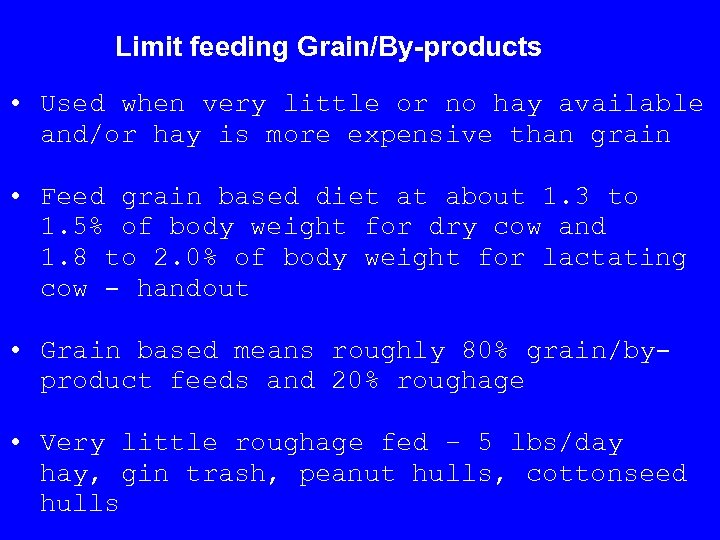 Limit feeding Grain/By-products • Used when very little or no hay available and/or hay is more expensive than grain • Feed grain based diet at about 1. 3 to 1. 5% of body weight for dry cow and 1. 8 to 2. 0% of body weight for lactating cow - handout • Grain based means roughly 80% grain/byproduct feeds and 20% roughage • Very little roughage fed – 5 lbs/day hay, gin trash, peanut hulls, cottonseed hulls
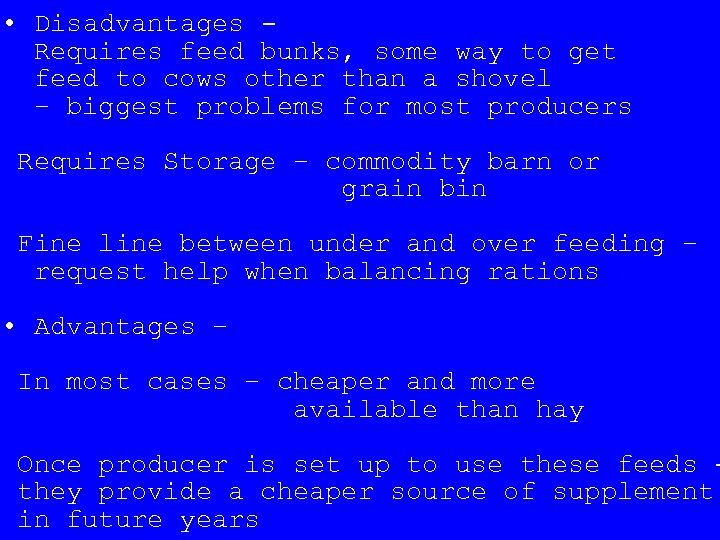 • Disadvantages Requires feed bunks, some way to get feed to cows other than a shovel – biggest problems for most producers Requires Storage – commodity barn or grain bin Fine line between under and over feeding – request help when balancing rations • Advantages – In most cases – cheaper and more available than hay Once producer is set up to use these feeds they provide a cheaper source of supplement in future years
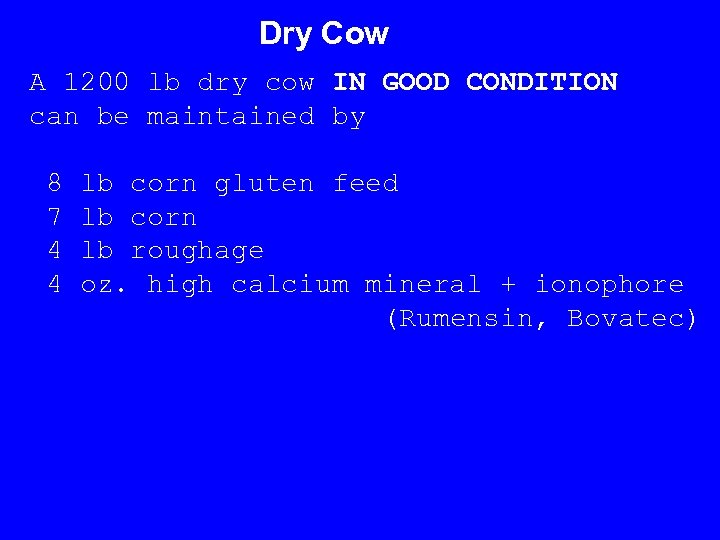 Dry Cow A 1200 lb dry cow IN GOOD CONDITION can be maintained by 8 7 4 4 lb corn gluten feed lb corn lb roughage oz. high calcium mineral + ionophore (Rumensin, Bovatec)
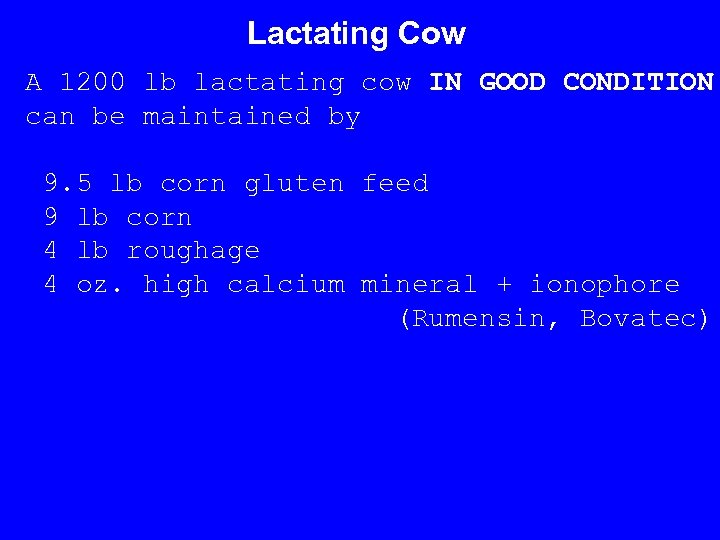 Lactating Cow A 1200 lb lactating cow IN GOOD CONDITION can be maintained by 9. 5 lb corn gluten feed 9 lb corn 4 lb roughage 4 oz. high calcium mineral + ionophore (Rumensin, Bovatec)
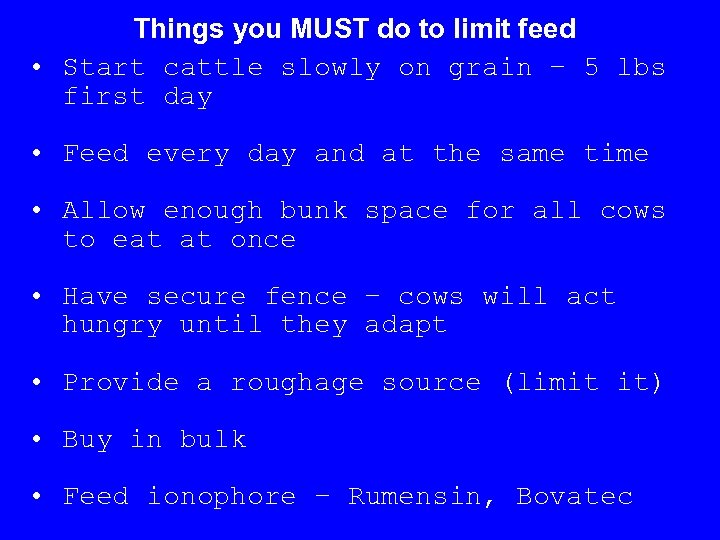 Things you MUST do to limit feed • Start cattle slowly on grain – 5 lbs first day • Feed every day and at the same time • Allow enough bunk space for all cows to eat at once • Have secure fence – cows will act hungry until they adapt • Provide a roughage source (limit it) • Buy in bulk • Feed ionophore – Rumensin, Bovatec
 Limit Hay/Grain Combinations • By-products such as soyhulls or corn gluten feed can be fed to stretch forage supply (1 lb of feed replaces about 1. 5 to 2 lbs of hay) • Must forage test hay to determine how much supplemental protein and energy is needed • Need a good idea of what bales weigh to determine daily feeding amounts • Pre-determined amount of hay can be fed per day OR you can limit access to hay – next slide
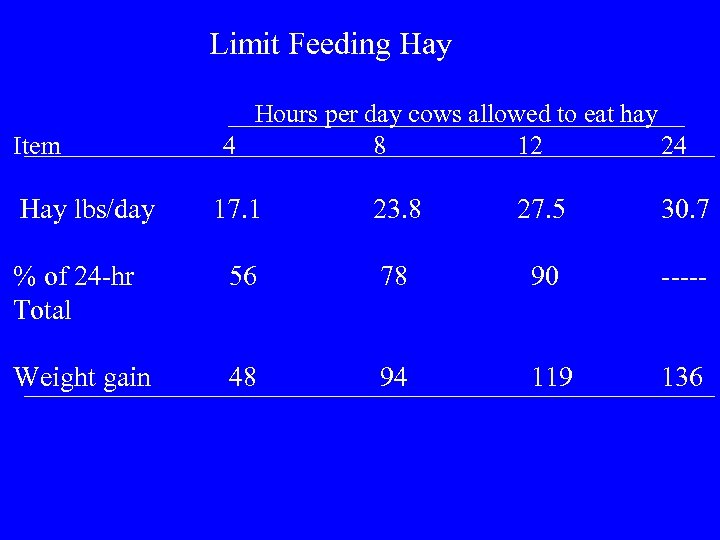 Limit Feeding Hay Item Hay lbs/day Hours per day cows allowed to eat hay 4 8 12 24 17. 1 23. 8 27. 5 30. 7 % of 24 -hr Total 56 78 90 ----- Weight gain 48 94 119 136
 Limit Hay/Grain Combinations Cont’d • Start limiting BEFORE you run out of hay • How do you limit hay? • Square bales • Round bales – roll hay out, limit access to hay in rings
 Stockpiled Forage • Do not cut after mid to late August • Plains trial – pregnant cows were grazed on stockpiled bermudagrass in Nov/Dec • Can extend grazing to mid-Dec on bermudagrass in south GA • Fescue will maintain higher quality in winter than bermudagrass – north GA • Must strip graze – cows were allowed to graze an area that lasted one week • Lactating cows may need supplement on stockpiled bermudagrass
 Stockpiled Forage/Winter Annuals/ Grain Combinations • Can limit graze and then feed grains/byproducts to provide necessary nutrients • Disadvantage – very difficult to determine intake of pasture • Watch body condition scores very closely • Cows should have at least 1 hour of grazing per day • Feed lower protein feeds when using winter annuals • Supplementation levels will vary with forage growth – 3 to 4 hours of grazing should provide 50% of daily nutrients?
 Crop Residues • Hay will be in limited supply this winter • Crop residues offer alternatives to hay – especially in south GA • Peanut hay – test and supplement if necessary • Gin trash – low quality, TDN (40 – 50%) - gin trash is cheap but needs supplement • Peanut hulls – low energy TDN (25%), limited to a roughage source for grain based diets • Straw – discussed earlier
 Crop Residues • Cotton, Corn stalks – dry cows can be maintained on residue with no supplement - protein and energy supplement needed for lactating cows • One acre of cotton stalk residue lasted a dry cow approximately 35 days at Plains • Vegetable crops – can be utilized; have feeds analyzed for nutrient content and we can work them into a ration for you, these feeds are usually very high in water content
 Early Weaning • Creep feeding – high feed costs – suggest weaning the calf • Can sell cull cows earlier • Greatly reduces needs of the cow (25 - 30%) • Calf – must be fed high quality pasture plus supplement or a grain-based diet • NO summer permanent pasture will work • Winter annuals plus supplement at 1% of body weight works well • Cheaper to feed calf directly than feed calf through the cow (milk) – fall calving
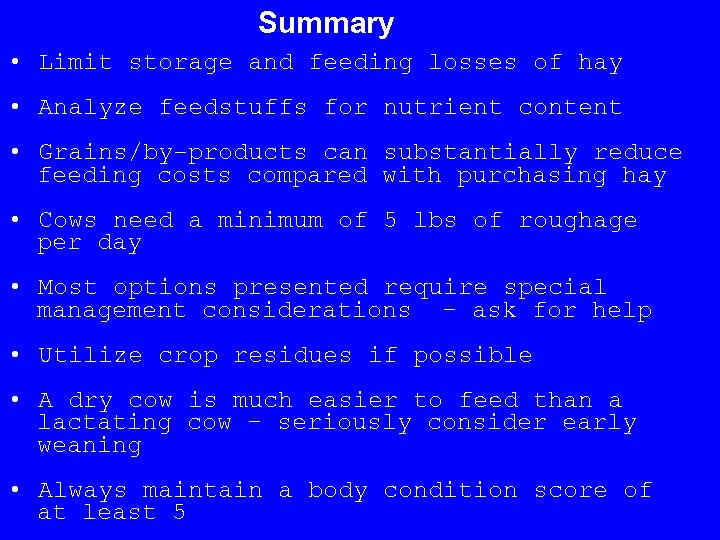 Summary • Limit storage and feeding losses of hay • Analyze feedstuffs for nutrient content • Grains/by-products can substantially reduce feeding costs compared with purchasing hay • Cows need a minimum of 5 lbs of roughage per day • Most options presented require special management considerations – ask for help • Utilize crop residues if possible • A dry cow is much easier to feed than a lactating cow – seriously consider early weaning • Always maintain a body condition score of at least 5
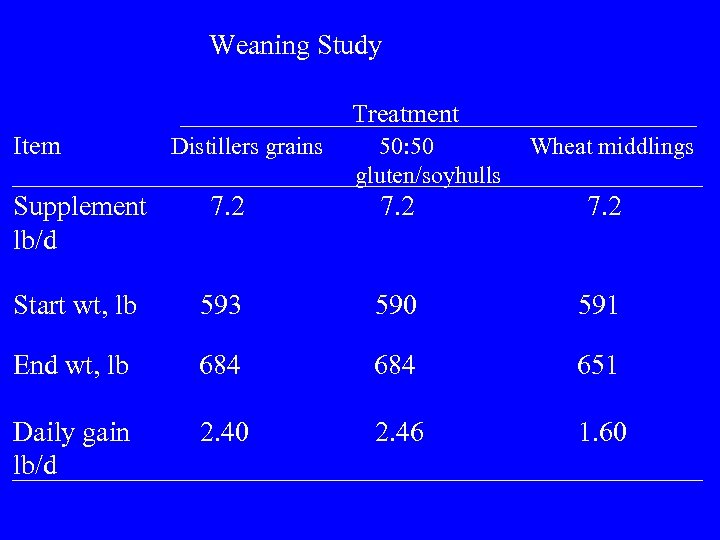 Weaning Study Treatment Item Distillers grains 50: 50 gluten/soyhulls Wheat middlings Supplement lb/d 7. 2 Start wt, lb 593 590 591 End wt, lb 684 651 Daily gain lb/d 2. 40 2. 46 1. 60
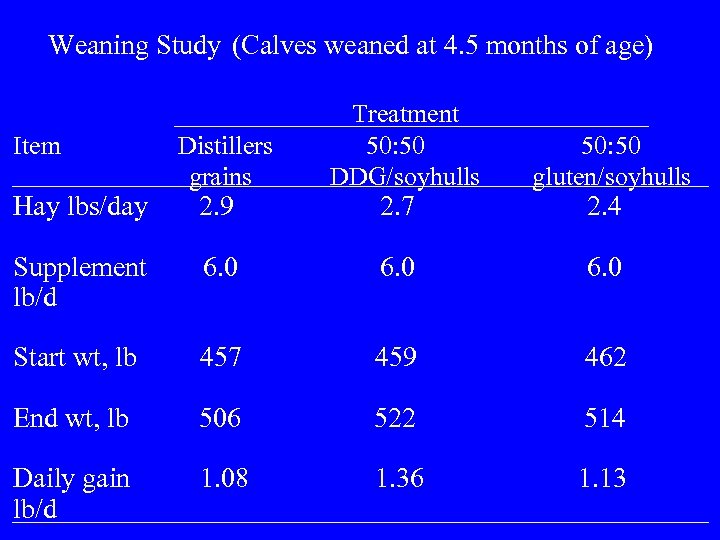 Weaning Study (Calves weaned at 4. 5 months of age) Distillers grains Treatment 50: 50 DDG/soyhulls 50: 50 gluten/soyhulls Supplement lb/d 6. 0 Start wt, lb 457 459 462 End wt, lb 506 522 514 Daily gain lb/d 1. 08 1. 36 1. 13 Item Hay lbs/day 2. 9 2. 7 2. 4