 Скачать презентацию Feedback is welcome click on www skysailtraining co
a2643d37ab4df65d268f52afa2742db6.ppt
- Количество слайдов: 66



Feedback is welcome. click on www. skysailtraining. co. uk for more tests on Weather and CEVNI, and to buy IRPCS/Colregs, Weather, VHF, Safety, CEVNI and Navigation skills charts. Skysail IRPCS Training International Regulations for Preventing Collisions at Sea IRPCS - Colregs Assessment Collision Regulations Exam Test yourself – online quiz RYA Day Skipper and Yachtmaster ICC / BSAC Seamanship Mouse click or Page Down to start © 2010 WWW. SKYSAILTRAINING. CO. UK Collision Regulations IRPCS 8 th May 2010 1
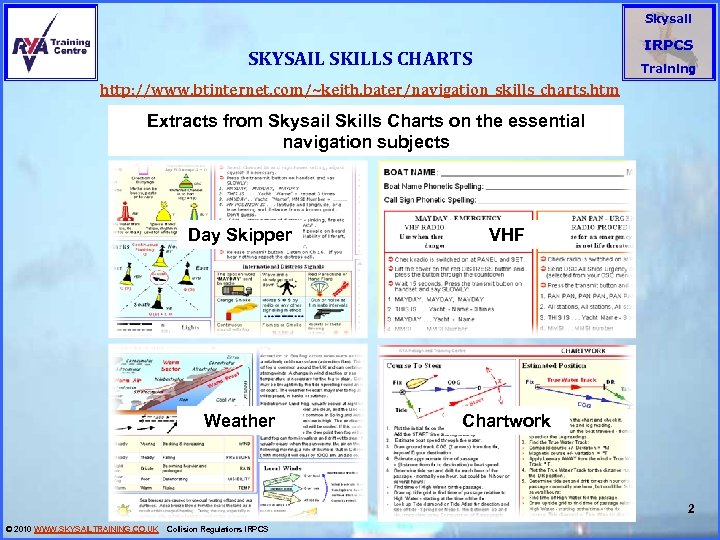
Skysail IRPCS SKYSAIL SKILLS CHARTS Training http: //www. btinternet. com/~keith. bater/navigation_skills_charts. htm Extracts from Skysail Skills Charts on the essential navigation subjects Day Skipper VHF Weather Chartwork 2 © 2010 WWW. SKYSAILTRAINING. CO. UK Collision Regulations IRPCS
Day Skipper Colregs Quiz Skysail IRPCS Training The full text of IRPCS is here: http: //www. btinternet. com/~keith. bater/irpcs_colregs_complete. htm Before the detailed Yachtmaster Collision Regs questions, there is a short section on what you need to know for the RYA Day Skipper course. 3 © 2010 WWW. SKYSAILTRAINING. CO. UK Collision Regulations IRPCS
Day Skipper – Colregs 1 Skysail IRPCS Training Basic Rules v v v v The rules apply anywhere on the sea or connected to it (subject to local by-laws). Keep a good lookout at all times by all means available (sight, sound, radar). Maintain a safe speed for the conditions: waves, hazards, tide, traffic, visibility, depth, manoeuvrability, background lights The words 'Right of Way' do not occur in the rules. A ‘Stand on' vessel should maintain its course and speed until it is clear that the ‘Give way' vessel is not taking avoiding action. Then all vessels must keep clear. Action taken to avoid a collision shall be positive, early and safe. A risk of collision exists if a bearing by compass, radar or transit stays constant. Navigate on the starboard side of a channel. When crossing a shipping lane or traffic separation scheme, keep your heading at right angles to the traffic. 4 © 2010 WWW. SKYSAILTRAINING. CO. UK Collision Regulations IRPCS
Day Skipper – Colregs 1 Skysail IRPCS Training Special rules apply in fog: There is no ‘Give Way’ vessel, everyone must keep clear. If you hear any vessel ahead: v sound your signal v slow down but keep steerage way on v stop if necessary v navigate with extreme caution till danger is past. 5 © 2010 WWW. SKYSAILTRAINING. CO. UK Collision Regulations IRPCS
Day Skipper - Colregs 2 1. 2. General Rules for Priority: v 1. Not Under Command Skysail IRPCS Training Sailing Rules 1. Starboard tack boat 2. Restricted Ability to Manoeuvre 2. Port tack boat 3. Constrained by Draught Sailing boats on the same tack: 4. Fishing Windward boat keeps clear. 5. Sail v 6. Motor (including motor sailing) Tugs are treated as motor vessels, unless they are also RAM or CBD 3. Exceptions to General Rules: Narrow channels Traffic Separation Schemes. 4. Motoring Rules Boats meeting head on - both turn to starboard. If two power vessels are crossing, the boat which has the other on her own starboard side shall keep out of the way. Overtaking boats keep clear - sail and power. © 2010 WWW. SKYSAILTRAINING. CO. UK 6 Collision Regulations IRPCS
Day Skipper Colregs Quiz 3 What is the meaning of this day shape? Vessel at anchor What is the meaning of this flag ? Skysail IRPCS Training What are the rules concerning lookout? Keep a good lookout at all times by all possible means Do the words ‘Right of Way’ appear in the Rules? No Diver down Keep well clear at slow speed 7 © 2010 WWW. SKYSAILTRAINING. CO. UK Collision Regulations IRPCS
Day Skipper Collision Regulations What is the meaning of this sign? Sailing vessel Motor sailing What is the meaning of this sign? Vessel fishing Skysail IRPCS Training Two motor boats meet head on, what action is required? Head on: Turn to Starboard Keep to Starboard side of channel Two motor boats converge A Converging: Boat on right stands on B goes behind, slows down or stops B 8 © 2010 WWW. SKYSAILTRAINING. CO. UK Collision Regulations IRPCS
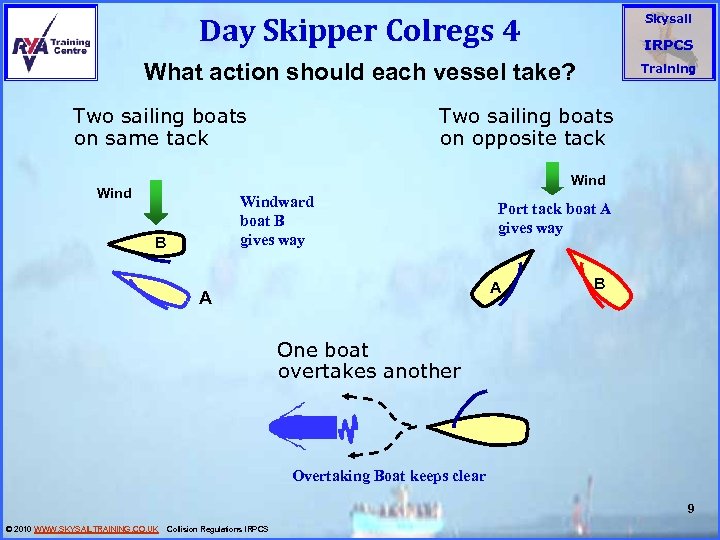
Day Skipper Colregs 4 Skysail IRPCS What action should each vessel take? Two sailing boats on same tack Training Two sailing boats on opposite tack Windward boat B gives way B Port tack boat A gives way A A B One boat overtakes another Overtaking Boat keeps clear 9 © 2010 WWW. SKYSAILTRAINING. CO. UK Collision Regulations IRPCS
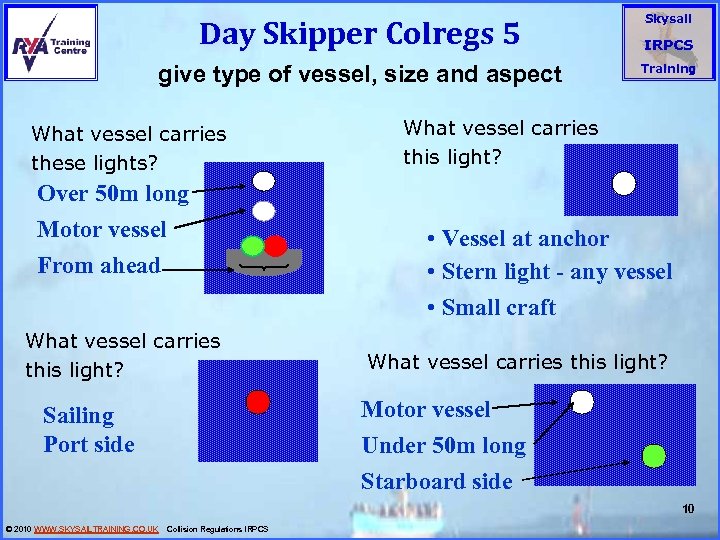
Day Skipper Colregs 5 give type of vessel, size and aspect What vessel carries these lights? Over 50 m long Motor vessel From ahead What vessel carries this light? Skysail IRPCS Training What vessel carries this light? • Vessel at anchor • Stern light - any vessel • Small craft What vessel carries this light? Motor vessel Sailing Port side Under 50 m long Starboard side 10 © 2010 WWW. SKYSAILTRAINING. CO. UK Collision Regulations IRPCS
Yachtmaster Assessments Skysail IRPCS Training The RYA assessment requires that you achieve 80% in the Collision Regulations assessment. You need to know all that follows in this test 11 © 2010 WWW. SKYSAILTRAINING. CO. UK Collision Regulations IRPCS
Application - IRPCS Rule 1 Skysail IRPCS Training Do the Collision Regulations apply on Lake Geneva? No. This is not the high seas, or navigable water connected with the high seas 12 © 2010 WWW. SKYSAILTRAINING. CO. UK Collision Regulations IRPCS
Responsibility – IRPCS Rule 2 Skysail IRPCS Training Do the words ‘right of way’ appear in the collision regulations? No. It is everyone’s responsibility to avoid a collision, there is no exoneration. There are ‘give way’ vessels and ‘stand on’ vessels. 13 © 2010 WWW. SKYSAILTRAINING. CO. UK Collision Regulations IRPCS
General Definitions - Rule 3 Skysail IRPCS Training Does a sailing yacht which is motor-sailing count as a sailing vessel or a power-driven vessel? A power-driven vessel, it is being propelled by machinery What is the definition of “under way”? Underway: not anchored, or made fast to the shore, or aground. Vessels ‘making way’ are moving through the water by power, sail or oars, but this is not defined in the IRPCS. 14 © 2010 WWW. SKYSAILTRAINING. CO. UK Collision Regulations IRPCS
Look-out - IRPCS Rule 5 Skysail IRPCS Training What do the colregs say about the maintenance of a look-out? At all times, by all available means, including sight, sound, and radar if available. May this rule be relaxed by single handed sailors? No 15 © 2010 WWW. SKYSAILTRAINING. CO. UK Collision Regulations IRPCS
Safe Speed – IRPCS Rule 6 Skysail IRPCS Training What is a safe speed? At a safe speed a vessel can take proper and effective action to avoid collision, and be stopped within a distance appropriate to the prevailing circumstances and conditions. Consider: 1. 2. 3. 4. 5. 6. 7. 8. © 2010 WWW. SKYSAILTRAINING. CO. UK Stopping and turning ability of your vessel Visibility Draught of your vessel and Depth of water Weather Sea State Traffic Hazards Background lights at night Collision Regulations IRPCS 16
Risk of Collision - Rule 7 Skysail IRPCS Training How do you determine that a risk of collision exists? Take bearings of an approaching vessel. If the bearings stay constant and the distance is closing there is a risk of collision. 17 © 2010 WWW. SKYSAILTRAINING. CO. UK Collision Regulations IRPCS
Action to avoid Collision - Rule 8 Skysail IRPCS Training What are the rules about action to avoid a collision? Action should be early, in ample time. Your action should obvious to another vessel. At night, show another aspect of your lights. Your action should be safe 18 © 2010 WWW. SKYSAILTRAINING. CO. UK Collision Regulations IRPCS
Narrow Channels - Rule 9 Skysail IRPCS Training What are the rules for any sailing vessel, and vessels less than 20 m in length, in narrow channels? They must not impede the passage of a vessel which can navigate safely only in the channel. 19 © 2010 WWW. SKYSAILTRAINING. CO. UK Collision Regulations IRPCS
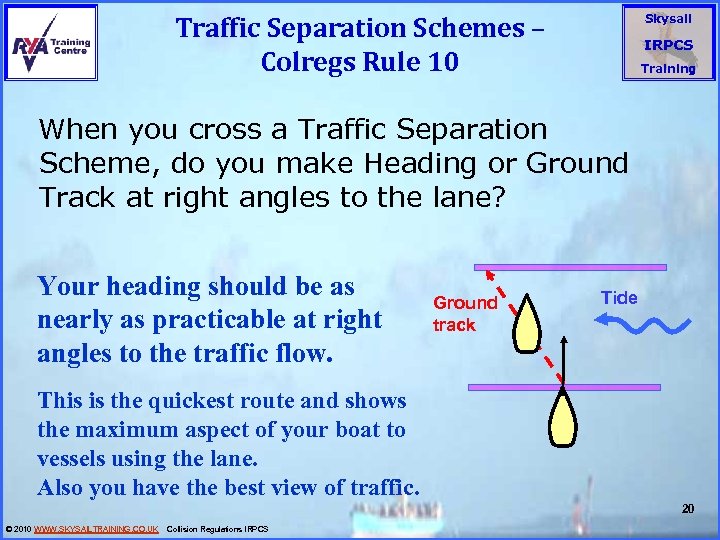
Traffic Separation Schemes – Colregs Rule 10 Skysail IRPCS Training When you cross a Traffic Separation Scheme, do you make Heading or Ground Track at right angles to the lane? Your heading should be as nearly as practicable at right angles to the traffic flow. Ground track Tide This is the quickest route and shows the maximum aspect of your boat to vessels using the lane. Also you have the best view of traffic. 20 © 2010 WWW. SKYSAILTRAINING. CO. UK Collision Regulations IRPCS
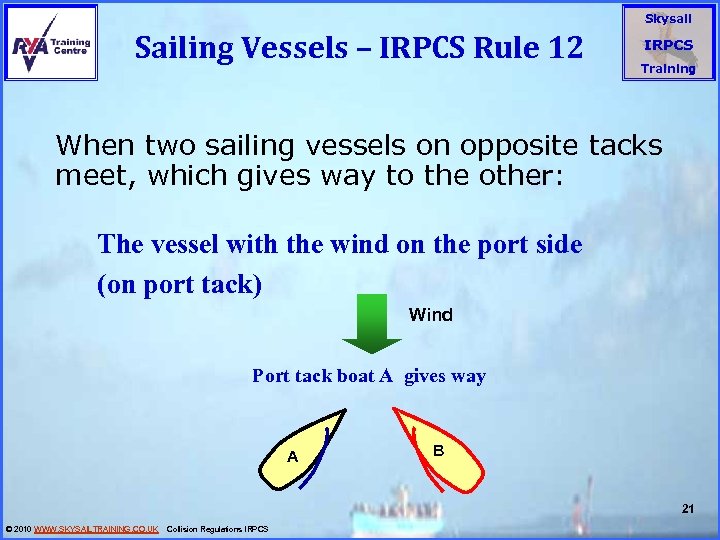
Skysail Sailing Vessels – IRPCS Rule 12 IRPCS Training When two sailing vessels on opposite tacks meet, which gives way to the other: The vessel with the wind on the port side (on port tack) Wind Port tack boat A gives way A B 21 © 2010 WWW. SKYSAILTRAINING. CO. UK Collision Regulations IRPCS
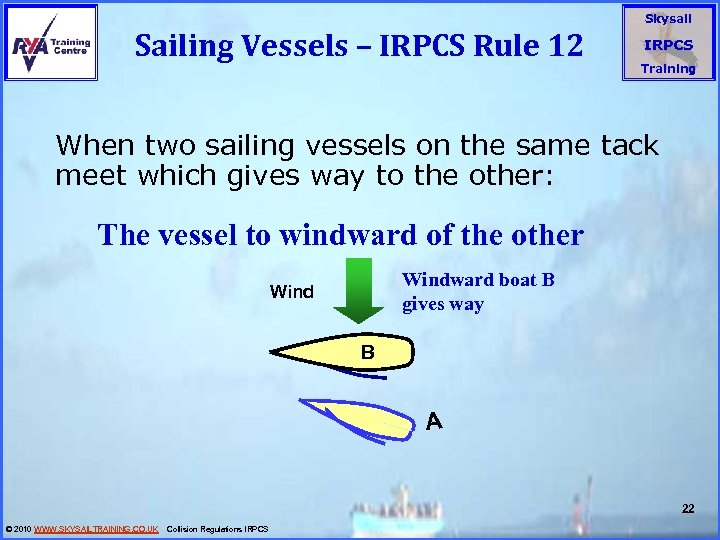
Sailing Vessels – IRPCS Rule 12 Skysail IRPCS Training When two sailing vessels on the same tack meet which gives way to the other: The vessel to windward of the other Windward boat B gives way Wind B A 22 © 2010 WWW. SKYSAILTRAINING. CO. UK Collision Regulations IRPCS
Sailing Vessels – Colregs Rule 12 Skysail IRPCS Training A sailing vessel on port tack sees another sailing vessel ahead to windward but is not certain whether the other vessel is on port or starboard tack. Does she: stand on or give way? She gives way 23 © 2010 WWW. SKYSAILTRAINING. CO. UK Collision Regulations IRPCS
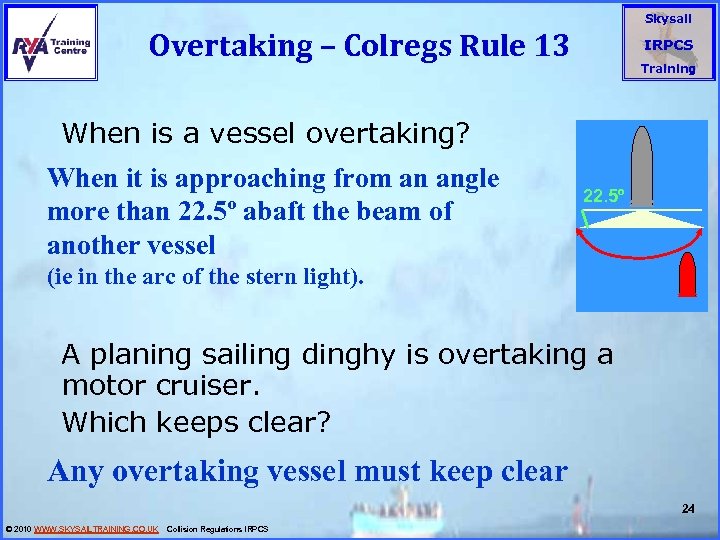
Skysail Overtaking – Colregs Rule 13 IRPCS Training When is a vessel overtaking? When it is approaching from an angle more than 22. 5º abaft the beam of another vessel 22. 5º (ie in the arc of the stern light). A planing sailing dinghy is overtaking a motor cruiser. Which keeps clear? Any overtaking vessel must keep clear 24 © 2010 WWW. SKYSAILTRAINING. CO. UK Collision Regulations IRPCS
Overtaking - IRPCS Rule 13 Skysail IRPCS Training What should you do if you are not sure you are overtaking? Assume you are overtaking and act accordingly. What happens if you change your course or speed to come out of the overtaking sector? Any subsequent alteration of the bearing between the two vessels shall not make the overtaking vessel a crossing vessel within the meaning of these Rules, or relieve her of the duty of keeping clear of the overtaken vessel until she is finally past and clear. 25 © 2010 WWW. SKYSAILTRAINING. CO. UK Collision Regulations IRPCS
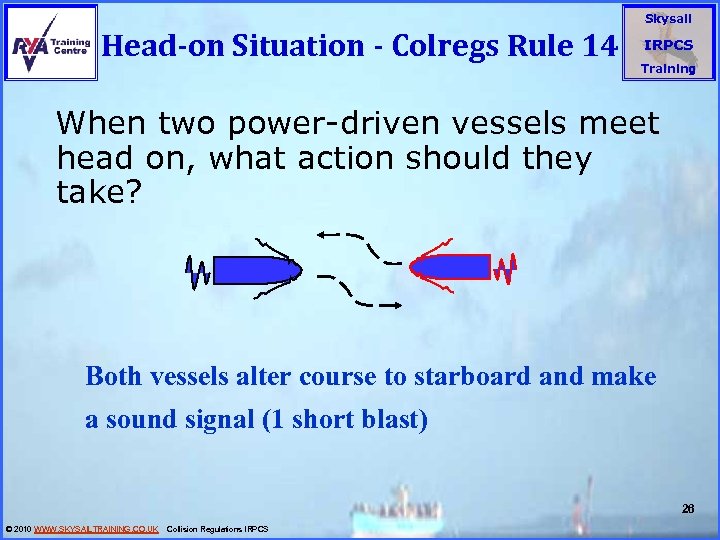
Head-on Situation - Colregs Rule 14 Skysail IRPCS Training When two power-driven vessels meet head on, what action should they take? Both vessels alter course to starboard and make a sound signal (1 short blast) 26 © 2010 WWW. SKYSAILTRAINING. CO. UK Collision Regulations IRPCS
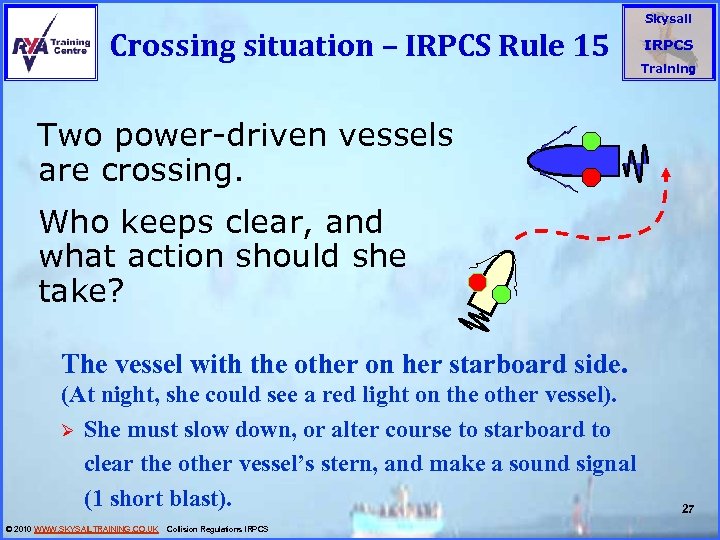
Crossing situation – IRPCS Rule 15 Skysail IRPCS Training Two power-driven vessels are crossing. Who keeps clear, and what action should she take? The vessel with the other on her starboard side. (At night, she could see a red light on the other vessel). Ø She must slow down, or alter course to starboard to clear the other vessel’s stern, and make a sound signal (1 short blast). © 2010 WWW. SKYSAILTRAINING. CO. UK Collision Regulations IRPCS 27
Action by give-way vessel - Rule 16 Skysail IRPCS Training What kind of action should be taken by the vessel required to keep clear? It should be early, in ample time and substantial 28 © 2010 WWW. SKYSAILTRAINING. CO. UK Collision Regulations IRPCS
Action by stand on vessel - Rule 17 Skysail IRPCS Training What is the ‘stand-on’ vessel required to do? Maintain her course and speed What should the ‘stand on’ vessel do if a collision appears imminent Take action to avoid the collision 29 © 2010 WWW. SKYSAILTRAINING. CO. UK Collision Regulations IRPCS
Skysail Responsibilities between vessels - Collision Regulations Rule 18 IRPCS Training List the following in order of priority Vessel restricted in ability to manoeuvre Power driven vessel Fishing vessel Sailing vessel Vessel Not Under Command Vessel Constrained by Draught 1 Vessel Not Under Command 2 Vessel Restricted in Ability to Manœuvre 3 Vessel Constrained by Draught 4 Fishing vessel 5 Sailing vessel 6 Power vessel © 2010 WWW. SKYSAILTRAINING. CO. UK Collision Regulations IRPCS 30
Skysail IRPCS Conduct of vessels in restricted visibility – Colregs Rule 19 Training In restricted visibility what must all vessels ensure regarding their speed and means of propulsion? v A safe speed suitable for the prevailing circumstances. v Engines are ready for immediate manoeuvre. 31 © 2010 WWW. SKYSAILTRAINING. CO. UK Collision Regulations IRPCS
Conduct of vessels in restricted visibility - Rule 19 Skysail IRPCS Training In restricted visibility, you hear the fog signal of vessel ahead of you. What must you do? 1 2 3 4 Sound your fog signal. Reduce speed to the minimum while maintaining steerage way. Stop if necessary. Navigate with extreme caution until danger of collision is over. 32 © 2010 WWW. SKYSAILTRAINING. CO. UK Collision Regulations IRPCS
Skysail Collision Regulations – Under Way IRPCS Training Which vessels can you distinguish as either ‘under way’ or ‘making way’ at night? 1. 2. 3. Not Under Command Restricted Ability to Manœuvre Fishing All other vessels can only be identified as ‘under way’ at night. 33 © 2010 WWW. SKYSAILTRAINING. CO. UK Collision Regulations IRPCS
Collision Regulations: Under way/ Making Way Skysail IRPCS Training How do vessels at night indicate they are making way? v Not Under Command: shows side and stern lights NB no steaming light at masthead. v Restricted Ability to Manœuvre, and Fishing: show side lights, stern lights and masthead (steaming) lights. 34 © 2010 WWW. SKYSAILTRAINING. CO. UK Collision Regulations IRPCS
Skysail Collision Regulations IRPCS Training Which vessels can only be distinguished as ‘under way’ at night? 1. 2. 3. 4. Sail Power Constrained By Draught Pilot Define Tugs as ‘Towing’. 35 © 2010 WWW. SKYSAILTRAINING. CO. UK Collision Regulations IRPCS
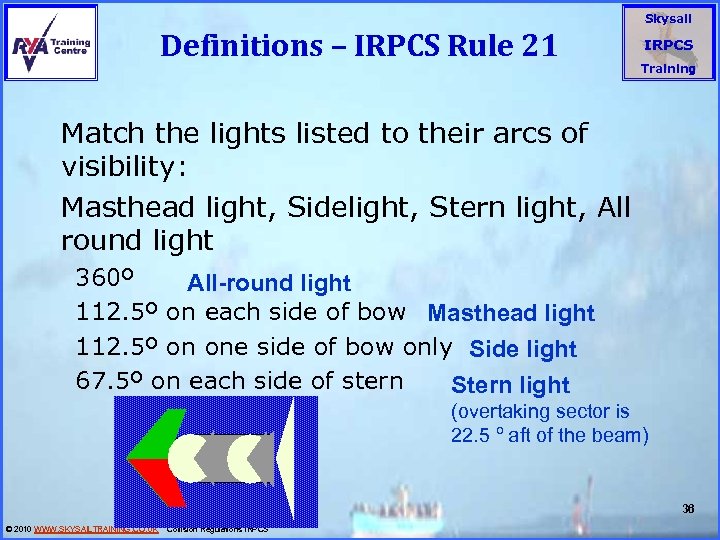
Definitions – IRPCS Rule 21 Skysail IRPCS Training Match the lights listed to their arcs of visibility: Masthead light, Sidelight, Stern light, All round light 360º All-round light 112. 5º on each side of bow Masthead light 112. 5º on one side of bow only Side light 67. 5º on each side of stern Stern light (overtaking sector is 22. 5 º aft of the beam) 36 © 2010 WWW. SKYSAILTRAINING. CO. UK Collision Regulations IRPCS
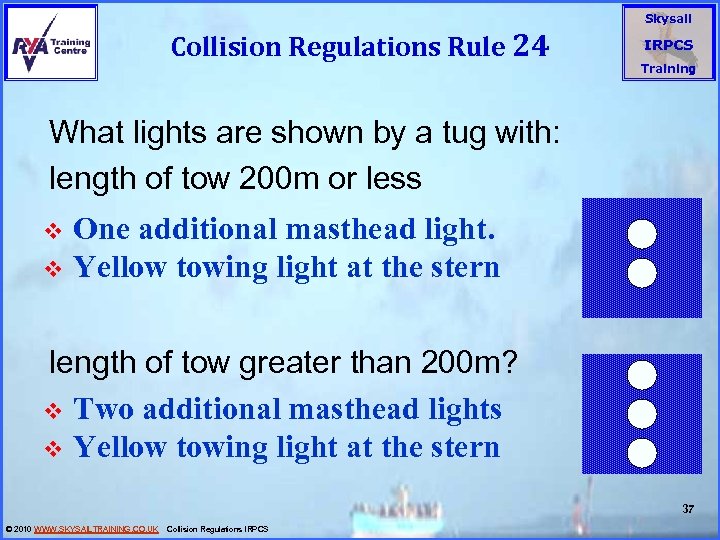
Collision Regulations Rule 24 Skysail IRPCS Training What lights are shown by a tug with: length of tow 200 m or less v v One additional masthead light. Yellow towing light at the stern length of tow greater than 200 m? v Two additional masthead lights v Yellow towing light at the stern 37 © 2010 WWW. SKYSAILTRAINING. CO. UK Collision Regulations IRPCS
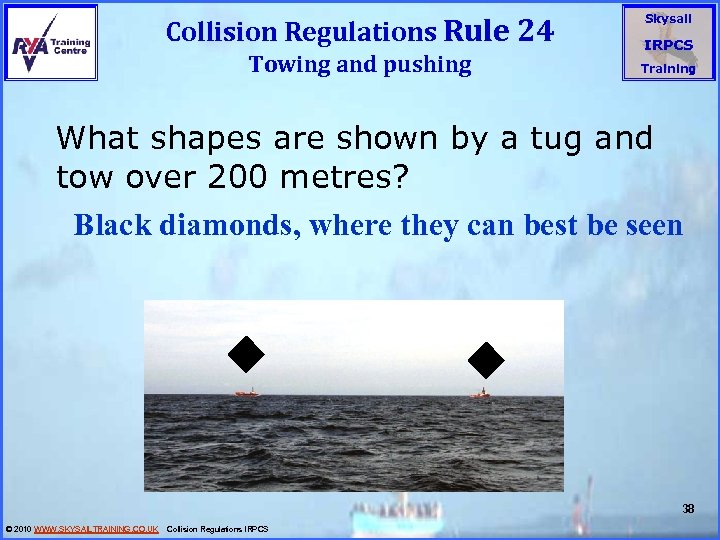
Collision Regulations Rule 24 Towing and pushing Skysail IRPCS Training What shapes are shown by a tug and tow over 200 metres? Black diamonds, where they can best be seen 38 © 2010 WWW. SKYSAILTRAINING. CO. UK Collision Regulations IRPCS
Collision Regulations Rule 24 Skysail IRPCS Training What lights are shown by a vessel being towed? v Sidelights and a Sternlight (Same as a sailing vessel, ie no power) 39 © 2010 WWW. SKYSAILTRAINING. CO. UK Collision Regulations IRPCS
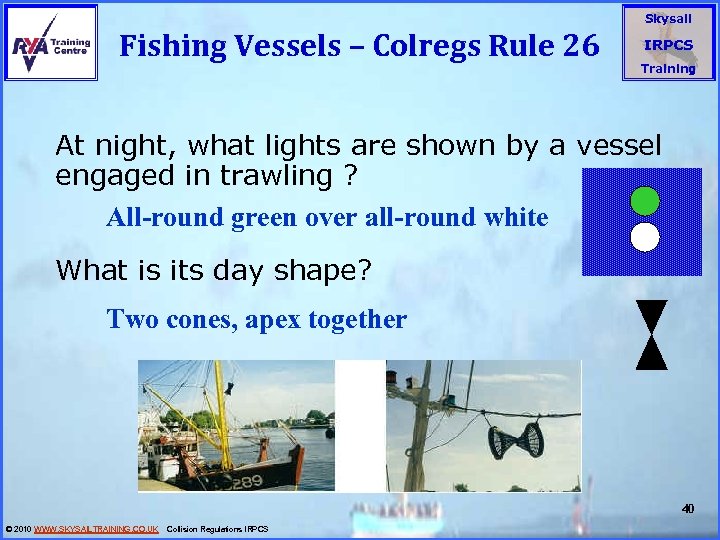
Fishing Vessels – Colregs Rule 26 Skysail IRPCS Training At night, what lights are shown by a vessel engaged in trawling ? All-round green over all-round white What is its day shape? Two cones, apex together 40 © 2010 WWW. SKYSAILTRAINING. CO. UK Collision Regulations IRPCS
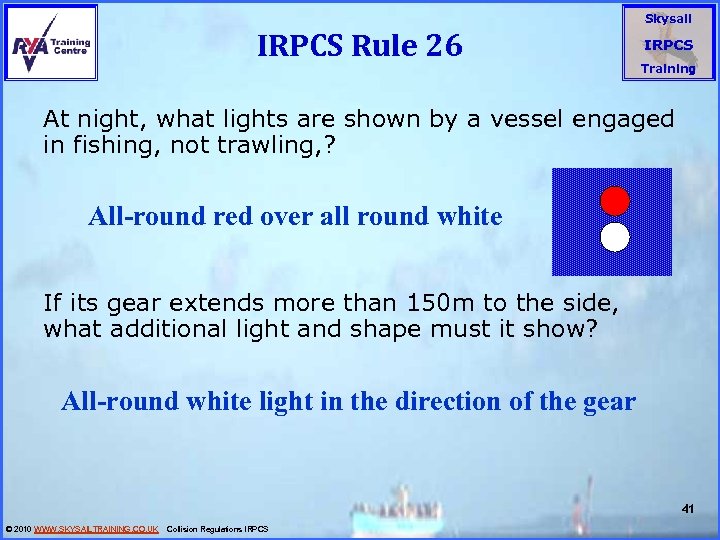
IRPCS Rule 26 Skysail IRPCS Training At night, what lights are shown by a vessel engaged in fishing, not trawling, ? All-round red over all round white If its gear extends more than 150 m to the side, what additional light and shape must it show? All-round white light in the direction of the gear 41 © 2010 WWW. SKYSAILTRAINING. CO. UK Collision Regulations IRPCS
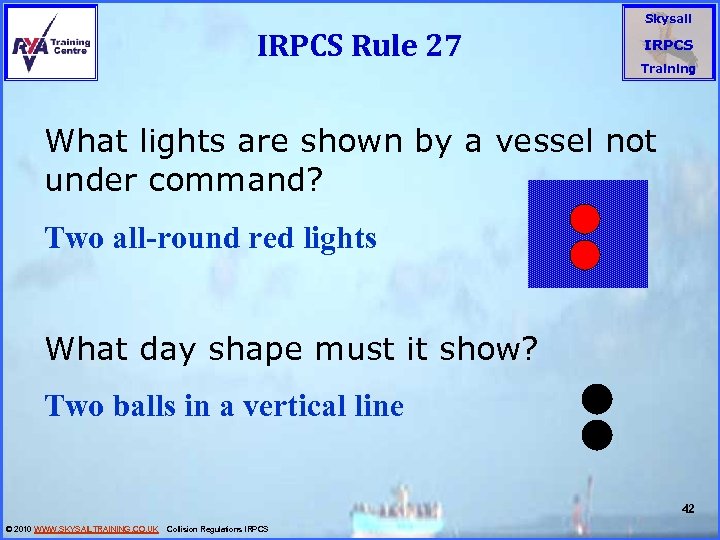
IRPCS Rule 27 Skysail IRPCS Training What lights are shown by a vessel not under command? Two all-round red lights What day shape must it show? Two balls in a vertical line 42 © 2010 WWW. SKYSAILTRAINING. CO. UK Collision Regulations IRPCS
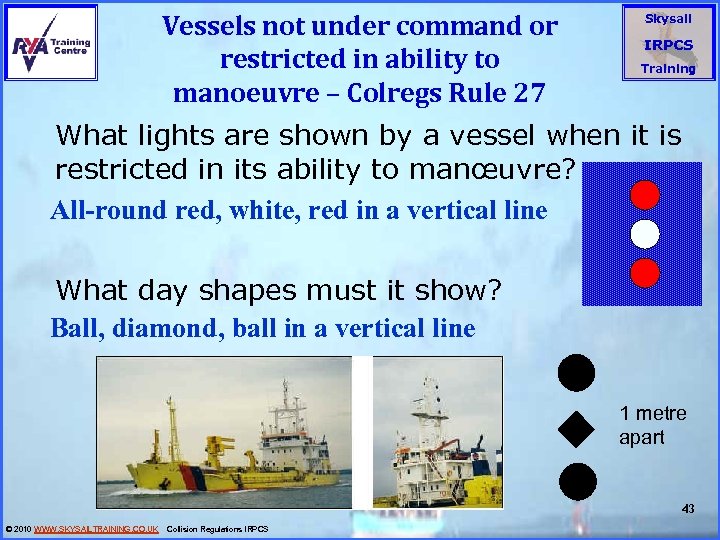
Vessels not under command or restricted in ability to manoeuvre – Colregs Rule 27 Skysail IRPCS Training What lights are shown by a vessel when it is restricted in its ability to manœuvre? All-round red, white, red in a vertical line What day shapes must it show? Ball, diamond, ball in a vertical line 1 metre apart 43 © 2010 WWW. SKYSAILTRAINING. CO. UK Collision Regulations IRPCS
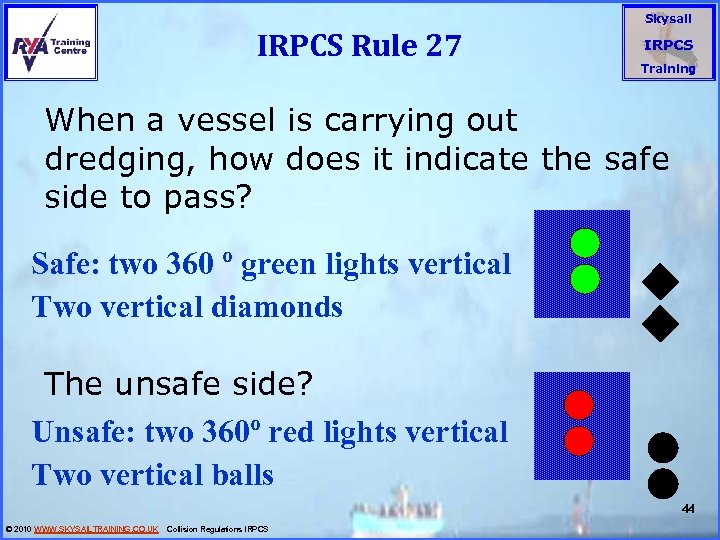
IRPCS Rule 27 Skysail IRPCS Training When a vessel is carrying out dredging, how does it indicate the safe side to pass? Safe: two 360 º green lights vertical Two vertical diamonds The unsafe side? Unsafe: two 360º red lights vertical Two vertical balls 44 © 2010 WWW. SKYSAILTRAINING. CO. UK Collision Regulations IRPCS
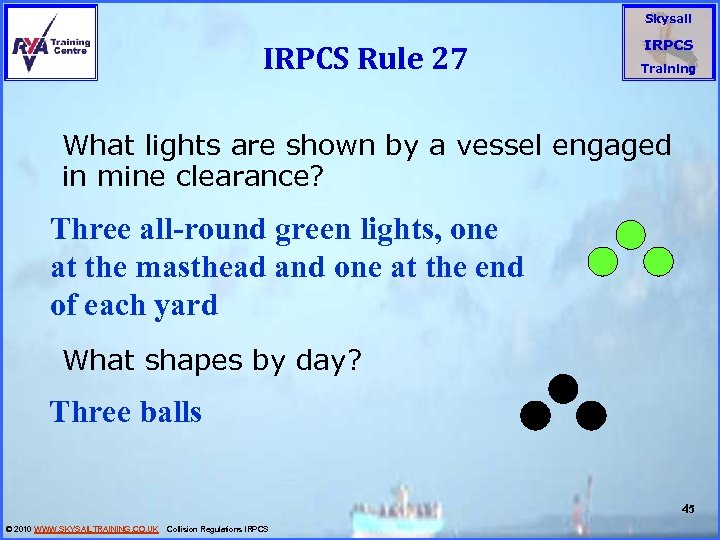
Skysail IRPCS Rule 27 IRPCS Training What lights are shown by a vessel engaged in mine clearance? Three all-round green lights, one at the masthead and one at the end of each yard What shapes by day? Three balls 45 © 2010 WWW. SKYSAILTRAINING. CO. UK Collision Regulations IRPCS
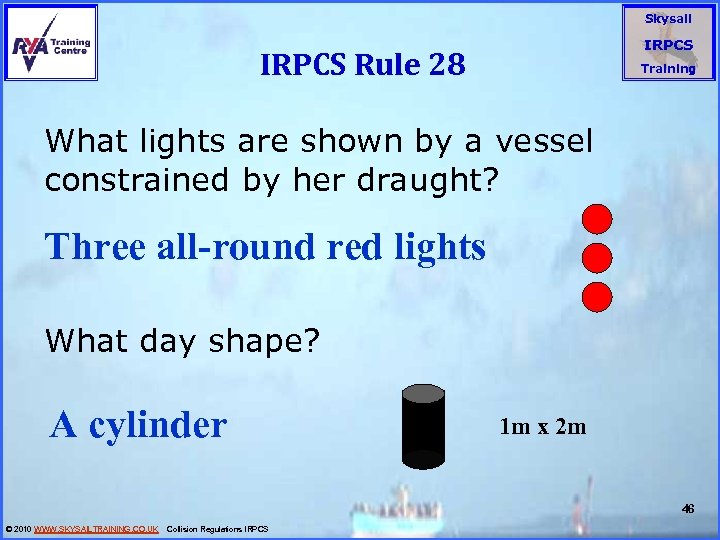
Skysail IRPCS Rule 28 Training What lights are shown by a vessel constrained by her draught? Three all-round red lights What day shape? A cylinder 1 m x 2 m 46 © 2010 WWW. SKYSAILTRAINING. CO. UK Collision Regulations IRPCS
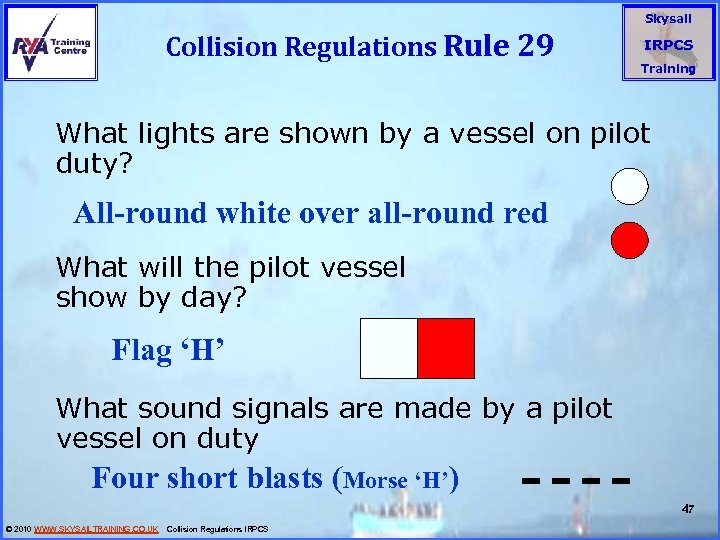
Collision Regulations Rule 29 Skysail IRPCS Training What lights are shown by a vessel on pilot duty? All-round white over all-round red What will the pilot vessel show by day? Flag ‘H’ What sound signals are made by a pilot vessel on duty Four short blasts (Morse ‘H’) 47 © 2010 WWW. SKYSAILTRAINING. CO. UK Collision Regulations IRPCS
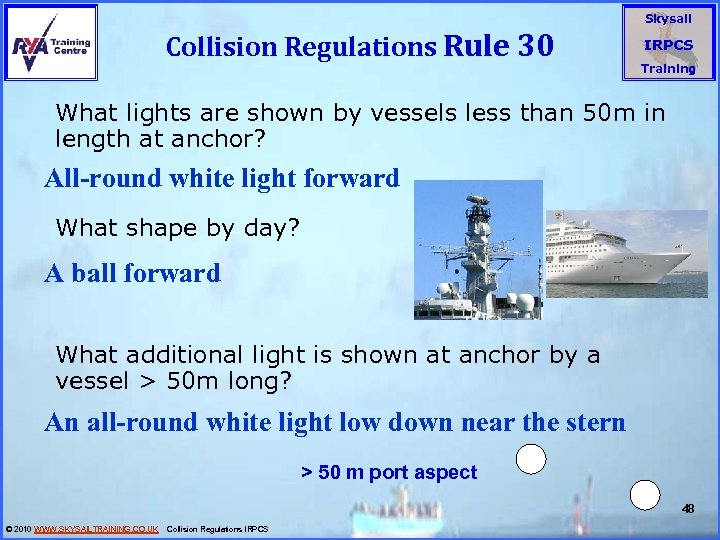
Collision Regulations Rule 30 Skysail IRPCS Training What lights are shown by vessels less than 50 m in length at anchor? All-round white light forward What shape by day? A ball forward What additional light is shown at anchor by a vessel > 50 m long? An all-round white light low down near the stern > 50 m port aspect 48 © 2010 WWW. SKYSAILTRAINING. CO. UK Collision Regulations IRPCS
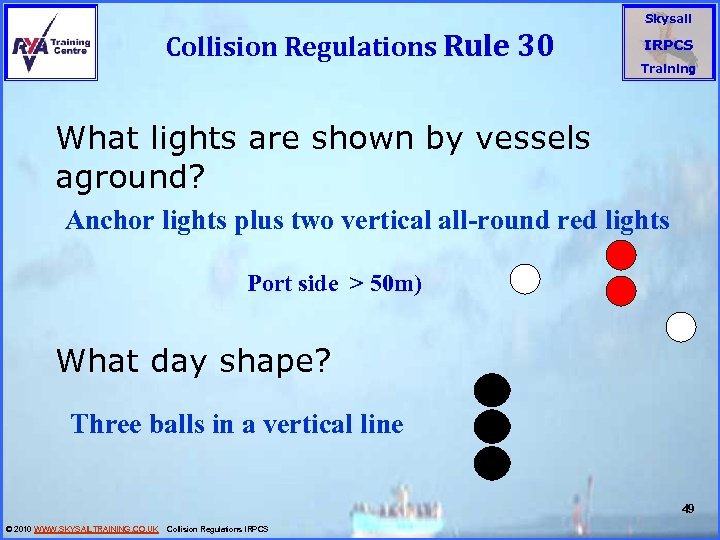
Collision Regulations Rule 30 Skysail IRPCS Training What lights are shown by vessels aground? Anchor lights plus two vertical all-round red lights Port side > 50 m) What day shape? Three balls in a vertical line 49 © 2010 WWW. SKYSAILTRAINING. CO. UK Collision Regulations IRPCS
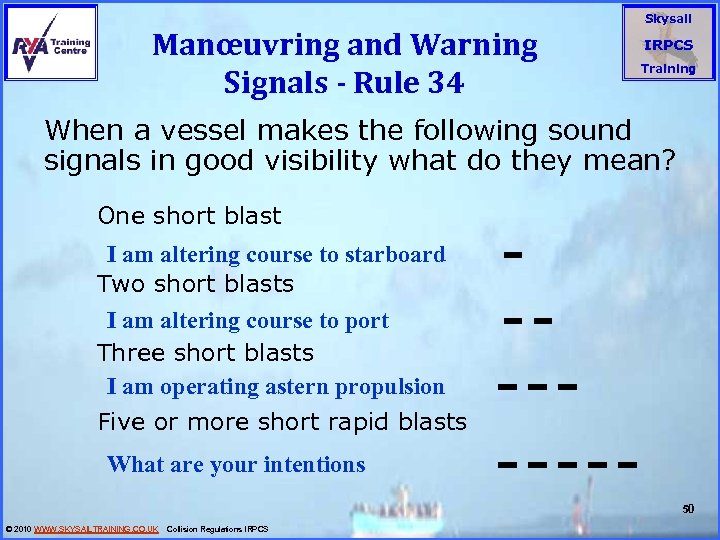
Manœuvring and Warning Signals - Rule 34 Skysail IRPCS Training When a vessel makes the following sound signals in good visibility what do they mean? One short blast I am altering course to starboard Two short blasts I am altering course to port Three short blasts I am operating astern propulsion Five or more short rapid blasts What are your intentions 50 © 2010 WWW. SKYSAILTRAINING. CO. UK Collision Regulations IRPCS
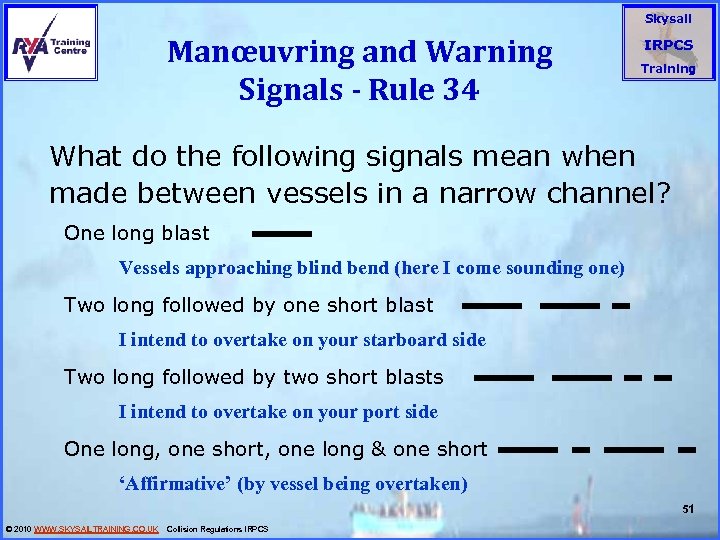
Skysail Manœuvring and Warning Signals - Rule 34 IRPCS Training What do the following signals mean when made between vessels in a narrow channel? One long blast Vessels approaching blind bend (here I come sounding one) Two long followed by one short blast I intend to overtake on your starboard side Two long followed by two short blasts I intend to overtake on your port side One long, one short, one long & one short ‘Affirmative’ (by vessel being overtaken) 51 © 2010 WWW. SKYSAILTRAINING. CO. UK Collision Regulations IRPCS
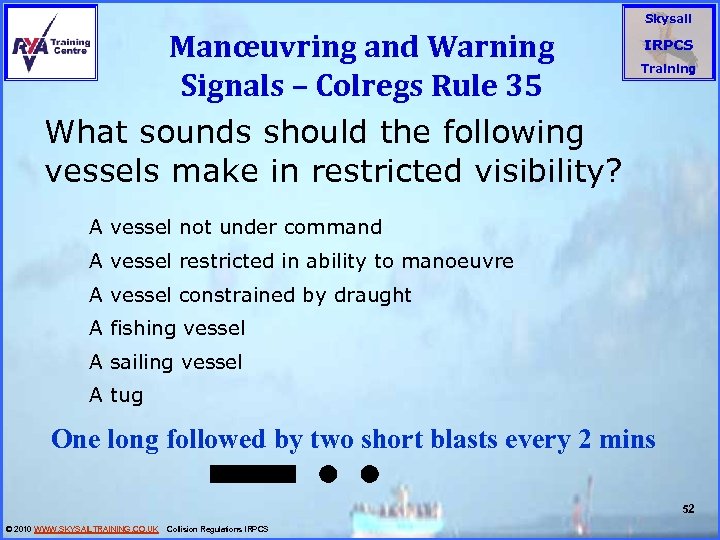
Skysail Manœuvring and Warning Signals – Colregs Rule 35 What sounds should the following vessels make in restricted visibility? IRPCS Training A vessel not under command A vessel restricted in ability to manoeuvre A vessel constrained by draught A fishing vessel A sailing vessel A tug One long followed by two short blasts every 2 mins 52 © 2010 WWW. SKYSAILTRAINING. CO. UK Collision Regulations IRPCS
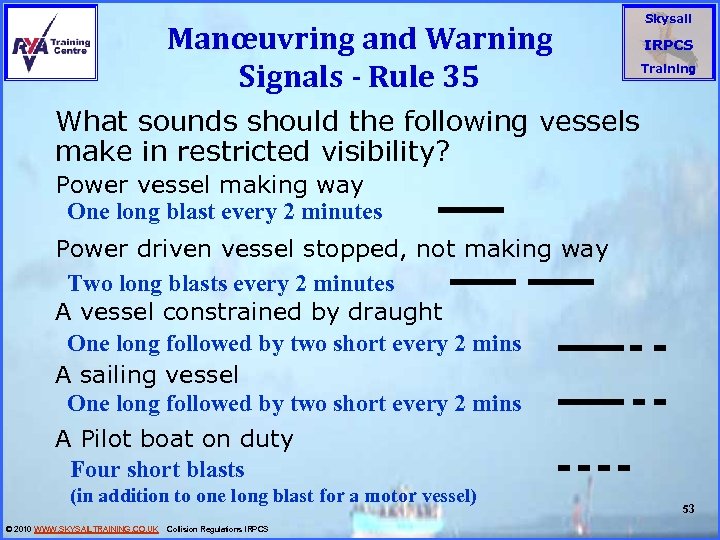
Manœuvring and Warning Signals - Rule 35 Skysail IRPCS Training What sounds should the following vessels make in restricted visibility? Power vessel making way One long blast every 2 minutes Power driven vessel stopped, not making way Two long blasts every 2 minutes A vessel constrained by draught One long followed by two short every 2 mins A sailing vessel One long followed by two short every 2 mins A Pilot boat on duty Four short blasts (in addition to one long blast for a motor vessel) © 2010 WWW. SKYSAILTRAINING. CO. UK Collision Regulations IRPCS 53
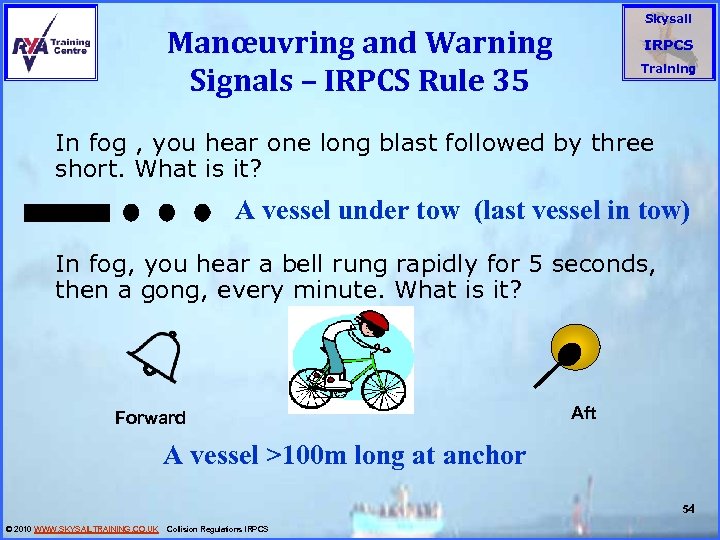
Skysail Manœuvring and Warning Signals – IRPCS Rule 35 IRPCS Training In fog , you hear one long blast followed by three short. What is it? A vessel under tow (last vessel in tow) In fog, you hear a bell rung rapidly for 5 seconds, then a gong, every minute. What is it? Forward Aft A vessel >100 m long at anchor 54 © 2010 WWW. SKYSAILTRAINING. CO. UK Collision Regulations IRPCS
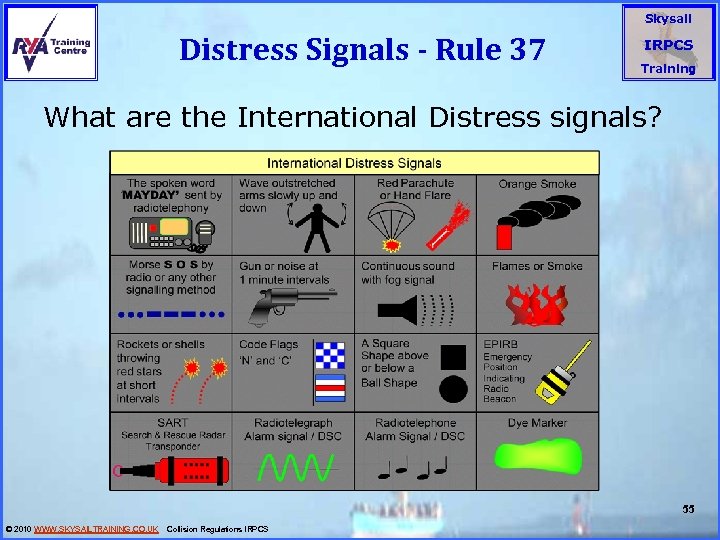
Skysail Distress Signals - Rule 37 IRPCS Training What are the International Distress signals? 55 © 2010 WWW. SKYSAILTRAINING. CO. UK Collision Regulations IRPCS
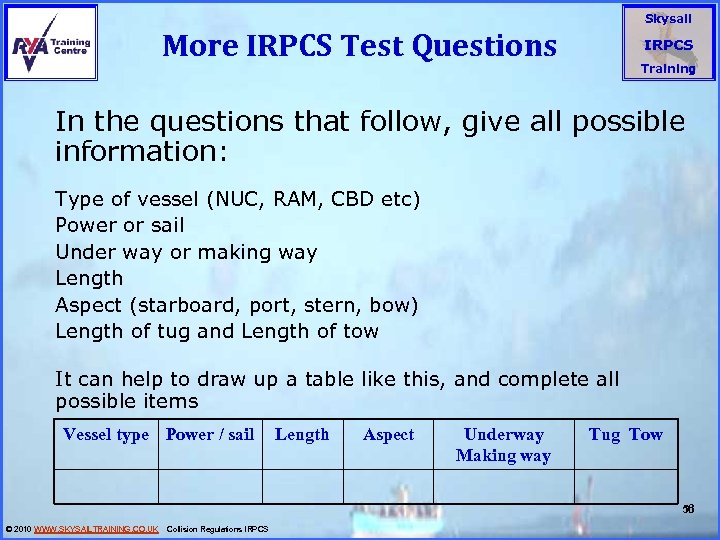
Skysail More IRPCS Test Questions IRPCS Training In the questions that follow, give all possible information: Type of vessel (NUC, RAM, CBD etc) Power or sail Under way or making way Length Aspect (starboard, port, stern, bow) Length of tug and Length of tow It can help to draw up a table like this, and complete all possible items Vessel type Power / sail Length Aspect Underway Making way Tug Tow 56 © 2010 WWW. SKYSAILTRAINING. CO. UK Collision Regulations IRPCS
More IRPCS Test Questions Skysail IRPCS Training You see a single white light. What is it? (3 answers) 1. The stern light of another boat 2. An anchor light 3. A light shown by a vessel < 7 m and < 7 knots eg a small motor boat or dinghy with a torch 57 © 2010 WWW. SKYSAILTRAINING. CO. UK Collision Regulations IRPCS
More IRPCS Test Questions Skysail IRPCS Training When does a sailing vessel on starboard tack give way to another vessel? 1. When it is overtaking boat 2. When it is to windward of another boat on starboard tack 3. When it meets another vessel which is NUC, RAM, CBD, Fishing. 4. When it meets a motor vessel which can only navigate within a narrow channel, or in a Traffic Separation Scheme. 58 © 2010 WWW. SKYSAILTRAINING. CO. UK Collision Regulations IRPCS
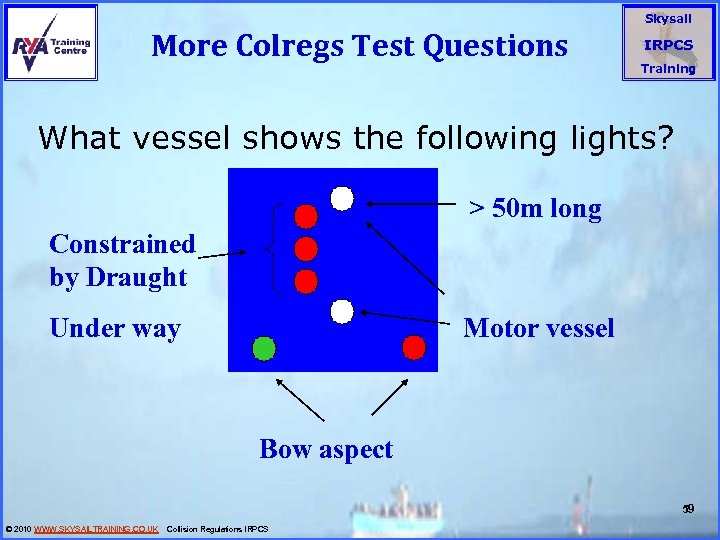
More Colregs Test Questions Skysail IRPCS Training What vessel shows the following lights? > 50 m long Constrained by Draught Motor vessel Under way Bow aspect 59 © 2010 WWW. SKYSAILTRAINING. CO. UK Collision Regulations IRPCS
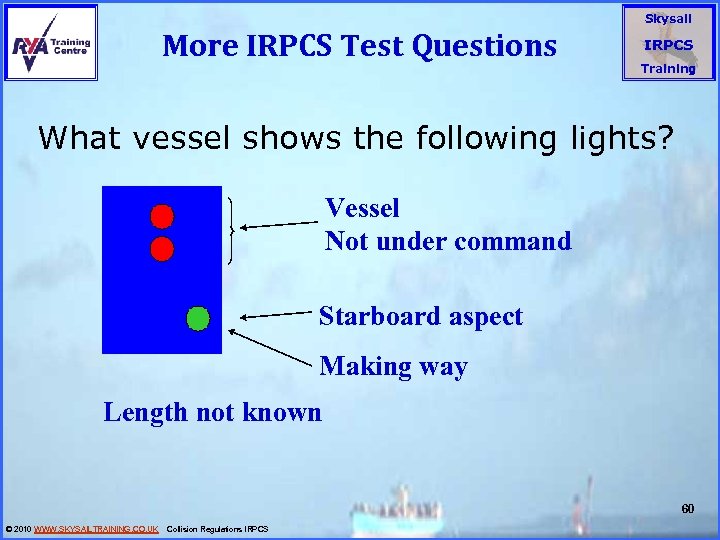
More IRPCS Test Questions Skysail IRPCS Training What vessel shows the following lights? Vessel Not under command Starboard aspect Making way Length not known 60 © 2010 WWW. SKYSAILTRAINING. CO. UK Collision Regulations IRPCS
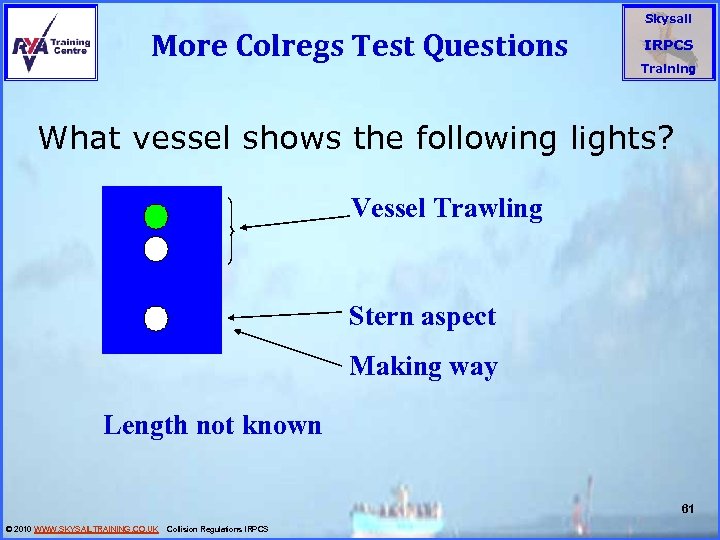
More Colregs Test Questions Skysail IRPCS Training What vessel shows the following lights? Vessel Trawling Stern aspect Making way Length not known 61 © 2010 WWW. SKYSAILTRAINING. CO. UK Collision Regulations IRPCS
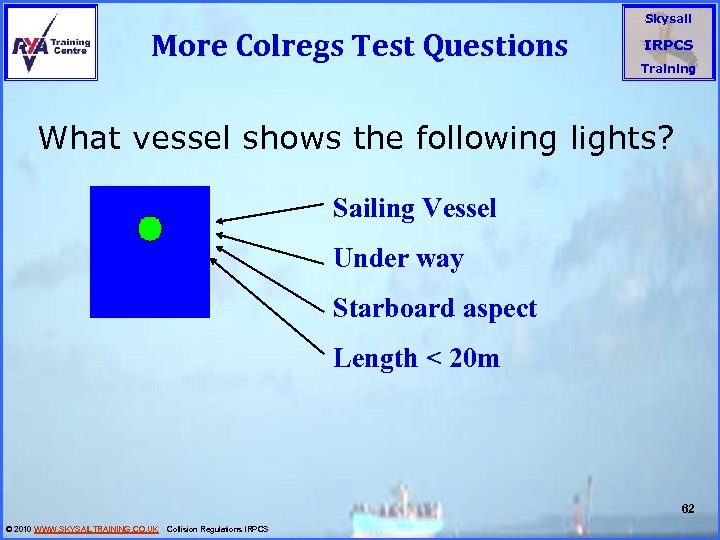
More Colregs Test Questions Skysail IRPCS Training What vessel shows the following lights? Sailing Vessel Under way Starboard aspect Length < 20 m 62 © 2010 WWW. SKYSAILTRAINING. CO. UK Collision Regulations IRPCS
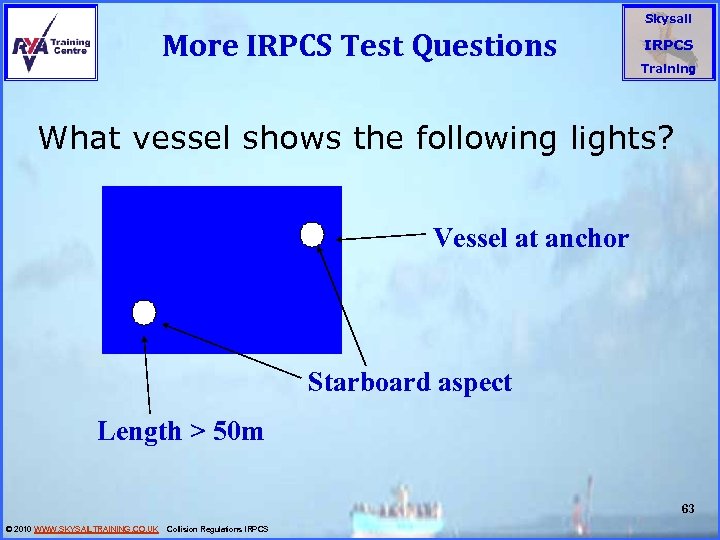
More IRPCS Test Questions Skysail IRPCS Training What vessel shows the following lights? Vessel at anchor Starboard aspect Length > 50 m 63 © 2010 WWW. SKYSAILTRAINING. CO. UK Collision Regulations IRPCS
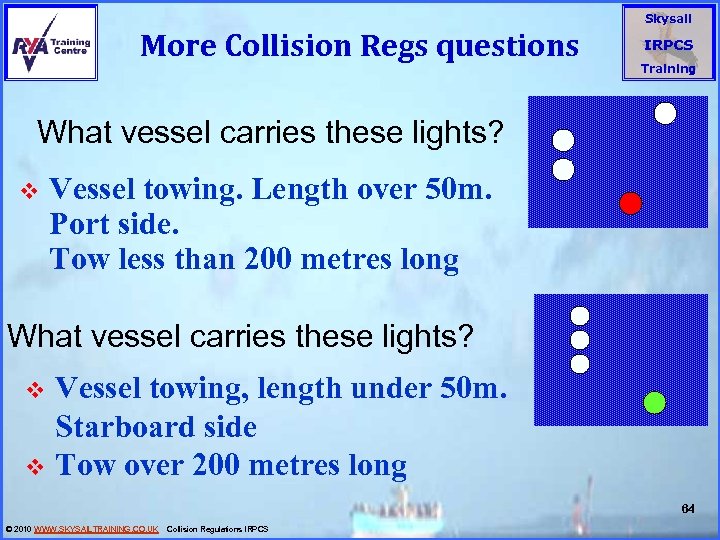
More Collision Regs questions Skysail IRPCS Training What vessel carries these lights? v Vessel towing. Length over 50 m. Port side. Tow less than 200 metres long What vessel carries these lights? v v Vessel towing, length under 50 m. Starboard side Tow over 200 metres long 64 © 2010 WWW. SKYSAILTRAINING. CO. UK Collision Regulations IRPCS
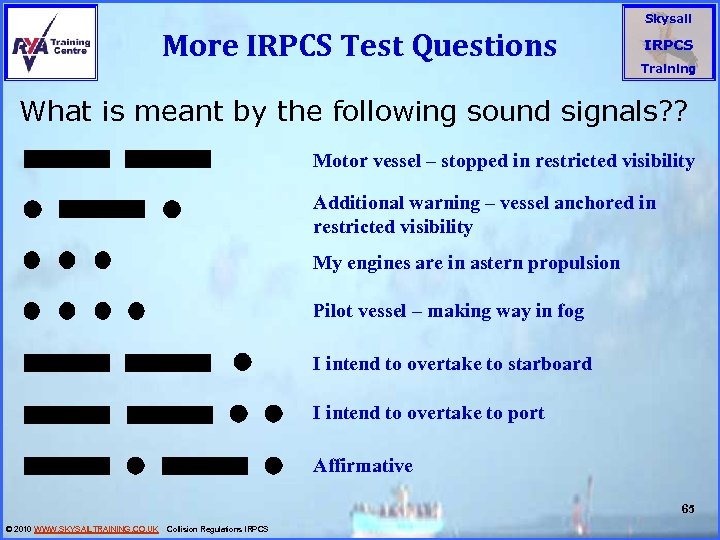
More IRPCS Test Questions Skysail IRPCS Training What is meant by the following sound signals? ? Motor vessel – stopped in restricted visibility Additional warning – vessel anchored in restricted visibility My engines are in astern propulsion Pilot vessel – making way in fog I intend to overtake to starboard I intend to overtake to port Affirmative 65 © 2010 WWW. SKYSAILTRAINING. CO. UK Collision Regulations IRPCS
Skysail IRPCS Training Colregs, IRPCS International Regulations for Preventing Collisions at Sea www. skysailtraining. co. uk 66 © 2010 WWW. SKYSAILTRAINING. CO. UK Collision Regulations IRPCS
Скачать презентацию Feedback is welcome click on www skysailtraining co
a2643d37ab4df65d268f52afa2742db6.ppt