


 Скачать презентацию Feed Efficiency of Pastured Poultry Systems Michael Seipel
f25002cd11f59ec743cd43b13467a213.ppt
- Количество слайдов: 18
 Feed Efficiency of Pastured Poultry Systems Michael Seipel, Joy Chisholm, Catherine Zivnuska, (Truman State University, Kirksville, Missouri) And David Trott (University of Wisconsin-Madison)
 What is Pastured Poultry? n n Pastured poultry: used to describe a variety of production systems in which the birds (chickens, turkeys, etc. ) have access to forage Salatin pen: an open-bottomed pen, moved daily to fresh pasture Day-range system: semi-permanent shelter with a large yard enclosed with electric netting, inside which the chickens forage Other systems: yarding, modified free-range, chicken tractor
 Growing Interest in Pastured Poultry n Interest from both farmers and consumers in alternative production and marketing systems n n n Reduced feed costs due to foraging (? ) n n n Low-input approach to poultry production Offers ecological, agronomic (fertilizer), and health benefits Poultry producer Joel Salatin: broilers raised on pasture consume 30% less feed than broilers raised on free choice feed alone Yet, there has been little interest from poultry scientists in researching pasture production systems There is a need for both on-farm and universitysponsored research to provide information to improve pasture production operations
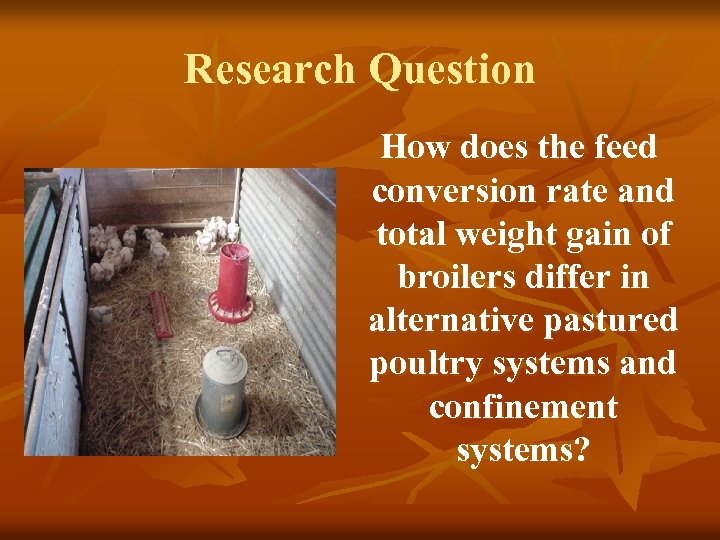 Research Question How does the feed conversion rate and total weight gain of broilers differ in alternative pastured poultry systems and confinement systems?
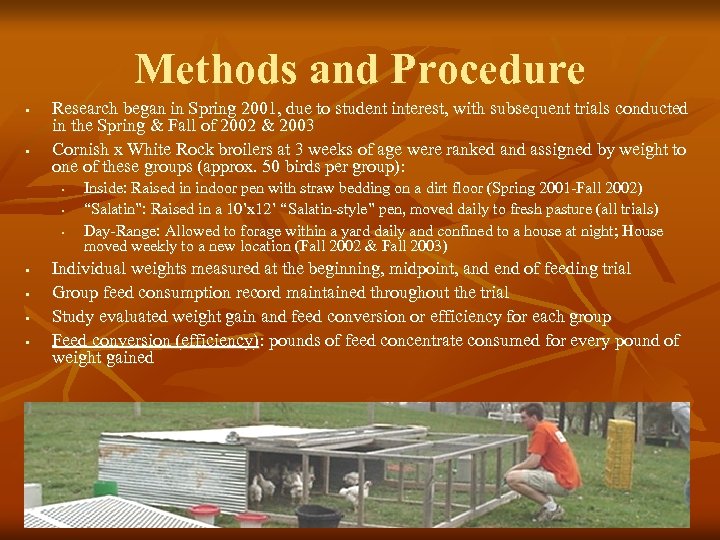 Methods and Procedure § § Research began in Spring 2001, due to student interest, with subsequent trials conducted in the Spring & Fall of 2002 & 2003 Cornish x White Rock broilers at 3 weeks of age were ranked and assigned by weight to one of these groups (approx. 50 birds per group): • • • § § Inside: Raised in indoor pen with straw bedding on a dirt floor (Spring 2001 -Fall 2002) “Salatin”: Raised in a 10’x 12’ “Salatin-style” pen, moved daily to fresh pasture (all trials) Day-Range: Allowed to forage within a yard daily and confined to a house at night; House moved weekly to a new location (Fall 2002 & Fall 2003) Individual weights measured at the beginning, midpoint, and end of feeding trial Group feed consumption record maintained throughout the trial Study evaluated weight gain and feed conversion or efficiency for each group Feed conversion (efficiency): pounds of feed concentrate consumed for every pound of weight gained
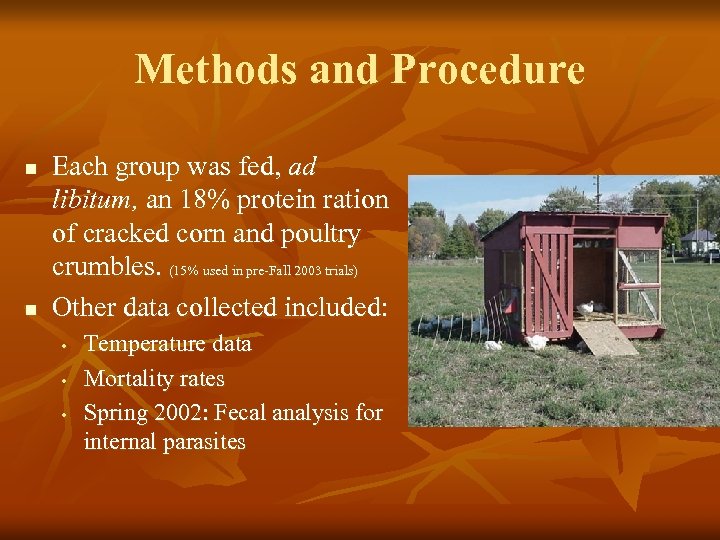 Methods and Procedure n n Each group was fed, ad libitum, an 18% protein ration of cracked corn and poultry crumbles. (15% used in pre-Fall 2003 trials) Other data collected included: • • • Temperature data Mortality rates Spring 2002: Fecal analysis for internal parasites
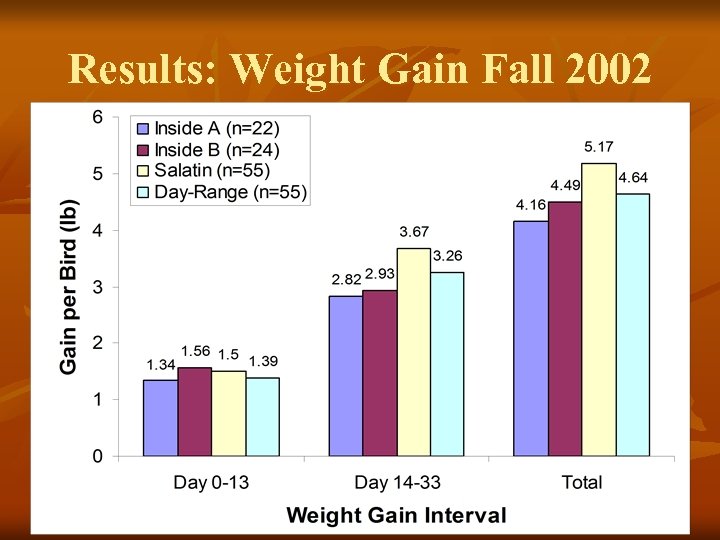 Results: Weight Gain Fall 2002
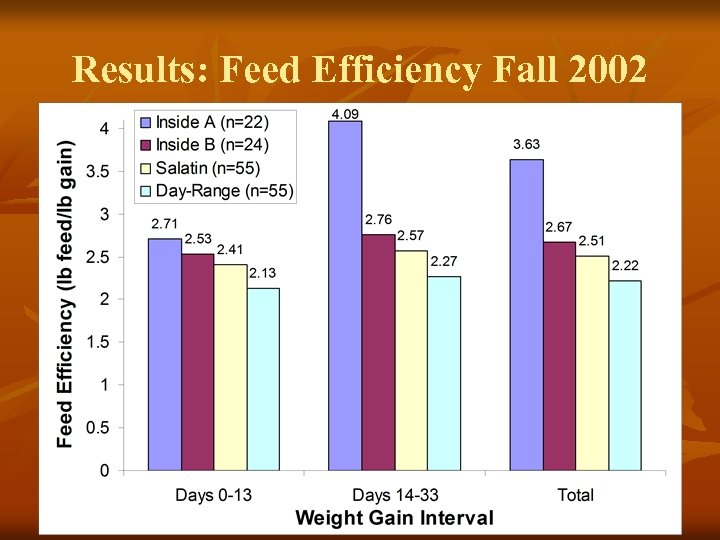 Results: Feed Efficiency Fall 2002
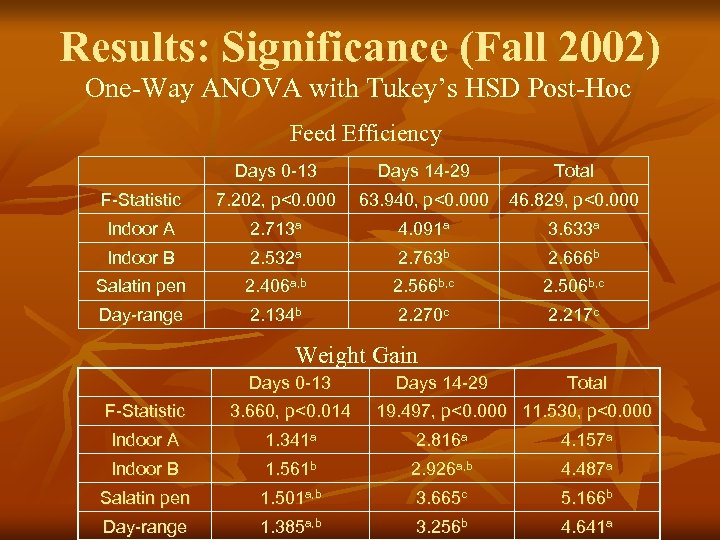 Results: Significance (Fall 2002) One-Way ANOVA with Tukey’s HSD Post-Hoc Feed Efficiency Days 0 -13 Days 14 -29 Total F-Statistic 7. 202, p<0. 000 63. 940, p<0. 000 46. 829, p<0. 000 Indoor A 2. 713 a 4. 091 a 3. 633 a Indoor B 2. 532 a 2. 763 b 2. 666 b Salatin pen 2. 406 a, b 2. 566 b, c 2. 506 b, c Day-range 2. 134 b 2. 270 c 2. 217 c Weight Gain Days 0 -13 Days 14 -29 Total F-Statistic 3. 660, p<0. 014 19. 497, p<0. 000 11. 530, p<0. 000 Indoor A 1. 341 a 2. 816 a 4. 157 a Indoor B 1. 561 b 2. 926 a, b 4. 487 a Salatin pen 1. 501 a, b 3. 665 c 5. 166 b Day-range 1. 385 a, b 3. 256 b 4. 641 a
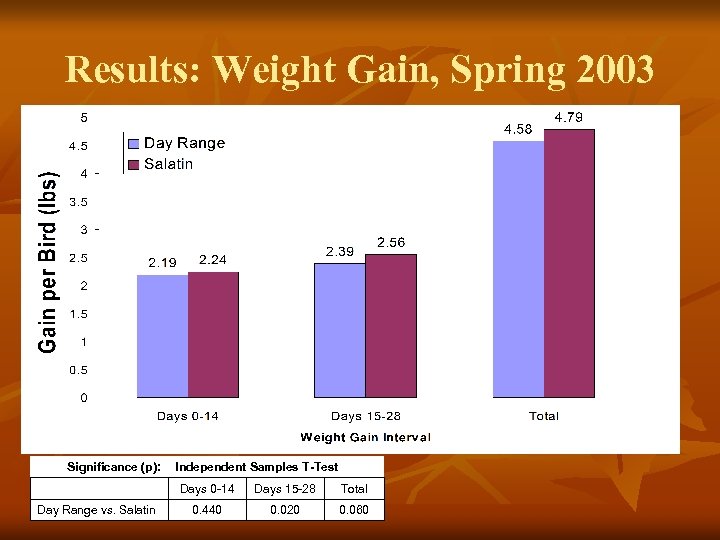 Results: Weight Gain, Spring 2003 Significance (p): Day Range vs. Salatin Independent Samples T-Test Days 0 -14 Days 15 -28 Total 0. 440 0. 020 0. 060
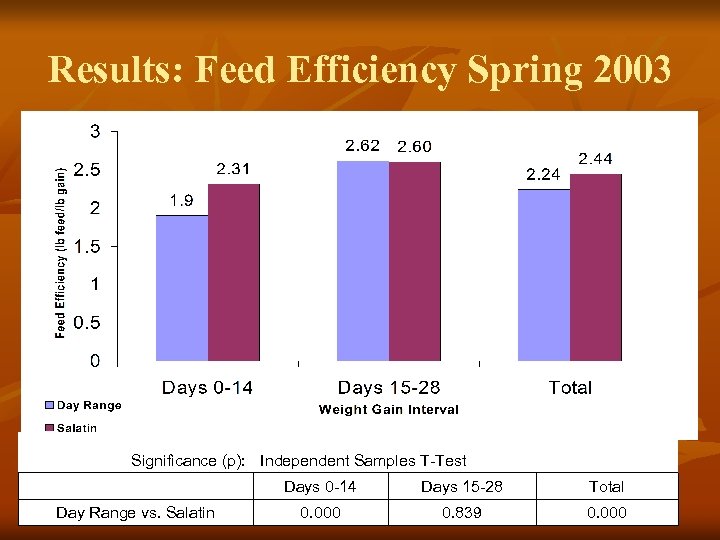 Results: Feed Efficiency Spring 2003 Significance (p): Independent Samples T-Test Days 0 -14 Days 15 -28 Total Day Range vs. Salatin 0. 000 0. 839 0. 000
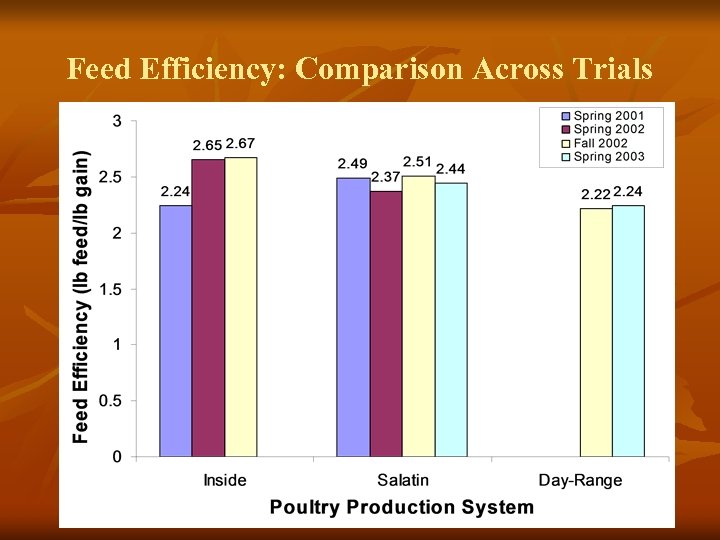 Feed Efficiency: Comparison Across Trials
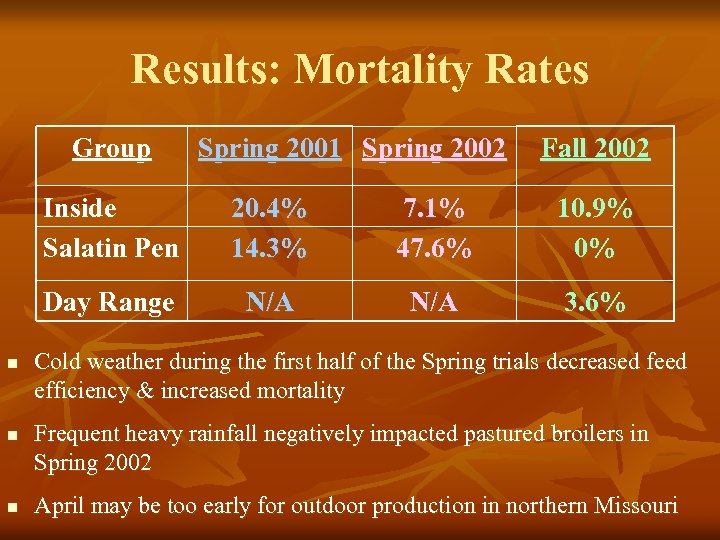 Results: Mortality Rates Group Spring 2001 Spring 2002 Fall 2002 Inside Salatin Pen n n 7. 1% 47. 6% 10. 9% 0% Day Range n 20. 4% 14. 3% N/A 3. 6% Cold weather during the first half of the Spring trials decreased feed efficiency & increased mortality Frequent heavy rainfall negatively impacted pastured broilers in Spring 2002 April may be too early for outdoor production in northern Missouri
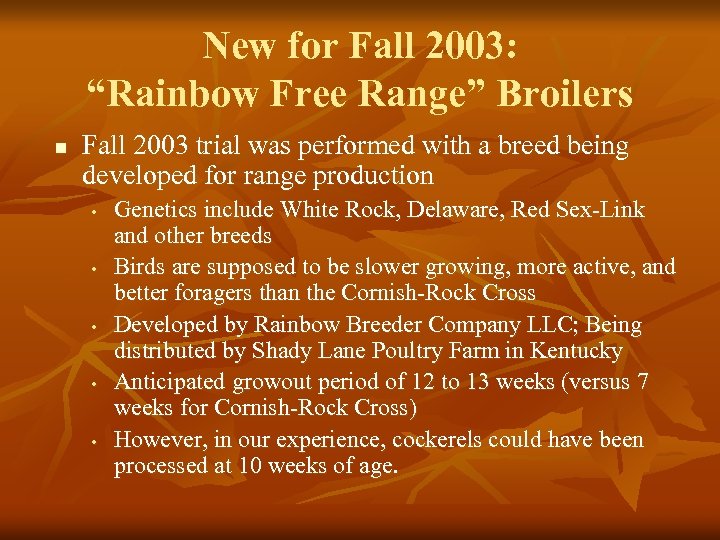 New for Fall 2003: “Rainbow Free Range” Broilers n Fall 2003 trial was performed with a breed being developed for range production • • • Genetics include White Rock, Delaware, Red Sex-Link and other breeds Birds are supposed to be slower growing, more active, and better foragers than the Cornish-Rock Cross Developed by Rainbow Breeder Company LLC; Being distributed by Shady Lane Poultry Farm in Kentucky Anticipated growout period of 12 to 13 weeks (versus 7 weeks for Cornish-Rock Cross) However, in our experience, cockerels could have been processed at 10 weeks of age.
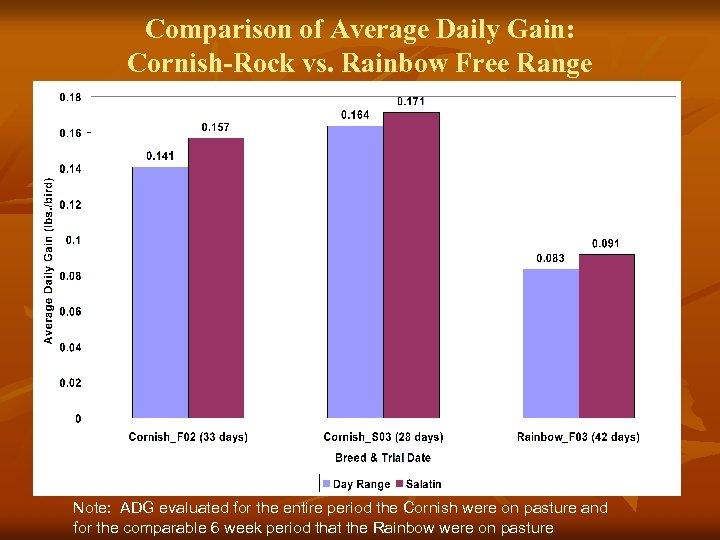 Comparison of Average Daily Gain: Cornish-Rock vs. Rainbow Free Range Note: ADG evaluated for the entire period the Cornish were on pasture and for the comparable 6 week period that the Rainbow were on pasture
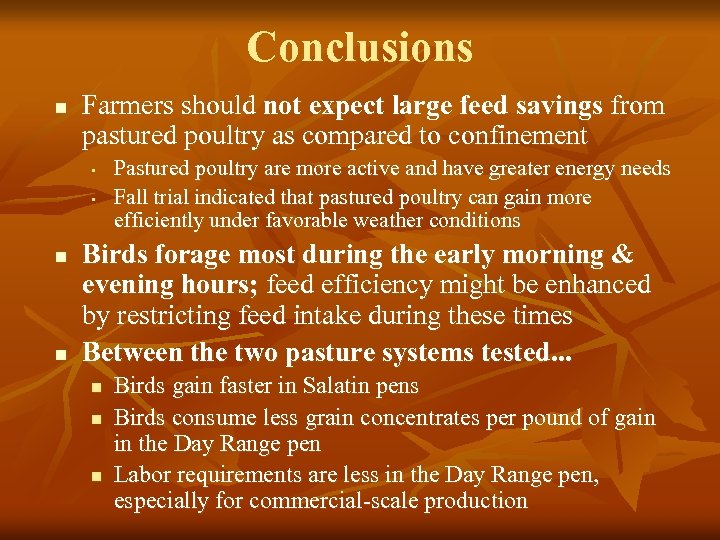 Conclusions n Farmers should not expect large feed savings from pastured poultry as compared to confinement • • n n Pastured poultry are more active and have greater energy needs Fall trial indicated that pastured poultry can gain more efficiently under favorable weather conditions Birds forage most during the early morning & evening hours; feed efficiency might be enhanced by restricting feed intake during these times Between the two pasture systems tested. . . n n n Birds gain faster in Salatin pens Birds consume less grain concentrates per pound of gain in the Day Range pen Labor requirements are less in the Day Range pen, especially for commercial-scale production
 Conclusions n Rainbow Free Range and other broilers bred for pasture production may eventually provide a preferable alternative to the Cornish-Rock cross. Currently. . . n n Rainbow Free Range are more aggressive foragers and generally more active in range conditions, but gain more slowly than Cornish Mortality rates can have a much larger impact on profitability than feed conversion Marketing and processing are more pressing concerns for most small-scale producers Environmental benefits and consumer appeal of pastured poultry offer marketing advantages that should outweigh any increased feed cost
 But marketing is not without its own challenges. . . Acknowledgements n n n Truman State University, Science Division Joy Chisholm, David Trott, Jeff Cox, Catherine Zivnuska, Justin Kelley Dr. Susan Guffey