


 Скачать презентацию FEED 260 261 Mentoring Through the New Testament Introduction
82790e301186fdc8f07e46a54cd73dff.ppt
- Количество слайдов: 44
 FEED 260/261 Mentoring Through the New Testament Introduction to the New Testament & the Synoptic Gospels (Matthew to Luke) Session #1 C Introduction to the Gospels
 § § § John Luke Mark NIV Study Bible, 1471 Matthew The Gospels “Gospel" comes from the Old English "God-spell. “ It translates the Greek word for "good news. " In antiquity king's heralds announced "glad tidings" of the king's birthday throughout the cities of the realm. It has the same meaning in our New Testament. The four Gospels announce the glad tidings about Jesus. The ancient world knew of history, poetry, prophecy and letters. But a "gospel" was new to them. Here, inspired writers gave more than just history. They also created faith (John 20: 30 -31) by proclaiming the good news that, just as the OT had promised, God had sent His Messiah to the world.
 Uniqueness of the Gospels l Jesus did not write the Gospels. l l l (Had He written, it would be something more like the Prophetic Books, such as Amos—a collection of spoken oracles and sayings , plus a few personal narratives (Amos 7: 10 -17)) Thus, they are not books by Jesus but books about Jesus’ native tongue was Aramaic but the Gospels come to us only in Greek! l Aramaic only appears once, in Christ’s cry from the cross.
 Uniqueness of the Gospels l It comprises of l l Sayings (Teachings of Jesus) Narratives (Life of Jesus) (In comparison, we know of Paul’s teaching from his epistles and his life from Acts. ) Common repeated themes in the gospels: l Jesus’ popularity with the masses. l Jesus’ discipleship to a few. l Jesus’ opposition from the authorities.
 Uniqueness of the Gospels l Merging of 2 ancient genres Jewish telling of Israel’s story l Greco-Roman form of biographies. l Jewish: Israel’s Story l The climax of Israel’s history and covenantal hopes converging in the person of Jesus. l
 Uniqueness of the Gospels l Jesus represents The new Israel and the new exodus in Mark. l The new David in Luke. l The new Moses & Torah in Matthew. l The new temple in John. l
 Uniqueness of the Gospels l Greco-Roman: Ancient Biographies The life of an individual is narrated in a selective, ideological and artistic way. l It is usually not a complete biography. l Neither does it offer a ‘neutral’ or objective reporting of historical events. l
 Uniqueness of the Gospels l There are 4 gospels l 3 of which are remarkably similar! l SYNOPTIC: common-view l None of the 4 Gospels supersedes the other: each stand equally valuable and equally authoritative. They all contain: l l Facts on the historical Jesus. Unique setting and existential concern of why they are retelling the story: l Different target audience who are not culturally and historically close to Jesus.
 Uniqueness of the Gospels l While it is important to try to get a full view of Jesus by combining all 4 Gospels, we need to recognize that each Gospel in its present form is God’s Word for us. Our reconstructions of Jesus’ life are not! l l The evangelists are authors , not compilers! The eschatological mindset during Jesus’ time.
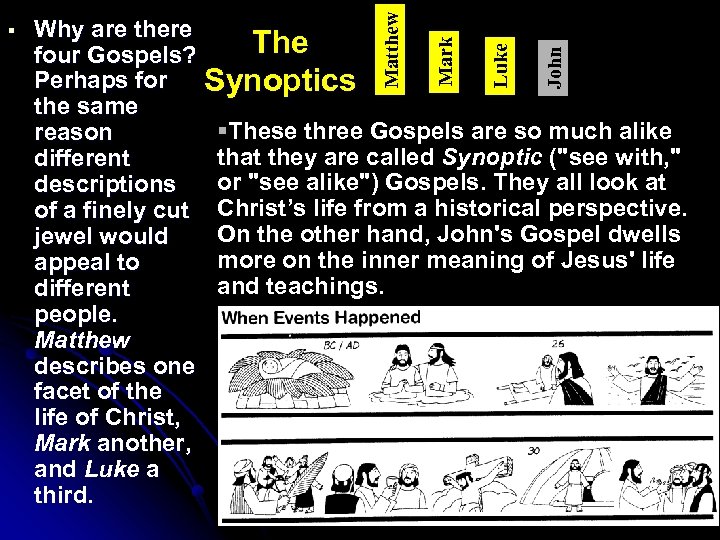 Matthew John Luke Why are there The four Gospels? Perhaps for Synoptics the same §These three Gospels are so much alike reason that they are called Synoptic ("see with, " different descriptions or "see alike") Gospels. They all look at of a finely cut Christ’s life from a historical perspective. On the other hand, John's Gospel dwells jewel would more on the inner meaning of Jesus' life appeal to and teachings. different people. Matthew describes one facet of the life of Christ, Mark another, and Luke a third. Mark §
 Synoptic Similarities l l Matthew, Mark and Luke are noticeably similar, while John is quite different. How do the first three Gospels agree? l l The math facts: l l l Language Material they include General order of the events and sayings from the life of Christ 91 percent of Mark is found in Matthew 53 percent of Mark is found in Luke Such agreement raises questions as to the origin of the Synoptic Gospels. Did the authors rely on a common source? Were they interdependent?
 The New Testament SOUNDING THAT STRANGE Comes Together WORD… SYNOPTIC: 2 1 MATTHEW JEWS SAID O YN PT SERVANT ” AS: WHAT HE: ER C: I S DID “TO GREEKS SEE GOD/MAN TOGETHER” FELT TO: AS: WHAT HE: “T O LUKE SE E 3 © 2006 TBBMI KING ROMANS ET H AS: WHAT HE: TO G TO: MARK John Fryman, “The Bible…Basically” Seminar 9. 65. 08. 20 3
 The New Testament FRAMING THE Comes Together GOSPELS… 1 MATTHEW 2 MARK 3 4 JOHN © 2006 TBBMI LUKE 9. 65. 08. 16 3
 The New Testament THE AUDIENCES FOR Comes Together 1 MATTHEW TO: 3 TO: © 2006 TBBMI JEWS LUKE GREEKS THE GOSPELS… 2 MARK TO: 4 TO: ROMANS JOHN CHURCH 9. 65. 08. 17 4
 The New Testament …PORTRAYING Comes Together 1 MATTHEW TO: AS: 3 JEWS KING LUKE JESUS AS… 2 MARK TO: ROMANS AS: SERVANT 4 JOHN TO: CHURCH AS: © 2006 TBBMI GREEKS GOD/MAN AS: GOD 9. 65. 08. 18 4
 The New Testament IN THE MESSAGE Comes Together 1 MATTHEW TO: JEWS 2 MARK WHAT HE: TO: ROMANS KING AS: 3 A NUTSHELL… AS: SERVANT SAID WHAT HE: DID LUKE 4 JOHN TO: GREEKS TO: CHURCH AS: GOD/MAN AS: GOD FELT WHAT HE: MEANT WHAT HE: © 2006 TBBMI 9. 65. 08. 19 5
 The New Testament “TO THE SYNOPTICS: Comes Together 1 MATTHEW SEE TOGETHER” 2 MARK TO: JEWS TO: ROMANS AS: WHAT HE: KING AS: WHAT HE: SERVANT 3 SAID LUKE 4 DID ∑ JOHN TO: CHURCH TO: AS: WHAT HE: © 2006 TBBMI GREEKS GOD/MAN AS: WHAT HE: FELT GOD MEANT 9. 65. 08. 21 1
 The New Testament MATERIAL… UNIQUE Comes Together 1 MATTHEW Baptism Lord's Birth Supper Genealogy 3 LUKE 2 4 MARK 7% unique! 5000 fed Passion JOHN 92% unique! © 2006 TBBMI 9. 65. 08. 16
 The Synoptic Problem Matthew, Mark & Luke in a nutshell: l How do we explain their similarities? How do we explain their l How do we explain their differences? How do we explain their
 51 661 Mark Marcan Priority Diagrammed 1068 333 M 1149 500 350 Matthew 235 Q Luke 564 L Numbers indicate the verses in each proposed source
 Dating the Synoptic Gospels Adapted from the NIV Study Bible, 1431 MARK MATTHEW LUKE ASSUMPTION A: Matthew and Luke used Mark as a source ASSUMPTION B: Matthew and Luke did not use Mark as a source View #1 Mark written in the 50 s or early 60 s (1) Matthew written in late 50 s or the 60 s View #1 Mark could have been written anytime between 50 and 70 (2) Luke written 59 -63 View #2 Mark written 65 -70 (1) Matthew written early 50 s (see Matthew notes) (1) Matthew written in the 70 s (2) Luke written 59 -63 (see Luke notes) (2) Luke written in the 70 s Taught in this class
 Solutions to the Synoptic Problem 1. 2. 3. 4. Questions like these constitute what is known as the Synoptic Problem. Several solutions have been advanced: The use of oral tradition. Some have thought that tradition had become so stereotyped that it provided a common source from which all the Gospel writers drew. The use of an early Gospel. Some have postulated that the Synoptic authors all had access to an earlier Gospel, now lost. The use of written fragments. Some have assumed that written fragments had been composed concerning various events from the life of Christ and that these were used by the Synoptic authors. Mutual dependence. Some have suggested that the Synoptic writers drew from each other with the result that what they wrote was often very similar. NIV Study Bible, 1431
 Solutions to the Synoptic Problem 4. 5. 6. The use of two major sources. The most common view currently is that Mark and a hypothetical document, called Quelle (German for "source") or Q, were used by Matthew and Luke as sources for most of the materials included in their Gospels. The priority and use of Matthew. Another view suggests that the other two Synoptics drew from Matthew as their main source. A combination of most of the above. This theory assumes that the authors of the Synoptic Gospels made use of oral tradition, written fragments, mutual dependence on other Synoptic writers or on their Gospels, and the testimony of eyewitnesses. NIV Study Bible, 1431
 Two-Source Hypothesis Q AD 50 Mark AD 65 Matthew Luke
 Four-Source Hypothesis M Jerusalem AD 60 -65 Mark Rome AD 65 Q Antioch AD 50 L Caesarea Proto-Luke Matthew Antioch AD 85 Antiochene Tradition Luke Caesarea, Corinth? AD 60, AD 80 Source of Luke 1 -2
 Date Options for John’s Gospel 70 Temple Destroyed 95 John's Death Sec ond Ce ntu Lat e F ir st C e 70 AD ore Bef 33 Christ's Death ry Authorship is easier to determine than when John wrote. Three periods have been proposed for the date of the Gospel:
 The Four Gospels Compared Matthew Mark Luke John Author Matthew Mark Luke John Job before Saved Tax Collector None (Youth) Medical Doctor Fisherman Race Jew Gentile Jew Apostle Service or Pastoring Service or Teaching Apostle Roman Gentile (Greek) World Wisdom (1 Cor. 1: 22) Office and / or Spiritual Gift Readers Ethnically Jewish Interest Signs (1 Cor. 1: 22) Spiritually Unbelievers Believers Unbelievers Model in Universality
 The Four Gospels Compared Matthew Mark Luke John Date Written 40 s 64 -68 57 -59 late 60 s Place Written Antioch or Syria Rome Caesarea or Rome Ephesus Asia, etc. Place Sent Palestine Rome To Theophilus Jesus is… King of Israel (Messiah) Suffering Servant (Deity) Ideal Man (Messiah) Son of God (Deity) Key Verse 21: 5 10: 45 19: 10 20: 31 Themes Law Power Grace Glory Literary Emphasis Sermons Miracles Parables Allegories Arrangeme Topical Chronologic Topical
 The Four Gospels Compared Matthew Scope Mark Luke John Birth to Ministry to Resurrection Tone Prophetic Pastoral Historical Spiritual Christ's Words 60% 42% 50% Chapters 28 16 24 21 Verses 1068 661 1149 878 Verses per Chap. 38 41 48 42 OT Quotations 53 36 25 20 OT Allusions 76 27 42 105 OT References 129 63 67 125
 Synoptic & Johannine Gospels Topics Synoptics John Portrait of Christ God – Man Perspective More Historical More Theological Unique Material Matthew – 42%; Mark – 7%; Luke – 59% 92% unique Geography Focus on Galilean ministry (North) Focus on Judean ministry (South) Teaching Method Parables Extended Discourse Chronology Mention of one Passover Mention of three (maybe four) Passovers Relation to other Gospels Complementary Supplementary
 How Well Do You Know the Life of Christ? How Well Do You Know the Life 4 Guest at Wedding Can you of Christ? number these events in chronological order? 6 Interview with Nicodemus 3 Enemy's 3 Temptations 7 Message on Mount 1 Birth in Bethlehem 5 Housecleaning the Temple (1 st time) 10 Washing Disciples' Feet 8 Parables of Kingdom 2 Carpenter in Nazareth 9 Tomb of Lazarus Terry Hall, Bible Panorama, 121

 A Definitive Work

 Chronology of the Life of Christ Harold Hoehner, Chronological Aspects of the Life of Christ
 Chronology of Jesus & Acts 4 BC 1 BC AD 1 Jesus’ – 1 year– Birth 14 29 Tiberius Crowned 15 th Yr. Tiberius – “In the 15 th year of Tiberius… John & John preached” (Luke 3: 1) Jesus 33 -34 years “Now Jesus himself was about 30 years old when he began his ministry” (Luke 3: 23) 30 33 35 Jesus’ Paul Death Believes
 Age of Jesus When He Began His Ministry 1 yr 28 / 29 years 3 yrs 4 BC 3 2 1 1 2 3 4 5 6 7 8 …………………………………… 26 27 28 29 AD 3 + 1 + 28 = 32 years (Non-inclusive of AD 29) 3 + 1 + 29 = 33 years (Inclusive of AD 29) Adapted from Michele Ang (NT Survey student, SBC, 2006)
 The Parables of Christ J. Dwight Pentecost, A Harmony of the Words and Works of Jesus Christ (Grand Rapids: Zondervan, 1981), 587 -88
 Miracles Of Jesus


 NEXT SESSION : 20 Feb 2016 (Sat) 8: 00 am to 12: 45 pm 2 A. Mark 2 B: . Matthew 2 C. Luke Assignments: 1. NT Reading: Matthew 26 to Luke 24 2. …Book By Book (BBB): Matthew-Luke (Page 269295) 3. …For All Its Worth (FAIW): Chapter 7 (Page 132 -153) 4. READING REPORT: #2