 Скачать презентацию ФЕДЕРАЛЬНОЕ АГЕНТСТВО ПО ОБРАЗОВАНИЮ Федеральное государственное образовательное учреждение
56846063fe29d894609575ba9193acd4.ppt
- Количество слайдов: 199



ФЕДЕРАЛЬНОЕ АГЕНТСТВО ПО ОБРАЗОВАНИЮ Федеральное государственное образовательное учреждение высшего профессионального образования Сибирский федеральный университет Красноярск, 2008
Т. Н. Ямских Р. А. Короленко Ю. В. Глущенко Профессиональный английский язык Красноярск, 2008
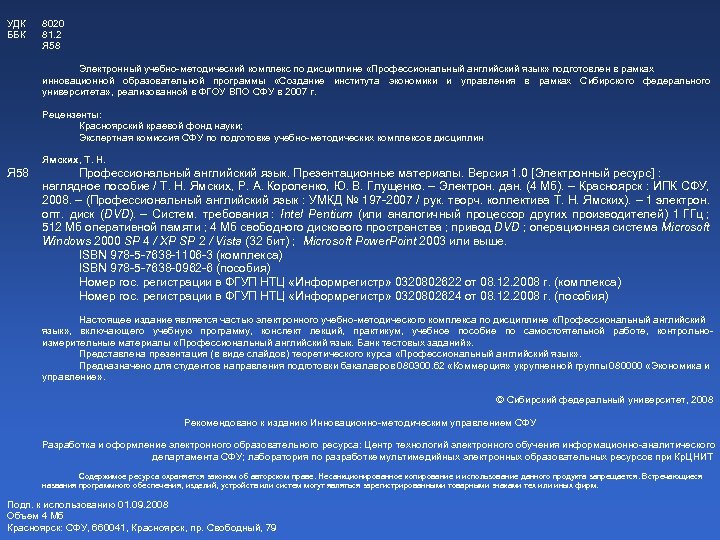
УДК ББК 8020 81. 2 Я 58 Электронный учебно методический комплекс по дисциплине «Профессиональный английский язык» подготовлен в рамках инновационной образовательной программы «Создание института экономики и управления в рамках Сибирского федерального университета» , реализованной в ФГОУ ВПО СФУ в 2007 г. Рецензенты: Красноярский краевой фонд науки; Экспертная комиссия СФУ по подготовке учебно методических комплексов дисциплин Ямских, Т. Н. Я 58 Профессиональный английский язык. Презентационные материалы. Версия 1. 0 [Электронный ресурс] : наглядное пособие / Т. Н. Ямских, Р. А. Короленко, Ю. В. Глущенко. – Электрон. дан. (4 Мб). – Красноярск : ИПК СФУ, 2008. – (Профессиональный английский язык : УМКД № 197 2007 / рук. творч. коллектива Т. Н. Ямских). – 1 электрон. опт. диск (DVD). – Систем. требования : Intel Pentium (или аналогичный процессор других производителей) 1 ГГц ; 512 Мб оперативной памяти ; 4 Мб свободного дискового пространства ; привод DVD ; операционная система Microsoft Windows 2000 SP 4 / XP SP 2 / Vista (32 бит) ; Microsoft Power. Point 2003 или выше. ISBN 978 5 7638 1106 3 (комплекса) ISBN 978 5 7638 0962 6 (пособия) Номер гос. регистрации в ФГУП НТЦ «Информрегистр» 0320802622 от 08. 12. 2008 г. (комплекса) Номер гос. регистрации в ФГУП НТЦ «Информрегистр» 0320802624 от 08. 12. 2008 г. (пособия) Настоящее издание является частью электронного учебно методического комплекса по дисциплине «Профессиональный английский язык» , включающего учебную программу, конспект лекций, практикум, учебное пособие по самостоятельной работе, контрольно измерительные материалы «Профессиональный английский язык. Банк тестовых заданий» . Представлена презентация (в виде слайдов) теоретического курса «Профессиональный английский язык» . Предназначено для студентов направления подготовки бакалавров 080300. 62 «Коммерция» укрупненной группы 080000 «Экономика и управление» . © Сибирский федеральный университет, 2008 Рекомендовано к изданию Инновационно методическим управлением СФУ Разработка и оформление электронного образовательного ресурса: Центр технологий электронного обучения информационно аналитического департамента СФУ; лаборатория по разработке мультимедийных электронных образовательных ресурсов при Кр. ЦНИТ Содержимое ресурса охраняется законом об авторском праве. Несанкционированное копирование и использование данного продукта запрещается. Встречающиеся названия программного обеспечения, изделий, устройств или систем могут являться зарегистрированными товарными знаками тех или иных фирм. Подп. к использованию 01. 09. 2008 Объем 4 Мб Красноярск: СФУ, 660041, Красноярск, пр. Свободный, 79
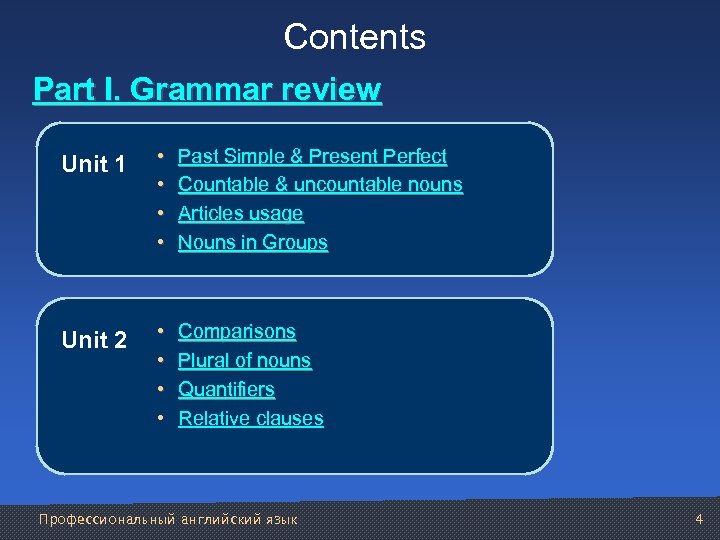
Contents Part I. Grammar review Unit 1 • • Past Simple & Present Perfect Countable & uncountable nouns Articles usage Nouns in Groups Unit 2 • • Comparisons Plural of nouns Quantifiers Relative clauses Профессиональный английский язык 4

Contents Part I. Grammar review Unit 3 • • • Present Simple &Present Continuous Modal verbs can/could may/might Modal verbs must/need Modal verbs must/have to/be to Modal verbs should/ought to Unit 4 • • • Active/Passive Forms Future forms Conditional 0 Conditional 1 Conditional 2 Conditional 3 Профессиональный английский язык 5
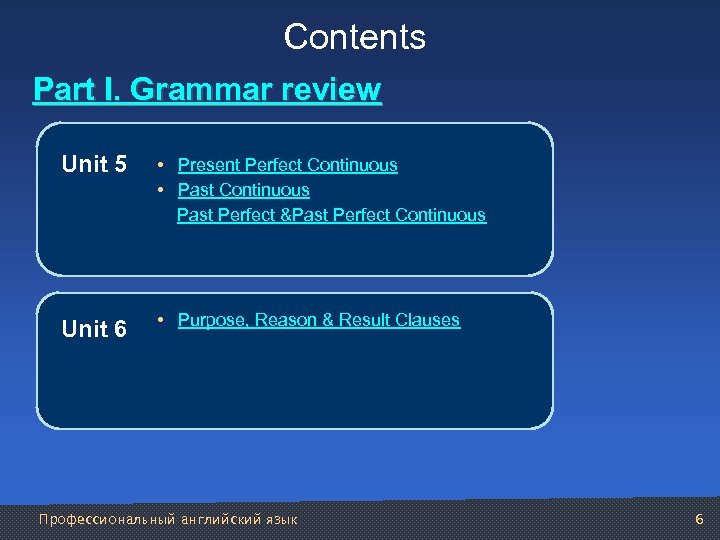
Contents Part I. Grammar review Unit 5 • Present Perfect Continuous • Past Continuous Past Perfect &Past Perfect Continuous Unit 6 • Purpose, Reason & Result Clauses Профессиональный английский язык 6
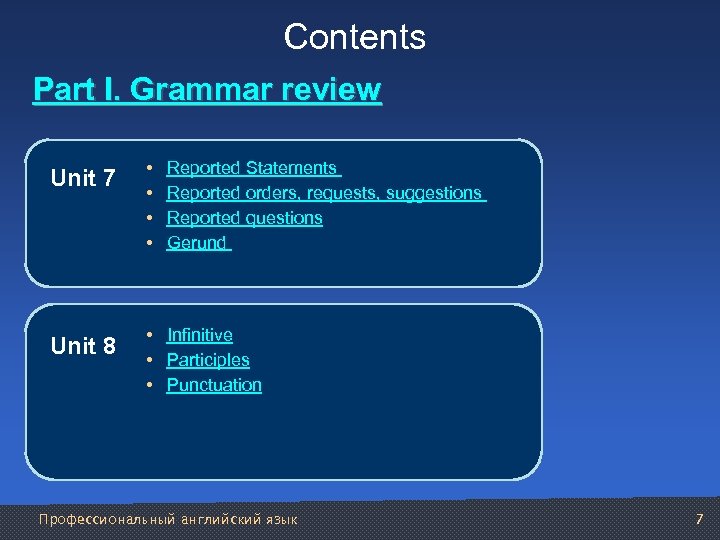
Contents Part I. Grammar review Unit 7 • • Unit 8 • Infinitive • Participles • Punctuation Reported Statements Reported orders, requests, suggestions Reported questions Gerund Профессиональный английский язык 7
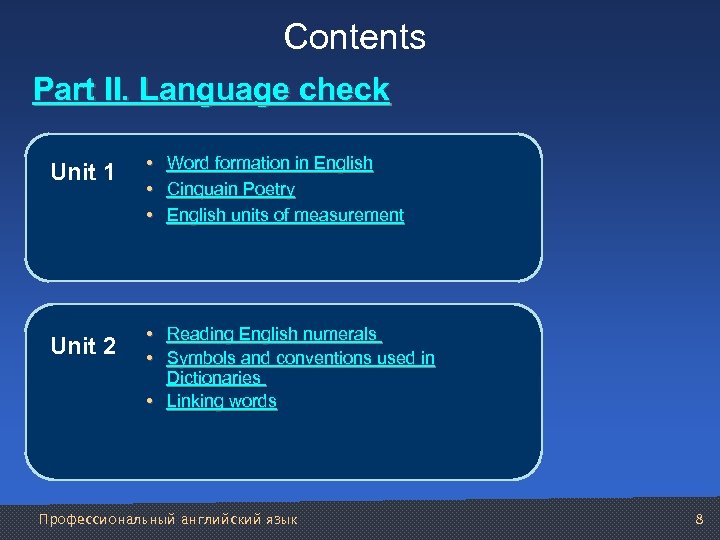
Contents Part II. Language check Unit 1 • Word formation in English • Cinquain Poetry • English units of measurement Unit 2 • Reading English numerals • Symbols and conventions used in Dictionaries • Linking words Профессиональный английский язык 8
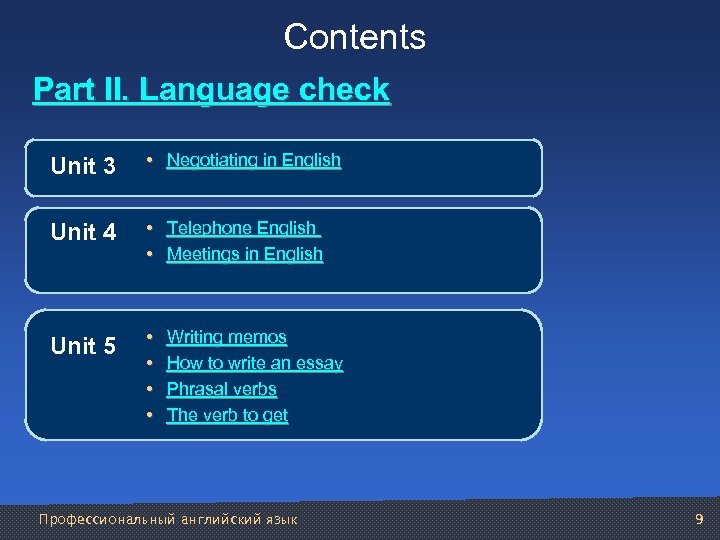
Contents Part II. Language check Unit 3 • Negotiating in English Unit 4 • Telephone English • Meetings in English Unit 5 • • Writing memos How to write an essay Phrasal verbs The verb to get Профессиональный английский язык 9
Contents Part II. Language check Unit 6 Unit 7 • • • Writing business letters Letters of complaint The guidelines to write e mail Letters of Enquiry Lack / lack of • Public Speaking • Writing job adverts Профессиональный английский язык 10
Contents Part II. Language check Unit 8 Unit 7 • • • How to write a CV (resume) in English Vocabulary for job interviews Staff or staffs Describing Trends Describing importance Describing satisfaction Bibliography Профессиональный английский язык 11

Part I. Grammar review 12
![Part I. Grammar review Past Simple FORM: [VERB+ed] or irregular verbs • You called](https://present5.com/presentation/56846063fe29d894609575ba9193acd4/image-13.jpg "Part I. Grammar review Past Simple FORM: [VERB+ed] or irregular verbs • You called")
Part I. Grammar review Past Simple FORM: [VERB+ed] or irregular verbs • You called Debbie • Did you call Debbie? • You did not call Debbie Профессиональный английский язык 13
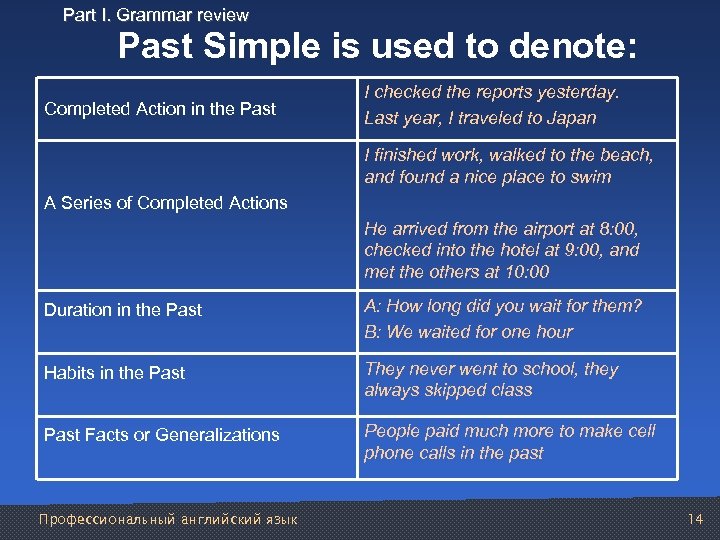
Part I. Grammar review Past Simple is used to denote: Completed Action in the Past I checked the reports yesterday. Last year, I traveled to Japan I finished work, walked to the beach, and found a nice place to swim A Series of Completed Actions He arrived from the airport at 8: 00, checked into the hotel at 9: 00, and met the others at 10: 00 Duration in the Past A: How long did you wait for them? B: We waited for one hour Habits in the Past They never went to school, they always skipped class Past Facts or Generalizations People paid much more to make cell phone calls in the past Профессиональный английский язык 14
![Part I. Grammar review Present Perfect FORM: [has/have + past participle] • You have](https://present5.com/presentation/56846063fe29d894609575ba9193acd4/image-15.jpg "Part I. Grammar review Present Perfect FORM: [has/have + past participle] • You have")
Part I. Grammar review Present Perfect FORM: [has/have + past participle] • You have seen that movie many times • Have you seen that movie many times? • You have not seen that movie many times Профессиональный английский язык 15
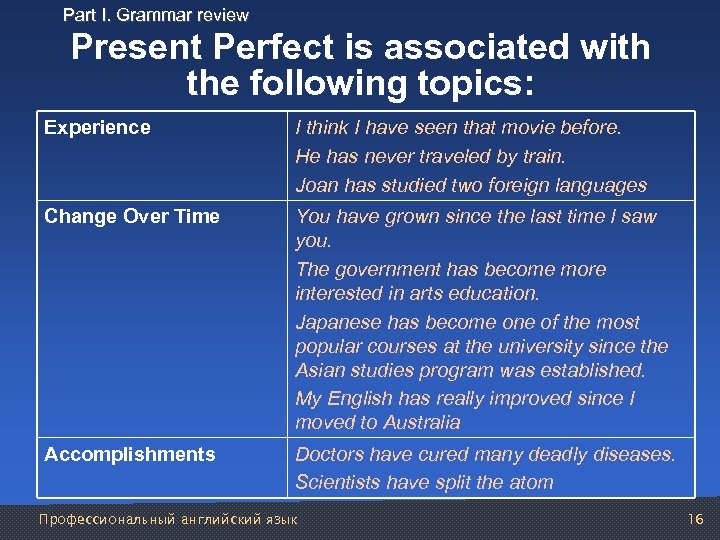
Part I. Grammar review Present Perfect is associated with the following topics: Experience I think I have seen that movie before. He has never traveled by train. Joan has studied two foreign languages Change Over Time You have grown since the last time I saw you. The government has become more interested in arts education. Japanese has become one of the most popular courses at the university since the Asian studies program was established. My English has really improved since I moved to Australia Accomplishments Doctors have cured many deadly diseases. Scientists have split the atom Профессиональный английский язык 16
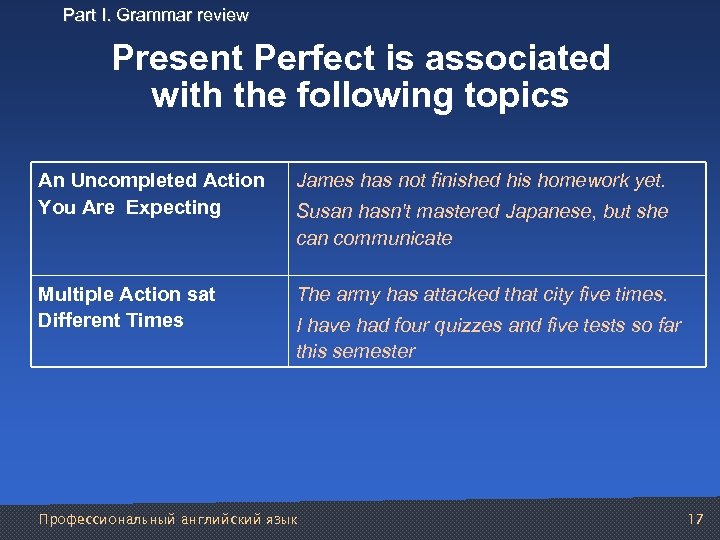
Part I. Grammar review Present Perfect is associated with the following topics An Uncompleted Action You Are Expecting James has not finished his homework yet. Multiple Action sat Different Times The army has attacked that city five times. Susan hasn't mastered Japanese, but she can communicate I have had four quizzes and five tests so far this semester Профессиональный английский язык 17
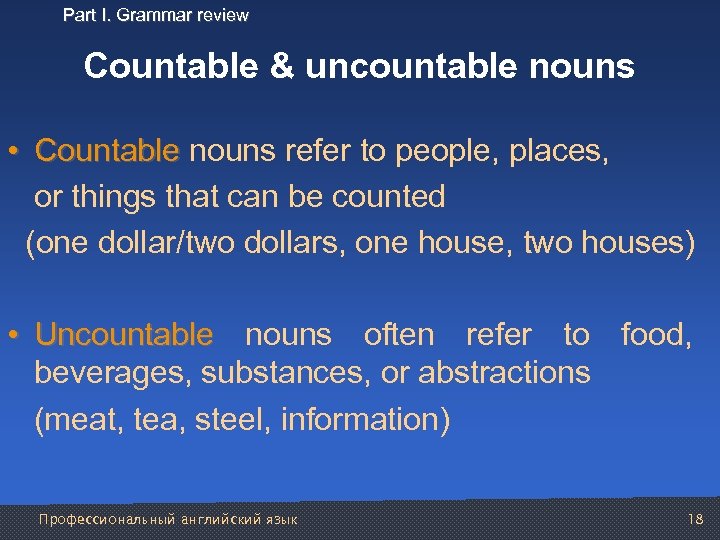
Part I. Grammar review Countable & uncountable nouns • Countable nouns refer to people, places, Countable or things that can be counted (one dollar/two dollars, one house, two houses) • Uncountable nouns often refer to food, Uncountable beverages, substances, or abstractions (meat, tea, steel, information) Профессиональный английский язык 18
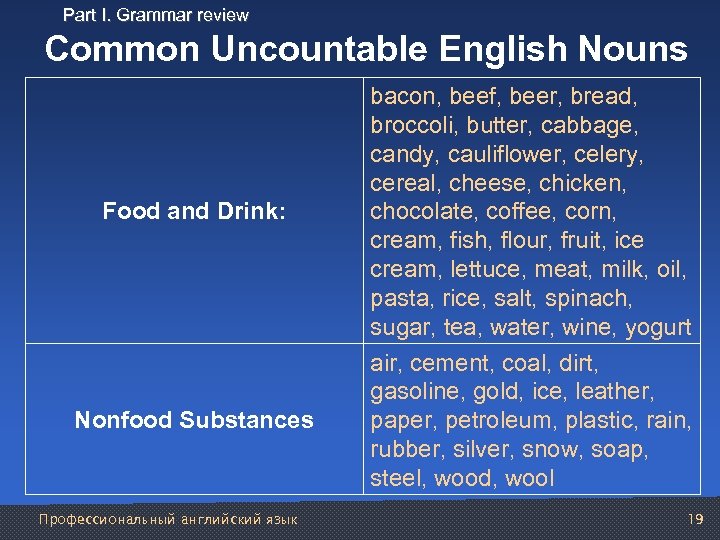
Part I. Grammar review Common Uncountable English Nouns Food and Drink: bacon, beef, beer, bread, broccoli, butter, cabbage, candy, cauliflower, celery, cereal, cheese, chicken, chocolate, coffee, corn, cream, fish, flour, fruit, ice cream, lettuce, meat, milk, oil, pasta, rice, salt, spinach, sugar, tea, water, wine, yogurt Nonfood Substances air, cement, coal, dirt, gasoline, gold, ice, leather, paper, petroleum, plastic, rain, rubber, silver, snow, soap, steel, wood, wool Профессиональный английский язык 19
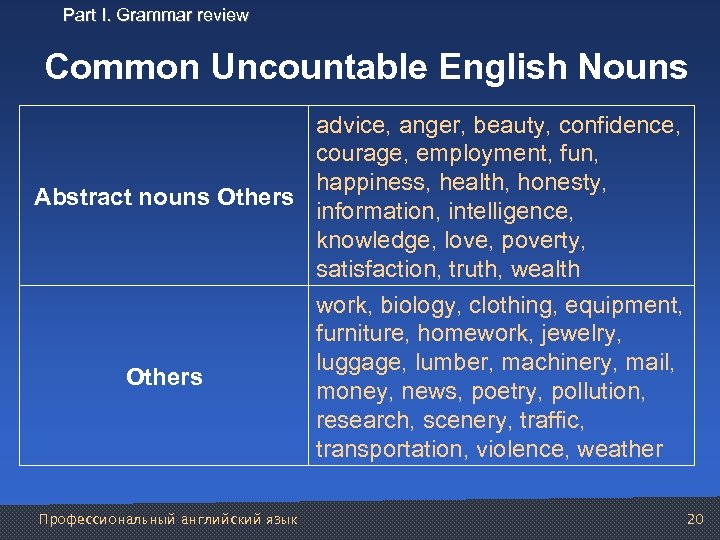
Part I. Grammar review Common Uncountable English Nouns advice, anger, beauty, confidence, courage, employment, fun, happiness, health, honesty, Abstract nouns Others information, intelligence, knowledge, love, poverty, satisfaction, truth, wealth Others Профессиональный английский язык work, biology, clothing, equipment, furniture, homework, jewelry, luggage, lumber, machinery, mail, money, news, poetry, pollution, research, scenery, traffic, transportation, violence, weather 20
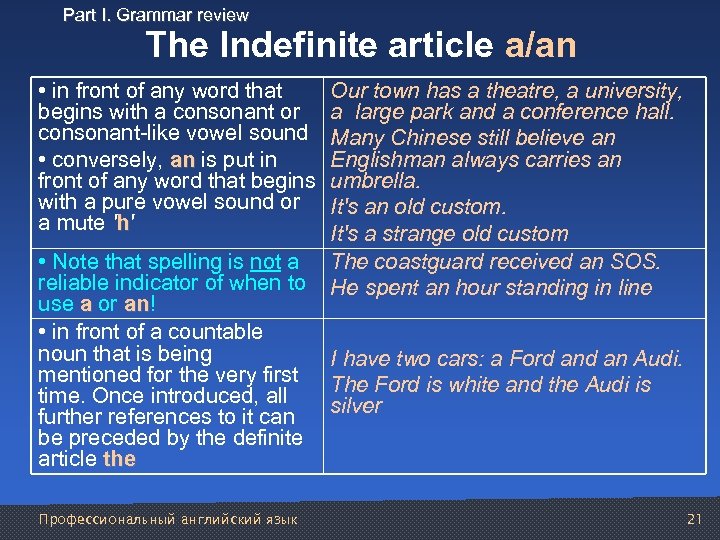
Part I. Grammar review The Indefinite article a/an • in front of any word that begins with a consonant or consonant like vowel sound • conversely, an is put in front of any word that begins with a pure vowel sound or a mute 'h' Our town has a theatre, a university, a large park and a conference hall. Many Chinese still believe an Englishman always carries an umbrella. It's an old custom. It's a strange old custom • Note that spelling is not a The coastguard received an SOS. reliable indicator of when to He spent an hour standing in line use a or an! an • in front of a countable noun that is being I have two cars: a Ford an Audi. mentioned for the very first The Ford is white and the Audi is time. Once introduced, all further references to it can silver be preceded by the definite article the Профессиональный английский язык 21
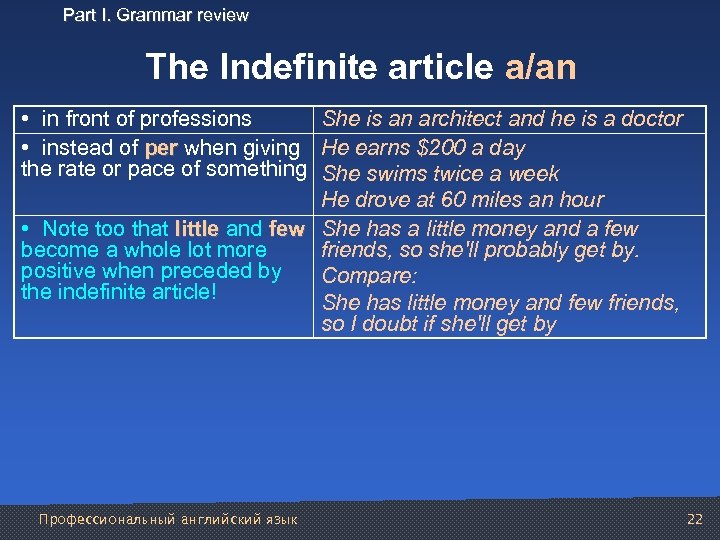
Part I. Grammar review The Indefinite article a/an • in front of professions She is an architect and he is a doctor • instead of per when giving He earns $200 a day per the rate or pace of something She swims twice a week He drove at 60 miles an hour • Note too that little and few She has a little money and a few little few become a whole lot more friends, so she'll probably get by. positive when preceded by Compare: the indefinite article! She has little money and few friends, so I doubt if she'll get by Профессиональный английский язык 22
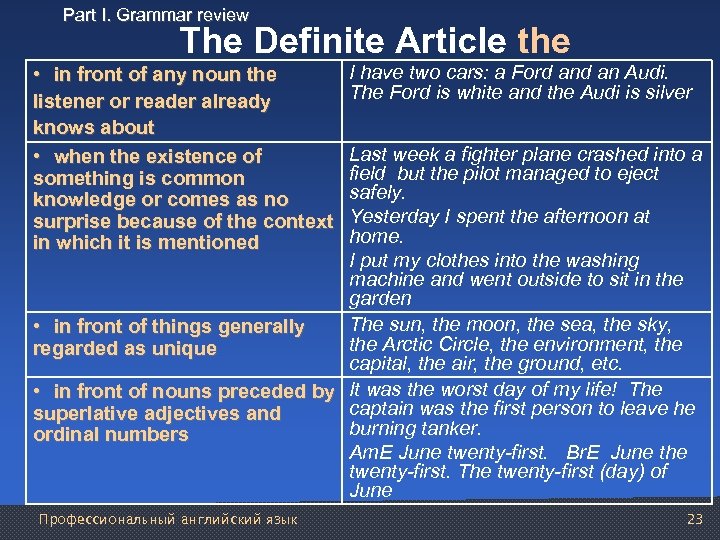
Part I. Grammar review The Definite Article the • in front of any noun the listener or reader already knows about • when the existence of something is common knowledge or comes as no surprise because of the context in which it is mentioned I have two cars: a Ford an Audi. The Ford is white and the Audi is silver Last week a fighter plane crashed into a field but the pilot managed to eject safely. Yesterday I spent the afternoon at home. I put my clothes into the washing machine and went outside to sit in the garden The sun, the moon, the sea, the sky, • in front of things generally the Arctic Circle, the environment, the regarded as unique capital, the air, the ground, etc. • in front of nouns preceded by It was the worst day of my life! The captain was the first person to leave he superlative adjectives and burning tanker. ordinal numbers Am. E June twenty first. Br. E June the twenty first. The twenty first (day) of June Профессиональный английский язык 23
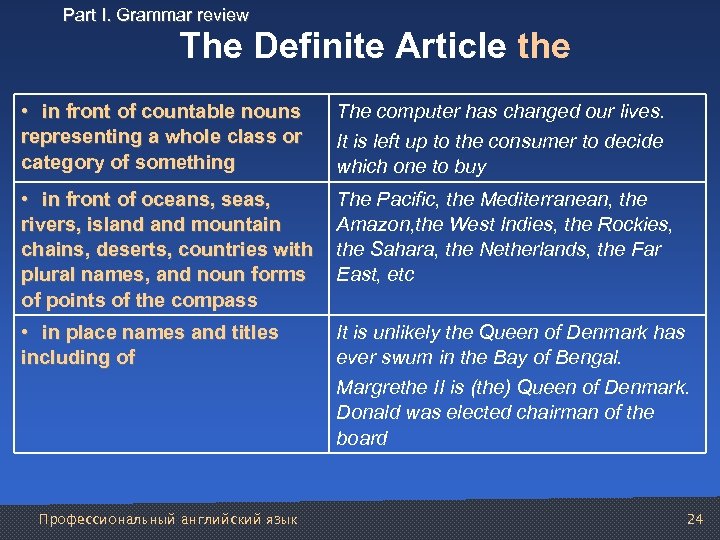
Part I. Grammar review The Definite Article the • in front of countable nouns representing a whole class or category of something The computer has changed our lives. It is left up to the consumer to decide which one to buy • in front of oceans, seas, rivers, island mountain chains, deserts, countries with plural names, and noun forms of points of the compass The Pacific, the Mediterranean, the Amazon, the West Indies, the Rockies, the Sahara, the Netherlands, the Far East, etc • in place names and titles including of It is unlikely the Queen of Denmark has ever swum in the Bay of Bengal. Margrethe II is (the) Queen of Denmark. Donald was elected chairman of the board Профессиональный английский язык 24
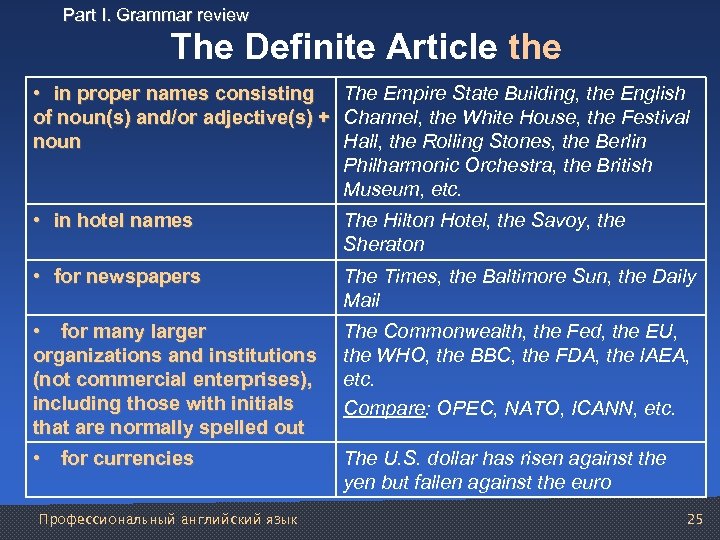
Part I. Grammar review The Definite Article the • in proper names consisting The Empire State Building, the English of noun(s) and/or adjective(s) + Channel, the White House, the Festival noun Hall, the Rolling Stones, the Berlin Philharmonic Orchestra, the British Museum, etc. • in hotel names The Hilton Hotel, the Savoy, the Sheraton • for newspapers The Times, the Baltimore Sun, the Daily Mail • for many larger organizations and institutions (not commercial enterprises), including those with initials that are normally spelled out • for currencies The Commonwealth, the Fed, the EU, the WHO, the BBC, the FDA, the IAEA, etc. Compare: OPEC, NATO, ICANN, etc. Профессиональный английский язык The U. S. dollar has risen against the yen but fallen against the euro 25
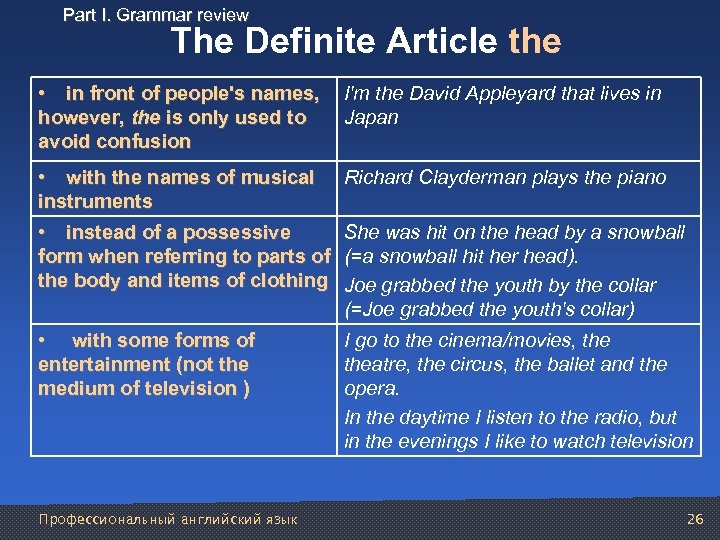
Part I. Grammar review The Definite Article the • in front of people's names, I'm the David Appleyard that lives in however, the is only used to Japan avoid confusion • with the names of musical instruments • instead of a possessive form when referring to parts of the body and items of clothing Richard Clayderman plays the piano • with some forms of entertainment (not the medium of television ) I go to the cinema/movies, theatre, the circus, the ballet and the opera. In the daytime I listen to the radio, but in the evenings I like to watch television Профессиональный английский язык She was hit on the head by a snowball (=a snowball hit her head). Joe grabbed the youth by the collar (=Joe grabbed the youth's collar) 26
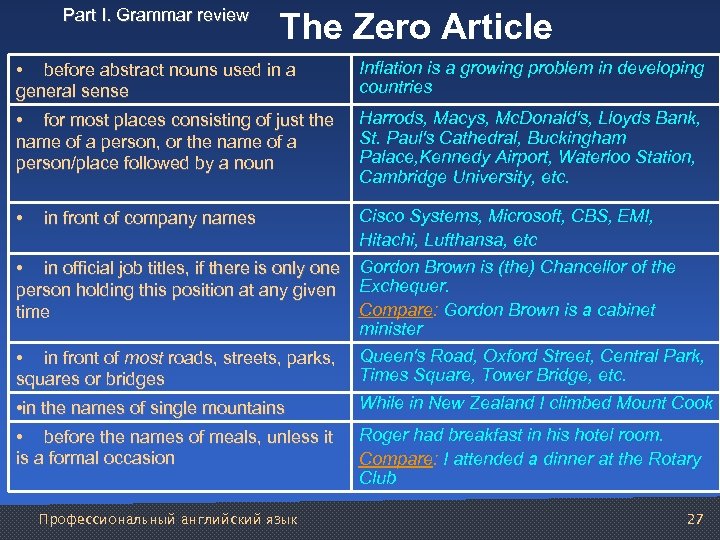
Part I. Grammar review The Zero Article • before abstract nouns used in a general sense Inflation is a growing problem in developing countries • for most places consisting of just the name of a person, or the name of a person/place followed by a noun Harrods, Macys, Mc. Donald's, Lloyds Bank, St. Paul's Cathedral, Buckingham Palace, Kennedy Airport, Waterloo Station, Cambridge University, etc. Cisco Systems, Microsoft, CBS, EMI, Hitachi, Lufthansa, etc • in official job titles, if there is only one Gordon Brown is (the) Chancellor of the person holding this position at any given Exchequer. Compare: Gordon Brown is a cabinet time minister • in front of most roads, streets, parks, Queen's Road, Oxford Street, Central Park, Times Square, Tower Bridge, etc. squares or bridges While in New Zealand I climbed Mount Cook • in the names of single mountains • in front of company names • before the names of meals, unless it is a formal occasion Профессиональный английский язык Roger had breakfast in his hotel room. Compare: I attended a dinner at the Rotary Club 27
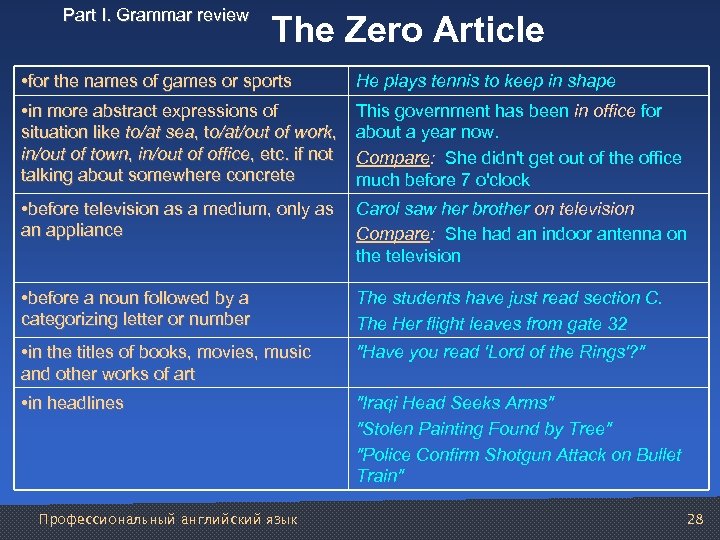
Part I. Grammar review The Zero Article • for the names of games or sports He plays tennis to keep in shape • in more abstract expressions of situation like to/at sea, to/at/out of work, in/out of town, in/out of office, etc. if not talking about somewhere concrete This government has been in office for about a year now. Compare: She didn't get out of the office much before 7 o'clock • before television as a medium, only as Carol saw her brother on television an appliance Compare: She had an indoor antenna on the television • before a noun followed by a categorizing letter or number The students have just read section C. The Her flight leaves from gate 32 • in the titles of books, movies, music and other works of art "Have you read 'Lord of the Rings'? " • in headlines "Iraqi Head Seeks Arms" "Stolen Painting Found by Tree" "Police Confirm Shotgun Attack on Bullet Train" Профессиональный английский язык 28
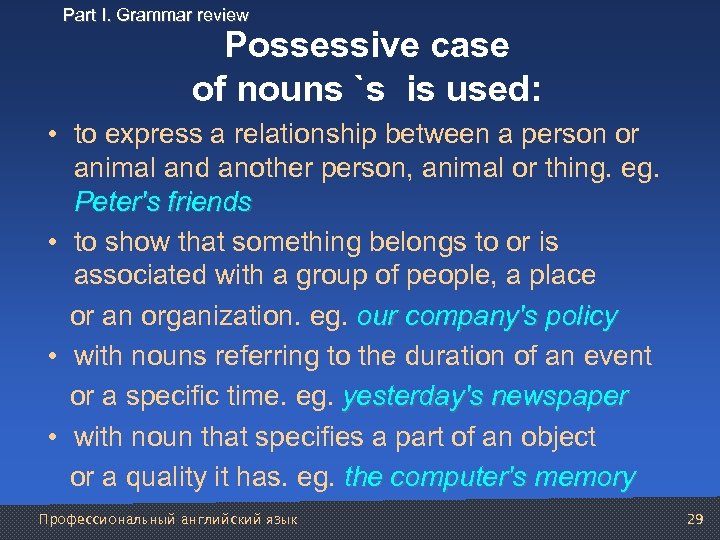
Part I. Grammar review Possessive case of nouns `s is used: • to express a relationship between a person or animal and another person, animal or thing. eg. Peter's friends • to show that something belongs to or is associated with a group of people, a place or an organization. eg. our company's policy • with nouns referring to the duration of an event or a specific time. eg. yesterday's newspaper • with noun that specifies a part of an object or a quality it has. eg. the computer's memory Профессиональный английский язык 29
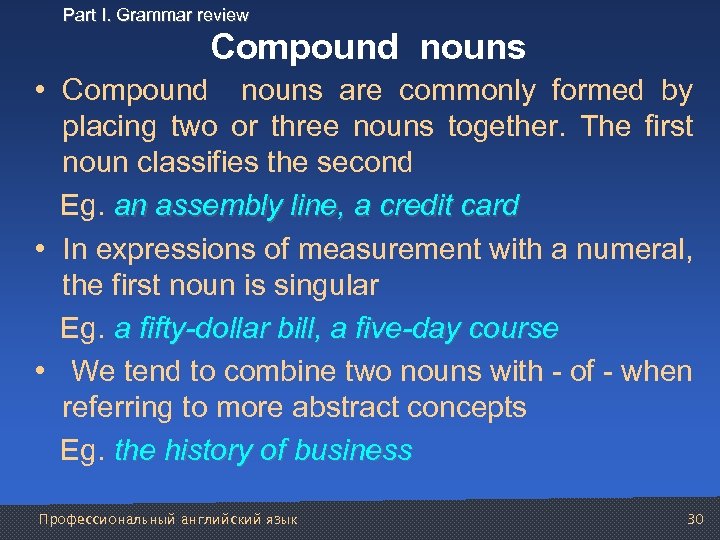
Part I. Grammar review Compound nouns • Compound nouns are commonly formed by placing two or three nouns together. The first noun classifies the second Eg. an assembly line, a credit card • In expressions of measurement with a numeral, the first noun is singular Eg. a fifty dollar bill, a five day course • We tend to combine two nouns with of when referring to more abstract concepts Eg. the history of business Профессиональный английский язык 30
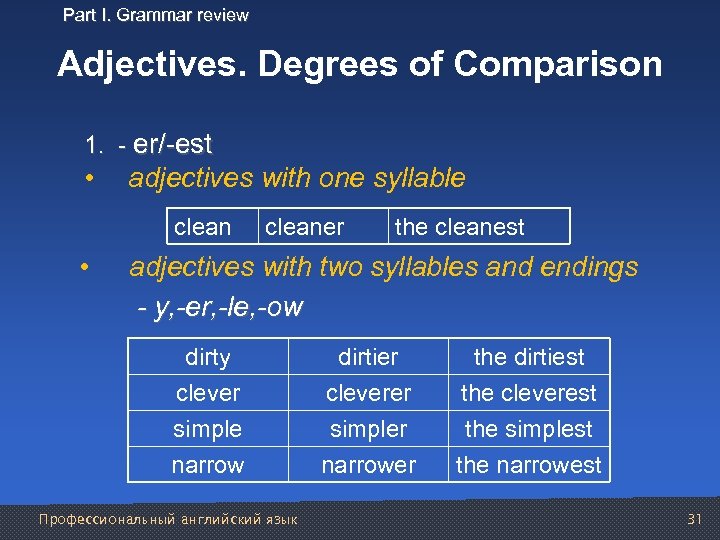
Part I. Grammar review Adjectives. Degrees of Comparison 1. er/ est • adjectives with one syllable clean • cleaner the cleanest adjectives with two syllables and endings y, er, le, ow dirty clever simple narrow Профессиональный английский язык dirtier cleverer simpler narrower the dirtiest the cleverest the simplest the narrowest 31
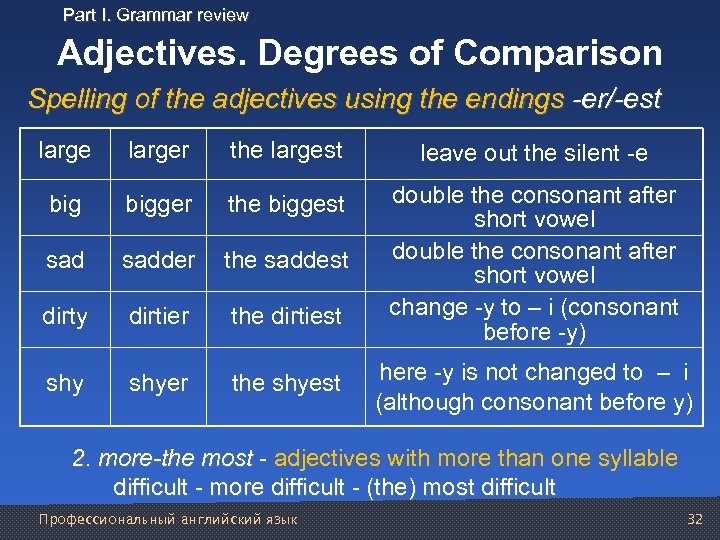
Part I. Grammar review Adjectives. Degrees of Comparison Spelling of the adjectives using the endings er/ est larger the largest leave out the silent e bigger the biggest sadder the saddest dirty dirtier the dirtiest double the consonant after short vowel change y to – i (consonant before y) shyer the shyest here y is not changed to – i (although consonant before y) 2. more the most adjectives with more than one syllable difficult more difficult (the) most difficult Профессиональный английский язык 32
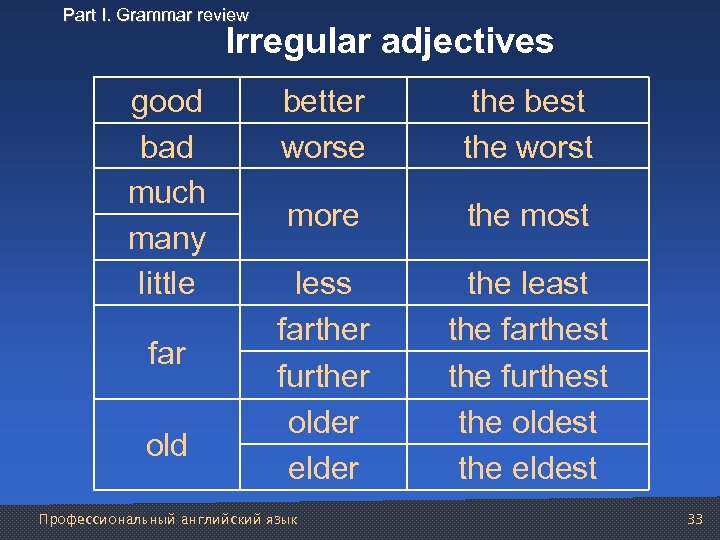
Part I. Grammar review Irregular adjectives good bad much many little far old better worse the best the worst more the most less farther further older elder the least the farthest the furthest the oldest the eldest Профессиональный английский язык 33
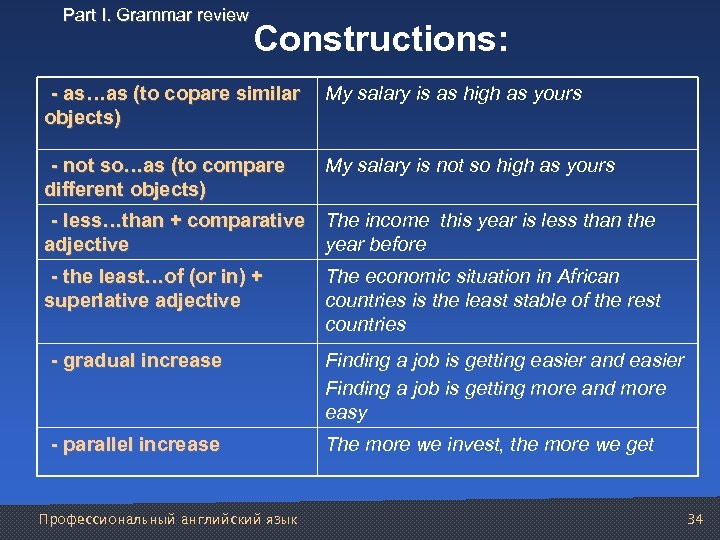
Part I. Grammar review Constructions: - as…as (to copare similar My salary is as high as yours objects) - not so…as (to compare different objects) My salary is not so high as yours - less…than + comparative The income this year is less than the adjective year before - the least…of (or in) + superlative adjective The economic situation in African countries is the least stable of the rest countries - gradual increase Finding a job is getting easier and easier Finding a job is getting more and more easy - parallel increase The more we invest, the more we get Профессиональный английский язык 34
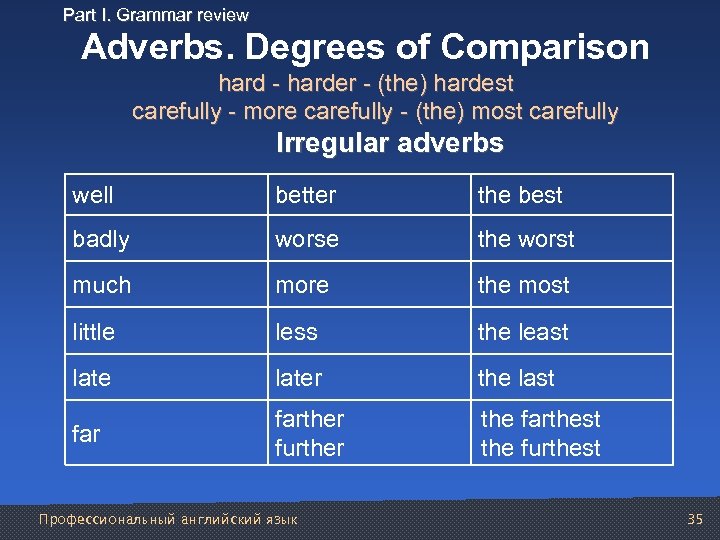
Part I. Grammar review Adverbs. Degrees of Comparison harder (the) hardest carefully more carefully (the) most carefully Irregular adverbs well better the best badly worse the worst much more the most little less the least later the last farther further the farthest the furthest Профессиональный английский язык 35
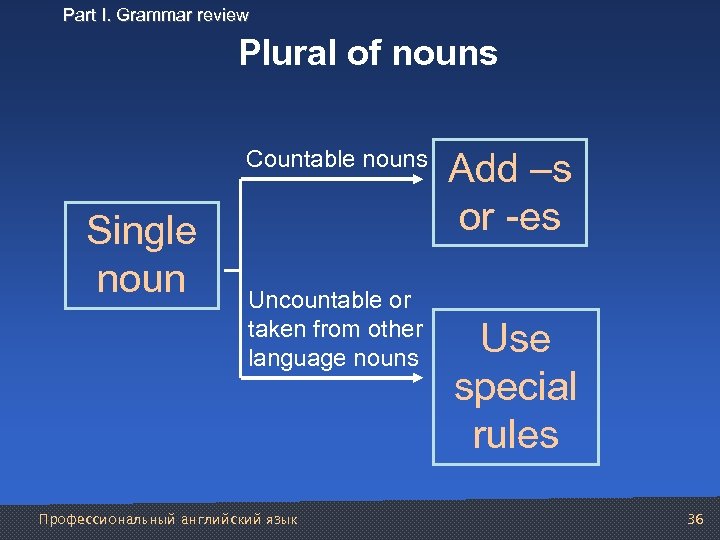
Part I. Grammar review Plural of nouns Countable nouns Single noun Uncountable or taken from other language nouns Профессиональный английский язык Add –s or es Use special rules 36
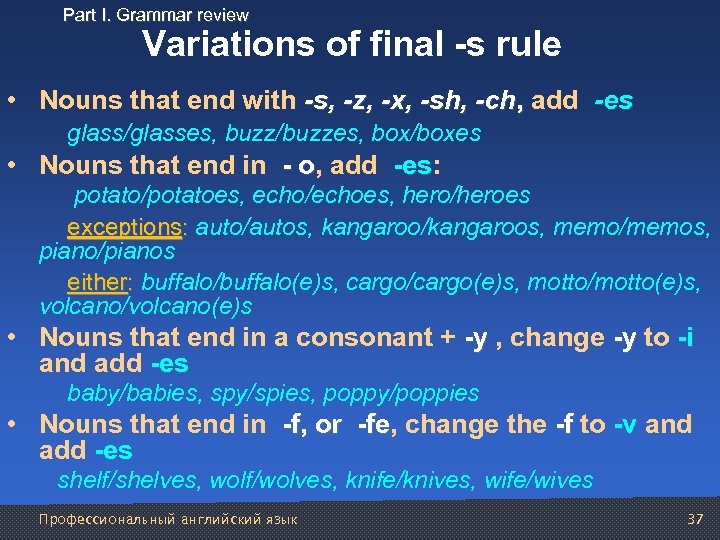
Part I. Grammar review Variations of final -s rule • Nouns that end with -s, -z, -x, -sh, -ch, add -es glass/glasses, buzz/buzzes, box/boxes • Nouns that end in - o, add -es: - o es potato/potatoes, echo/echoes, hero/heroes exceptions: auto/autos, kangaroo/kangaroos, memo/memos, piano/pianos either: buffalo/buffalo(e)s, cargo/cargo(e)s, motto/motto(e)s, volcano/volcano(e)s • Nouns that end in a consonant + -y , change -y to -i -y -y -i and add -es baby/babies, spy/spies, poppy/poppies • Nouns that end in -f, or -fe, change the -f to -v and fe -f -v add -es shelf/shelves, wolf/wolves, knife/knives, wife/wives Профессиональный английский язык 37
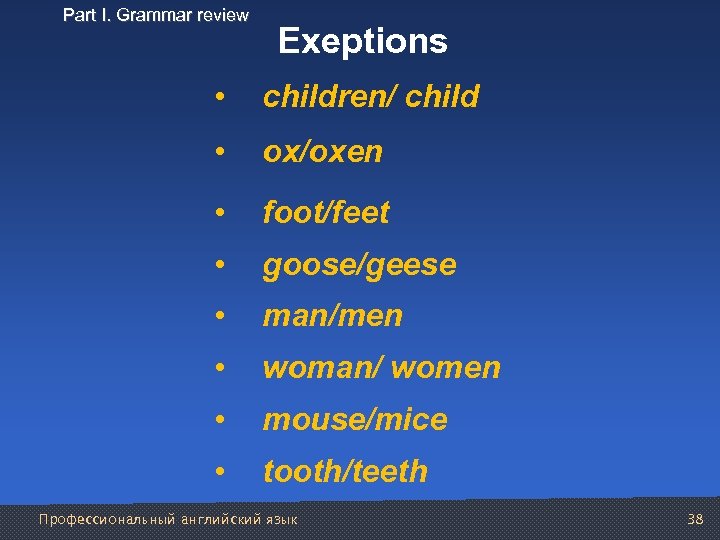
Part I. Grammar review Exeptions • children/ child • ox/oxen • foot/feet • goose/geese • man/men • woman/ women • mouse/mice • tooth/teeth Профессиональный английский язык 38
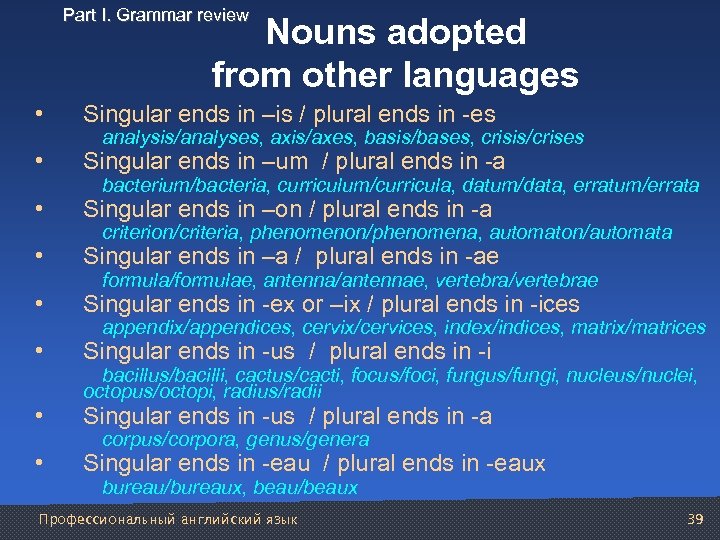
Part I. Grammar review Nouns adopted from other languages • Singular ends in –is / plural ends in es • Singular ends in –um / plural ends in a • Singular ends in –on / plural ends in a • Singular ends in –a / plural ends in ae • Singular ends in ex or –ix / plural ends in ices • Singular ends in us / plural ends in i • Singular ends in us / plural ends in a • Singular ends in eau / plural ends in eaux analysis/analyses, axis/axes, basis/bases, crisis/crises bacterium/bacteria, curriculum/curricula, datum/data, erratum/errata criterion/criteria, phenomenon/phenomena, automaton/automata formula/formulae, antenna/antennae, vertebra/vertebrae appendix/appendices, cervix/cervices, index/indices, matrix/matrices bacillus/bacilli, cactus/cacti, focus/foci, fungus/fungi, nucleus/nuclei, octopus/octopi, radius/radii corpus/corpora, genus/genera bureau/bureaux, beau/beaux Профессиональный английский язык 39
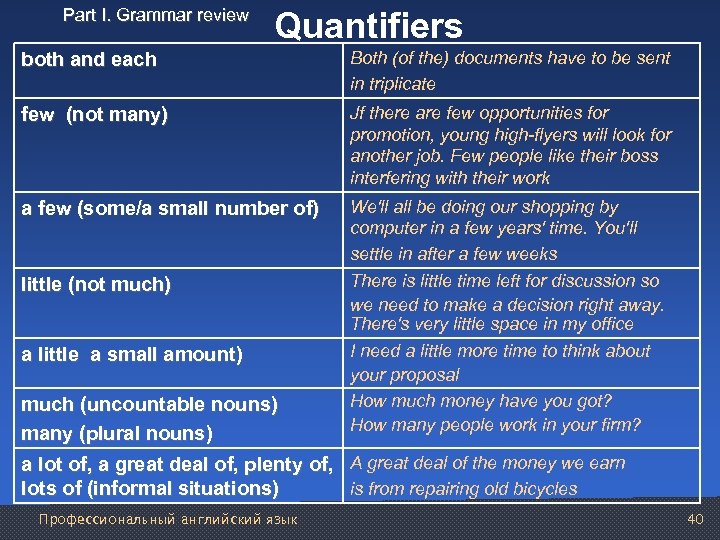
Part I. Grammar review Quantifiers both and each Both (of the) documents have to be sent in triplicate few (not many) Jf there are few opportunities for promotion, young high flyers will look for another job. Few people like their boss interfering with their work a few (some/a small number of) We'll all be doing our shopping by computer in a few years' time. You'll settle in after a few weeks little (not much) There is little time left for discussion so we need to make a decision right away. There's very little space in my office I need a little more time to think about your proposal How much money have you got? How many people work in your firm? a little a small amount) much (uncountable nouns) many (plural nouns) a lot of, a great deal of, plenty of, A great deal of the money we earn is from repairing old bicycles lots of (informal situations) Профессиональный английский язык 40
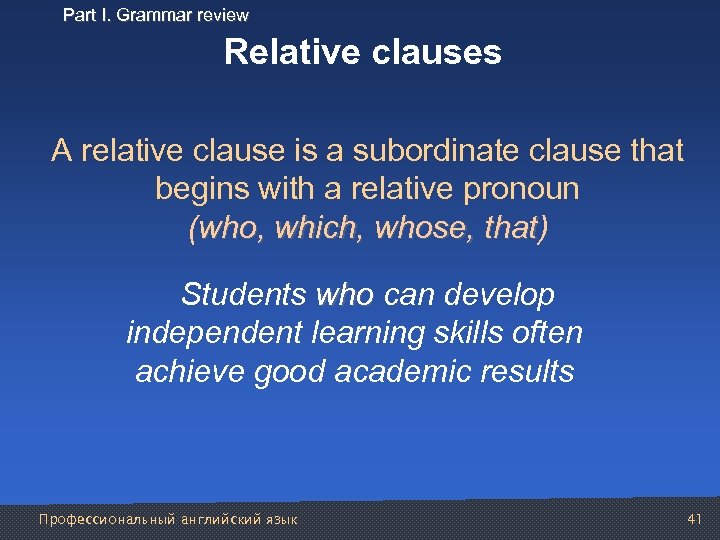
Part I. Grammar review Relative clauses A relative clause is a subordinate clause that begins with a relative pronoun (who, which, whose, that) who, which, whose, that Students who can develop who independent learning skills often achieve good academic results Профессиональный английский язык 41
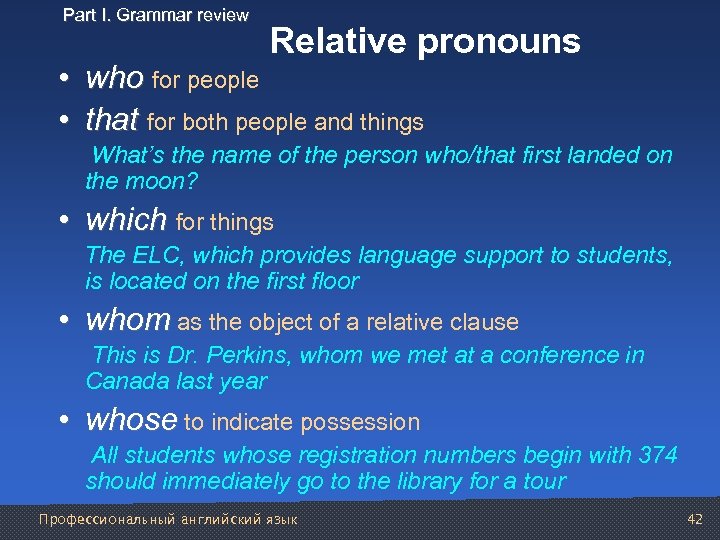
Part I. Grammar review Relative pronouns • who for people who • that for both people and things that What’s the name of the person who/that first landed on the moon? • which for things which The ELC, which provides language support to students, is located on the first floor • whom as the object of a relative clause This is Dr. Perkins, whom we met at a conference in Canada last year • whose to indicate possession All students whose registration numbers begin with 374 should immediately go to the library for a tour Профессиональный английский язык 42
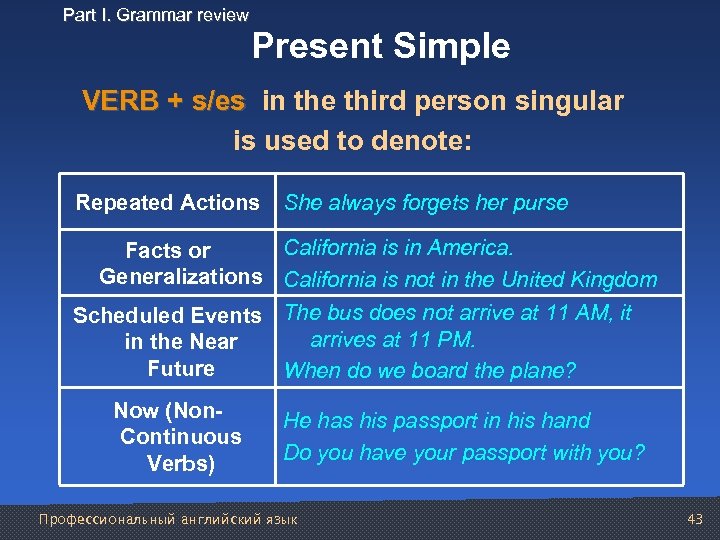
Part I. Grammar review Present Simple VERB + s/es in the third person singular is used to denote: Repeated Actions She always forgets her purse California is in America. Facts or Generalizations California is not in the United Kingdom Scheduled Events The bus does not arrive at 11 AM, it arrives at 11 PM. in the Near Future When do we board the plane? Now (Non. Continuous Verbs) He has his passport in his hand Do you have your passport with you? Профессиональный английский язык 43
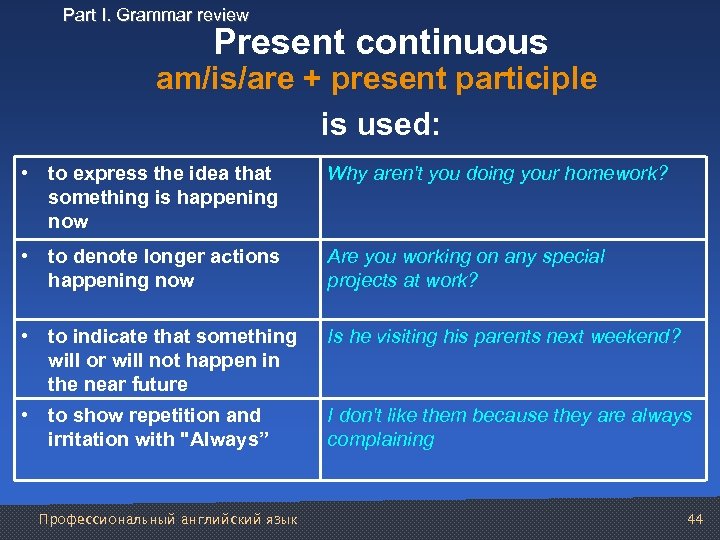
Part I. Grammar review Present continuous am/is/are + present participle is used: • to express the idea that something is happening now Why aren't you doing your homework? • to denote longer actions happening now Are you working on any special projects at work? • to indicate that something will or will not happen in the near future Is he visiting his parents next weekend? • to show repetition and irritation with "Always” I don't like them because they are always complaining Профессиональный английский язык 44

Part I. Grammar review Present simple versus present continuous is used to express general truths and is used to express temporary actions habitual actions which are in or around the present KEY WORDS The frequency adverbs: always, usually, often, some times, occasionally, seldom, rarely, hardly ever, never, every (week, day, . . . ) Note: Frequency adverbs can be used Note: with tenses other than present simple, depending on the meaning John Lennon always wore glasses Профессиональный английский язык KEY WORDS Now, right now, pres ently, at the moment EXCEPTIONS: Certain verbs are rarely EXCEPTIONS: used in the con inuous tenses. These t verbs are: be, seem, need, owe, want, verbs of pos ess on (have, own, possess, s i belong), verbs which express thoughts (think, remember, forget, know, believe), involuntary sense verbs (see, taste, feel, hear, smell) 45
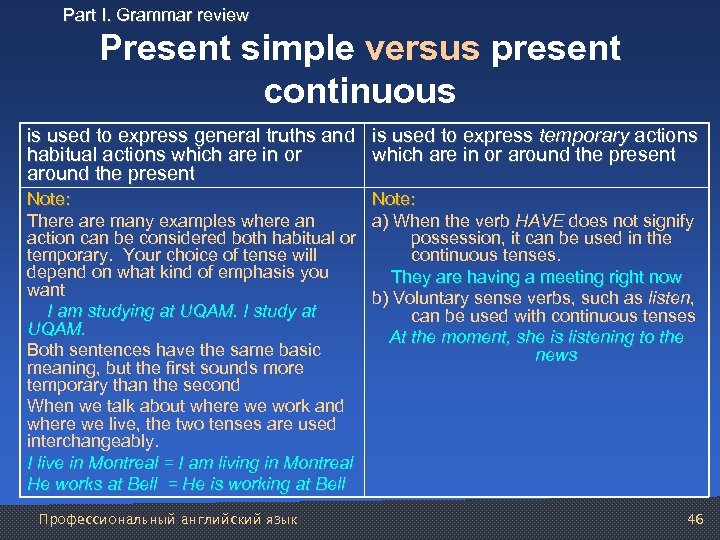
Part I. Grammar review Present simple versus present continuous is used to express general truths and is used to express temporary actions habitual actions which are in or around the present Note: There are many examples where an a) When the verb HAVE does not signify action can be considered both habitual or possession, it can be used in the temporary. Your choice of tense will continuous tenses. depend on what kind of emphasis you They are having a meeting right now want b) Voluntary sense verbs, such as listen, I am studying at UQAM. I study at can be used with continuous tenses UQAM. At the moment, she is listening to the Both sentences have the same basic news meaning, but the first sounds more temporary than the second When we talk about where we work and where we live, the two tenses are used interchangeably. I live in Montreal = I am living in Montreal He works at Bell = He is working at Bell Профессиональный английский язык 46
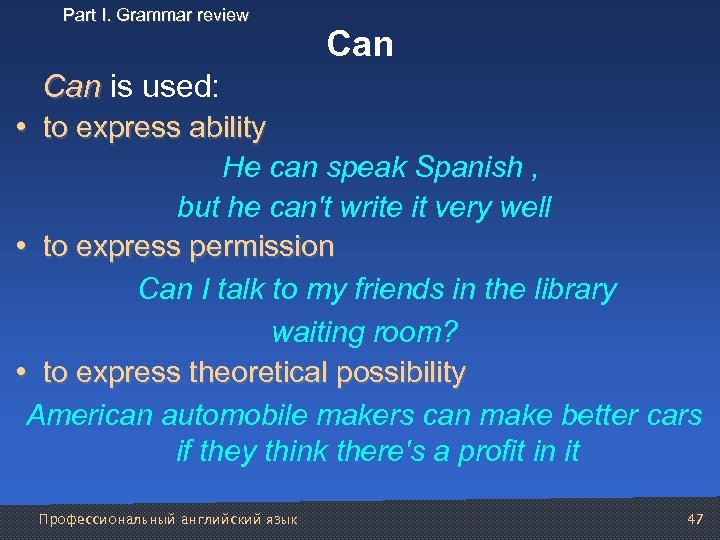
Part I. Grammar review Can is used: • to express ability He can speak Spanish , but he can't write it very well • to express permission Can I talk to my friends in the library waiting room? • to express theoretical possibility American automobile makers can make better cars if they think there's a profit in it Профессиональный английский язык 47
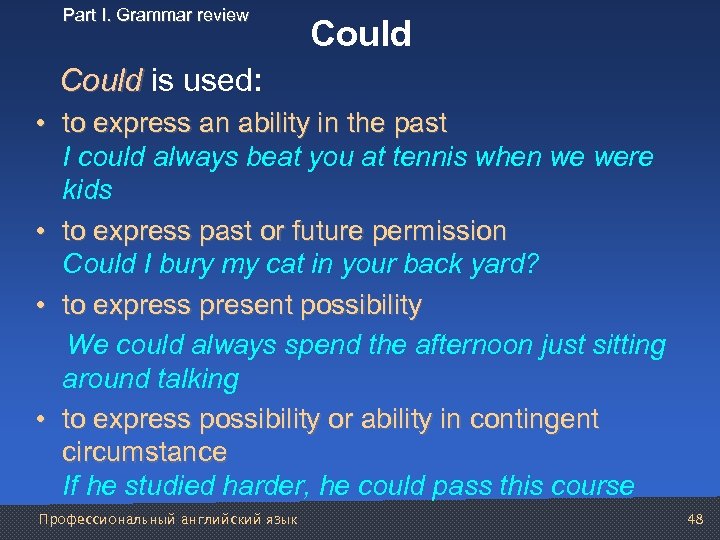
Part I. Grammar review Could is used: • to express an ability in the past I could always beat you at tennis when we were kids • to express past or future permission to express past or future permission Could I bury my cat in your back yard? • to express present possibility We could always spend the afternoon just sitting around talking • to express possibility or ability in contingent circumstance If he studied harder, he could pass this course Профессиональный английский язык 48
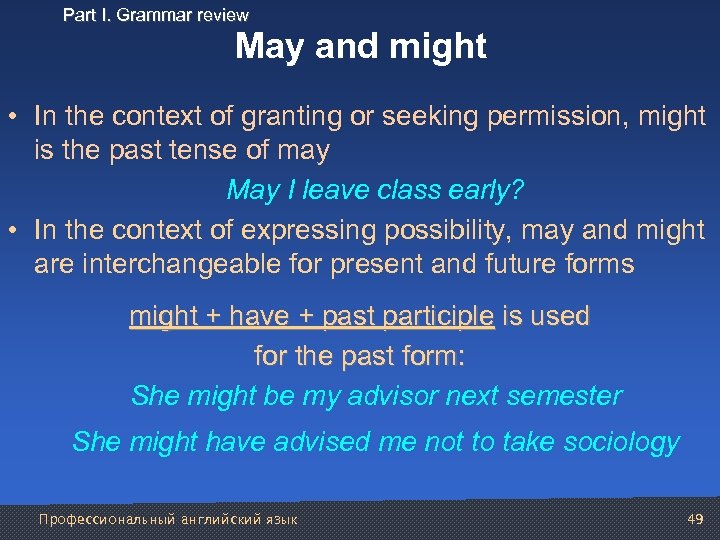
Part I. Grammar review May and might • In the context of granting or seeking permission, might is the past tense of may May I leave class early? • In the context of expressing possibility, may and might are interchangeable for present and future forms might + have + past participle is used for the past form: She might be my advisor next semester She might have advised me not to take sociology Профессиональный английский язык 49
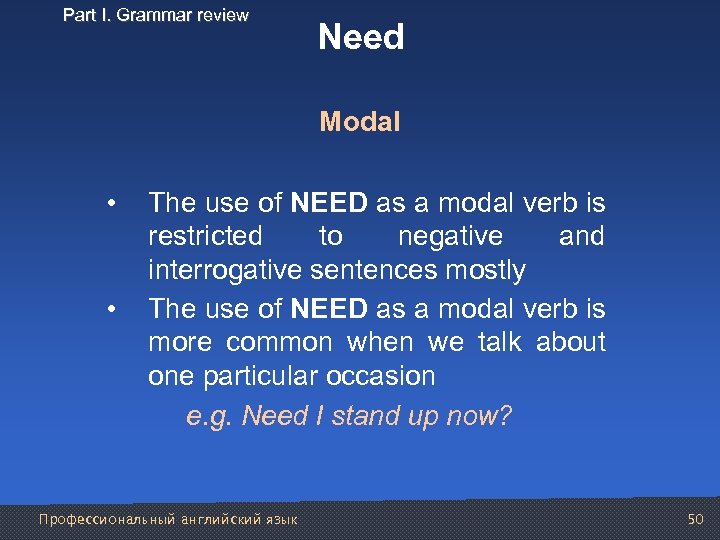
Part I. Grammar review Need Modal • The use of NEED as a modal verb is restricted to negative and interrogative sentences mostly • The use of NEED as a modal verb is more common when we talk about one particular occasion e. g. Need I stand up now? Профессиональный английский язык 50
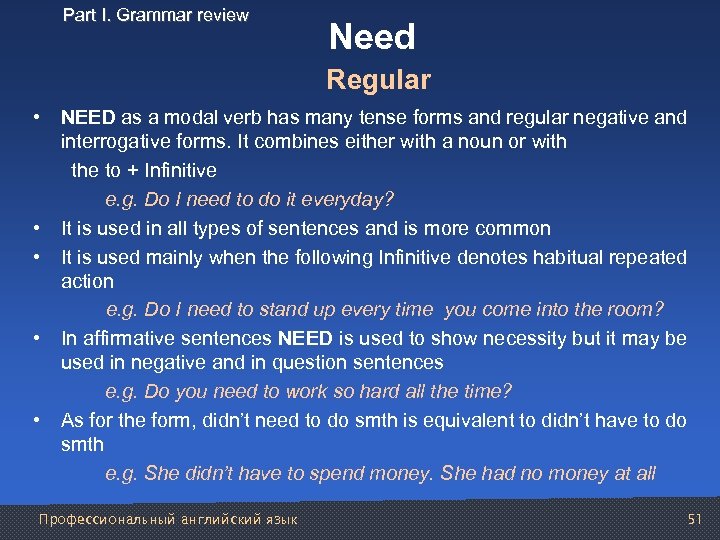
Part I. Grammar review Need Regular • NEED as a modal verb has many tense forms and regular negative and interrogative forms. It combines either with a noun or with the to + Infinitive e. g. Do I need to do it everyday? • It is used in all types of sentences and is more common • It is used mainly when the following Infinitive denotes habitual repeated action e. g. Do I need to stand up every time you come into the room? • In affirmative sentences NEED is used to show necessity but it may be used in negative and in question sentences e. g. Do you need to work so hard all the time? • As for the form, didn’t need to do smth is equivalent to didn’t have to do smth e. g. She didn’t have to spend money. She had no money at all Профессиональный английский язык 51
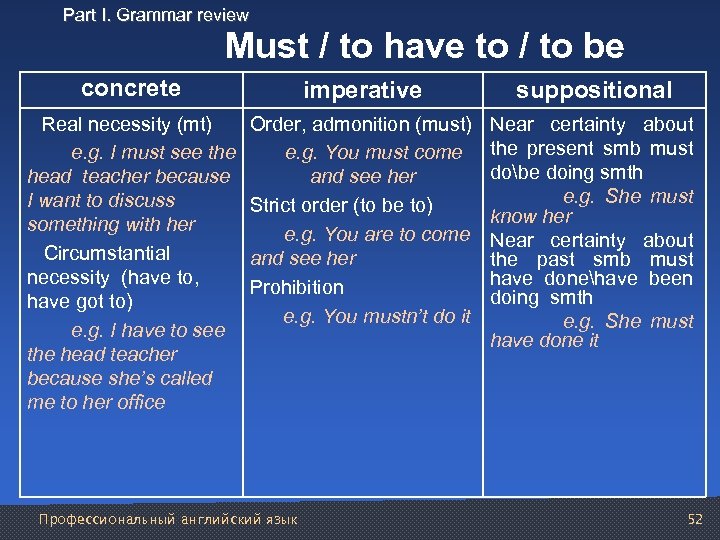
Part I. Grammar review Must / to have to / to be concrete imperative suppositional Real necessity (mt) e. g. I must see the head teacher because I want to discuss something with her Circumstantial necessity (have to, have got to) e. g. I have to see the head teacher because she’s called me to her office Order, admonition (must) e. g. You must come and see her Strict order (to be to) e. g. You are to come and see her Prohibition e. g. You mustn’t do it Near certainty about the present smb must dobe doing smth e. g. She must know her Near certainty about the past smb must have donehave been doing smth e. g. She must have done it Профессиональный английский язык 52
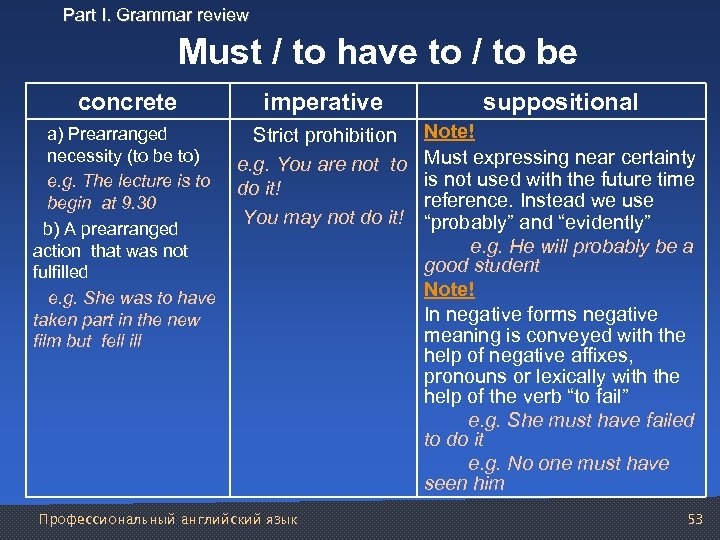
Part I. Grammar review Must / to have to / to be concrete a) Prearranged necessity (to be to) e. g. The lecture is to begin at 9. 30 b) A prearranged action that was not fulfilled e. g. She was to have taken part in the new film but fell imperative suppositional Note! Strict prohibition e. g. You are not to Must expressing near certainty is not used with the future time do it! reference. Instead we use You may not do it! “probably” and “evidently” e. g. He will probably be a good student Note! In negative forms negative meaning is conveyed with the help of negative affixes, pronouns or lexically with the help of the verb “to fail” e. g. She must have failed to do it e. g. No one must have seen him Профессиональный английский язык 53

Part I. Grammar review Should / ought to The modal verbs ought to and should are used to express: • expectation I'm in a meeting at the moment. We should / ought to / expect to finish by 3 p. m. and I'll call you back then • probability You should / ought to receive the goods on Tuesday • desirability You should / ought to have stayed for the last day of the conference, it was very interesting • an obligation or duty, giving advice You should / ought to look at our prices, they are very competitive Профессиональный английский язык 54
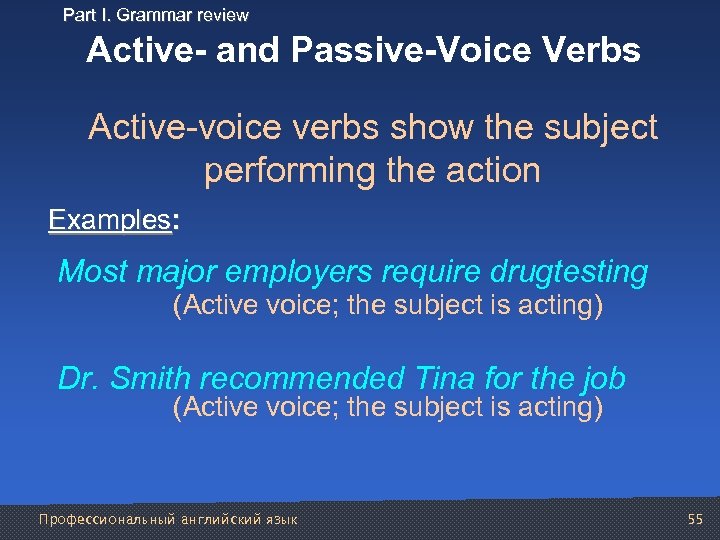
Part I. Grammar review Active- and Passive-Voice Verbs Active voice verbs show the subject performing the action Examples: Most major employers require drugtesting (Active voice; the subject is acting) Dr. Smith recommended Tina for the job (Active voice; the subject is acting) Профессиональный английский язык 55
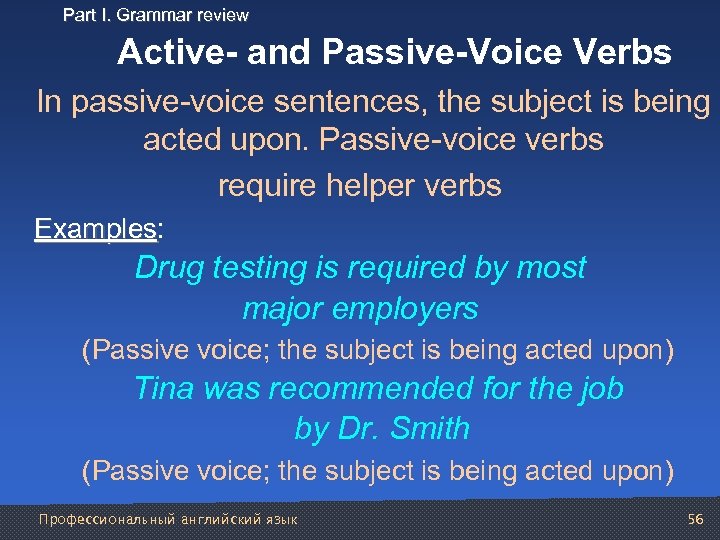
Part I. Grammar review Active- and Passive-Voice Verbs In passive voice sentences, the subject is being acted upon. Passive voice verbs require helper verbs Examples: Examples Drug testing is required by most major employers (Passive voice; the subject is being acted upon) Tina was recommended for the job by Dr. Smith (Passive voice; the subject is being acted upon) Профессиональный английский язык 56
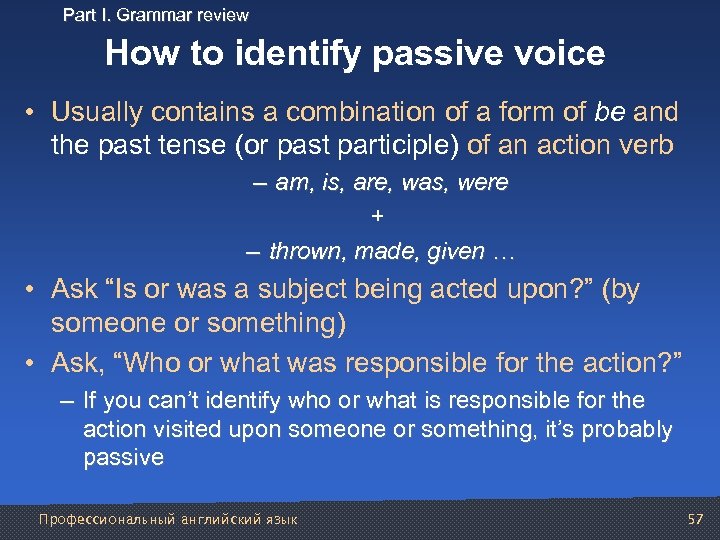
Part I. Grammar review How to identify passive voice • Usually contains a combination of a form of be and the past tense (or past participle) of an action verb – am, is, are, was, were + – thrown, made, given … • Ask “Is or was a subject being acted upon? ” (by someone or something) • Ask, “Who or what was responsible for the action? ” – If you can’t identify who or what is responsible for the action visited upon someone or something, it’s probably passive Профессиональный английский язык 57
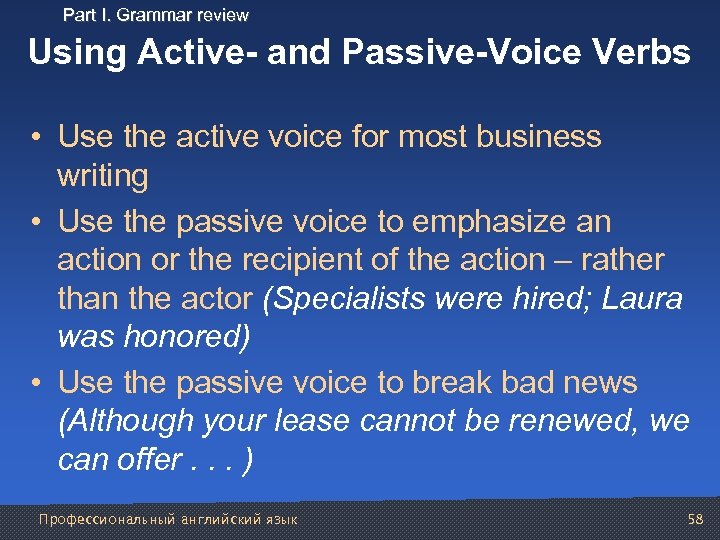
Part I. Grammar review Using Active- and Passive-Voice Verbs • Use the active voice for most business writing • Use the passive voice to emphasize an action or the recipient of the action – rather than the actor (Specialists were hired; Laura was honored) • Use the passive voice to break bad news (Although your lease cannot be renewed, we can offer. . . ) Профессиональный английский язык 58
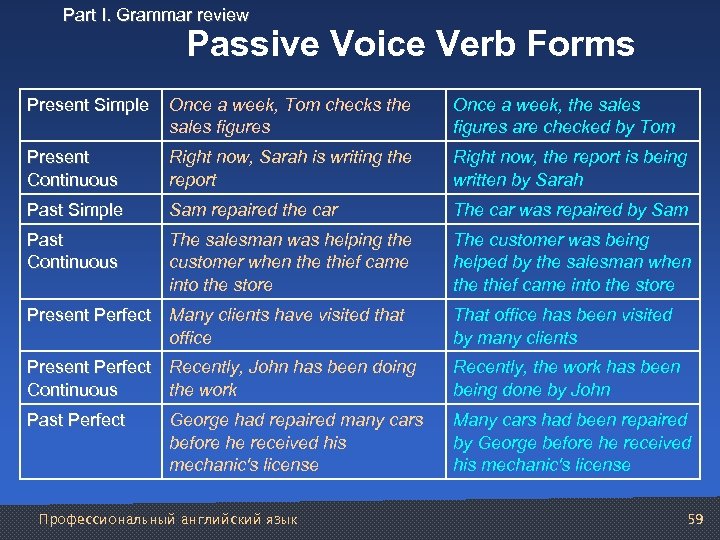
Part I. Grammar review Passive Voice Verb Forms Present Simple Once a week, Tom checks the sales figures Once a week, the sales figures are checked by Tom Present Continuous Right now, Sarah is writing the report Right now, the report is being written by Sarah Past Simple Sam repaired the car The car was repaired by Sam Past Continuous The salesman was helping the customer when the thief came into the store The customer was being helped by the salesman when the thief came into the store Present Perfect Many clients have visited that office That office has been visited by many clients Present Perfect Recently, John has been doing Continuous the work Recently, the work has been being done by John Past Perfect Many cars had been repaired by George before he received his mechanic's license George had repaired many cars before he received his mechanic's license Профессиональный английский язык 59
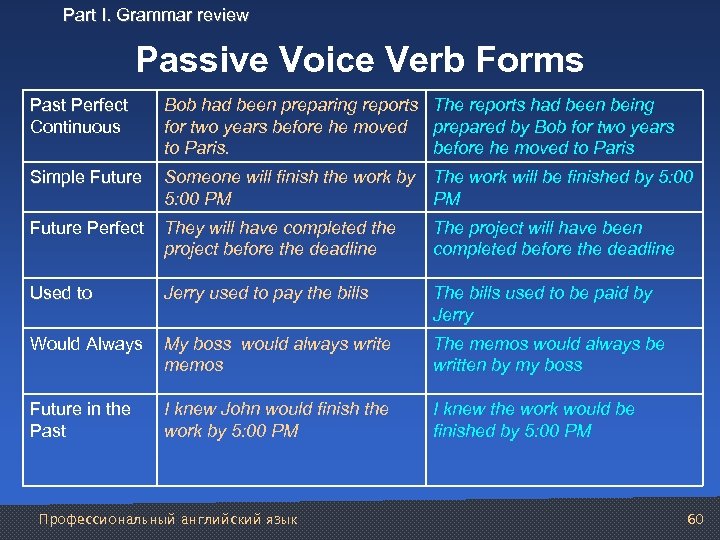
Part I. Grammar review Passive Voice Verb Forms Past Perfect Continuous Bob had been preparing reports The reports had been being for two years before he moved prepared by Bob for two years to Paris. before he moved to Paris Simple Future Someone will finish the work by The work will be finished by 5: 00 PM PM Future Perfect They will have completed the project before the deadline The project will have been completed before the deadline Used to Jerry used to pay the bills The bills used to be paid by Jerry Would Always My boss would always write memos The memos would always be written by my boss Future in the Past I knew John would finish the work by 5: 00 PM I knew the work would be finished by 5: 00 PM Профессиональный английский язык 60
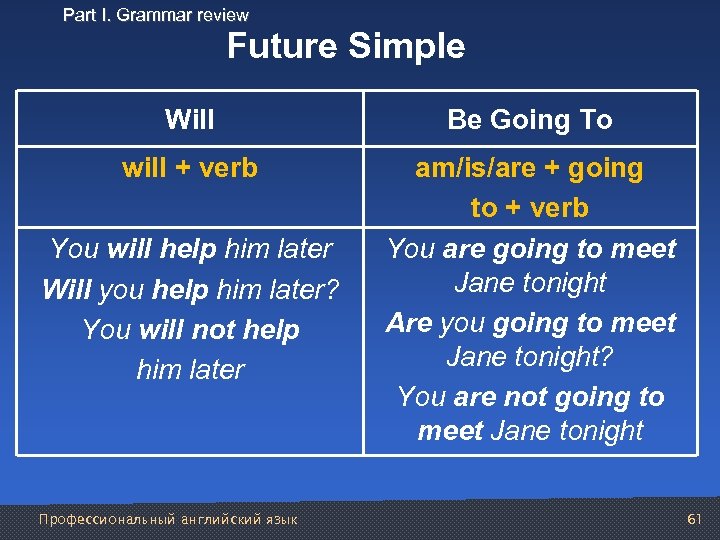
Part I. Grammar review Future Simple Will Be Going To will + verb am/is/are + going to + verb You are going to meet Jane tonight Are you going to meet Jane tonight? You are not going to meet Jane tonight You will help him later Will you help him later? You will not help him later Профессиональный английский язык 61
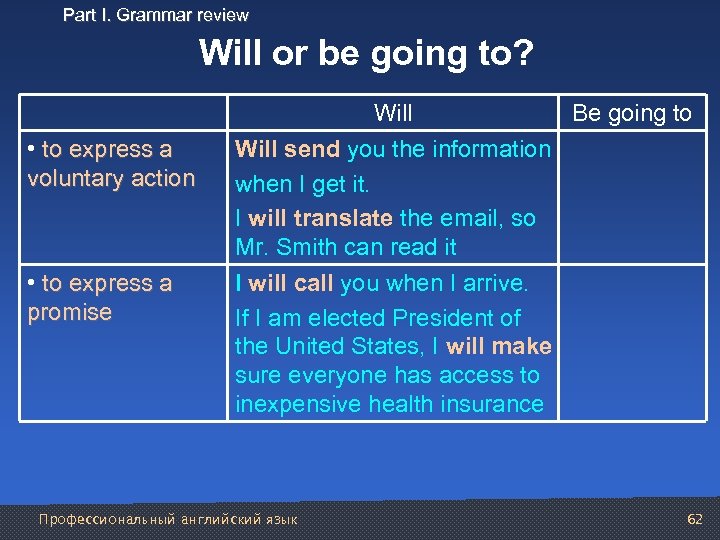
Part I. Grammar review Will or be going to? • to express a voluntary action • to express a promise Will Be going to Will send you the information when I get it. I will translate the email, so Mr. Smith can read it I will call you when I arrive. If I am elected President of the United States, I will make sure everyone has access to inexpensive health insurance Профессиональный английский язык 62
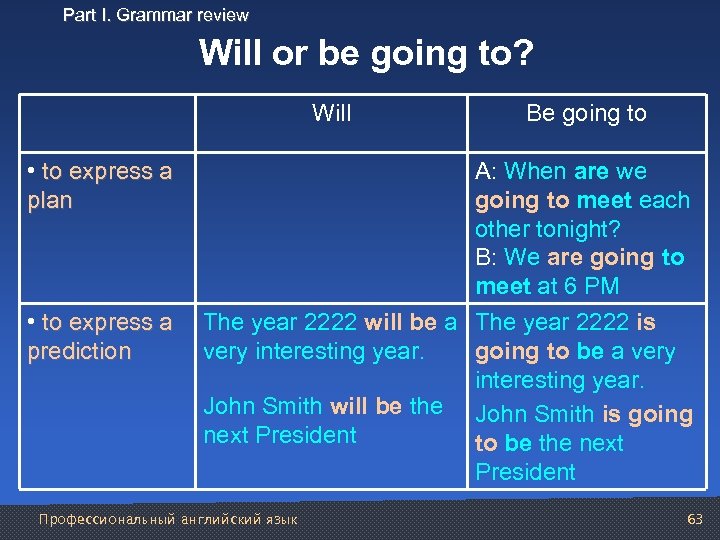
Part I. Grammar review Will or be going to? Will • to express a plan Be going to A: When are we going to meet each other tonight? B: We are going to meet at 6 PM • to express a The year 2222 will be a The year 2222 is prediction very interesting year. going to be a very interesting year. John Smith will be the John Smith is going next President to be the next President Профессиональный английский язык 63
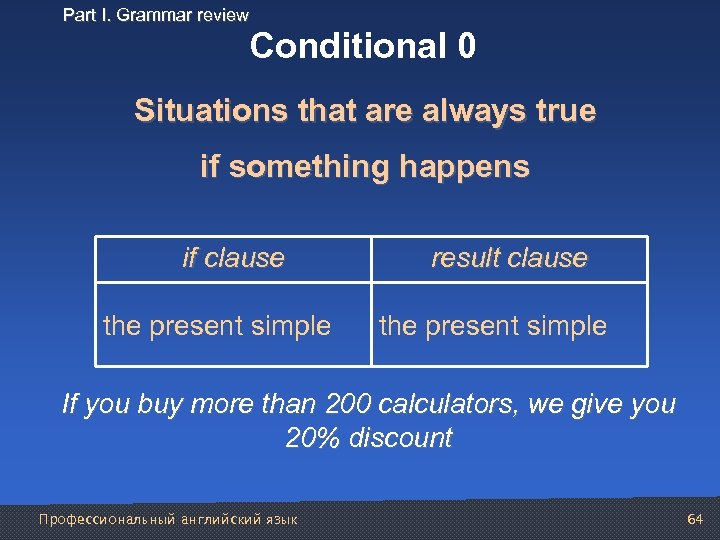
Part I. Grammar review Conditional 0 Situations that are always true if something happens if clause the present simple result clause the present simple If you buy more than 200 calculators, we give you 20% discount Профессиональный английский язык 64
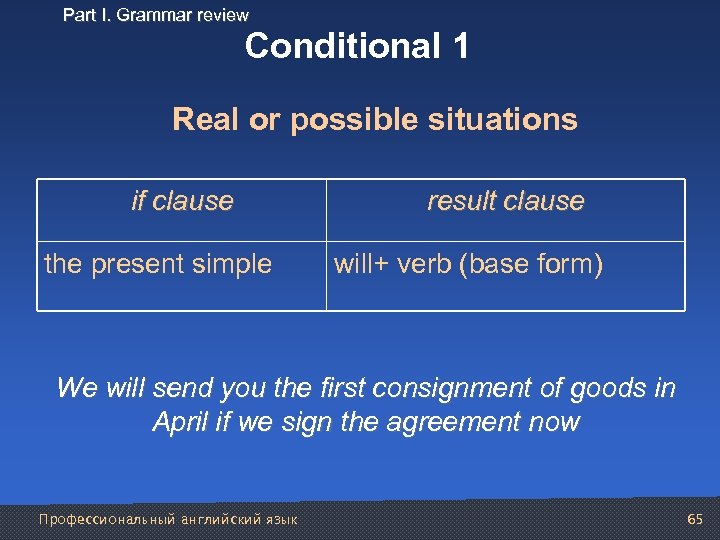
Part I. Grammar review Conditional 1 Real or possible situations if clause the present simple result clause will+ verb (base form) We will send you the first consignment of goods in April if we sign the agreement now Профессиональный английский язык 65
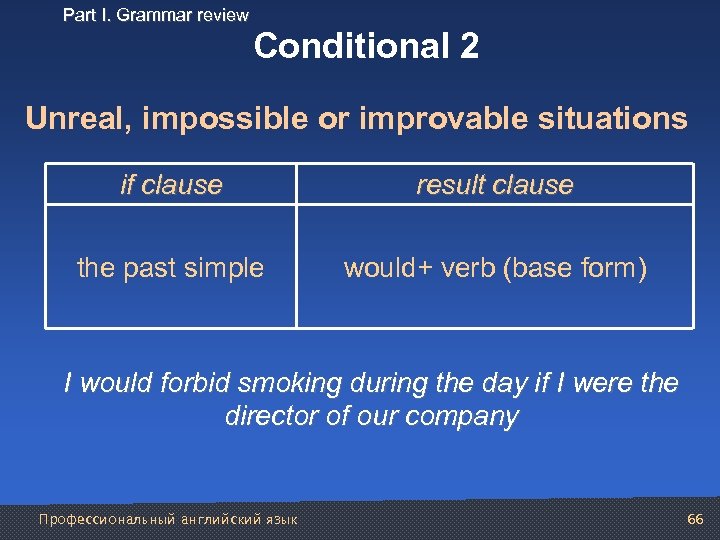
Part I. Grammar review Conditional 2 Unreal, impossible or improvable situations if clause result clause the past simple would+ verb (base form) I would forbid smoking during the day if I were the director of our company Профессиональный английский язык 66

Part I. Grammar review Conditional 3 Past situations with hypothetical results if clause the past perfect result clause would have+ past participle If I had known that boss watching I wouldn’t have played videogames on the working place Профессиональный английский язык 67
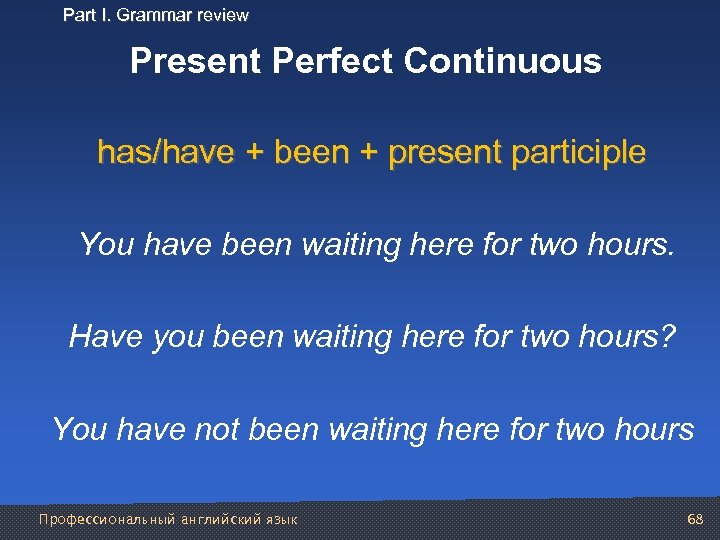
Part I. Grammar review Present Perfect Continuous has/have + been + present participle You have been waiting here for two hours. Have you been waiting here for two hours? You have not been waiting here for two hours Профессиональный английский язык 68
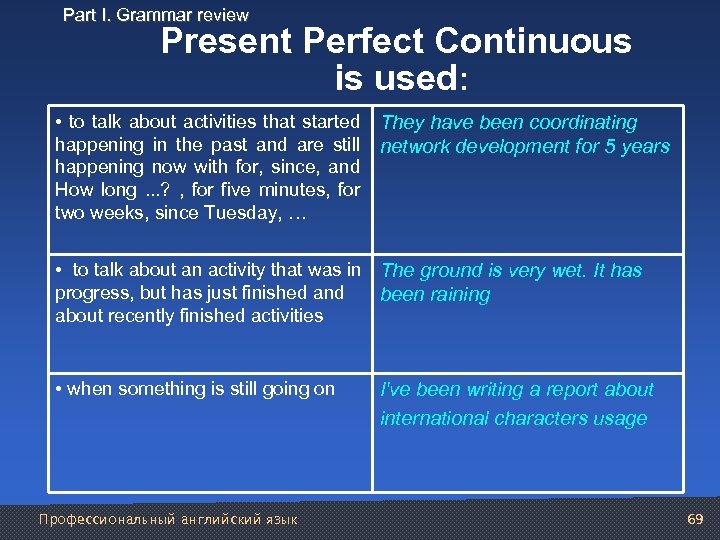
Part I. Grammar review Present Perfect Continuous is used: • to talk about activities that started They have been coordinating happening in the past and are still network development for 5 years happening now with for, since, and How long . . . ? , for five minutes, for two weeks, since Tuesday, … • to talk about an activity that was in The ground is very wet. It has progress, but has just finished and been raining about recently finished activities • when something is still going on Профессиональный английский язык I've been writing a report about international characters usage 69
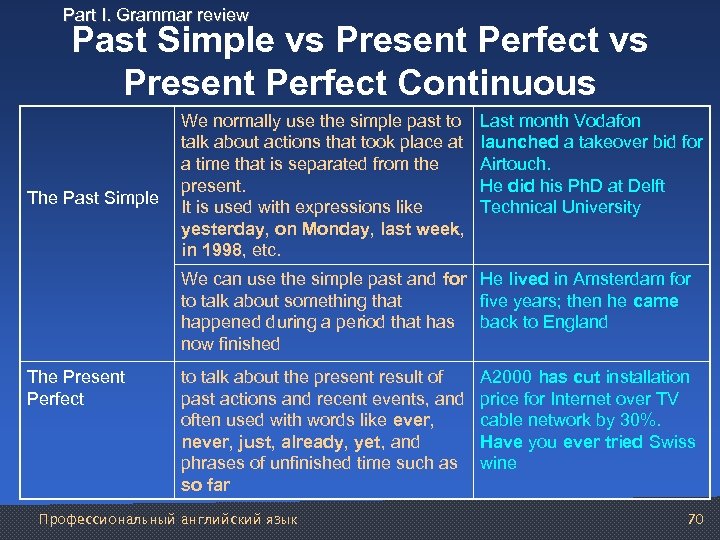
Part I. Grammar review Past Simple vs Present Perfect Continuous The Past Simple We normally use the simple past to talk about actions that took place at a time that is separated from the present. It is used with expressions like yesterday, on Monday, last week, in 1998, etc. Last month Vodafon launched a takeover bid for Airtouch. He did his Ph. D at Delft Technical University We can use the simple past and for He lived in Amsterdam for to talk about something that five years; then he came happened during a period that has back to England now finished The Present Perfect to talk about the present result of past actions and recent events, and often used with words like ever, never, just, already, yet, and phrases of unfinished time such as so far Профессиональный английский язык A 2000 has cut installation price for Internet over TV cable network by 30%. Have you ever tried Swiss wine 70
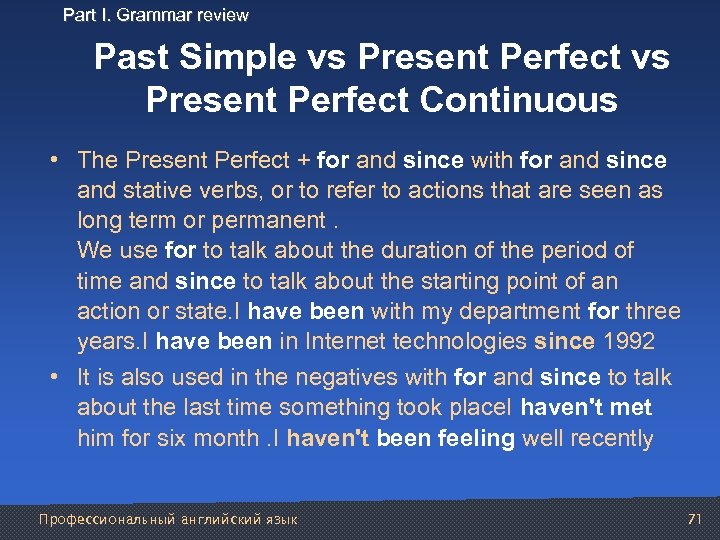
Part I. Grammar review Past Simple vs Present Perfect Continuous • The Present Perfect + for and since with for and since and stative verbs, or to refer to actions that are seen as long term or permanent. We use for to talk about the duration of the period of time and since to talk about the starting point of an action or state. I have been with my department for three years. I have been in Internet technologies since 1992 • It is also used in the negatives with for and since to talk about the last time something took place. I haven't met him for six month. I haven't been feeling well recently Профессиональный английский язык 71
Part I. Grammar review Past Simple vs Present Perfect Continuous • It is used with since to talk about completed action. The Commission has launched three new programs since December • The Present Perfect Continuous. The present perfect continuous can be used with for and since to talk about activities that have gone on repeatedly or continuously for a period of time, and are still going on. The Commission has been coordinating network development for 5 years Профессиональный английский язык 72
Part I. Grammar review Past Continuous was/were + present participle You were studying when she called. Were you studying when she called? You were not studying when she called Профессиональный английский язык 73
Part I. Grammar review Past Continuous is used: • to indicate that a longer Sammy was waiting for us when action in the past was we got off the plane. interrupted While I was writing the email, the computer suddenly went off. A: What were you doing when you broke your leg? B: I was snowboarding • to express the idea that I wasn't paying attention while I parallel actions were was writing the letter, so I made happening at the same several mistakes. time What were you doing while you were waiting? Профессиональный английский язык 74
Part I. Grammar review Past Continuous is used: • to describe the atmosphere at a particular time in the past When I walked into the office, several people were busily typing, some were talking on the phones, the boss was yelling directions, and customers were waiting to be helped. One customer was yelling at a secretary and waving his hands. Others were complaining to each other about the bad service • to expresse the idea that something irritating or shocking often happened in the past. He was constantly talking. He annoyed everyone. I didn't like them because they were always complaining Профессиональный английский язык 75
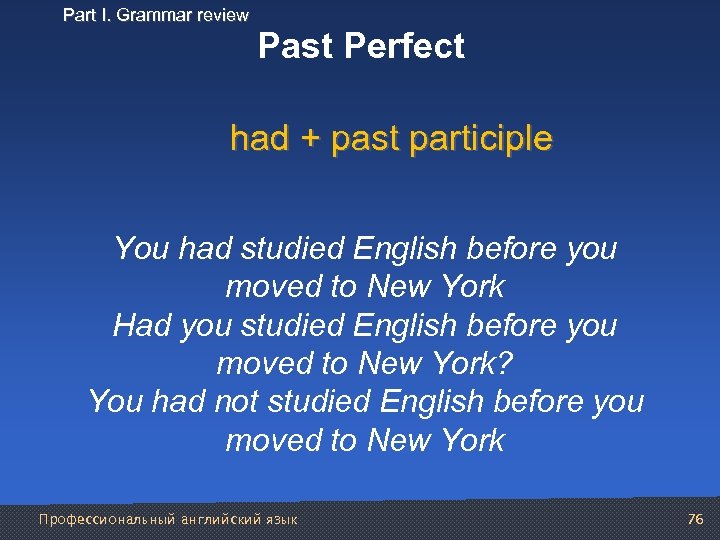
Part I. Grammar review Past Perfect had + past participle You had studied English before you moved to New York Had you studied English before you moved to New York? You had not studied English before you moved to New York Профессиональный английский язык 76
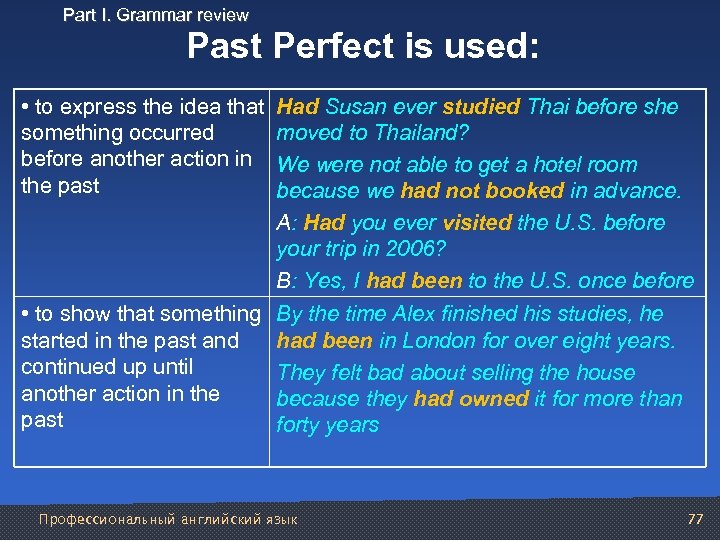
Part I. Grammar review Past Perfect is used: • to express the idea that Had Susan ever studied Thai before she something occurred moved to Thailand? before another action in We were not able to get a hotel room the past because we had not booked in advance. A: Had you ever visited the U. S. before your trip in 2006? B: Yes, I had been to the U. S. once before • to show that something By the time Alex finished his studies, he started in the past and had been in London for over eight years. continued up until They felt bad about selling the house another action in the because they had owned it for more than past forty years Профессиональный английский язык 77
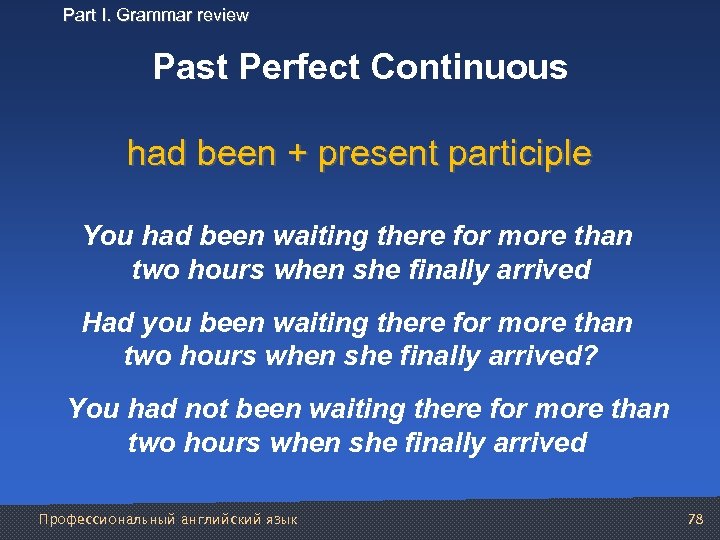
Part I. Grammar review Past Perfect Continuous had been + present participle You had been waiting there for more than two hours when she finally arrived Had you been waiting there for more than two hours when she finally arrived? You had not been waiting there for more than two hours when she finally arrived Профессиональный английский язык 78
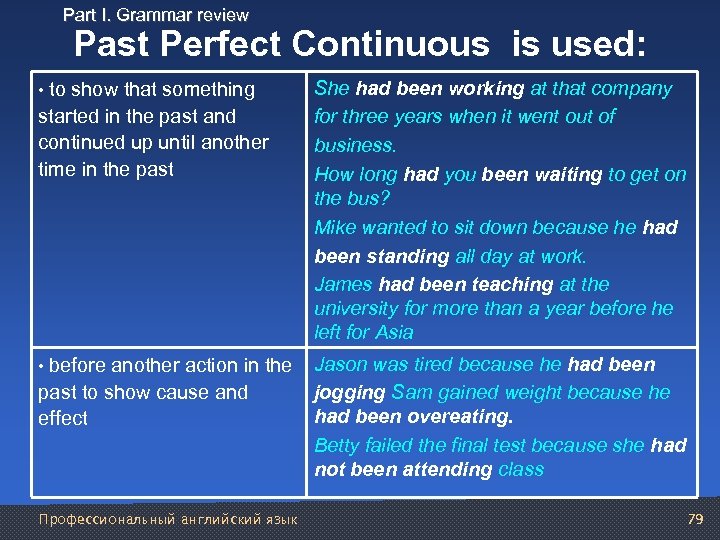
Part I. Grammar review Past Perfect Continuous is used: • to show that something started in the past and continued up until another time in the past She had been working at that company for three years when it went out of business. How long had you been waiting to get on the bus? Mike wanted to sit down because he had been standing all day at work. James had been teaching at the university for more than a year before he left for Asia • before another action in the Jason was tired because he had been past to show cause and effect Профессиональный английский язык jogging Sam gained weight because he had been overeating. Betty failed the final test because she had not been attending class 79
Part I. Grammar review Purpose clauses • to state the purpose of the action in the independent clause. The most common type of purpose clause is a to-infinitive clause Sarah went to the computer lab to print out her research report • In formal writing, in order to and so as to are often used The company conducted a detailed survey in order to gauge its clients’ views • In formal writing, so that or in order that can be used These finite purpose clauses usually contain a modal Dr Green adjusted the overhead projector so that the students would be able to see the chart more clearly Профессиональный английский язык 80
Part I. Grammar review Reason clauses • to explain why something happens, you can use a reason clause introduced by the conjunctions because, as or since As she wanted to practice her spoken English, Carrie regularly took part in the ELC’s Big Mouth Corner • to express reason use the prepositional phrases because of and on account of We were unable to carry out the experiment on account of a malfunction in the computer Профессиональный английский язык 81
Part I. Grammar review Result clauses • to indicate the result of an action or situation, you can use a result clause. Result clauses are introduced by conjunctions such as so, so. . . that, or such … that The lecture was boring and irrelevant, so some of the students began to fall asleep • to talk about the result of an action or situation you may prefer to use and as a result or with the result that The lecture was boring and irrelevant, and as a result some of the students began to fall asleep Профессиональный английский язык 82
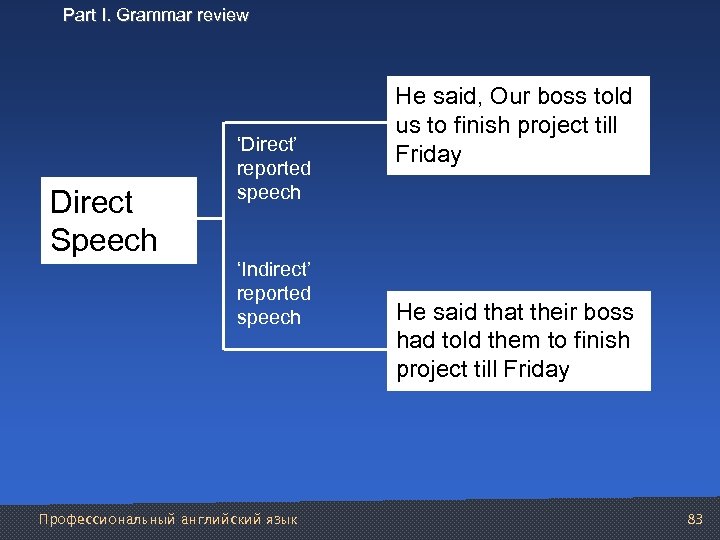
Part I. Grammar review Direct Speech ‘Direct’ reported speech ‘Indirect’ reported speech Профессиональный английский язык He said, Our boss told us to finish project till Friday He said that their boss had told them to finish project till Friday 83
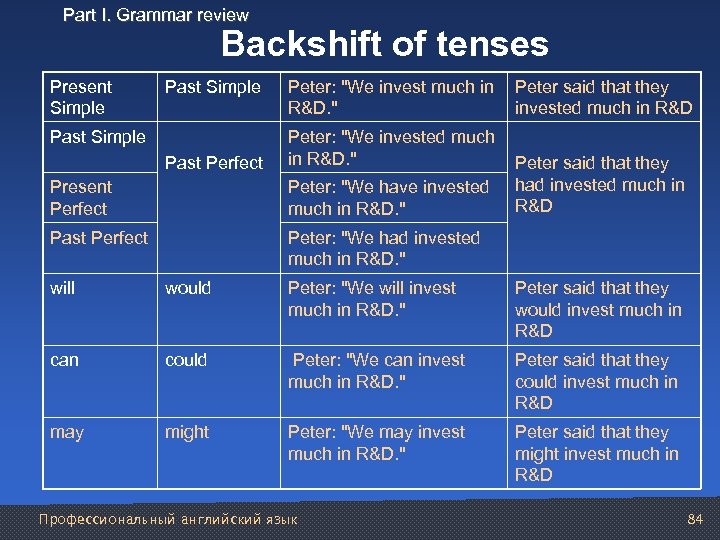
Part I. Grammar review Backshift of tenses Present Simple Past Perfect Present Perfect Past Perfect Peter: "We invest much in Peter said that they R&D. " invested much in R&D Peter: "We invested much in R&D. " Peter said that they Peter: "We have invested had invested much in R&D. " Peter: "We had invested much in R&D. " will would Peter: "We will invest much in R&D. " Peter said that they would invest much in R&D can could Peter: "We can invest much in R&D. " Peter said that they could invest much in R&D may might Peter: "We may invest much in R&D. " Peter said that they might invest much in R&D Профессиональный английский язык 84
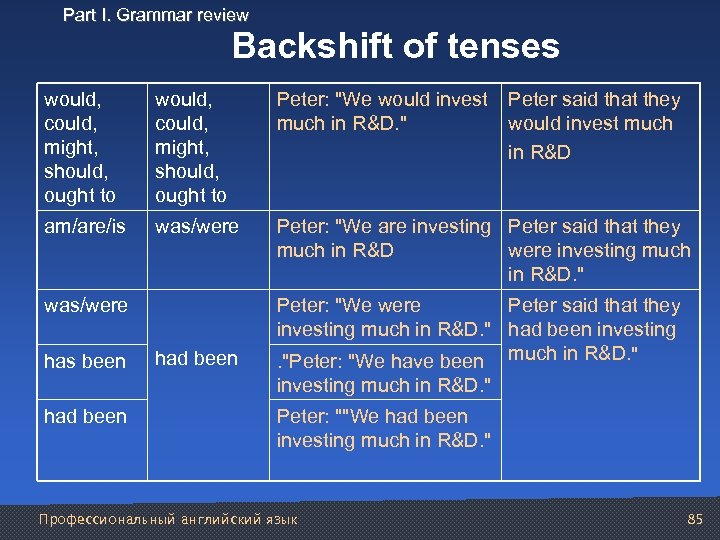
Part I. Grammar review Backshift of tenses would, could, might, should, ought to Peter: "We would invest Peter said that they much in R&D. " would invest much in R&D am/are/is was/were Peter: "We are investing Peter said that they much in R&D were investing much in R&D. " was/were has been had been Peter: "We were Peter said that they investing much in R&D. " had been investing . "Peter: "We have been much in R&D. " investing much in R&D. " had been Peter: ""We had been investing much in R&D. " Профессиональный английский язык 85
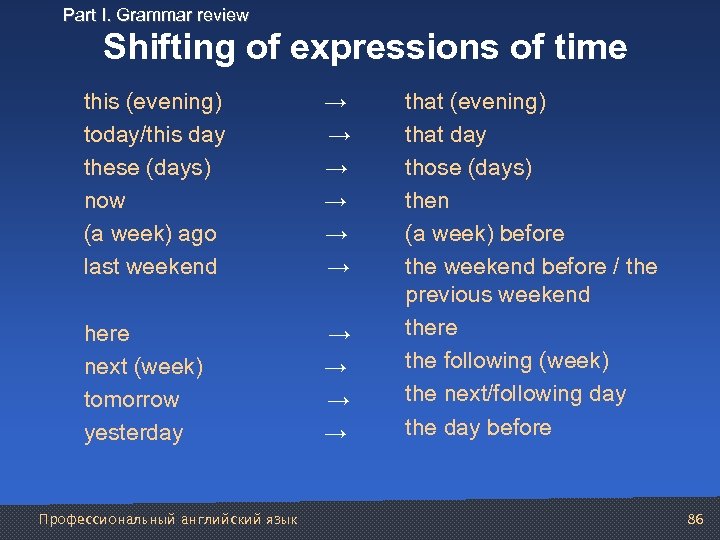
Part I. Grammar review Shifting of expressions of time this (evening) → today/this day → these (days) → now → (a week) ago → last weekend → here → next (week) → tomorrow → yesterday → Профессиональный английский язык that (evening) that day those (days) then (a week) before the weekend before / the previous weekend there the following (week) the next/following day the day before 86
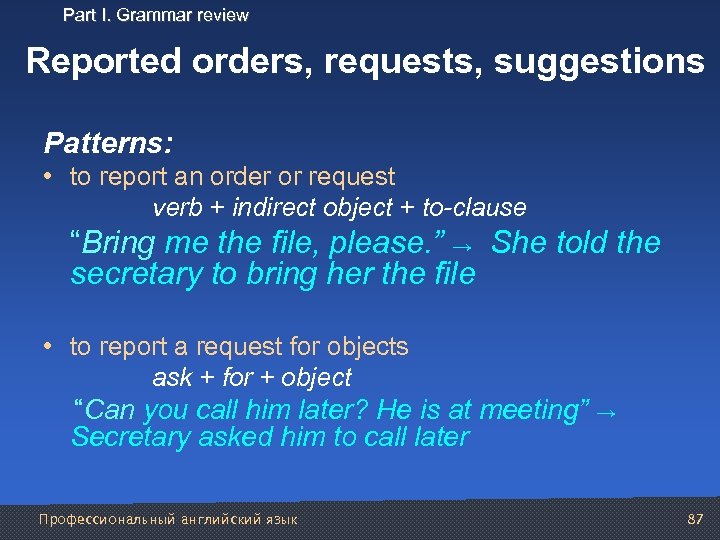
Part I. Grammar review Reported orders, requests, suggestions Patterns: • to report an order or request verb + indirect object + to clause “Bring me the file, please. ” → She told the secretary to bring her the file • to report a request for objects ask + for + object “Can you call him later? He is at meeting” → Secretary asked him to call later Профессиональный английский язык 87
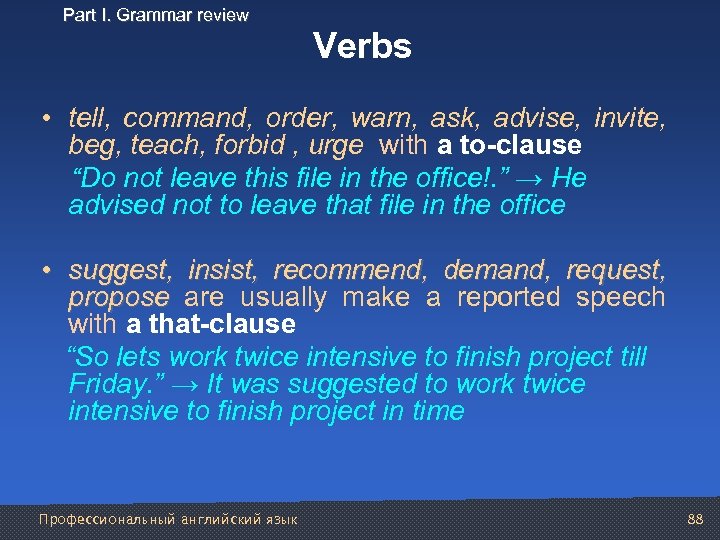
Part I. Grammar review Verbs • tell, command, order, warn, ask, advise, invite, beg, teach, forbid , urge with a to-clause “Do not leave this file in the office!. ” → He advised not to leave that file in the office • suggest, insist, recommend, demand, request, propose are usually make a reported speech propose with a that-clause “So lets work twice intensive to finish project till Friday. ” → It was suggested to work twice intensive to finish project in time Профессиональный английский язык 88
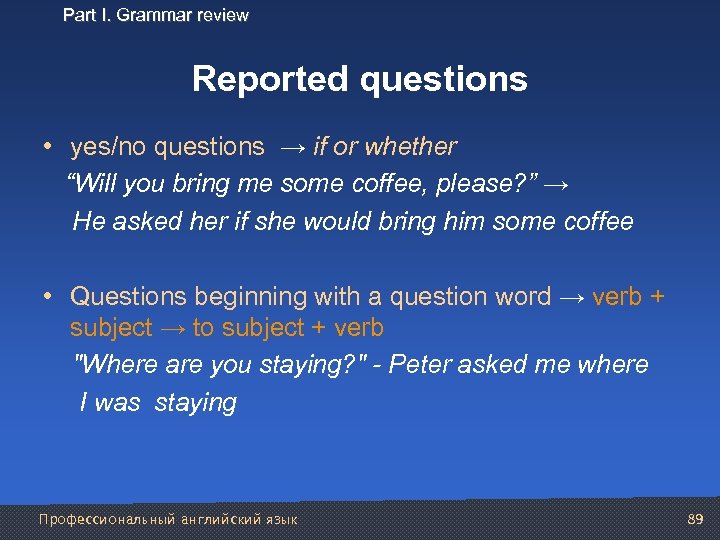
Part I. Grammar review Reported questions • yes/no questions → if оr whether “Will you bring me some coffee, please? ” → He asked her if she would bring him some coffee • Questions beginning with a question word → verb + subject → to subject + verb "Where are you staying? " Peter asked me where I was staying Профессиональный английский язык 89
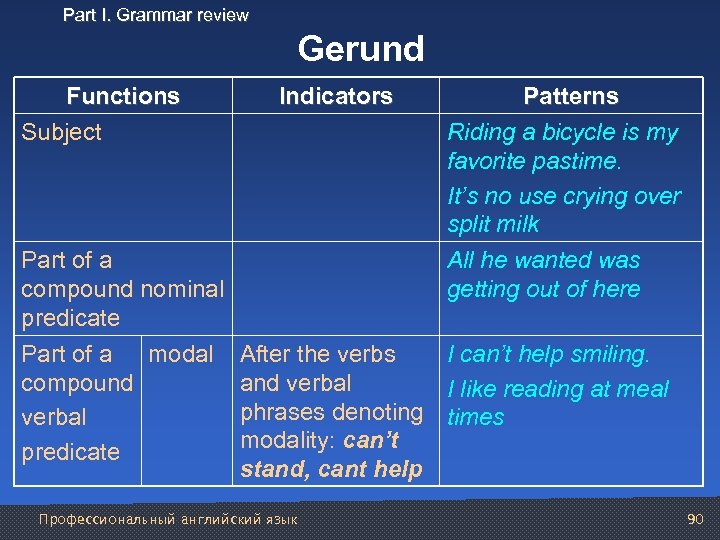
Part I. Grammar review Gerund Functions Subject Part of a compound nominal predicate Part of a modal compound verbal predicate Indicators Patterns Riding a bicycle is my favorite pastime. It’s no use crying over split milk All he wanted was getting out of here After the verbs I can’t help smiling. and verbal I like reading at meal phrases denoting times modality: can’t stand, cant help Профессиональный английский язык 90
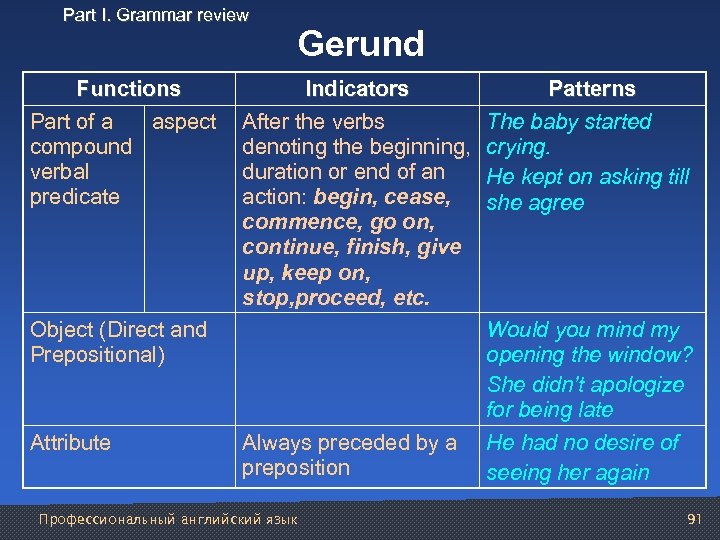
Part I. Grammar review Functions Part of a aspect compound verbal predicate Gerund Indicators After the verbs denoting the beginning, duration or end of an action: begin, cease, commence, go on, continue, finish, give up, keep on, stop, proceed, etc. Object (Direct and Prepositional) Attribute Always preceded by a preposition Профессиональный английский язык Patterns The baby started crying. He kept on asking till she agree Would you mind my opening the window? She didn’t apologize for being late He had no desire of seeing her again 91
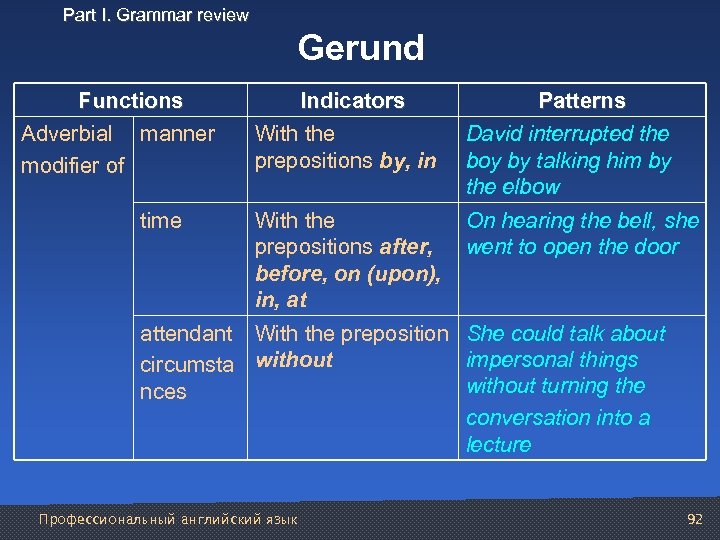
Part I. Grammar review Gerund Functions Adverbial manner modifier of time Indicators With the prepositions by, in Patterns David interrupted the boy by talking him by the elbow With the prepositions after, before, on (upon), in, at On hearing the bell, she went to open the door attendant With the preposition She could talk about impersonal things circumsta without turning the nces conversation into a lecture Профессиональный английский язык 92
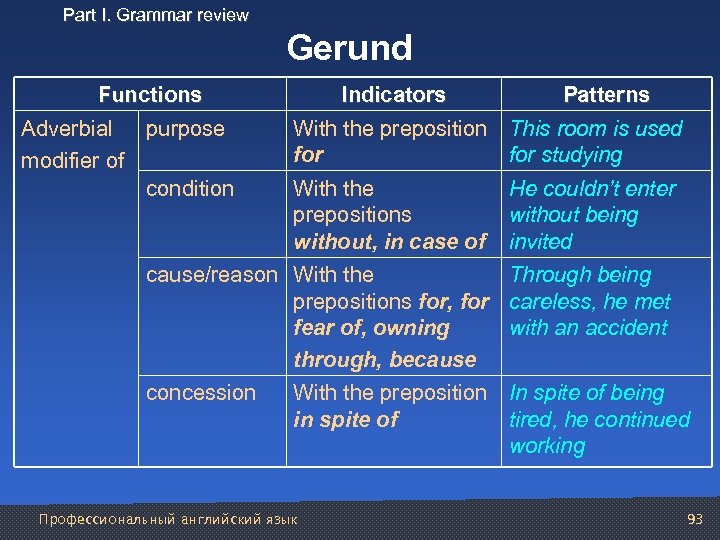
Part I. Grammar review Gerund Functions Adverbial purpose modifier of condition Indicators Patterns With the preposition This room is used for studying With the prepositions without, in case of He couldn’t enter without being invited cause/reason With the Through being prepositions for, for careless, he met fear of, owning with an accident through, because concession With the preposition In spite of being in spite of tired, he continued working Профессиональный английский язык 93
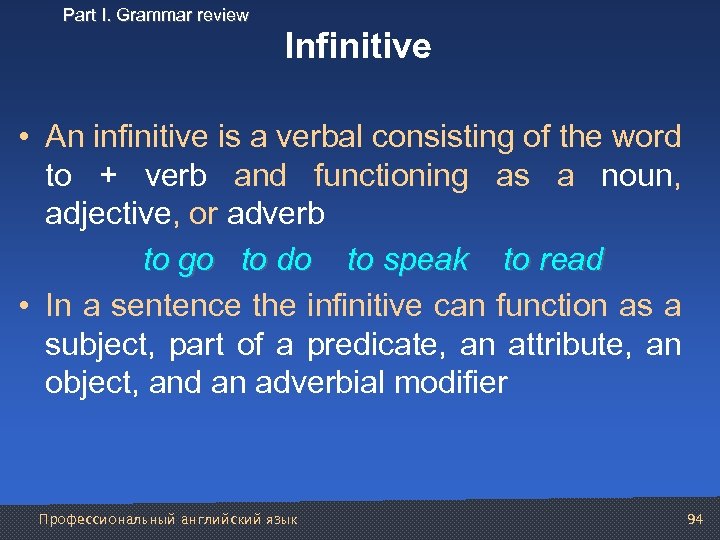
Part I. Grammar review Infinitive • An infinitive is a verbal consisting of the word to + verb and functioning as a noun, adjective, or adverb to go to do to speak to read • In a sentence the infinitive can function as a subject, part of a predicate, an attribute, an object, and an adverbial modifier Профессиональный английский язык 94
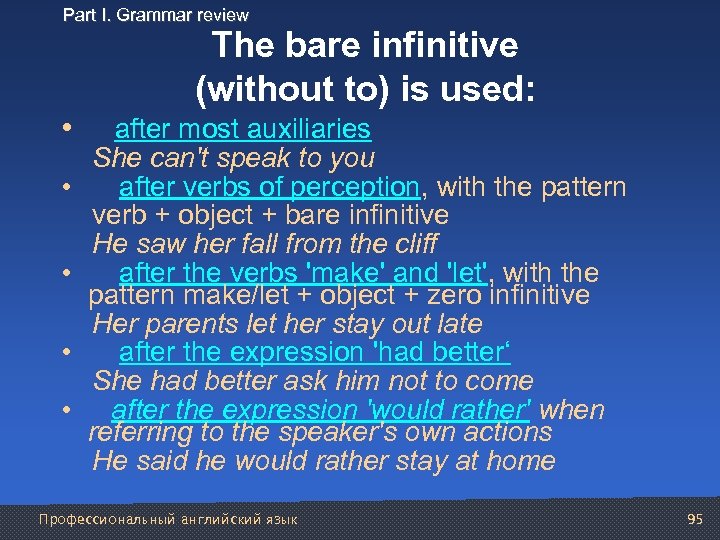
Part I. Grammar review The bare infinitive (without to) is used: • after most auxiliaries She can't speak to you • after verbs of perception, with the pattern verb + object + bare infinitive He saw her fall from the cliff • after the verbs 'make' and 'let', with the pattern make/let + object + zero infinitive Her parents let her stay out late • after the expression 'had better‘ She had better ask him not to come • after the expression 'would rather' when referring to the speaker's own actions Не said he would rather stay at home Профессиональный английский язык 95
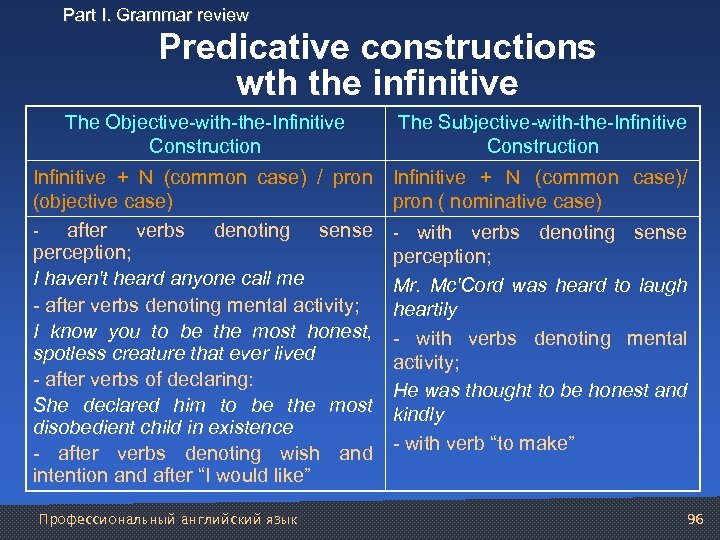
Part I. Grammar review Predicative constructions wth the infinitive The Objective with the Infinitive Construction The Subjective with the Infinitive Construction Infinitive + N (common case) / pron (objective case) after verbs denoting sense perception; I haven't heard anyone call me after verbs denoting mental activity; I know you to be the most honest, spotless creature that ever lived after verbs of declaring: She declared him to be the most disobedient child in existence after verbs denoting wish and intention and after “I would like” Infinitive + N (common case)/ pron ( nominative case) Профессиональный английский язык with verbs denoting sense perception; Mr. Mc'Cord was heard to laugh heartily with verbs denoting mental activity; He was thought to be honest and kindly with verb “to make” 96
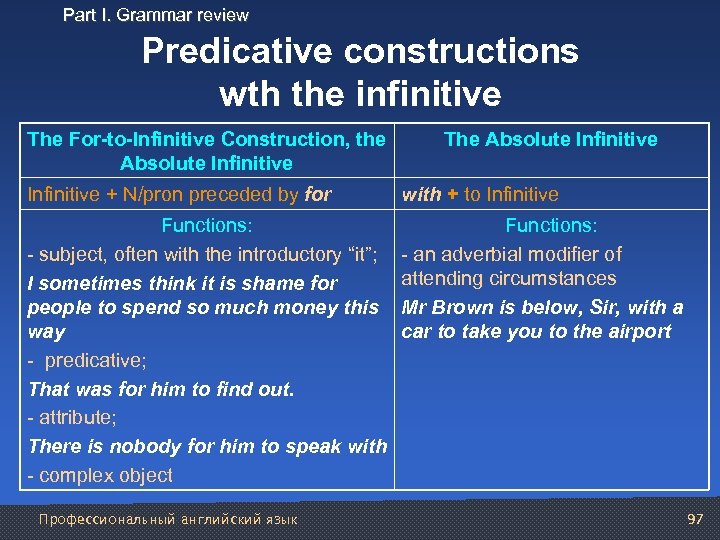
Part I. Grammar review Predicative constructions wth the infinitive The For-to-Infinitive Construction, the Absolute Infinitive The Absolute Infinitive + N/pron preceded by for with + to Infinitive Functions: subject, often with the introductory “it”; I sometimes think it is shame for people to spend so much money this way predicative; That was for him to find out. attribute; There is nobody for him to speak with complex object Functions: an adverbial modifier of attending circumstances Mr Brown is below, Sir, with a car to take you to the airport Профессиональный английский язык 97
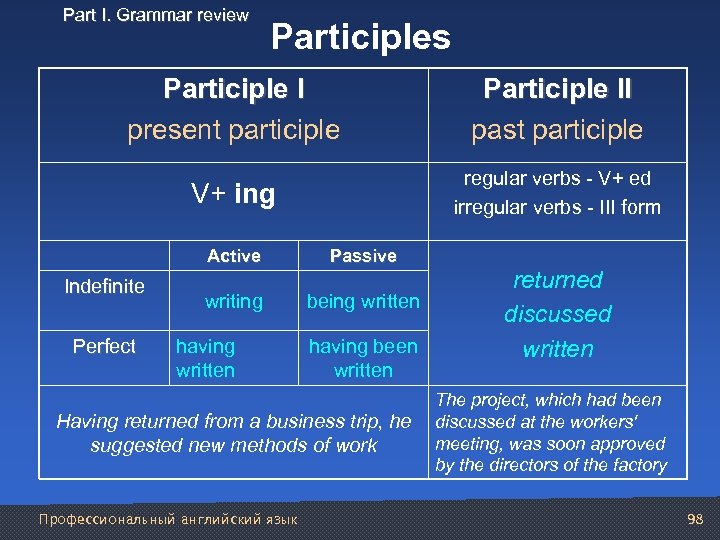
Part I. Grammar review Participles Participle I present participle Participle II past participle V+ ing regular verbs V+ ed irregular verbs III form Active Indefinite Perfect Passive writing being written having written having been written Having returned from a business trip, he suggested new methods of work Профессиональный английский язык returned discussed written The project, which had been discussed at the workers' meeting, was soon approved by the directors of the factory 98
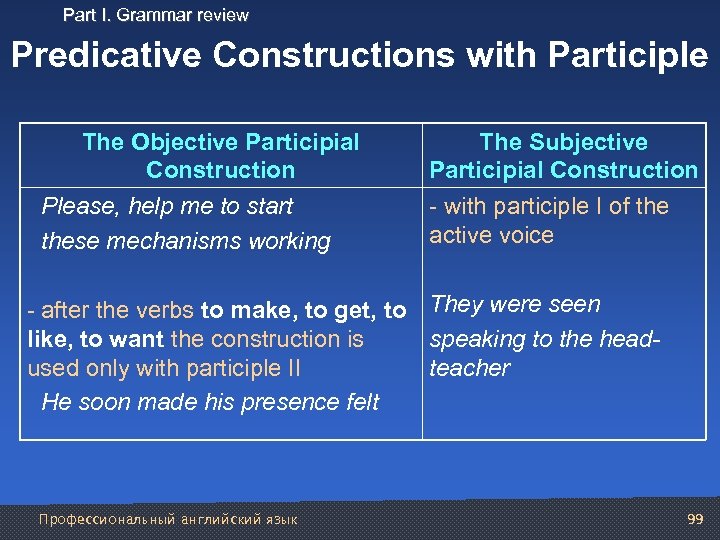
Part I. Grammar review Predicative Constructions with Participle The Objective Participial Construction Please, help me to start these mechanisms working The Subjective Participial Construction with participle I of the active voice after the verbs to make, to get, to They were seen speaking to the head like, to want the construction is teacher used only with participle II He soon made his presence felt Профессиональный английский язык 99
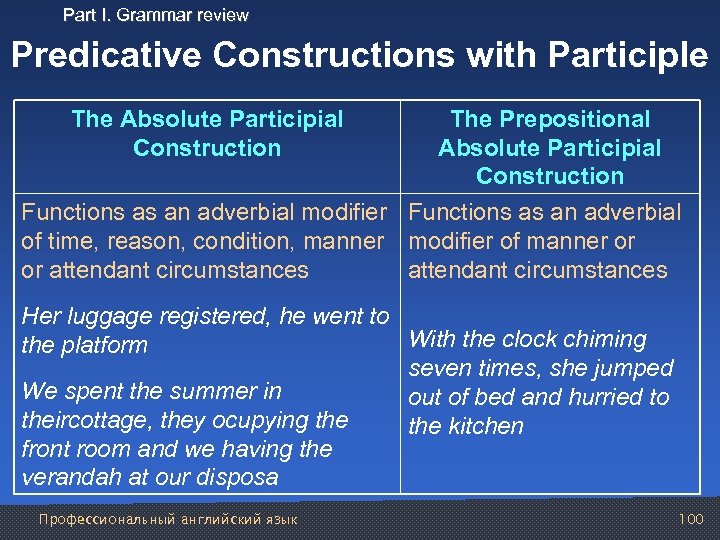
Part I. Grammar review Predicative Constructions with Participle The Absolute Participial Construction The Prepositional Absolute Participial Construction Functions as an adverbial modifier Functions as an adverbial of time, reason, condition, manner modifier of manner or or attendant circumstances Her luggage registered, he went to With the clock chiming the platform seven times, she jumped We spent the summer in out of bed and hurried to theircottage, they ocupying the kitchen front room and we having the verandah at our disposa Профессиональный английский язык 100
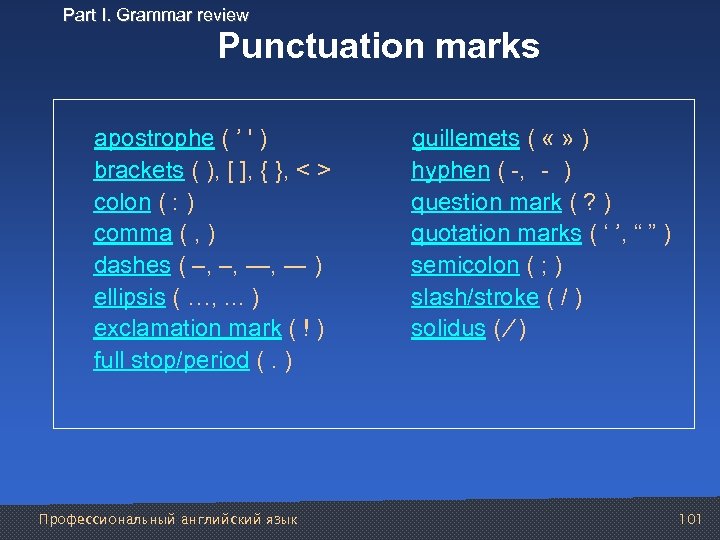
Part I. Grammar review Punctuation marks apostrophe ( ’ ' ) brackets ( ), [ ], { }, < > colon ( : ) comma ( , ) dashes ( ‒, –, —, ― ) ellipsis ( …, . . . ) exclamation mark ( ! ) full stop/period (. ) Профессиональный английский язык guillemets ( « » ) hyphen ( , ‐ ) question mark ( ? ) quotation marks ( ‘ ’, “ ” ) semicolon ( ; ) slash/stroke ( / ) solidus ( ∕ ) 101
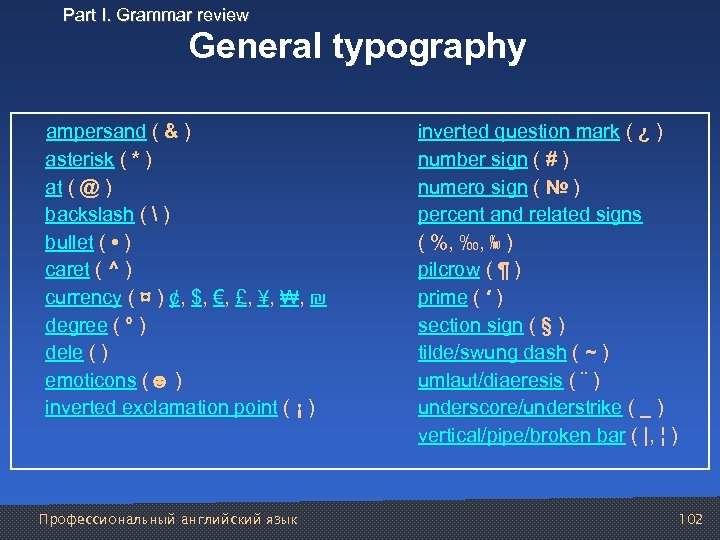
Part I. Grammar review General typography ampersand ( & ) asterisk ( * ) at ( @ ) backslash ( ) bullet ( • ) caret ( ^ ) currency ( ¤ ) ¢, $, €, £, ¥, ₩, ₪ degree ( ° ) dele ( ) emoticons (☻ ) inverted exclamation point ( ¡ ) Профессиональный английский язык inverted question mark ( ¿ ) number sign ( # ) numero sign ( № ) percent and related signs ( %, ‰, ‱ ) pilcrow ( ¶ ) prime ( ′ ) section sign ( § ) tilde/swung dash ( ~ ) umlaut/diaeresis ( ¨ ) underscore/understrike ( _ ) vertical/pipe/broken bar ( |, ¦ ) 102
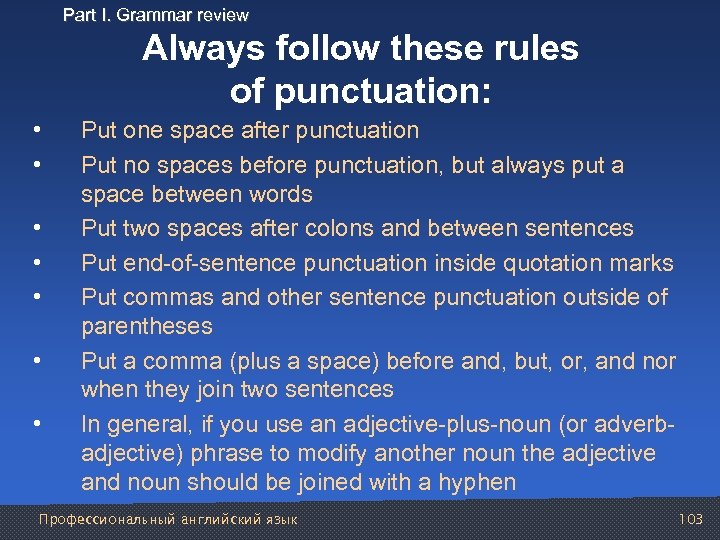
Part I. Grammar review Always follow these rules of punctuation: • • Put one space after punctuation Put no spaces before punctuation, but always put a space between words Put two spaces after colons and between sentences Put end of sentence punctuation inside quotation marks Put commas and other sentence punctuation outside of parentheses Put a comma (plus a space) before and, but, or, and nor when they join two sentences In general, if you use an adjective plus noun (or adverb adjective) phrase to modify another noun the adjective and noun should be joined with a hyphen Профессиональный английский язык 103
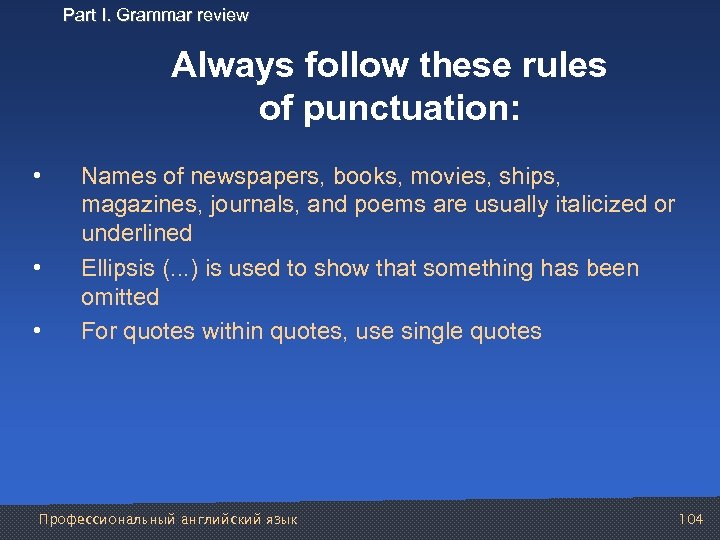
Part I. Grammar review Always follow these rules of punctuation: • • • Names of newspapers, books, movies, ships, magazines, journals, and poems are usually italicized or underlined Ellipsis (. . . ) is used to show that something has been omitted For quotes within quotes, use single quotes Профессиональный английский язык 104

Part II. Language check 105
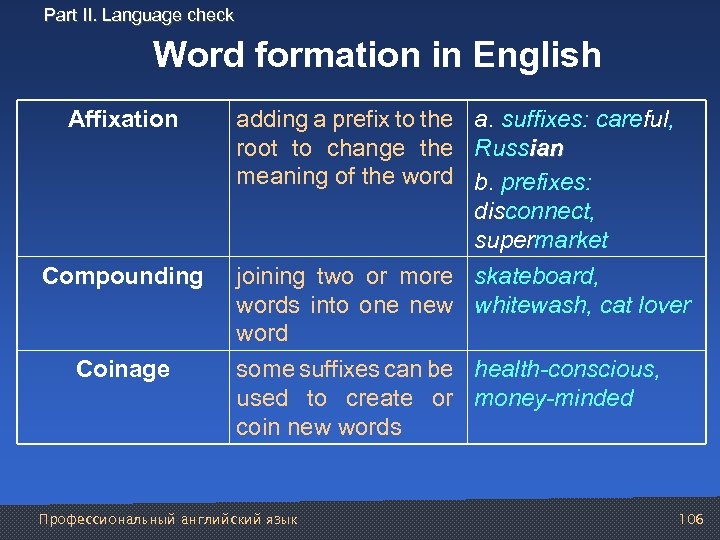
Part II. Language check Word formation in English Affixation Compounding Coinage adding a prefix to the a. suffixes: careful, root to change the Russian meaning of the word b. prefixes: disconnect, supermarket joining two or more words into one new word some suffixes can be used to create or coin new words Профессиональный английский язык skateboard, whitewash, cat lover health conscious, money minded 106
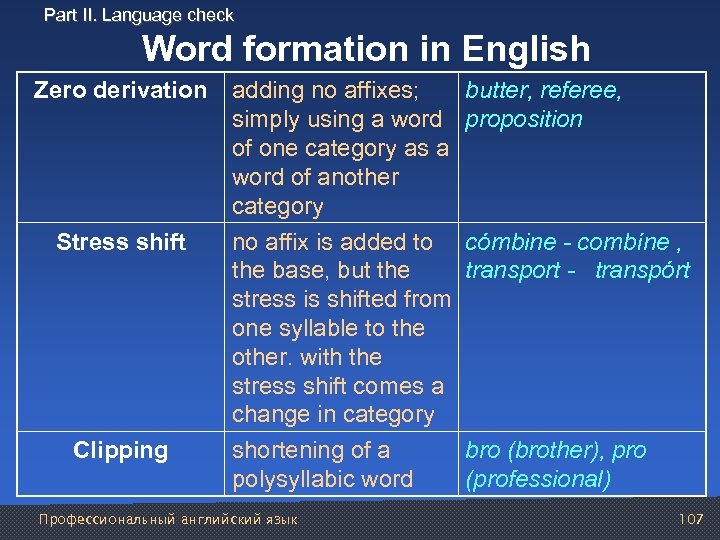
Part II. Language check Word formation in English Zero derivation Stress shift Clipping adding no affixes; butter, referee, simply using a word proposition of one category as a word of another category no affix is added to cómbine combíne , the base, but the transport transpórt stress is shifted from one syllable to the other. with the stress shift comes a change in category shortening of a bro (brother), pro polysyllabic word (professional) Профессиональный английский язык 107
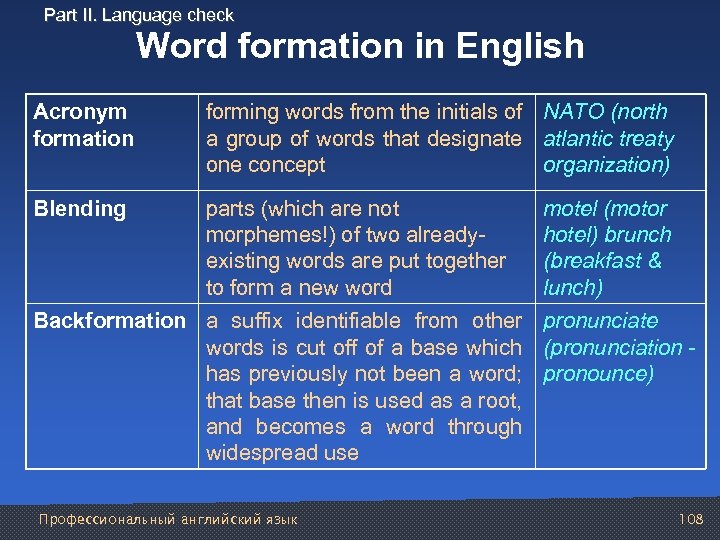
Part II. Language check Word formation in English Acronym formation forming words from the initials of NATO (north a group of words that designate atlantic treaty one concept organization) Blending parts (which are not morphemes!) of two already existing words are put together to form a new word motel (motor hotel) brunch (breakfast & lunch) Backformation a suffix identifiable from other pronunciate words is cut off of a base which (pronunciation has previously not been a word; pronounce) that base then is used as a root, and becomes a word through widespread use Профессиональный английский язык 108
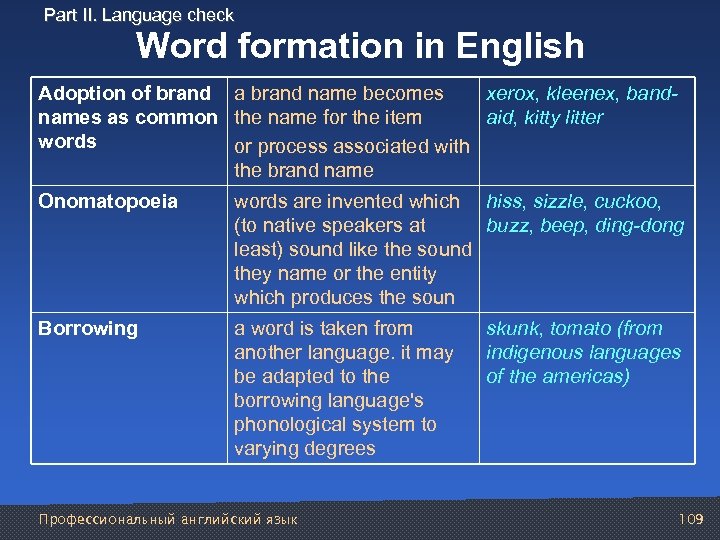
Part II. Language check Word formation in English Adoption of brand a brand name becomes xerox, kleenex, band names as common the name for the item aid, kitty litter words or process associated with the brand name Onomatopoeia words are invented which hiss, sizzle, cuckoo, (to native speakers at buzz, beep, ding dong least) sound like the sound they name or the entity which produces the soun Borrowing a word is taken from another language. it may be adapted to the borrowing language's phonological system to varying degrees Профессиональный английский язык skunk, tomato (from indigenous languages of the americas) 109
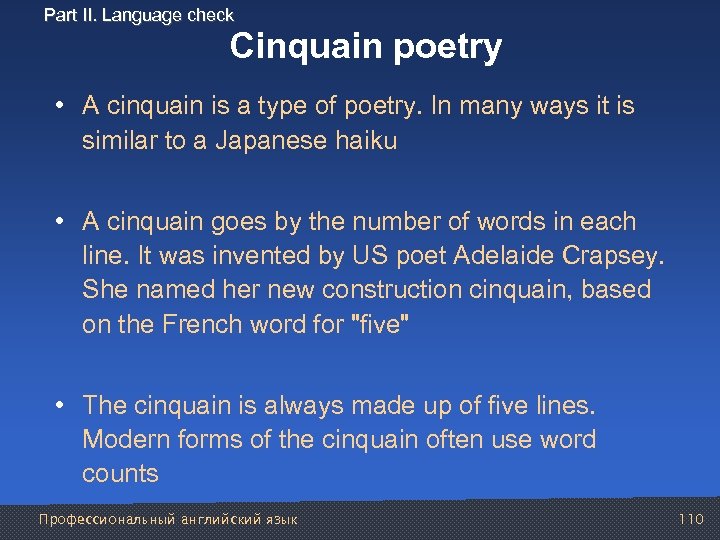
Part II. Language check Cinquain poetry • A cinquain is a type of poetry. In many ways it is similar to a Japanese haiku • A cinquain goes by the number of words in each line. It was invented by US poet Adelaide Crapsey. She named her new construction cinquain, based on the French word for "five" • The cinquain is always made up of five lines. Modern forms of the cinquain often use word counts Профессиональный английский язык 110
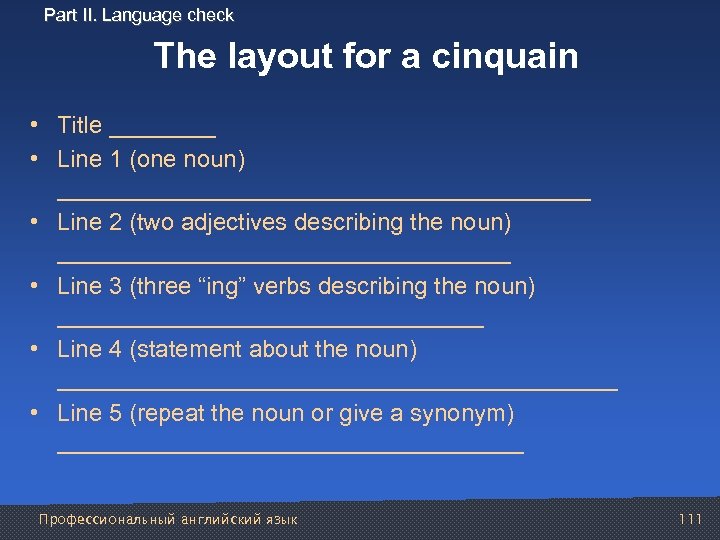
Part II. Language check The layout for a cinquain • Title ____ • Line 1 (one noun) ____________________ • Line 2 (two adjectives describing the noun) _________________ • Line 3 (three “ing” verbs describing the noun) ________________ • Line 4 (statement about the noun) _____________________ • Line 5 (repeat the noun or give a synonym) __________________ Профессиональный английский язык 111
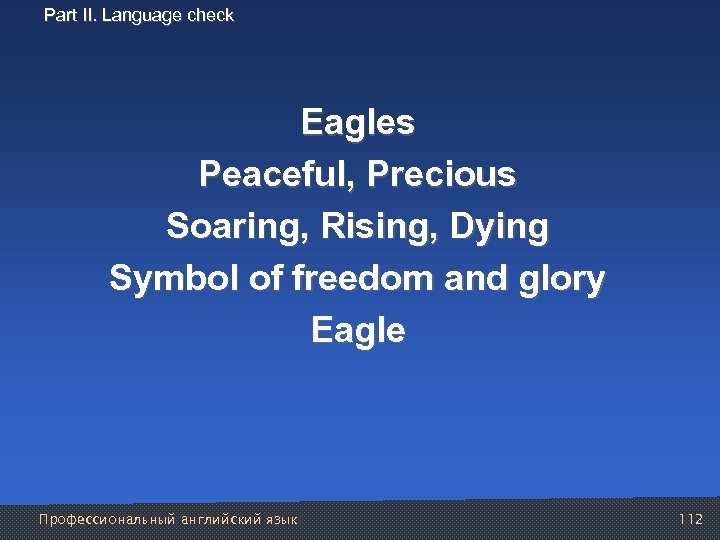
Part II. Language check Eagles Peaceful, Precious Soaring, Rising, Dying Symbol of freedom and glory Eagle Профессиональный английский язык 112
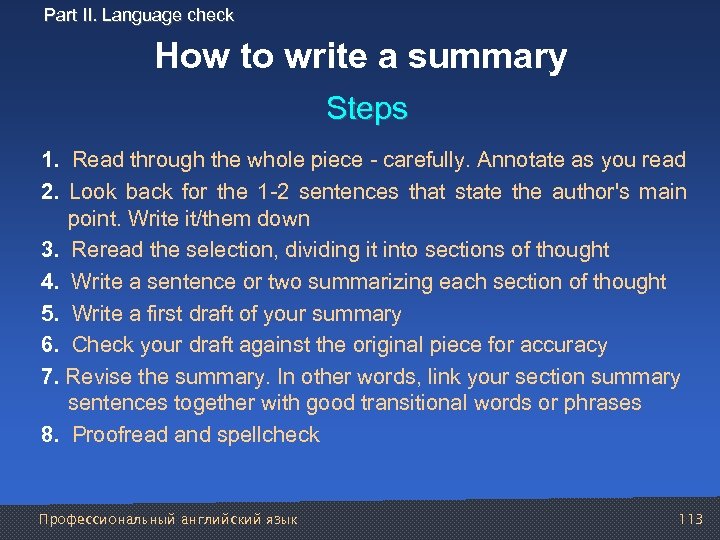
Part II. Language check How to write a summary Steps 1. Read through the whole piece carefully. Annotate as you read 2. Look back for the 1 2 sentences that state the author's main point. Write it/them down 3. Reread the selection, dividing it into sections of thought 4. Write a sentence or two summarizing each section of thought 5. Write a first draft of your summary 6. Check your draft against the original piece for accuracy 7. Revise the summary. In other words, link your section summary sentences together with good transitional words or phrases 8. Proofread and spellcheck Профессиональный английский язык 113
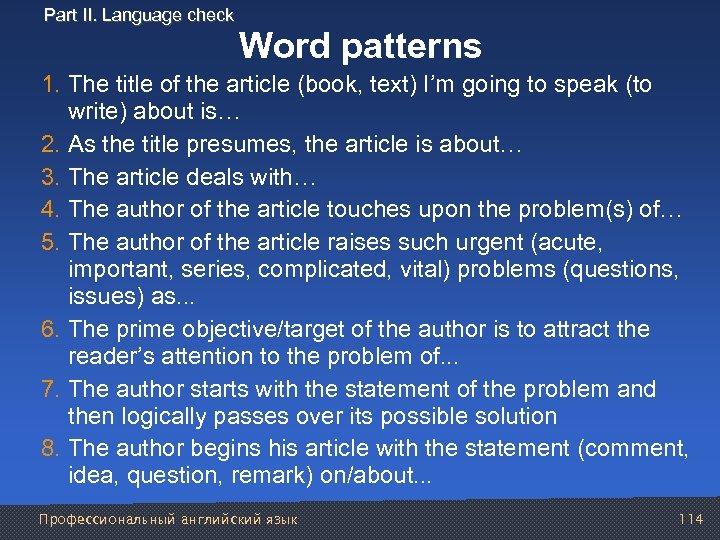
Part II. Language check Word patterns 1. The title of the article (book, text) I’m going to speak (to write) about is… 2. As the title presumes, the article is about… 3. The article deals with… 4. The author of the article touches upon the problem(s) of… 5. The author of the article raises such urgent (acute, important, series, complicated, vital) problems (questions, issues) as. . . 6. The prime objective/target of the author is to attract the reader’s attention to the problem of. . . 7. The author starts with the statement of the problem and then logically passes over its possible solution 8. The author begins his article with the statement (comment, idea, question, remark) on/about. . . Профессиональный английский язык 114
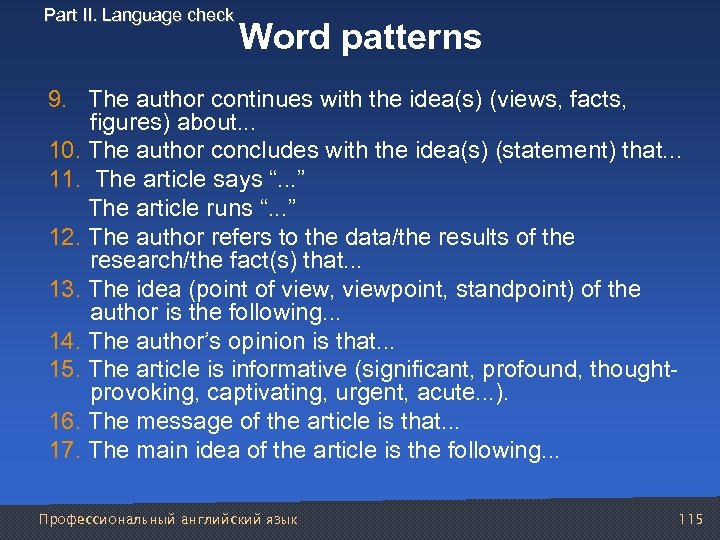
Part II. Language check Word patterns 9. The author continues with the idea(s) (views, facts, figures) about. . . 10. The author concludes with the idea(s) (statement) that. . . 11. The article says “. . . ” The article runs “. . . ” 12. The author refers to the data/the results of the research/the fact(s) that. . . 13. The idea (point of view, viewpoint, standpoint) of the author is the following. . . 14. The author’s opinion is that. . . 15. The article is informative (significant, profound, thought provoking, captivating, urgent, acute. . . ). 16. The message of the article is that. . . 17. The main idea of the article is the following. . . Профессиональный английский язык 115
![Part II. Language check Measures of Length Imperial Metric 1 inch [in] 2. 54](https://present5.com/presentation/56846063fe29d894609575ba9193acd4/image-116.jpg "Part II. Language check Measures of Length Imperial Metric 1 inch [in] 2. 54")
Part II. Language check Measures of Length Imperial Metric 1 inch [in] 2. 54 cm 1 foot [ft] 12 in 0. 3048 m 1 yard [yd] 3 ft Metric Imperial 0. 03937 in 1 millimetre [mm] 10 mm 0. 3937 in 100 cm 1. 0936 yd 1000 m 0. 6214 mile 0. 9144 m 1 centimetre [cm] 1 metre [m] 1 mile 1760 yd 1. 6093 km 1 int nautical mile 2025. 4 yd 1. 853 km Профессиональный английский язык 1 kilometre [km] 116
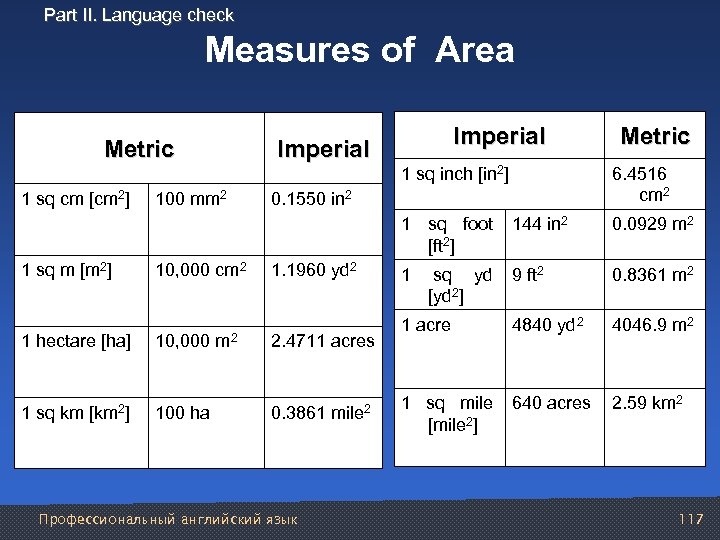
Part II. Language check Measures of Area Metric Imperial Metric 1 sq inch [in 2] 1 sq foot 144 in 2 [ft 2] 1 sq cm [cm 2] 1 sq m [m 2] 1 hectare [ha] 1 sq km [km 2] 100 mm 2 10, 000 cm 2 6. 4516 cm 2 0. 0929 m 2 1 sq yd 9 ft 2 [yd 2] 0. 8361 m 2 1 acre 4046. 9 m 2 0. 1550 in 2 1. 1960 yd 2 10, 000 m 2 2. 4711 acres 100 ha 0. 3861 mile 2 Профессиональный английский язык 4840 yd 2 1 sq mile 640 acres [mile 2] 2. 59 km 2 117
![Part II. Language check Measures of Volume Metric Imperial 1 cu cm [cm] 0.](https://present5.com/presentation/56846063fe29d894609575ba9193acd4/image-118.jpg "Part II. Language check Measures of Volume Metric Imperial 1 cu cm [cm] 0.")
Part II. Language check Measures of Volume Metric Imperial 1 cu cm [cm] 0. 0610 in 3 Imperial 1 cu inch [in 3] 1 cu decimetre 1, 000 cm 3 0. 0353 ft 3 3] [dm 1 cu metre [m 3] 1 litre [l] 1 hectolitre [hl] 1, 000 dm 3 1 cu foot [ft 3] 16. 387 cm 3 1, 728 in 3 1 fluid ounce [fl oz] 1. 3080 yd 3 Metric 0. 0283 m 3 28. 413 ml 1 pint [pt] 20 fl oz 0. 5683 l 1 gallon[gal] 8 pt 1. 76 pt 100 l 21. 997 gal USA measure 4. 5461 l Metric 1 fluid ounce 1. 0408 uk fl oz 29. 574 ml 1 pint (16 fl oz) 0. 8327 uk pt 0. 4731 l 1 gallon 0. 8327 uk gal 3. 7854 l Профессиональный английский язык 118
![Part II. Language check Measures of Mass Metric Imperial 1 milligram [mg] 0. 0154](https://present5.com/presentation/56846063fe29d894609575ba9193acd4/image-119.jpg "Part II. Language check Measures of Mass Metric Imperial 1 milligram [mg] 0. 0154")
Part II. Language check Measures of Mass Metric Imperial 1 milligram [mg] 0. 0154 grain Imperial Metric 1, 000 mg 1 kilogram [kg] 1, 000 g 1 tonne [t] 1, 000 kg 0. 0353 oz 437 grain 28. 35 g 1 pound [lb] 16 oz 0. 4536 kg 1 stone 1 gram [g] 1 ounce [oz] 14 lb 6. 3503 kg 1 hundredweight 112 lb [cwt] 50. 802 kg 2. 2046 lb 0. 9842 ton 1 long ton (uk) Профессиональный английский язык 20 cwt 1. 016 t 119
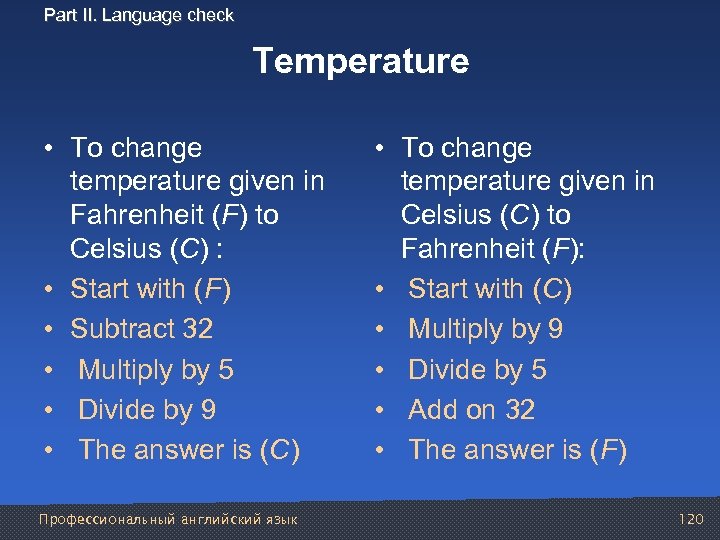
Part II. Language check Temperature • To change temperature given in Fahrenheit (F) to Celsius (C) : • Start with (F) • Subtract 32 • Multiply by 5 • Divide by 9 • The answer is (C) Профессиональный английский язык • To change temperature given in Celsius (C) to Fahrenheit (F): • Start with (C) • Multiply by 9 • Divide by 5 • Add on 32 • The answer is (F) 120
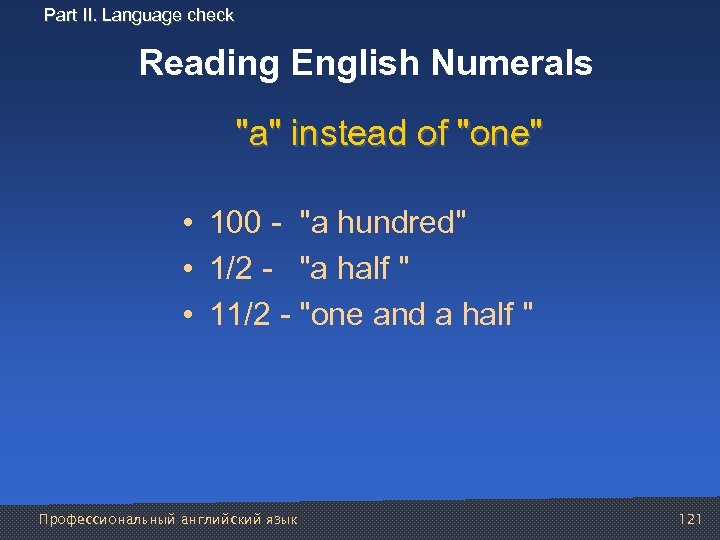
Part II. Language check Reading English Numerals "a" instead of "one" • 100 "a hundred" • 1/2 "a half " • 11/2 "one and a half " Профессиональный английский язык 121
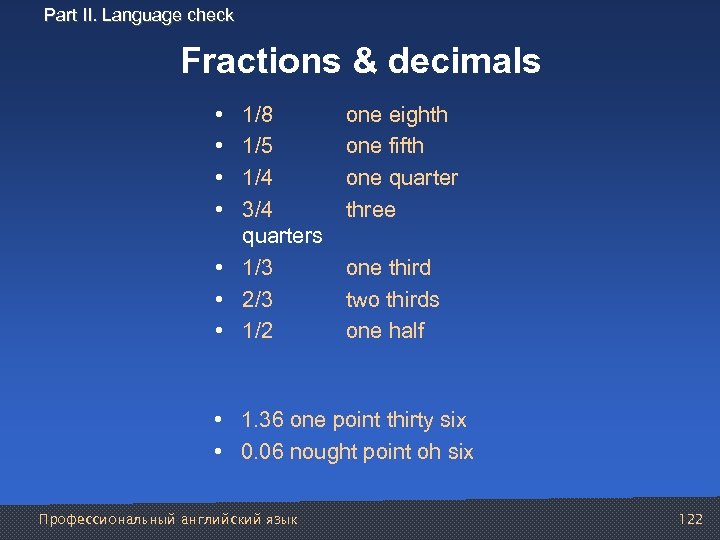
Part II. Language check Fractions & decimals • • 1/8 one eighth 1/5 one fifth 1/4 one quarter 3/4 three quarters • 1/3 one third • 2/3 two thirds • 1/2 one half • 1. 36 one point thirty six • 0. 06 nought point oh six Профессиональный английский язык 122
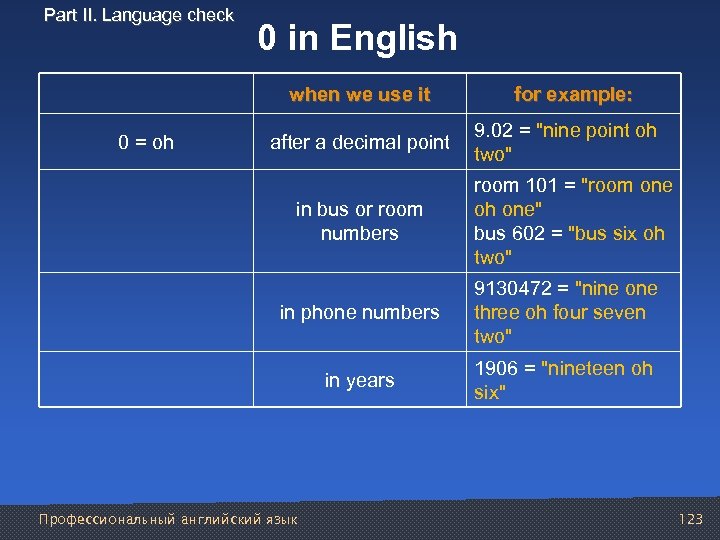
Part II. Language check 0 in English when we use it 0 = oh after a decimal point in bus or room numbers for example: 9. 02 = "nine point oh two" room 101 = "room one oh one" bus 602 = "bus six oh two" in phone numbers 9130472 = "nine one three oh four seven two" in years 1906 = "nineteen oh six" Профессиональный английский язык 123
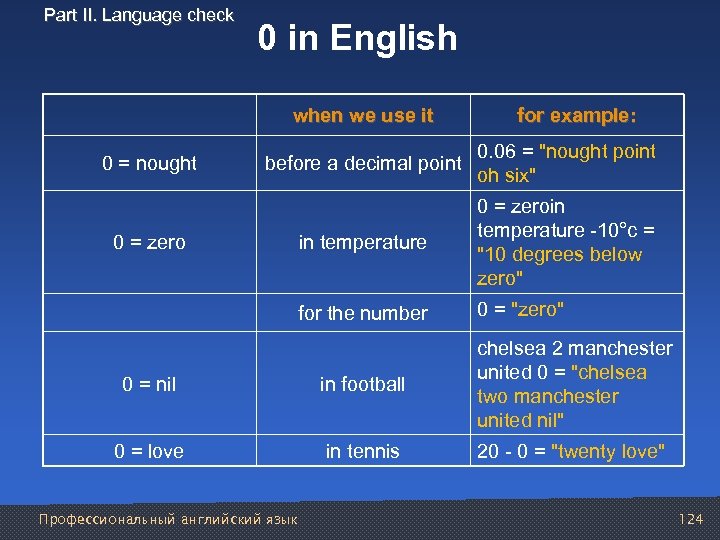
Part II. Language check 0 in English when we use it for example: before a decimal point 0. 06 = "nought point oh six" in temperature 0 = zeroin temperature 10°c = "10 degrees below zero" for the number 0 = nought 0 = "zero" 0 = zero 0 = nil in football chelsea 2 manchester united 0 = "chelsea two manchester united nil" 0 = love in tennis 20 0 = "twenty love" Профессиональный английский язык 124
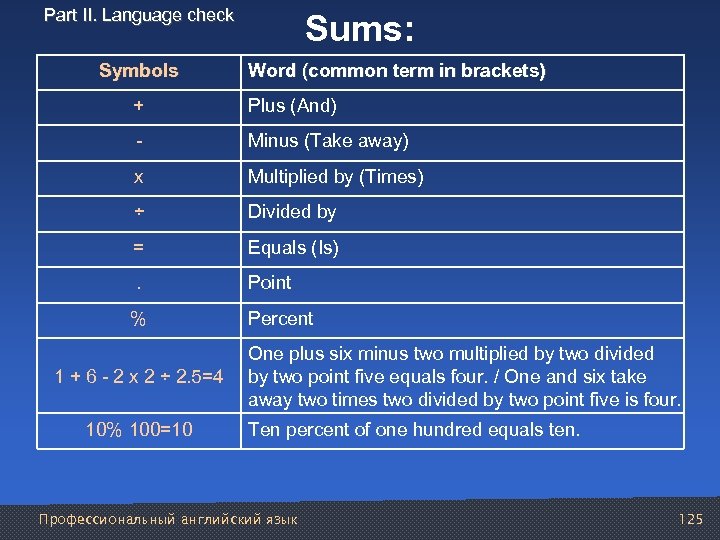
Part II. Language check Symbols Sums: Word (common term in brackets) + Plus (And) Minus (Take away) x Multiplied by (Times) ÷ Divided by = Equals (Is) . Point % 1 + 6 2 x 2 ÷ 2. 5=4 10% 100=10 Percent One plus six minus two multiplied by two divided by two point five equals four. / One and six take away two times two divided by two point five is four. Ten percent of one hundred equals ten. Профессиональный английский язык 125
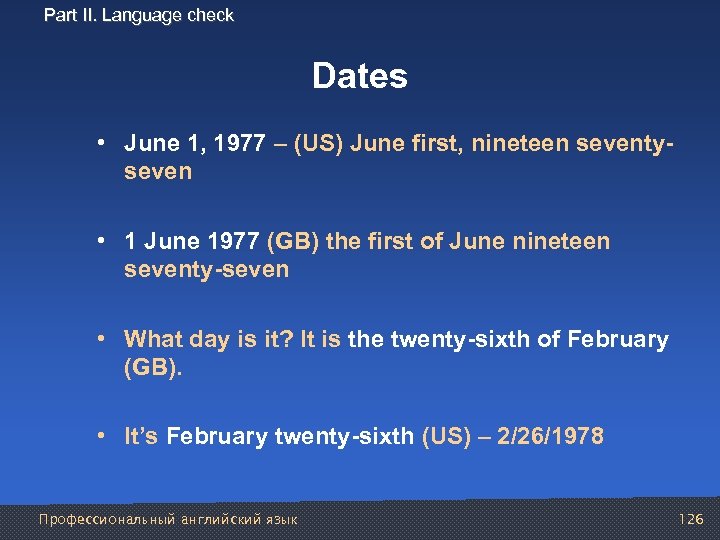
Part II. Language check Dates • June 1, 1977 – (US) June first, nineteen seventyseven • 1 June 1977 (GB) the first of June nineteen seventy-seven • What day is it? It is the twenty-sixth of February (GB). • It’s February twenty-sixth (US) – 2/26/1978 Профессиональный английский язык 126
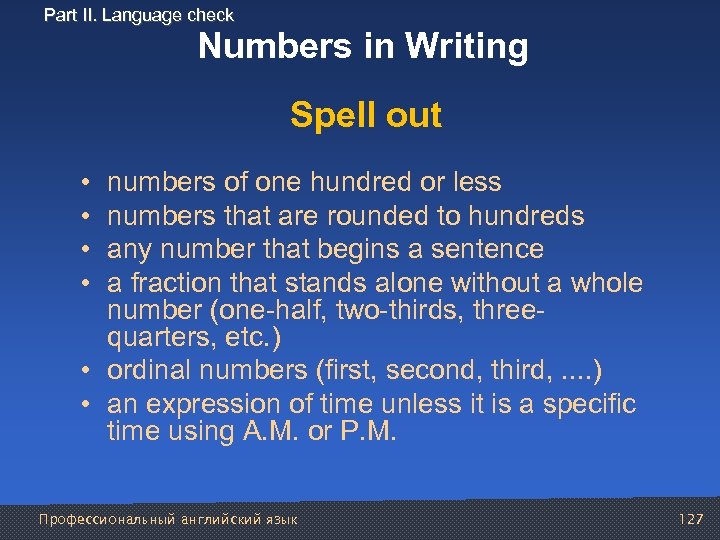
Part II. Language check Numbers in Writing Spell out • • numbers of one hundred or less numbers that are rounded to hundreds any number that begins a sentence a fraction that stands alone without a whole number (one half, two thirds, three quarters, etc. ) • ordinal numbers (first, second, third, . . ) • an expression of time unless it is a specific time using A. M. or P. M. Профессиональный английский язык 127
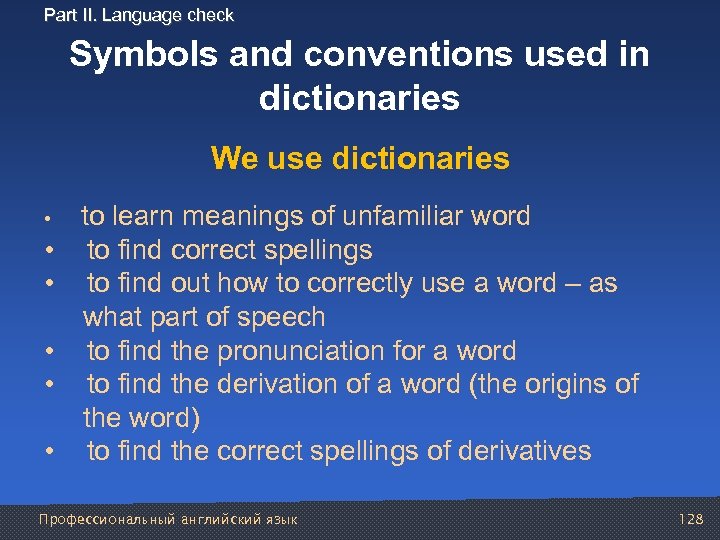
Part II. Language check Symbols and conventions used in dictionaries We use dictionaries • to learn meanings of unfamiliar word • to find correct spellings • to find out how to correctly use a word – as what part of speech • to find the pronunciation for a word • to find the derivation of a word (the origins of the word) • to find the correct spellings of derivatives Профессиональный английский язык 128
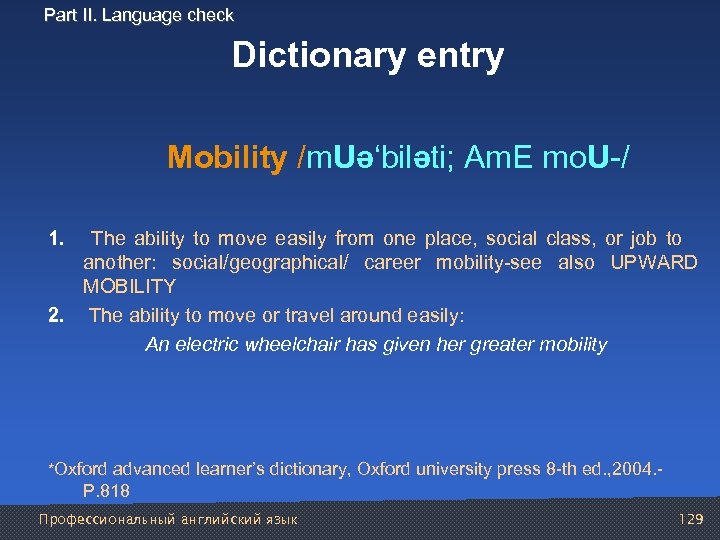
Part II. Language check Dictionary entry Mobility /m. Uə‘biləti; Am. E mo. U / 1. The ability to move easily from one place, social class, or job to another: social/geographical/ career mobility see also UPWARD MOBILITY 2. The ability to move or travel around easily: An electric wheelchair has given her greater mobility *Oxford advanced learner’s dictionary, Oxford university press 8 th ed. , 2004. P. 818 Профессиональный английский язык 129
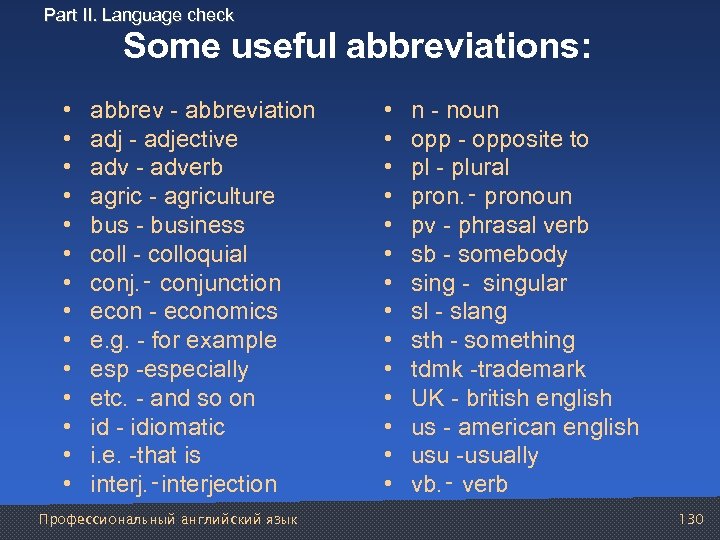
Part II. Language check Some useful abbreviations: • • • • abbreviation adjective adverb agriculture business colloquial conj. ‑ conjunction economics e. g. for example especially etc. and so on id idiomatic i. e. that is interj. ‑interjection Профессиональный английский язык • • • • n noun opposite to pl plural pron. ‑ pronoun pv phrasal verb sb somebody singular sl slang sth something tdmk trademark UK british english us american english usually vb. ‑ verb 130
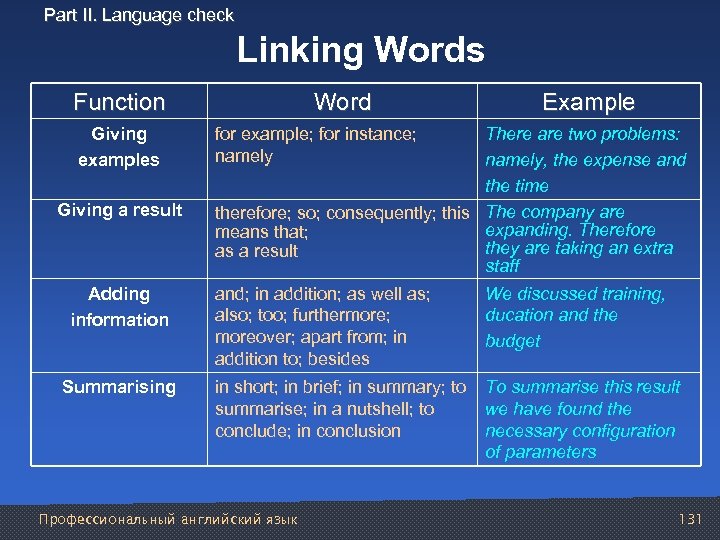
Part II. Language check Linking Words Function Giving examples Giving a result Adding information Summarising Word Example for example; for instance; namely There are two problems: namely, the expense and the time therefore; so; consequently; this The company are expanding. Therefore means that; they are taking an extra as a result staff and; in addition; as well as; also; too; furthermore; moreover; apart from; in addition to; besides We discussed training, ducation and the budget in short; in brief; in summary; to To summarise this result summarise; in a nutshell; to we have found the conclude; in conclusion necessary configuration of parameters Профессиональный английский язык 131
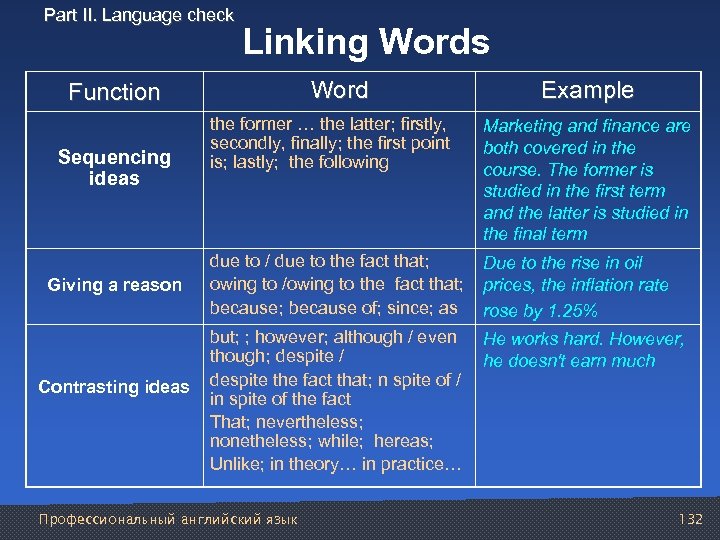
Part II. Language check Linking Words Word Function Sequencing ideas Giving a reason Contrasting ideas Example the former … the latter; firstly, secondly, finally; the first point is; lastly; the following Marketing and finance are both covered in the course. The former is studied in the first term and the latter is studied in the final term due to / due to the fact that; owing to /owing to the fact that; because of; since; as Due to the rise in oil prices, the inflation rate rose by 1. 25% but; ; however; although / even He works hard. However, though; despite / he doesn't earn much despite the fact that; n spite of / in spite of the fact That; nevertheless; nonetheless; while; hereas; Unlike; in theory… in practice… Профессиональный английский язык 132
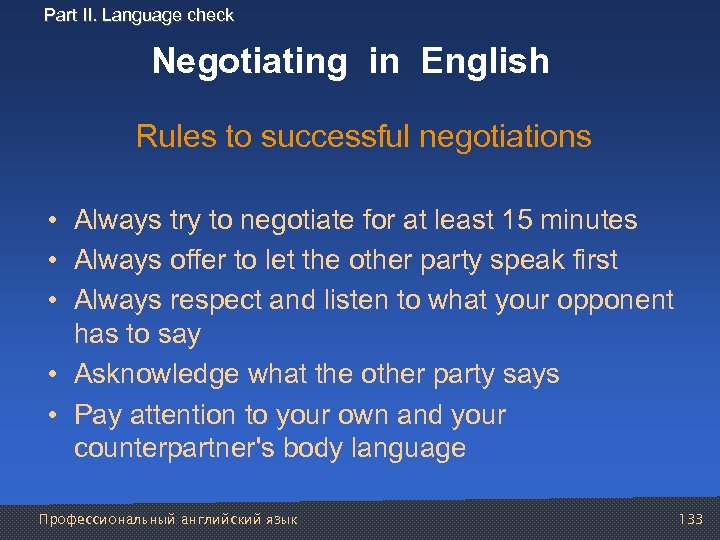
Part II. Language check Negotiating in English Rules to successful negotiations • Always try to negotiate for at least 15 minutes • Always offer to let the other party speak first • Always respect and listen to what your opponent has to say • Asknowledge what the other party says • Pay attention to your own and your counterpartner's body language Профессиональный английский язык 133
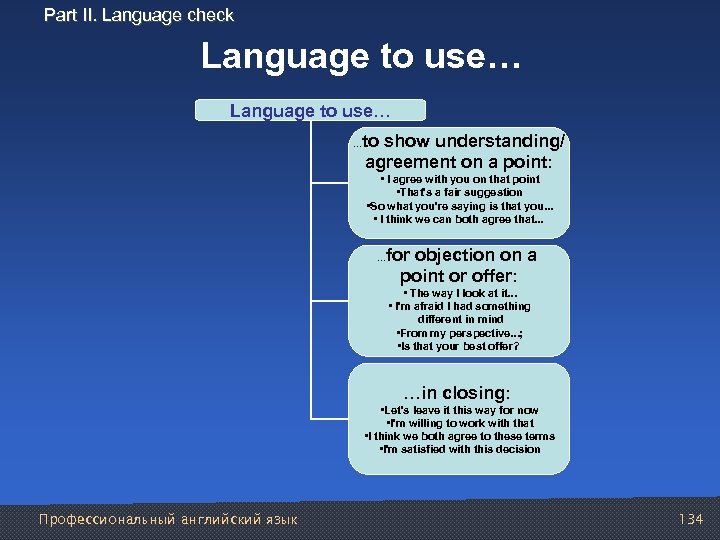
Part II. Language check Language to use… to show understanding/ agreement on a point: … • I agree with you on that point • That's a fair suggestion • So what you're saying is that you. . . • I think we can both agree that. . . for objection on a point or offer: … • The way I look at it. . . • I'm afraid I had something different in mind • From my perspective. . . ; • Is that your best offer? …in closing: • Let's leave it this way for now • I'm willing to work with that • I think we both agree to these terms • I'm satisfied with this decision Профессиональный английский язык 134
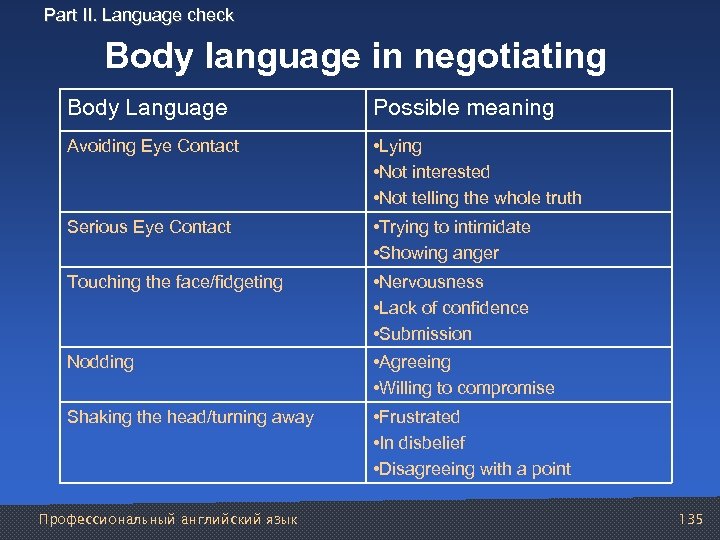
Part II. Language check Body language in negotiating Body Language Possible meaning Avoiding Eye Contact • Lying • Not interested • Not telling the whole truth Serious Eye Contact • Trying to intimidate • Showing anger Touching the face/fidgeting • Nervousness • Lack of confidence • Submission Nodding • Agreeing • Willing to compromise Shaking the head/turning away • Frustrated • In disbelief • Disagreeing with a point Профессиональный английский язык 135
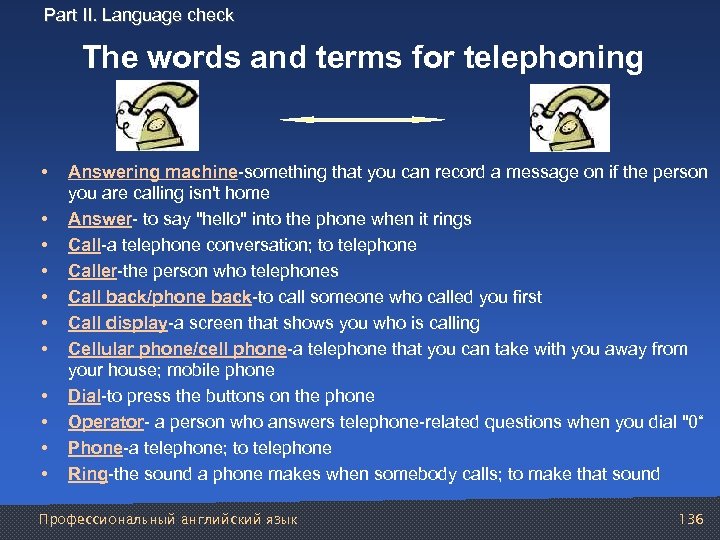
Part II. Language check The words and terms for telephoning • • • Answering machine something that you can record a message on if the person you are calling isn't home Answer to say "hello" into the phone when it rings Call a telephone conversation; to telephone Caller the person who telephones Call back/phone back to call someone who called you first Call display a screen that shows you who is calling Cellular phone/cell phone a telephone that you can take with you away from your house; mobile phone Dial to press the buttons on the phone Operator a person who answers telephone related questions when you dial "0“ Phone a telephone; to telephone Ring the sound a phone makes when somebody calls; to make that sound Профессиональный английский язык 136
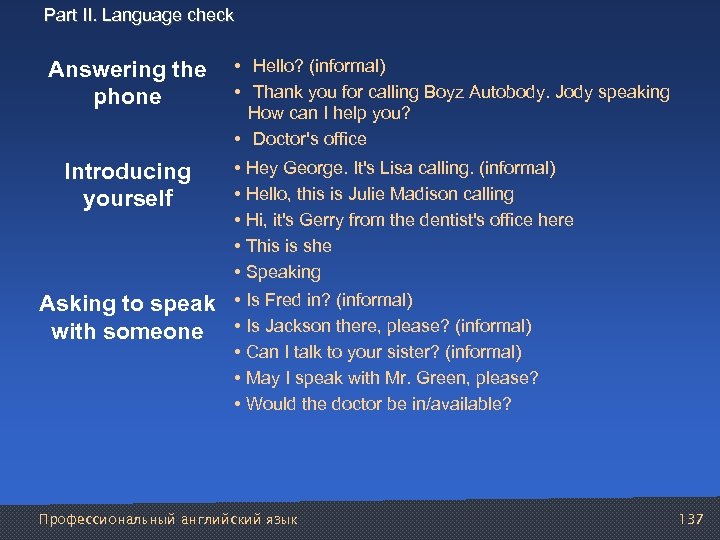
Part II. Language check Answering the • • phone Hello? (informal) Thank you for calling Boyz Autobody. Jody speaking How can I help you? • Doctor's office Introducing yourself • Hey George. It's Lisa calling. (informal) • Hello, this is Julie Madison calling • Hi, it's Gerry from the dentist's office here • This is she • Speaking Asking to speak • Is Fred in? (informal) with someone • Is Jackson there, please? (informal) • Can I talk to your sister? (informal) • May I speak with Mr. Green, please? • Would the doctor be in/available? Профессиональный английский язык 137
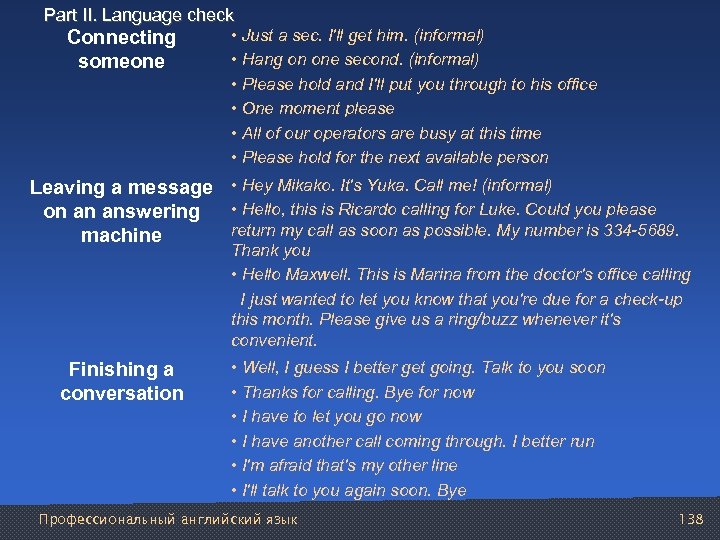
Part II. Language check • Just a sec. I'll get him. (informal) Connecting • Hang on one second. (informal) someone • Please hold and I'll put you through to his office • One moment please • All of our operators are busy at this time • Please hold for the next available person Leaving a message • Hey Mikako. It's Yuka. Call me! (informal) on an answering • Hello, this is Ricardo calling for Luke. Could you please return my call as soon as possible. My number is 334 5689. machine Thank you • Hello Maxwell. This is Marina from the doctor's office calling I just wanted to let you know that you're due for a check up this month. Please give us a ring/buzz whenever it's convenient. Finishing a conversation • Well, I guess I better get going. Talk to you soon • Thanks for calling. Bye for now • I have to let you go now • I have another call coming through. I better run • I'm afraid that's my other line • I'll talk to you again soon. Bye Профессиональный английский язык 138
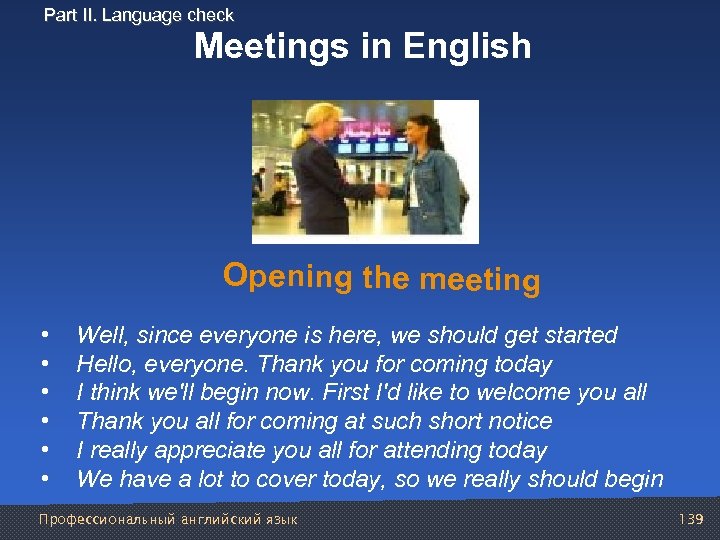
Part II. Language check Meetings in English Opening the meeting • • • Well, since everyone is here, we should get started Hello, everyone. Thank you for coming today I think we'll begin now. First I'd like to welcome you all Thank you all for coming at such short notice I really appreciate you all for attending today We have a lot to cover today, so we really should begin Профессиональный английский язык 139
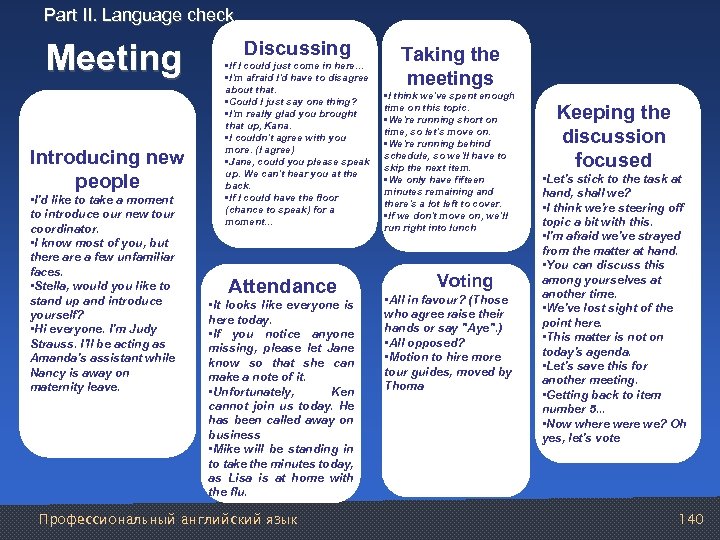
Part II. Language check Meeting Introducing new people • I'd like to take a moment to introduce our new tour coordinator. • I know most of you, but there a few unfamiliar faces. • Stella, would you like to stand up and introduce yourself? • Hi everyone. I'm Judy Strauss. I'll be acting as Amanda's assistant while Nancy is away on maternity leave. Discussing • If I could just come in here. . . • I'm afraid I'd have to disagree about that. • Could I just say one thing? • I'm really glad you brought that up, Kana. • I couldn't agree with you more. (I agree) • Jane, could you please speak up. We can't hear you at the back. • If I could have the floor (chance to speak) for a moment. . . Attendance • It looks like everyone is here today. • If you notice anyone missing, please let Jane know so that she can make a note of it. • Unfortunately, Ken cannot join us today. He has been called away on business • Mike will be standing in to take the minutes today, as Lisa is at home with the flu. Профессиональный английский язык Taking the meetings • I think we've spent enough time on this topic. • We're running short on time, so let's move on. • We're running behind schedule, so we'll have to skip the next item. • We only have fifteen minutes remaining and there's a lot left to cover. • If we don't move on, we'll run right into lunch Voting • All in favour? (Those who agree raise their hands or say "Aye". ) • All opposed? • Motion to hire more tour guides, moved by Thomas Keeping the discussion focused • Let's stick to the task at hand, shall we? • I think we're steering off topic a bit with this. • I'm afraid we've strayed from the matter at hand. • You can discuss this among yourselves at another time. • We've lost sight of the point here. • This matter is not on today's agenda. • Let's save this for another meeting. • Getting back to item number 5. . . • Now where we? Oh yes, let's vote 140
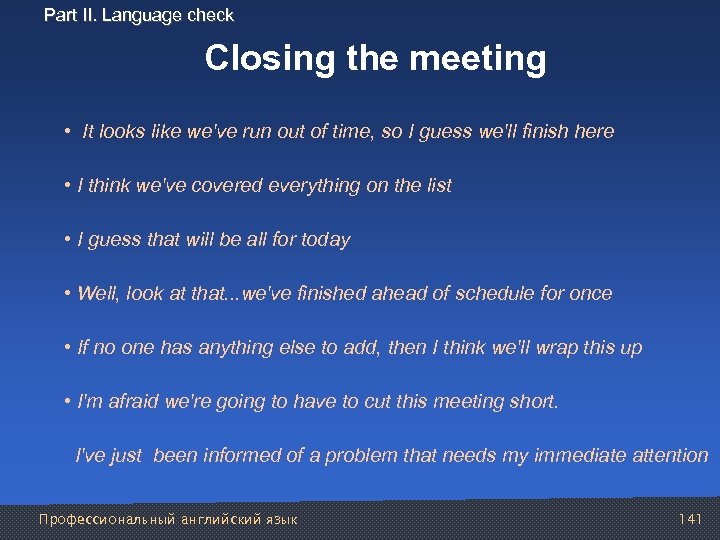
Part II. Language check Closing the meeting • It looks like we've run out of time, so I guess we'll finish here • I think we've covered everything on the list • I guess that will be all for today • Well, look at that. . . we've finished ahead of schedule for once • If no one has anything else to add, then I think we'll wrap this up • I'm afraid we're going to have to cut this meeting short. I've just been informed of a problem that needs my immediate attention Профессиональный английский язык 141
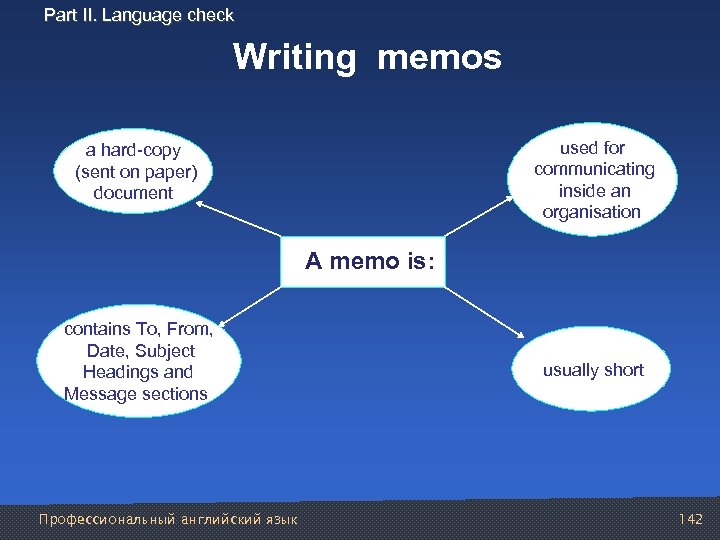
Part II. Language check Writing memos used for communicating inside an organisation a hard copy (sent on paper) document A memo is: contains To, From, Date, Subject Headings and Message sections Профессиональный английский язык usually short 142
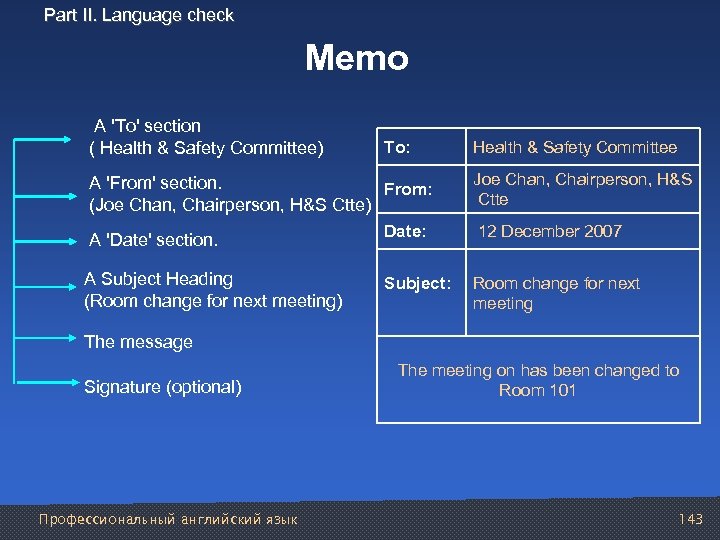
Part II. Language check Memo A 'To' section To: ( Health & Safety Committee) A 'From' section. From: (Joe Chan, Chairperson, H&S Ctte) Date: A 'Date' section. A Subject Heading (Room change for next meeting) Subject: Health & Safety Committee Joe Chan, Chairperson, H&S Ctte 12 December 2007 Room change for next meeting The message Signature (optional) Профессиональный английский язык The meeting on has been changed to Room 101 143
Part II. Language check How to write an essay • Here's How • • • Select the topic of your essay Outline your essay into introductory, body and summary paragraphs Use one sentence to introduce every body paragraph to follow Finish the introductory paragraph with a short summary or goal statement The penultimate sentence should restate your basic thesis of the essay In each of the body paragraphs the ideas first presented in the introductory paragraph are developed Body paragraphs should develop the central idea and finish with a summary of that idea. There should be at least two examples or facts in each body paragraph to support the central idea Профессиональный английский язык 144
Part II. Language check Tips • Use strong verbs and avoid modals to state your opinion • Do not apologize for what you are saying. An essay is about your opinion • Do not translate from your mother tongue, it will quickly get you into trouble! Профессиональный английский язык 145
Part II. Language check Phrasal verbs • A phrasal verb is a verb plus a preposition or adverb which creates a meaning different from the original verb I ran into my teacher at the movies last night • Some phrasal verbs are intransitive. An intransitive verb cannot be followed by an object He suddenly showed up • Some phrasal verbs are transitive. A transitive verb can be followed by an object I made up the story Профессиональный английский язык 146
Part II. Language check Phrasal verbs • Some transitive phrasal verbs are separable. The object is placed between the verb and the preposition. She looked the phone number up • Some transitive phrasal verbs are inseparable. The object is placed after the preposition I ran into an old friend yesterday. They are looking into the problem • Some transitive phrasal verbs can take an object in both places I looked the number up in the phone book. I looked up the number in the phone book Профессиональный английский язык 147
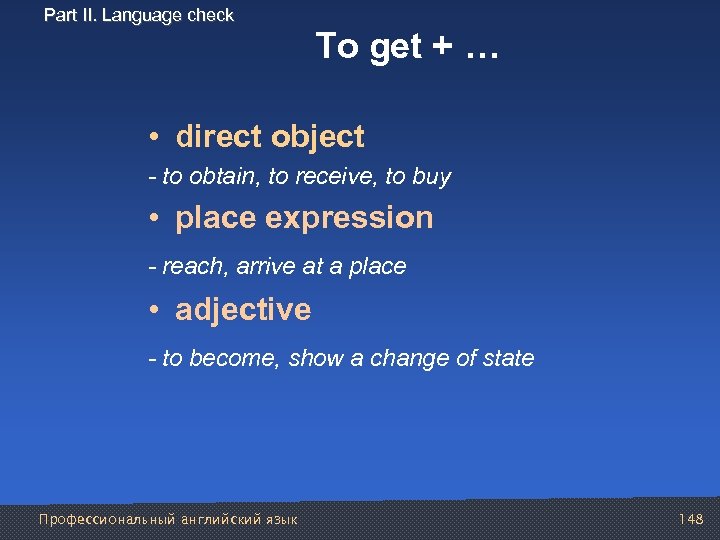
Part II. Language check To get + … • direct object to obtain, to receive, to buy • place expression reach, arrive at a place • adjective to become, show a change of state Профессиональный английский язык 148
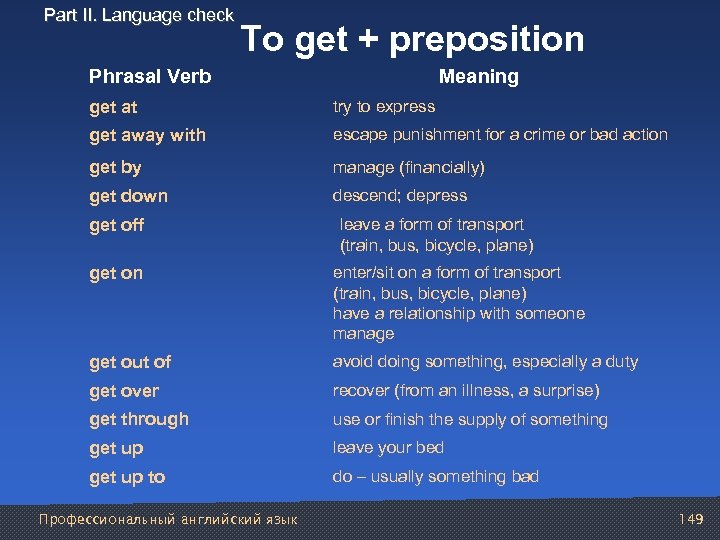
Part II. Language check To get + preposition Phrasal Verb Meaning get at try to express get away with escape punishment for a crime or bad action get by manage (financially) get down descend; depress get off leave a form of transport (train, bus, bicycle, plane) get on enter/sit on a form of transport (train, bus, bicycle, plane) have a relationship with someone manage get out of avoid doing something, especially a duty get over recover (from an illness, a surprise) get through use or finish the supply of something get up leave your bed get up to do – usually something bad Профессиональный английский язык 149
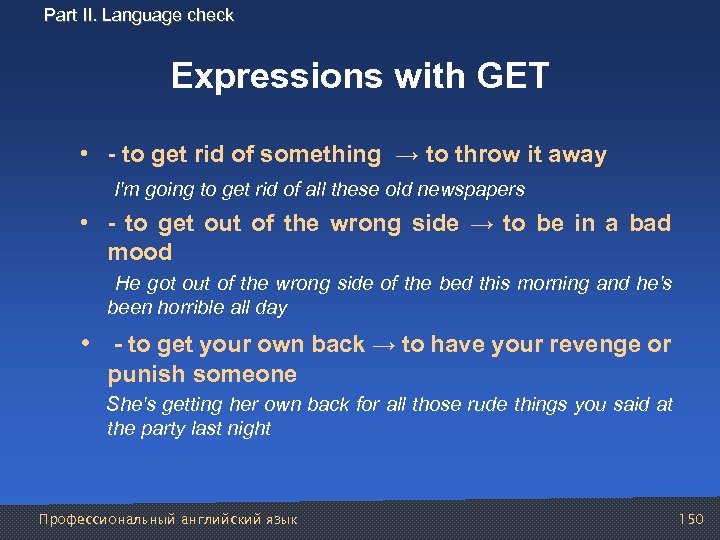
Part II. Language check Expressions with GET • - to get rid of something → to throw it away I'm going to get rid of all these old newspapers • - to get out of the wrong side → to be in a bad mood He got out of the wrong side of the bed this morning and he's been horrible all day • - to get your own back → to have your revenge or punish someone She's getting her own back for all those rude things you said at the party last night Профессиональный английский язык 150
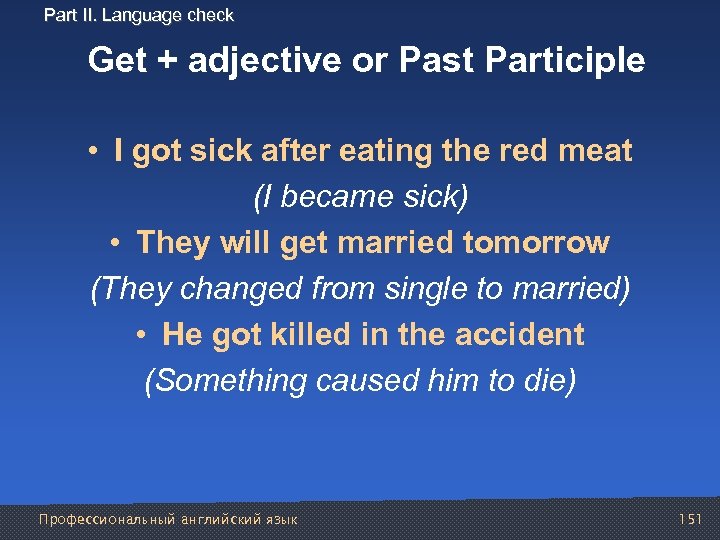
Part II. Language check Get + adjective or Past Participle • I got sick after eating the red meat (I became sick) • They will get married tomorrow (They changed from single to married) • He got killed in the accident (Something caused him to die) Профессиональный английский язык 151
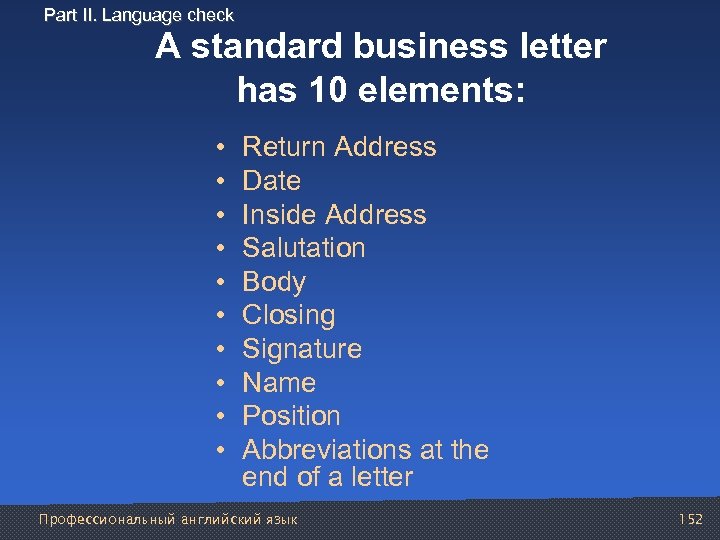
Part II. Language check A standard business letter has 10 elements: • • • Return Address Date Inside Address Salutation Body Closing Signature Name Position Abbreviations at the end of a letter Профессиональный английский язык 152
![Part II. Language check Full Block Format XYZ COMMCO INC. [1] 111 Any Street](https://present5.com/presentation/56846063fe29d894609575ba9193acd4/image-153.jpg "Part II. Language check Full Block Format XYZ COMMCO INC. [1] 111 Any Street")
Part II. Language check Full Block Format XYZ COMMCO INC. [1] 111 Any Street -- San Francisco, CA 94118 -- (415) 221 -1212 [1] May 22, 2007 [2] Mr. John Smith [3] XYZ Company 123 Anything Avenue San Francisco, CA 94115 Dear Mr. Smith: [4] With the full-block letter style each paragraph begins on the left margin. Some more important information continues in the first paragraph for two to four sentences. [5] Between paragraphs there is additional line space indicating a new paragraph. As before, this paragraph begins at the left margin, as do the date of composition, receiver’s address, complimentary close, sender’s name, title, and additional information. [5] Sincerely yours, [6] Terry or Terry D. Sender(signed) [7] Terry D. Sender [8] Project Manager [9] TDS: YS [10] CC: A. Receiver, B. Receiver Профессиональный английский язык 153
![Part II. Language check Block Format XYZ COMMCO INC [1] 111 Any Street --](https://present5.com/presentation/56846063fe29d894609575ba9193acd4/image-154.jpg "Part II. Language check Block Format XYZ COMMCO INC [1] 111 Any Street --")
Part II. Language check Block Format XYZ COMMCO INC [1] 111 Any Street -- San Francisco, CA 94118 -- (415) 221 -1212 [1] May 22, 2007 [2] Mr. John Smith [3] XYZ Company 123 Anything Avenue San Francisco, CA 94115 Dear Mr. Smith: [4] With the block letter style each paragraph begins on the left margin. Some more important information continues in the first paragraph for two to four sentences. [5] Between paragraphs there is additional line space indicating a new paragraph. As before, this paragraph begins at the left margin, as do , receiver’s address, salutation. , and additional information. However, the date of composition, complimentary close, sender’s name, and title are placed right of center. This makes the block style both functional and a bit more stylized in composition. [5] Sincerely yours, [6] Terry or Terry D. Sender(signed) [7] Terry D. Sender [8] Project Manager [9] TDS: YS [10] CC: A. Receiver, B. Receiver Профессиональный английский язык 154
![Part II. Language check Semi Block Format XYZ COMMCO INC [1] 111 Any Street](https://present5.com/presentation/56846063fe29d894609575ba9193acd4/image-155.jpg "Part II. Language check Semi Block Format XYZ COMMCO INC [1] 111 Any Street")
Part II. Language check Semi Block Format XYZ COMMCO INC [1] 111 Any Street -- San Francisco, CA 94118 -- (415) 221 -1212 [1] May 22, 2007 [2] Mr. John Smith [3] XYZ Company 123 Anything Avenue San Francisco, CA 94115 Dear Mr. Smith: [4] With the block letter style each paragraph begins on the left margin. Some more important information continues in the first paragraph for two to four sentences. [5] Between paragraphs there is additional line space indicating a new paragraph. As before, this paragraph begins at the left margin, as do , receiver’s address, salutation. , and additional information. However, the date of composition, complimentary close, sender’s name, and title are placed right of center. This makes the block style both functional and a bit more stylized in composition. [5] Sincerely yours, [6] Terry or Terry D. Sender(signed) [7] Terry D. Sender [8] Project Manager [9] TDS: YS [10] CC: A. Receiver, B. Receiver Профессиональный английский язык 155
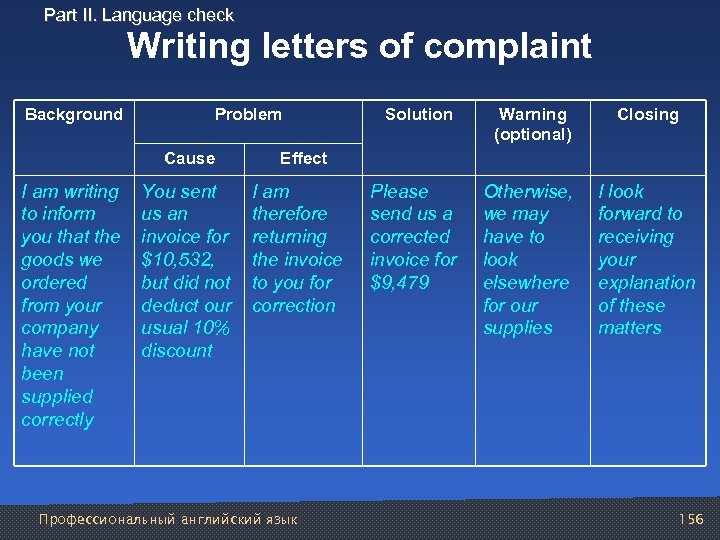
Part II. Language check Writing letters of complaint Background Problem Cause I am writing to inform you that the goods we ordered from your company have not been supplied correctly I am therefore returning the invoice to you for correction Warning (optional) Closing Please send us a corrected invoice for $9, 479 Otherwise, we may have to look elsewhere for our supplies I look forward to receiving your explanation of these matters Effect You sent us an invoice for $10, 532, but did not deduct our usual 10% discount Solution Профессиональный английский язык 156
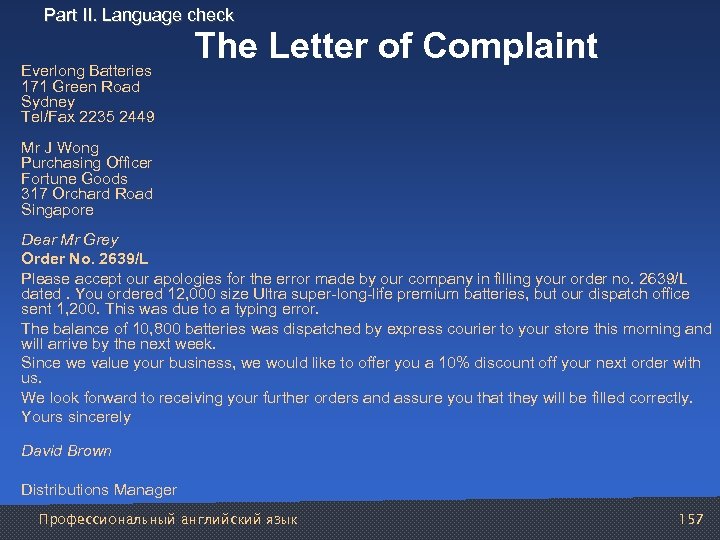
Part II. Language check Everlong Batteries 171 Green Road Sydney Tel/Fax 2235 2449 The Letter of Complaint Mr J Wong Purchasing Officer Fortune Goods 317 Orchard Road Singapore Dear Mr Grey Order No. 2639/L Please accept our apologies for the error made by our company in filling your order no. 2639/L dated. You ordered 12, 000 size Ultra super long life premium batteries, but our dispatch office sent 1, 200. This was due to a typing error. The balance of 10, 800 batteries was dispatched by express courier to your store this morning and will arrive by the next week. Since we value your business, we would like to offer you a 10% discount off your next order with us. We look forward to receiving your further orders and assure you that they will be filled correctly. Yours sincerely David Brown Distributions Manager Профессиональный английский язык 157
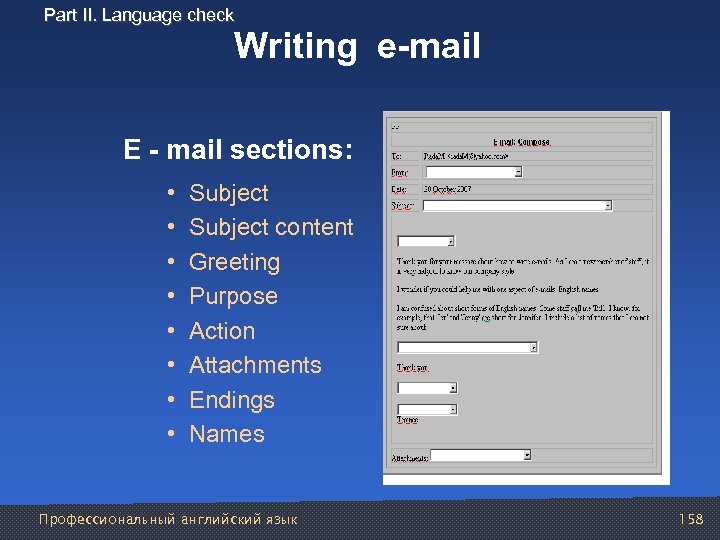
Part II. Language check Writing e-mail E - mail sections: • • Subject content Greeting Purpose Action Attachments Endings Names Профессиональный английский язык 158
Part II. Language check Tips to writing business e-mails • Use proper salutations and subject headings • Avoid using all caps • Check and re check before sending an e mail • Ask the original sender's permission before forwarding an e mail • Abbreviations and emoticons should not be used in professional e mails • Remember that certain situations still require face to face communication Профессиональный английский язык 159
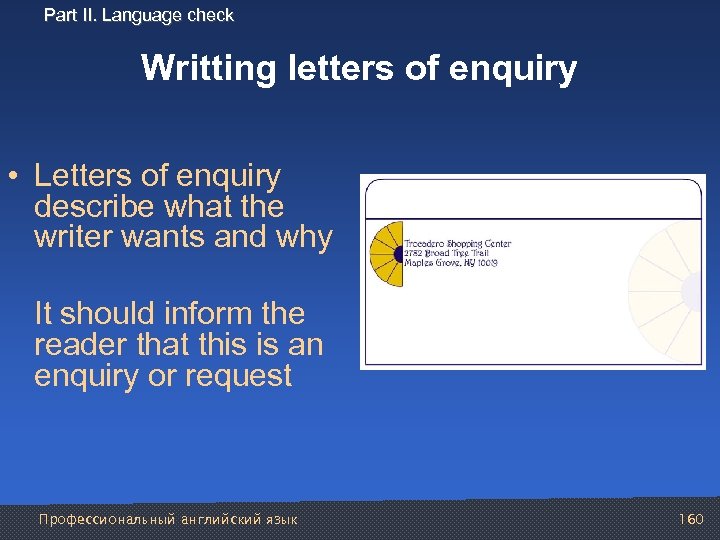
Part II. Language check Writting letters of enquiry • Letters of enquiry describe what the writer wants and why It should inform the reader that this is an enquiry or request Профессиональный английский язык 160

Part II. Language check Letter of enquiry Rich Lucky Trading Company 345, Nathan Rd, Kowloon, H. K. 10 August 2007 Hi-fashion Garment Ltd Unit 398 Industrial Estate Dear Sir or Madam Request for Catalogue Please send me your current catalogue. Your company was recommended to me by Ms. Elsie Wong of Far Eastern Logistics. Our African customer is interested in importing a range of printed 100% cotton cloth. I look forward to hearing from you. Yours K. Brown Merchandiser Профессиональный английский язык 161
Part II. Language check First Paragraph • tells the reader what you want; e. g. » Please send me. . . » (for things that the organisation offers to send) » I would be grateful if you could tell me. . . » (for things that are not normally offered) » I am writing to enquire whether. . . » (to see if something is possible) » I would especially like to know. . . » ( + a more detailed request) Профессиональный английский язык 162
Part II. Language check Second Paragraph • tells the reader why you are contacting his or her organisation, and gives further details of the enquiry ; e. g. • I saw your advert in the New York Times on Monday, 6 August 2007 • Your company was recommended to me by Ms. Barbara Green Профессиональный английский язык 163
Part II. Language check Final Paragraph • contains a polite expression and/or an expression of thanks to the reader : e. g. • Thanks (For a very informal and normal enquiry or request) • I look forward to hearing from you • I am looking forward to hearing from you • Thank you for your assistance • I look forward to hearing from you Профессиональный английский язык 164
Part II. Language check Abbreviations used in letters • • • • asap as soon as possible cc carbon copy enc. or enclosure pp = per procurationem ps postscript pto (informal) please turn over RSVP please reply Rd. , St. , Sq. – road, street, square # 24. , No. 24 – number (US/UK) c/o – care of Attn. – for the attention of P. OB. – Post office Box e. g. – for example eg, i. e. or ie – that is etc. or etc – and so on/etcetera cf. – compare Профессиональный английский язык • • • • do – ditto viz – namely PLC – Public Limited Company Ltd – Limited Bros&Co – Brothers and company Corp. – Corporation Incorporated @¥ 3000 each – at 3000 yen © 2005 – copyright Apple® registered Macintosh™ trade mark P. S. – postscript inst. – this month (instant) prox. – next month (proximo) ult. – last month (ultimo) 165
Part II. Language check Lack/lack of Word Part of Speech Example Sentences verb I/you/we/they lack he/she/it lacks singular noun + lacks uncountable noun + lacks The government overall lacks dynamism. It was so interesting to see how Western thinking lacks creativity and is not geared to changes lacking '_ing' form (present participle) Lacking any respect for the union, the workers went on strike lacking in adjective It was a well organized meeting but lacking in good leadership lacks Профессиональный английский язык 166
Part II. Language check Lack/lack of Word Part of Speech Example Sentences lacking adjective lacking '_ing' form (reduced Students lacking a dictionary can relative clause: the use an online dictionary relative pronoun e. g. 'who' and the verb are missing) lackedverb - perfect and past tenses His leadership has lacked imagination and aggression lack of noun Social workers blame the Government for the severe lack of residential places Профессиональный английский язык Financial support for the programme is still lacking 167
Part II. Language check Public speaking • A successful presentation is one of the most effective ways of communicating your message Профессиональный английский язык 168
Part II. Language check Advice • • Your language must be simple and clear Use short words and short sentences Do not use jargon Talk about concrete facts rather than abstract ideas • Use active verbs instead of passive verbs Профессиональный английский язык 169
Part II. Language check Signposting Function Language Introducing the subject I'd like to start by. . . , Let's begin by. . . Finishing one subject. . . Well, I've told you about. . . , That's all I have to say about. . . , We've looked at. . . , So much for. . . . and starting another Now we'll move on to. . . , Let me turn now to. . . , Next. . . , Turning to. . . Analysing a point and giving recommendations Where does that lead us? , Let's consider this in more detail. . , What does this mean for ABC? , Translated into real terms. . . Профессиональный английский язык 170
Part II. Language check Signposting Function Giving an example Language For example, A good example of this is. . . , As an illustration, To give you an example, To illustrate this point Dealing with questions We'll be examining this point in more detail later on. . , I'd like to deal with this question later, if I may. . . Summarising and concluding In conclusion, . . . , Right, let's sum up, shall we? , I'd like now to recap. . . Ordering Профессиональный английский язык Firstly. . . secondly. . . thirdly. . . lastly. . . First of all. . . then. . . next. . . after that. . . finally. . . To start with. . . later. . . to finish up. . . 171
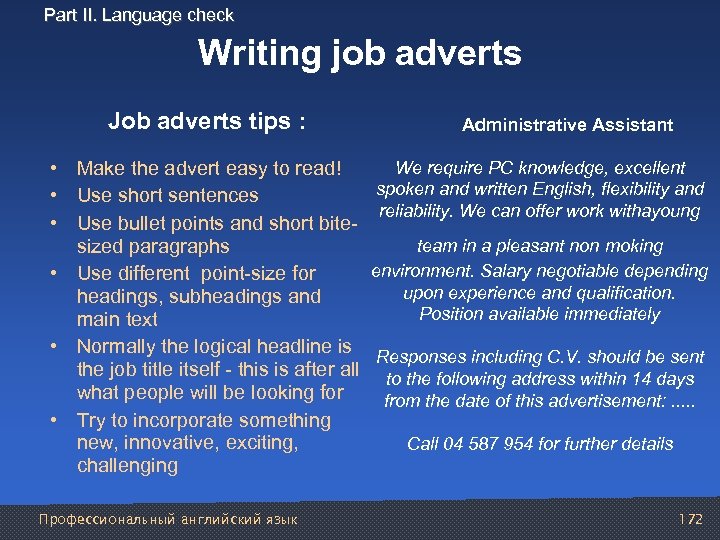
Part II. Language check Writing job adverts Job adverts tips : Administrative Assistant We require PC knowledge, excellent • Make the advert easy to read! spoken and written English, flexibility and • Use short sentences reliability. We can offer work withayoung • Use bullet points and short bite team in a pleasant non moking sized paragraphs environment. Salary negotiable depending • Use different point size for upon experience and qualification. headings, subheadings and Position available immediately main text • Normally the logical headline is Responses including C. V. should be sent the job title itself this is after all to the following address within 14 days what people will be looking for from the date of this advertisement: . . . • Try to incorporate something new, innovative, exciting, Call 04 587 954 for further details challenging Профессиональный английский язык 172
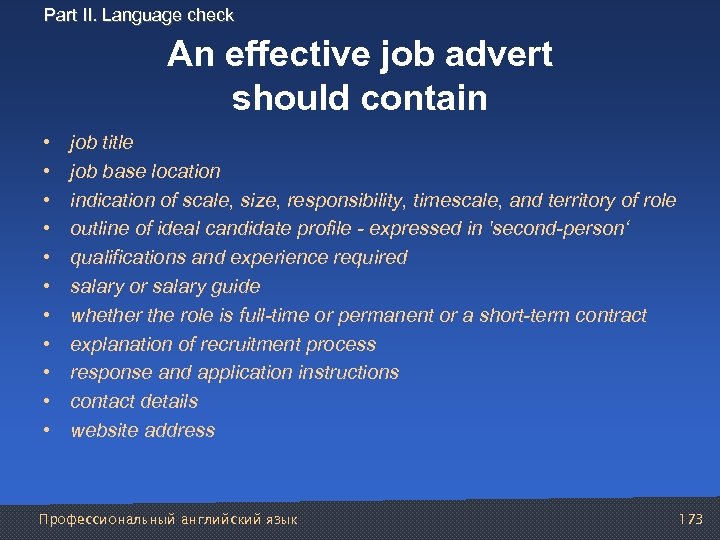
Part II. Language check An effective job advert should contain • • • job title job base location indication of scale, size, responsibility, timescale, and territory of role outline of ideal candidate profile expressed in 'second person‘ qualifications and experience required salary or salary guide whether the role is full time or permanent or a short term contract explanation of recruitment process response and application instructions contact details website address Профессиональный английский язык 173
Part II. Language check How to write resume in English Resume Sections Include: • Name and Address • Career Objective • Education • Activities and honors • Qualifications Профессиональный английский язык 174
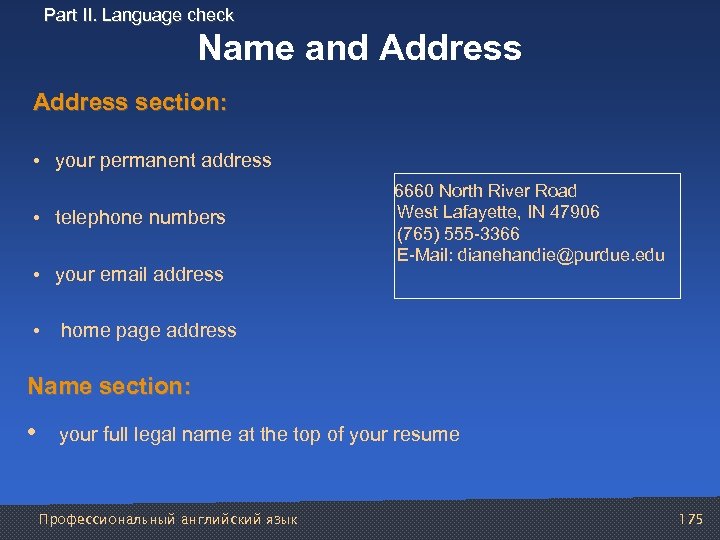
Part II. Language check Name and Address section: • your permanent address 6660 North River Road • telephone numbers • your email address West Lafayette, IN 47906 (765) 555 3366 E Mail: dianehandie@purdue. edu • home page address Name section: • your full legal name at the top of your resume Профессиональный английский язык 175
Part II. Language check Career Objective • the length of the position you are seeking • the job title you for which you are applying • the field or industry in which you wish to work • your most relevant skills or qualifications Purdue University, West Lafayette, Indiana Bachelor of Science, May 1999 Major: Supervision; GPA 5. 5/6. 0 Профессиональный английский язык 176
Part II. Language check Education • the name and location of your college or university • your degree and graduation date • your major(s) and minor(s) • grade point average Purdue University, West Lafayette, Indiana Bachelor of Science, May 1999 Major: Supervision; GPA 5. 5/6. 0 Профессиональный английский язык 177
Part II. Language check Activities and honors • Activities and honors that support your career objective • List your college organizations and arrange them in order of importance as they relate to your career objective • Include any office or official position you held • Spell out any acronyms your employer may not recognize Accounting Club, President Alpha Zeta Professional Fraternity Purdue Grand Prix Foundation, President Purdue Association for the Education of Young Children (PAEYC) Профессиональный английский язык 178
Part II. Language check Qualifications • jobs, activities, projects and special offices • skills gained through those experiences Conducted monthly club and board meetings for Lafayette Junior Woman's Club. Headed club's $8, 000 philanthropic project sponsored by Tippecanoe County Historical Association. Coordinated responsibilities of committees to sell and serve food to 1500 people at fund raiser Профессиональный английский язык 179
Part II. Language check Job Interview The job interview contains specific questions and appropriate answers Most important part of any job interview is: • • • Education Work experience Qualification Профессиональный английский язык 180
Part II. Language check Job Interview common questions • What type of position are you looking for? • Are you interested in a full time or part time position? • Can you tell about your responsibilities at your last job? • What is your greatest strength? • What is your greatest weakness? • Why do you want to work here? • When can you begin? Профессиональный английский язык 181
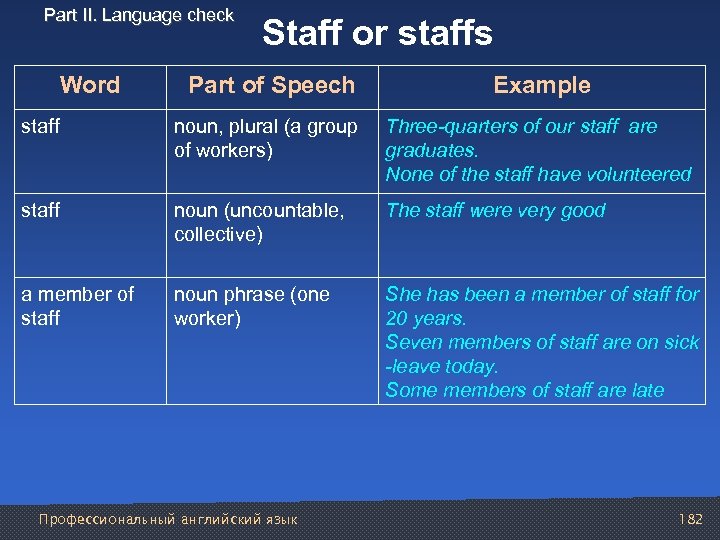
Part II. Language check Word Staff or staffs Part of Speech Example staff noun, plural (a group of workers) Three quarters of our staff are graduates. None of the staff have volunteered staff noun (uncountable, collective) The staff were very good a member of staff noun phrase (one worker) She has been a member of staff for 20 years. Seven members of staff are on sick leave today. Some members of staff are late Профессиональный английский язык 182
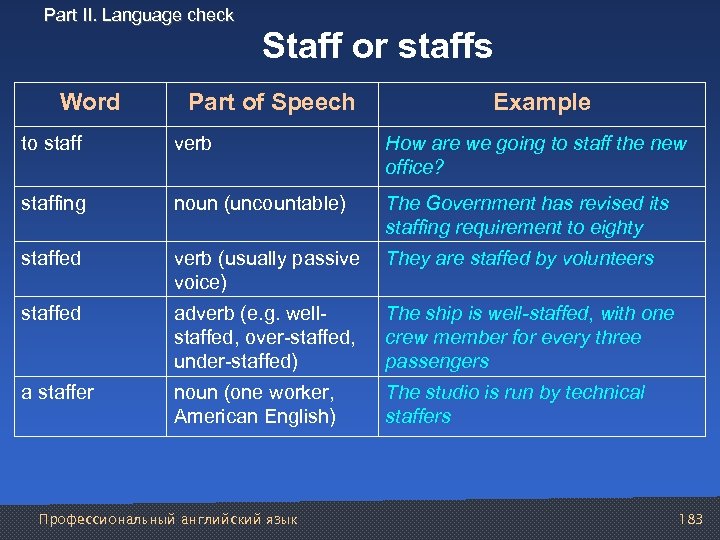
Part II. Language check Staff or staffs Word Part of Speech Example to staff verb How are we going to staff the new office? staffing noun (uncountable) The Government has revised its staffing requirement to eighty staffed verb (usually passive They are staffed by volunteers voice) staffed adverb (e. g. well staffed, over staffed, under staffed) The ship is well staffed, with one crew member for every three passengers a staffer noun (one worker, American English) The studio is run by technical staffers Профессиональный английский язык 183
Part II. Language check What is a trend? Trends are the changes or movements in facts and figures over a period of time To describe trends follow the tips: • Don’t repeat verbs • Before you start to write, make a list of synonyms words with the same meaning) • See how many ways you can rephrase the title • Be careful with prepositions. They can make a big difference in meaning. Learn your verbs with the preposition that goes with them Профессиональный английский язык 184
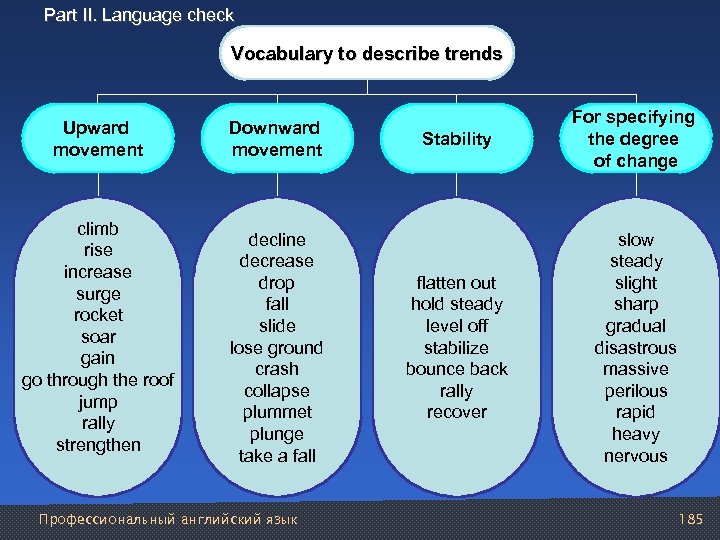
Part II. Language check Vocabulary to describe trends Upward movement climb rise increase surge rocket soar gain go through the roof jump rally strengthen Downward movement decline decrease drop fall slide lose ground crash collapse plummet plunge take a fall Профессиональный английский язык Stability For specifying the degree of change flatten out hold steady level off stabilize bounce back rally recover slow steady slight sharp gradual disastrous massive perilous rapid heavy nervous 185
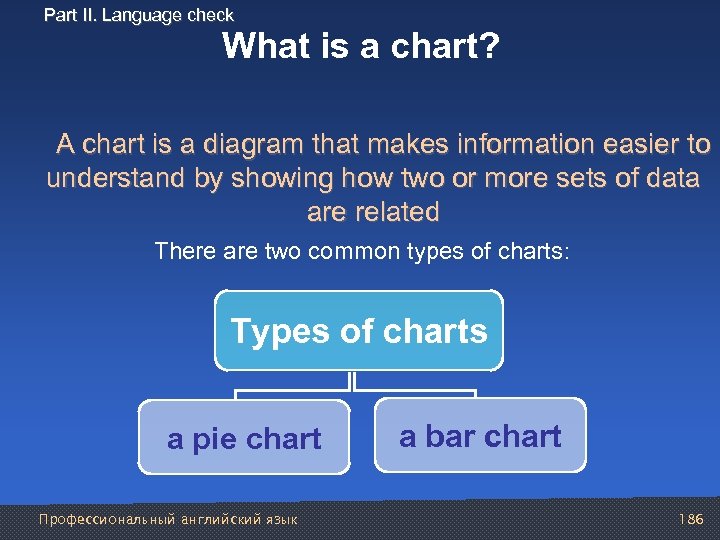
Part II. Language check What is a chart? A chart is a diagram that makes information easier to understand by showing how two or more sets of data are related There are two common types of charts: Types of charts a pie chart Профессиональный английский язык a bar chart 186
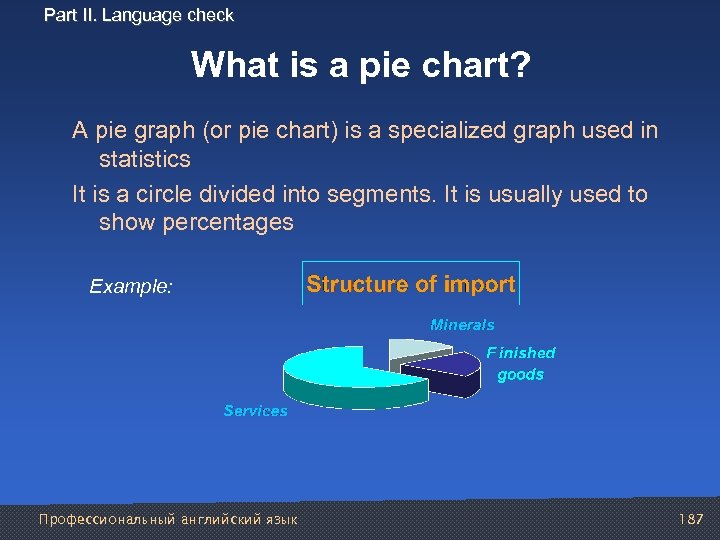
Part II. Language check What is a pie chart? A pie graph (or pie chart) is a specialized graph used in statistics It is a circle divided into segments. It is usually used to show percentages Example: Профессиональный английский язык 187
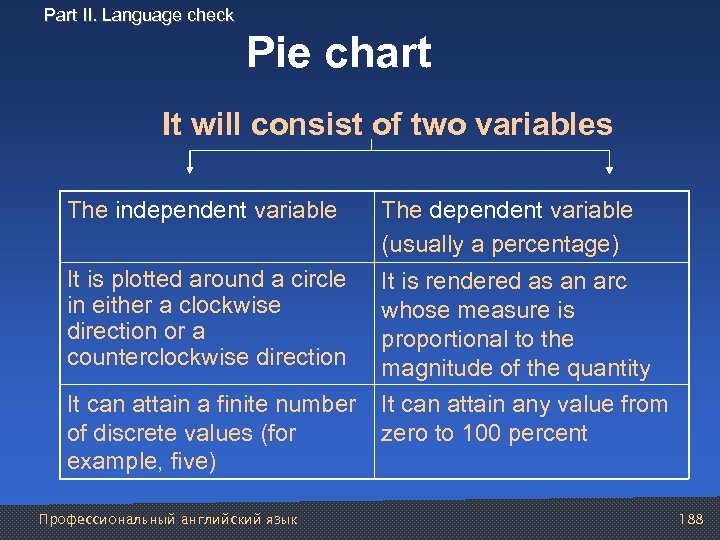
Part II. Language check Pie chart It will consist of two variables The independent variable The dependent variable (usually a percentage) It is plotted around a circle in either a clockwise direction or a counterclockwise direction It is rendered as an arc whose measure is proportional to the magnitude of the quantity It can attain a finite number It can attain any value from of discrete values (for zero to 100 percent example, five) Профессиональный английский язык 188
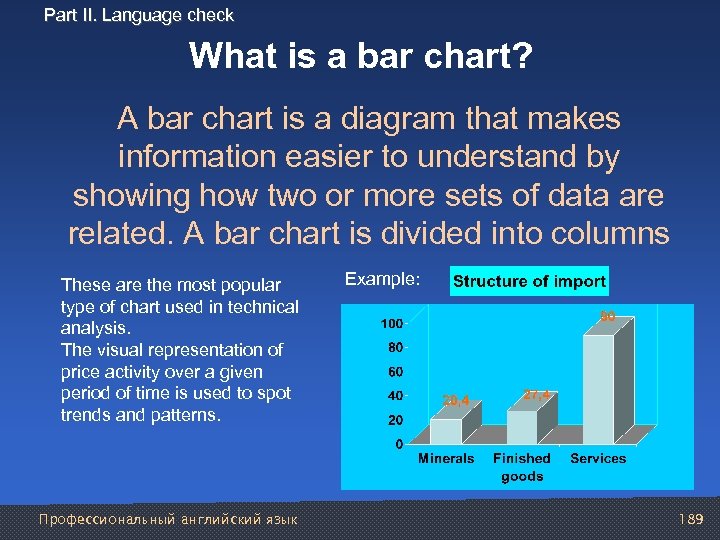
Part II. Language check What is a bar chart? A bar chart is a diagram that makes information easier to understand by showing how two or more sets of data are related. A bar chart is divided into columns These are the most popular type of chart used in technical analysis. The visual representation of price activity over a given period of time is used to spot trends and patterns. Профессиональный английский язык Example: 189
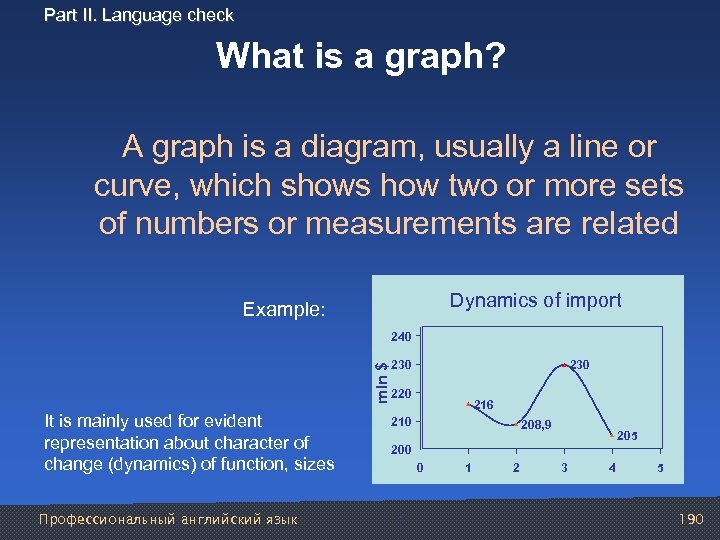
Part II. Language check What is a graph? A graph is a diagram, usually a line or curve, which shows how two or more sets of numbers or measurements are related Dynamics of import Example: mln $ 240 It is mainly used for evident representation about character of change (dynamics) of function, sizes Профессиональный английский язык 230 220 216 210 208, 9 205 200 0 1 2 3 4 5 190
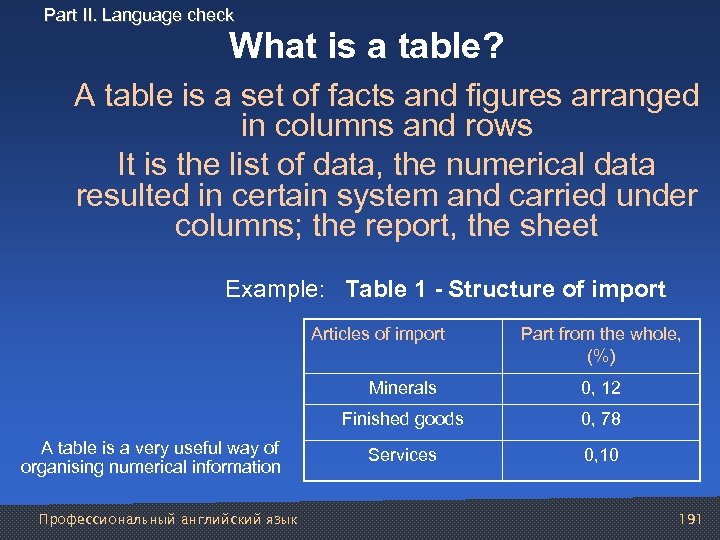
Part II. Language check What is a table? A table is a set of facts and figures arranged in columns and rows It is the list of data, the numerical data resulted in certain system and carried under columns; the report, the sheet Example: Table 1 - Structure of import Articles of import Part from the whole, (%) Minerals Finished goods A table is a very useful way of organising numerical information Профессиональный английский язык 0, 12 0, 78 Services 0, 10 191
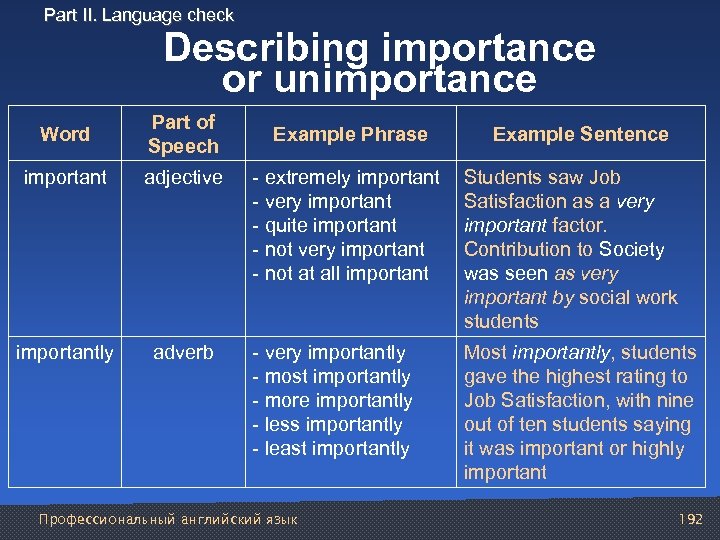
Part II. Language check Describing importance or unimportance Word Part of Speech important adjective importantly adverb Example Phrase Example Sentence extremely important very important quite important not very important not at all important Students saw Job Satisfaction as a very important factor. Contribution to Society was seen as very important by social work students very importantly most importantly more importantly less importantly least importantly Most importantly, students gave the highest rating to Job Satisfaction, with nine out of ten students saying it was important or highly important Профессиональный английский язык 192
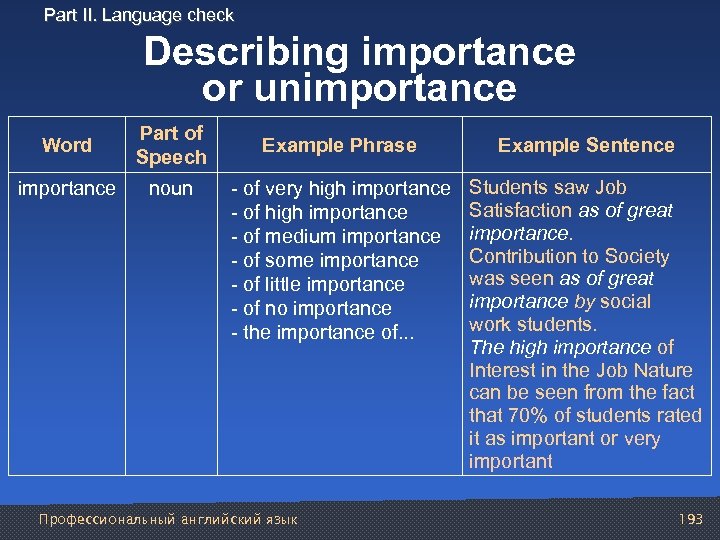
Part II. Language check Describing importance or unimportance Word Part of Speech importance noun Example Phrase Example Sentence of very high importance of medium importance of some importance of little importance of no importance the importance of. . . Students saw Job Satisfaction as of great importance. Contribution to Society was seen as of great importance by social work students. The high importance of Interest in the Job Nature can be seen from the fact that 70% of students rated it as important or very important Профессиональный английский язык 193
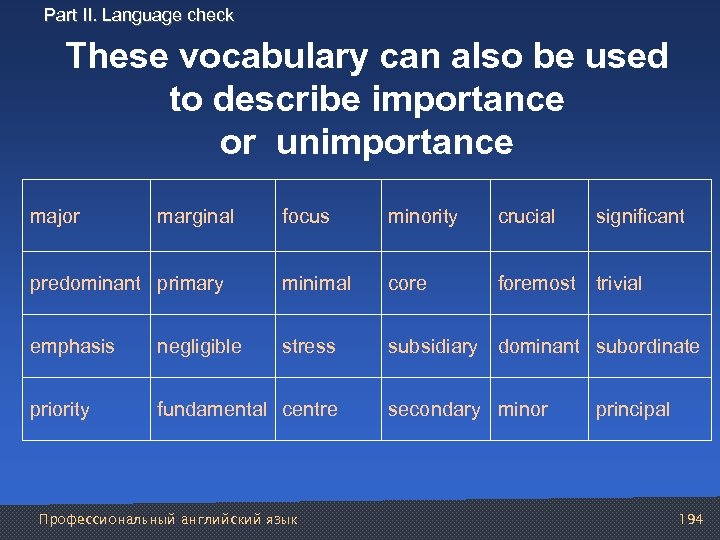
Part II. Language check These vocabulary can also be used to describe importance or unimportance major marginal focus minority crucial predominant primary minimal core foremost trivial emphasis negligible stress subsidiary dominant subordinate priority fundamental centre Профессиональный английский язык secondary minor significant principal 194
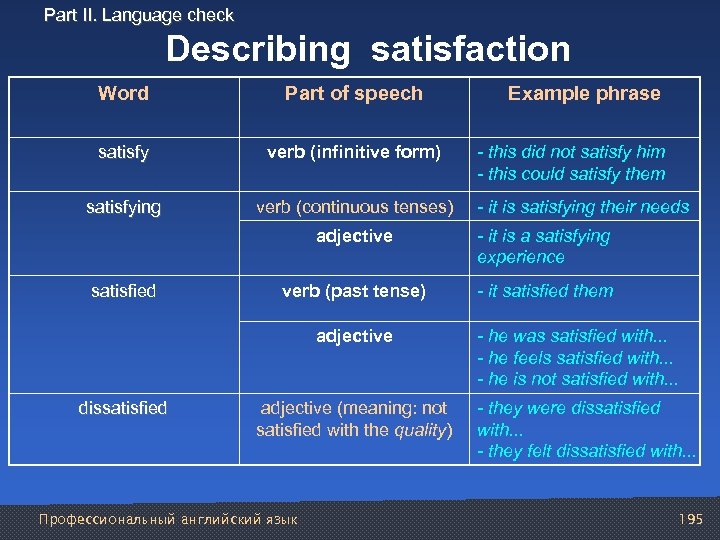
Part II. Language check Describing satisfaction Word Part of speech satisfy verb (infinitive form) satisfying verb (continuous tenses) Example phrase this did not satisfy him this could satisfy them it is satisfying their needs adjective satisfied it is a satisfying experience verb (past tense) it satisfied them adjective dissatisfied adjective (meaning: not satisfied with the quality) Профессиональный английский язык he was satisfied with. . . he feels satisfied with. . . he is not satisfied with. . . they were dissatisfied with. . . they felt dissatisfied with. . . 195
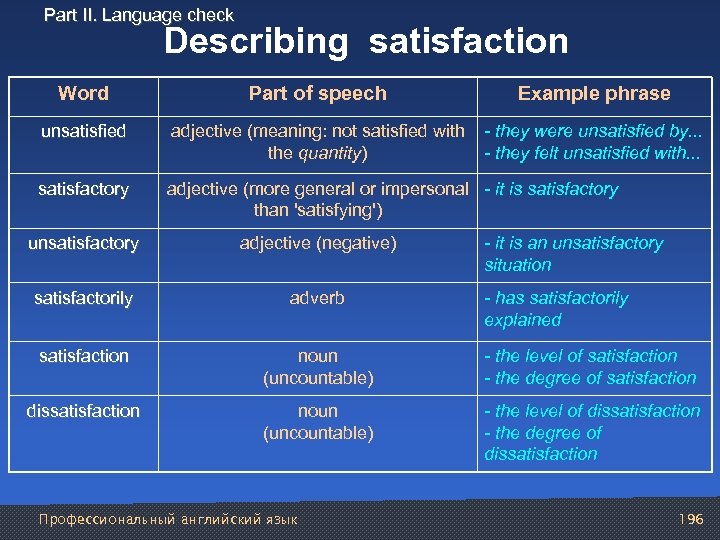
Part II. Language check Describing satisfaction Word Part of speech Example phrase unsatisfied adjective (meaning: not satisfied with they were unsatisfied by. . . the quantity) they felt unsatisfied with. . . satisfactory adjective (more general or impersonal it is satisfactory than 'satisfying') unsatisfactory adjective (negative) satisfactorily adverb satisfaction noun (uncountable) the level of satisfaction the degree of satisfaction dissatisfaction noun (uncountable) the level of dissatisfaction the degree of dissatisfaction Профессиональный английский язык it is an unsatisfactory situation has satisfactorily explained 196
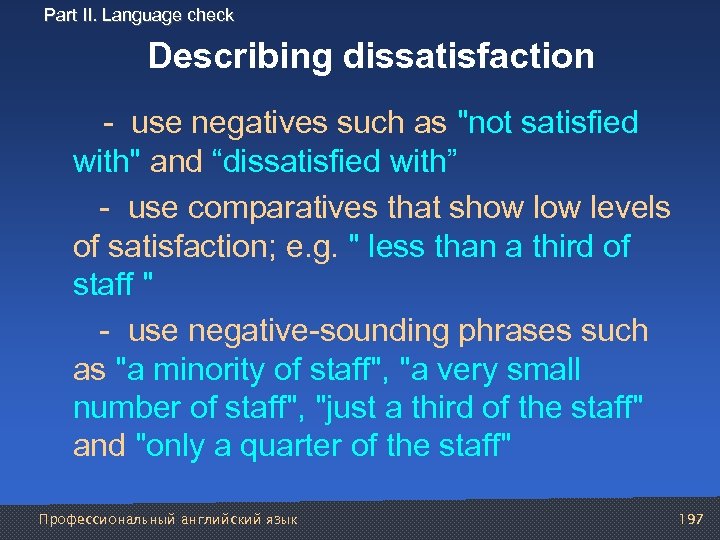
Part II. Language check Describing dissatisfaction use negatives such as "not satisfied with" and “dissatisfied with” use comparatives that show levels of satisfaction; e. g. " less than a third of staff " use negative sounding phrases such as "a minority of staff", "a very small number of staff", "just a third of the staff" and "only a quarter of the staff" Профессиональный английский язык 197
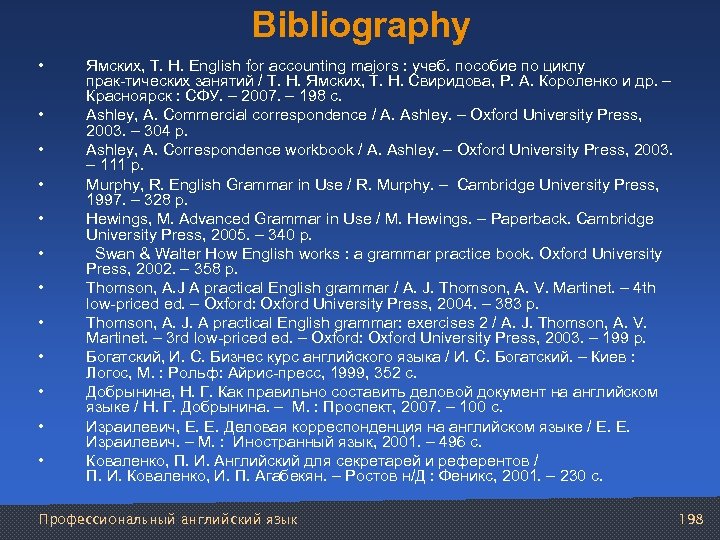
Bibliography • • • Ямских, Т. Н. English for accounting majors : учеб. пособие по циклу прак тических занятий / Т. Н. Ямских, Т. Н. Свиридова, Р. А. Короленко и др. – Красноярск : СФУ. – 2007. – 198 c. Ashley, A. Commercial correspondence / A. Ashley. – Oxford University Press, 2003. – 304 p. Ashley, A. Correspondence workbook / A. Ashley. – Oxford University Press, 2003. – 111 p. Murphy, R. English Grammar in Use / R. Murphy. – Cambridge University Press, 1997. – 328 p. Hewings, M. Advanced Grammar in Use / M. Hewings. – Paperback. Cambridge University Press, 2005. – 340 p. Swan & Walter How English works : a grammar practice book. Oxford University Press, 2002. – 358 p. Thomson, A. J A practical English grammar / A. J. Thomson, A. V. Martinet. – 4 th low priced ed. – Oxford: Oxford University Press, 2004. – 383 p. Thomson, A. J. A practical English grammar: exercises 2 / A. J. Thomson, A. V. Martinet. – 3 rd low priced ed. – Oxford: Oxford University Press, 2003. – 199 p. Богатский, И. С. Бизнес курс английского языка / И. С. Богатский. – Киев : Логос, М. : Рольф: Айрис пресс, 1999, 352 с. Добрынина, Н. Г. Как правильно составить деловой документ на английском языке / Н. Г. Добрынина. – М. : Проспект, 2007. – 100 c. Израилевич, Е. Е. Деловая корреспонденция на английском языке / Е. Е. Израилевич. – М. : Иностранный язык, 2001. – 496 с. Коваленко, П. И. Английский для секретарей и референтов / П. И. Коваленко, И. П. Агабекян. – Ростов н/Д : Феникс, 2001. – 230 с. Профессиональный английский язык 198
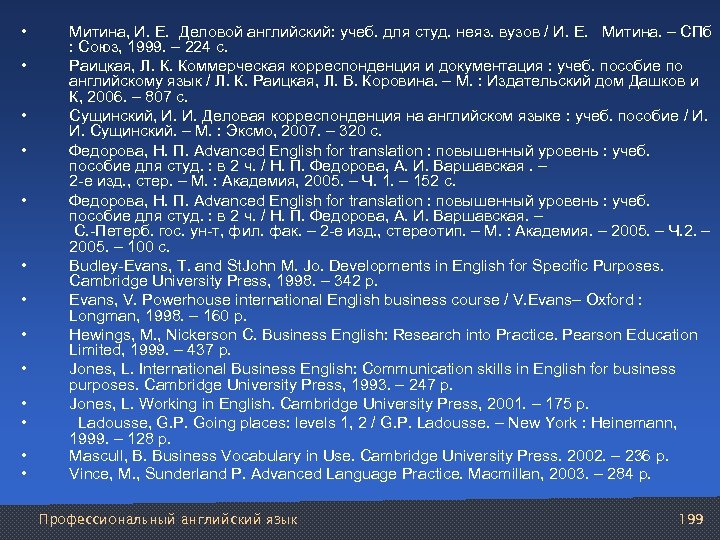
• • • • Митина, И. Е. Деловой английский: учеб. для студ. неяз. вузов / И. Е. Митина. – СПб : Союз, 1999. – 224 с. Раицкая, Л. К. Коммерческая корреспонденция и документация : учеб. пособие по английскому язык / Л. К. Раицкая, Л. В. Коровина. – М. : Издательский дом Дашков и К, 2006. – 807 с. Сущинский, И. И. Деловая корреспонденция на английском языке : учеб. пособие / И. Сущинский. – М. : Эксмо, 2007. – 320 с. Федорова, Н. П. Advanced English for translation : повышенный уровень : учеб. пособие для студ. : в 2 ч. / Н. П. Федорова, А. И. Варшавская. – 2 е изд. , стер. – М. : Академия, 2005. – Ч. 1. – 152 с. Федорова, Н. П. Advanced English for translation : повышенный уровень : учеб. пособие для студ. : в 2 ч. / Н. П. Федорова, А. И. Варшавская. – С. Петерб. гос. ун т, фил. фак. – 2 е изд. , стереотип. – М. : Академия. – 2005. – Ч. 2. – 2005. – 100 с. Budley Evans, T. and St. John M. Jo. Developments in English for Specific Purposes. Cambridge University Press, 1998. – 342 p. Evans, V. Powerhouse international English business course / V. Evans– Oxford : Longman, 1998. – 160 p. Hewings, M. , Nickerson C. Business English: Research into Practice. Pearson Education Limited, 1999. – 437 p. Jones, L. International Business English: Communication skills in English for business purposes. Cambridge University Press, 1993. – 247 p. Jones, L. Working in English. Cambridge University Press, 2001. – 175 p. Ladousse, G. P. Going places: levels 1, 2 / G. P. Ladousse. – New York : Heinemann, 1999. – 128 p. Mascull, B. Business Vocabulary in Use. Cambridge University Press. 2002. – 236 p. Vince, M. , Sunderland P. Advanced Language Practice. Macmillan, 2003. – 284 p. Профессиональный английский язык 199
Скачать презентацию ФЕДЕРАЛЬНОЕ АГЕНТСТВО ПО ОБРАЗОВАНИЮ Федеральное государственное образовательное учреждение
56846063fe29d894609575ba9193acd4.ppt