


 Скачать презентацию Federalism Unit 2 Journal 1 28 Chapter 3
0cabdf5e600f12c85f781e372928e031.ppt
- Количество слайдов: 69
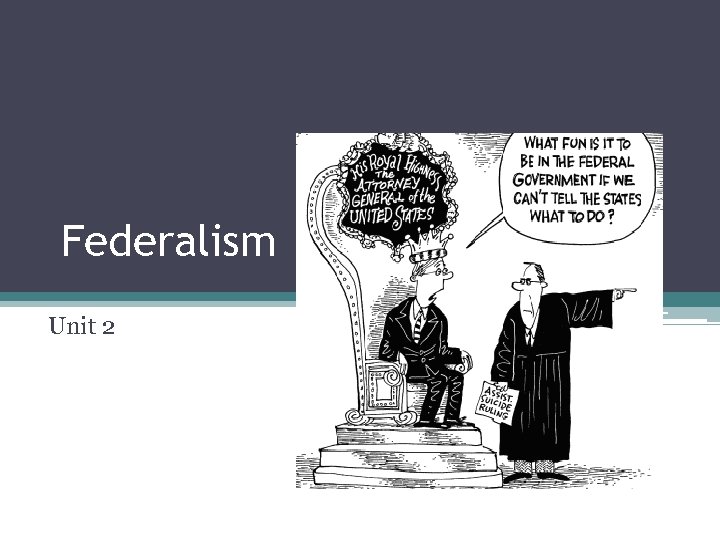 Federalism Unit 2
 Journal 1/28 Chapter 3 of your text opens with a question posed by a Utah congressman; “who is the sovereign, the state or the federal government? ” How would you answer this question? Think about the 9 th and 10 th Amendments, the Supremacy Clause (6. 2), the necessary and proper clause (8. 1), etc…
 Why Bother? • Fear ▫ Federalism is a compromise ▫ The Constitution, not the central gov’t would reign supreme • Unity ▫ Confederalism is a lack of unity ▫ Unitary is TOO MUCH • “…A republic if you can keep it”
 The Problem With Feds Is… • Federalism requires all people to accept the dominance of one document ▫ Difficult in diverse areas… Iraq India Former USSR Pakistan • Nation-Centered Federalism • State-Centered Federalism • Dual Federalism
 Federalism FRQ (72 -88) Read these pages and come up with your own FRQ. It must: A. B. C. D. Have two, related questions Include a logical scoring guide Be worth at least five points Scoring guide must include possible answers. See the next slide for an example of what I’m asking
 Federalism FRQ (72 -79) One feature of the US Constitution is federalism. While the basic definition of federalism has always been the same, the federal government has redefined its own powers in many ways a) Explain one way in which SCOTUS redefined the powers of the federal government b) Explain one way in which the President has redefined the powers of the federal government c) Explain one way in which Congress has redefined the powers of the federal government d) Pick two of the “ways” you mentioned above and explain why the Federalists would have been uncomfortable with them. Do the same, with a different example from a-c, for Anti. Federalists.
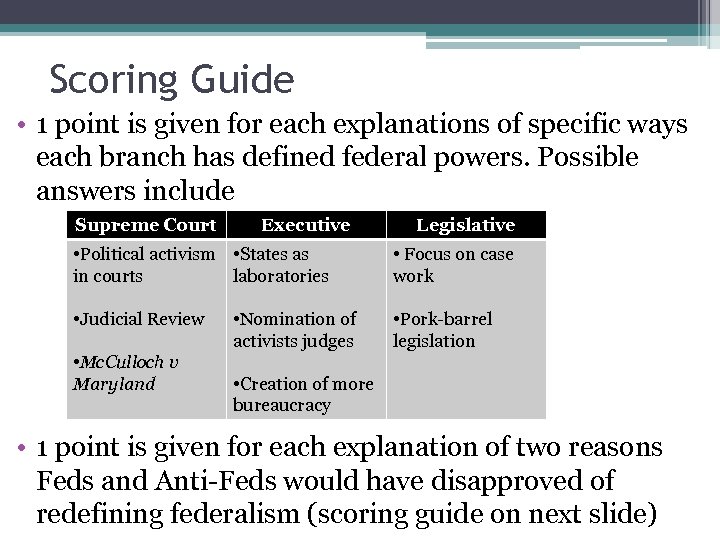 Scoring Guide • 1 point is given for each explanations of specific ways each branch has defined federal powers. Possible answers include Supreme Court Executive Legislative • Political activism • States as in courts laboratories • Focus on case work • Judicial Review • Pork-barrel legislation • Mc. Culloch v Maryland • Nomination of activists judges • Creation of more bureaucracy • 1 point is given for each explanation of two reasons Feds and Anti-Feds would have disapproved of redefining federalism (scoring guide on next slide)
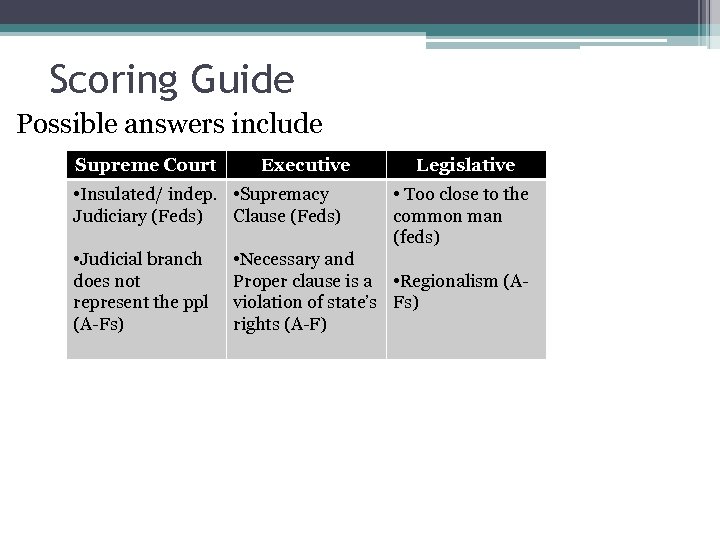 Scoring Guide Possible answers include Supreme Court Executive • Insulated/ indep. • Supremacy Judiciary (Feds) Clause (Feds) • Judicial branch does not represent the ppl (A-Fs) Legislative • Too close to the common man (feds) • Necessary and Proper clause is a • Regionalism (Aviolation of state’s Fs) rights (A-F)
 Journal 9/10 What will you be paying attention to in the upcoming election? Why?
 Journal 9/17 Look at the chart on page 80. What is this telling you? Consider what you know, think you know, have heard about these different ‘programs’; it this money well spent? Explain. Is there something NOT ON THIS CHART you would give money to in the states?
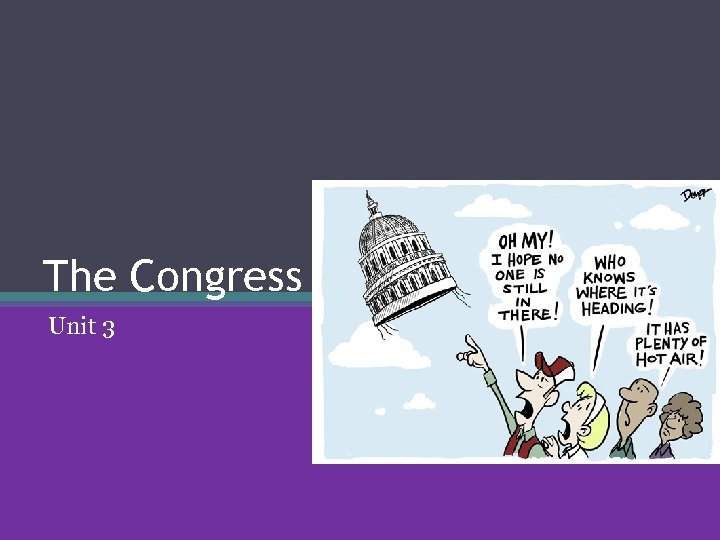 The Congress Unit 3
 In Mc. Cullough v Maryland SCOTUS established which of the following principles? A. States cannot interfere with or tax the legitimate activities of the federal government B. The Judicial branch can not intervene in political disputes between the President and Congress C. The federal Bill of Rights places no limitations on the states D. The federal government has the power to regulate commerce E. It is within the judiciary's authority to interpret the Constitution
 Journal 2/12 What is apportionment? Why do we do it? What’s its relevance to congress?
 Congressional Oversight (309 -311) Oversight: a. Gov’t Accountability Office (GAO) 1. 2. b. Committee Hearings 1. 2. 3. c. Budget! Control! 1. 2.
 Clips 1. Clip: Automotive Industry 2. http: //www. cnn. com/2012/07/02/politics/contempt-vote-politicalsurvival/index. html 3. http: //www. youtube. com/watch? v=YD 9 sz 8 rvhe. I&list=PLdd 7 Ck. XO H 44 xv. WC 933 d. XQgt. Jymt. MVJg. FH&index=1&feature=plpp_video
 Practice FRQ (2006) Congress – Bi-cameral structure A. State 2 reasons why founding fathers created a bicameral legislature § Consider: representation, population, constitutional compromise, checks and balances B. Explain one unique power of the House and describe why founding fathers gave it this power C. Explain one unique power of the Senate and describe why founding fathers gave it this power ▫ ▫ Consider (for B and C) Money Bills start in the House. Why? Think about pre-17 th amendment USA. Which house was connected more to the people? Senate has power of advice and consent (Art II Sec II). Pre-17 th USA which house was more “mature”? Why’d the founders do that?
 SOMETHING TO THINK ABOUT On page 314 the book says competition AND civility are important in congress; do you agree? Explain.
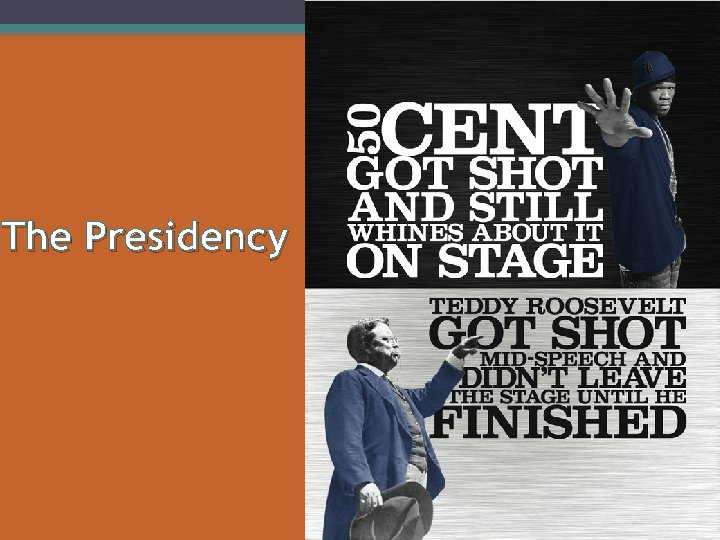 The Presidency
 The Man…or woman? Maybe? Someday? • Qualifications ▫ 1 ▫ 2 ▫ 3 • Experience ▫ ▫ Lincoln v Buchanan and Johnson Obama Adamses Second term • Perks and Pay (328)
 Journal 2/18 You get to amend the Constitution…create two more qualifications to become POTUS. Why are these important to you?
 Journal 10/15 Read the excerpt from Bill Moyer’s Journal. What does Bacevich mean by imperial presidency? Why is it significant to him that power is shifting to the executive branch and how is this happening? You can use 326 of your book to help you a little…
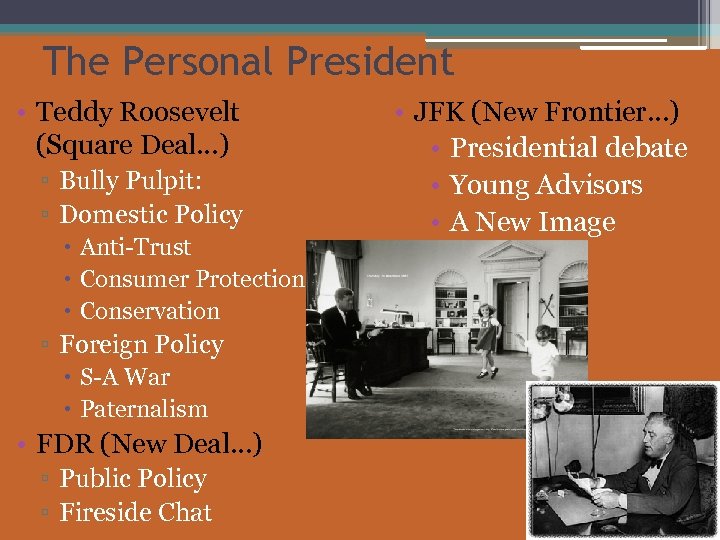 The Personal President • Teddy Roosevelt (Square Deal…) ▫ Bully Pulpit: ▫ Domestic Policy Anti-Trust Consumer Protection Conservation ▫ Foreign Policy S-A War Paternalism • FDR (New Deal…) ▫ Public Policy ▫ Fireside Chat • JFK (New Frontier…) • Presidential debate • Young Advisors • A New Image
 FRQ (2011) • The Constitution of the United States creates a government of separate institutions that share power rather than a government that delegates power exclusively to a single branch. Frequently, this means that presidents and Congress struggle with each other. For each of the presidential powers below, explain one way that congressional decision making is affected by that power. • Veto power • Power to issue executive orders • Power as commander in chief
 MC Practice • In vetoing a bill, the president does which of the following? A. Rejects only a part of the bill without rejecting it entirely. B. Prevents any further action on the bill C. Sends the bill back to conference committee. D. Rejects all sections of the bill. E. Decides the bill’s constitutionality.
 FRQ (2011) • The Constitution of the United States creates a government of separate institutions that share power rather than a government that delegates power exclusively to a single branch. Frequently, this means that presidents and Congress struggle with each other. • For each of the congressional powers below, explain one way that presidential decision making is affected by that power. ▫ Legislative oversight power ▫ Senate advice and consent power ▫ Budgetary power
 Consider the following (354 -359) 1. How does a previous administration seem to affect the one that follows? 2. The book says the president sets himself up in the election to be a disappointment while in office; why is this? 3. What are some things which affect the president’s approval rating which are beyond his control? 4. Do you believe it’s more noticeable when Congress is ineffective or when POTUS is? Explain. 5. If Obama wins a second term how does the text suggest he will do? Do you agree? Explain. 6. During the election what promises have the candidates made you think will be impossible for them to keep?
 Journal 2/25 Turn to page 391. What was Ledbetter v Goodyear about? What law did this case challenge? What was the immediate outcome of the trial? What did congress do in reaction? How is this an example of checks and balances?
 Journal 2/28 Currently there is a Kansas gun bill going through the state congress; if passed this bill would make it illegal for the federal gov’t to regulate guns owned and sold in KS. What’s the issue with this?
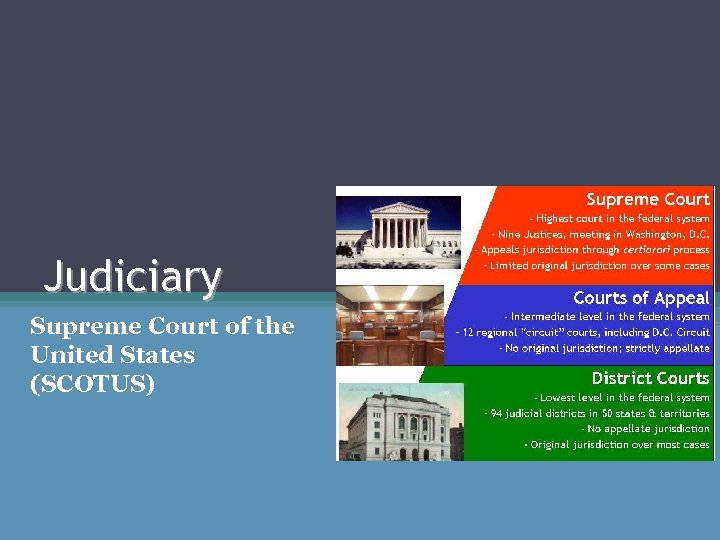 Judiciary Supreme Court of the United States (SCOTUS)
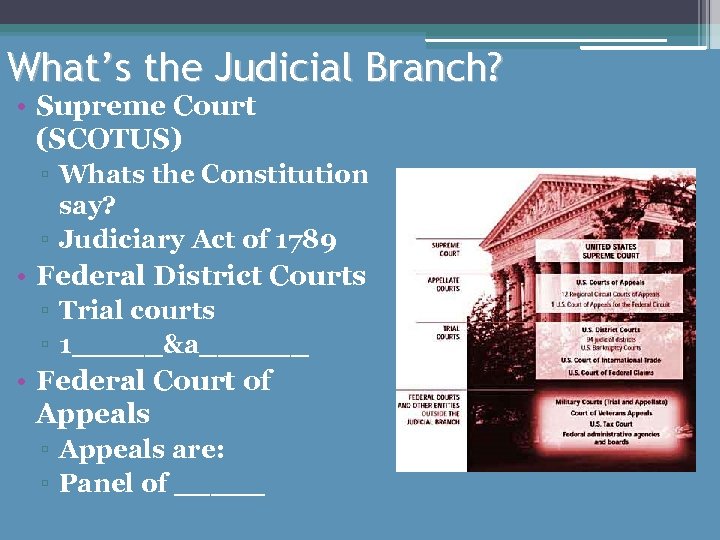 What’s the Judicial Branch? • Supreme Court (SCOTUS) ▫ Whats the Constitution say? ▫ Judiciary Act of 1789 • Federal District Courts ▫ Trial courts ▫ 1_____&a______ • Federal Court of Appeals ▫ Appeals are: ▫ Panel of _____
 394 -398 1. What are POTUS’ criteria for SCOTUS? 2. How does POTUS use SCOTUS nominees to boost his poll numbers? 3. What’s the job of the Senate Judiciary Committee? 4. How has the committee changed presidential consideration of justices? 5. Is SCOTUS really as ‘independent’ as we think? Explain. 6. What powers does the minority party have when it come to nominations? 7. Analyze the cartoon on 398.
 401 -409 1. Why does the book suggest the wealthy have an advantage in court? 2. What role do interest groups play in cases? Why do they do this? 3. Why is it the job of the courts to define terms? 4. How does the decision making of a restrained judge differ from that of an activist judge? 5. How might it be stated that judges make the law? 6. What’s the process for trial at SCOTUS?
 Journal 3/7 Describe Judicial Review. This power is implied (not in the Constitution); why does SCOTUS have it? Do you believe judicial review is constitutional? Explain.
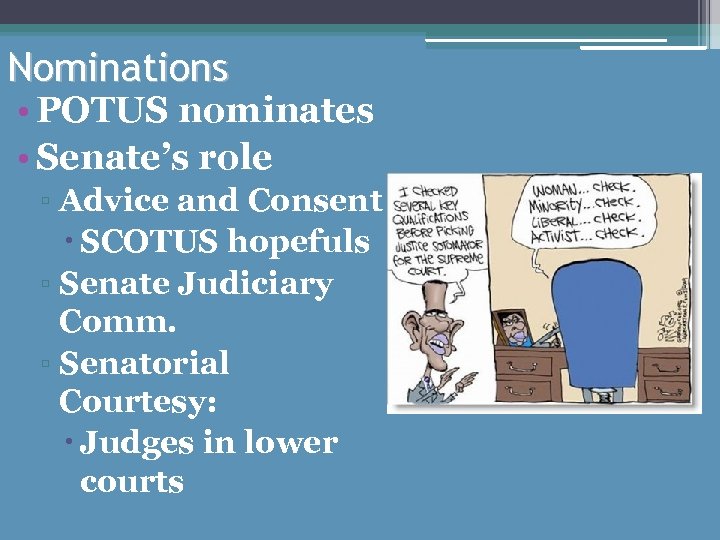 Nominations • POTUS nominates • Senate’s role ▫ Advice and Consent SCOTUS hopefuls ▫ Senate Judiciary Comm. ▫ Senatorial Courtesy: Judges in lower courts
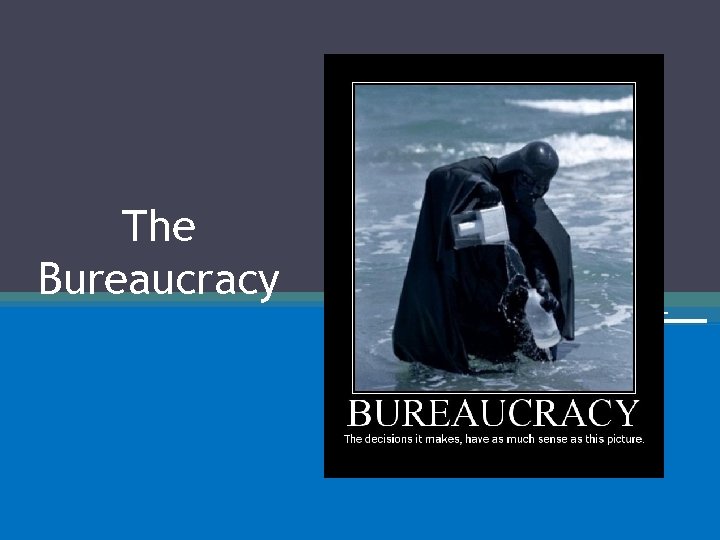 The Bureaucracy
 Journal 3/12 Your book claims that “policy making without administration is tantamount to no policy making at all; ” explain this sentiment. Do you agree?
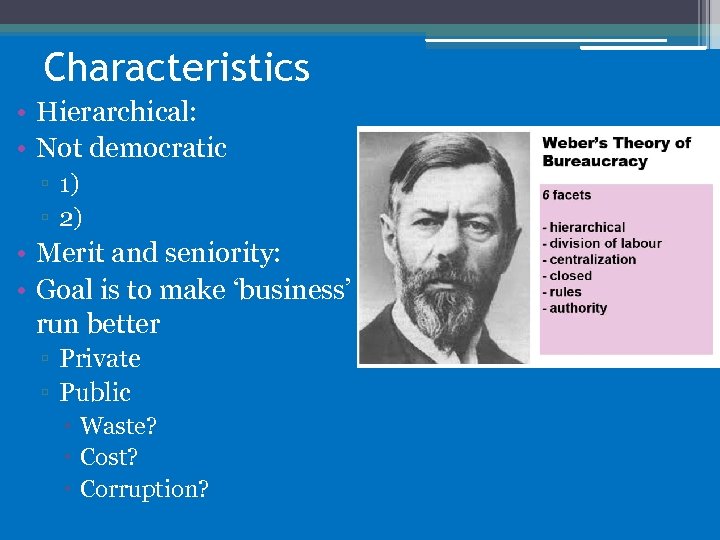 Characteristics • Hierarchical: • Not democratic ▫ 1) ▫ 2) • Merit and seniority: • Goal is to make ‘business’ run better ▫ Private ▫ Public Waste? Cost? Corruption?
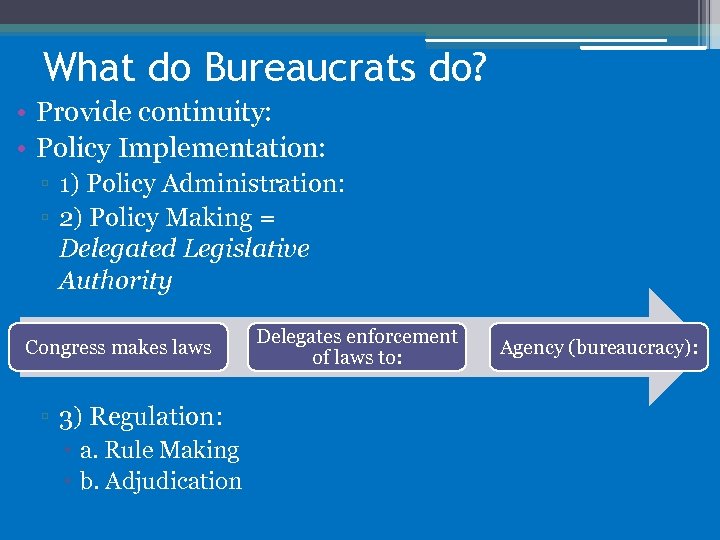 What do Bureaucrats do? • Provide continuity: • Policy Implementation: ▫ 1) Policy Administration: ▫ 2) Policy Making = Delegated Legislative Authority Congress makes laws ▫ 3) Regulation: a. Rule Making b. Adjudication Delegates enforcement of laws to: Agency (bureaucracy):
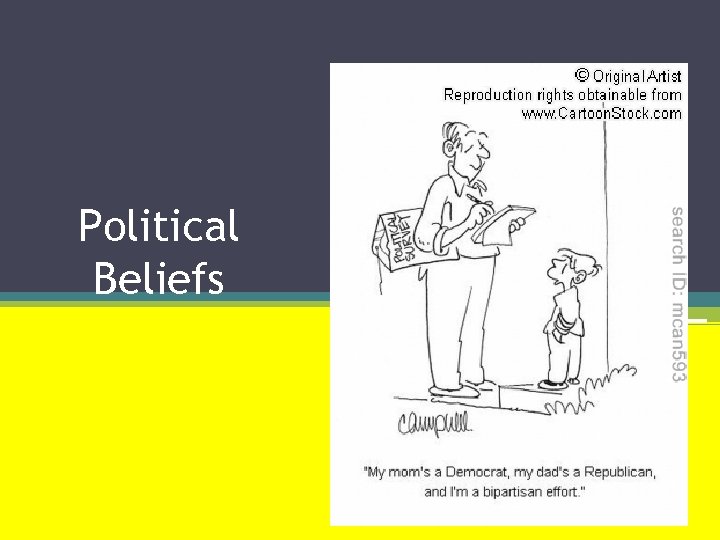 Political Beliefs
 Journal 3/28 • Do Americans trust the government? • How has trust in government changed over the years? • What factors impact trust in government? • What occurred in trust immediately after 9/11 & why?
 What’s Political Socialization? What are agents of political socialization? Rank the following in order of the most influential to the least influential agent of political socialization. • Peers • Family • School • Media • Political leaders • Communities
 More Key Terms • Political Culture – Widely or commonly held beliefs/attitudes within a society. • Political Ideology – A set of principles that provides guidance on the proper behavior of government. • Efficacy – citizen’s belief in their ability to impact government. • Legitimacycitizen’s belief that the government has the right to rule. • Individualism/limited government/American dream – the individual is responsible for finding prosperity.
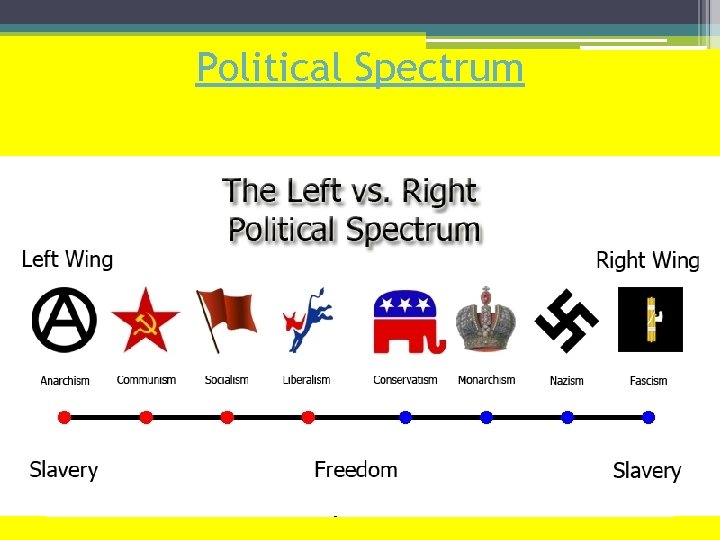
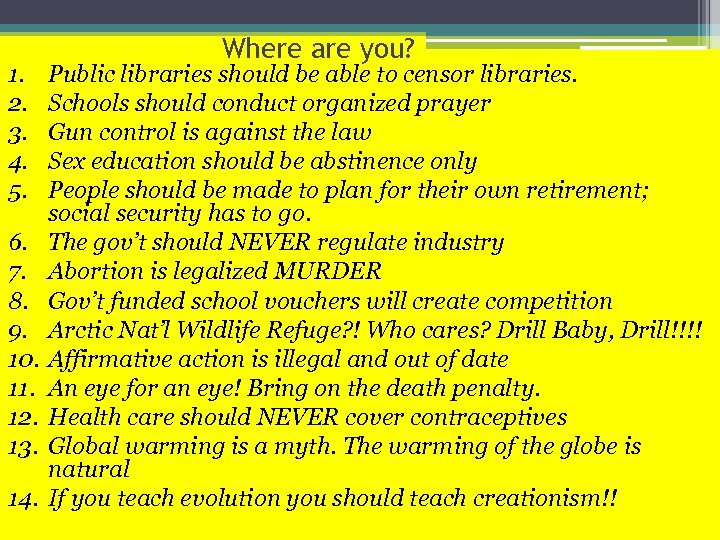
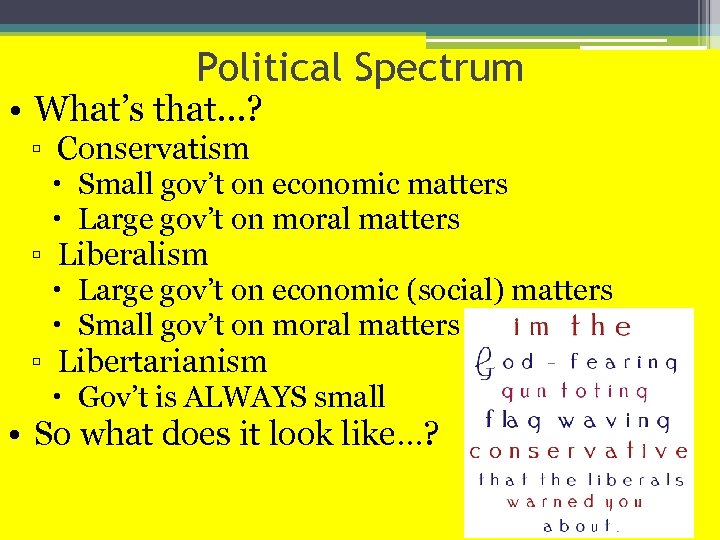 Political Spectrum • What’s that…? ▫ Conservatism Small gov’t on economic matters Large gov’t on moral matters ▫ Liberalism Large gov’t on economic (social) matters Small gov’t on moral matters ▫ Libertarianism Gov’t is ALWAYS small • So what does it look like…?
 Political Spectrum
 1. 2. 3. 4. 5. 6. 7. 8. 9. 10. 11. 12. 13. 14. Where are you? Public libraries should be able to censor libraries. Schools should conduct organized prayer Gun control is against the law Sex education should be abstinence only People should be made to plan for their own retirement; social security has to go. The gov’t should NEVER regulate industry Abortion is legalized MURDER Gov’t funded school vouchers will create competition Arctic Nat’l Wildlife Refuge? ! Who cares? Drill Baby, Drill!!!! Affirmative action is illegal and out of date An eye for an eye! Bring on the death penalty. Health care should NEVER cover contraceptives Global warming is a myth. The warming of the globe is natural If you teach evolution you should teach creationism!!
 Political Parties
 Journal 4/2 Read the Talking Points on page 183. • What’s a RINO? • Why was Specter able to win five terms as a “RINO” in Pennsylvania? • What does “big tent party” mean?
 American Party System • Minor “third” parties ▫ Most success in local elections ▫ Give issues air time… Perot and Nat’l Debt Nader and Environmental issues ▫ A “wasted” vote? • Parties are not centralized ▫ Power is distributed ▫ POTUS may be the head of the party but congressmen answer to their constituents…
 Party Organization • The National Committee (Party HQ) ▫ Headed by National Party Chair Appointed by the party or POTUS Spokesperson for party ▫ House and Senate campaign committees Recruit candidates Develop strategy • State/local party organization ▫ Committees and chairs tailor activity for their level
 More Key Terms • Two Party System– Only two parties have a realistic chance to win POTUS. Different in… • Single-Member Districts One representative per district. Lowers efficacy b/c: • Winner-take-all Provision – man with the most votes wins whole district. • Proportional Representation (PR) Opposite of W-T-A:
 Journal 04/02 How might changes such as the following help quell the influence of money on elections and law making (choose one to discuss)? • More Public Financing • Anonymity of big donors • Constitutional Amendment • Immediate Disclosure
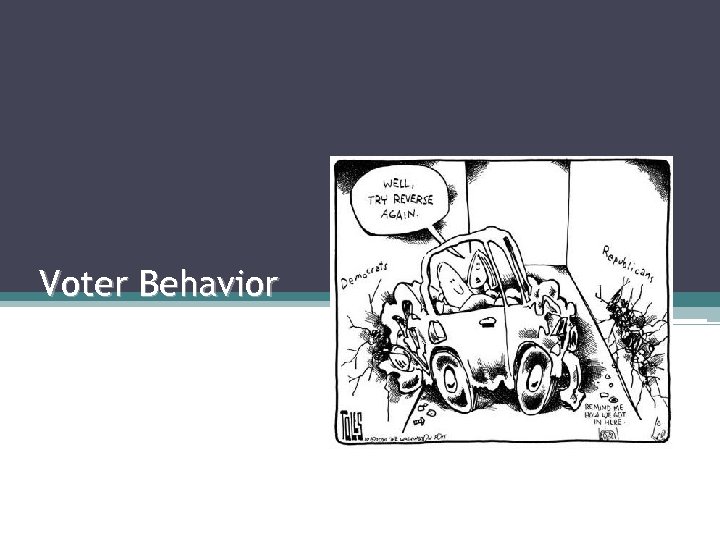 Voter Behavior
 Three Indicators of Voter Behavior 1) Candidates ▫ ▫ ▫ Personality Style Indicator has become more prevalent: 2) Issues ▫ ▫ ▫ More likely to vote for a candidate: Issues voters more prevalent: Retrospective voting:
 Questions for reading… • According to the author why do campaigns create negative ads (DO NOT SAY to get the candidate elected)? • How does the American public respond to them and what info is gleaned from attack ads? • Explain this quote “If people want to complain about 527 s, thank Mc. Cain-Feingold” • What kinds of things do campaigns consider when creating attack ads? • Look up negative attack ads. Find one you think is particularly effective. Email me the link and explain why it’s effective?
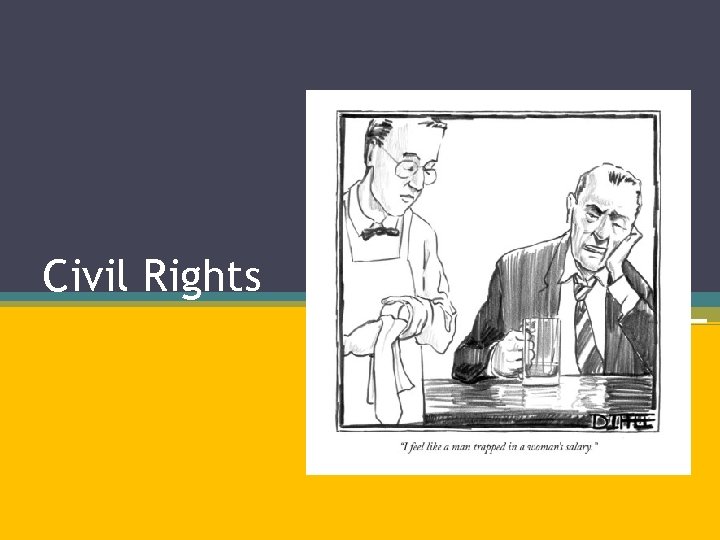 Civil Rights
 Due Process • In the ____Amendment DP is about: ▫ “No person shall be held to answer …for a crime…nor shall any person be subject for the same offense…twice…nor shall be compelled…to be a witness against himself, nor be deprived of life, liberty, or property, without due process of law…” • In the _____Amendment DP is about: • All persons born or naturalized in the United States…are citizens…No State shall make or enforce any law to abridge rights of US citizens… nor shall any State deprive any person of life, liberty, or property, without due process of law; nor deny to any person within its jurisdiction the equal protection of the laws. . . The Congress shall have power to enforce, this law
 Civil Right Act 1964 Outlawed discrimination in the United States against African Americans (including racial segregation). What else did the law do?
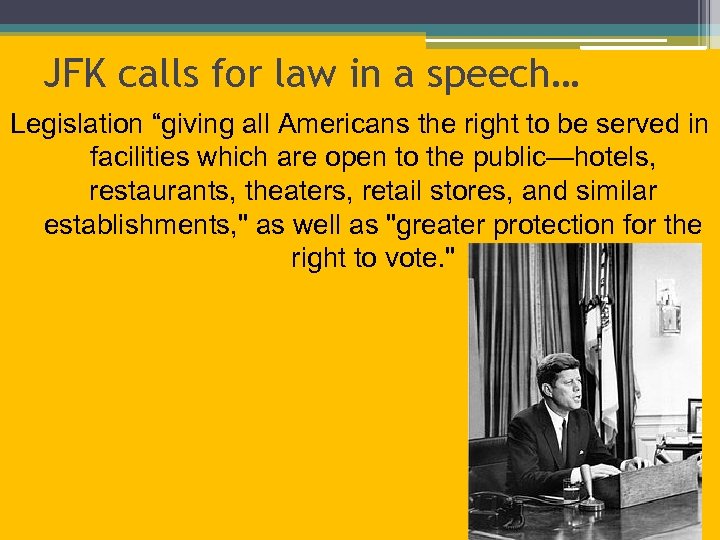 JFK calls for law in a speech… Legislation “giving all Americans the right to be served in facilities which are open to the public—hotels, restaurants, theaters, retail stores, and similar establishments, " as well as "greater protection for the right to vote. "
 House Action d a e Chair Howard Smith (VA-D) L not to L segregationist who vowed a for floor debate. schedule the bill T s Democrats in House draft legislation modeled after Kennedy’s proposal – outlawing racial segregation in public places and allowing citizens to sue for discrimination. Members of Congress who support the bill cite Congress’s power to regulate interstate commerce (the Commerce Clause) of the Constitution as their authority Bill strengthened in Committee Clause to include women
 Senate Action R e T s U B I L I F Bill had support from Majority and Minority leaders in the Senate and is scheduled for debate! Strom Thurmond (R-SC)
 Kennedy Assassination ! d e chambers Bill went back tos both slarge margins. and passed by a P The assassination of President Kennedy occurs as the Civil Rights Act is stalled in both the House of Representatives and the Senate. The assassination causes sympathy for Kennedy’s cause, and the filibuster is broken. The Conference Committee Adopted the Senate version of the bill which was stronger than the House version.
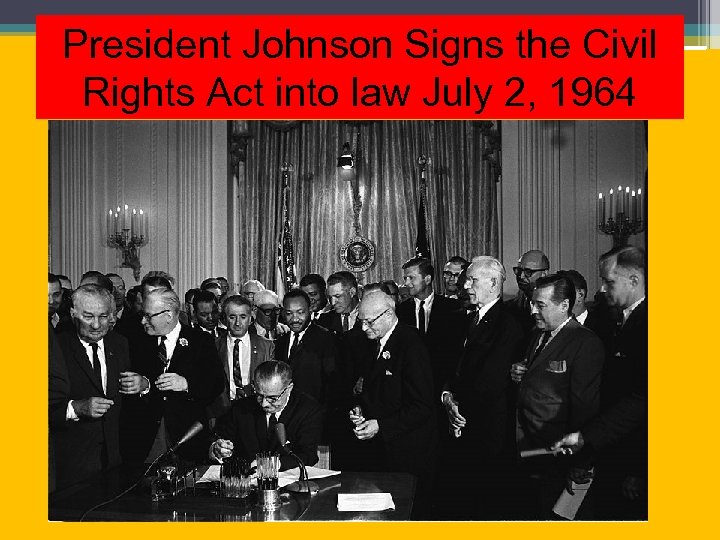 President Johnson Signs the Civil Rights Act into law July 2, 1964
 Selective Incorporation
 A riddle for you In 1833 Barron v. Baltimore the Supreme Court ruled that the Bill of Rights did not apply to the states. How could this be true?
 A riddle for you – More about the case 5 th Amendment “due process of law” A wharf owner in Md had his property seized by the state. He alleged he had been denied his “Due Process of Law” rights by the state. He lost. Because according to the Supreme Court, the B. O. R. did not apply to the states, therefore the 5 th amendment due process clause did not apply to state government.
 The Supreme Court Ruled That the Bill of Rights Applied only to the National Government, not the state governments. For Example: 1 st Amendment “Congress Shall Make no law. . ” = national congress
 14 th Amendment eventually changes this… What was 14 th designed to do? - provide citizenship to former slaves How is it worded? “No state shall deprive citizens Of life liberty or property Without due process of law”
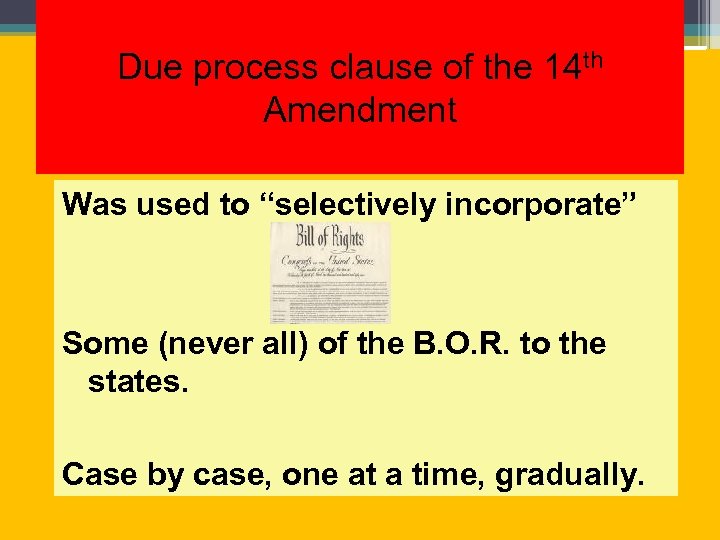 Due process clause of the 14 th Amendment Was used to “selectively incorporate” Some (never all) of the B. O. R. to the states. Case by case, one at a time, gradually.