


 Скачать презентацию Federalism Federalism is the division of power
72f5a0aad1d549d3ea639d5345ec696f.ppt
- Количество слайдов: 30
 Federalism
 Federalism is the division of power between the federal/national and the state/local government.
 Federal Power • Delegated/ expressed/ enumerated powers: – Declare war – Coin Money – Raise & maintain a military( armed forces) – Regulate interstate/ foreign trade – Foreign relations – New states
 Implied Powers • • • Ex: draft, raise an army & navy Ex: minimum wage, regulate commerce Ex: Federal Reserve System, borrow money Ex: punish tax evaders, collect taxes Ex: prohibit mail fraud, establish post office (Necessary & Proper clause- Article 1 section 8 aka elastic clause) Don’t write
 Inherent Powers • Examples – Control immigration – Establish diplomatic relations – New territories – Defend gov
 Shared Powers • Concurrent Powers examples – Tax • Both tax your income – Transportation – Crimes & courts – Enforce laws – Spend for general welfare
 States Powers • Reserved Powers: – Education – Marriage/ divorce – Driving licenses – Elections – Regulate intrastate commerce – Local government systems – Protect the public’s health and welfare
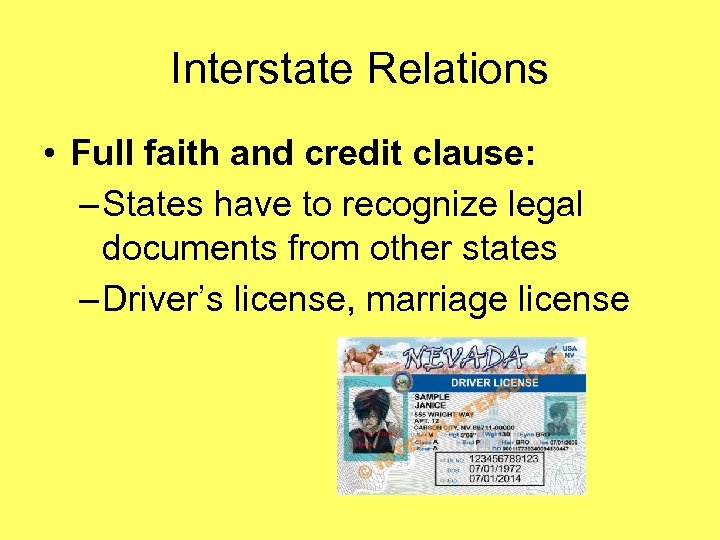 Interstate Relations • Full faith and credit clause: – States have to recognize legal documents from other states – Driver’s license, marriage license
 • Privileges and Immunities clause: – Residency requirements must be fair – Out of state tuition – Non-residents of NV pay extra $14, 000 a year for tuition at UNLV • Extradition: – states must return fugitives from the law
 Mc. Cullough v. Maryland (1813) • Determined that the Elastic Clause (necessary & proper) of the Constitution allows for Congress to stretch its powers beyond what is written in the Constitution. (aka loose constructionist)
 Where it gets tricky… • What if a state wants to pass a law that goes against a federal law? – NV passes a law that allows for use recreational marijuana • Or what if the federal gov wants to pass a law in an area that has historically belonged to the states? – Congress sets standards in education through Common Core
 Supremacy Clause • Constitution supreme law of the land
 Federalism Today
 Gibbons v. Ogden (1824) • Ferry between New Jersey & New York • Gibbons received a license from the federal gov • Ogden received one from NY • Who gets it? • Constitution gives Congress the power over interstate commerce (trade between states) thus Gibbons wins!
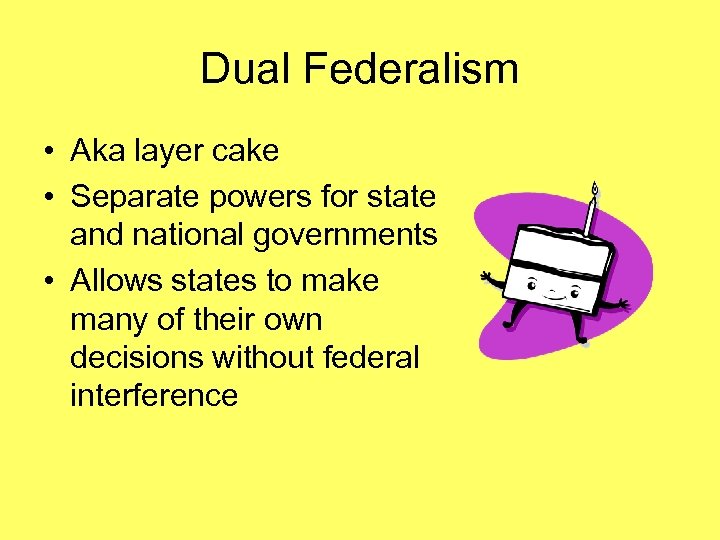 Dual Federalism • Aka layer cake • Separate powers for state and national governments • Allows states to make many of their own decisions without federal interference
 Examples of Dual Federalism • Allows businesses to create monopolies, low wages, etc. • Plessy v. Ferguson (1896) – Plessy: 1/8 black, sits in white compartment of a train, arrested, convicted – States could allow for “separate but equal” facilities
 National Government Fights Back! • FDR & his New Deal begin to challenge states’ rights by creating new federal laws such FDIC (bank insurance) • Cooperative Federalism: Federal & state governments work together (who has the power when is not always clear) • AKA marble cake
 Heart of Atlanta Motel v. U. S. (1964) • If you own your own business can you refuse the right to serve any one you want? • An owner of hotel in Georgia says YES! • The federal government passed a law that says – businesses cannot discriminate • Who’s right?
 And the winner is… • Congress: – Commerce clause: Congress can make rules affecting any kind of commerce between 2 or more states – If you know hotels in Georgia will refuse to serve you, you will not go, and your money will stay home thus affecting the economy of Georgia
 So, if… • Congress can regulate any kind of commerce that crosses state lines, what does that include? • What then can Congress NOT regulate? • Does this leave Congress with ALL the power?
 Let’s see… • U. S. v. Lopez (1995)
 Significance of Lopez • Devolution: power returning to states from federal gov – Commerce Clause: cannot encompass everything – 10 th Amendment: states do reserve some powers • Judicial Review: Power of Supreme Court over other 2 branches (checks & balances)
 Fiscal Federalism
 Fiscal (taxing & spending) Federalism • Sharing of federal monies (revenue – money coming in via taxes) with states – A way to ensure that states comply with federal laws
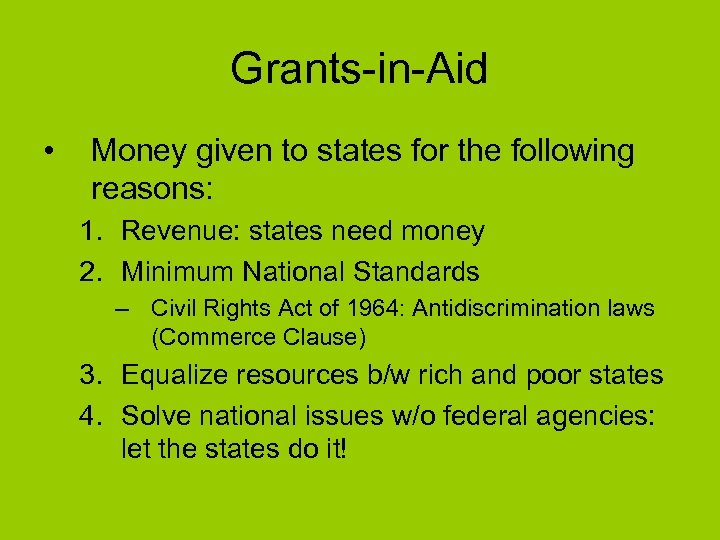 Grants-in-Aid • Money given to states for the following reasons: 1. Revenue: states need money 2. Minimum National Standards – Civil Rights Act of 1964: Antidiscrimination laws (Commerce Clause) 3. Equalize resources b/w rich and poor states 4. Solve national issues w/o federal agencies: let the states do it!
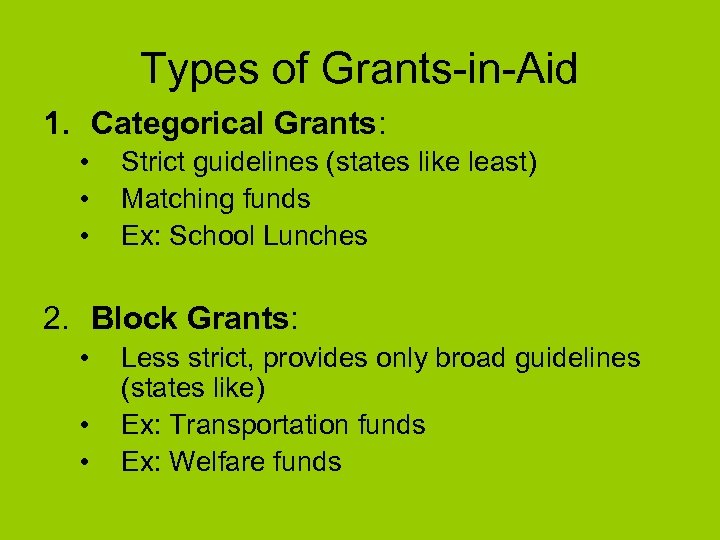 Types of Grants-in-Aid 1. Categorical Grants: • • • Strict guidelines (states like least) Matching funds Ex: School Lunches 2. Block Grants: • • • Less strict, provides only broad guidelines (states like) Ex: Transportation funds Ex: Welfare funds
 3. Revenue Sharing: • • • States receive a % of federal revenue No guidelines – states really liked! Ended in 1987
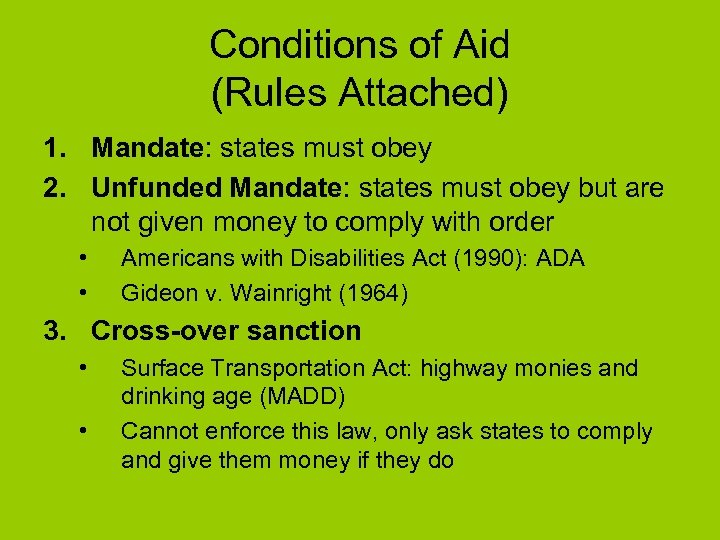 Conditions of Aid (Rules Attached) 1. Mandate: states must obey 2. Unfunded Mandate: states must obey but are not given money to comply with order • • Americans with Disabilities Act (1990): ADA Gideon v. Wainright (1964) 3. Cross-over sanction • • Surface Transportation Act: highway monies and drinking age (MADD) Cannot enforce this law, only ask states to comply and give them money if they do
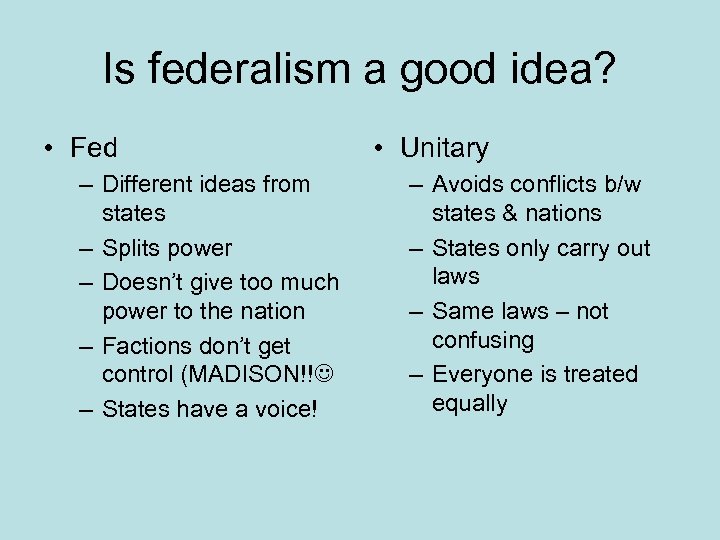 Is federalism a good idea? • Fed – Different ideas from states – Splits power – Doesn’t give too much power to the nation – Factions don’t get control (MADISON!! – States have a voice! • Unitary – Avoids conflicts b/w states & nations – States only carry out laws – Same laws – not confusing – Everyone is treated equally
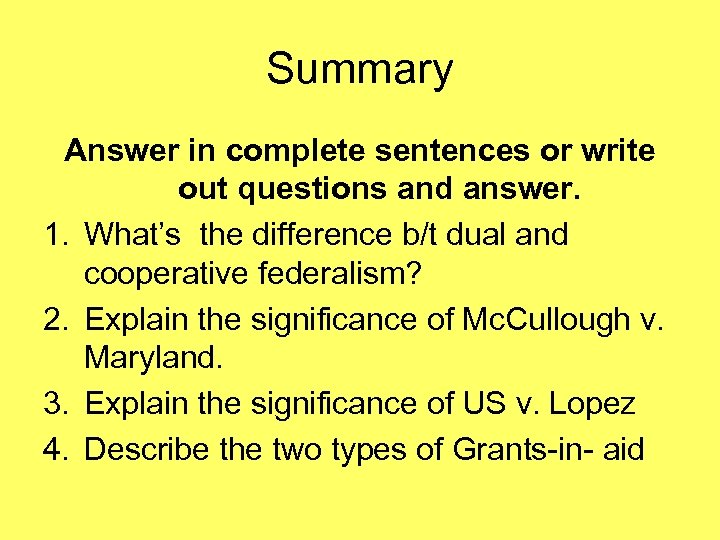 Summary Answer in complete sentences or write out questions and answer. 1. What’s the difference b/t dual and cooperative federalism? 2. Explain the significance of Mc. Cullough v. Maryland. 3. Explain the significance of US v. Lopez 4. Describe the two types of Grants-in- aid