 Скачать презентацию Federal State budgetary institution of the highest education
Presentation Advertising.pptx
- Количество слайдов: 28



Federal State budgetary institution of the highest education «FINANCE UNIVERSITY UNDER THE GOVERNMENT OF THE RUSSIAN FEDERATION» (Financial University) DEPARTMENT “MICROECONOMICS” COURSEWORK on the topic: * Completed by: Zherebyatyeva N. D. Scientific director: Allenykh M. A.
* In the present time, advertising, being the constant companion of the person, everyday it is massively influences it, plays an essential role in life of human society. This role isn't limited a framework of mass media, even all market activity. Advertising activity is based on marketing activity of the enterprise and solves problems of achievement of the objectives of the enterprise, it is one of the major problems in business, that is understanding of a place and an advertising role in business activity
* Advertising stimulates sale of goods and accelerates a failure bad, that is it an element of all complex of marketing, and, therefore, and has to be used as a system element that not always is understood in the Russian business. Thus, advertising, being changing reality of the today's Russian market, demands attentive studying and knowledge of all its tools. The solution of the problem of effective use of advertising opens to the enterprise a way to success and provides competitiveness in the market.
The purpose of this work is to study a place and a role of advertising in economy. Tasks: • To consider definition, essence, the content of advertising; • To characterize the main tendencies of development of advertising; • To characterize economic efficiency of advertising for society; • To analyze features of development of an advertising in Russia and the international rules in the field of advertising.
During writing of a coursework following methods of scientific research were used: - Literature analysis; - Comparative method; - Studying of legal and regulatory framework; - Studying of monographic publications and articles; - Analytical method; - Generalization.
* Theoretical studying of advertising activity
* Definition • Advertising - the paid, unidirectional and impersonal address which is carried out through mass media and other types of communication, propaganda in favor of any goods or service. Features of advertising 1. Advertising at the same time reaches a large number of consumers and is rather cheap on one client; 2. Advertising publicly and it means that the goods are checked, and its acquisition won't meet condemnation from the public; 3. Advertising allows repeating addresses repeatedly; 4. Advertising is expressive as influences sense organs of the person.
Advertising is a very delicate market tool. In the conditions of the developed market when there is a high competition, and each seller aspires as much as possible, to satisfy needs of the buyer, advertising can serve as a decisive factor of competitive fight. Advertising – the most effective tool in attempts of the enterprise to modify behavior of buyers, to draw their attention to its goods (services), to create a positive image of the enterprise, to show its public importance and usefulness.
• Branded advertising shows advantages of the enterprise, difference from competitors, creates an image of the enterprise in the opinion of consumers. Therefore, advertising pursues two main aims: 1. To create an image of the company (long-term influence); 2. To increase sale (short-term influence)
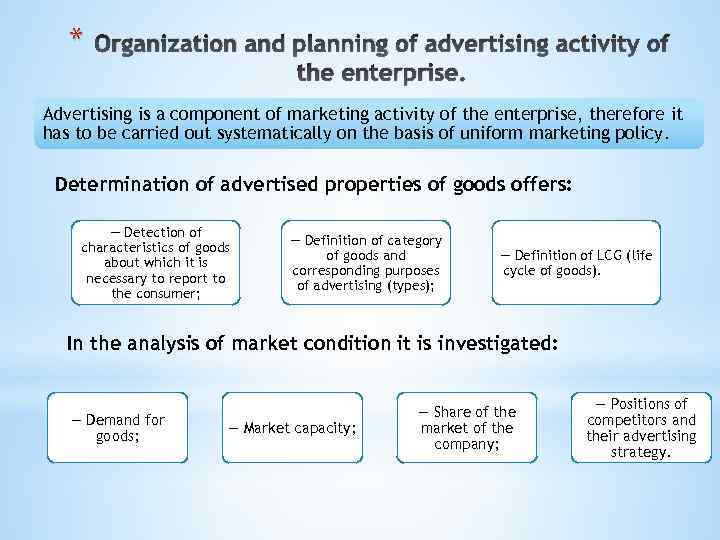
* Organization and planning of advertising activity of the enterprise. Advertising is a component of marketing activity of the enterprise, therefore it has to be carried out systematically on the basis of uniform marketing policy. Determination of advertised properties of goods offers: — Detection of characteristics of goods about which it is necessary to report to the consumer; — Definition of category of goods and corresponding purposes of advertising (types); — Definition of LCG (life cycle of goods). In the analysis of market condition it is investigated: — Demand for goods; — Market capacity; — Share of the market of the company; — Positions of competitors and their advertising strategy.
Only having received "a consumer image" management and specialists in advertising develop the advertising strategy which main components are: — Advertising purposes; — Consumer; — Advertising idea or advertising subject (creative strategy); — Strategy of placement advertising. Development of creative strategy of advertising has essential value, which includes: 1. 2. 3. 4. advertising slogan (motto) image; scenario text; use of a color score in advertising.
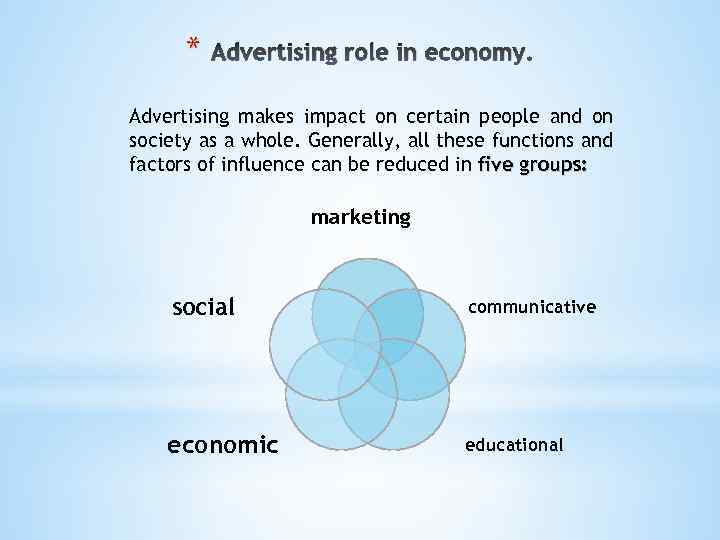
* Advertising role in economy. Advertising makes impact on certain people and on society as a whole. Generally, all these functions and factors of influence can be reduced in five groups: marketing social communicative economic educational
* Economic efficiency of advertising for society. Advertising plays more and more noticeable role in society. • First of all it is possible to allocate the economic aspect having impact on a standard of living, welfare. • The second position concerns the social sphere: advertising forms ideas of values, lifestyle. • And, at last, one more component of a problem "advertising and society" includes ethical standards and questions of regulation of advertising activity.
* Conclusion for chapter 1: Advertising is any paid form of impersonal representation and sales promotion of ideas, goods and services by a certain sponsor. 2. Advertising is the most significant component of system of marketing communications which allows the enterprises to achieve long-term competitive advantage, and also serves as the main instrument of positioning of the enterprise in consciousness of a target segment of the market. 3. The essence of advertising consists that she transfers by means of mass media information on consumer properties of goods for the purpose of creation of demand for it. 4. The purpose of advertising consists in systematic impact on mentality of the person to cause in it desire to get the known benefits. 5. Advertising became the integral and active part of a communication complex of marketing. And its level of development defines quality and efficiency of promotional and informational activity of the producer and its compliance to new requirements of the world market.
* Chapter 2 Features of development of an advertising in Russia and the international rules in the field of advertising
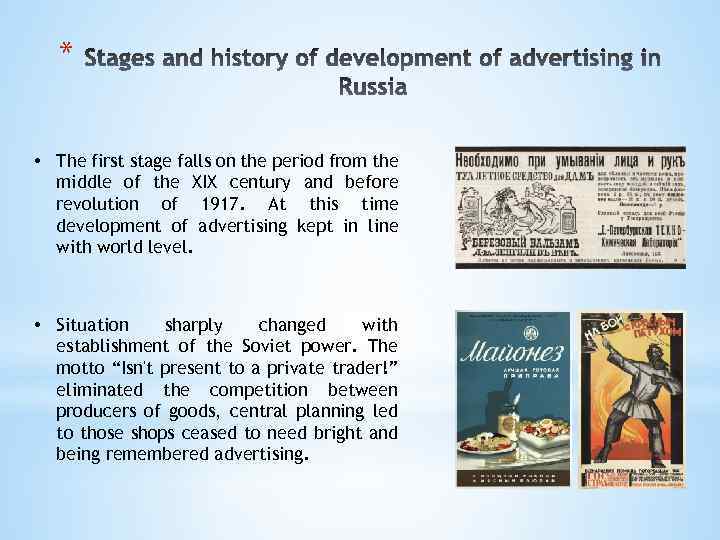
* • The first stage falls on the period from the middle of the XIX century and before revolution of 1917. At this time development of advertising kept in line with world level. • Situation sharply changed with establishment of the Soviet power. The motto “Isn't present to a private trader!” eliminated the competition between producers of goods, central planning led to those shops ceased to need bright and being remembered advertising.
• Political, social and economic transformations in Russia in the 1990 th which have brought to the country certain political freedoms and relative liberalization of economy, allowed the joint venture to attract on the Russian market of the traditional transnational advertisers of "Procter & Gamble", "Philip Morris", "General Motors", and also the largest producers of food, other goods of the mass demand which have filled with the production counters of the Russian shops. The first results testified that the most prepared for work in the market of Russia there were multinational advertising companies which have come here before all. Their emergence in Russia played a positive role in revival of the national advertising industry. The international advertising groups initially set a high level as to advertising creativity, so as a whole professional advertising activity of the Russian experts.
On this background the Russian structure of advertising was intensively formed: advertising and communication agencies, associations of advertising workers, the bodies regulating advertising — everything that allows to operate advertising and promotes its development. Leading advertising agencies in Russia treat: -"Mc. Cann-Erickson", Moscow; -"BBDO Moscow', Moscow; -"Navigator DDB", Moscow; -"Young & Rubicam", Moscow; -"Ark Thompson", Moscow; -"TBWA Russia" ("Partner"), Moscow; -"Ogilvy & Mather, Moscow; -"D'Arcy — Moscow', Moscow; -"Leo Burnett Maridpour", Moscow; -"Rose Creative Strategies", Moscow;
Among the positive tendencies defining today the direction of development of the Russian advertising, especially it should be noted change of the relation to a trademark among the Russian businessmen as to the instrument of advance of goods made by them and services. Today there is a turn in public consciousness towards domestic trademarks. Consumer preferences of Russians are formed under influence not only conscious patriotism, but also the rational choice of buyers based on an assessment of quality of offered goods. The taxable base of advertising today has importance. Problem: rather low norm of advertising expenses is referred on prime cost, i. e. the advertising expenses exempted from taxes.
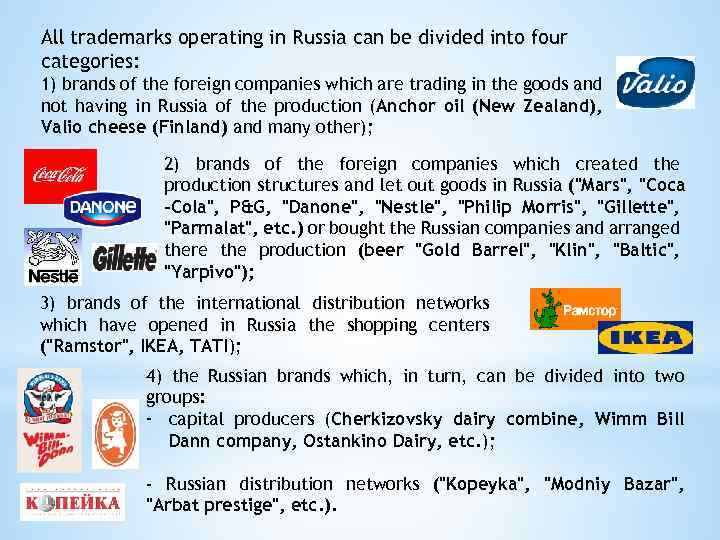
All trademarks operating in Russia can be divided into four categories: 1) brands of the foreign companies which are trading in the goods and not having in Russia of the production (Anchor oil (New Zealand), Valio cheese (Finland) and many other); 2) brands of the foreign companies which created the production structures and let out goods in Russia ("Mars", "Coca -Cola", P&G, "Danone", "Nestle", "Philip Morris", "Gillette", "Parmalat", etc. ) or bought the Russian companies and arranged there the production (beer "Gold Barrel", "Klin", "Baltic", "Yarpivo"); 3) brands of the international distribution networks which have opened in Russia the shopping centers ("Ramstor", IKEA, TATI); 4) the Russian brands which, in turn, can be divided into two groups: - capital producers (Cherkizovsky dairy combine, Wimm Bill Dann company, Ostankino Dairy, etc. ); - Russian distribution networks ("Kopeyka", "Modniy Bazar", "Arbat prestige", etc. ).
The commission of experts of Association of Communication Agencies of Russia summed up development of the advertising market of Russia for 2012. The total volume of advertising in means of its distribution (a segment of ATL services) excluding VAT, despite unevenness of dynamics within a year, made nearly 300 billion rubles that is 13% more, than for previous year. The size of the market of advertising in a segment of BTL services made 80, 4 billion rubles that is 18% more, than a similar indicator of 2011.
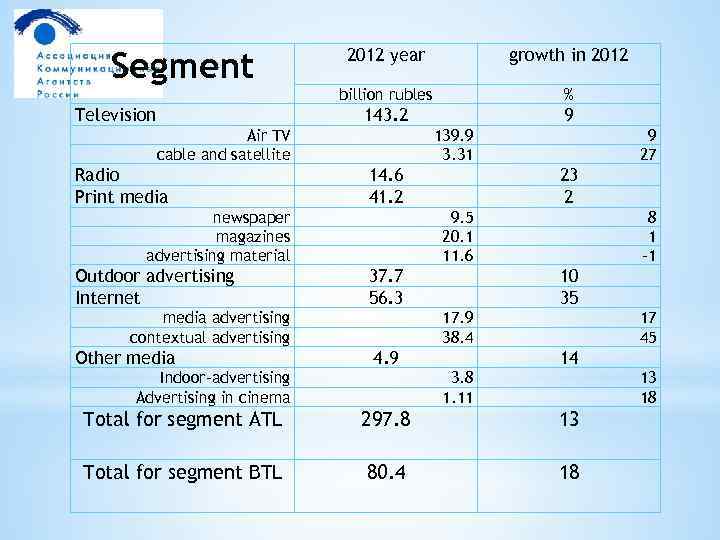
Television growth in 2012 billion rubles % 143. 2 Segment 2012 year 9 Air TV cable and satellite Radio Print media 139. 9 3. 31 14. 6 41. 2 newspaper magazines advertising material Outdoor advertising Internet 23 2 9. 5 20. 1 11. 6 37. 7 56. 3 media advertising contextual advertising Other media 9 27 8 1 -1 10 35 17. 9 38. 4 4. 9 Indoor-advertising Advertising in cinema 17 45 14 3. 8 1. 11 13 18 Total for segment ATL 297. 8 13 Total for segment BTL 80. 4 18
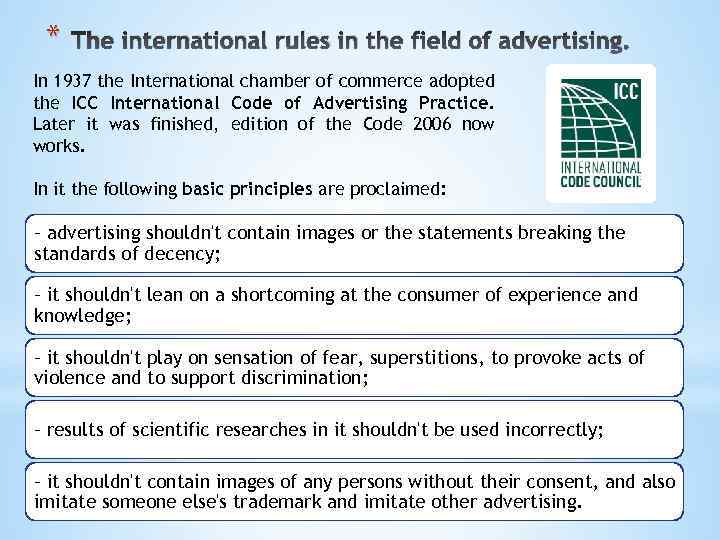
* The international rules in the field of advertising. In 1937 the International chamber of commerce adopted the ICC International Code of Advertising Practice. Later it was finished, edition of the Code 2006 now works. In it the following basic principles are proclaimed: – advertising shouldn't contain images or the statements breaking the standards of decency; – it shouldn't lean on a shortcoming at the consumer of experience and knowledge; – it shouldn't play on sensation of fear, superstitions, to provoke acts of violence and to support discrimination; – results of scientific researches in it shouldn't be used incorrectly; – it shouldn't contain images of any persons without their consent, and also imitate someone else's trademark and imitate other advertising.
In January, 1995 The State Duma of the Russian Federation adopted the Law on advertising (on July 18, 1995 No. 108 -FL) which acted till July 1, 2006. Since July 1, 2006 new edition of the law works. • According to art. 33 of the Law “On Advertising”, the state control of observance of the legislation of the Russian Federation about advertising is exercised by Federal antimonopoly authority and its territorial bodies.
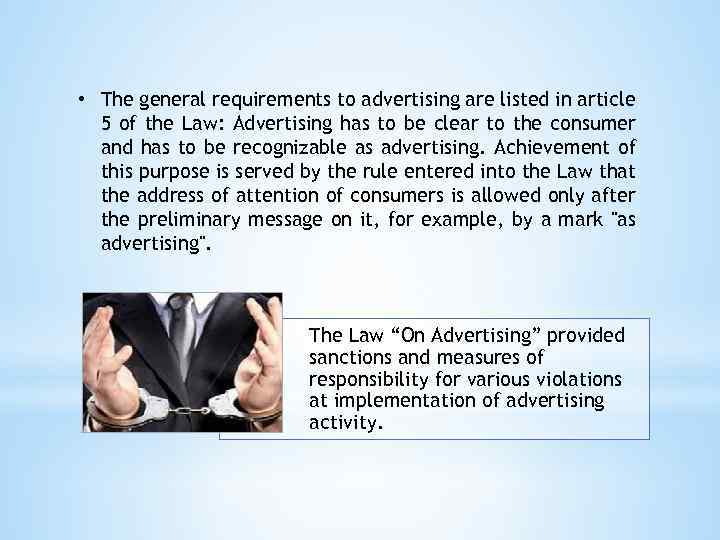
• The general requirements to advertising are listed in article 5 of the Law: Advertising has to be clear to the consumer and has to be recognizable as advertising. Achievement of this purpose is served by the rule entered into the Law that the address of attention of consumers is allowed only after the preliminary message on it, for example, by a mark "as advertising". The Law “On Advertising” provided sanctions and measures of responsibility for various violations at implementation of advertising activity.
* Conclusion for chapter 2: Thus, the Russian market of advertising is developed now well: exists not only legislative base of advertising, but also advertising institutes are developed, the trademark is used as the instrument of advertising, etc.
* Conclusion The conducted researches allowed to solve the problems set in work. • Advertising is a specific area of mass communication in the conditions of the market competition between advertisers and various audiences for the purpose of active impact on these audiences which has to promote the solution of certain marketing tasks of the advertiser. • Advertising makes impact on certain people and on society as a whole. Generally, all these functions and factors of influence can be reduced in five groups: marketing, economic, social, communicative, educational. • Advertising activity in Russia is supervised and regulated by the state. In January, 1995 The State Duma of the Russian Federation adopted the Law on Advertising (on July 18, 1995 No. 108 -FL) which acted till July 1, 2006. Since July 1, 2006 new edition of the law works. • Among the positive tendencies defining today the direction of development of the Russian advertising, especially it should be noted change of the relation to a trademark among the Russian businessmen as to the instrument of advance of goods made by them and services.

Thank you for attention!
Скачать презентацию Federal State budgetary institution of the highest education
Presentation Advertising.pptx