 Скачать презентацию Federal Revenue and Borrowing LO 14 1 Describe
2c240a9bbf97ac1bc3639c4353bd1506.ppt
- Количество слайдов: 36



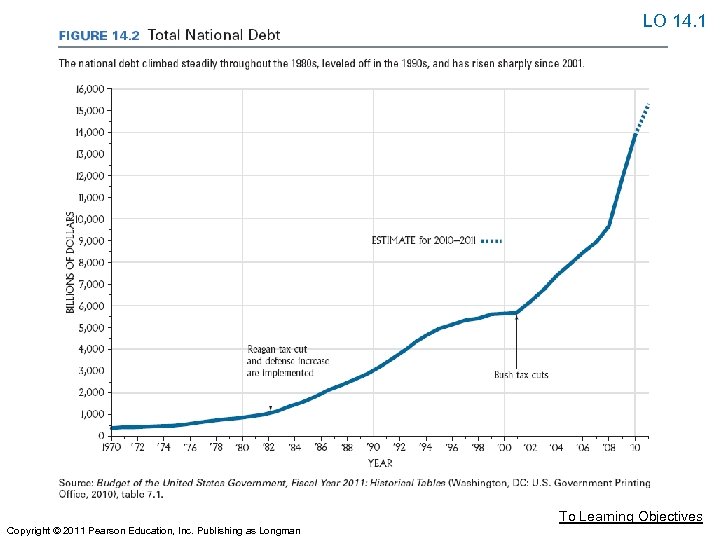
Federal Revenue and Borrowing LO 14. 1: Describe the sources of funding for the federal government and assess the consequences of tax expenditures and borrowing. • Budget • A policy document allocating burdens (taxes) and benefits (expenditures). • Deficit • Excess of federal expenditures over federal revenues. • Total debt will be about $15 trillion by 2011. To Learning Objectives Copyright © 2011 Pearson Education, Inc. Publishing as Longman
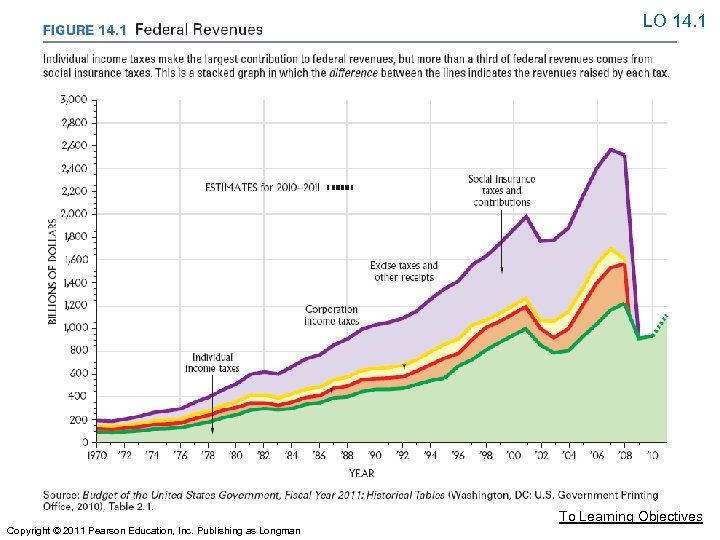
Federal Revenue and Borrowing LO 14. 1 • Expenditures • Government spending – Major areas are social services and national defense. • Revenues • Financial resources of the government – Individual income tax and Social Security tax are two major sources. To Learning Objectives Copyright © 2011 Pearson Education, Inc. Publishing as Longman
Federal Revenue and Borrowing • • LO 14. 1 Personal and Corporate Income Tax Social Insurance Taxes Borrowing Taxes and Public Policy To Learning Objectives Copyright © 2011 Pearson Education, Inc. Publishing as Longman
LO 14. 1 To Learning Objectives Copyright © 2011 Pearson Education, Inc. Publishing as Longman
Federal Revenue and Borrowing LO 14. 1 • Personal and Corporate Income Tax • Income tax – Shares of individual wages and corporate revenues collected by the government. • Sixteenth Amendment – Explicitly authorized Congress to levy a tax on income. To Learning Objectives Copyright © 2011 Pearson Education, Inc. Publishing as Longman
Federal Revenue and Borrowing LO 14. 1 • Social Insurance Taxes • Both employers and employees pay Social Security and Medicare taxes. • In 2010, employees and employers each paid a Social Security tax equal to 6. 2 percent of the first $106, 800 of earnings, and for Medicare they paid another 1. 45 percent on all earnings. To Learning Objectives Copyright © 2011 Pearson Education, Inc. Publishing as Longman
Federal Revenue and Borrowing LO 14. 1 • Borrowing • Treasury Department sells bonds when the federal government wants to borrow money. • Federal debt – All the money borrowed by the federal government over the years and still outstanding. • Today the federal debt is about $15 trillion. To Learning Objectives Copyright © 2011 Pearson Education, Inc. Publishing as Longman
LO 14. 1 To Learning Objectives Copyright © 2011 Pearson Education, Inc. Publishing as Longman
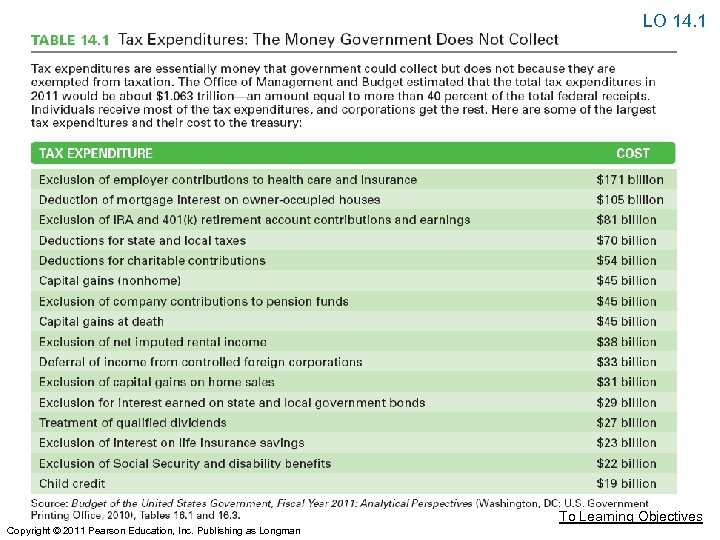
Federal Revenue and Borrowing LO 14. 1 • Taxes and Public Policy • Tax Expenditures – Revenue losses from special exemptions, exclusions, or deductions allowed by federal tax law. • Tax Reduction – In 2001, tax cut gradually lowered tax rates over the next ten years, and in 2003, Congress reduced the tax rates on capital gains and dividends. To Learning Objectives Copyright © 2011 Pearson Education, Inc. Publishing as Longman
LO 14. 1 To Learning Objectives Copyright © 2011 Pearson Education, Inc. Publishing as Longman
Federal Expenditures LO 14. 2: Analyze federal expenditures and the growth of the budget. • Big Governments, Big Budgets • The Rise of the National Security State • The Rise of the Social Service State • Incrementalism • “Uncontrollable” Expenditures To Learning Objectives Copyright © 2011 Pearson Education, Inc. Publishing as Longman
LO 14. 2 Federal Expenditures • Big Governments, Big Budgets • Big budgets are necessary to pay for big governments. • National, state, and local government spend an amount equal to one-third of the gross domestic product (GDP). • National government’s spending alone currently represent about one-fourth of the GDP. To Learning Objectives Copyright © 2011 Pearson Education, Inc. Publishing as Longman
LO 14. 2 Federal Expenditures • The Rise of the National Security State • In the 1950 s and 1960 s the Department of Defense received more than 50% of federal budget. • Defense now gets about one-sixth of all federal expenditures. • This is one reason for growth of government. To Learning Objectives Copyright © 2011 Pearson Education, Inc. Publishing as Longman
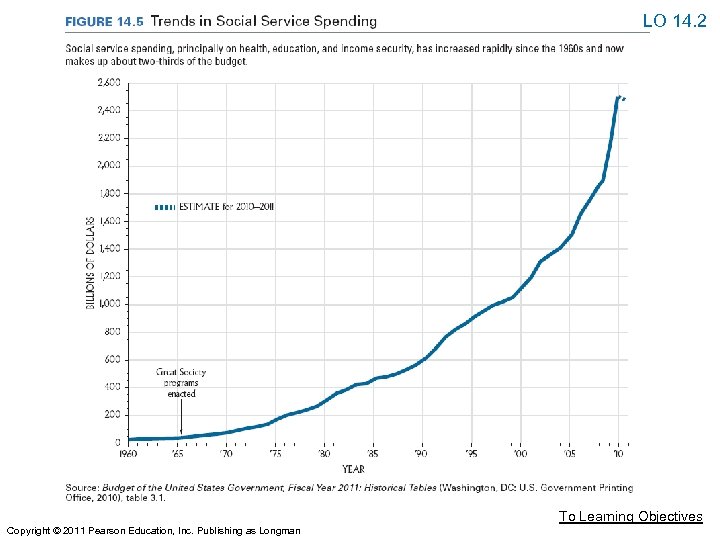
LO 14. 2 Federal Expenditures • The Rise of the Social Service State • The biggest federal spender is now income security programs. • Social Security is #1 spender, now it includes disability benefits and Medicare, and its recipients are living longer. • This is another reason for government growth. To Learning Objectives Copyright © 2011 Pearson Education, Inc. Publishing as Longman
LO 14. 2 To Learning Objectives Copyright © 2011 Pearson Education, Inc. Publishing as Longman
Federal Expenditures LO 14. 2 • Incrementalism • A description of the budget process where the best predictor of this year’s budget is last year’s budget, plus a little bit more (an increment). • According to Aaron Wildavsky, “Most of the budget is a product of previous decisions. ” To Learning Objectives Copyright © 2011 Pearson Education, Inc. Publishing as Longman
Federal Expenditures LO 14. 2 • Incrementalism (cont. ) • Policymakers focus little attention on the budgetary base. • Agencies can safely assume they will get at least the budget they had the previous year. • Most of the debate and attention is on the proposed increment. • Any given agency’s budget tends to grow a little bit every year. To Learning Objectives Copyright © 2011 Pearson Education, Inc. Publishing as Longman
LO 14. 2 Federal Expenditures • “Uncontrollable” Expenditures • Expenditures determined by how many eligible beneficiaries there are for a program or by previous obligations of the government and that Congress therefore cannot easily control. • Social Security benefits are an example of uncontrollable expenditures. To Learning Objectives Copyright © 2011 Pearson Education, Inc. Publishing as Longman
Federal Expenditures LO 14. 2 • “Uncontrollable” Expenditures (cont. ) • Entitlements – Policies for which Congress has obligated itself to pay X level of benefits to Y number of recipients. • Social Security benefits are an example of entitlements. To Learning Objectives Copyright © 2011 Pearson Education, Inc. Publishing as Longman
The Budgetary Process LO 14. 3: Outline the budgetary process and explain the role that politics plays. • Budgetary Politics • The President’s Budget • Congress and the Budget To Learning Objectives Copyright © 2011 Pearson Education, Inc. Publishing as Longman
The Budgetary Process LO 14. 3 • Budgetary Politics • Stakes and Strategies – Every political actor has a stake in the budget. • Think of budgetary politics as a game in which players adopt various strategies. • There are plenty of players in the budgetary politics game, and they have their own strategies. To Learning Objectives Copyright © 2011 Pearson Education, Inc. Publishing as Longman
LO 14. 3 The Budgetary Process • Budgetary Politics (cont. ) • The Players – Interest groups lobby for their needs; agencies push for higher budget requests; Office of Management and Budget (OMB) prepares the president’s budget; and the president makes the final decisions on what to propose to Congress. To Learning Objectives Copyright © 2011 Pearson Education, Inc. Publishing as Longman
The Budgetary Process LO 14. 3 • Budgetary Politics (cont. ) • The Players – Tax committees in Congress write the tax codes; Budget Committees and the Congressional Budget Office (CBO) set the parameters of the congressional budget process; and subjectmatter committees write new laws, which require new expenditures. To Learning Objectives Copyright © 2011 Pearson Education, Inc. Publishing as Longman
The Budgetary Process LO 14. 3 • Budgetary Politics (cont. ) • The Players – Appropriations Committees decide who gets what and their subcommittees hold hearings on agencies’ requests; Congress as a whole approves taxes and appropriations; and the Government Accountability Office (GAO) audits, monitors, and evaluates what agencies are doing with their budgets. To Learning Objectives Copyright © 2011 Pearson Education, Inc. Publishing as Longman
The Budgetary Process LO 14. 3 • The President’s Budget • Budget and Accounting Act (1921) requires presidents to propose an executive budget to Congress and created the Bureau of the Budget to help them. • In the 1970 s, President Nixon reorganized the Bureau of the Budget and renamed it the Office of Management and Budget (OMB). To Learning Objectives Copyright © 2011 Pearson Education, Inc. Publishing as Longman
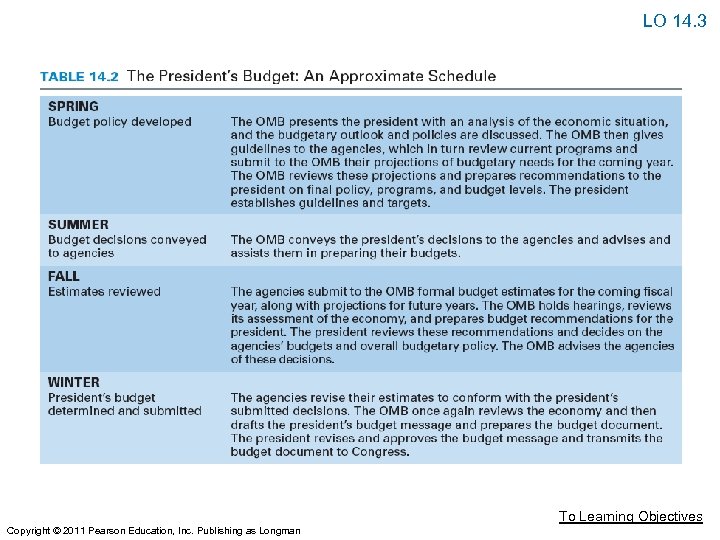
LO 14. 3 The Budgetary Process • The President’s Budget (cont. ) • Spring – Budget policy developed. • Summer – Budget decisions conveyed to agencies. • Fall – Estimates reviewed. • Winter – President’s budget determined and submitted. To Learning Objectives Copyright © 2011 Pearson Education, Inc. Publishing as Longman
LO 14. 3 To Learning Objectives Copyright © 2011 Pearson Education, Inc. Publishing as Longman
The Budgetary Process LO 14. 3 • Congress and the Budget • Congressional Budget and Impoundment Control Act of 1974 was designed to reform the congressional budgetary process. • It established a fixed budget calendar; a budget committee in each house; and a congressional budget office. To Learning Objectives Copyright © 2011 Pearson Education, Inc. Publishing as Longman
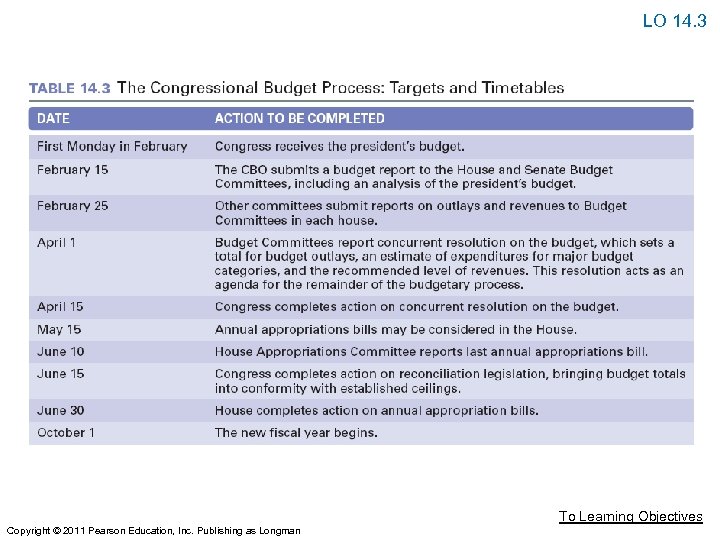
LO 14. 3 To Learning Objectives Copyright © 2011 Pearson Education, Inc. Publishing as Longman
LO 14. 3 The Budgetary Process • Congress and the Budget (cont. ) • Congressional Budget Office – To advise Congress on the probable consequences of its decisions and to forecast revenues. • Budget Resolution – A resolution binding Congress to a total expenditure level, supposedly the bottom line of all federal spending for all programs. To Learning Objectives Copyright © 2011 Pearson Education, Inc. Publishing as Longman
LO 14. 3 The Budgetary Process • Congress and the Budget (cont. ) • Reconciliation – How program authorizations are revised to achieve required savings. • Authorization Bill – Establish, continue, or change programs. • Appropriations Bill – Funds programs established by the authorization bills. To Learning Objectives Copyright © 2011 Pearson Education, Inc. Publishing as Longman
The Budgetary Process LO 14. 3 • Congress and the Budget (cont. ) • Budgets were in red every year between 1974 reforms and 1998. • Continuing Resolutions – Allow agencies to spend at last year’s level when Congress can not pass appropriations bills on time. • Omnibus Bills – Appropriations bills all together in one bill and not 13 appropriations bills. To Learning Objectives Copyright © 2011 Pearson Education, Inc. Publishing as Longman
LO 14. 3 The Budgetary Process • Congress and the Budget (cont. ) • The 1974 reforms have helped Congress view the entire budget early in the process. • The problem is not so much the procedure as disagreement over how scarce resources should be spent. To Learning Objectives Copyright © 2011 Pearson Education, Inc. Publishing as Longman
Understanding Budgeting LO 14. 4: Assess the impact of democratic politics on budgetary growth and of the budget on scope of government. • Democracy and Budgeting • The Budget and the Scope of Government To Learning Objectives Copyright © 2011 Pearson Education, Inc. Publishing as Longman
Understanding Budgeting LO 14. 4 • Democracy and Budgeting • Many politicians spend money to buy votes. • Bigger budgets – Many groups and people ask for government assistance. • People like government programs, but they really do not want to pay for them, thus there are deficits and federal debt. To Learning Objectives Copyright © 2011 Pearson Education, Inc. Publishing as Longman
LO 14. 4 Understanding Budgeting • The Budget and the Scope of Government • The size of budget is the scope of government. • The bigger the government, the bigger the budget. • Limits on revenues can limit what the government can do. To Learning Objectives Copyright © 2011 Pearson Education, Inc. Publishing as Longman
Скачать презентацию Federal Revenue and Borrowing LO 14 1 Describe
2c240a9bbf97ac1bc3639c4353bd1506.ppt