


 Скачать презентацию Federal R D Funding A SIAM Perspective Mel Ciment
47ebb8109d631241ab15df30e3982a12.ppt
- Количество слайдов: 7
 Federal R&D Funding: A SIAM Perspective Mel Ciment Senior Advisor SIAM, Washington Office mel@ciment. com Tel: 301 -622 -5984 May 6, 2001
 Outline Of Talk • Strategies for building SIAM Initiatives – History of HPCC – Scenario building
 SIAM Science Policy Role • Help formulate computational and applied math research agendas in R&D agencies • Provide broad support for NSF, and other agency, R&D budgets to raise all boats • Support strategies for building SIAM-centric Initiatives across all these agencies • My perspective of 20 years of building such initiatives: – History of High Performance Computing & Communications (HPCC) • Scenario for fictitious “Math” Initiative
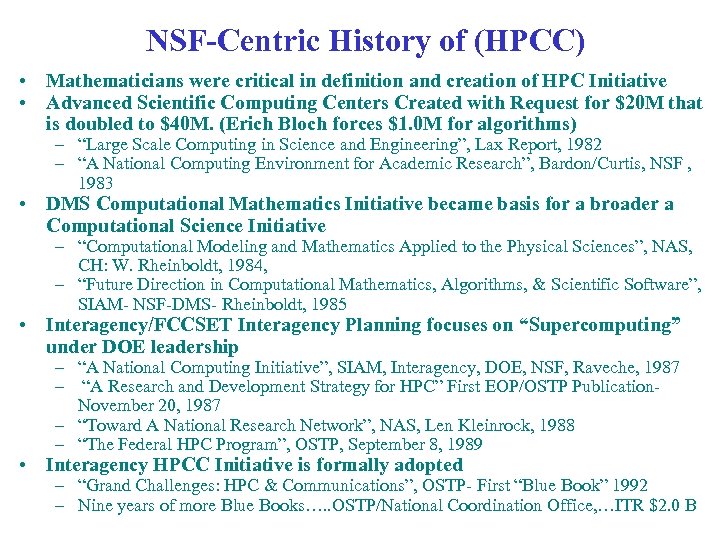 NSF-Centric History of (HPCC) • Mathematicians were critical in definition and creation of HPC Initiative • Advanced Scientific Computing Centers Created with Request for $20 M that is doubled to $40 M. (Erich Bloch forces $1. 0 M for algorithms) – “Large Scale Computing in Science and Engineering”, Lax Report, 1982 – “A National Computing Environment for Academic Research”, Bardon/Curtis, NSF , 1983 • DMS Computational Mathematics Initiative became basis for a broader a Computational Science Initiative – “Computational Modeling and Mathematics Applied to the Physical Sciences”, NAS, CH: W. Rheinboldt, 1984, – “Future Direction in Computational Mathematics, Algorithms, & Scientific Software”, SIAM- NSF-DMS- Rheinboldt, 1985 • Interagency/FCCSET Interagency Planning focuses on “Supercomputing” under DOE leadership – “A National Computing Initiative”, SIAM, Interagency, DOE, NSF, Raveche, 1987 – “A Research and Development Strategy for HPC” First EOP/OSTP Publication. November 20, 1987 – “Toward A National Research Network”, NAS, Len Kleinrock, 1988 – “The Federal HPC Program”, OSTP, September 8, 1989 • Interagency HPCC Initiative is formally adopted – “Grand Challenges: HPC & Communications”, OSTP- First “Blue Book” 1992 – Nine years of more Blue Books…. . OSTP/National Coordination Office, …ITR $2. 0 B
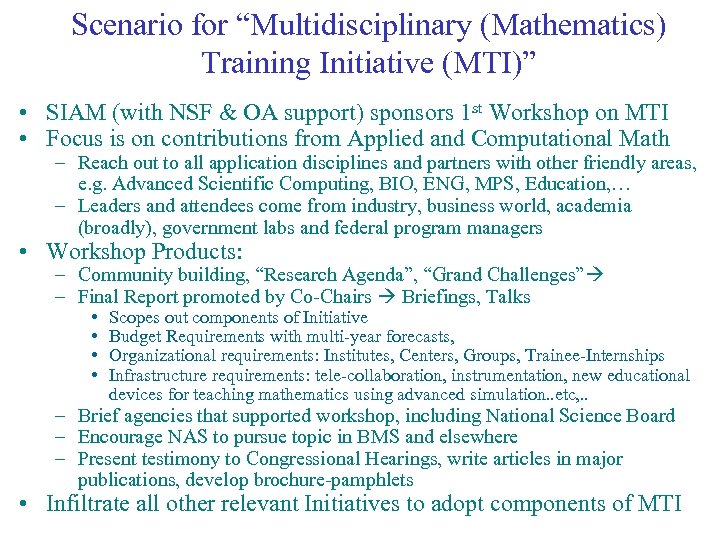 Scenario for “Multidisciplinary (Mathematics) Training Initiative (MTI)” • SIAM (with NSF & OA support) sponsors 1 st Workshop on MTI • Focus is on contributions from Applied and Computational Math – Reach out to all application disciplines and partners with other friendly areas, e. g. Advanced Scientific Computing, BIO, ENG, MPS, Education, … – Leaders and attendees come from industry, business world, academia (broadly), government labs and federal program managers • Workshop Products: – Community building, “Research Agenda”, “Grand Challenges” – Final Report promoted by Co-Chairs Briefings, Talks • • Scopes out components of Initiative Budget Requirements with multi-year forecasts, Organizational requirements: Institutes, Centers, Groups, Trainee-Internships Infrastructure requirements: tele-collaboration, instrumentation, new educational devices for teaching mathematics using advanced simulation. . etc, . . – Brief agencies that supported workshop, including National Science Board – Encourage NAS to pursue topic in BMS and elsewhere – Present testimony to Congressional Hearings, write articles in major publications, develop brochure-pamphlets • Infiltrate all other relevant Initiatives to adopt components of MTI
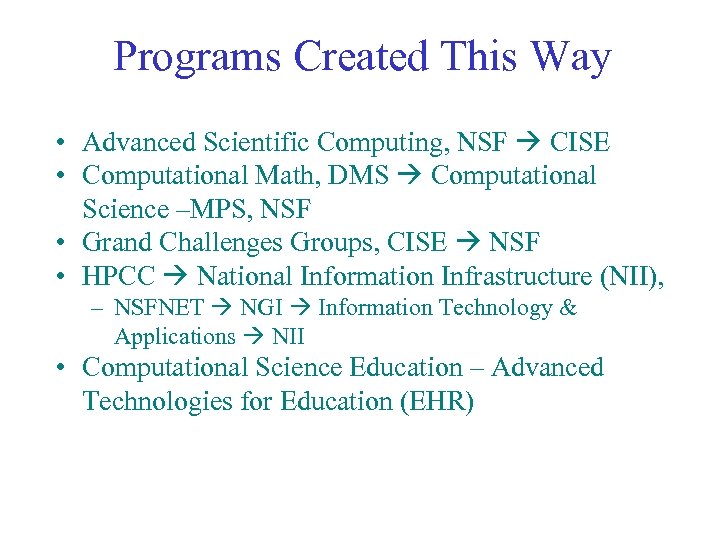 Programs Created This Way • Advanced Scientific Computing, NSF CISE • Computational Math, DMS Computational Science –MPS, NSF • Grand Challenges Groups, CISE NSF • HPCC National Information Infrastructure (NII), – NSFNET NGI Information Technology & Applications NII • Computational Science Education – Advanced Technologies for Education (EHR)
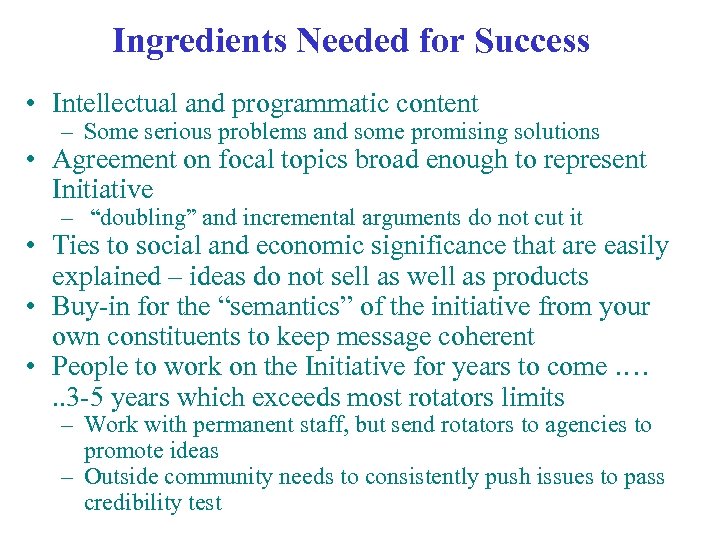 Ingredients Needed for Success • Intellectual and programmatic content – Some serious problems and some promising solutions • Agreement on focal topics broad enough to represent Initiative – “doubling” and incremental arguments do not cut it • Ties to social and economic significance that are easily explained – ideas do not sell as well as products • Buy-in for the “semantics” of the initiative from your own constituents to keep message coherent • People to work on the Initiative for years to come. …. . 3 -5 years which exceeds most rotators limits – Work with permanent staff, but send rotators to agencies to promote ideas – Outside community needs to consistently push issues to pass credibility test