 Скачать презентацию Federal Grant Fiscal Responsibilities Presented by Anthony Hearn
276daf11d19903054420493b0755e29d.ppt
- Количество слайдов: 71



Federal Grant Fiscal Responsibilities Presented by: Anthony Hearn, CPA New Jersey Department of Education Office of Supplemental Educational Programs
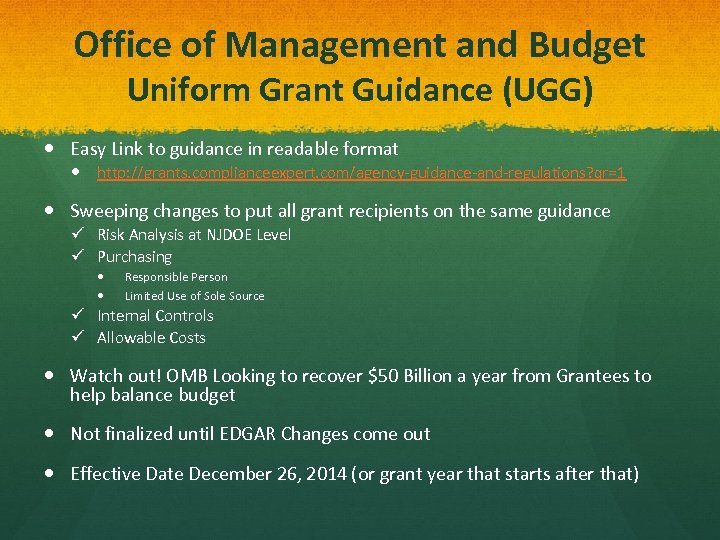
Office of Management and Budget Uniform Grant Guidance (UGG) Easy Link to guidance in readable format http: //grants. complianceexpert. com/agency-guidance-and-regulations? qr=1 Sweeping changes to put all grant recipients on the same guidance ü Risk Analysis at NJDOE Level ü Purchasing Responsible Person Limited Use of Sole Source ü Internal Controls ü Allowable Costs Watch out! OMB Looking to recover $50 Billion a year from Grantees to help balance budget Not finalized until EDGAR Changes come out Effective Date December 26, 2014 (or grant year that starts after that)
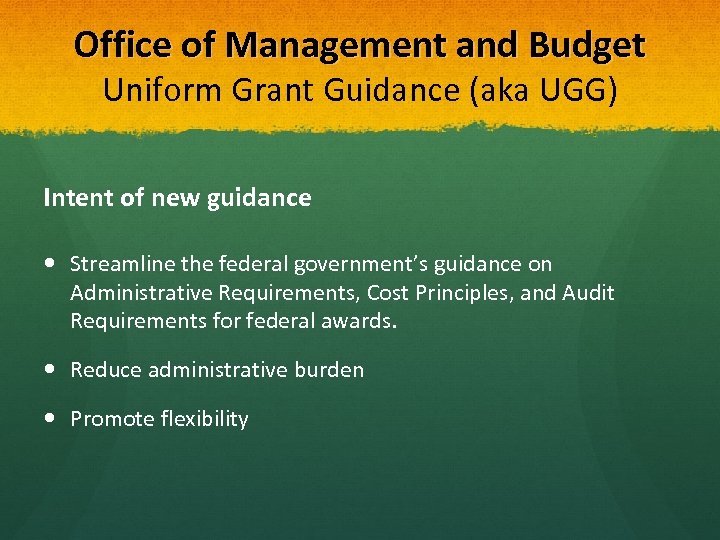
Office of Management and Budget Uniform Grant Guidance (aka UGG) Intent of new guidance Streamline the federal government’s guidance on Administrative Requirements, Cost Principles, and Audit Requirements for federal awards. Reduce administrative burden Promote flexibility
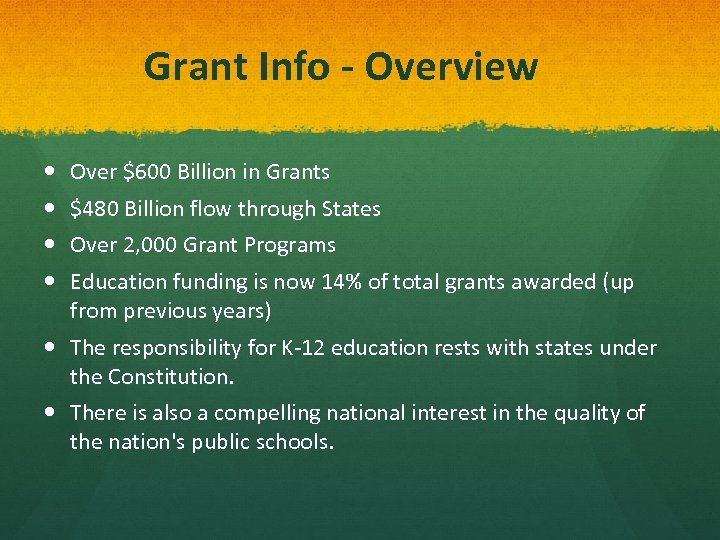
Grant Info - Overview Over $600 Billion in Grants $480 Billion flow through States Over 2, 000 Grant Programs Education funding is now 14% of total grants awarded (up from previous years) The responsibility for K-12 education rests with states under the Constitution. There is also a compelling national interest in the quality of the nation's public schools.
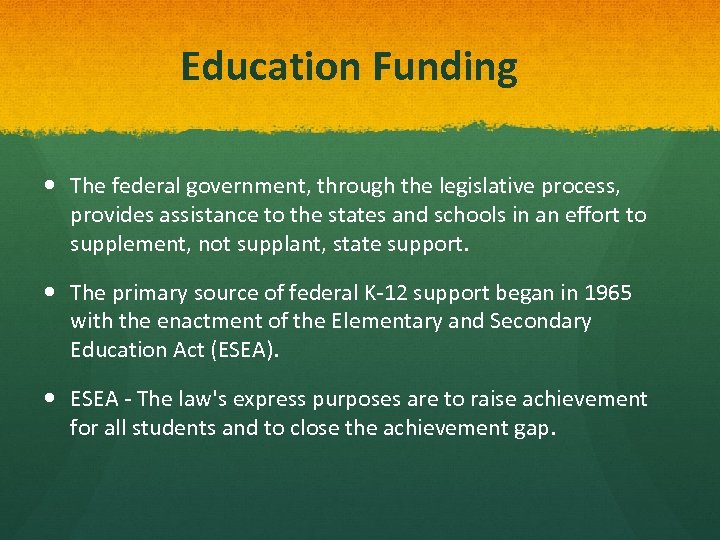
Education Funding The federal government, through the legislative process, provides assistance to the states and schools in an effort to supplement, not supplant, state support. The primary source of federal K-12 support began in 1965 with the enactment of the Elementary and Secondary Education Act (ESEA). ESEA - The law's express purposes are to raise achievement for all students and to close the achievement gap.
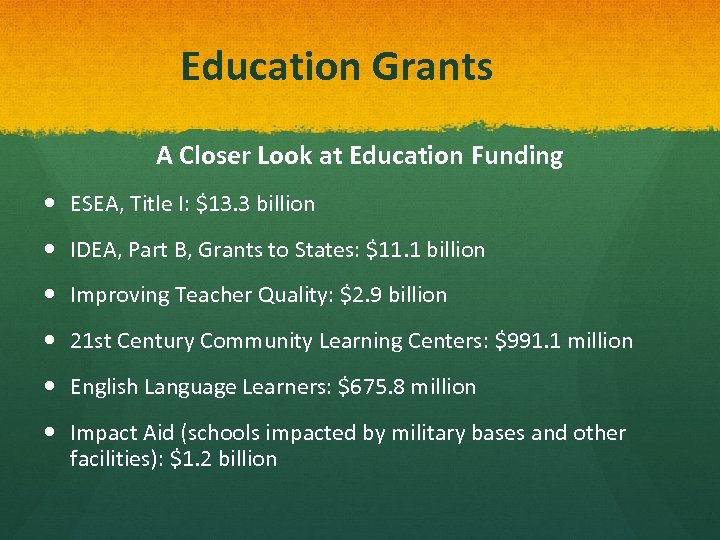
Education Grants A Closer Look at Education Funding ESEA, Title I: $13. 3 billion IDEA, Part B, Grants to States: $11. 1 billion Improving Teacher Quality: $2. 9 billion 21 st Century Community Learning Centers: $991. 1 million English Language Learners: $675. 8 million Impact Aid (schools impacted by military bases and other facilities): $1. 2 billion
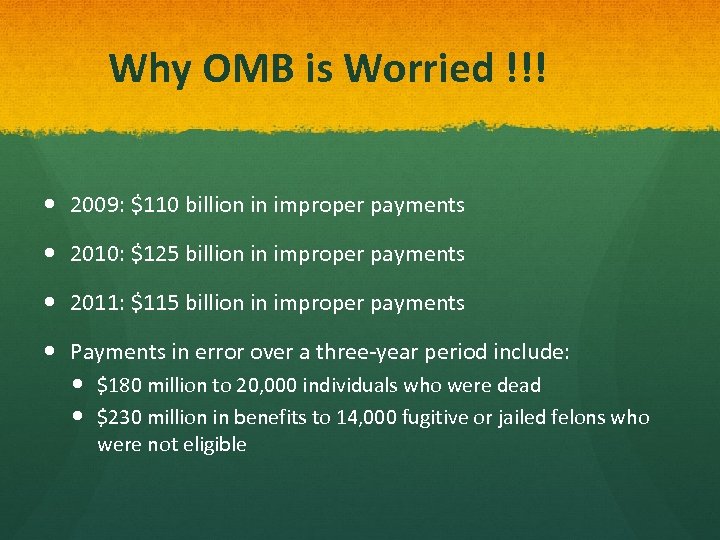
Why OMB is Worried !!! 2009: $110 billion in improper payments 2010: $125 billion in improper payments 2011: $115 billion in improper payments Payments in error over a three-year period include: $180 million to 20, 000 individuals who were dead $230 million in benefits to 14, 000 fugitive or jailed felons who were not eligible
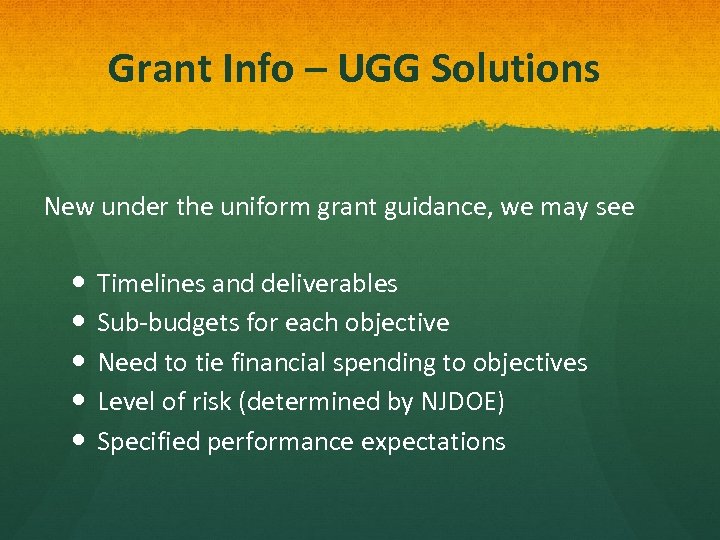
Grant Info – UGG Solutions New under the uniform grant guidance, we may see Timelines and deliverables Sub-budgets for each objective Need to tie financial spending to objectives Level of risk (determined by NJDOE) Specified performance expectations
NJDOE to Help “The most terrifying words in the English language are: I’m from the government and I’m here to help. ” President Ronald Reagan
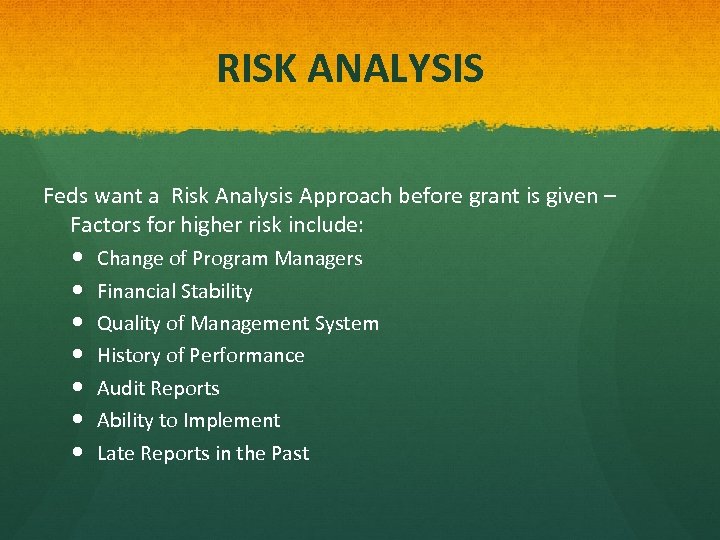
RISK ANALYSIS Feds want a Risk Analysis Approach before grant is given – Factors for higher risk include: Change of Program Managers Financial Stability Quality of Management System History of Performance Audit Reports Ability to Implement Late Reports in the Past
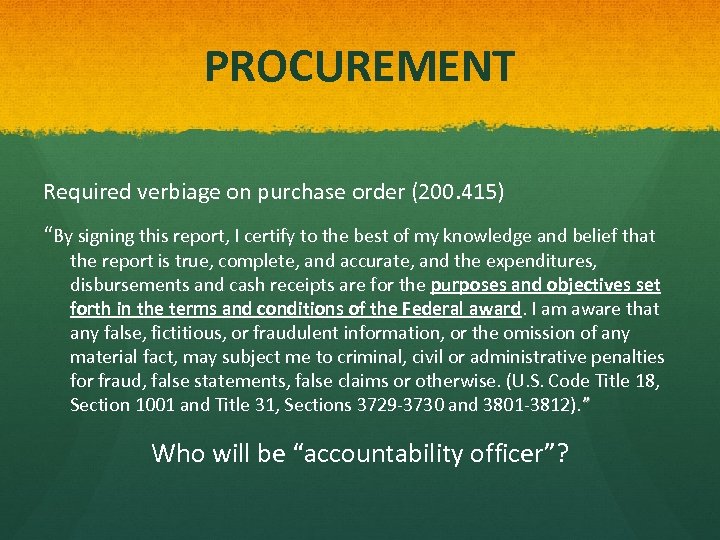
PROCUREMENT Required verbiage on purchase order (200. 415) “By signing this report, I certify to the best of my knowledge and belief that the report is true, complete, and accurate, and the expenditures, disbursements and cash receipts are for the purposes and objectives set forth in the terms and conditions of the Federal award. I am aware that any false, fictitious, or fraudulent information, or the omission of any material fact, may subject me to criminal, civil or administrative penalties for fraud, false statements, false claims or otherwise. (U. S. Code Title 18, Section 1001 and Title 31, Sections 3729 -3730 and 3801 -3812). ” Who will be “accountability officer”?
PROCUREMENT Just Remember: “No law or ordinance is mightier than understanding. ” Plato
PROCUREMENT (§ 200. 320) Procurement by micro-purchases. Acquisition of supplies or services, the aggregate dollar amount of which does not exceed $3, 000 To the extent practicable, the non-Federal entity must distribute micro-purchases equitably among qualified suppliers. May be awarded without soliciting competitive quotations if the non-Federal entity considers the price to be reasonable.
PROCUREMENT (§ 200. 320) Procurement by small purchase procedures. Small purchase procedures are those relatively simple and informal procurement methods for securing services, supplies, or other property that do not cost more than the Simplified Acquisition Threshold ($100, 000). Price or rate quotations must be obtained from an adequate number of qualified sources.
PROCUREMENT (§ 200. 320) New Jersey Thresholds only important if more restrictive 18 A: 18 A-3(a) and (c) Limits for bid and quote not important Bid Threshold with QPA - $36, 000 Quote Threshold with QPA - $5, 400 Bid Threshold without a QPA - $26, 000 Quote Threshold without a QPA - $3, 900 FEDERAL UNDER $3, 000 Aggregate State Limit for Bid is less than Federal of $150, 000
PROCUREMENT – SOLE SOURCE (§ 200. 320) (f) Procurement by noncompetitive proposals is procurement through solicitation of a proposal from only one source and may be used only when one or more of the following circumstances apply: (1) The item is available only from a single source; (2) The public exigency or emergency for the requirement will not permit a delay resulting from competitive solicitation; (3) The Federal awarding agency or pass-through entity expressly authorizes noncompetitive proposals in response to a written request from the non-Federal entity; or (4) After solicitation of a number of sources, competition is determined inadequate. *** Watch Vendor Names in Grant Application***
INTERNAL CONTROLS § 200. 61 Internal controls Process, implemented by a non-Federal entity, designed to provide reasonable assurance regarding the achievement of objectives in the following categories: (a) Effectiveness and efficiency of operations; (b) Reliability of reporting for internal and external use; and (c) Compliance with applicable laws and regulations.
INTERNAL CONTROLS § 200. 62 Internal control over compliance requirements for Federal awards means a process implemented by a non-Federal entity designed to provide reasonable assurance regarding the achievement of the following objectives for Federal awards: (a) Transactions are properly recorded and accounted for, in order to: (1) Permit the preparation of reliable financial statements and Federal reports; (2) Maintain accountability over assets; and (3) Demonstrate compliance with Federal statutes, regulations, and the terms and conditions of the Federal award; (b) Transactions are executed in compliance with: (1) Federal statutes, regulations, and the terms and conditions of the Federal award that could have a direct and material effect on a Federal program; and (2) Any other Federal statutes and regulations that are identified in the Compliance Supplement; and (c) Funds, property, and other assets are safeguarded against loss from unauthorized use or disposition.
ALLOWABLE COSTS Covered in Subpart E: Cost Principles 200. 400 of the Uniform Grant Guidance Protect allowable costs Internal policies may need revision to better align with the UGG and to protect allowable costs.
ALLOWABLE COSTS 1. 2. 3. 4. 5. 6. 7. EQUIPMENT Property records must be maintained that include a description of the property, a serial number or other identification number, the source of funding for the property (including the FAIN), who holds title, the acquisition date, and cost of the property, percentage of Federal participation in the project costs for the Federal award under which the property was acquired, the location, use and condition of the property, and any ultimate disposition data including the date of disposal and sale price of the property.
ALLOWABLE COSTS EQUIPMENT – CONTINUED A physical inventory of the property must be taken and the results reconciled with the property records at least once every two years. A control system must be developed to ensure adequate safeguards to prevent loss, damage, or theft of the property. Any loss, damage, or theft must be investigated. Adequate maintenance procedures must be developed to keep the property in good condition.
ALLOWABLE COSTS Advertising and public relations (§ 200. 421) Advertising is not allowable, except for: Hiring of personnel for the grant Procurement of goods and services for the grant Disposal of scrap (per the grant program) Program outreach (new) Social media advertising for personnel (new)
ALLOWABLE COSTS MEALS § 200. 456 Participant support costs as defined in § 200. 75 Participant support costs are allowable with the prior approval of the Federal awarding agency.
ALLOWABLE COSTS ENTERTAINMENT § 200. 438 Entertainment costs Costs of entertainment, including amusement, diversion, and social activities and any associated costs are unallowable, except where specific costs that might otherwise be considered entertainment have a programmatic purpose and are authorized either in the approved budget for the Federal award or with prior written approval of the Federal awarding agency.
ALLOWABLE COSTS WAGES § 200. 430 Compensation—Personal services Must account for Non-Charged Time (Issue was with charging over 100% to multiple grant) If you use the prescribed model, you should be covered
ALLOWABLE COSTS CONFERENCES § 200. 432 Conferences. (Family Friendly or Not) A conference is defined as a meeting, retreat, seminar, symposium, workshop or event whose primary purpose is the dissemination of technical information and is necessary and reasonable for successful performance under the Federal award.
ALLOWABLE COSTS § 200. 432 Conferences. (Family Friendly or Not) Allowable conference costs paid by the non-Federal entity as a sponsor or host of the conference may include rental of facilities, speakers' fees, costs of meals and refreshments, local transportation, and other items incidental to such conferences unless further restricted by the terms and conditions of the Federal award. As needed, the costs of identifying, but not providing, locally available dependent-care resources are allowable. Conference hosts/sponsors must exercise discretion and judgment in ensuring that conference costs are appropriate, necessary and managed in a manner that minimizes costs to the Federal award. The Federal awarding agency may authorize exceptions where appropriate for programs
ALLOWABLE COSTS § 200. 474 Travel costs (Family Friendly or Not) (2) The costs are reasonable and consistent with non-Federal entity's established travel policy. (c)(1) Temporary dependent care costs (as dependent is defined in 26 USC 152) above and beyond regular dependent care that directly results from travel to conferences is allowable provided that: (i) The costs are a direct result of the individual's travel for the Federal award; (ii) The costs are consistent with the non-Federal entity's documented travel policy for all entity travel; and (iii) Are only temporary during the travel period.
Grant Specific Title I – Very Programmatic: Be able to identify additional programs in place (that are funded) for low performing students in Targeted Assistance Title I – Schoolwide: Plan dictates Other ESEA ü Title IIA Will Sample Staff and HQT Status Review of Professional Development Plan ü Title III What additional Programs in place
Common Issues and Resolutions Summary Financial Management, Procurement and EDGAR 80. 36 Time Sheets Equipment Non Allowable Uses of Funds Lack of Identified Programs Lack of Nonpublic Consultation Process (IDEA and Title I)
Time Sheets, PARs, Funded Staff, etc. VERY IMPORTANT to Understand Need to Show v What they are doing (e. g. : In Class Support) v Where they are doing it (e. g. : Room or Ms. Jones Class) v When they are doing it (e. g. : Time Schedule)
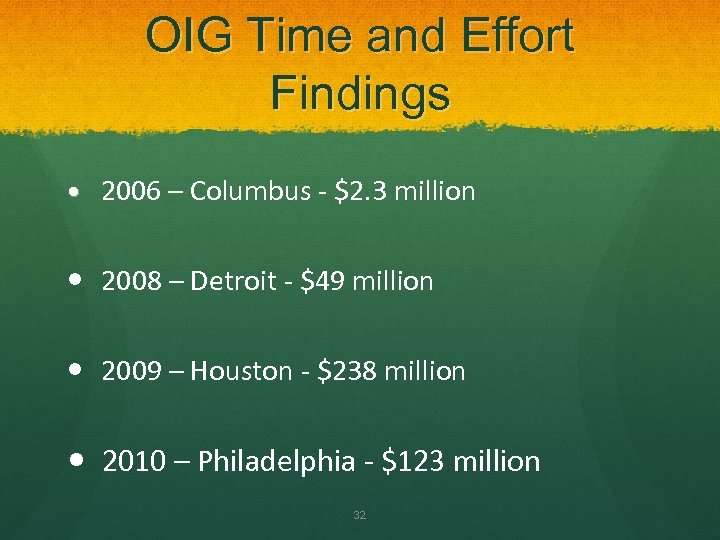
OIG Time and Effort Findings 2006 – Columbus - $2. 3 million 2008 – Detroit - $49 million 2009 – Houston - $238 million 2010 – Philadelphia - $123 million 32
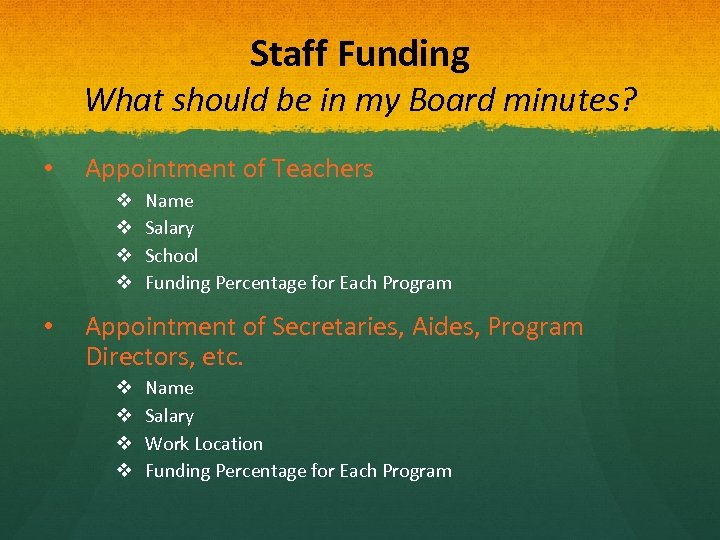
Staff Funding What should be in my Board minutes? • Appointment of Teachers v v • Name Salary School Funding Percentage for Each Program Appointment of Secretaries, Aides, Program Directors, etc. v v Name Salary Work Location Funding Percentage for Each Program
Staff Funding and Time Sheets Fully-funded Salaries Applies to all Fund 20 Federal Grants Periodic certification signed at least semi-annually Clarification on Funding vs. Cost Objective – UGH !!!!!! – New Model Implemented Signed by employee and supervisor NEW EXAMPLE IN OCT of 2012
Staff Funding and Time Sheets Multiple Cost Objectives or Split-funded Salaries • Personnel activity reports • Signed by employee and supervisor • Must be an after-the-fact distribution of actual activity • Prepared at least monthly and must coincide with pay periods • NEW EXAMPLE IN OCT of 2012
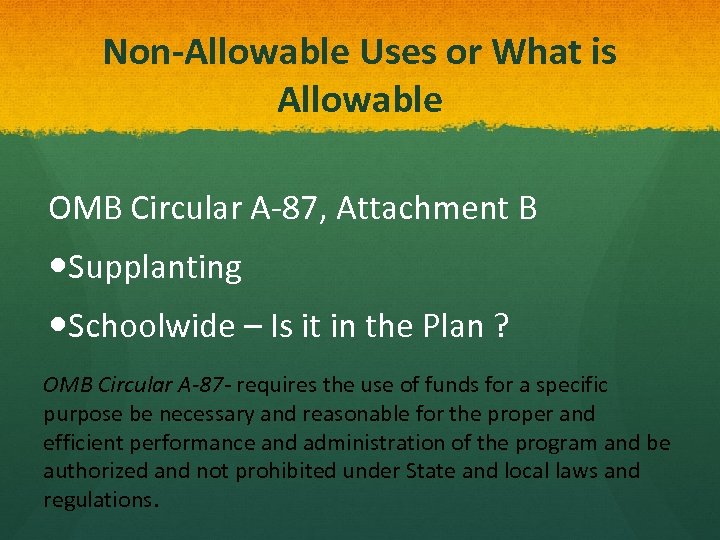
Non-Allowable Uses or What is Allowable OMB Circular A-87, Attachment B Supplanting Schoolwide – Is it in the Plan ? OMB Circular A-87 - requires the use of funds for a specific purpose be necessary and reasonable for the proper and efficient performance and administration of the program and be authorized and not prohibited under State and local laws and regulations.
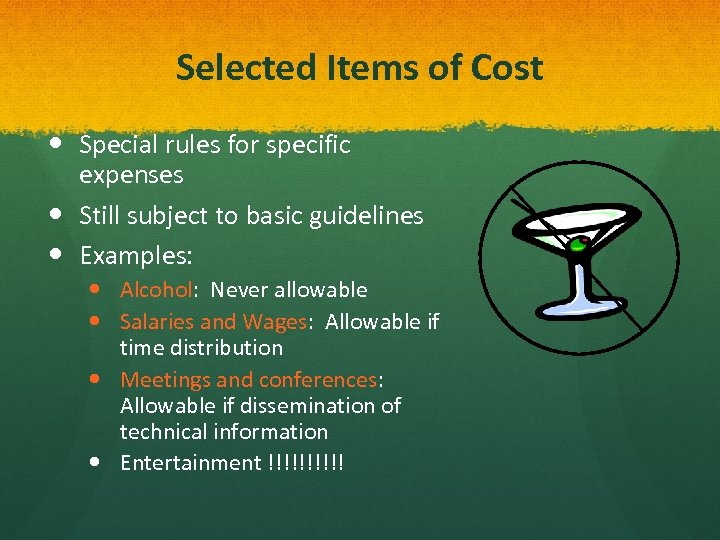
Selected Items of Cost Special rules for specific expenses Still subject to basic guidelines Examples: Alcohol: Never allowable Salaries and Wages: Allowable if time distribution Meetings and conferences: Allowable if dissemination of technical information Entertainment !!!!!
Select Expenditures and Support Needed General Purchases Must have purchase orders Must have account number on P. O. Should indicate Grant on P. O. (Not Just Account #) Signed by Business Administrator If split P. O. , Title I should be easily identifiable REMEMBER Title I – Money spent in Individual Schools should EQUAL amount in Step 4 of Eligibility
Select Expenditures and Support Needed General Purchases – New Omni Circular Rules Must have good controls in place Cash Management (EWEG Draw down policies and support) Written procedures by districts that determine allowability Must have conflict of interest policy Cost Price Analysis softened (more to come)
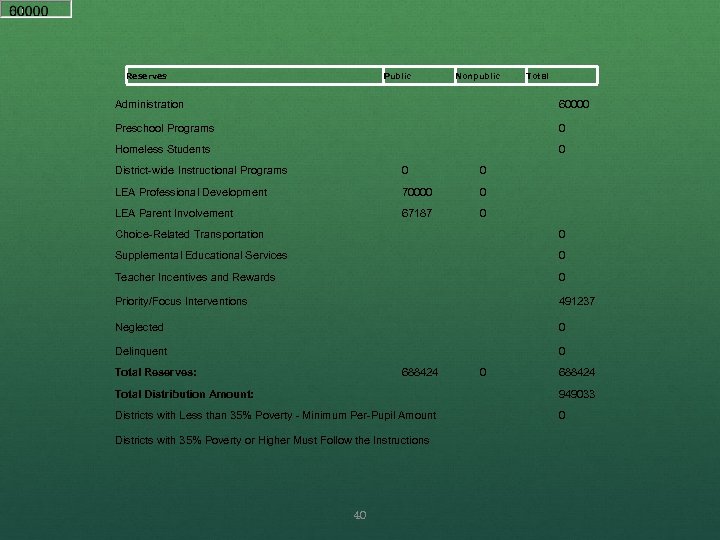
Reserves Public Nonpublic Total Administration 60000 Preschool Programs 0 Homeless Students 0 District-wide Instructional Programs 0 0 LEA Professional Development 70000 0 LEA Parent Involvement 67187 0 Choice-Related Transportation 0 Supplemental Educational Services 0 Teacher Incentives and Rewards 0 Priority/Focus Interventions 491237 Neglected 0 Delinquent 0 0 688424 Total Reserves: 688424 Total Distribution Amount: 949033 Districts with Less than 35% Poverty - Minimum Per-Pupil Amount 0 Districts with 35% Poverty or Higher Must Follow the Instructions 40
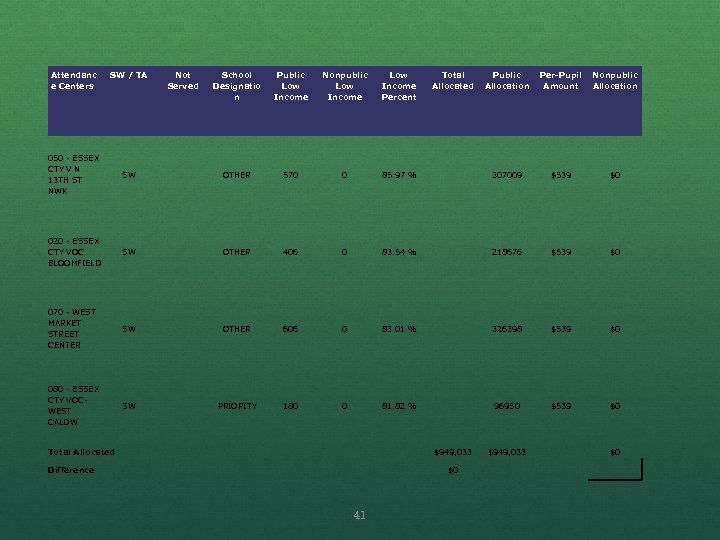
Attendanc e Centers SW / TA Not Served School Designatio n Public Low Income Nonpublic Low Income Percent Total Allocated Public Allocation Per-Pupil Amount Nonpublic Allocation 050 - ESSEX CTY V N 13 TH ST NWK SW OTHER 570 0 85. 97 % 307009 $539 $0 020 - ESSEX CTY VOC BLOOMFIELD SW OTHER 406 0 83. 54 % 218676 $539 $0 070 - WEST MARKET STREET CENTER SW OTHER 606 0 83. 01 % 326398 $539 $0 080 - ESSEX CTY VOCWEST CALDW SW PRIORITY 180 0 81. 82 % 96950 $539 $0 Total Allocated $949, 033 Difference $0 41 $949, 033 $0
Supplement Not Supplant Funds must be“supplemental” to local spending Supplemental Defined: “In the absence of federal funds, would funds have been spent (prior year funding is one distinguishing factor)”
Supplement Not Supplant If it is“REQUIRED, then you can NOT fund it!
Supplement Not Supplant If all students/classroom get items, district can’t pay for Title I / IDEA part out of grant. Items purchased should not be used by non-eligible students (can have some incidental benefit, but need to document). Presentations/Trips should not benefit non-eligible students (identify Title I and in IEP for IDEA). Special rules apply to approved and implemented “Schoolwide Programs. ”
Student Incentives The US Dept. of Education(ED) has indicated that an LEA may use Title I funds to provide“non-monetary” rewards of“nominal”value (e. g. , Plaque, gift certificate, or book, etc. ) in an effort recognize Title I students for good performance. Title I funds may NOT be used to pay students a stipend or provide some other type of award as an incentive for student participation in a Title I program
Parent Incentives To encourage parents of Title I students to participate in school activities in the evening, an LEA may use Title I funds to provide light refreshments. Note, ESEA § 1118(e)(8) authorizes LEAs to use Title I funds for“parent-related” activities that are reasonable and necessary for expenses associated with parental involvement activities, including child care and transportation to enable parents to attend“school-related”meetings and training sessions
Helpful Questions to Ask When Analyzing Proposed Costs Is it consistent with federal cost principles? OMB A 87, Attachment B Is it allowable under the relevant program? (Title I, IDEA, etc. ) Is it consistent with an approved program plan and budget? (EWEG) Is it consistent with program specific fiscal rules? (Supplement not Supplant) Is it consistent with EDGAR?
Allowable Costs All Costs must be: Necessary Reasonable Allocable Legal under state and local law (A 5)
Allowable Costs Must be necessary for the performance or administration of the grant Must follow sound business practices: Arms length bargaining (hint: procurement processes) Follow federal, state and local laws Follow terms of the grant award
Schoolwide Program & Expenses • MUST have approved plan that addresses all schoolwide issues • Time sheets are required (except in a blended resource fund, e. g. , Fund 15 former Abbott districts) • Key questions to be addressed: – Do the activities budgeted support the intent of the law? [Federal Register: July 2, 2004 (Volume 69, Number 127)] – Are supplemental services provided to the students enrolled in the school?
Lack of Identified Funded Programs for Title I must be clear and distinct. Programs for Title I must be the “icing on the cake” for low performing students. Watch for funded programs that v Are replacement programs (in lieu of core math or English) v Pull children away from elective classes
Allowable Nonpublic Expenses IDEA and Title I have different coverage areas for services to students Title I – Students that would have attended, but are out of district – anywhere IDEA – Just resident students Remember allowable cost rules are the same for Nonpublic as for Public Schools If Third-Party contractors hired District needs to maintain plans Responsibility for all areas should be addressed in the contract Only allow to bill for actual services, not flat fee monthly
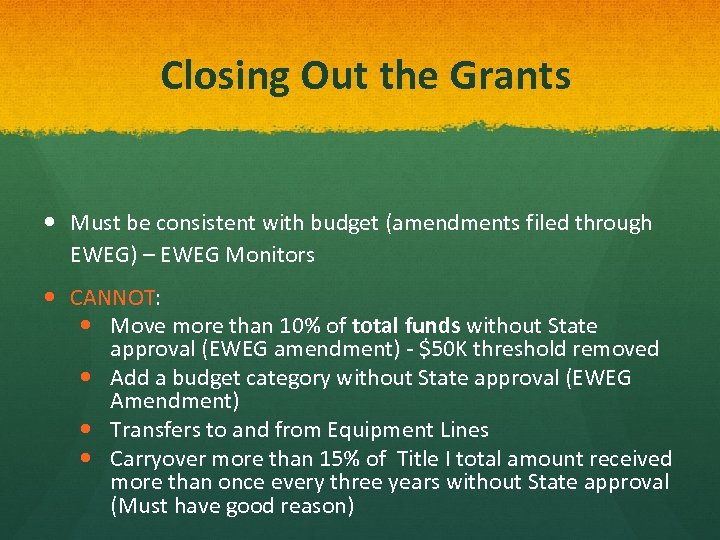
Closing Out the Grants Must be consistent with budget (amendments filed through EWEG) – EWEG Monitors CANNOT: Move more than 10% of total funds without State approval (EWEG amendment) - $50 K threshold removed Add a budget category without State approval (EWEG Amendment) Transfers to and from Equipment Lines Carryover more than 15% of Title I total amount received more than once every three years without State approval (Must have good reason)
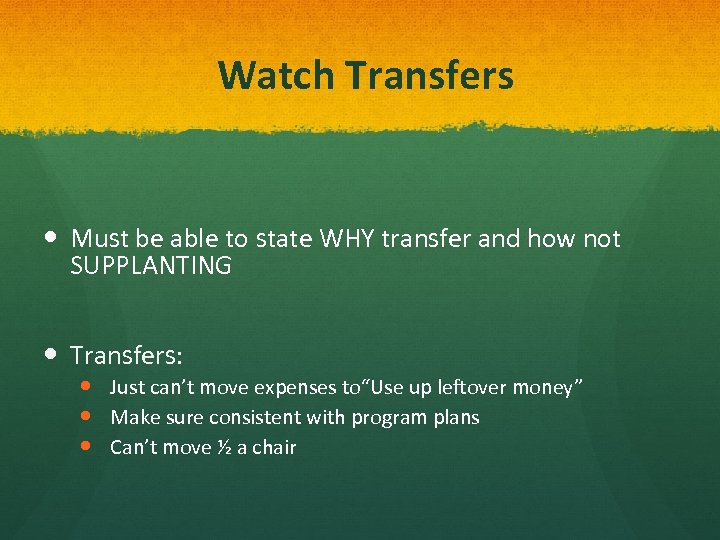
Watch Transfers Must be able to state WHY transfer and how not SUPPLANTING Transfers: Just can’t move expenses to“Use up leftover money” Make sure consistent with program plans Can’t move ½ a chair
Restrictions and Reserves Title I Parental Involvement RAC Reserve Spending by location Non Public Funds
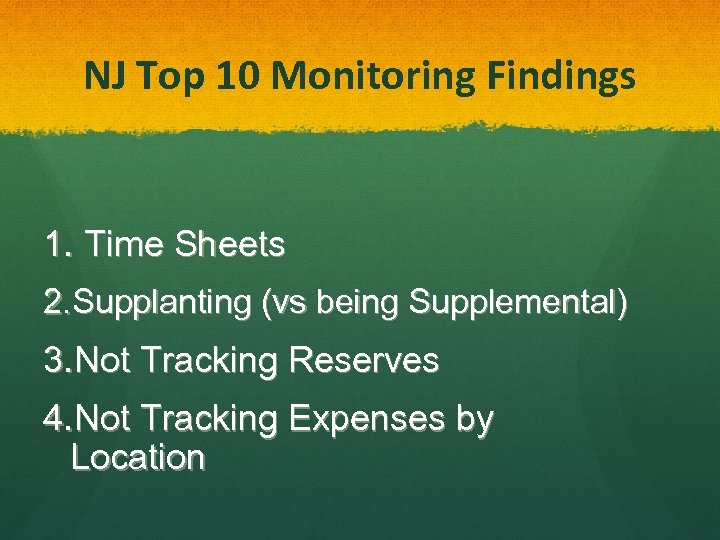
NJ Top 10 Monitoring Findings 1. Time Sheets 2. Supplanting (vs being Supplemental) 3. Not Tracking Reserves 4. Not Tracking Expenses by Location
NJ Top 10 Monitoring Findings 5. Competitive Contracting and Other Fiscal Policies (Draw downs, Disbarred Vendor checking) 6. Title I Program Related (Student Identification and Identifiable Program) 7. Title I Non Public vs IDEA Non Public Service Areas 8. Title I Non Public Services
NJ Top 10 Monitoring Findings 9. Required Parent Notifications 10. Title I Parental Involvement (activities and polcies)
Fiscal News from Washington New Haven Audit Report from Office of Inspector General Supplanting in a Schoolwide Program http: //www. ed. gov/about/offices/list/oig/auditreports/a 02 f 0005. pdf
Fiscal News from Washington William Floyd Audit Report from Office of Inspector General Unsupported Expenses Unsupported Adjusting Journal Entries Supplanting of Textbooks Weak Internal Controls http: //www. ed. gov/about/offices/list/oig/auditreports/a 02 f 0030. p df
Fiscal News from Washington City of Detroit and Parent Involvement Fund 2005 Disallowed Charges for Entertainment, Promotional Items and Public Relations Need to be necessary, reasonable, allocable and documented Disallowed items include advertising for an event and live musical entertainment at parent volunteer function http: //www. ed. gov/about/offices/list/oig/auditreports/a 05 f 0018. pdf
Fiscal News from Washington City of Detroit -Revisit in 2008 Over $131 Million in 2005 and $126 Million in 2006 No Time Sheets – Almost $50 Million Teaching non-Title I students – even though most of Detroit is schoolwide some schools are not (no plan submitted) and OIG looked to these schools and found staff being funded that were teaching non-Title I identified students. Detroit argued they could have been schoolwide if they did a plan and the OIG rejected this argument Over $21 M for adjusting entries for employees that were charged to other programs and then charged to Title I Gift cards they could not show got to students $150, 000 for martial arts training
Fiscal News from Washington St. Louis OIG Audit Lost 125 Computers Serving Ineligible Schools http: //www. ed. gov/about/offices/list/oig/areports. html
Fiscal News from Washington Philadelphia • Findings totaling $138, 376, 068 • Unsupported Salaries (some direct and some thru adjusting entries) • School Police paid from Title I Funds • Supplanting (moving company, etc) • No backup for School Choice Charges of $1. 3 M • Weak internal controls
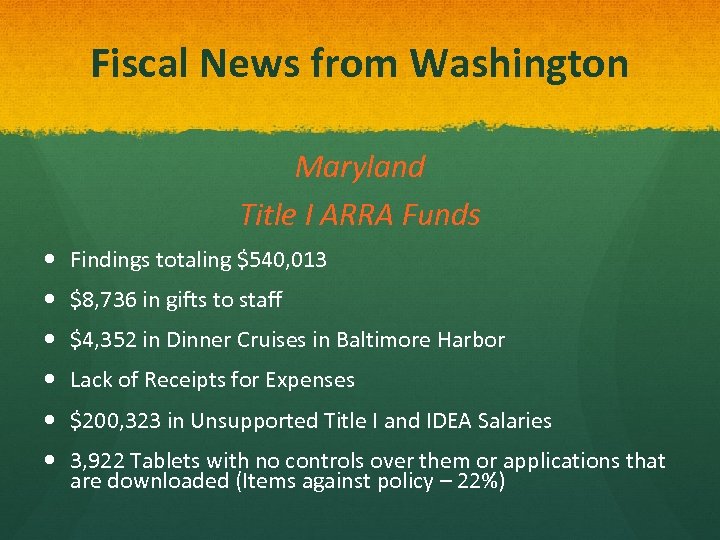
Fiscal News from Washington Maryland Title I ARRA Funds Findings totaling $540, 013 $8, 736 in gifts to staff $4, 352 in Dinner Cruises in Baltimore Harbor Lack of Receipts for Expenses $200, 323 in Unsupported Title I and IDEA Salaries 3, 922 Tablets with no controls over them or applications that are downloaded (Items against policy – 22%)
US Dept. of Education- Office of Inspector General Four Jefferson Parish Public School System Employees Sentenced (Louisiana). Four former sentenced for their roles in an embezzlement scheme. Two employees submitted fraudulent documents for themselves and their co-conspirators to receive supplemental pay and stipends for various district tutoring, testing, and remediation programs None of the employees were certified teachers or qualified to perform those activities. Two ringleaders sentenced to 6 months of home confinement and 5 years of probation. v Also ordered to pay more than $132, 000 in restitution. v Two co-conspirators sentenced to serve between 3 and 5 years of probation and ordered to pay $9, 700 and $11, 800, respectively, in restitution.
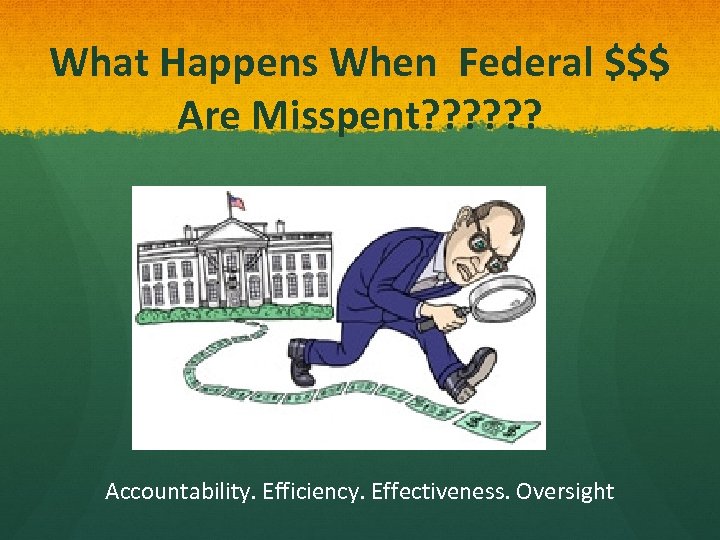
What Happens When Federal $$$ Are Misspent? ? ? Accountability. Efficiency. Effectiveness. Oversight
US Dept. of Education Office of Inspector General Former Charles County Public Schools Title I Coordinator Sentenced (Maryland). The former Title I coordinator sentenced to 27 months in prison and 36 months of supervised release. Also ordered to pay more than $115, 300 in restitution for theft. Used Title I grant funds to purchase technology items for herself, family, and friends, including computers, video games consoles, portable media players, tablet computers, and televisions.

US Dept. of Education Office of Inspector General Sandra Campbell, 57 a former Detroit Public Schools contract accountant and school board candidate, and her daughter, Domonique Campbell, 38, a Detroit Public Schools teacher convicted by a federal jury on charges of program fraud conspiracy, money laundering conspiracy, and tax charges Between 2004 and 2008, the employees obtained in excess of $530, 000 from the Detroit Public Schools through a fraudulent scheme Employees placed orders for books and educational materials with their sham company The women conspired to launder the fraud proceeds and to defraud the Internal Revenue Service and failed to report the money they fraudulently obtained from the Detroit Public Schools as income on their tax returns. United States Attorney Barbara L. Mc. Quade said, “Anyone who considers stealing from our school children should take note that we are scrutinizing records and conduct, and will prosecute wrongdoers. ”
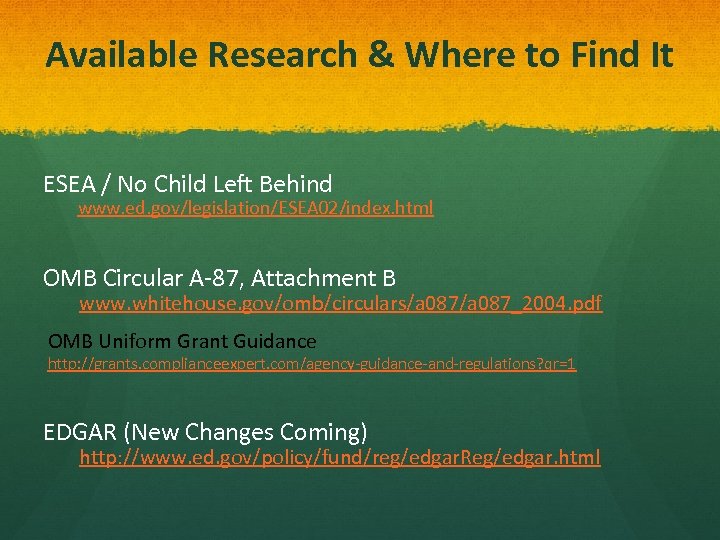
Available Research & Where to Find It ESEA / No Child Left Behind www. ed. gov/legislation/ESEA 02/index. html OMB Circular A-87, Attachment B www. whitehouse. gov/omb/circulars/a 087_2004. pdf OMB Uniform Grant Guidance http: //grants. complianceexpert. com/agency-guidance-and-regulations? qr=1 EDGAR (New Changes Coming) http: //www. ed. gov/policy/fund/reg/edgar. Reg/edgar. html
Conclusion Remember: “If the district takes the money, they are responsible for knowing the rules and regulations concerning the grant. ” If you need further help contact Anthony Hearn (609) 633 -2492 anthony. hearn@doe. state. nj. us
Скачать презентацию Federal Grant Fiscal Responsibilities Presented by Anthony Hearn
276daf11d19903054420493b0755e29d.ppt