


 Скачать презентацию Federal Education Update Mary Kusler Asst Director Advocacy
f733ed18a65b1e2f9de73409bb182dc9.ppt
- Количество слайдов: 18
 Federal Education Update Mary Kusler Asst. Director, Advocacy & Policy American Association of School Administrators April 22, 2009
 Reauthorization of ESEA – A New Vision • Secretary Duncan has said ESEA will not be their first thing out of the gate. • The House committee plans to being discussions off of their draft version of ESEA from two years ago. – The committee composition has not really changed. • The Senate will begin informal staff level conversations from where they left off last. – More complicated due to Senator Kennedy’s health. – Still some vacancies on the committee and some new additions. • The reality? Reauthorization will be difficult to complete this Congress but a lot of discussion will occur.
 Changes in the Title I Regulations • Secretary proposed changes to the Spellings regulations: • States will not have to adjust their cohort size to be under 30. • Secretary will work with states to make allowances for students who take 5 or 6 years to graduate. • Change will allow states a one year waiver from 14 day parental notification for public school choice. • Regulations will propose allowing schools and districts to provide SES regardless of INOI status.
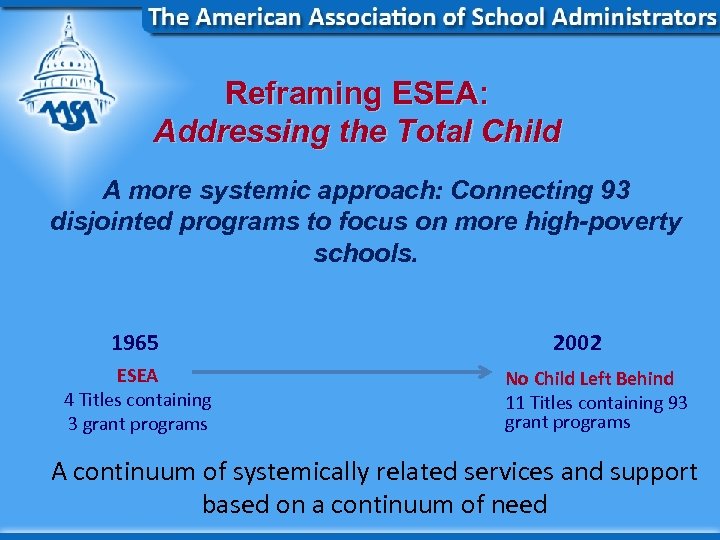 Reframing ESEA: Addressing the Total Child A more systemic approach: Connecting 93 disjointed programs to focus on more high-poverty schools. 1965 ESEA 4 Titles containing 3 grant programs 2002 No Child Left Behind 11 Titles containing 93 grant programs A continuum of systemically related services and support based on a continuum of need
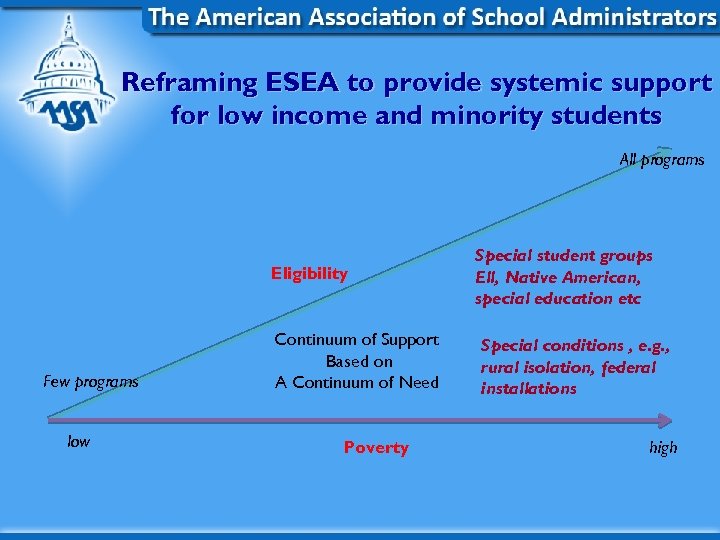 Reframing ESEA to provide systemic support for low income and minority students All programs Eligibility Few programs low Continuum of Support Based on A Continuum of Need Poverty Special student groups Ell, Native American, special education etc Special conditions , e. g. , rural isolation, federal installations high
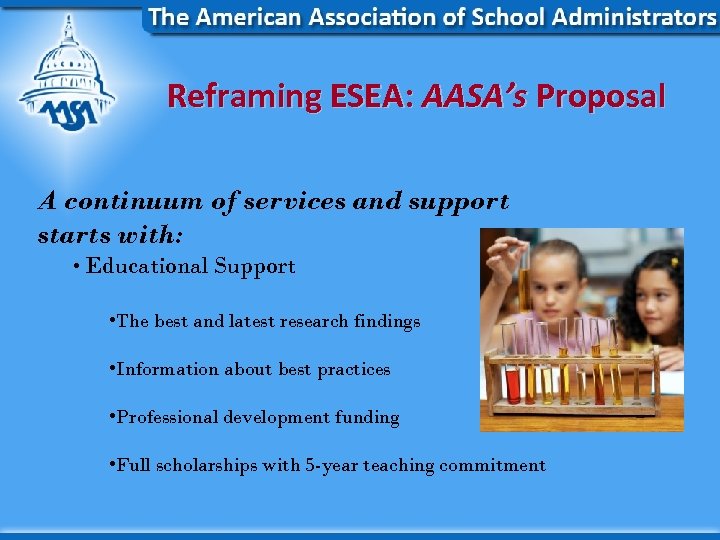 Reframing ESEA: AASA’s Proposal A continuum of services and support starts with: • Educational Support • The best and latest research findings • Information about best practices • Professional development funding • Full scholarships with 5 -year teaching commitment
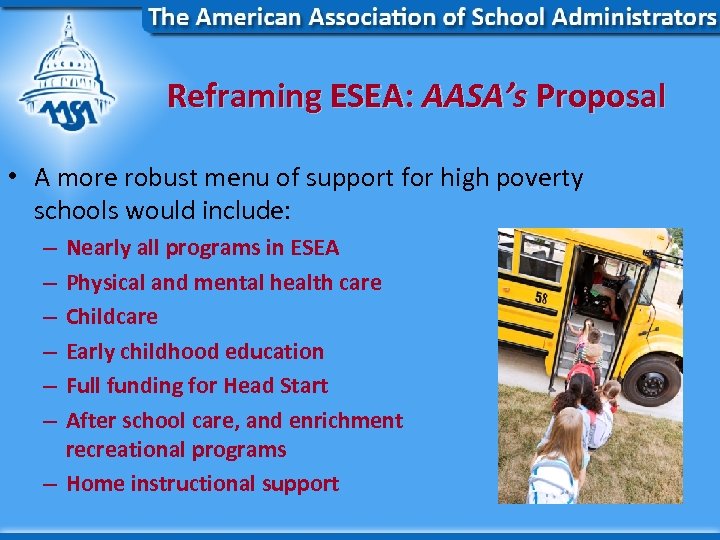 Reframing ESEA: AASA’s Proposal • A more robust menu of support for high poverty schools would include: Nearly all programs in ESEA Physical and mental health care Childcare Early childhood education Full funding for Head Start After school care, and enrichment recreational programs – Home instructional support – – – and
 Reauthorization of REAP • Some changes need to be made to improve REAP in the coming reauthorization. • Specifically, a number of districts are no longer receiving a financial benefit from the program despite qualifying. – Allow districts to choose which program to apply under. – Raise the sliding scale from $20, 000 - $60, 000 to $25, 000 - $70, 000. • For the Rural & Low-income program, use free and reduced lunch instead of census. • Update Locale codes. • Need to fight changes being proposed in the Senate draft. • Support the REAP Reauthorization Act
 A Quick Word About Money • At the federal level there are two processes: – Budget – where the amount of money to be spent is set. • Fight for the maximum amount of $ available for education. – Appropriations – where individual program funding levels are set. • Fight for specific programs. 9
 FY 2009 Appropriations • The House passed the bill in late February with a vote of 245 – 178 • The Senate passed the bill on March 10, 2009 by voice vote. • Title I - $594 million increase • School Improvement - $54 million increase • Title II, Teacher Quality - $12. 5 million • After school - $50 million increase • ELL, Title III - $29. 61 increase • IDEA – $557 million increase – now at 17. 4 percent • Reading First – Eliminated • REAP - $1. 5 million increase
 FY 2010 Budget • President Obama has announced his budget framework but details are expected in May. • The House and Senate have both passed their bills and are working on a single version. • There does not seem to be enough money to sustain the ARRA investments in Title I & IDEA. • Larger conversations over higher education: Pell Grants and the direct lending program • Senate version contains higher funding levels then the House.
 Private School Vouchers • DC Private School Voucher program is set to expire this year. • Language was included in the FY 2009 funding bill that will prevent DC Vouchers from being funded next year without a full reauthorization and approval by the DC City Council. • The Dept of Ed evaluation showed no benefits for target group: students from schools INOI. • Senate has already scheduled a hearing for May 13. • We need to stand against federal dollars for private school vouchers.
 IDEA Mandatory Funding • Congress has promised to provide 40% of the APPE for every child in special education. – They are currently at 17. 5% (not counting ARRA). • Proposals in both the House and the Senate will be introduced to make the increases mandatory ensuring 40% within 8 years. – Senator Harkin (D-IA) and Roberts (R-KS) – Representatives Van Hollen (D-MD), Platts (R-PA) and Walz (D-MN) • How do we deal with the investment under ARRA?
 School-based Medicaid Claiming • The final rule to eliminate administrative and transportation claiming was published on December 28, 2007. • Congressional moratorium prevents the rule from being implemented before July 1, 2009. • Need to go through an official rule making to reverse the regulations. • Support efforts to legitimize claiming for school districts. Expand claiming to 504 Vocational Rehab students. – Support uniform methodology for claiming. • Urge your members of Congress to recognize the role schools play in health care.
 Telecom Act & E-Rate • Congress will likely reauthorize the Telecommunications Act, including E-Rate – Can push for an expansion of the $2. 25 billion funding cap. – Continue inclusion of E-Rate in the Universal Service Fund. – Reduction of the paperwork requirements for program participation while still ensuring program integrity. • Immediate need to promote a permanent exemption from the Anti-deficiency Act. – Ask your members to support: • S 348 – House bill to come… • Both provide a permanent exemption
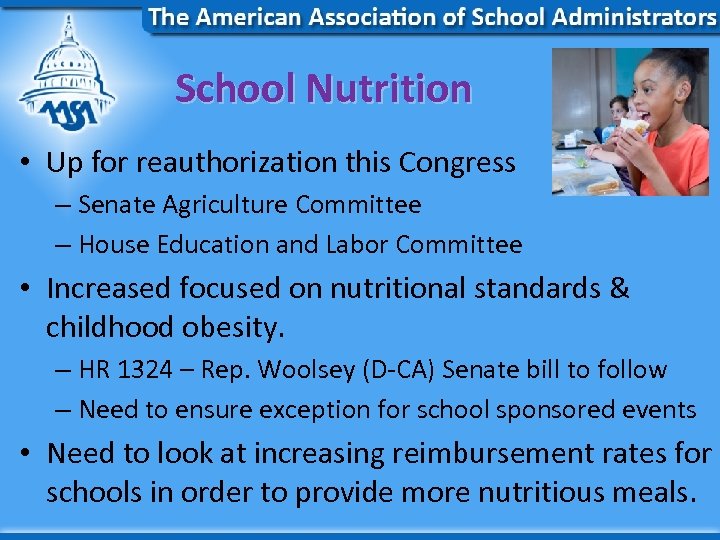 School Nutrition • Up for reauthorization this Congress – Senate Agriculture Committee – House Education and Labor Committee • Increased focused on nutritional standards & childhood obesity. – HR 1324 – Rep. Woolsey (D-CA) Senate bill to follow – Need to ensure exception for school sponsored events • Need to look at increasing reimbursement rates for schools in order to provide more nutritious meals.
 Next Steps: Time for You to Get Involved • Start to talk with your members of Congress about moving forward. • Get involved, make a call, don’t assume that someone else will do it! – Be sure to get to know the Education LA in DC! – 15 minutes a month on your outlook calendar. • Try to talk about the reauthorization of the Elementary and Secondary Education Act, not NCLB. • Keep this issue on the front burner in your communities to help create the dialogue.
 Any questions? Mary Kusler Assistant Director, Advocacy & Policy American Association of School Administrators 801 N. Quincy Street, Suite 700 Arlington, VA 22203 (703) 875 - 0733 mkusler@aasa. org