 Скачать презентацию Feb Studies in a Nutshell Nick Walker Workshop
2e96cd697846a84c119f83cc4ef767ca.ppt
- Количество слайдов: 14



Feb. Studies in a Nutshell Nick Walker Workshop on Long Bunch-Train Operations in FLASH
Primary goals and strategy • Demonstrating ‘flat gradient’ solutions – at different gradients (vector sums) – with different beam loading – PK – QL studies • Compensating Lorentz Force Detuning (LFD) – Comprehensive studies with piezo tuners • Important aspects associated with above: – Benchmarking simulation model(s) l – Characterisation of hardware (e. g. coupler ranges, goa e ot th un n calibration) 9 m. A r this r fo – Careful machine setup ( Ibeam < 5 m. A) 06. 11 N. Walker - FLASH LBTO Workshop 2
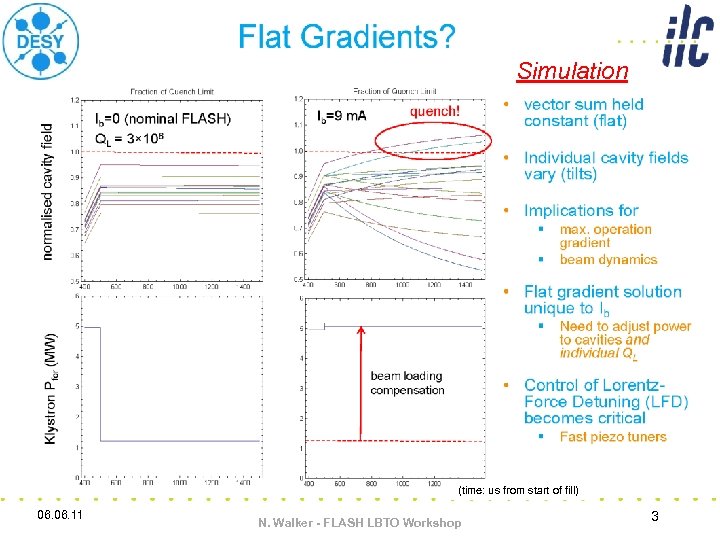
Simulation (time: us from start of fill) 06. 11 N. Walker - FLASH LBTO Workshop 3
The Plan • Three-shift cycle: – Day: Machine setup (gradient & current) – Evening: Pk-QL studies – Night: Piezo studies (detuning studies) • Friday-Sunday – 1 MHz laser with 10 Hz machine rep. rate (Ibeam < 1. 6 m. A) • Monday-Tuesday – 3 MHz laser with 5 Hz machine rep. rate (Ibeam < 5 m. A) 06. 11 N. Walker - FLASH LBTO Workshop 4
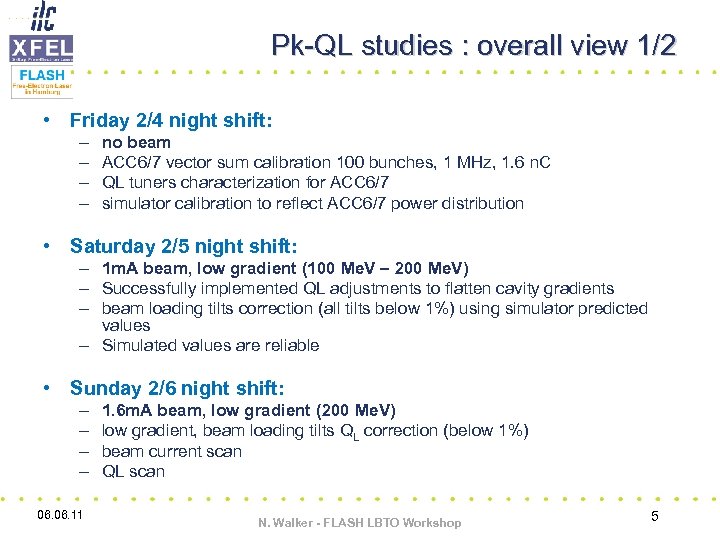
Pk-QL studies : overall view 1/2 • Friday 2/4 night shift: – – no beam ACC 6/7 vector sum calibration 100 bunches, 1 MHz, 1. 6 n. C QL tuners characterization for ACC 6/7 simulator calibration to reflect ACC 6/7 power distribution • Saturday 2/5 night shift: – 1 m. A beam, low gradient (100 Me. V – 200 Me. V) – Successfully implemented QL adjustments to flatten cavity gradients – beam loading tilts correction (all tilts below 1%) using simulator predicted values – Simulated values are reliable • Sunday 2/6 night shift: – – 06. 11 1. 6 m. A beam, low gradient (200 Me. V) low gradient, beam loading tilts QL correction (below 1%) beam current scan QL scan N. Walker - FLASH LBTO Workshop 5
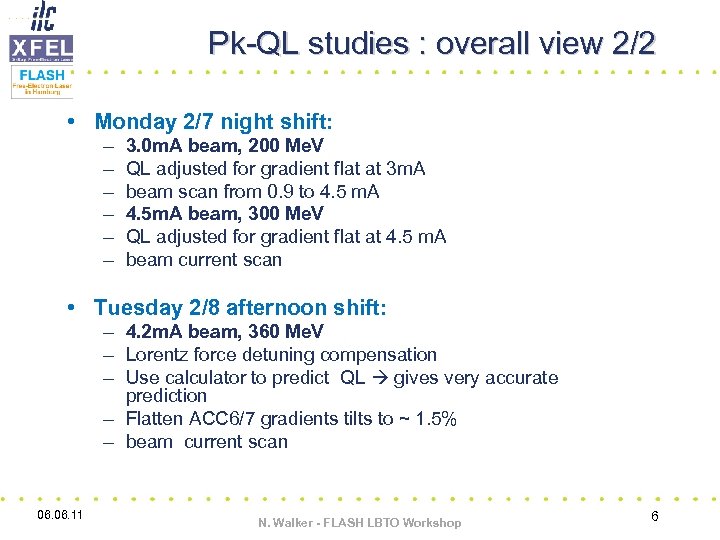
Pk-QL studies : overall view 2/2 • Monday 2/7 night shift: – – – 3. 0 m. A beam, 200 Me. V QL adjusted for gradient flat at 3 m. A beam scan from 0. 9 to 4. 5 m. A 4. 5 m. A beam, 300 Me. V QL adjusted for gradient flat at 4. 5 m. A beam current scan • Tuesday 2/8 afternoon shift: – 4. 2 m. A beam, 360 Me. V – Lorentz force detuning compensation – Use calculator to predict QL gives very accurate prediction – Flatten ACC 6/7 gradients tilts to ~ 1. 5% – beam current scan 06. 11 N. Walker - FLASH LBTO Workshop 6
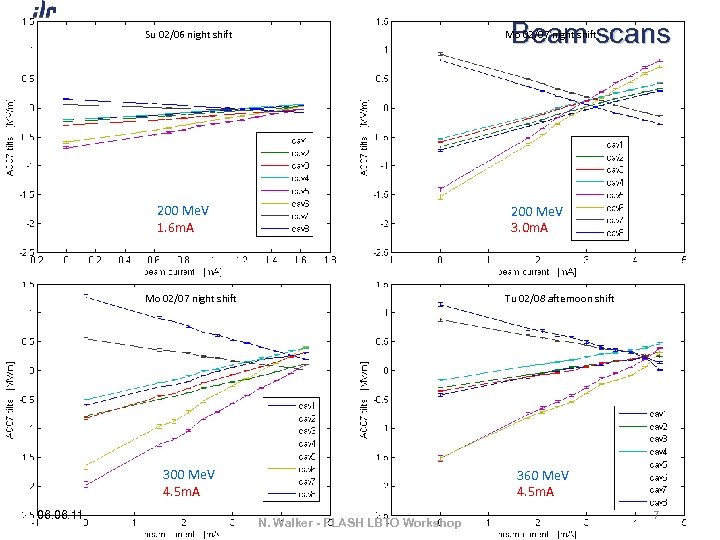
Beam scans Su 02/06 night shift Mo 02/07 night shift 200 Me. V 1. 6 m. A 200 Me. V 3. 0 m. A Mo 02/07 night shift Tu 02/08 afternoon shift 300 Me. V 4. 5 m. A 06. 11 360 Me. V 4. 5 m. A N. Walker - FLASH LBTO Workshop 7
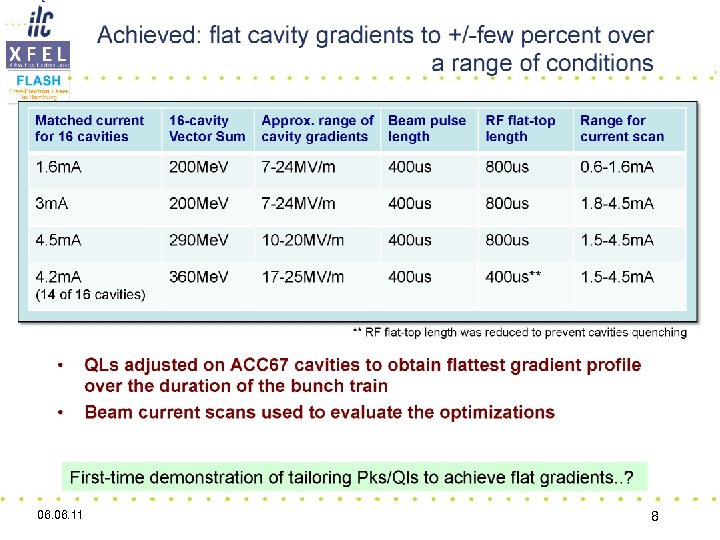
06. 11 8
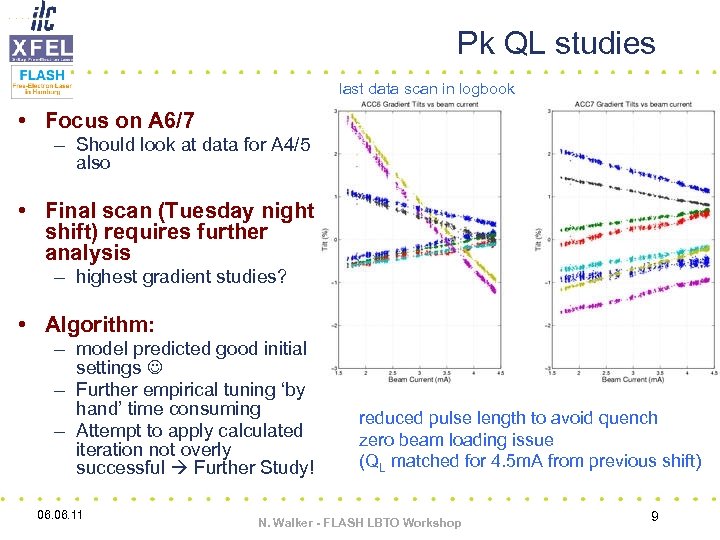
Pk QL studies last data scan in logbook • Focus on A 6/7 – Should look at data for A 4/5 also • Final scan (Tuesday night shift) requires further analysis – highest gradient studies? • Algorithm: – model predicted good initial settings – Further empirical tuning ‘by hand’ time consuming – Attempt to apply calculated iteration not overly successful Further Study! 06. 11 reduced pulse length to avoid quench zero beam loading issue (QL matched for 4. 5 m. A from previous shift) N. Walker - FLASH LBTO Workshop 9
LFD studies • Several shifts dedicated to LFD piezo compensation – Note C 5 A 6 and C 1 A 7 broken • Automated script for compensation – issues of signal calibration – solved? • General analysis of piezo signals – lowest RMS signal = tuned cavity – scans of piezo system parameters – curvature studies • Two sets of data of detuning measurements by scanning RF pulse length available – Saturday day: piezos off – Tuesday night: after ‘high-gradient’ LFD compensation 06. 11 N. Walker - FLASH LBTO Workshop 10
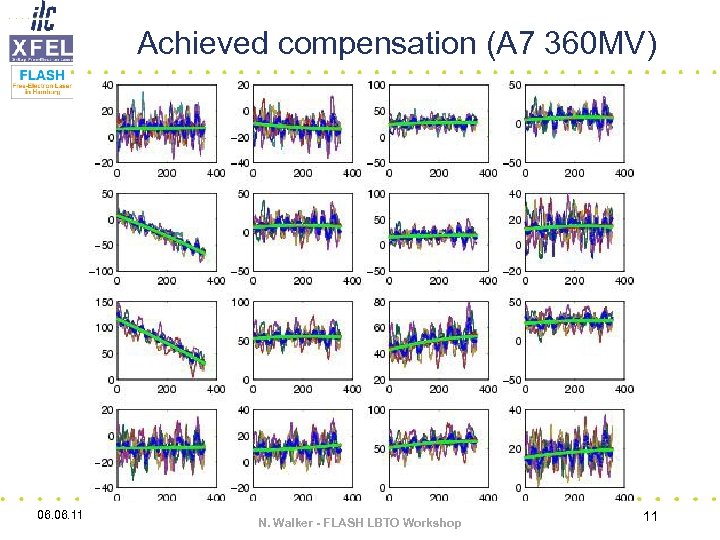
Achieved compensation (A 7 360 MV) 06. 11 N. Walker - FLASH LBTO Workshop 11
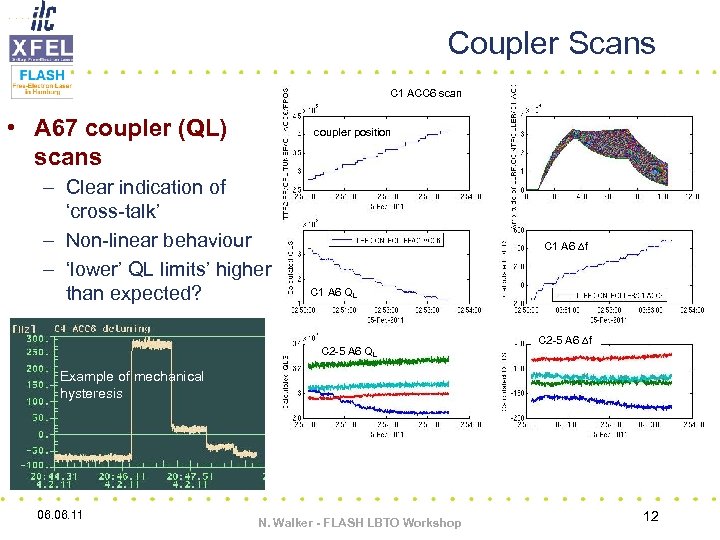
Coupler Scans C 1 ACC 6 scan • A 67 coupler (QL) scans coupler position – Clear indication of ‘cross-talk’ – Non-linear behaviour – ‘lower’ QL limits’ higher than expected? C 1 A 6 Df C 1 A 6 QL C 2 -5 A 6 Df Example of mechanical hysteresis 06. 11 N. Walker - FLASH LBTO Workshop 12
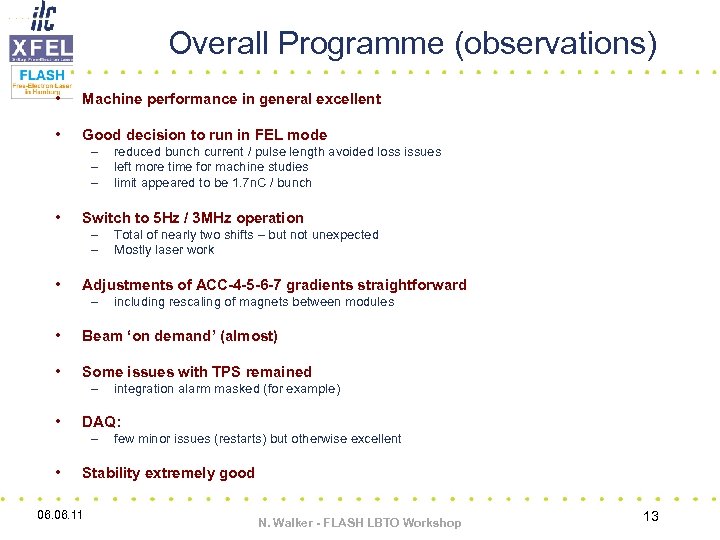
Overall Programme (observations) • Machine performance in general excellent • Good decision to run in FEL mode – – – • Switch to 5 Hz / 3 MHz operation – – • reduced bunch current / pulse length avoided loss issues left more time for machine studies limit appeared to be 1. 7 n. C / bunch Total of nearly two shifts – but not unexpected Mostly laser work Adjustments of ACC-4 -5 -6 -7 gradients straightforward – including rescaling of magnets between modules • Beam ‘on demand’ (almost) • Some issues with TPS remained – • DAQ: – • integration alarm masked (for example) few minor issues (restarts) but otherwise excellent Stability extremely good 06. 11 N. Walker - FLASH LBTO Workshop 13
![To Do [review] • Define list of measurements (scans) to make; e. g. –](https://present5.com/presentation/2e96cd697846a84c119f83cc4ef767ca/image-14.jpg "To Do [review] • Define list of measurements (scans) to make; e. g. –")
To Do [review] • Define list of measurements (scans) to make; e. g. – – – PDS ratios as a function of forward power QL as a function of forward power Field flatness / voltage as a function of QL (per cavity) Piezo LFD compensation: sensitivity to adjustment parameters. Detuning as a function of time (RF pulse length) • using the decay at Pfor=0 • for different gradients (take 3) – Cross-talk within cavity pair: repeat detuning scans (with mechanical tuner!) – Vector sum tilt versus flat-top forward power (open loop) – gradient (flat-top) jitter (rms) vs detuning (a la Shilun) – cavity gradients as a function of beam current • feedback off, LFF off, no change to BLC. – impact of beam current on flat-gradient solution. ies d • once flat gradient solution obtain, scan current ± to see effect on cavity tilts. (Keeping vector sum constant – best way? ) – Repeat above for gradient (adjust energy of 67 • Analysis scripts to support above 06. 11 N. Walker - FLASH LBTO Workshop M de a for Stu. eb F 14
Скачать презентацию Feb Studies in a Nutshell Nick Walker Workshop
2e96cd697846a84c119f83cc4ef767ca.ppt