

Features of English painting of the XIX century

 Скачать презентацию Features of English painting of the XIX century
Картины-Анг.ppt
- Количество слайдов: 6
Features of English painting of the XIX century
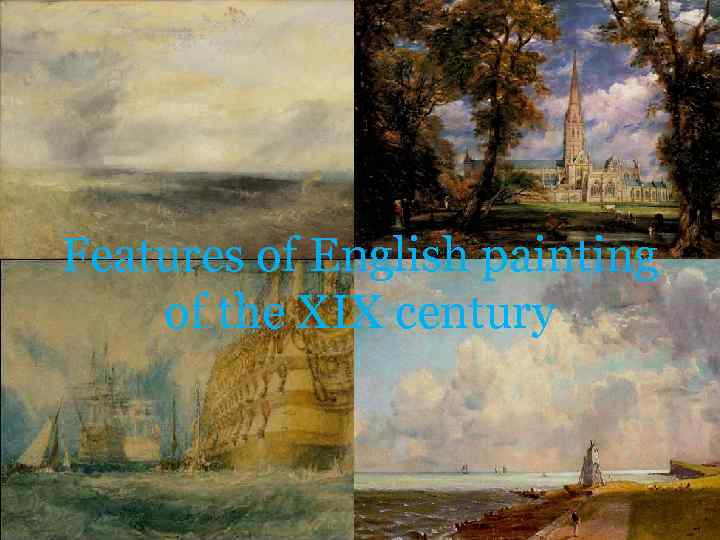
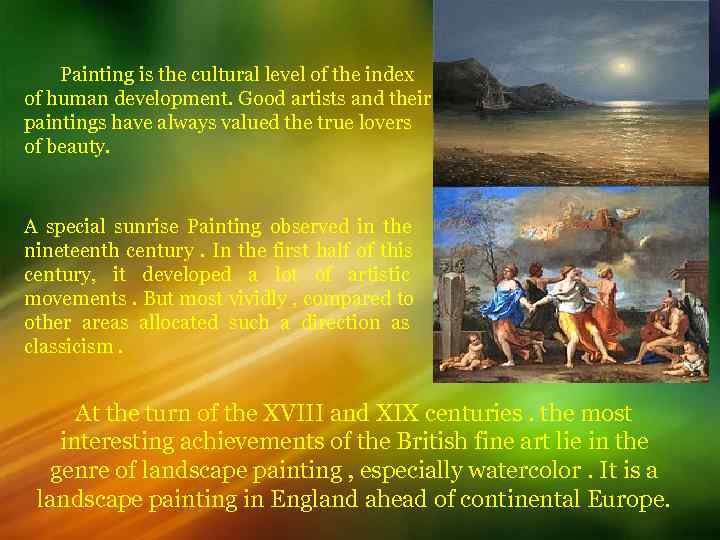
Painting is the cultural level of the index of human development. Good artists and their paintings have always valued the true lovers of beauty. A special sunrise Painting observed in the nineteenth century. In the first half of this century, it developed a lot of artistic movements. But most vividly , compared to other areas allocated such a direction as classicism. At the turn of the XVIII and XIX centuries. the most interesting achievements of the British fine art lie in the genre of landscape painting , especially watercolor. It is a landscape painting in England ahead of continental Europe.
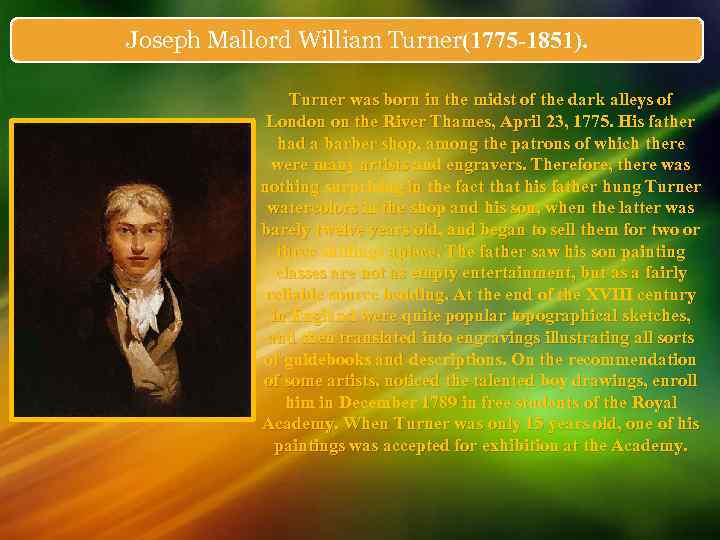
Joseph Mallord William Turner(1775 -1851). Turner was born in the midst of the dark alleys of London on the River Thames, April 23, 1775. His father had a barber shop, among the patrons of which there were many artists and engravers. Therefore, there was nothing surprising in the fact that his father hung Turner watercolors in the shop and his son, when the latter was barely twelve years old, and began to sell them for two or three shillings apiece. The father saw his son painting classes are not as empty entertainment, but as a fairly reliable source bedding. At the end of the XVIII century in England were quite popular topographical sketches, and then translated into engravings illustrating all sorts of guidebooks and descriptions. On the recommendation of some artists, noticed the talented boy drawings, enroll him in December 1789 in free students of the Royal Academy. When Turner was only 15 years old, one of his paintings was accepted for exhibition at the Academy.
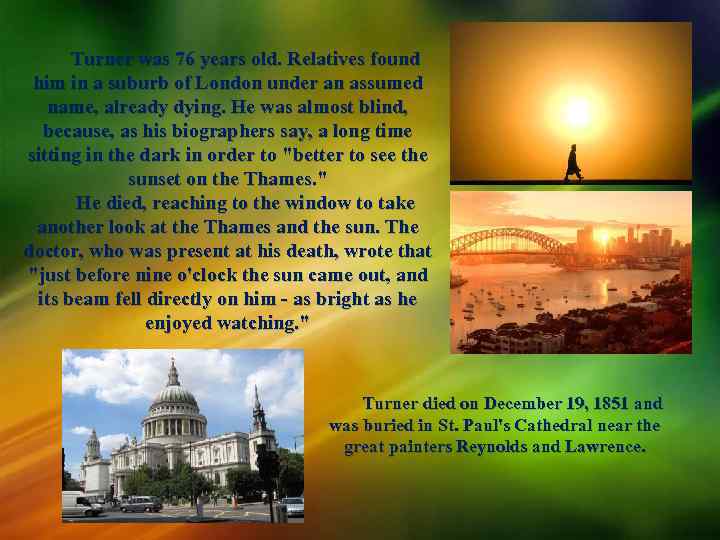
Turner was 76 years old. Relatives found him in a suburb of London under an assumed name, already dying. He was almost blind, because, as his biographers say, a long time sitting in the dark in order to "better to see the sunset on the Thames. " He died, reaching to the window to take another look at the Thames and the sun. The doctor, who was present at his death, wrote that "just before nine o'clock the sun came out, and its beam fell directly on him - as bright as he enjoyed watching. " Turner died on December 19, 1851 and was buried in St. Paul's Cathedral near the great painters Reynolds and Lawrence.
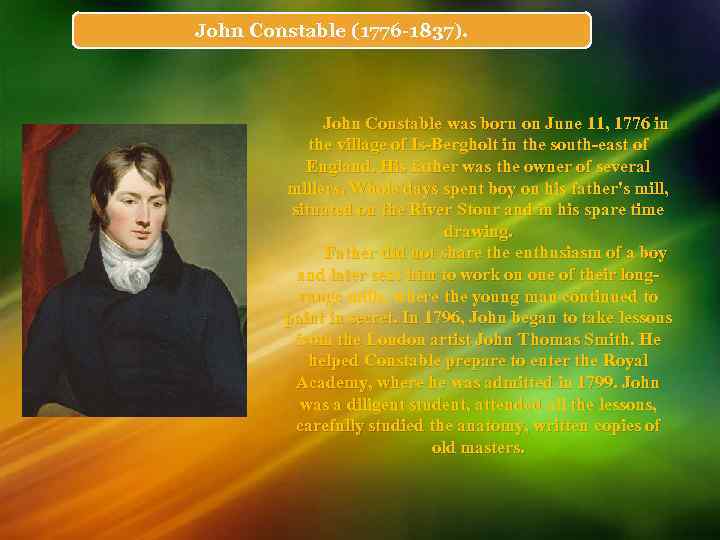
John Constable (1776 -1837). John Constable was born on June 11, 1776 in the village of Is-Bergholt in the south-east of England. His father was the owner of several millers. Whole days spent boy on his father's mill, situated on the River Stour and in his spare time drawing. Father did not share the enthusiasm of a boy and later sent him to work on one of their long- range mills, where the young man continued to paint in secret. In 1796, John began to take lessons from the London artist John Thomas Smith. He helped Constable prepare to enter the Royal Academy, where he was admitted in 1799. John was a diligent student, attended all the lessons, carefully studied the anatomy, written copies of old masters.
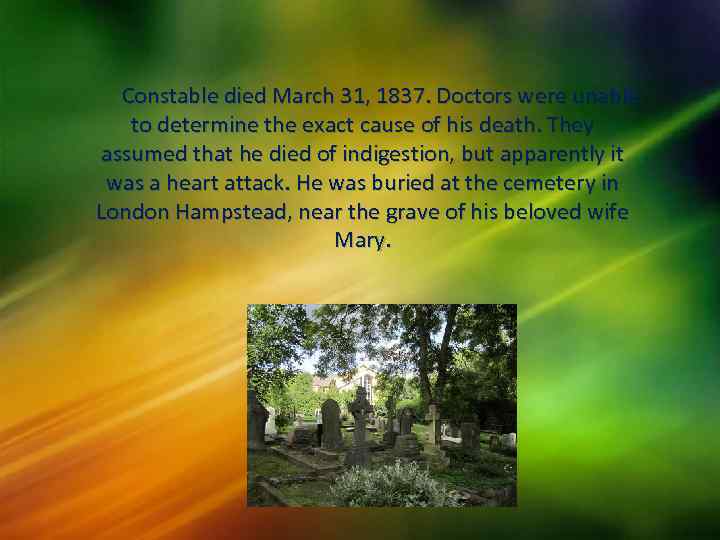
Constable died March 31, 1837. Doctors were unable to determine the exact cause of his death. They assumed that he died of indigestion, but apparently it was a heart attack. He was buried at the cemetery in London Hampstead, near the grave of his beloved wife Mary.